aads

Study shows how a single gene drives aggression in wild songbirds

White-throated sparrows come in two different morphs, the white-striped (left) and the tan-striped (right). The morphs have both different plumage and behaviors, making these wild songbirds a good model organism for the genetic basis of behavior. (Photo by Jennifer Merritt)

By Carol Clark

A new study shows how differentiation of a single gene changes behavior in a wild songbird, determining whether the white-throated sparrow displays more, or less, aggression. The Proceedings of the National Academy of Sciences (PNAS) published the research, led by neuroscientists at Emory University.

The researchers singled out an estrogen receptor from a complex of more than 1,000 genes known as a “supergene,” or genetic material inherited together as a block. The work provides a rare look at how genomic divergence can lead to behavioral divergence in a vertebrate.

“Evolution has tinkered with the DNA sequence of a gene of this songbird, and we demonstrated that those little changes affect both the expression of the gene and the bird’s behavior,” says Emory graduate student Jennifer Merritt, first author of the paper.

Merritt is a PhD candidate in the lab of Donna Maney, senior author of the paper and an Emory professor of psychology.

“White-throated sparrows are common backyard birds found through most of North America,” Merritt says. “What’s remarkable about them is that they occur in two different morphs that have not only different plumage, but also different strategies for maximizing reproductive output. Both types of differences are caused by genetic differentiation of only one region of a single chromosome, and we know exactly where it is.”

At some point during the evolution of a species, a chromosome can break and flip. This process, called an inversion, isolates the genes that are trapped inside, producing a supergene. In some cases, supergenes have led to distinct morphs within a single species — individuals with the supergene and those without it.

In the case of the white-throated sparrows, the white-striped morph sports bright yellow, black and white stripes on its crown while the tan-striped morph has more muted, tan and grayish stripes. The white-striped birds, which all possess at least one copy of the rearranged chromosome, tend to be more aggressive and less parental than the tan-striped birds, which do not have the rearranged chromosome.

“Scientists have hypothesized for 100 years that inversions are important for the evolution of some of the complex behaviors that we see in nature,” Maney says. “But inversions are challenging to understand because, when they turn into supergenes, all of the genes are inherited together. We already knew a lot about the natural history of the white-throated sparrow, as well as the biological mechanisms underlying its aggression. Using that knowledge, we were able to finally show the evolutionary role of a supergene at the molecular level.”

The current paper builds on previous work by the Maney lab, a leader in connecting gene sequence with behavior in free-living animals. In 2014, the lab identified a hormone receptor —estrogen receptor alpha (ER-alpha) — that appeared connected to the differences in the sparrows’ aggression and parenting behaviors in the wild. The white-striped birds express this receptor at much higher levels than the tan-striped birds, and the more the expression, the more aggressive the bird.

“For this paper, we wanted to follow the genetic variation of ER-alpha all the way up to where it’s expressed in the brain, and then to behavior, to see if we could trace the behavioral variation to variation in this one gene,” Merritt says.

The birds sing to establish a territory. The rate at which they sing gives a measure of their level of aggression, along with the frequency at which they charge, or “attack,” animals encroaching on what they consider their territory.

In field studies of white-throated sparrows in their natural habitat, the researchers showed that the more a bird expresses the supergene version of the estrogen receptor, the more vigorously it defends its territory.

The researchers then moved beyond the correlational work by taking an experimental approach. White-throated sparrows in the lab were given a substance to block expression of the ER-alpha gene and their aggression levels were measured. The results showed that when expression of that one gene was blocked, the aggression of the white-striped birds went down so they behaved like the tan-striped ones.

“We believe this is the first demonstration of how a single gene within a supergene drives changes in a social behavior in a wild vertebrate,” Merritt says. She gives an analogy for the challenge involved: “Imagine each of the genes within a supergene as tributaries converging into a river, the behavior. And then taking a sample of water from the river and determining which tributary the sample came from.”

The Maney lab is continuing to investigate a suite of other neuroendocrine genes captured by the chromosome rearrangement in the white-throated sparrow that are thought to be important players in the regulation of social behavior.

Co-authors of the PNAS paper include Eric Ortlund, a biochemist and an expert in the ER-alpha gene at the Emory School of Medicine; Kathleen Grogan and Wendy Zinzow-Kramer, former post-doctoral fellows in the Maney lab; and Dan Sun and Soojin Yi, from Georgia Tech. The work was funded by grants from the National Institutes of Health and the National Science Foundation.

Related:
Wild sparrow study traces social behaviors in the wild to a single gene
Birdsongs study pecks theory that music is uniquely human

from eScienceCommons https://ift.tt/2Eg06Bi
White-throated sparrows come in two different morphs, the white-striped (left) and the tan-striped (right). The morphs have both different plumage and behaviors, making these wild songbirds a good model organism for the genetic basis of behavior. (Photo by Jennifer Merritt)

By Carol Clark

A new study shows how differentiation of a single gene changes behavior in a wild songbird, determining whether the white-throated sparrow displays more, or less, aggression. The Proceedings of the National Academy of Sciences (PNAS) published the research, led by neuroscientists at Emory University.

The researchers singled out an estrogen receptor from a complex of more than 1,000 genes known as a “supergene,” or genetic material inherited together as a block. The work provides a rare look at how genomic divergence can lead to behavioral divergence in a vertebrate.

“Evolution has tinkered with the DNA sequence of a gene of this songbird, and we demonstrated that those little changes affect both the expression of the gene and the bird’s behavior,” says Emory graduate student Jennifer Merritt, first author of the paper.

Merritt is a PhD candidate in the lab of Donna Maney, senior author of the paper and an Emory professor of psychology.

“White-throated sparrows are common backyard birds found through most of North America,” Merritt says. “What’s remarkable about them is that they occur in two different morphs that have not only different plumage, but also different strategies for maximizing reproductive output. Both types of differences are caused by genetic differentiation of only one region of a single chromosome, and we know exactly where it is.”

At some point during the evolution of a species, a chromosome can break and flip. This process, called an inversion, isolates the genes that are trapped inside, producing a supergene. In some cases, supergenes have led to distinct morphs within a single species — individuals with the supergene and those without it.

In the case of the white-throated sparrows, the white-striped morph sports bright yellow, black and white stripes on its crown while the tan-striped morph has more muted, tan and grayish stripes. The white-striped birds, which all possess at least one copy of the rearranged chromosome, tend to be more aggressive and less parental than the tan-striped birds, which do not have the rearranged chromosome.

“Scientists have hypothesized for 100 years that inversions are important for the evolution of some of the complex behaviors that we see in nature,” Maney says. “But inversions are challenging to understand because, when they turn into supergenes, all of the genes are inherited together. We already knew a lot about the natural history of the white-throated sparrow, as well as the biological mechanisms underlying its aggression. Using that knowledge, we were able to finally show the evolutionary role of a supergene at the molecular level.”

The current paper builds on previous work by the Maney lab, a leader in connecting gene sequence with behavior in free-living animals. In 2014, the lab identified a hormone receptor —estrogen receptor alpha (ER-alpha) — that appeared connected to the differences in the sparrows’ aggression and parenting behaviors in the wild. The white-striped birds express this receptor at much higher levels than the tan-striped birds, and the more the expression, the more aggressive the bird.

“For this paper, we wanted to follow the genetic variation of ER-alpha all the way up to where it’s expressed in the brain, and then to behavior, to see if we could trace the behavioral variation to variation in this one gene,” Merritt says.

The birds sing to establish a territory. The rate at which they sing gives a measure of their level of aggression, along with the frequency at which they charge, or “attack,” animals encroaching on what they consider their territory.

In field studies of white-throated sparrows in their natural habitat, the researchers showed that the more a bird expresses the supergene version of the estrogen receptor, the more vigorously it defends its territory.

The researchers then moved beyond the correlational work by taking an experimental approach. White-throated sparrows in the lab were given a substance to block expression of the ER-alpha gene and their aggression levels were measured. The results showed that when expression of that one gene was blocked, the aggression of the white-striped birds went down so they behaved like the tan-striped ones.

“We believe this is the first demonstration of how a single gene within a supergene drives changes in a social behavior in a wild vertebrate,” Merritt says. She gives an analogy for the challenge involved: “Imagine each of the genes within a supergene as tributaries converging into a river, the behavior. And then taking a sample of water from the river and determining which tributary the sample came from.”

The Maney lab is continuing to investigate a suite of other neuroendocrine genes captured by the chromosome rearrangement in the white-throated sparrow that are thought to be important players in the regulation of social behavior.

Co-authors of the PNAS paper include Eric Ortlund, a biochemist and an expert in the ER-alpha gene at the Emory School of Medicine; Kathleen Grogan and Wendy Zinzow-Kramer, former post-doctoral fellows in the Maney lab; and Dan Sun and Soojin Yi, from Georgia Tech. The work was funded by grants from the National Institutes of Health and the National Science Foundation.

Related:
Wild sparrow study traces social behaviors in the wild to a single gene
Birdsongs study pecks theory that music is uniquely human

from eScienceCommons https://ift.tt/2Eg06Bi

Earth’s night sky as Milky Way and Andromeda merge

Composite image showing a very bright glowing oblique spiral several times larger than the crescent moon.

Andromeda galaxy actual size? Yes. This image truly depicts what the night sky would look like if the Andromeda galaxy – the galaxy next door – were brighter. Original background shot of the moon by Stephen Rahn. Andromeda galaxy image via NASA. Composite photo by Tom Buckley-Houston. Not convinced? Here’s a similar image from APOD.

The image above is making the rounds on social media this week. It’s true. The neighboring Andromeda galaxy occupies about the width of 6 moon-diameters on our sky’s dome. But, of course, the galaxy isn’t nearly this bright. You need a dark sky to see it, and, even then, it’s a barely visible fuzzy patch of light. In order to appear as bright as in the image above, the Andromeda galaxy would need to be closer. If it were close enough to look so bright, it would appear even bigger on our sky’s dome. And that’s going to happen someday! The Andromeda galaxy is currently racing toward our Milky Way at a speed of about 70 miles (110 km) per second. Ultimately, the two galaxies will merge. Between now and that eventual merger, any beings alive on Earth will see the Andromeda galaxy get bigger and bigger and BIGGER in our night sky.

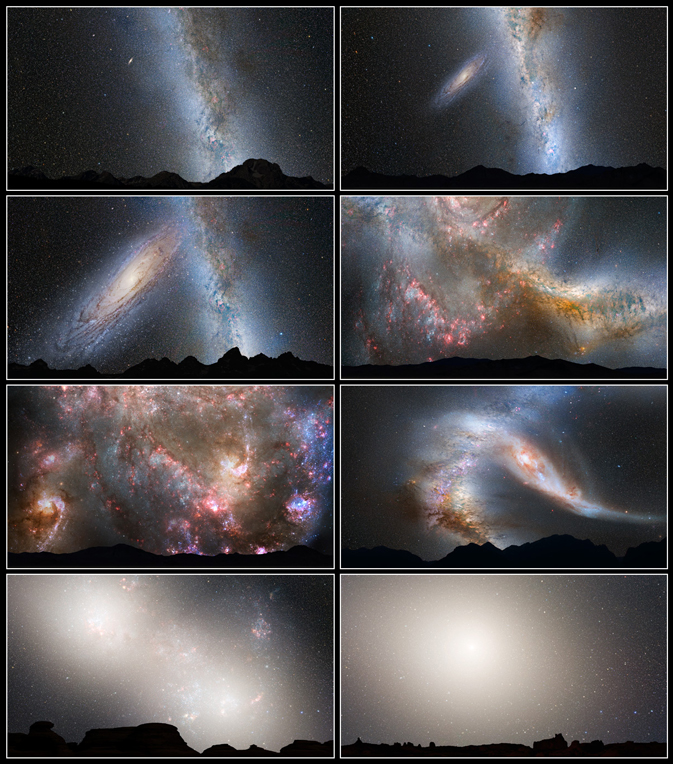
The Andromeda galaxy is now about 2.5 million light-years away from us. The artist’s concepts below, released by NASA in 2012, show what will happen to Earth’s night sky as the Andromeda galaxy hurtles toward us.

Eight panels with night sky views ranging from today's through a chaos of stars to a smooth background glow.

View larger. | This series of illustrations shows the predicted merger between our Milky Way galaxy and the neighboring Andromeda galaxy.
First row, left: Present day.
First row, right: In 2 billion years the disk of the approaching Andromeda galaxy is noticeably larger.
Second row, left: In 3.75 billion years Andromeda fills the field of view.
Second row, right: In 3.85 billion years the sky is ablaze with new star formation.
Third row, left: In 3.9 billion years, star formation continues.
Third row, right: In 4 billion years Andromeda is tidally stretched and the Milky Way becomes warped.
Fourth row, left: In 5.1 billion years the cores of the Milky Way and Andromeda appear as a pair of bright lobes.
Fourth row, right: In 7 billion years the merged galaxies form a huge elliptical galaxy, its bright core dominating the nighttime sky.
Image via NASA/ ESA/ Z. Levay and R. van der Marel, STScI/ T. Hallas/ A. Mellinger.

The descriptions above are based on painstaking Hubble Space Telescope measurements of the motion of the Andromeda galaxy, followed by computer modeling of the inevitable future collision between the two galaxies. A series of studies published in 2012 showed that – rather than glancing off each other, as merging galaxies sometimes do – our Milky Way galaxy and the Andromeda galaxy will in fact merge to form a single big elliptical, or football-shaped, galaxy.

The Milky Way and Andromeda galaxies won’t be the only ones involved in this merger. As shown in the video below, the other large galaxy in our Local Group of galaxies – M33, aka the Triangulum galaxy – will also play a role. In this video, you’ll recognize the Triangulum galaxy as the smaller object near the Andromeda and Milky Way galaxies. Although the Triangulum galaxy likely won’t join the merger, it may at some point strike our Milky Way while engaged in a great cosmic dance with the two larger galaxies.

Across the universe, galaxies are colliding with each other. Astronomers see galactic collisons – or their aftermaths – through their telescopes. In some ways, when a galactic merger takes place, the two galaxies are like ghosts; they simply pass through each other. That’s because stars inside galaxies are separated by such great distances. Thus the stars themselves typically don’t collide when galaxies merge.

That said, the stars in both the Andromeda galaxy and our Milky Way will be affected by the merger. The Andromeda galaxy contains about a trillion stars. The Milky Way has about 300 billion stars. Stars from both galaxies will be thrown into new orbits around the newly merged galactic center. For example, according to scientists involved in the 2012 studies:

It is likely the sun will be flung into a new region of our galaxy …

And yet, they said,

.. our Earth and solar system are in no danger of being destroyed.

How about life on Earth? Will earthly life survive the merger? Astronomers say that the luminosity, or intrinsic brightness, of our sun is due to increase steadily over the next 4 billion years. As the sun’s luminosity increases, the amount of solar radiation reaching the Earth will also increase. It’s possible that – by 4 billion years from now – the increase in the Earth’s surface temperature will have caused a runaway greenhouse effect, perhaps similar to that going on now on the planet next door, Venus, whose surface is hot enough to melt lead. No one expects to find life on Venus. Likewise, it seems likely life on Earth will not exist 4 billion years from now.

What’s more, our sun is evolving, too. It’s expected to become a red giant star eventually. The sun’s outer layers will swell into the space of the solar system so that Earth itself is swallowed by the sun’s outer layers. That’s expected to happen about 7.5 billion years from now.

Perhaps by that time, some earthly inhabitants will have become space-faring. Perhaps we’ll have left Earth, and even our solar system. Do you think so? Let us know in the comments below.

Read more: Hubble Shows Milky Way is Destined for Head-On Collision, via NASA in 2012

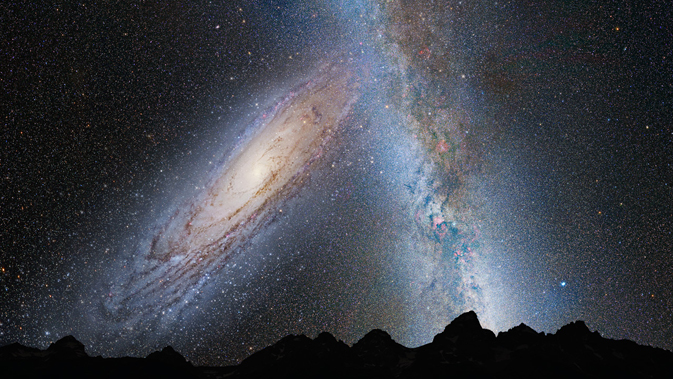
Andromeda galaxy and the Milky Way - both as we see them in our sky - shown close together, appearing to begin a merger.

View larger. | Artist’s concept of a stage in the predicted merger between our Milky Way galaxy and the neighboring Andromeda galaxy, as it’ll unfold over the next several billion years. In this image, representing Earth’s night sky in 3.75 billion years, Andromeda (left) fills the field of view and begins to distort the Milky Way with tidal pull. Image via NASA/ ESA/ Z. Levay and R. van der Marel, STScI/ T. Hallas/ A. Mellinger.

Bottom line: Billions of years from now, our Milky Way galaxy and the Andromeda galaxy are expected to merge. This post contains photos and video illustrating the impending merger and showing how the Andromeda galaxy will appear in Earth’s night sky over the next 7 billion years.

The M31 Velocity Vector. I. Hubble Space Telescope Proper Motion Measurements

The M31 Velocity Vector. II. Radial Orbit Towards the Milky Way and Implied Local Group Mass

The M31 Velocity Vector. III. Future Milky Way-M31-M33 Orbital Evolution, Merging, and Fate of the Sun

Via NASA


from EarthSky https://ift.tt/3h2E7MR
Composite image showing a very bright glowing oblique spiral several times larger than the crescent moon.

Andromeda galaxy actual size? Yes. This image truly depicts what the night sky would look like if the Andromeda galaxy – the galaxy next door – were brighter. Original background shot of the moon by Stephen Rahn. Andromeda galaxy image via NASA. Composite photo by Tom Buckley-Houston. Not convinced? Here’s a similar image from APOD.

The image above is making the rounds on social media this week. It’s true. The neighboring Andromeda galaxy occupies about the width of 6 moon-diameters on our sky’s dome. But, of course, the galaxy isn’t nearly this bright. You need a dark sky to see it, and, even then, it’s a barely visible fuzzy patch of light. In order to appear as bright as in the image above, the Andromeda galaxy would need to be closer. If it were close enough to look so bright, it would appear even bigger on our sky’s dome. And that’s going to happen someday! The Andromeda galaxy is currently racing toward our Milky Way at a speed of about 70 miles (110 km) per second. Ultimately, the two galaxies will merge. Between now and that eventual merger, any beings alive on Earth will see the Andromeda galaxy get bigger and bigger and BIGGER in our night sky.

The Andromeda galaxy is now about 2.5 million light-years away from us. The artist’s concepts below, released by NASA in 2012, show what will happen to Earth’s night sky as the Andromeda galaxy hurtles toward us.

Eight panels with night sky views ranging from today's through a chaos of stars to a smooth background glow.

View larger. | This series of illustrations shows the predicted merger between our Milky Way galaxy and the neighboring Andromeda galaxy.
First row, left: Present day.
First row, right: In 2 billion years the disk of the approaching Andromeda galaxy is noticeably larger.
Second row, left: In 3.75 billion years Andromeda fills the field of view.
Second row, right: In 3.85 billion years the sky is ablaze with new star formation.
Third row, left: In 3.9 billion years, star formation continues.
Third row, right: In 4 billion years Andromeda is tidally stretched and the Milky Way becomes warped.
Fourth row, left: In 5.1 billion years the cores of the Milky Way and Andromeda appear as a pair of bright lobes.
Fourth row, right: In 7 billion years the merged galaxies form a huge elliptical galaxy, its bright core dominating the nighttime sky.
Image via NASA/ ESA/ Z. Levay and R. van der Marel, STScI/ T. Hallas/ A. Mellinger.

The descriptions above are based on painstaking Hubble Space Telescope measurements of the motion of the Andromeda galaxy, followed by computer modeling of the inevitable future collision between the two galaxies. A series of studies published in 2012 showed that – rather than glancing off each other, as merging galaxies sometimes do – our Milky Way galaxy and the Andromeda galaxy will in fact merge to form a single big elliptical, or football-shaped, galaxy.

The Milky Way and Andromeda galaxies won’t be the only ones involved in this merger. As shown in the video below, the other large galaxy in our Local Group of galaxies – M33, aka the Triangulum galaxy – will also play a role. In this video, you’ll recognize the Triangulum galaxy as the smaller object near the Andromeda and Milky Way galaxies. Although the Triangulum galaxy likely won’t join the merger, it may at some point strike our Milky Way while engaged in a great cosmic dance with the two larger galaxies.

Across the universe, galaxies are colliding with each other. Astronomers see galactic collisons – or their aftermaths – through their telescopes. In some ways, when a galactic merger takes place, the two galaxies are like ghosts; they simply pass through each other. That’s because stars inside galaxies are separated by such great distances. Thus the stars themselves typically don’t collide when galaxies merge.

That said, the stars in both the Andromeda galaxy and our Milky Way will be affected by the merger. The Andromeda galaxy contains about a trillion stars. The Milky Way has about 300 billion stars. Stars from both galaxies will be thrown into new orbits around the newly merged galactic center. For example, according to scientists involved in the 2012 studies:

It is likely the sun will be flung into a new region of our galaxy …

And yet, they said,

.. our Earth and solar system are in no danger of being destroyed.

How about life on Earth? Will earthly life survive the merger? Astronomers say that the luminosity, or intrinsic brightness, of our sun is due to increase steadily over the next 4 billion years. As the sun’s luminosity increases, the amount of solar radiation reaching the Earth will also increase. It’s possible that – by 4 billion years from now – the increase in the Earth’s surface temperature will have caused a runaway greenhouse effect, perhaps similar to that going on now on the planet next door, Venus, whose surface is hot enough to melt lead. No one expects to find life on Venus. Likewise, it seems likely life on Earth will not exist 4 billion years from now.

What’s more, our sun is evolving, too. It’s expected to become a red giant star eventually. The sun’s outer layers will swell into the space of the solar system so that Earth itself is swallowed by the sun’s outer layers. That’s expected to happen about 7.5 billion years from now.

Perhaps by that time, some earthly inhabitants will have become space-faring. Perhaps we’ll have left Earth, and even our solar system. Do you think so? Let us know in the comments below.

Read more: Hubble Shows Milky Way is Destined for Head-On Collision, via NASA in 2012

Andromeda galaxy and the Milky Way - both as we see them in our sky - shown close together, appearing to begin a merger.

View larger. | Artist’s concept of a stage in the predicted merger between our Milky Way galaxy and the neighboring Andromeda galaxy, as it’ll unfold over the next several billion years. In this image, representing Earth’s night sky in 3.75 billion years, Andromeda (left) fills the field of view and begins to distort the Milky Way with tidal pull. Image via NASA/ ESA/ Z. Levay and R. van der Marel, STScI/ T. Hallas/ A. Mellinger.

Bottom line: Billions of years from now, our Milky Way galaxy and the Andromeda galaxy are expected to merge. This post contains photos and video illustrating the impending merger and showing how the Andromeda galaxy will appear in Earth’s night sky over the next 7 billion years.

The M31 Velocity Vector. I. Hubble Space Telescope Proper Motion Measurements

The M31 Velocity Vector. II. Radial Orbit Towards the Milky Way and Implied Local Group Mass

The M31 Velocity Vector. III. Future Milky Way-M31-M33 Orbital Evolution, Merging, and Fate of the Sun

Via NASA


from EarthSky https://ift.tt/3h2E7MR

Great Square points to Andromeda galaxy

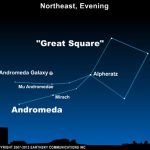
The Great Square of Pegasus looks like a … well … a big square. Four medium-bright stars mark its corners. But if you can think of it instead as a baseball diamond, you can use the Square to find the famous Andromeda galaxy, the large spiral galaxy next door to our Milky Way and the most distant object visible to the eye alone. Look at the Square on our chart at top. Now imagine the farthest star to the left – Alpheratz – as the third-base star. A line drawn from the first-base star through Alpheratz points in the general direction of the Andromeda galaxy.

For some idea of the Great Square’s size, extend your hand an arm’s length from your eye. You’ll see that any two Great Square stars are farther apart than the width of your hand.

At mid-northern latitudes, the Great Square of Pegasus sparkles over your eastern horizon at about 8 or 9 p.m. in late August and early September. That’s 8 or 9 p.m. local time. Some two weeks from now – around mid-September – the Square will return to the same place in the sky about an hour earlier.

Want to see the Great Square of Pegasus from your specific location on the globe, or at a different time of night or different time of year? Try Stellarium.

Enjoying EarthSky so far? Sign up for our free daily newsletter today!

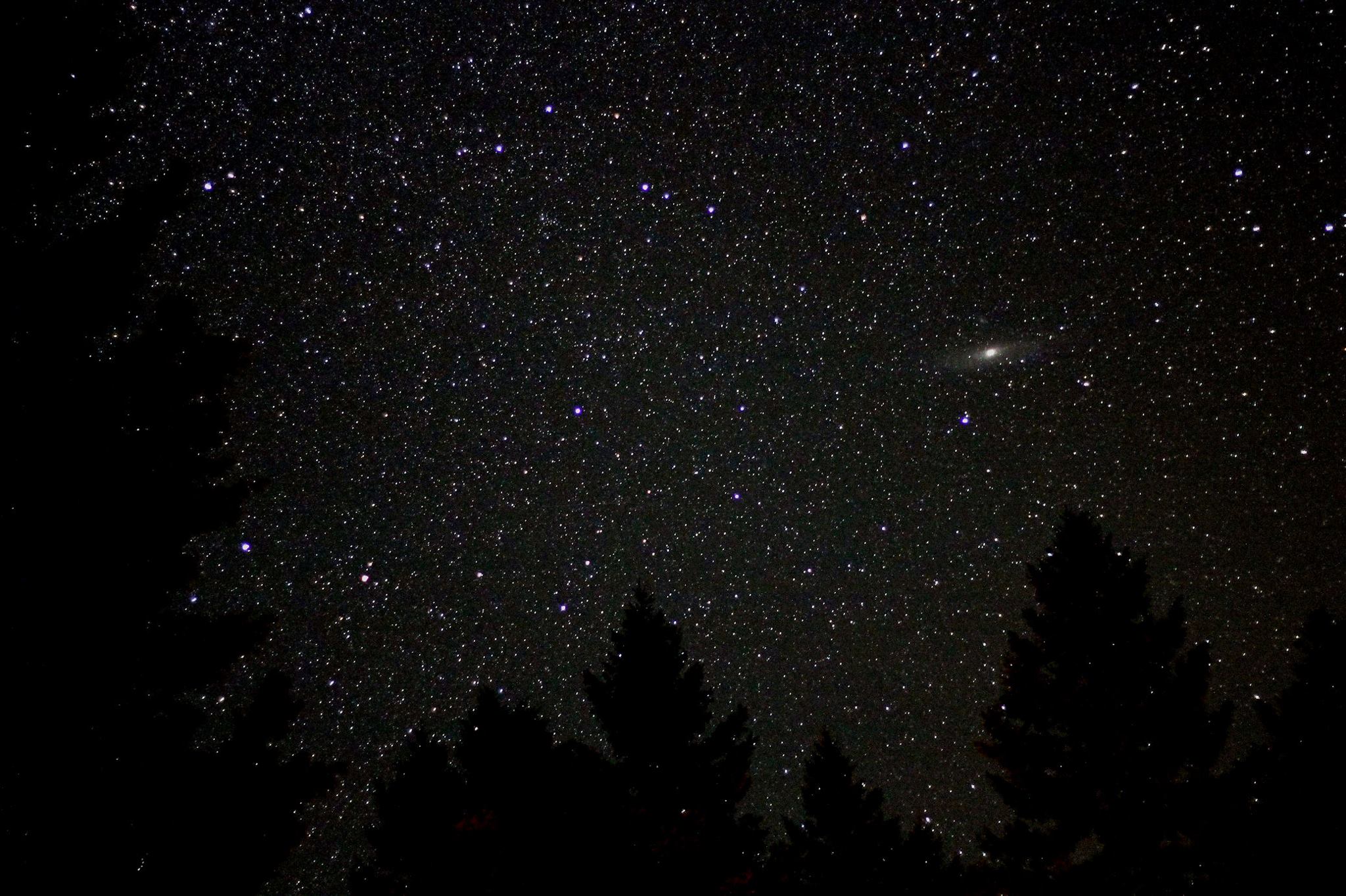
Dense star field above treetops, showing small elongated bright smudge of light with brighter center.

View larger. | The Andromeda galaxy (right side of photo) as seen by Ted Van at a Montana campsite on an August evening.

Now let’s get more specific. If it’s dark enough, you’ll see two streamers of stars flying to the north (or left) of the star Alpheratz on August and September evenings. You might see these two streamers in the pattern of a bugle or a cornucopia. That pattern isn’t part of Pegasus. It’s the constellation Andromeda the Princess. Along the bottom streamer, star-hop from Alpheratz to the star Mirach. Draw a line from Mirach through the upper streamer star – which is called Mu Andromedae – and go about the same distance again as that between Mirach and Mu. You’ve just located the Andromeda galaxy!

Read more: Cassiopeia the Queen also points to the Andromeda galaxy

The Andromeda galaxy looks like a large fuzzy patch in a dark sky. If you can’t see this fuzzy patch of light with the unaided eye, maybe your sky isn’t dark enough. Try binoculars! Don’t worry if you miss it tonight, for the Andromeda galaxy will be in the evening sky from now until spring.

Oblique view of flat, glowing spiral with bright center and two nearby small smudges of light.

The Andromeda galaxy and 2 satellite galaxies as seen through a powerful telescope. To the eye, the galaxy looks like a fuzzy patch. It’s an island of stars in space, much like our Milky Way. Image via NOAO.

Bottom line: The Andromeda galaxy can be seen somewhere in our sky for much of every year. Every August, it’s ascending in the sky during the evening hours. This post explains how to use the Great Square of Pegasus to find the Andromeda galaxy.

Help support EarthSky! Visit the EarthSky store for to see the great selection of educational tools and team gear we have to offer.

Read more: Mirach is guide star to 3 galaxies


from EarthSky https://ift.tt/2NlrOzh

The Great Square of Pegasus looks like a … well … a big square. Four medium-bright stars mark its corners. But if you can think of it instead as a baseball diamond, you can use the Square to find the famous Andromeda galaxy, the large spiral galaxy next door to our Milky Way and the most distant object visible to the eye alone. Look at the Square on our chart at top. Now imagine the farthest star to the left – Alpheratz – as the third-base star. A line drawn from the first-base star through Alpheratz points in the general direction of the Andromeda galaxy.

For some idea of the Great Square’s size, extend your hand an arm’s length from your eye. You’ll see that any two Great Square stars are farther apart than the width of your hand.

At mid-northern latitudes, the Great Square of Pegasus sparkles over your eastern horizon at about 8 or 9 p.m. in late August and early September. That’s 8 or 9 p.m. local time. Some two weeks from now – around mid-September – the Square will return to the same place in the sky about an hour earlier.

Want to see the Great Square of Pegasus from your specific location on the globe, or at a different time of night or different time of year? Try Stellarium.

Enjoying EarthSky so far? Sign up for our free daily newsletter today!

Dense star field above treetops, showing small elongated bright smudge of light with brighter center.

View larger. | The Andromeda galaxy (right side of photo) as seen by Ted Van at a Montana campsite on an August evening.

Now let’s get more specific. If it’s dark enough, you’ll see two streamers of stars flying to the north (or left) of the star Alpheratz on August and September evenings. You might see these two streamers in the pattern of a bugle or a cornucopia. That pattern isn’t part of Pegasus. It’s the constellation Andromeda the Princess. Along the bottom streamer, star-hop from Alpheratz to the star Mirach. Draw a line from Mirach through the upper streamer star – which is called Mu Andromedae – and go about the same distance again as that between Mirach and Mu. You’ve just located the Andromeda galaxy!

Read more: Cassiopeia the Queen also points to the Andromeda galaxy

The Andromeda galaxy looks like a large fuzzy patch in a dark sky. If you can’t see this fuzzy patch of light with the unaided eye, maybe your sky isn’t dark enough. Try binoculars! Don’t worry if you miss it tonight, for the Andromeda galaxy will be in the evening sky from now until spring.

Oblique view of flat, glowing spiral with bright center and two nearby small smudges of light.

The Andromeda galaxy and 2 satellite galaxies as seen through a powerful telescope. To the eye, the galaxy looks like a fuzzy patch. It’s an island of stars in space, much like our Milky Way. Image via NOAO.

Bottom line: The Andromeda galaxy can be seen somewhere in our sky for much of every year. Every August, it’s ascending in the sky during the evening hours. This post explains how to use the Great Square of Pegasus to find the Andromeda galaxy.

Help support EarthSky! Visit the EarthSky store for to see the great selection of educational tools and team gear we have to offer.

Read more: Mirach is guide star to 3 galaxies


from EarthSky https://ift.tt/2NlrOzh

2019 State of the Climate Report: Peak greenhouse gases and record heat

Photo of planet Earth with a jagged rising graph at the bottom of the picture.

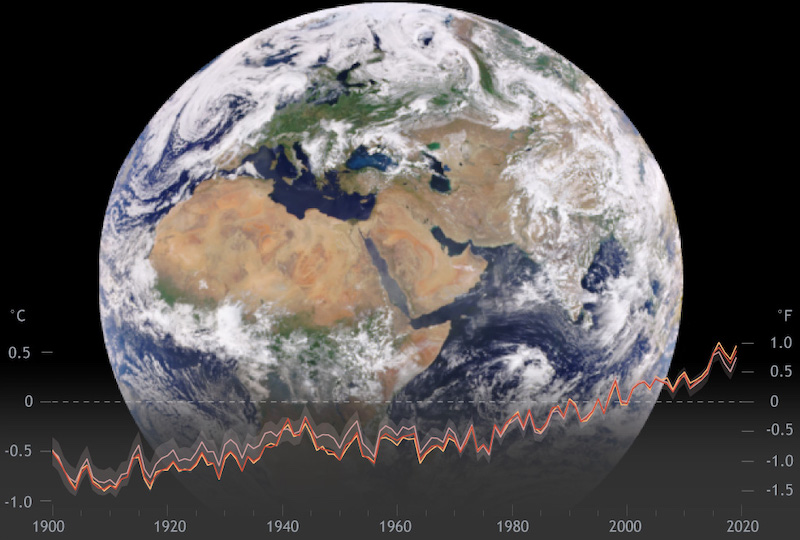
Temperature records from NOAA, NASA, and the University of East Anglia all show an increase from the start of the 20th century through 2019. The year 2019 counted among the top 3 warmest years on record. Image via NOAA.

On August 12, 2020, the American Meteorological Society released State of the Climate Report for 2019. An international, peer-reviewed publication released each summer, the State of the Climate Report is a review of the world’s climate, based on contributions from more than 520 scientists in over 60 countries. It offers insight on global climate indicators, extreme weather events and other environmental data.

The 2019 report is the 30th annual such report. According to it, in 2019, climate records were, once more, either challenged or broken. 2019 now ranks among the world’s three hottest years. What’s more, greenhouse gases peaked in 2019 to their highest levels on record. Plus, the six warmest years on record have all occurred in the past six years, since 2014.

The State of the Climate report is led by scientists from NOAA’s National Centers for Environmental Information and published by the Bulletin of the American Meteorological Society. Read the complete report here.

Graph with sawtooth line ascending from lower left to upper right overlaid with smooth thick line.

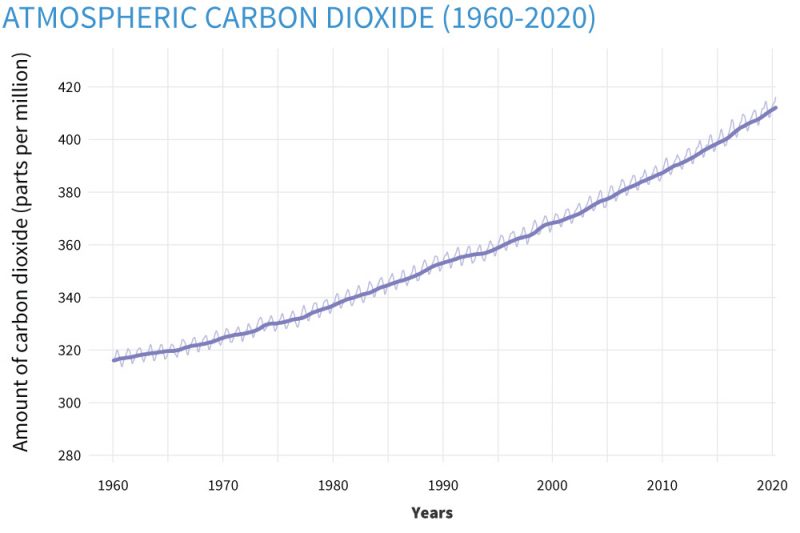
The thin line shows monthly average carbon dioxide at NOAA’s Mauna Loa Observatory in Hawaii in parts per million (ppm): the number of carbon dioxide molecules per million molecules of dry air. Over the course of the year, values are higher in Northern Hemisphere winter and lower in summer. The thick line shows the annual trend, calculated as a 12-month rolling average. NOAA’s information about how CO2 is measured at Mauna Loa here. Graph by Climate.gov based on data from NOAA Earth System Research Laboratories.

According to a statement from NOAA, notable findings from the international report include:

– Last year continued Earth’s warming trend. The globally averaged annual surface temperature was 0.79–1.00 degrees Fahrenheit (0.44–0.56 degrees Celsius) above the 1981–2010 average depending upon the dataset used. More specifically, NOAA and NASA both found 2019 to be the second-hottest year on record, behind 2016, while the United Kingdom’s Met Office ranked 2019 as the third-hottest year, behind 2016 and 2015 respectively.

– Earth’s greenhouse gases were at their highest level on record. Continuing their rise, major greenhouse gas concentrations in the atmosphere – including carbon dioxide (CO2), methane and nitrous oxide – all reached another record in 2019. The global annual average atmospheric CO2 concentration was 409.8 parts per million (ppm). This was 2.5 ppm greater than 2018 amounts and was the highest in the modern 61-year measurement record as well as the highest ever measured in ice core records dating back as far as 800,000 years.

– Sea-surface temperatures were near-record warm. The globally averaged 2019 sea surface temperature was the second highest on record, surpassed only by the record El Niño year of 2016.

– Sea levels were the highest on record, again. For the eighth consecutive year, global average sea level rose to a new record high and was about 3.4 inches (87.6 mm) higher than the 1993 average, the year that marks the beginning of the satellite altimeter record. Global sea level is rising at an average rate of 1.3 inches (3.2 cm) per decade. Melting of glaciers and ice sheets, along with warming oceans, account for the trend in rising global mean sea level.

Four scientists standing on icy surface next to sea.

Image via NOAA.

– The Arctic and Antarctic saw near-record warmth. The annual mean surface air temperature for the Arctic land areas was the second highest in the 120-year record, trailing only 2016. In the Antarctic, 2019 was the second warmest year for the continent as a whole since the start of the reanalysis record in 1979, surpassing 2018 and behind only 1980.

Large black silhouette of a kangaroo against a background of solid flame.

Kangaroo silhouette looking at a fire in an Australian forest. Image via Benny Marty iStock/ Getty Images/ AMS.

– The Indian Ocean dipole affected weather from Africa to Australia. The Indian Ocean dipole – measured as the difference between sea-surface temperature departure from average in the eastern and western Indian Ocean -contributed to heavy rainfall over the Horn of Africa from October through December 2019, resulting in widespread flooding across East Africa. Meanwhile, record heat and dryness in Australia intensified drought conditions already in place, leading to severe impacts during late austral spring and summer, including catastrophic wildfires.

Bottom line: 2019 ranks among the three warmest years in records dating to the mid-1800s. In 2019, greenhouse gases reached their highest levels on record. Both facts are from the 30th annual State of the Climate report, a review of world climate based on contributions from more than 520 scientists in over 60 countries.

Source: State of the Climate in 2019

Via NOAA


from EarthSky https://ift.tt/2DZE0U2
Photo of planet Earth with a jagged rising graph at the bottom of the picture.

Temperature records from NOAA, NASA, and the University of East Anglia all show an increase from the start of the 20th century through 2019. The year 2019 counted among the top 3 warmest years on record. Image via NOAA.

On August 12, 2020, the American Meteorological Society released State of the Climate Report for 2019. An international, peer-reviewed publication released each summer, the State of the Climate Report is a review of the world’s climate, based on contributions from more than 520 scientists in over 60 countries. It offers insight on global climate indicators, extreme weather events and other environmental data.

The 2019 report is the 30th annual such report. According to it, in 2019, climate records were, once more, either challenged or broken. 2019 now ranks among the world’s three hottest years. What’s more, greenhouse gases peaked in 2019 to their highest levels on record. Plus, the six warmest years on record have all occurred in the past six years, since 2014.

The State of the Climate report is led by scientists from NOAA’s National Centers for Environmental Information and published by the Bulletin of the American Meteorological Society. Read the complete report here.

Graph with sawtooth line ascending from lower left to upper right overlaid with smooth thick line.

The thin line shows monthly average carbon dioxide at NOAA’s Mauna Loa Observatory in Hawaii in parts per million (ppm): the number of carbon dioxide molecules per million molecules of dry air. Over the course of the year, values are higher in Northern Hemisphere winter and lower in summer. The thick line shows the annual trend, calculated as a 12-month rolling average. NOAA’s information about how CO2 is measured at Mauna Loa here. Graph by Climate.gov based on data from NOAA Earth System Research Laboratories.

According to a statement from NOAA, notable findings from the international report include:

– Last year continued Earth’s warming trend. The globally averaged annual surface temperature was 0.79–1.00 degrees Fahrenheit (0.44–0.56 degrees Celsius) above the 1981–2010 average depending upon the dataset used. More specifically, NOAA and NASA both found 2019 to be the second-hottest year on record, behind 2016, while the United Kingdom’s Met Office ranked 2019 as the third-hottest year, behind 2016 and 2015 respectively.

– Earth’s greenhouse gases were at their highest level on record. Continuing their rise, major greenhouse gas concentrations in the atmosphere – including carbon dioxide (CO2), methane and nitrous oxide – all reached another record in 2019. The global annual average atmospheric CO2 concentration was 409.8 parts per million (ppm). This was 2.5 ppm greater than 2018 amounts and was the highest in the modern 61-year measurement record as well as the highest ever measured in ice core records dating back as far as 800,000 years.

– Sea-surface temperatures were near-record warm. The globally averaged 2019 sea surface temperature was the second highest on record, surpassed only by the record El Niño year of 2016.

– Sea levels were the highest on record, again. For the eighth consecutive year, global average sea level rose to a new record high and was about 3.4 inches (87.6 mm) higher than the 1993 average, the year that marks the beginning of the satellite altimeter record. Global sea level is rising at an average rate of 1.3 inches (3.2 cm) per decade. Melting of glaciers and ice sheets, along with warming oceans, account for the trend in rising global mean sea level.

Four scientists standing on icy surface next to sea.

Image via NOAA.

– The Arctic and Antarctic saw near-record warmth. The annual mean surface air temperature for the Arctic land areas was the second highest in the 120-year record, trailing only 2016. In the Antarctic, 2019 was the second warmest year for the continent as a whole since the start of the reanalysis record in 1979, surpassing 2018 and behind only 1980.

Large black silhouette of a kangaroo against a background of solid flame.

Kangaroo silhouette looking at a fire in an Australian forest. Image via Benny Marty iStock/ Getty Images/ AMS.

– The Indian Ocean dipole affected weather from Africa to Australia. The Indian Ocean dipole – measured as the difference between sea-surface temperature departure from average in the eastern and western Indian Ocean -contributed to heavy rainfall over the Horn of Africa from October through December 2019, resulting in widespread flooding across East Africa. Meanwhile, record heat and dryness in Australia intensified drought conditions already in place, leading to severe impacts during late austral spring and summer, including catastrophic wildfires.

Bottom line: 2019 ranks among the three warmest years in records dating to the mid-1800s. In 2019, greenhouse gases reached their highest levels on record. Both facts are from the 30th annual State of the Climate report, a review of world climate based on contributions from more than 520 scientists in over 60 countries.

Source: State of the Climate in 2019

Via NOAA


from EarthSky https://ift.tt/2DZE0U2

What are lightning sprites?

A red, glowing structure in the sky, with an intricate, jellyfish-like shape, domed top with streamers hanging down.

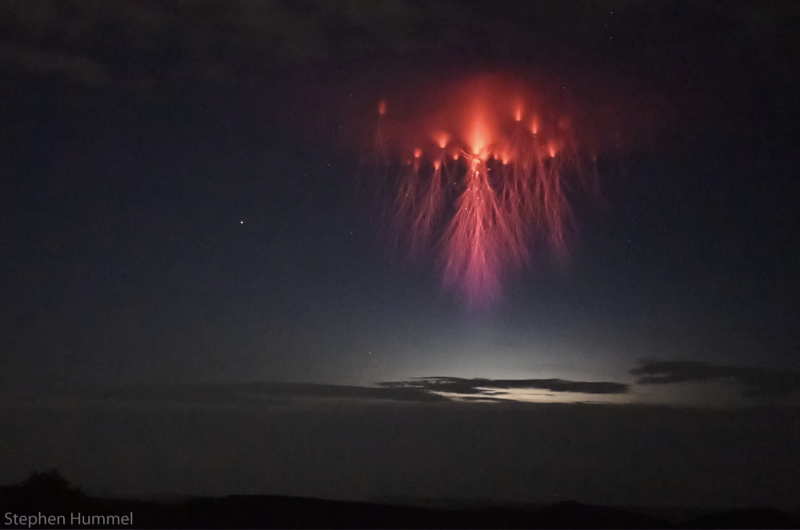
View at EarthSky Community Photos. | Stephen Hummel, who works at McDonald Observatory in West Texas, captured this fleeting lightning sprite – aka a red sprite – on July 2, 2020. McDonald Observatory is spearheading a Dark Skies Initiative in its region. Stephen commented, “Dark skies help you see faint objects like sprites.” Thank you, Stephen!

Did you know that lightning sprites – like the one captured in the image above – exist above some thunderstorms? Sprites aren’t terribly well known, except to meteorologists, nature photographers and others who study the skies. They aren’t rare, but they’re fleeting. They’re not easy to capture on film. Lightning sprites are electrical discharges high in Earth’s atmosphere. They’re associated with thunderstorms, but they’re not born in the clouds that send us rain. Thunderstorms – in fact all earthly weather – happen in the layer of Earth’s atmosphere called the troposphere, which extends directly above Earth about 4 to 12 miles up (about 6 to 19 km up). Lightning sprites – also known as red sprites – occur in Earth’s mesosphere, up to 50 miles (80 km) high in the sky.

So when you’re standing on Earth’s surface and you spot one, it’s relatively small, even though, in fact, these sprites can be some 30 miles (50 km) across. As Matthew Cappucci of the Washington Post’s Capital Weather Gang said in an article about lightning sprites in April, 2019:

Imagine one electrical discharge spanning the distance from Baltimore to Washington, D.C.

Cappucci also commented:

Although sprites are poorly understood, atmospheric electrodynamicists have figured out the basics behind their formation. Sprites are often triggered by a strong, positive bolt of ordinary lightning near the ground. They’re thought to be a balancing mechanism that the atmosphere uses to dispense charges vertically. It’s a quick process that takes less than a tenth of a second.

That’s what makes hunting for sprites so tough. Blink and you’ll miss them.

The fleeting aspect of lightning sprites probably explains why – when people first see photos of them – they’re surprised such a strange-looking weather phenomenon even exists. Also, it hasn’t been that many years since lightning sprites were confirmed. In the 20th century, pilots spoke of “flashes above thunderstorms.” Lightning sprites as we know them today weren’t captured, and their intricate structure didn’t begin to be recorded on film, until 1989 when experimental physicist John R. Winckler (1916-2001) happened to capture one while testing a low-light television camera.

Today, people around the world routinely capture photos of lightning sprites. You’ll find many photos of them in this gallery from SpaceWeather.com.

To photograph a sprite, you need a dark sky and a clear view toward a distant thunderstorm. The sky needs to be dark, because you’ll be taking long exposures; too much stray light in your sky will wash out your photo and make capturing sprites impossible. One of the most successful sprite photographers in the U.S., and likely in the world, is Paul M. Smith. He captured the sprite below in June, 2020. You can follow him on Twitter: @PaulMSmithPhoto. Or find him on YouTube.

Want more photos of lightning sprites? Try these:

Lightning sprites over the Andes in early 2020, from Yuri Beletsky

Lightning sprites over Oklahoma in 2018, from Paul Smith

Captures of elusive red sprites from the International Space Station

Bottom line: Lightning sprites, or red sprites, often associated with lightning, are short-lived electrical discharges that flash high above thunderstorms in the mesosphere layer of the atmosphere.


from EarthSky https://ift.tt/2Y8KLcU
A red, glowing structure in the sky, with an intricate, jellyfish-like shape, domed top with streamers hanging down.

View at EarthSky Community Photos. | Stephen Hummel, who works at McDonald Observatory in West Texas, captured this fleeting lightning sprite – aka a red sprite – on July 2, 2020. McDonald Observatory is spearheading a Dark Skies Initiative in its region. Stephen commented, “Dark skies help you see faint objects like sprites.” Thank you, Stephen!

Did you know that lightning sprites – like the one captured in the image above – exist above some thunderstorms? Sprites aren’t terribly well known, except to meteorologists, nature photographers and others who study the skies. They aren’t rare, but they’re fleeting. They’re not easy to capture on film. Lightning sprites are electrical discharges high in Earth’s atmosphere. They’re associated with thunderstorms, but they’re not born in the clouds that send us rain. Thunderstorms – in fact all earthly weather – happen in the layer of Earth’s atmosphere called the troposphere, which extends directly above Earth about 4 to 12 miles up (about 6 to 19 km up). Lightning sprites – also known as red sprites – occur in Earth’s mesosphere, up to 50 miles (80 km) high in the sky.

So when you’re standing on Earth’s surface and you spot one, it’s relatively small, even though, in fact, these sprites can be some 30 miles (50 km) across. As Matthew Cappucci of the Washington Post’s Capital Weather Gang said in an article about lightning sprites in April, 2019:

Imagine one electrical discharge spanning the distance from Baltimore to Washington, D.C.

Cappucci also commented:

Although sprites are poorly understood, atmospheric electrodynamicists have figured out the basics behind their formation. Sprites are often triggered by a strong, positive bolt of ordinary lightning near the ground. They’re thought to be a balancing mechanism that the atmosphere uses to dispense charges vertically. It’s a quick process that takes less than a tenth of a second.

That’s what makes hunting for sprites so tough. Blink and you’ll miss them.

The fleeting aspect of lightning sprites probably explains why – when people first see photos of them – they’re surprised such a strange-looking weather phenomenon even exists. Also, it hasn’t been that many years since lightning sprites were confirmed. In the 20th century, pilots spoke of “flashes above thunderstorms.” Lightning sprites as we know them today weren’t captured, and their intricate structure didn’t begin to be recorded on film, until 1989 when experimental physicist John R. Winckler (1916-2001) happened to capture one while testing a low-light television camera.

Today, people around the world routinely capture photos of lightning sprites. You’ll find many photos of them in this gallery from SpaceWeather.com.

To photograph a sprite, you need a dark sky and a clear view toward a distant thunderstorm. The sky needs to be dark, because you’ll be taking long exposures; too much stray light in your sky will wash out your photo and make capturing sprites impossible. One of the most successful sprite photographers in the U.S., and likely in the world, is Paul M. Smith. He captured the sprite below in June, 2020. You can follow him on Twitter: @PaulMSmithPhoto. Or find him on YouTube.

Want more photos of lightning sprites? Try these:

Lightning sprites over the Andes in early 2020, from Yuri Beletsky

Lightning sprites over Oklahoma in 2018, from Paul Smith

Captures of elusive red sprites from the International Space Station

Bottom line: Lightning sprites, or red sprites, often associated with lightning, are short-lived electrical discharges that flash high above thunderstorms in the mesosphere layer of the atmosphere.


from EarthSky https://ift.tt/2Y8KLcU

New moon is August 19, 2020

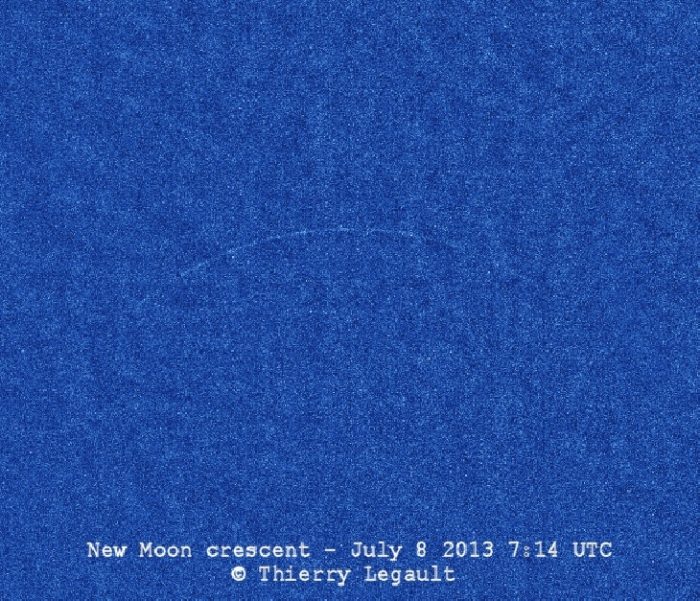
Extremely thin, threadlike crescent against blue background.

Youngest possible lunar crescent, with the moon’s age being exactly zero when this photo was taken – at the instant of new moon – 07:14 UTC on July 8, 2013. Image by Thierry Legault.

The new moon falls on Wednesday, August 19, 2020 at 02:41 UTC. For U.S. time zones, it will occur on Tuesday, the 18th, before midnight: 10:41 p.m. EDT, 9:41 p.m. CDT, 8:41 MST, and 7:41 PDT. Translate UTC to your time.

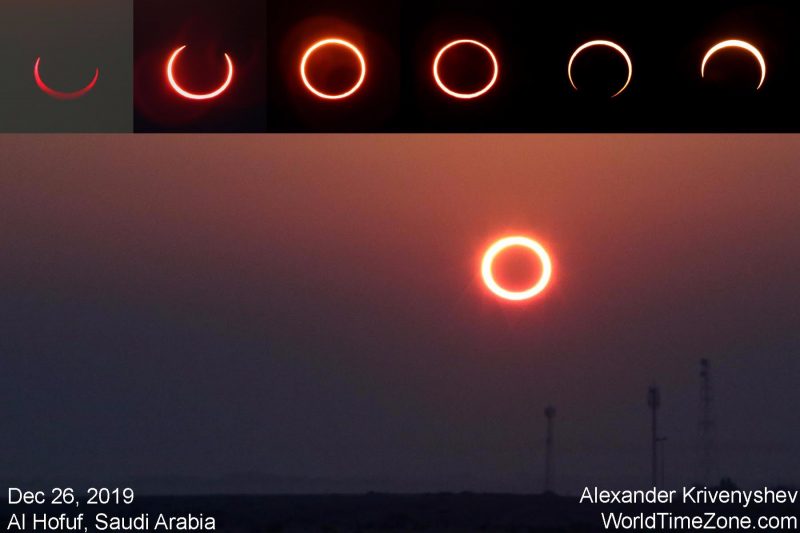
When the moon is new, it’s most nearly between the Earth and sun for any particular month. There’s a new moon about once a month, because the moon takes about a month to orbit Earth. Most of the time, the new moon passes not in front of the sun, but simply near it in our sky. That’s why, in most months, there’s no solar eclipse. In June 2020, however, the moon passed dead-on in front of the sun, causing an annular – or ring – solar eclipse. Read more about the solar eclipse here.

Annular solar eclipse.

View at EarthSky Community Photos. | Annular solar eclipse of December 26, 2019. Alexander Krivenyshev of the website WorldTimeZone.com caught it at Al Hofuf, Saudi Arabia. Thank you, Alexander! Read more about the June 21, 2020 annular solar eclipse.

The photo of a new moon at the top of this page shows the moon as it passed near the sun on July 8, 2013. There was no eclipse that day; it was an ordinary new moon.

New moons typically can’t be seen, or at least they can’t without special equipment and a lot of moon-photography experience. Thierry Legault was able to catch the photo at top – the moon at the instant it was new – because the moon that month passed to one side of the sun, and the faintest of lunar crescents was visible.

Either way – in front of the sun or just near it – on the day of new moon, the moon travels across the sky with the sun during the day, hidden in the sun’s glare.

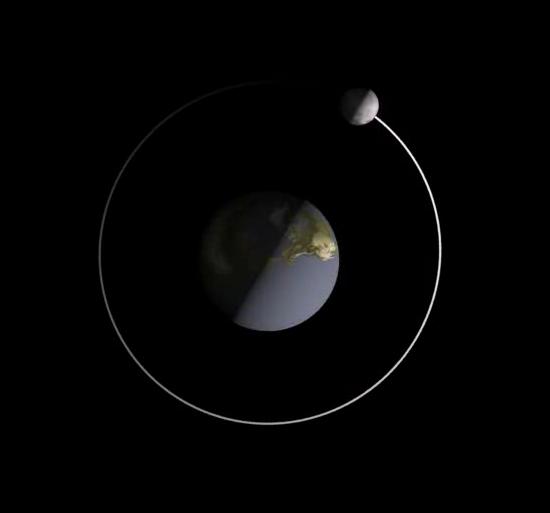
Half-lit Earth from north, and half-lit moon with divisions between dark and light sides lined up.

Click here to see animation. As seen from the north side of the moon’s orbital plane, the Earth rotates counterclockwise on its rotational axis, and the moon revolves counterclockwise around Earth. In the linked animation note that the new moon happens when the moon is on the same side of Earth as the sun.

Some people use the term new moon for a thin crescent moon visible in the west after sunset. You always see these little crescents – which set shortly after the sun – a day or two after each month’s new moon. Astronomers don’t call these little crescent moons new moons, however. In the language of astronomy, this slim crescent is called a young moon.

New moons, and young moons, are fascinating to many. The Farmer’s Almanac, for example, still offers information on gardening by the moon. And many cultures have holidays based on moon phases.

Bottom line: New moons generally can’t be seen. They cross the sky with the sun during the day. This month’s new moon happens on August 19 at 02:41 UTC. Afterward – beginning around August 20 – the moon will return to the evening sky.

Read more: What’s the youngest moon you can see?

Read more: Top 4 keys to understanding moon phases

Help EarthSky keep going! Please donate.


from EarthSky https://ift.tt/2QpMvsB
Extremely thin, threadlike crescent against blue background.

Youngest possible lunar crescent, with the moon’s age being exactly zero when this photo was taken – at the instant of new moon – 07:14 UTC on July 8, 2013. Image by Thierry Legault.

The new moon falls on Wednesday, August 19, 2020 at 02:41 UTC. For U.S. time zones, it will occur on Tuesday, the 18th, before midnight: 10:41 p.m. EDT, 9:41 p.m. CDT, 8:41 MST, and 7:41 PDT. Translate UTC to your time.

When the moon is new, it’s most nearly between the Earth and sun for any particular month. There’s a new moon about once a month, because the moon takes about a month to orbit Earth. Most of the time, the new moon passes not in front of the sun, but simply near it in our sky. That’s why, in most months, there’s no solar eclipse. In June 2020, however, the moon passed dead-on in front of the sun, causing an annular – or ring – solar eclipse. Read more about the solar eclipse here.

Annular solar eclipse.

View at EarthSky Community Photos. | Annular solar eclipse of December 26, 2019. Alexander Krivenyshev of the website WorldTimeZone.com caught it at Al Hofuf, Saudi Arabia. Thank you, Alexander! Read more about the June 21, 2020 annular solar eclipse.

The photo of a new moon at the top of this page shows the moon as it passed near the sun on July 8, 2013. There was no eclipse that day; it was an ordinary new moon.

New moons typically can’t be seen, or at least they can’t without special equipment and a lot of moon-photography experience. Thierry Legault was able to catch the photo at top – the moon at the instant it was new – because the moon that month passed to one side of the sun, and the faintest of lunar crescents was visible.

Either way – in front of the sun or just near it – on the day of new moon, the moon travels across the sky with the sun during the day, hidden in the sun’s glare.

Half-lit Earth from north, and half-lit moon with divisions between dark and light sides lined up.

Click here to see animation. As seen from the north side of the moon’s orbital plane, the Earth rotates counterclockwise on its rotational axis, and the moon revolves counterclockwise around Earth. In the linked animation note that the new moon happens when the moon is on the same side of Earth as the sun.

Some people use the term new moon for a thin crescent moon visible in the west after sunset. You always see these little crescents – which set shortly after the sun – a day or two after each month’s new moon. Astronomers don’t call these little crescent moons new moons, however. In the language of astronomy, this slim crescent is called a young moon.

New moons, and young moons, are fascinating to many. The Farmer’s Almanac, for example, still offers information on gardening by the moon. And many cultures have holidays based on moon phases.

Bottom line: New moons generally can’t be seen. They cross the sky with the sun during the day. This month’s new moon happens on August 19 at 02:41 UTC. Afterward – beginning around August 20 – the moon will return to the evening sky.

Read more: What’s the youngest moon you can see?

Read more: Top 4 keys to understanding moon phases

Help EarthSky keep going! Please donate.


from EarthSky https://ift.tt/2QpMvsB

Today in science: Asaph Hall finds Mars moon Phobos

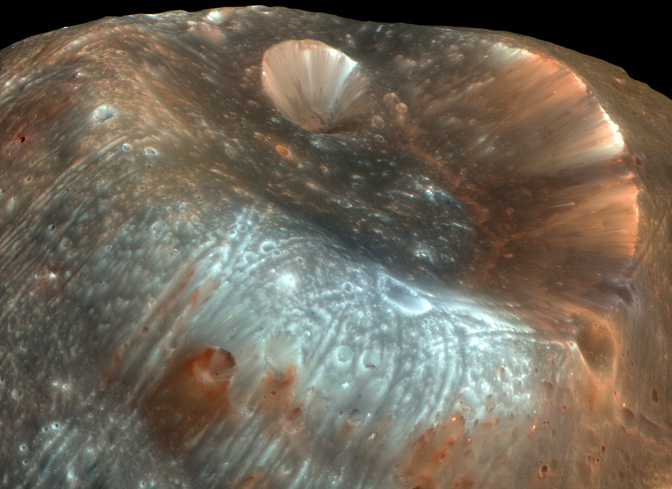
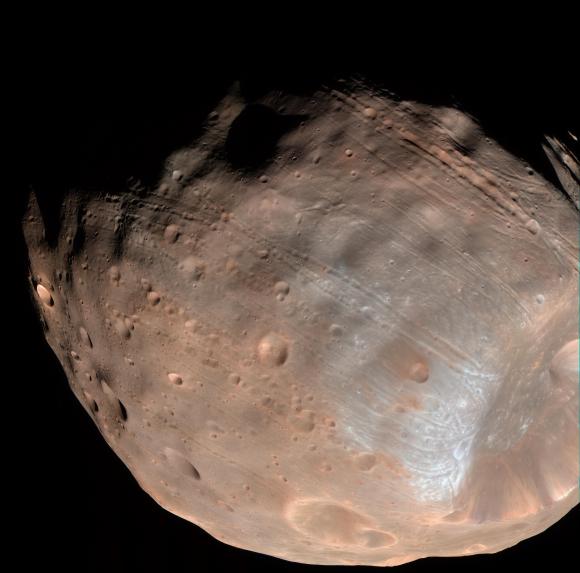
Very large crater on blue and pink landscape with many small craters.

Color-enhanced image of the large crater Stickney on the Martian moon Phobos. The crater is 5.6 miles (9 km) in diameter, so it takes up a substantial proportion of Phobos’ surface. The impact almost destroyed the small moon! Notice the smaller crater within Stickney, about 1.2 miles (2 km) in diameter, resulting from a later impact. Image via HiRISE/ MRO/ LPL (U. Arizona)/ NASA.

August 17, 1877. It was on this date that American astronomer Asaph Hall discovered Phobos, the larger of Mars’ two small moons. He also found the other moon, which we call Deimos, later that same year. Both of these moons are potato-shaped. They look more like asteroids than they do Earth’s much-larger companion moon. It’s possible that – millions of years from now – Phobos will shatter and form a ring around Mars. Or it’s possible that the material in this moon alternates between becoming a planetary ring and clumping up again to form a moon. More about ring theories of Phobos below.

Phobos and Deimos – whose names mean Fear and Terror – were named for the horses that pulled the chariot of the Greek war god Ares, who was the counterpart to the Roman war god Mars. They’re the only moons ever found orbiting the Red Planet.

Although it is the larger moon, Phobos is tiny, with a mean diameter of only about 14 miles (22.2 km). It’s more than 7 times as massive as Deimos, whose mean diameter is about 7.7 miles (12.4 km). For these moons, we’re speaking in terms of a mean diameter because both moons are oblong in shape and not spherical. In contrast, Earth’s moon is nearly round, since it is large enough for its gravity to pull it into a spherical shape. It’s also much larger, 2,159 miles (3,475 km) in diameter. Both Phobos and Deimos have very weak gravity since they are so tiny, and so not nearly strong enough for those moons to be round.

It wasn’t until 1971 and 1972 when scientists got their first close-up look at Phobos, during Mariner 9’s mission to Mars. It’s oblong surface was found to be pitted by many small craters, just like asteroids. But one large crater stood out, later called Stickney Crater, after Chloe Angeline Stickney Hall, wife of Phobos’ discoverer. It looks like a giant hole in one end of the moon, and the asteroid or other rocky body that created it was almost big enough to have shattered the moon completely, but not quite. Phobos barely survived the impact.

Oval object half in shadow with giant dent in one end.

Phobos and its large crater, named Stickney, as seen by Viking I. The spacecraft acquired this image in June 1977, 100 years after the discovery of Phobos. Image via NASA.

Oblong rocky moon covered with craters and straight grooves, in black space.

A closer view of the grooves on Phobos. Image via NASA/ JPL-Caltech/ University of Arizona.

Gray terrain covered by craters and grooves.

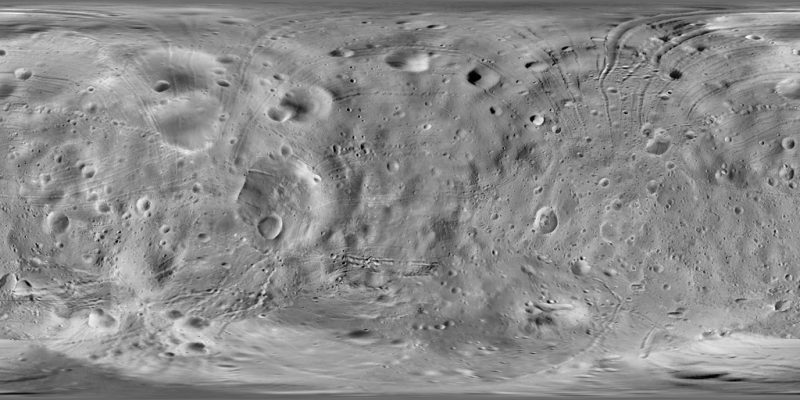
Global map of Phobos, obtained by the Viking orbiter. Image via Astrogeology Science Center/ Planetary Data System/ Phil Stooke.

Was Phobos once a ring? Will it be again? Phobos also has long, shallow grooves running across its surface, radiating away from Stickney. Many planetary scientists believe that they are early signs of the eventual structural failure in the moon. They say it’s possible that – some 50 million years from now – Phobos will break apart, becoming a ring around Mars.

A study in 2018 study suggested that rolling boulders created the grooves as they were sprayed across the surface of Phobos during the impact that created the large Stickney crater. As Ken Ramsley, a planetary science researcher at Brown University who led the work, explained:

These grooves are a distinctive feature of Phobos, and how they formed has been debated by planetary scientists for 40 years. We think this study is another step toward zeroing in on an explanation.

In 2017, a new theory by Purdue University (PU) scientists suggested that Mars’ moon Phobos might not only break apart, and form a ring around the planet, but also that this ring formation had happened before. David Minton, a professor at PU, and Andrew Hesselbrock, a doctoral student at PU, developed a computer model showing that debris that was pushed into space from an asteroid or other body slamming into Mars – some 4.3 billion years ago – would now alternate between becoming a planetary ring and clumping up again to form the moon Phobos. Read more about that theory here.

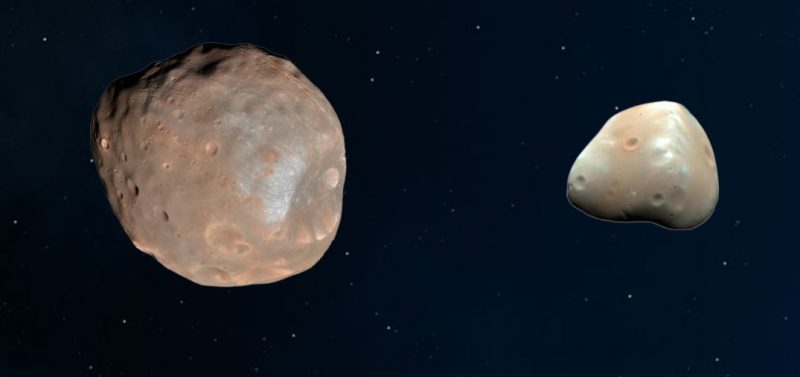
Two rocky objects, one twice the apparent size of the other, next to each other on black background with stars.

Size and visual comparison of Phobos (left) and Deimos (right). Image via NASA.

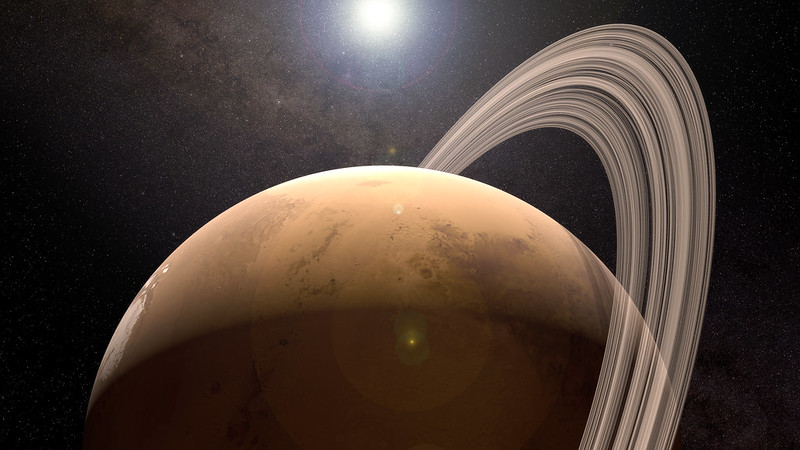
Reddish planet with rings, and sun and stars in background.

Artist’s concept of rings around Mars. Image via Kevin Gill on Flickr/ CC by 2.0.

Another study, from scientists at PU and the SETI Institute in June 2020, also came to the conclusion that Mars used to have a ring, or series of rings, based on studies of Deimos. The findings of that study would also help to explain why the smaller moon Deimos has an unusually tilted orbit, while Phobos does not. Deimos’ orbit is inclined about 2 degrees relative to Mars’ equator.

How does this relate to Phobos? According to the researchers:

These orbital resonances are picky but predictable … We can tell that only an outward-moving moon could have strongly affected Deimos, which means that Mars must have had a ring pushing the inner moon outward. Cuk and collaborators deduce that this moon may have been 20 times as massive as Phobos, and may have been its ‘grandparent’ existing just over 3 billion years ago … [that] was followed by two more ring-moon cycles, with the latest moon being Phobos.

So basically, there used to be a moon about 20 times as massive as Phobos that was being pushed outward by the ring(s). At least two times since then, that moon broke apart and then formed a new ring, before the material coalesced together again to form a new moon. Phobos is now that current moon, and, the scientists say, will eventually break apart to form a new ring, continuing the cycle.

Scientists also now know that Phobos is much younger than Deimos – perhaps only 200 million years old – which would fit the moon/ring scenario. The Phobos wee see today is simply a younger and smaller version of its original self.

Asaph Hall probably never imagined the idea of Phobos breaking apart and forming a ring around Mars. And he couldn’t possibly have imagined the video above, which was acquired by NASA’s Mars rover Curiosity on August 1, 2013. The rover had been taking a series of shots of the sky above, from Mars’ surface. This video shows both moons, Phobos and Deimos, as you might see them while standing on the surface of Mars. You can clearly see some of the large craters on Phobos in these images.

This was the first time ever that images taken from Mars’ surface caught one moon eclipsing the other. The moons have also sometimes been seen passing in front of the sun, although they don’t block it out completely like a total eclipse on Earth.

Bottom line: On August 17, 1877, American astronomer Asaph Hall discovered Phobos, the larger of the two Martian moons. He also discovered Deimos later that year.


from EarthSky https://ift.tt/2Y8KEy0
Very large crater on blue and pink landscape with many small craters.

Color-enhanced image of the large crater Stickney on the Martian moon Phobos. The crater is 5.6 miles (9 km) in diameter, so it takes up a substantial proportion of Phobos’ surface. The impact almost destroyed the small moon! Notice the smaller crater within Stickney, about 1.2 miles (2 km) in diameter, resulting from a later impact. Image via HiRISE/ MRO/ LPL (U. Arizona)/ NASA.

August 17, 1877. It was on this date that American astronomer Asaph Hall discovered Phobos, the larger of Mars’ two small moons. He also found the other moon, which we call Deimos, later that same year. Both of these moons are potato-shaped. They look more like asteroids than they do Earth’s much-larger companion moon. It’s possible that – millions of years from now – Phobos will shatter and form a ring around Mars. Or it’s possible that the material in this moon alternates between becoming a planetary ring and clumping up again to form a moon. More about ring theories of Phobos below.

Phobos and Deimos – whose names mean Fear and Terror – were named for the horses that pulled the chariot of the Greek war god Ares, who was the counterpart to the Roman war god Mars. They’re the only moons ever found orbiting the Red Planet.

Although it is the larger moon, Phobos is tiny, with a mean diameter of only about 14 miles (22.2 km). It’s more than 7 times as massive as Deimos, whose mean diameter is about 7.7 miles (12.4 km). For these moons, we’re speaking in terms of a mean diameter because both moons are oblong in shape and not spherical. In contrast, Earth’s moon is nearly round, since it is large enough for its gravity to pull it into a spherical shape. It’s also much larger, 2,159 miles (3,475 km) in diameter. Both Phobos and Deimos have very weak gravity since they are so tiny, and so not nearly strong enough for those moons to be round.

It wasn’t until 1971 and 1972 when scientists got their first close-up look at Phobos, during Mariner 9’s mission to Mars. It’s oblong surface was found to be pitted by many small craters, just like asteroids. But one large crater stood out, later called Stickney Crater, after Chloe Angeline Stickney Hall, wife of Phobos’ discoverer. It looks like a giant hole in one end of the moon, and the asteroid or other rocky body that created it was almost big enough to have shattered the moon completely, but not quite. Phobos barely survived the impact.

Oval object half in shadow with giant dent in one end.

Phobos and its large crater, named Stickney, as seen by Viking I. The spacecraft acquired this image in June 1977, 100 years after the discovery of Phobos. Image via NASA.

Oblong rocky moon covered with craters and straight grooves, in black space.

A closer view of the grooves on Phobos. Image via NASA/ JPL-Caltech/ University of Arizona.

Gray terrain covered by craters and grooves.

Global map of Phobos, obtained by the Viking orbiter. Image via Astrogeology Science Center/ Planetary Data System/ Phil Stooke.

Was Phobos once a ring? Will it be again? Phobos also has long, shallow grooves running across its surface, radiating away from Stickney. Many planetary scientists believe that they are early signs of the eventual structural failure in the moon. They say it’s possible that – some 50 million years from now – Phobos will break apart, becoming a ring around Mars.

A study in 2018 study suggested that rolling boulders created the grooves as they were sprayed across the surface of Phobos during the impact that created the large Stickney crater. As Ken Ramsley, a planetary science researcher at Brown University who led the work, explained:

These grooves are a distinctive feature of Phobos, and how they formed has been debated by planetary scientists for 40 years. We think this study is another step toward zeroing in on an explanation.

In 2017, a new theory by Purdue University (PU) scientists suggested that Mars’ moon Phobos might not only break apart, and form a ring around the planet, but also that this ring formation had happened before. David Minton, a professor at PU, and Andrew Hesselbrock, a doctoral student at PU, developed a computer model showing that debris that was pushed into space from an asteroid or other body slamming into Mars – some 4.3 billion years ago – would now alternate between becoming a planetary ring and clumping up again to form the moon Phobos. Read more about that theory here.

Two rocky objects, one twice the apparent size of the other, next to each other on black background with stars.

Size and visual comparison of Phobos (left) and Deimos (right). Image via NASA.

Reddish planet with rings, and sun and stars in background.

Artist’s concept of rings around Mars. Image via Kevin Gill on Flickr/ CC by 2.0.

Another study, from scientists at PU and the SETI Institute in June 2020, also came to the conclusion that Mars used to have a ring, or series of rings, based on studies of Deimos. The findings of that study would also help to explain why the smaller moon Deimos has an unusually tilted orbit, while Phobos does not. Deimos’ orbit is inclined about 2 degrees relative to Mars’ equator.

How does this relate to Phobos? According to the researchers:

These orbital resonances are picky but predictable … We can tell that only an outward-moving moon could have strongly affected Deimos, which means that Mars must have had a ring pushing the inner moon outward. Cuk and collaborators deduce that this moon may have been 20 times as massive as Phobos, and may have been its ‘grandparent’ existing just over 3 billion years ago … [that] was followed by two more ring-moon cycles, with the latest moon being Phobos.

So basically, there used to be a moon about 20 times as massive as Phobos that was being pushed outward by the ring(s). At least two times since then, that moon broke apart and then formed a new ring, before the material coalesced together again to form a new moon. Phobos is now that current moon, and, the scientists say, will eventually break apart to form a new ring, continuing the cycle.

Scientists also now know that Phobos is much younger than Deimos – perhaps only 200 million years old – which would fit the moon/ring scenario. The Phobos wee see today is simply a younger and smaller version of its original self.

Asaph Hall probably never imagined the idea of Phobos breaking apart and forming a ring around Mars. And he couldn’t possibly have imagined the video above, which was acquired by NASA’s Mars rover Curiosity on August 1, 2013. The rover had been taking a series of shots of the sky above, from Mars’ surface. This video shows both moons, Phobos and Deimos, as you might see them while standing on the surface of Mars. You can clearly see some of the large craters on Phobos in these images.

This was the first time ever that images taken from Mars’ surface caught one moon eclipsing the other. The moons have also sometimes been seen passing in front of the sun, although they don’t block it out completely like a total eclipse on Earth.

Bottom line: On August 17, 1877, American astronomer Asaph Hall discovered Phobos, the larger of the two Martian moons. He also discovered Deimos later that year.


from EarthSky https://ift.tt/2Y8KEy0

adds 2