aads

Another intense summer of fires in Siberia

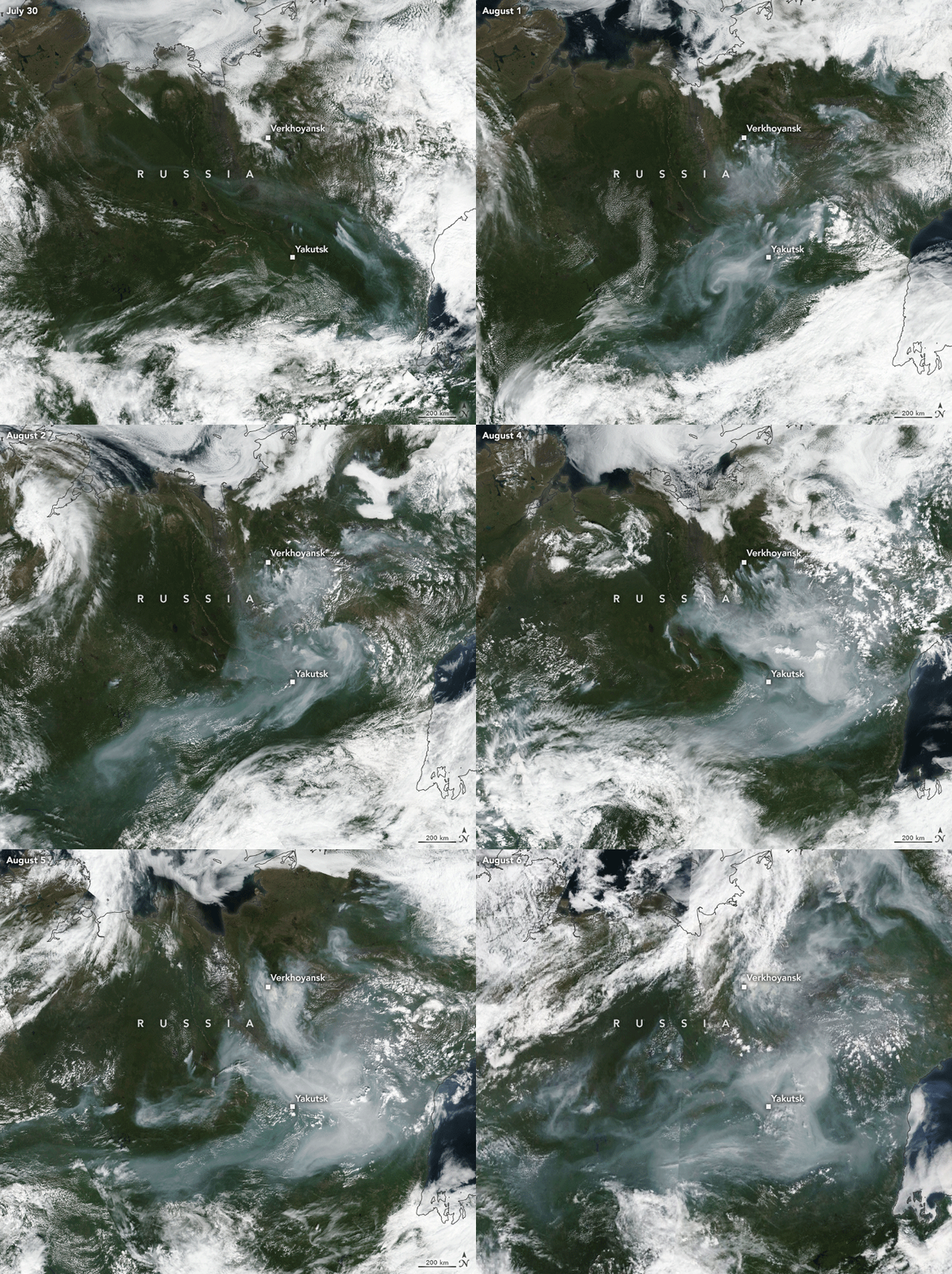
Orbital view of dark green land with huge areas covered in swirling white smoke.

The area shown in this time-lapse sequence includes the Sakha Republic, one of the most active fire regions in Siberia this summer. The NASA satellite image shows smoke plumes billowing from July 30 to August 6, 2020. Image via NASA.

EarthSky’s yearly crowd-funding campaign is in progress. In 2020, we are donating 8.5% of all incoming revenues to No Kids Hungry. Click to learn more and donate.

By Kasha Patel/ NASA Earth Observatory

Abnormally warm temperatures have spawned an intense fire season in eastern Siberia this summer. Satellite data show that fires have been more abundant, more widespread, and produced more carbon emissions than recent seasons.

Strong winds occasionally carried the plumes as far as Alaska in late July. As of August 6, approximately 19 fires were burning in the Sakha Republic (shown in the image above), one of the most active fire regions in Siberia in summer 2020.

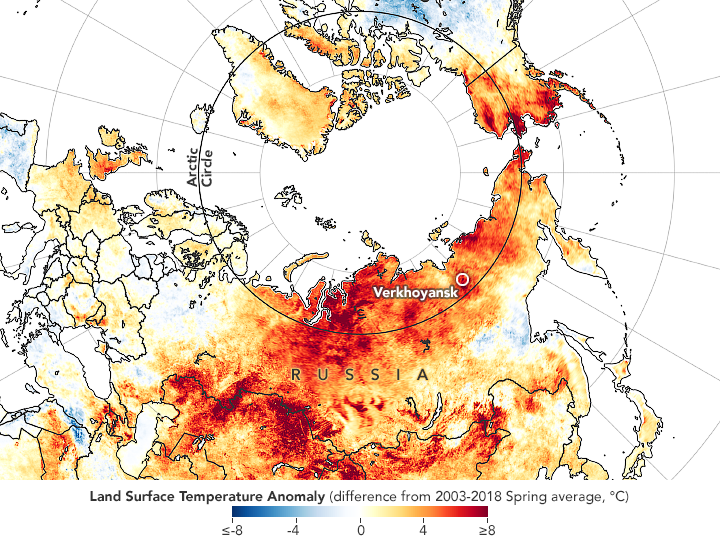
Polar map of world with islands and continents outlined with very many red splotches and 2 or 3 blue ones.

This map shows land surface temperature anomalies from March 19 to June 20, 2020. Red colors depict areas that were hotter than average for the same period from 2003-2018; blues were colder than average. The map is based on NASA satellite data. Image via NASA.

Mark Parrington is a senior scientist at the Copernicus Atmosphere Monitoring Service (CAMS) of the European Centre for Medium-Range Weather Forecasts. He said:

After the Arctic fires in 2019, the activity in 2020 was not so surprising through June. What has been surprising is the rapid increase in the scale and intensity of the fires through July, largely driven by a large cluster of active fires in the northern Sakha Republic.

Estimates show that around half of the fires in Arctic Russia this year are burning through areas with peat soil, decomposed organic matter that is a large natural carbon source. Warm temperatures (such as the record-breaking heatwave in June) can thaw and dry frozen peatlands, making them highly flammable. Peat fires can burn longer than forest fires and release vast amounts of carbon into the atmosphere

Parrington noted that fires in Arctic Russia released more carbon dioxide (CO2) in June and July 2020 alone than in any complete fire season since 2003 (when data collection began).

Dorothy Peteet of NASA’s Goddard Institute for Space Studies, said:

The destruction of peat by fire is troubling for so many reasons. As the fires burn off the top layers of peat, the permafrost depth may deepen, further oxidizing the underlying peat.

Peteet and colleagues recently reported that the amount of carbon stored in northern peatlands is double the previous estimates.

Fires in these regions are not just releasing recent surface peat carbon, but stores that have taken 15,000 years to the accumulate, said Peteet. They also release methane, which is a more potent greenhouse gas than carbon dioxide. Peteet said:

If fire seasons continue to increase in severity, and possibly in seasonal extent, more peatlands will burn. This source of more carbon dioxide and methane to our atmosphere increases the greenhouse gas problem for us, making the planet even warmer.

Bottom line: Fires in Siberia in summer 2020 have been abundant and widespread, and have produced abnormally large carbon emissions.

Via NASA Earth Observatory


from EarthSky https://ift.tt/33SVo7C
Orbital view of dark green land with huge areas covered in swirling white smoke.

The area shown in this time-lapse sequence includes the Sakha Republic, one of the most active fire regions in Siberia this summer. The NASA satellite image shows smoke plumes billowing from July 30 to August 6, 2020. Image via NASA.

EarthSky’s yearly crowd-funding campaign is in progress. In 2020, we are donating 8.5% of all incoming revenues to No Kids Hungry. Click to learn more and donate.

By Kasha Patel/ NASA Earth Observatory

Abnormally warm temperatures have spawned an intense fire season in eastern Siberia this summer. Satellite data show that fires have been more abundant, more widespread, and produced more carbon emissions than recent seasons.

Strong winds occasionally carried the plumes as far as Alaska in late July. As of August 6, approximately 19 fires were burning in the Sakha Republic (shown in the image above), one of the most active fire regions in Siberia in summer 2020.

Polar map of world with islands and continents outlined with very many red splotches and 2 or 3 blue ones.

This map shows land surface temperature anomalies from March 19 to June 20, 2020. Red colors depict areas that were hotter than average for the same period from 2003-2018; blues were colder than average. The map is based on NASA satellite data. Image via NASA.

Mark Parrington is a senior scientist at the Copernicus Atmosphere Monitoring Service (CAMS) of the European Centre for Medium-Range Weather Forecasts. He said:

After the Arctic fires in 2019, the activity in 2020 was not so surprising through June. What has been surprising is the rapid increase in the scale and intensity of the fires through July, largely driven by a large cluster of active fires in the northern Sakha Republic.

Estimates show that around half of the fires in Arctic Russia this year are burning through areas with peat soil, decomposed organic matter that is a large natural carbon source. Warm temperatures (such as the record-breaking heatwave in June) can thaw and dry frozen peatlands, making them highly flammable. Peat fires can burn longer than forest fires and release vast amounts of carbon into the atmosphere

Parrington noted that fires in Arctic Russia released more carbon dioxide (CO2) in June and July 2020 alone than in any complete fire season since 2003 (when data collection began).

Dorothy Peteet of NASA’s Goddard Institute for Space Studies, said:

The destruction of peat by fire is troubling for so many reasons. As the fires burn off the top layers of peat, the permafrost depth may deepen, further oxidizing the underlying peat.

Peteet and colleagues recently reported that the amount of carbon stored in northern peatlands is double the previous estimates.

Fires in these regions are not just releasing recent surface peat carbon, but stores that have taken 15,000 years to the accumulate, said Peteet. They also release methane, which is a more potent greenhouse gas than carbon dioxide. Peteet said:

If fire seasons continue to increase in severity, and possibly in seasonal extent, more peatlands will burn. This source of more carbon dioxide and methane to our atmosphere increases the greenhouse gas problem for us, making the planet even warmer.

Bottom line: Fires in Siberia in summer 2020 have been abundant and widespread, and have produced abnormally large carbon emissions.

Via NASA Earth Observatory


from EarthSky https://ift.tt/33SVo7C

Are differences in treatment driving variation in ovarian cancer survival internationally?

Illustrated map of the world.

Ovarian cancer is an aggressive disease. In the UK, ovarian cancer is the 6th most common cancer for women and causes the most deaths of all the gynaecological cancers.

But researchers are keen to do better, not only by developing new treatments and tools to diagnose cancers earlier, but also by understanding if there are improvements that can be made in how people are diagnosed and treated in different healthcare systems.

This is where the International Cancer Benchmarking Partnership (ICBP) – which unites clinicians, researchers, data experts and policymakers from around the world – comes in.

They have looked at how ovarian cancer diagnosis and survival differs between countries, in the hope of finding ways to improve. It’s a project John Butler, a consultant specialising in gynaecological cancer surgery, believes has become even more important in the last few months.

“In light of the COVID-19 pandemic and the severe challenges it brings, benchmarking efforts and learning lessons on best practice from other countries is now more important than ever,” says Butler.

Comparisons like this can be tricky – mainly because countries collect and record data in slightly different ways, something the ICBP is looking at in more detail. But despite the challenges, the latest figures from the ICBP are the best available and will only get better as more analysis is done.

And the latest data, which compared ovarian cancer diagnosis and survival in 7 high-income countries, including the UK, reveal that while more people are surviving their cancer, there’s still a long way to go.

Variations in survival

The biggest variations were found in survival figures of older women.

In Norway for example, over half of women aged 65-74 years survived their disease for 3 years after being diagnosed. Whereas in Ireland, only around a quarter of women survived for 3 years. In the UK, only 33% of women in this age group survived for 3 years after they were diagnosed.

And the big question was – why do the differences exist?

It’s likely to be complex, as lots of things can affect how likely someone is to survive their cancer. But one thing that is less likely to be driving differences is how and when people are diagnosed, as there’s room for improvement across the board.

In all 7 countries, most women were diagnosed with advanced or late stage ovarian cancer, ranging from 64% to 71% of women across countries.

Unfortunately, seeing more women having advanced disease at diagnosis does not come as a surprise to Butler. “The disease typically starts in the fallopian tubes or surface of the ovaries and spreads to the abdomen very quickly, so there’s less time compared to other cancers between it being an early stage disease and a more advanced stage.” And as symptoms are usually non-specific – bloating, abdominal pain and having to pee more frequently – it can go undetected for some time.

It’s an area that researchers are keen to improve. “Researchers are trying their best to try and understand how and why we can diagnose and detect ovarian cancer earlier, but this is very much an evolving and complex picture” Butler told us.

With improvement needed across the board in ovarian cancer diagnosis, something else must be driving the variation.

Differences in ovarian cancer treatment

The team delved into how ovarian cancer is treated – where differences in ovarian cancer surgery became apparent.

In countries with higher survival, like Norway and Australia, surgeons were more likely to operate before giving any chemotherapy and were more likely to use more extensive/radical procedures.

These countries also reported fewer barriers – like a lack of intensive care capacity or not having enough staff in hospitals – to providing care than countries like Ireland, New Zealand and the UK, all of which have lower survival.

While these variations aren’t necessarily responsible for all the differences in survival, Butler thinks these barriers are worth investigating.

As most women with ovarian cancer are diagnosed with advanced disease and are typically older, they are more likely to require complex surgery. This means they are likely to need to stay in intensive care wards when recovering from surgery. “If there is a limitation in access to intensive care, there will therefore be a limitation in the number of patients getting optimal surgery” says Butler.

This has become even more relevant when considering the backlog of services generated by COVID-19.

After looking at clinical guidelines, the team also found that some targeted therapies were not recommended in two countries: New Zealand and Wales. Targeted therapies have been found to benefit a small number of patients, such as those with inherited genes, but it’s still not clear if differences in their availability could explain survival differences between countries.

How can we close the gap?

The relationship between cancer treatment and cancer outcomes is complicated, but this research can help shine a light on areas for researchers to explore in the future.

What’s clear from this research is that there are international differences in how ovarian cancer is treated. And we now need to dig deeper to better understand how these treatment differences may be driving differences in survival between countries.

“The best way to improve services, is by measuring what is happening in practice to learn from this” Butler explained to us.

Collecting data via audits is a good place to start. By doing this, we can see if guidelines and standards for care are being followed, and where improvements need to be made. For example, audits exist for several cancer types including for bowel, oesophago-gastric and head and neck cancers. The same does not exist for ovarian cancer, despite the benefits.

Ovarian cancer treatments have come a long way, including more extensive surgery and more effective anti-cancer drugs. But there’s still room for improvement by prioritising the resources and capacity needed to manage more patients in a strained health system.

And it’s not just treatment – finding ways to diagnose ovarian cancer earlier is a vital part of the equation. And while research into new tests have been challenging, progress is being made. Combining new and innovative tests with increased awareness of ovarian cancer symptoms is the way forward for Butler, which has become even more important than ever in the wake of COVID-19.

“Early diagnosis of cancer is as essential as ever, even in the times of COVID-19, so I’d really encourage people to tell their GP when they notice something abnormal or have any signs and symptoms that worry them” says Butler.

Charles Norell is a senior officer and Charlotte Lynch is a research officer in the ICBP team at Cancer Research UK


from Cancer Research UK – Science blog https://ift.tt/33N0HFl
Illustrated map of the world.

Ovarian cancer is an aggressive disease. In the UK, ovarian cancer is the 6th most common cancer for women and causes the most deaths of all the gynaecological cancers.

But researchers are keen to do better, not only by developing new treatments and tools to diagnose cancers earlier, but also by understanding if there are improvements that can be made in how people are diagnosed and treated in different healthcare systems.

This is where the International Cancer Benchmarking Partnership (ICBP) – which unites clinicians, researchers, data experts and policymakers from around the world – comes in.

They have looked at how ovarian cancer diagnosis and survival differs between countries, in the hope of finding ways to improve. It’s a project John Butler, a consultant specialising in gynaecological cancer surgery, believes has become even more important in the last few months.

“In light of the COVID-19 pandemic and the severe challenges it brings, benchmarking efforts and learning lessons on best practice from other countries is now more important than ever,” says Butler.

Comparisons like this can be tricky – mainly because countries collect and record data in slightly different ways, something the ICBP is looking at in more detail. But despite the challenges, the latest figures from the ICBP are the best available and will only get better as more analysis is done.

And the latest data, which compared ovarian cancer diagnosis and survival in 7 high-income countries, including the UK, reveal that while more people are surviving their cancer, there’s still a long way to go.

Variations in survival

The biggest variations were found in survival figures of older women.

In Norway for example, over half of women aged 65-74 years survived their disease for 3 years after being diagnosed. Whereas in Ireland, only around a quarter of women survived for 3 years. In the UK, only 33% of women in this age group survived for 3 years after they were diagnosed.

And the big question was – why do the differences exist?

It’s likely to be complex, as lots of things can affect how likely someone is to survive their cancer. But one thing that is less likely to be driving differences is how and when people are diagnosed, as there’s room for improvement across the board.

In all 7 countries, most women were diagnosed with advanced or late stage ovarian cancer, ranging from 64% to 71% of women across countries.

Unfortunately, seeing more women having advanced disease at diagnosis does not come as a surprise to Butler. “The disease typically starts in the fallopian tubes or surface of the ovaries and spreads to the abdomen very quickly, so there’s less time compared to other cancers between it being an early stage disease and a more advanced stage.” And as symptoms are usually non-specific – bloating, abdominal pain and having to pee more frequently – it can go undetected for some time.

It’s an area that researchers are keen to improve. “Researchers are trying their best to try and understand how and why we can diagnose and detect ovarian cancer earlier, but this is very much an evolving and complex picture” Butler told us.

With improvement needed across the board in ovarian cancer diagnosis, something else must be driving the variation.

Differences in ovarian cancer treatment

The team delved into how ovarian cancer is treated – where differences in ovarian cancer surgery became apparent.

In countries with higher survival, like Norway and Australia, surgeons were more likely to operate before giving any chemotherapy and were more likely to use more extensive/radical procedures.

These countries also reported fewer barriers – like a lack of intensive care capacity or not having enough staff in hospitals – to providing care than countries like Ireland, New Zealand and the UK, all of which have lower survival.

While these variations aren’t necessarily responsible for all the differences in survival, Butler thinks these barriers are worth investigating.

As most women with ovarian cancer are diagnosed with advanced disease and are typically older, they are more likely to require complex surgery. This means they are likely to need to stay in intensive care wards when recovering from surgery. “If there is a limitation in access to intensive care, there will therefore be a limitation in the number of patients getting optimal surgery” says Butler.

This has become even more relevant when considering the backlog of services generated by COVID-19.

After looking at clinical guidelines, the team also found that some targeted therapies were not recommended in two countries: New Zealand and Wales. Targeted therapies have been found to benefit a small number of patients, such as those with inherited genes, but it’s still not clear if differences in their availability could explain survival differences between countries.

How can we close the gap?

The relationship between cancer treatment and cancer outcomes is complicated, but this research can help shine a light on areas for researchers to explore in the future.

What’s clear from this research is that there are international differences in how ovarian cancer is treated. And we now need to dig deeper to better understand how these treatment differences may be driving differences in survival between countries.

“The best way to improve services, is by measuring what is happening in practice to learn from this” Butler explained to us.

Collecting data via audits is a good place to start. By doing this, we can see if guidelines and standards for care are being followed, and where improvements need to be made. For example, audits exist for several cancer types including for bowel, oesophago-gastric and head and neck cancers. The same does not exist for ovarian cancer, despite the benefits.

Ovarian cancer treatments have come a long way, including more extensive surgery and more effective anti-cancer drugs. But there’s still room for improvement by prioritising the resources and capacity needed to manage more patients in a strained health system.

And it’s not just treatment – finding ways to diagnose ovarian cancer earlier is a vital part of the equation. And while research into new tests have been challenging, progress is being made. Combining new and innovative tests with increased awareness of ovarian cancer symptoms is the way forward for Butler, which has become even more important than ever in the wake of COVID-19.

“Early diagnosis of cancer is as essential as ever, even in the times of COVID-19, so I’d really encourage people to tell their GP when they notice something abnormal or have any signs and symptoms that worry them” says Butler.

Charles Norell is a senior officer and Charlotte Lynch is a research officer in the ICBP team at Cancer Research UK


from Cancer Research UK – Science blog https://ift.tt/33N0HFl

Surprising number of exoplanets could host life

Oblique views of suns with wide green stripes around them, with planets in the stripes.

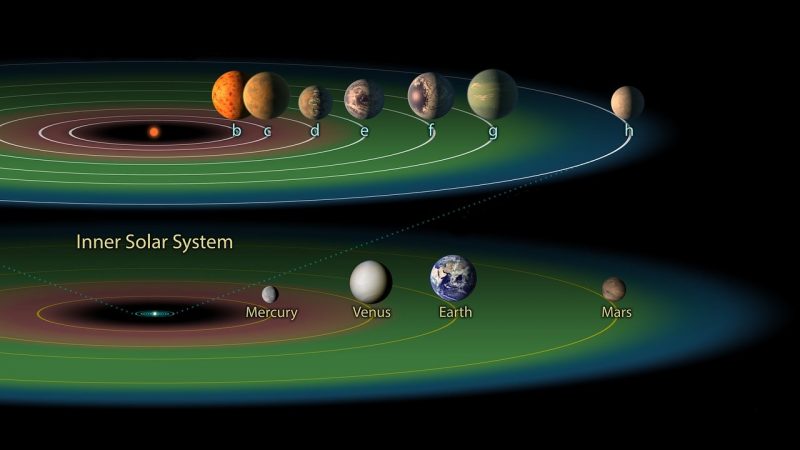
Artist’s concept of habitable zones – zones in which liquid water can exist – in our solar system in contrast to the Trappist-1 system, about 40 light-years away. The Trappist-1 system has 3 planets in its habitable zone (the green area). Our solar system has just 1, our Earth. Image via NASA/ JPL/ Caltech.

EarthSky’s yearly crowd-funding campaign is in progress. In 2020, we are donating 8.5% to No Kids Hungry. Please donate to help us keep going, and help feed a kid!

A new computer model developed by astrobiologists at University of California, Riverside suggests that – in the absence of a gas giant planet like Jupiter – some stars in our Milky Way galaxy could have as many as seven Earth-like planets. That’s in contrast to our solar system, which has a Jupiter and only one planet in its habitable zone, our own Earth.

The peer-reviewed Astronomical Journal published this study on July 27, 2020.

So far, Earth is the only planet in the universe where we know for certain life exists. It’s only logical that life exists elsewhere, though. When astrobiologists talk about other worlds that might host life, they tend to focus on those in the habitable zone, the zone around a star where liquid water can exist. Astrobiologist Stephen Kane has been studying the nearby planetary system system Trappist-1, which caused a sensation when it was discovered this system has at least seven planets, including three Earth-like planets in its habitable zone. Kane said in a statement:

This made me wonder about the maximum number of habitable planets it’s possible for a star to have, and why our star only has one. It didn’t seem fair!

Kane’s team created a computer model simulating planets of various sizes orbiting their stars. An algorithm accounted for gravitational forces and helped test how the planets interacted with each other over millions of years. The researchers found that it’s possible for some stars to support as many as seven planets in the habitable zone. Kane commented:

More than seven, and the planets become too close to each other and destabilize each other’s orbits.

Colorful bands and swirls, including large red oval, in atmosphere of giant planet.

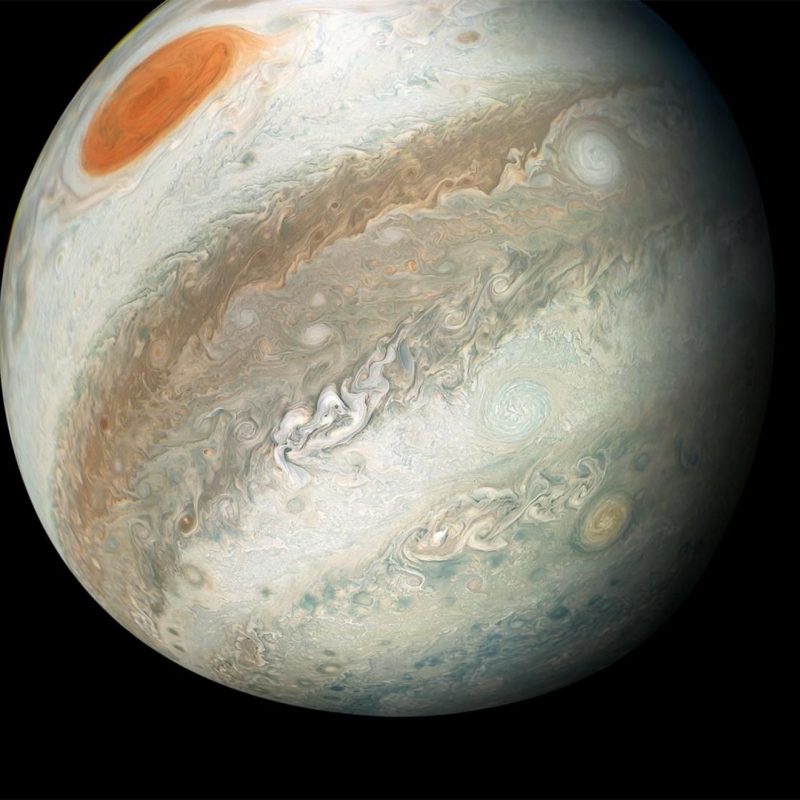
This is Jupiter as seen by the Juno spacecraft in April 2018. Does this giant world prevent our solar system from having more than one inhabited planet? Image via NASA/ JPL-Caltech/ SwRI/ MSSS/ Gerald Eichstad/ Sean Doran.

What determines this abundance of planets in a star’s habitable zone? The answer doesn’t lie within the star itself. These scientists said a star like our sun could potentially support six planets with liquid water. But it doesn’t. Why?

One factor is the shape of the planets’ orbits. It helps, these scientists explained, if the planets’ movements in orbit around their star are more circular than, for example, Earth’s orbit. Our planet’s orbit is very nearly circular, but still somewhat elliptical, like a circle someone sat down on. Earth’s elliptical orbit explains why our planet is closest to the sun in early January (Northern Hemisphere winter) and farthest from the sun in early July (Northern Hemisphere summer). A more circular orbit – rather than a more eccentric or irregular orbit – minimizes close contacts between planets in the system and helps maintain stable orbits, these scientists explained. And it makes sense that a stable orbit – a constant distance from a star – would be beneficial to life as it’s evolving. It wouldn’t do to have ice ages coming and going on timescales of hundreds of years, for example – rather than thousands as on our own planet – as you would have on a planet with a highly elliptical 100+-year orbit.

There’s also another big factor in our solar system that has kept more planets from being in our sun’s habitable zone. And that is our solar system’s biggest planet, giant Jupiter. Jupiter has a mass 2 1/2 times that of all the other planets in the solar system combined. Kane explained:

It has a big effect on the habitability of our solar system because it’s massive and disturbs other orbits.

These scientists are the first to point out that the Trappist-1 system is a rarity for earthly astronomers thus far; only a handful of stars are known to have multiple planets in their habitable zones. Moving forward, Kane plans to search for more stars like Trappist-1, surrounded entirely by smaller planets with no big gas giants like Jupiter. He said these stars will be prime targets for direct imaging with NASA telescopes like the one at Jet Propulsion Laboratory’s Habitable Exoplanet Observatory.

Kane’s study identified one such star – Beta Canum Venaticorum, aka Beta CVn – which is relatively close by at 27 light-years. Because it doesn’t have a Jupiter-like planet, it will be included as one of the stars checked for multiple habitable zone planets, these scientists said.

Bottom line: A new study suggests that some stars could have up to 7 planets in their habitable zones.

Source: Dynamical Packing in the Habitable Zone: The Case of Beta CVn

Via University of California, Riverside


from EarthSky https://ift.tt/2DXo7Ni
Oblique views of suns with wide green stripes around them, with planets in the stripes.

Artist’s concept of habitable zones – zones in which liquid water can exist – in our solar system in contrast to the Trappist-1 system, about 40 light-years away. The Trappist-1 system has 3 planets in its habitable zone (the green area). Our solar system has just 1, our Earth. Image via NASA/ JPL/ Caltech.

EarthSky’s yearly crowd-funding campaign is in progress. In 2020, we are donating 8.5% to No Kids Hungry. Please donate to help us keep going, and help feed a kid!

A new computer model developed by astrobiologists at University of California, Riverside suggests that – in the absence of a gas giant planet like Jupiter – some stars in our Milky Way galaxy could have as many as seven Earth-like planets. That’s in contrast to our solar system, which has a Jupiter and only one planet in its habitable zone, our own Earth.

The peer-reviewed Astronomical Journal published this study on July 27, 2020.

So far, Earth is the only planet in the universe where we know for certain life exists. It’s only logical that life exists elsewhere, though. When astrobiologists talk about other worlds that might host life, they tend to focus on those in the habitable zone, the zone around a star where liquid water can exist. Astrobiologist Stephen Kane has been studying the nearby planetary system system Trappist-1, which caused a sensation when it was discovered this system has at least seven planets, including three Earth-like planets in its habitable zone. Kane said in a statement:

This made me wonder about the maximum number of habitable planets it’s possible for a star to have, and why our star only has one. It didn’t seem fair!

Kane’s team created a computer model simulating planets of various sizes orbiting their stars. An algorithm accounted for gravitational forces and helped test how the planets interacted with each other over millions of years. The researchers found that it’s possible for some stars to support as many as seven planets in the habitable zone. Kane commented:

More than seven, and the planets become too close to each other and destabilize each other’s orbits.

Colorful bands and swirls, including large red oval, in atmosphere of giant planet.

This is Jupiter as seen by the Juno spacecraft in April 2018. Does this giant world prevent our solar system from having more than one inhabited planet? Image via NASA/ JPL-Caltech/ SwRI/ MSSS/ Gerald Eichstad/ Sean Doran.

What determines this abundance of planets in a star’s habitable zone? The answer doesn’t lie within the star itself. These scientists said a star like our sun could potentially support six planets with liquid water. But it doesn’t. Why?

One factor is the shape of the planets’ orbits. It helps, these scientists explained, if the planets’ movements in orbit around their star are more circular than, for example, Earth’s orbit. Our planet’s orbit is very nearly circular, but still somewhat elliptical, like a circle someone sat down on. Earth’s elliptical orbit explains why our planet is closest to the sun in early January (Northern Hemisphere winter) and farthest from the sun in early July (Northern Hemisphere summer). A more circular orbit – rather than a more eccentric or irregular orbit – minimizes close contacts between planets in the system and helps maintain stable orbits, these scientists explained. And it makes sense that a stable orbit – a constant distance from a star – would be beneficial to life as it’s evolving. It wouldn’t do to have ice ages coming and going on timescales of hundreds of years, for example – rather than thousands as on our own planet – as you would have on a planet with a highly elliptical 100+-year orbit.

There’s also another big factor in our solar system that has kept more planets from being in our sun’s habitable zone. And that is our solar system’s biggest planet, giant Jupiter. Jupiter has a mass 2 1/2 times that of all the other planets in the solar system combined. Kane explained:

It has a big effect on the habitability of our solar system because it’s massive and disturbs other orbits.

These scientists are the first to point out that the Trappist-1 system is a rarity for earthly astronomers thus far; only a handful of stars are known to have multiple planets in their habitable zones. Moving forward, Kane plans to search for more stars like Trappist-1, surrounded entirely by smaller planets with no big gas giants like Jupiter. He said these stars will be prime targets for direct imaging with NASA telescopes like the one at Jet Propulsion Laboratory’s Habitable Exoplanet Observatory.

Kane’s study identified one such star – Beta Canum Venaticorum, aka Beta CVn – which is relatively close by at 27 light-years. Because it doesn’t have a Jupiter-like planet, it will be included as one of the stars checked for multiple habitable zone planets, these scientists said.

Bottom line: A new study suggests that some stars could have up to 7 planets in their habitable zones.

Source: Dynamical Packing in the Habitable Zone: The Case of Beta CVn

Via University of California, Riverside


from EarthSky https://ift.tt/2DXo7Ni

Images show Martian night sky pulsing with ultraviolet light


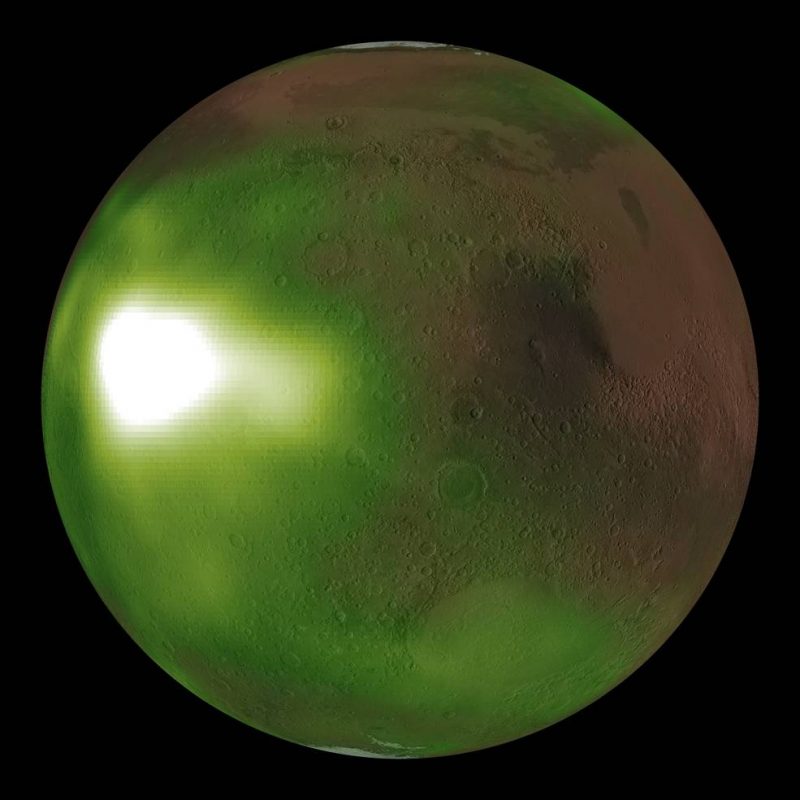
Mars’ nightside atmosphere glows and pulsates in this data animation from MAVEN spacecraft observations. Green-to-white false color shows the enhanced brightenings of Mars’ ultraviolet “nightglow” measured by MAVEN’s Imaging UltraViolet Spectrograph at about 40 miles (70 km) altitude. A simulated view of the Mars globe is added digitally for context, with ice caps visible at the poles. Three nightglow brightenings occur over 1 Mars rotation, the 1st much brighter than the other 2. All 3 brightenings occur shortly after sunset, appearing on the left of this view of the night side of the planet. The pulsations are caused by downward winds which enhance a chemical reaction, creating nitric oxide which causes the glow. Months of data were averaged to identify these patterns, indicating they repeat nightly.

EarthSky’s yearly crowd-funding campaign is in progress. In 2020, we are donating 8.5% of all incoming revenues to No Kids Hungry. Click to learn more and donate.

New images from NASA’s MAVEN spacecraft – released August 6, 2020 – reveal vast areas of Mars’ night sky pulsing in ultraviolet light.

The MAVEN mission team was surprised to find that the atmosphere pulsed exactly 3 times per night, and only during Mars’ spring and fall. The new data also revealed unexpected waves and spirals over the winter poles, while also confirming earlier results from the Mars Express spacecraft that this nightglow was brightest over the winter polar regions.

This so-called “nightglow” would not be visible to an astronaut standing on Mars. That’s because ultraviolet light – although detectable by specialized instruments – is invisible to the human eye. Zac Milby, of University of Colorado’s Laboratory for Atmospheric and Space Physics, said in a statement:

The ultraviolet glow comes mostly from an altitude of about 70 kilometers (approximately 40 miles), with the brightest spot about a thousand kilometers (approximately 600 miles) across, and is as bright in the ultraviolet as Earth’s northern lights. Unfortunately, the composition of Mars’ atmosphere means that these bright spots emit no light at visible wavelengths that would allow them to be seen by future Mars astronauts. Too bad: the bright patches would intensify overhead every night after sunset, and drift across the sky at 300 kilometers per hour (about 180 miles per hour).

A shiny green ball with a large fuzzy-edged white area on a black background.

This is an image of the ultraviolet “nightglow” in the Martian atmosphere. Green and white false colors represent the intensity of ultraviolet light, with white being the brightest. The image shows an intense brightening in Mars’ nightside atmosphere. The brightenings occur regularly after sunset on Martian evenings during fall and winter seasons, and fade by midnight. The brightening is caused by increased downward winds which enhance a chemical reaction creating nitric oxide, which causes the glow. Image via NASA/ MAVEN/ Goddard Space Flight Center/ CU/ LASP.

The team found that Mars’ nightglow seems to be brightest at the height of the planet’s northern and southern winters, when hotter currents rush away from the equator and toward Mars’ poles.

University of Colorado’s Nick Schneider is instrument lead for the MAVEN Imaging Ultraviolet Spectrograph (IUVS) instrument that made these observations, and lead author of a paper on this research published August 6, 2020 in the Journal of Geophysical Research, Space Physics. Schneider said:

MAVEN’s images offer our first global insights into atmospheric motions in Mars’ middle atmosphere, a critical region where air currents carry gases between the lowest and highest layers.

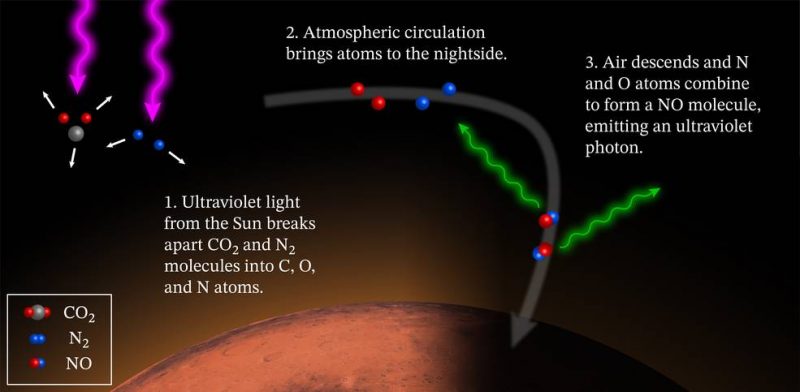
Diagram of Martian atmosphere with molecules breaking apart and re-forming, and arrows showing emitted light.

The diagram explains the cause of Mars’ glowing nightside atmosphere. On Mars’ dayside, molecules are torn apart by energetic solar photons. Global circulation patterns carry the atomic fragments to the nightside, where downward winds increase the reaction rate for the atoms to re-form molecules. The downward winds occur near the poles at some seasons and in the equatorial regions at others. The new molecules hold extra energy which they emit as ultraviolet light. Image via NASA/ MAVEN/ Goddard Space Flight Center/ CU/ LASP.

The scientists say the pulsations reveal the importance of planet-encircling waves in the Mars atmosphere. The number of waves and their speed indicates that Mars’ middle atmosphere is influenced by the daily pattern of solar heating and disturbances from the topography of Mars’ huge volcanic mountains. These pulsating spots are the clearest evidence that the middle atmosphere waves match those known to dominate the layers above and below.

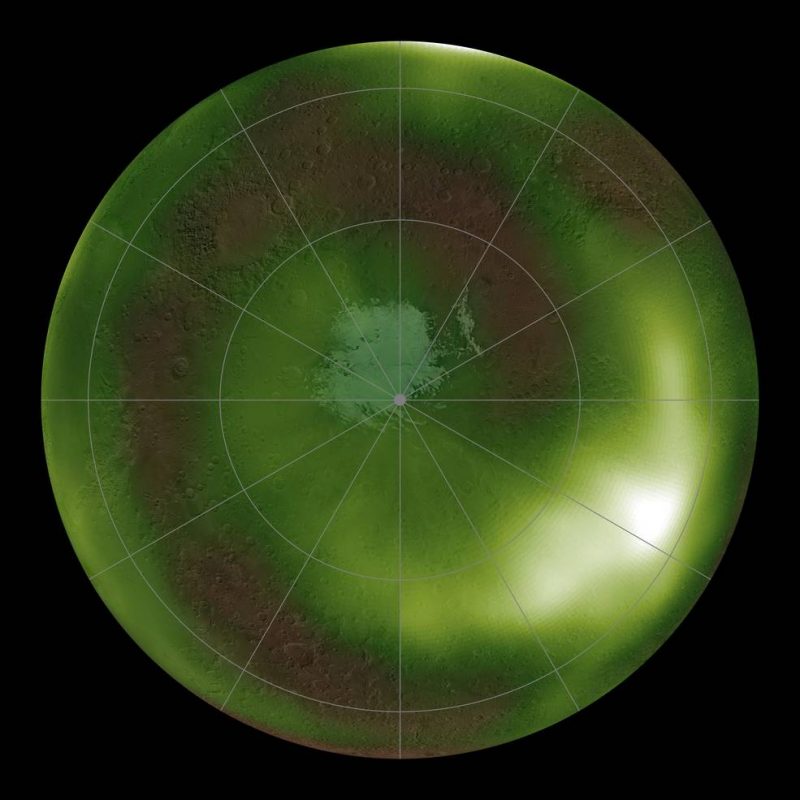
Polar view of Mars in green with latitude and longitude lines, and a large blurry white area on lower right.

This is an image of the ultraviolet “nightglow” in the Martian atmosphere over the south pole. Green and white false colors represent the intensity of ultraviolet light, with white being the brightest. The nightglow was measured at about 40 miles (70 km) altitude by the Imaging UltraViolet Spectrograph instrument on NASA’s MAVEN spacecraft. A simulated view of the Mars globe is added digitally for context, and the faint white area in the center of the image is the polar ice cap. The image shows an unexpectedly bright glowing spiral in Mars’ nightside atmosphere. The cause of the spiral pattern is unknown. Image via NASA/ MAVEN/ Goddard Space Flight Center/ CU/ LASP.

MAVEN mission scientists are using the new images to help illuminate complex circulation patterns in the Martian atmosphere. Sonal Jain, also of University of Colorado’s Laboratory for Atmospheric and Space Physics, said:

MAVEN’s main discoveries of atmosphere loss and climate change show the importance of these vast circulation patterns that transport atmospheric gases around the globe and from the surface to the edge of space.

Here’s more about the MAVEN mission:

Bottom line: New MAVEN mission images show vast areas of Mars’ night sky glowing and pulsating with ultraviolet light.

Source: Imaging of Martian Circulation Patterns and Atmospheric Tides Through MAVEN/IUVS Nightglow Observations

Via NASA


from EarthSky https://ift.tt/3fK8Ix5


Mars’ nightside atmosphere glows and pulsates in this data animation from MAVEN spacecraft observations. Green-to-white false color shows the enhanced brightenings of Mars’ ultraviolet “nightglow” measured by MAVEN’s Imaging UltraViolet Spectrograph at about 40 miles (70 km) altitude. A simulated view of the Mars globe is added digitally for context, with ice caps visible at the poles. Three nightglow brightenings occur over 1 Mars rotation, the 1st much brighter than the other 2. All 3 brightenings occur shortly after sunset, appearing on the left of this view of the night side of the planet. The pulsations are caused by downward winds which enhance a chemical reaction, creating nitric oxide which causes the glow. Months of data were averaged to identify these patterns, indicating they repeat nightly.

EarthSky’s yearly crowd-funding campaign is in progress. In 2020, we are donating 8.5% of all incoming revenues to No Kids Hungry. Click to learn more and donate.

New images from NASA’s MAVEN spacecraft – released August 6, 2020 – reveal vast areas of Mars’ night sky pulsing in ultraviolet light.

The MAVEN mission team was surprised to find that the atmosphere pulsed exactly 3 times per night, and only during Mars’ spring and fall. The new data also revealed unexpected waves and spirals over the winter poles, while also confirming earlier results from the Mars Express spacecraft that this nightglow was brightest over the winter polar regions.

This so-called “nightglow” would not be visible to an astronaut standing on Mars. That’s because ultraviolet light – although detectable by specialized instruments – is invisible to the human eye. Zac Milby, of University of Colorado’s Laboratory for Atmospheric and Space Physics, said in a statement:

The ultraviolet glow comes mostly from an altitude of about 70 kilometers (approximately 40 miles), with the brightest spot about a thousand kilometers (approximately 600 miles) across, and is as bright in the ultraviolet as Earth’s northern lights. Unfortunately, the composition of Mars’ atmosphere means that these bright spots emit no light at visible wavelengths that would allow them to be seen by future Mars astronauts. Too bad: the bright patches would intensify overhead every night after sunset, and drift across the sky at 300 kilometers per hour (about 180 miles per hour).

A shiny green ball with a large fuzzy-edged white area on a black background.

This is an image of the ultraviolet “nightglow” in the Martian atmosphere. Green and white false colors represent the intensity of ultraviolet light, with white being the brightest. The image shows an intense brightening in Mars’ nightside atmosphere. The brightenings occur regularly after sunset on Martian evenings during fall and winter seasons, and fade by midnight. The brightening is caused by increased downward winds which enhance a chemical reaction creating nitric oxide, which causes the glow. Image via NASA/ MAVEN/ Goddard Space Flight Center/ CU/ LASP.

The team found that Mars’ nightglow seems to be brightest at the height of the planet’s northern and southern winters, when hotter currents rush away from the equator and toward Mars’ poles.

University of Colorado’s Nick Schneider is instrument lead for the MAVEN Imaging Ultraviolet Spectrograph (IUVS) instrument that made these observations, and lead author of a paper on this research published August 6, 2020 in the Journal of Geophysical Research, Space Physics. Schneider said:

MAVEN’s images offer our first global insights into atmospheric motions in Mars’ middle atmosphere, a critical region where air currents carry gases between the lowest and highest layers.

Diagram of Martian atmosphere with molecules breaking apart and re-forming, and arrows showing emitted light.

The diagram explains the cause of Mars’ glowing nightside atmosphere. On Mars’ dayside, molecules are torn apart by energetic solar photons. Global circulation patterns carry the atomic fragments to the nightside, where downward winds increase the reaction rate for the atoms to re-form molecules. The downward winds occur near the poles at some seasons and in the equatorial regions at others. The new molecules hold extra energy which they emit as ultraviolet light. Image via NASA/ MAVEN/ Goddard Space Flight Center/ CU/ LASP.

The scientists say the pulsations reveal the importance of planet-encircling waves in the Mars atmosphere. The number of waves and their speed indicates that Mars’ middle atmosphere is influenced by the daily pattern of solar heating and disturbances from the topography of Mars’ huge volcanic mountains. These pulsating spots are the clearest evidence that the middle atmosphere waves match those known to dominate the layers above and below.

Polar view of Mars in green with latitude and longitude lines, and a large blurry white area on lower right.

This is an image of the ultraviolet “nightglow” in the Martian atmosphere over the south pole. Green and white false colors represent the intensity of ultraviolet light, with white being the brightest. The nightglow was measured at about 40 miles (70 km) altitude by the Imaging UltraViolet Spectrograph instrument on NASA’s MAVEN spacecraft. A simulated view of the Mars globe is added digitally for context, and the faint white area in the center of the image is the polar ice cap. The image shows an unexpectedly bright glowing spiral in Mars’ nightside atmosphere. The cause of the spiral pattern is unknown. Image via NASA/ MAVEN/ Goddard Space Flight Center/ CU/ LASP.

MAVEN mission scientists are using the new images to help illuminate complex circulation patterns in the Martian atmosphere. Sonal Jain, also of University of Colorado’s Laboratory for Atmospheric and Space Physics, said:

MAVEN’s main discoveries of atmosphere loss and climate change show the importance of these vast circulation patterns that transport atmospheric gases around the globe and from the surface to the edge of space.

Here’s more about the MAVEN mission:

Bottom line: New MAVEN mission images show vast areas of Mars’ night sky glowing and pulsating with ultraviolet light.

Source: Imaging of Martian Circulation Patterns and Atmospheric Tides Through MAVEN/IUVS Nightglow Observations

Via NASA


from EarthSky https://ift.tt/3fK8Ix5

What is a waning crescent moon?

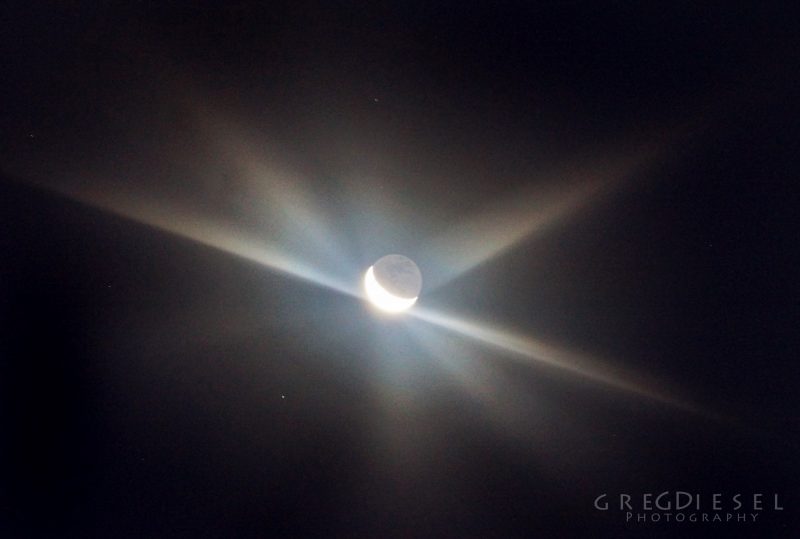
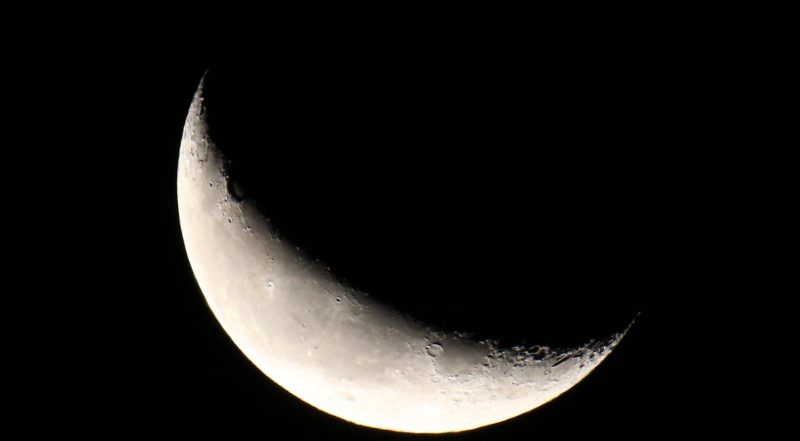
Here’s a waning crescent moon – 27% illuminated, with earthshine – and showing a humidity-induced lens flare. Photo by Greg Diesel Walck – Lunar/Landscape Photographer.

In the week following last quarter moon, the moon continues to wane. You’ll see it as a waning crescent moon – sometimes called an old moon – visible in the east before dawn.

Each morning, the moon shows us less and less of its lighted side. It rises closer to the sunrise, heading for new moon.

Want to know a sky trick? The illuminated side of a waning crescent moon always points eastward, or in the direction of sunrise.

Moreover, the lit side of waning crescent points in the direction of the moon’s daily motion relative to the backdrop stars and planets of the zodiac. That direction is also east.

Many people miss the waning crescent moon because it’s a morning moon, visible before sunrise. But it’s fun to follow the waning crescent day by day, as it inches into the dawn glare.

As the moon orbits Earth, it changes phase in an orderly way. Follow the links below to understand the phases of the moon.

New moon
Waxing crescent moon
First quarter moon
Waxing gibbous moon
Full moon
Waning gibbous moon
Last quarter moon
Waning crescent moon

Read more: 4 keys to understanding moon phases

Waning crescent moon from Russ Adams in Pike County, Illinois. Thanks, Russ!

Bottom line: A waning crescent moon comes between last quarter moon and new moon.

Check out EarthSky’s guide to the bright planets.

Help EarthSky keep going! Please donate.


from EarthSky https://ift.tt/2DOsEBQ

Here’s a waning crescent moon – 27% illuminated, with earthshine – and showing a humidity-induced lens flare. Photo by Greg Diesel Walck – Lunar/Landscape Photographer.

In the week following last quarter moon, the moon continues to wane. You’ll see it as a waning crescent moon – sometimes called an old moon – visible in the east before dawn.

Each morning, the moon shows us less and less of its lighted side. It rises closer to the sunrise, heading for new moon.

Want to know a sky trick? The illuminated side of a waning crescent moon always points eastward, or in the direction of sunrise.

Moreover, the lit side of waning crescent points in the direction of the moon’s daily motion relative to the backdrop stars and planets of the zodiac. That direction is also east.

Many people miss the waning crescent moon because it’s a morning moon, visible before sunrise. But it’s fun to follow the waning crescent day by day, as it inches into the dawn glare.

As the moon orbits Earth, it changes phase in an orderly way. Follow the links below to understand the phases of the moon.

New moon
Waxing crescent moon
First quarter moon
Waxing gibbous moon
Full moon
Waning gibbous moon
Last quarter moon
Waning crescent moon

Read more: 4 keys to understanding moon phases

Waning crescent moon from Russ Adams in Pike County, Illinois. Thanks, Russ!

Bottom line: A waning crescent moon comes between last quarter moon and new moon.

Check out EarthSky’s guide to the bright planets.

Help EarthSky keep going! Please donate.


from EarthSky https://ift.tt/2DOsEBQ

Not a rainbow, not an iridescent cloud

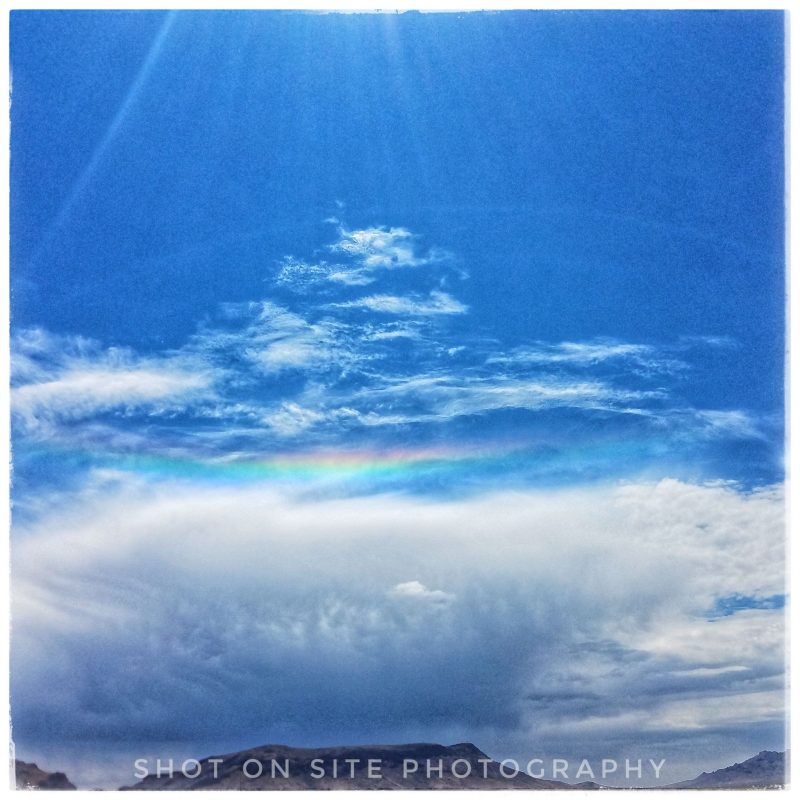
Circumhorizon arc over a ridgeline, with the sun just out of view at the top of the image.

View at EarthSky Community Photos. | Daniel Gauss of Luna County, New Mexico captured this circumhorizon arc with his phone on August 6, 2020.

Daniel Gauss wrote:

Driving home (southbound) happened to look up to view the big cloud and glimpsed this prismatic feature on the leading edge of the cloud. Pulled off the road, and rolled down the window to make sure it wasn’t from the tinted windshield and my sunglasses. Took two shots with the phone. It was high noon, the sun directly overhead. I’m not sure what I’m looking at. Is it the lower portion of a 22° halo? Lower tangent arc? A confused rainbow? Also, what is the faint white line just below the sun’s rays? It seems to complete an oval with the rainbow portion. Tell me great oracles!

Hey, Daniel, the prismatic feature is the easy part. You’re right that it’s not a rainbow, because the sun is above it, and rainbows are always seen opposite the sun. It’s not a 22-degree halo, although – like a 22-degree halo – it’s made by ice crystals. It’s what’s called a circumhorizon arc. More about that below. Now … about that thin white arc above the colored arc. It puzzled us, too. For the answer, we had to go to the true oracle on sky phenomena of this kind – Les Cowley of the website Atmospheric Optics. Les told us in an email:

[The thin white arc between the sun’s rays and the circumhorizon arc] is a camera artifact of some kind. Common when the lens is looking almost toward the sun. The give-away is that it’s so sharp and narrow.

Les also has this to say about circumhorizon arcs on his website:

Near to noon in mid summer is a good time [to see circumhorizon arcs] in middle latitudes. The halo is beneath the sun and twice as far from it (two hand spans) as the 22º halo.

It is a very large halo and always parallel to the horizon. Often only fragments are visible where there happen to be cirrus clouds – the individual patches of cirrus are then lit with colour that can be mistaken for iridescence.

Thank you, Les, and thank you, Daniel!

Bottom line: A photo from the EarthSky community of a circumhorizon arc.

Read more and see more photos: Iridescent cloud? Or circumhorizon arc?


from EarthSky https://ift.tt/33MePyD
Circumhorizon arc over a ridgeline, with the sun just out of view at the top of the image.

View at EarthSky Community Photos. | Daniel Gauss of Luna County, New Mexico captured this circumhorizon arc with his phone on August 6, 2020.

Daniel Gauss wrote:

Driving home (southbound) happened to look up to view the big cloud and glimpsed this prismatic feature on the leading edge of the cloud. Pulled off the road, and rolled down the window to make sure it wasn’t from the tinted windshield and my sunglasses. Took two shots with the phone. It was high noon, the sun directly overhead. I’m not sure what I’m looking at. Is it the lower portion of a 22° halo? Lower tangent arc? A confused rainbow? Also, what is the faint white line just below the sun’s rays? It seems to complete an oval with the rainbow portion. Tell me great oracles!

Hey, Daniel, the prismatic feature is the easy part. You’re right that it’s not a rainbow, because the sun is above it, and rainbows are always seen opposite the sun. It’s not a 22-degree halo, although – like a 22-degree halo – it’s made by ice crystals. It’s what’s called a circumhorizon arc. More about that below. Now … about that thin white arc above the colored arc. It puzzled us, too. For the answer, we had to go to the true oracle on sky phenomena of this kind – Les Cowley of the website Atmospheric Optics. Les told us in an email:

[The thin white arc between the sun’s rays and the circumhorizon arc] is a camera artifact of some kind. Common when the lens is looking almost toward the sun. The give-away is that it’s so sharp and narrow.

Les also has this to say about circumhorizon arcs on his website:

Near to noon in mid summer is a good time [to see circumhorizon arcs] in middle latitudes. The halo is beneath the sun and twice as far from it (two hand spans) as the 22º halo.

It is a very large halo and always parallel to the horizon. Often only fragments are visible where there happen to be cirrus clouds – the individual patches of cirrus are then lit with colour that can be mistaken for iridescence.

Thank you, Les, and thank you, Daniel!

Bottom line: A photo from the EarthSky community of a circumhorizon arc.

Read more and see more photos: Iridescent cloud? Or circumhorizon arc?


from EarthSky https://ift.tt/33MePyD

A deep, giant cloud disruption found on Venus

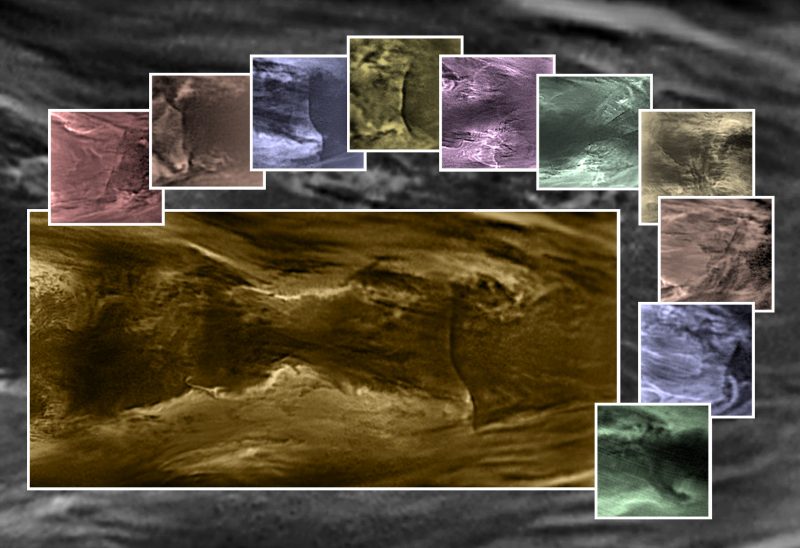
Multi-colored wavy formations in small inset squares next to a large rectangle around waves.

Sequence of infrared images of the lower clouds on Venus, showing a consistent pattern of a planetary-scale cloud discontinuity. This type of giant atmospheric wave has never been before on any other planets in our solar system. Image via Javier Peralta/ JAXA-Planet-C team/ Astrophysics and Space Sciences.

EarthSky’s yearly crowd-funding campaign is in progress. In 2020, we are donating 8.5% of all incoming revenues to No Kids Hungry. Click to learn more and donate.

Scientists have announced something new and unexpected: a giant atmospheric “wave” or disruption in Venus’ lower atmosphere. It’s unlike anything else seen in the solar system. The researchers say it has been rapidly moving at about 30 miles (50 km) above the planet’s surface for at least 35 years. It went completely undetected until now.

The amazing discovery is reported in a new peer-reviewed study, published May 27, 2020, in Geophysical Research Letters.

Venus is the planet next-inward to the sun from Earth. It’s completely covered by thick clouds. These clouds are so dense that we can’t peer beneath them to view Venus’ surface. For this reason, the lower atmosphere and surface of Venus have remained largely mysterious. We know the clouds of Venus consist mostly of carbon dioxide, with droplets of sulphuric acid. Strong wind patterns have been observed before in the atmosphere of Venus in ultraviolet and infrared light.

The new atmospheric feature – a giant wall of acidic clouds – is different from previous observations in part because it’s the first huge atmospheric wave found at the lower cloud level in Venus’ atmosphere, at altitudes between 29.5 and 35 miles (47.5 and 56.5 km). This wall of clouds is massive, extending as far as 4,700 miles (7,500 km) across the equator of Venus, from 30 degrees north to 40 degrees south.

According to the researchers, it rotates around the planet in five days, at about 204 miles per hour (328 kph). It’s been doing that since at least 1983.

The Japanese space agency JAXA’s Venus orbiter Akatsuki made the discovery. The phenomenon looked like an atmospheric wave, only much larger than what’s typically seen. It was found by Akatsuki as the spacecraft acquired detailed infrared images of Venus’ nightside, studying the mid and lower layers of the planet’s atmosphere.

Rotating grayscale globe with large wavy formations, with text annotations on black background.

Animation showing Venus’s lower clouds (about 30 miles/ 50 km above the surface) in infrared light. Bright clouds are more transparent to thermal radiation emitted from the ground than darker clouds. Image via Javier Peralta/ JAXA-Planet C team/ Astrophysics and Space Sciences.

Pedro Machado – of the Institute of Astrophysics and Space Sciences, part of the University of Lisbon in Portugal – said in a statement:

If this happened on Earth, this would be a frontal surface at the scale of the planet, and that’s incredible. Under the follow-up campaign, we went back to images I took in the infrared in 2012 with the Galileo National Telescope in the Canary Islands, and we found precisely the same disruption.

The Institute of Astrophysics and Space Sciences has had a long-running research program studying Venus’ winds. It also contributed follow-up observations with NASA’s Infrared Telescope Facility in Hawaii, coordinated with the new observations from Akatsuki.

Huge cloud patterns have been observed before in Venus’ atmosphere, such as the Y wave, a dark Y-shaped structure found in the upper atmosphere that covers nearly the whole planetary disk. It is only visible when observed in ultraviolet light. There is also a 6,200-mile-long (10,000-km-long) bow-shaped stationary wave, also in the upper clouds layers, thought to be caused by the planet’s huge mountain ranges.

Meanwhile, in visible light, Venus’ dense atmosphere looks very bland.

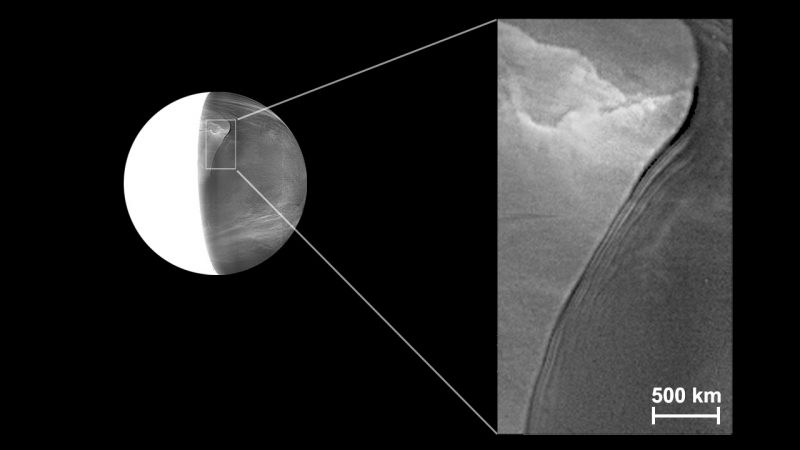
Grayish sphere with grayish rectangle inset showing wavy pattern on both, against black background.

Example of undulations behind the atmospheric discontinuity on the night side of Venus on April 15, 2016. Image via Javier Peralta/ JAXA-Planet C team/ Astrophysics and Space Sciences.

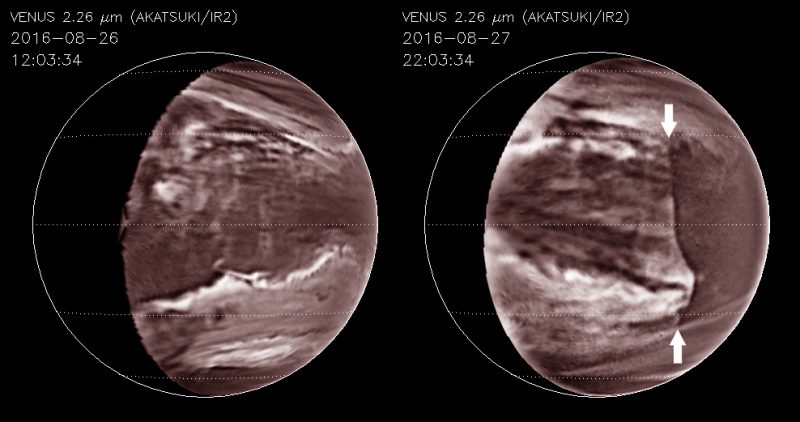
Two mauve spheres with wavy patterns, one with a discontinuity in the pattern.

Pattern of cloud disruption seen in infrared images taken by the Japanese space agency JAXA Akatsuki Venus orbiter in 2016. Image via Javier Peralta/ JAXA-Planet C team/ Astrophysics and Space Sciences.

Finding this phenomenon in the lower atmosphere is interesting, not only because it wasn’t noticed before, but also because this region in the atmosphere of Venus is thought to be responsible for the planet’s hellish greenhouse effect. This effect causes the heat of the sun to be retained near Venus’ surface. It keeps the surface at a sizzling temperature of 869 degrees Fahrenheit (465 degrees Celsius), hot enough to melt lead. The dynamics of Venus’ atmosphere are still not well understood overall, so planetary-scale waves such as this might help scientists better understand how the planet’s surface and atmosphere interact.

Javier Peralta, who led the new study, said:

Since the disruption cannot be observed in the ultraviolet images sensing the top of the clouds at about 43-mile (70-km) height, confirming its wave nature is of critical importance. We would have finally found a wave transporting momentum and energy from the deep atmosphere and dissipating before arriving at the top of the clouds. It would therefore be depositing momentum precisely at the level where we observe the fastest winds of the so-called atmospheric super-rotation of Venus, whose mechanisms have been a long-time mystery.

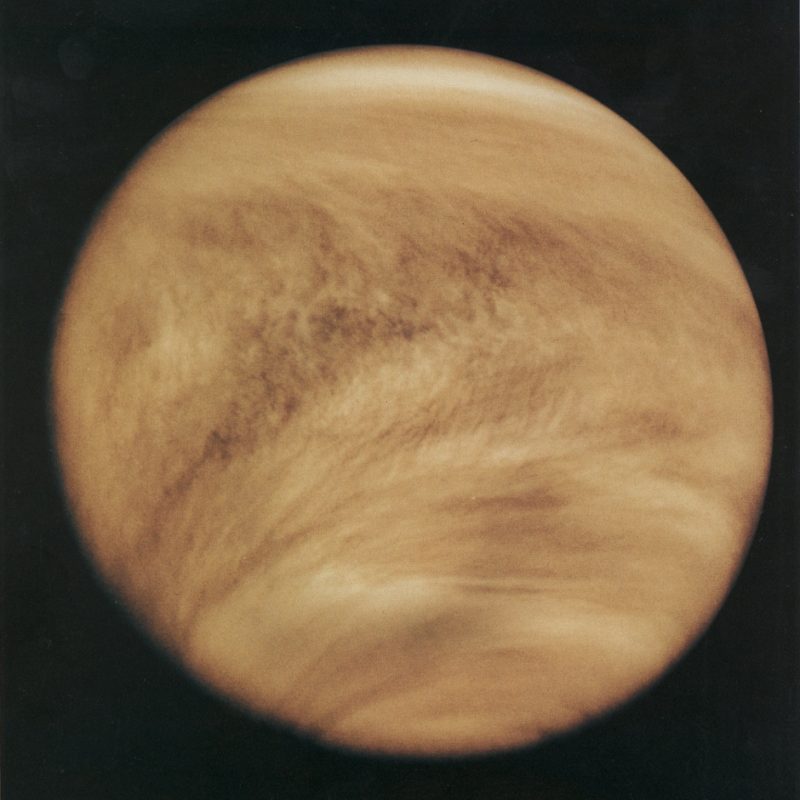
Brownish-colored clouds covering a planet, on black background.

Ultraviolet image of the Y wave in Venus’ upper atmosphere, from the Pioneer Venus Orbiter on February 26, 1979. Image via NASA/ Astronomy Now.

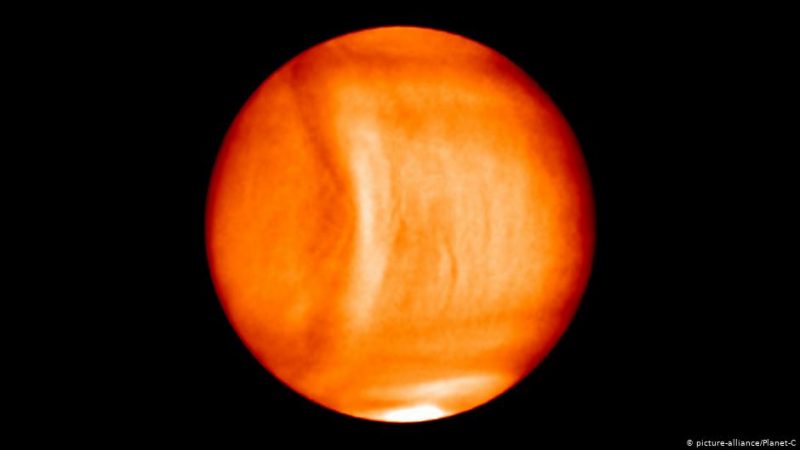
Red and ywllow false-color Venus with bow-shaped wave feature running nearly from pole to pole, on black background.

The bow-shaped atmospheric wave in Venus’ upper atmosphere, as seen by Akatsuki in 2015. It is thought to be caused by Venus’ massive mountain ranges. Image via JAXA/ Science Alert.

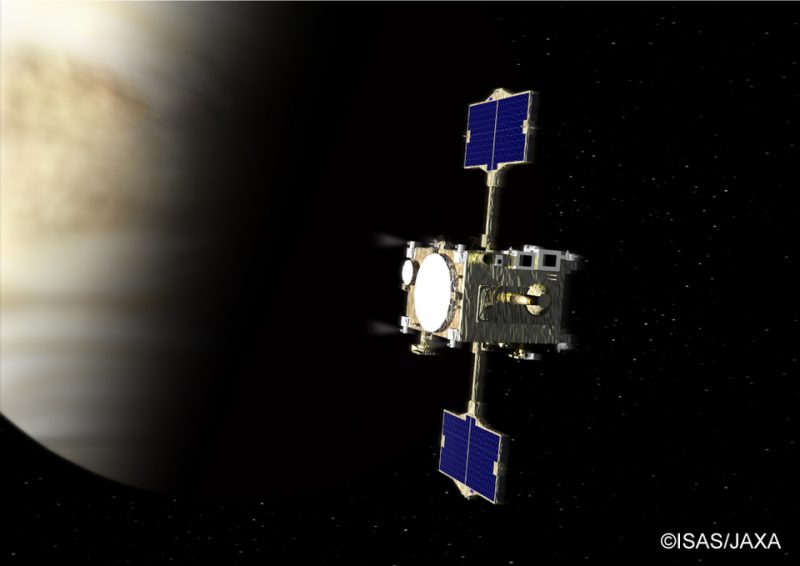
Boxy satellite with solar panel wings orbiting a cloudy planet.

Artist’s illustration of Akatsuki orbiting Venus. Image via ISAS/ JAXA.

This newly discovered cloud front on Venus is essentially meteorological. Basically, we’re talking here about the weather on Venus. The feature appears to be unique; it’s never been seen before on any other planets in the solar system. It’s therefore difficult to know for certain what is happening, even though the researchers have devised computer simulations to try to mimic the cloud feature. The mechanisms that can create such a giant and long-lasting atmospheric wave are still unknown.

One possibility is that this atmospheric disruption may be a physical manifestation of a type of Kelvin wave, a class of atmospheric gravity wave that shares some important common features with this disruption. Kelvin waves can maintain their shape over long periods of time, and in this case, propagate in the same direction as Venus’ super-rotating winds. Kelvin waves can also interact with other types of atmospheric waves, such as Rossby waves, which naturally occur as a result of the rotation of the planet. Like Kelvin waves, they can be seen in both atmospheres and oceans. On Venus, they may transport energy from the super-rotation of the atmosphere – where the atmosphere rotates faster than the planet itself – to the equator.

The researchers looked at images of Venus going as far back as 1983. They were able to confirm the presence of the same features that were seen by Akatsuki. But how did this particular – and huge – wind formation go unnoticed for so long? According to Machado:

… we needed access to a large, growing and scattered collection of images of Venus gathered in the recent decades with different telescopes.

Smiling man with short hair, beard and eyeglasses.

Javier Peralta, a team member of the Akatsuki mission who led the new study. Image via The Planetary Society.

Finding such a large atmospheric phenomenon on Venus, after its being undetected for so long, was a big surprise for scientists. The discovery will help them learn more about the planet’s complex atmosphere and how it interacts with the planet itself.

Bottom line: Researchers have discovered a giant atmospheric wave-like phenomenon in Venus’ lower atmosphere, something not seen anywhere else in the solar system.

Source: A Long-Lived Sharp Disruption on the Lower Clouds of Venus

Via Institute of Astrophysics and Space Sciences

Via Institute of Space and Astronautical Science


from EarthSky https://ift.tt/3ae8ywN
Multi-colored wavy formations in small inset squares next to a large rectangle around waves.

Sequence of infrared images of the lower clouds on Venus, showing a consistent pattern of a planetary-scale cloud discontinuity. This type of giant atmospheric wave has never been before on any other planets in our solar system. Image via Javier Peralta/ JAXA-Planet-C team/ Astrophysics and Space Sciences.

EarthSky’s yearly crowd-funding campaign is in progress. In 2020, we are donating 8.5% of all incoming revenues to No Kids Hungry. Click to learn more and donate.

Scientists have announced something new and unexpected: a giant atmospheric “wave” or disruption in Venus’ lower atmosphere. It’s unlike anything else seen in the solar system. The researchers say it has been rapidly moving at about 30 miles (50 km) above the planet’s surface for at least 35 years. It went completely undetected until now.

The amazing discovery is reported in a new peer-reviewed study, published May 27, 2020, in Geophysical Research Letters.

Venus is the planet next-inward to the sun from Earth. It’s completely covered by thick clouds. These clouds are so dense that we can’t peer beneath them to view Venus’ surface. For this reason, the lower atmosphere and surface of Venus have remained largely mysterious. We know the clouds of Venus consist mostly of carbon dioxide, with droplets of sulphuric acid. Strong wind patterns have been observed before in the atmosphere of Venus in ultraviolet and infrared light.

The new atmospheric feature – a giant wall of acidic clouds – is different from previous observations in part because it’s the first huge atmospheric wave found at the lower cloud level in Venus’ atmosphere, at altitudes between 29.5 and 35 miles (47.5 and 56.5 km). This wall of clouds is massive, extending as far as 4,700 miles (7,500 km) across the equator of Venus, from 30 degrees north to 40 degrees south.

According to the researchers, it rotates around the planet in five days, at about 204 miles per hour (328 kph). It’s been doing that since at least 1983.

The Japanese space agency JAXA’s Venus orbiter Akatsuki made the discovery. The phenomenon looked like an atmospheric wave, only much larger than what’s typically seen. It was found by Akatsuki as the spacecraft acquired detailed infrared images of Venus’ nightside, studying the mid and lower layers of the planet’s atmosphere.

Rotating grayscale globe with large wavy formations, with text annotations on black background.

Animation showing Venus’s lower clouds (about 30 miles/ 50 km above the surface) in infrared light. Bright clouds are more transparent to thermal radiation emitted from the ground than darker clouds. Image via Javier Peralta/ JAXA-Planet C team/ Astrophysics and Space Sciences.

Pedro Machado – of the Institute of Astrophysics and Space Sciences, part of the University of Lisbon in Portugal – said in a statement:

If this happened on Earth, this would be a frontal surface at the scale of the planet, and that’s incredible. Under the follow-up campaign, we went back to images I took in the infrared in 2012 with the Galileo National Telescope in the Canary Islands, and we found precisely the same disruption.

The Institute of Astrophysics and Space Sciences has had a long-running research program studying Venus’ winds. It also contributed follow-up observations with NASA’s Infrared Telescope Facility in Hawaii, coordinated with the new observations from Akatsuki.

Huge cloud patterns have been observed before in Venus’ atmosphere, such as the Y wave, a dark Y-shaped structure found in the upper atmosphere that covers nearly the whole planetary disk. It is only visible when observed in ultraviolet light. There is also a 6,200-mile-long (10,000-km-long) bow-shaped stationary wave, also in the upper clouds layers, thought to be caused by the planet’s huge mountain ranges.

Meanwhile, in visible light, Venus’ dense atmosphere looks very bland.

Grayish sphere with grayish rectangle inset showing wavy pattern on both, against black background.

Example of undulations behind the atmospheric discontinuity on the night side of Venus on April 15, 2016. Image via Javier Peralta/ JAXA-Planet C team/ Astrophysics and Space Sciences.

Two mauve spheres with wavy patterns, one with a discontinuity in the pattern.

Pattern of cloud disruption seen in infrared images taken by the Japanese space agency JAXA Akatsuki Venus orbiter in 2016. Image via Javier Peralta/ JAXA-Planet C team/ Astrophysics and Space Sciences.

Finding this phenomenon in the lower atmosphere is interesting, not only because it wasn’t noticed before, but also because this region in the atmosphere of Venus is thought to be responsible for the planet’s hellish greenhouse effect. This effect causes the heat of the sun to be retained near Venus’ surface. It keeps the surface at a sizzling temperature of 869 degrees Fahrenheit (465 degrees Celsius), hot enough to melt lead. The dynamics of Venus’ atmosphere are still not well understood overall, so planetary-scale waves such as this might help scientists better understand how the planet’s surface and atmosphere interact.

Javier Peralta, who led the new study, said:

Since the disruption cannot be observed in the ultraviolet images sensing the top of the clouds at about 43-mile (70-km) height, confirming its wave nature is of critical importance. We would have finally found a wave transporting momentum and energy from the deep atmosphere and dissipating before arriving at the top of the clouds. It would therefore be depositing momentum precisely at the level where we observe the fastest winds of the so-called atmospheric super-rotation of Venus, whose mechanisms have been a long-time mystery.

Brownish-colored clouds covering a planet, on black background.

Ultraviolet image of the Y wave in Venus’ upper atmosphere, from the Pioneer Venus Orbiter on February 26, 1979. Image via NASA/ Astronomy Now.

Red and ywllow false-color Venus with bow-shaped wave feature running nearly from pole to pole, on black background.

The bow-shaped atmospheric wave in Venus’ upper atmosphere, as seen by Akatsuki in 2015. It is thought to be caused by Venus’ massive mountain ranges. Image via JAXA/ Science Alert.

Boxy satellite with solar panel wings orbiting a cloudy planet.

Artist’s illustration of Akatsuki orbiting Venus. Image via ISAS/ JAXA.

This newly discovered cloud front on Venus is essentially meteorological. Basically, we’re talking here about the weather on Venus. The feature appears to be unique; it’s never been seen before on any other planets in the solar system. It’s therefore difficult to know for certain what is happening, even though the researchers have devised computer simulations to try to mimic the cloud feature. The mechanisms that can create such a giant and long-lasting atmospheric wave are still unknown.

One possibility is that this atmospheric disruption may be a physical manifestation of a type of Kelvin wave, a class of atmospheric gravity wave that shares some important common features with this disruption. Kelvin waves can maintain their shape over long periods of time, and in this case, propagate in the same direction as Venus’ super-rotating winds. Kelvin waves can also interact with other types of atmospheric waves, such as Rossby waves, which naturally occur as a result of the rotation of the planet. Like Kelvin waves, they can be seen in both atmospheres and oceans. On Venus, they may transport energy from the super-rotation of the atmosphere – where the atmosphere rotates faster than the planet itself – to the equator.

The researchers looked at images of Venus going as far back as 1983. They were able to confirm the presence of the same features that were seen by Akatsuki. But how did this particular – and huge – wind formation go unnoticed for so long? According to Machado:

… we needed access to a large, growing and scattered collection of images of Venus gathered in the recent decades with different telescopes.

Smiling man with short hair, beard and eyeglasses.

Javier Peralta, a team member of the Akatsuki mission who led the new study. Image via The Planetary Society.

Finding such a large atmospheric phenomenon on Venus, after its being undetected for so long, was a big surprise for scientists. The discovery will help them learn more about the planet’s complex atmosphere and how it interacts with the planet itself.

Bottom line: Researchers have discovered a giant atmospheric wave-like phenomenon in Venus’ lower atmosphere, something not seen anywhere else in the solar system.

Source: A Long-Lived Sharp Disruption on the Lower Clouds of Venus

Via Institute of Astrophysics and Space Sciences

Via Institute of Space and Astronautical Science


from EarthSky https://ift.tt/3ae8ywN

adds 2