aads

News digest – dinosaur bone cancer, YouTube junk food ad ban and COVID-19 updates

Doctors diagnose cancer in a dinosaur

The horned dinosaur, originally excavated in 1989, was originally thought to have a leg fracture that hadn’t healed properly. But a team of scientists have since diagnosed the plant-eating Centrosaurus with osteosarcoma, a type of bone cancer. The dinosaur, which lived around 77 million years ago, is thought to be one of the oldest examples of cancer. Scientists say studying the fossilised remains could help to uncover more about the evolutionary origins of disease. Read the full story at Science Mag.

NHS to roll out “COVID-friendly” cancer treatments

The £160 million initiative will pay for drugs that require fewer hospital visits or have fewer side-effects affecting the immune system, both of which can leave patients more susceptible to infection. Since the pandemic began, almost 2,000 people have been given these therapies, which has allowed their treatment to continue rather than being delayed or halted.

Text reminders boost screening uptake

Campaigners are urging the NHS to send text reminders to everyone invited for screening, after the SMS iniative boosted cervical screening participation by around 5% in a recent study by Imperial.  Currently, only 34% of GP practices are able to send text reminders for screening invites. More on this at The Times (£).

Google to block junk food ads for under-18s

The Daily Mail reports on Google’s ‘junk food crackdown’, banning junk food adverts being shown to children in the UK on all its platforms, including YouTube. The announcement comes a week after the UK Government launched a new strategy to tackle obesity, including restrictions on junk food marketing on TV and online. While the move is a step in the right direction, age verification doesn’t always work as well as it should, which is why we’ve called for a 9pm watershed.

Not all cancer patients ‘vulnerable’ to COVID-19

A group of oncologists have argued that not all cancer patients should be considered vulnerable to COVID-19, reports the Pharmaceutical Journal. They’re calling for evidence-based treatment decisions, which will be helped by the data collected on people with cancer’s experience during the pandemic. In similar news, BBC covered new study findings that suggest continuing chemotherapy and immunotherapy may not pose a risk for some cancer patients with COVID-19.

“The NHS must never again be a COVID-only service.”

Experts are urging NHS bosses not to impose the same mass closure of services that were introduced in March if a second wave of COVID-19 hits, reports The Guardian. We’ve blogged before about what needs to happen to get cancer services back on track during the coronavirus pandemic.

And finally…

More than two million people in England, Scotland and Northern Ireland can now leave their home and return to work, as shielding ends. People shielding in Wales have been advised to continue until 16 August. Read more at BBC.

Scarlett Sangster is a writer for PA Media Group


from Cancer Research UK – Science blog https://ift.tt/3ipI7qP

Doctors diagnose cancer in a dinosaur

The horned dinosaur, originally excavated in 1989, was originally thought to have a leg fracture that hadn’t healed properly. But a team of scientists have since diagnosed the plant-eating Centrosaurus with osteosarcoma, a type of bone cancer. The dinosaur, which lived around 77 million years ago, is thought to be one of the oldest examples of cancer. Scientists say studying the fossilised remains could help to uncover more about the evolutionary origins of disease. Read the full story at Science Mag.

NHS to roll out “COVID-friendly” cancer treatments

The £160 million initiative will pay for drugs that require fewer hospital visits or have fewer side-effects affecting the immune system, both of which can leave patients more susceptible to infection. Since the pandemic began, almost 2,000 people have been given these therapies, which has allowed their treatment to continue rather than being delayed or halted.

Text reminders boost screening uptake

Campaigners are urging the NHS to send text reminders to everyone invited for screening, after the SMS iniative boosted cervical screening participation by around 5% in a recent study by Imperial.  Currently, only 34% of GP practices are able to send text reminders for screening invites. More on this at The Times (£).

Google to block junk food ads for under-18s

The Daily Mail reports on Google’s ‘junk food crackdown’, banning junk food adverts being shown to children in the UK on all its platforms, including YouTube. The announcement comes a week after the UK Government launched a new strategy to tackle obesity, including restrictions on junk food marketing on TV and online. While the move is a step in the right direction, age verification doesn’t always work as well as it should, which is why we’ve called for a 9pm watershed.

Not all cancer patients ‘vulnerable’ to COVID-19

A group of oncologists have argued that not all cancer patients should be considered vulnerable to COVID-19, reports the Pharmaceutical Journal. They’re calling for evidence-based treatment decisions, which will be helped by the data collected on people with cancer’s experience during the pandemic. In similar news, BBC covered new study findings that suggest continuing chemotherapy and immunotherapy may not pose a risk for some cancer patients with COVID-19.

“The NHS must never again be a COVID-only service.”

Experts are urging NHS bosses not to impose the same mass closure of services that were introduced in March if a second wave of COVID-19 hits, reports The Guardian. We’ve blogged before about what needs to happen to get cancer services back on track during the coronavirus pandemic.

And finally…

More than two million people in England, Scotland and Northern Ireland can now leave their home and return to work, as shielding ends. People shielding in Wales have been advised to continue until 16 August. Read more at BBC.

Scarlett Sangster is a writer for PA Media Group


from Cancer Research UK – Science blog https://ift.tt/3ipI7qP

Moon and Mars late evening to dawn August 7 to 9

EarthSky’s yearly crowd-funding campaign is in progress. In 2020, we are donating 8.5% to No Kids Hungry. Please donate to help us keep going, and help feed a kid!

On August 7, 8 and 9, 2020, look eastward before going to bed, and you might just catch the waning gibbous moon and red planet Mars. After this brilliant twosome rises, the moon and Mars will travel westward across the nighttime sky. They’ll reach their high point for the night at or near morning dawn.

For many months now, Mars has been either absent from our sky or inconspicuous. But now Mars is brightening, day by day, as Earth sweeps up from behind Mars in our smaller, faster orbit. By September 2020, our faster motion will have brought us even nearer to Mars. The red planet will then outshine Sirius, the brightest star in our sky (besides the sun). In October – when Earth will sweep between the sun and Mars, bringing Mars to its every-other-year opposition – Mars will outshine not only all the stars, but also Jupiter, the second-brightest planet.

Mars will beam at its brightest and best for the year in mid-October 2020. At that time, the red planet will shine about 3 1/2 times more brightly than it does now.

That’s why now is a good time to start watching Mars! It’s already quite bright and lots of fun to see …

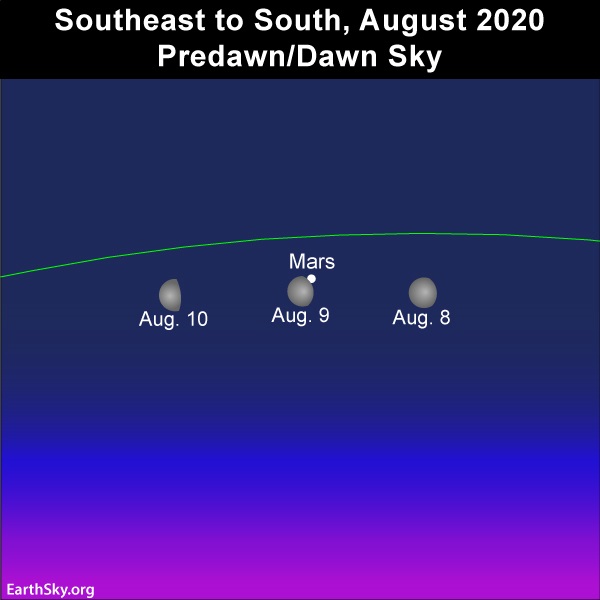
Sky chart: Mars and 3 positions of the moon close to the nearly horizontal green line of the ecliptic.

If you’re more of an early bird than a night owl, look for the moon and Mars much higher up in the sky before sunup this weekend. Note: the moon appears larger on the sky chart than it does in the real sky.

Like to get up early? Look for the moon and Mars around their highest in the sky before dawn. Better yet – in those early-morning hours – you’ll also enjoy an eyeful of Venus, the brightest planet of them all, basking in the light of the sun in the eastern morning sky. Venus ranks as the third-brightest celestial object in all the heavens, after the sun and moon, respectively. In fact, sharped-eyed folks can even see Venus with the eye alone in a daytime sky.

Mars and the moon high up at dawn, with Venus blazing in the east! What could be better? Well … maybe a meteor? The Perseid meteor shower is now rising to its peak. If you’re under a dark sky, you might catch one sweeping in the predawn.

Read more: All you need to know about 2020’s Perseid meteor shower

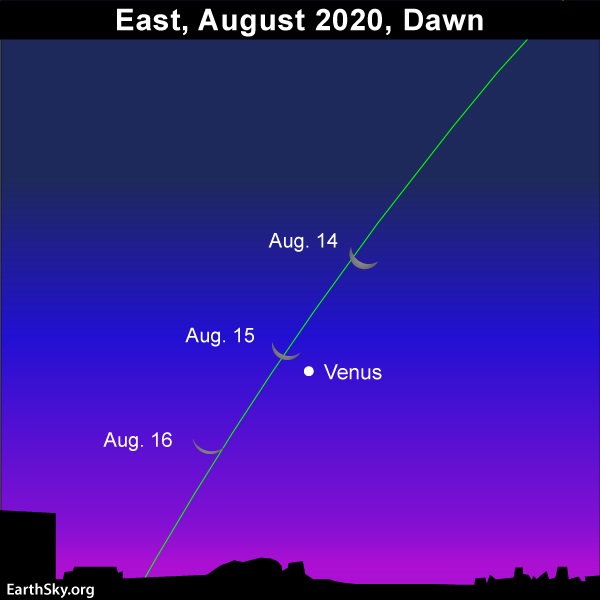
Sky chart: 3 positions of thin waning crescent moon near planet Venus along steep line of ecliptic.

After the moon meets up with Mars around August 9, it’ll go past Venus around August 15. Read more.

If you’re up before dawn and have an unobstructed view east and west, you might also catch Jupiter and Saturn in the southwest sky. Thus, at this early hour, you might catch four bright planets at one time: Mars near the moon, Venus in the east, and Jupiter and Saturn in the southwest.

More likely, it’ll be easier to catch Jupiter and Saturn in the evening sky, because the these two planets pop out first thing at nightfall and stay out nearly all night long.

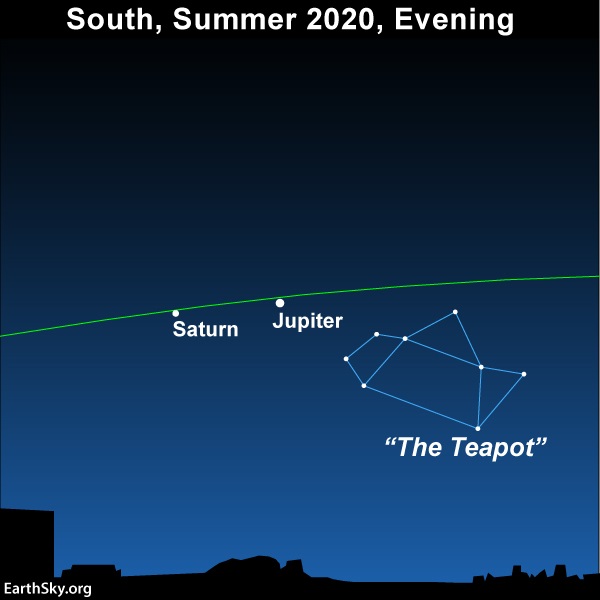
Sky chart: Jupiter and Saturn (on ecliptic) and the Teapot asterism in the August 2020 evening sky.

Jupiter and Saturn climb highest up for the night at mid-to-late evening in early August, and by early-to-mid evening by the month’s end.

Mars, though not as bright as Venus or Jupiter, is nonetheless brilliant and beautiful and a wonder to behold. In fact, at present, Mars presently ranks as the sixth-brightest celestial body, after the sun, moon, Venus, Jupiter and the star Sirius, respectively. Depending on where you live worldwide, you might – or might not – see Sirius in the August morning twilight; it has just begun to climb out of the glare of sunrise.

Have fun, sky-watchers!

Bottom line: Use the moon to find Mars on the nights of August 7 to 9. Then keep watching this fiery world as it lights up the nighttime for the rest of this year. The year 2020 showcases Mars’ brightest performance until the year 2035. Don’t miss out!


from EarthSky https://ift.tt/2DI45GC

EarthSky’s yearly crowd-funding campaign is in progress. In 2020, we are donating 8.5% to No Kids Hungry. Please donate to help us keep going, and help feed a kid!

On August 7, 8 and 9, 2020, look eastward before going to bed, and you might just catch the waning gibbous moon and red planet Mars. After this brilliant twosome rises, the moon and Mars will travel westward across the nighttime sky. They’ll reach their high point for the night at or near morning dawn.

For many months now, Mars has been either absent from our sky or inconspicuous. But now Mars is brightening, day by day, as Earth sweeps up from behind Mars in our smaller, faster orbit. By September 2020, our faster motion will have brought us even nearer to Mars. The red planet will then outshine Sirius, the brightest star in our sky (besides the sun). In October – when Earth will sweep between the sun and Mars, bringing Mars to its every-other-year opposition – Mars will outshine not only all the stars, but also Jupiter, the second-brightest planet.

Mars will beam at its brightest and best for the year in mid-October 2020. At that time, the red planet will shine about 3 1/2 times more brightly than it does now.

That’s why now is a good time to start watching Mars! It’s already quite bright and lots of fun to see …

Sky chart: Mars and 3 positions of the moon close to the nearly horizontal green line of the ecliptic.

If you’re more of an early bird than a night owl, look for the moon and Mars much higher up in the sky before sunup this weekend. Note: the moon appears larger on the sky chart than it does in the real sky.

Like to get up early? Look for the moon and Mars around their highest in the sky before dawn. Better yet – in those early-morning hours – you’ll also enjoy an eyeful of Venus, the brightest planet of them all, basking in the light of the sun in the eastern morning sky. Venus ranks as the third-brightest celestial object in all the heavens, after the sun and moon, respectively. In fact, sharped-eyed folks can even see Venus with the eye alone in a daytime sky.

Mars and the moon high up at dawn, with Venus blazing in the east! What could be better? Well … maybe a meteor? The Perseid meteor shower is now rising to its peak. If you’re under a dark sky, you might catch one sweeping in the predawn.

Read more: All you need to know about 2020’s Perseid meteor shower

Sky chart: 3 positions of thin waning crescent moon near planet Venus along steep line of ecliptic.

After the moon meets up with Mars around August 9, it’ll go past Venus around August 15. Read more.

If you’re up before dawn and have an unobstructed view east and west, you might also catch Jupiter and Saturn in the southwest sky. Thus, at this early hour, you might catch four bright planets at one time: Mars near the moon, Venus in the east, and Jupiter and Saturn in the southwest.

More likely, it’ll be easier to catch Jupiter and Saturn in the evening sky, because the these two planets pop out first thing at nightfall and stay out nearly all night long.

Sky chart: Jupiter and Saturn (on ecliptic) and the Teapot asterism in the August 2020 evening sky.

Jupiter and Saturn climb highest up for the night at mid-to-late evening in early August, and by early-to-mid evening by the month’s end.

Mars, though not as bright as Venus or Jupiter, is nonetheless brilliant and beautiful and a wonder to behold. In fact, at present, Mars presently ranks as the sixth-brightest celestial body, after the sun, moon, Venus, Jupiter and the star Sirius, respectively. Depending on where you live worldwide, you might – or might not – see Sirius in the August morning twilight; it has just begun to climb out of the glare of sunrise.

Have fun, sky-watchers!

Bottom line: Use the moon to find Mars on the nights of August 7 to 9. Then keep watching this fiery world as it lights up the nighttime for the rest of this year. The year 2020 showcases Mars’ brightest performance until the year 2035. Don’t miss out!


from EarthSky https://ift.tt/2DI45GC

Emory students win Amazon's Alexa Prize for AI with strategy of caring about others

Jinho Choi (center), the faculty advisor for the Emory Alexa Prize team, with graduate students James Finch (left), and Sarah Fillwock, the team leader.

A team of Emory University students won Amazon’s 2020 Alexa Prize, a global competition to create the most engaging chatbot to advance the field of artificial intelligence. The team earned $500,000 for taking first place with their chatbot named Emora.

The students designed Emora to provide comfort and warmth to people interacting with Amazon’s voice-activated Alexa-enabled devices, whether they wanted to discuss movies, sports and their pets or their concerns for themselves and their families amid the COVID-19 pandemic.

The Emory team consisted of 14 students led by graduate student Sarah Fillwock and faculty advisor Jinho Choi, assistant professor in the Department of Computer Science. They christened their chatbot Emora because it sounds like a feminine version of “Emory” and is similar to a Hebrew term for a sage skilled in eloquence.

Even as they celebrate their win, the Emory team is looking ahead to how they can apply the concepts they developed to benefit everything from education to people suffering from depression and social isolation.

The annual Alexa Prize, launched in 2016, challenges university students to make breakthroughs in the design of chatbots, or social bots — software apps that simplify interactions between humans and computers by allowing them to talk with one another. Emory used a unique strategy to beat out nine other universities and take the top spot in this year’s competition, the most hotly contested ever. 

“Normally people think of a chatbot as being an intelligent assistant, to answer questions or provide a customer service,” Fillwock says. “We designed a more socially oriented chatbot that could actually show interest in an individual user and provide comfort to people if they wanted it.”

Read the full story.

Related:
Emory team vies for best social bot via Amazon's Alexa Prize

from eScienceCommons https://ift.tt/3ibYoQa
Jinho Choi (center), the faculty advisor for the Emory Alexa Prize team, with graduate students James Finch (left), and Sarah Fillwock, the team leader.

A team of Emory University students won Amazon’s 2020 Alexa Prize, a global competition to create the most engaging chatbot to advance the field of artificial intelligence. The team earned $500,000 for taking first place with their chatbot named Emora.

The students designed Emora to provide comfort and warmth to people interacting with Amazon’s voice-activated Alexa-enabled devices, whether they wanted to discuss movies, sports and their pets or their concerns for themselves and their families amid the COVID-19 pandemic.

The Emory team consisted of 14 students led by graduate student Sarah Fillwock and faculty advisor Jinho Choi, assistant professor in the Department of Computer Science. They christened their chatbot Emora because it sounds like a feminine version of “Emory” and is similar to a Hebrew term for a sage skilled in eloquence.

Even as they celebrate their win, the Emory team is looking ahead to how they can apply the concepts they developed to benefit everything from education to people suffering from depression and social isolation.

The annual Alexa Prize, launched in 2016, challenges university students to make breakthroughs in the design of chatbots, or social bots — software apps that simplify interactions between humans and computers by allowing them to talk with one another. Emory used a unique strategy to beat out nine other universities and take the top spot in this year’s competition, the most hotly contested ever. 

“Normally people think of a chatbot as being an intelligent assistant, to answer questions or provide a customer service,” Fillwock says. “We designed a more socially oriented chatbot that could actually show interest in an individual user and provide comfort to people if they wanted it.”

Read the full story.

Related:
Emory team vies for best social bot via Amazon's Alexa Prize

from eScienceCommons https://ift.tt/3ibYoQa

Mars big as the moon on August 27?

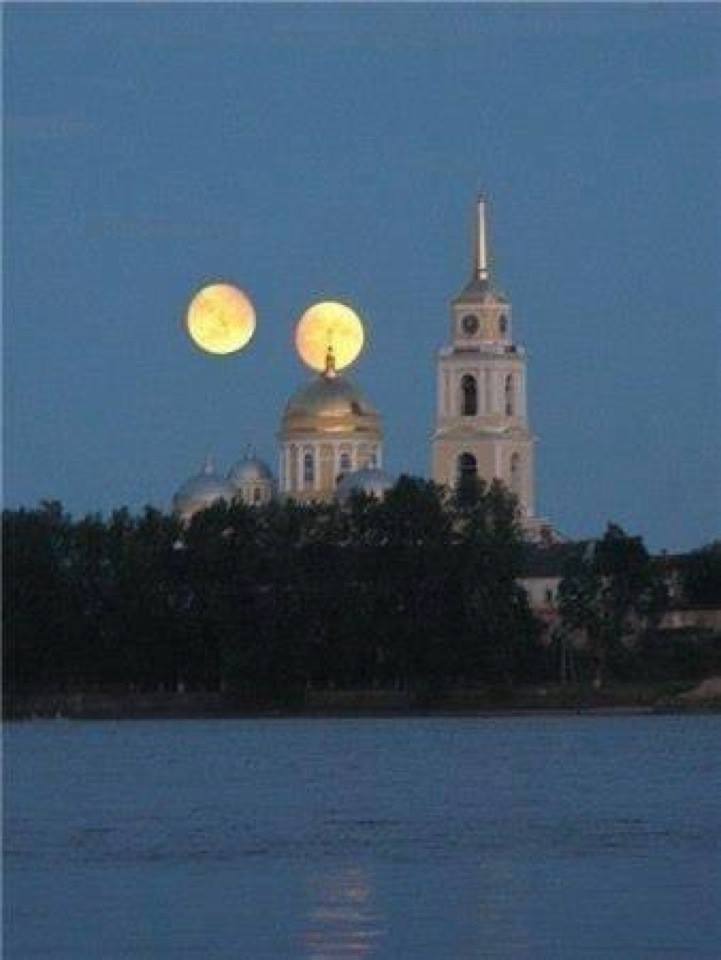
This image is circulating on Facebook, with the claim that Mars will appear as big and bright as a full moon on August 27, 2014. It's a hoax. Don't believe it. Mars never appears as large as a full moon in Earth's sky.

This image – or one like it – sometimes circulates on social media, with the claim that Mars will appear as big and bright as a full moon. It’s a hoax. Don’t believe it.

Will Mars and the moon will appear the same size on August 27, 2020? Will Mars ever appear as big as the moon, seen from Earth? No to both. This hoax has its roots in a real 15-year cycle of Mars, that’s peeking – giving us an excellent year to observe Mars – in 2020. Although it’s not true, you’re likely to see the claim as an email – or on social media – that Mars will appear as large as a full moon in Earth’s sky on a particular date, often August 27 of any given year. Sometimes there’s a suggestion that Mars and Earth’s moon will appear as a double moon. I’ve also seen the photo above, circulating on Facebook. And that is just not true. It’s not true in 2020. It’s never been true. It never will be true.

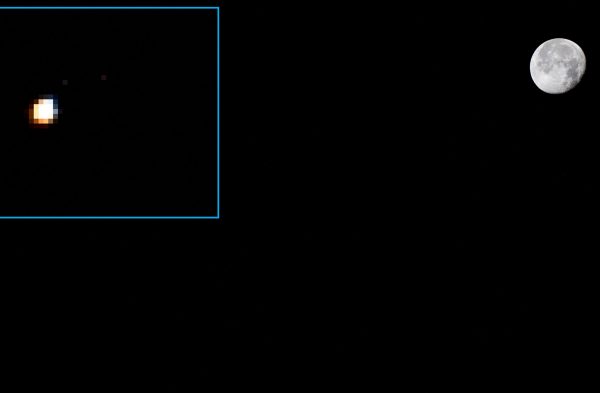
In this astronaut photo, taken from the International Space Station on June 30, 2018, Mars has been highlighted and enlarged 20 times. Read more about this image.

Here’s a sample of what the hoax typically says:

SEE MARS AS LARGE AS THE FULL MOON. Should be spectacular! Truly a once in a lifetime experience!

It sounds amazing! Can it possibly be true?

No. It can’t.

Mars can never appear as large as a full moon as seen from Earth. As seen from Earth, in months when Mars does appear side by side with a full moon, Mars’ diameter appears, on average, about 1/140th the diameter of the full moon.

In other words, you’d have to line up 140 planet Mars – side by side – to equal the moon’s diameter.

Earth and Mars had a particularly close opposition on on July 27, 2018. Beginning around July 7, Mars bumped Jupiter out of the second-brightest planet slot; Mars has been the second-brightest planet (after Venus) and will remain so until about September 7, 2018. Mars’ opposition happens whenever we pass between it and the sun in our smaller, faster orbit. Mars was closest to us on July 31, closer than it’s been since 2003! It’s been bright and very reddish! Like a dot of flame.

Thus the Mars-as-big-as-the-moon and double moon rumors are flying!

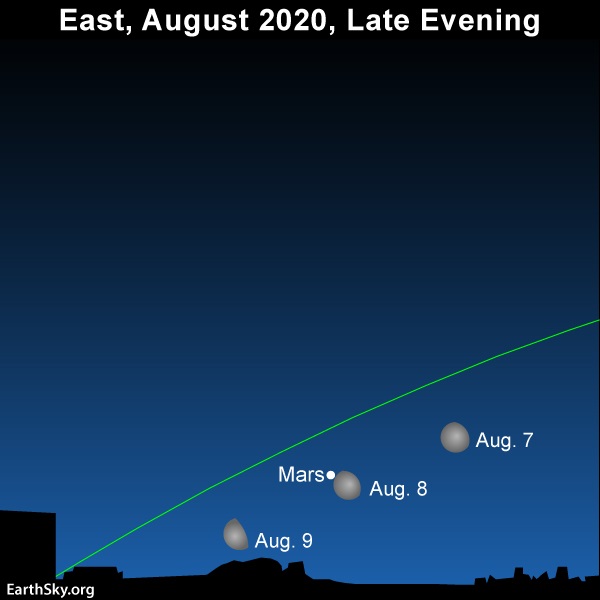
Chart showing moon passing Mars on August 7, 8 and 9, 2020.

In 2020, the moon will be sweeping past Mars on August 7, 8 and 9. You’ll find them ascending in the east late at night, or at their highest in the sky before sunrise. Read more.

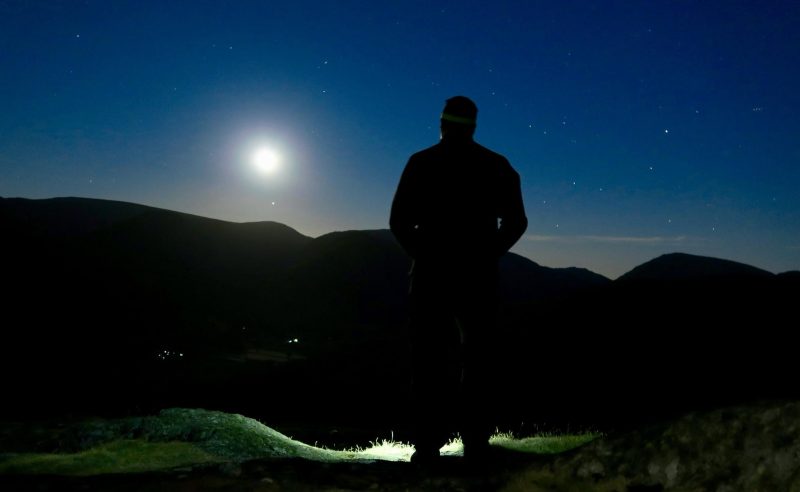
Moon and Mars rising over the hills of the English Lake District on July 1, 2018, via Adrian Strand. In this photo, Mars is in the 5 o’clock position with respect to the moon. If you see Mars near the moon on August 7, 8 or 9, it’ll look about like this … a big round world (the moon) and a bright red dot (Mars).

Ah, Mars. World of dreams and visions. Mars is the world orbiting one step outward from Earth’s orbit. This world is slightly smaller than Earth – but slightly larger than Earth’s moon. Mars is also much much farther away than Earth’s moon. It’s hard to comprehend what little specks the planets and moons are in contrast to the vastness of space, but let me put it this way. Earth’s moon is about a light-second away. Traveling at 186,000 miles per second (300,000 km/sec), light bouncing from the moon’s surface takes about a second to reach us here on Earth. Meanwhile, light from Mars takes much much longer to reach Earth – from several minutes to about 20 minutes – with the difference being the result of Earth’s and Mars’ motions around the sun. In other words, when Mars is on the same side of the sun as Earth, its distance from us is less than when it’s on the far side of the sun from us.

The moon is much closer than Mars, and that’s why we see the moon as a bright disk in our sky. Meanwhile – to the eye – Mars never appears as anything but a reddish starlike point.

So how did this rumor of Mars-as-big-and-bright-as-the-moon get started? It started with an actual (though much more subtle) event in 2003. On August 27 of that year, Earth and Mars came very slightly closer than they’d been in nearly 60,000 years. Center-to-center, Earth and Mars were less than 35 million miles apart (about 56 million km) – just over three light-minutes apart. The last people to come so close to Mars were Neanderthals. Astronomy writers like me had a field day that year, talking about Mars at its closest. Was it a spectacular sight? Yes!

Was Mars as big and bright as the moon, even at its closest in 2003? Never. But the legend continues …

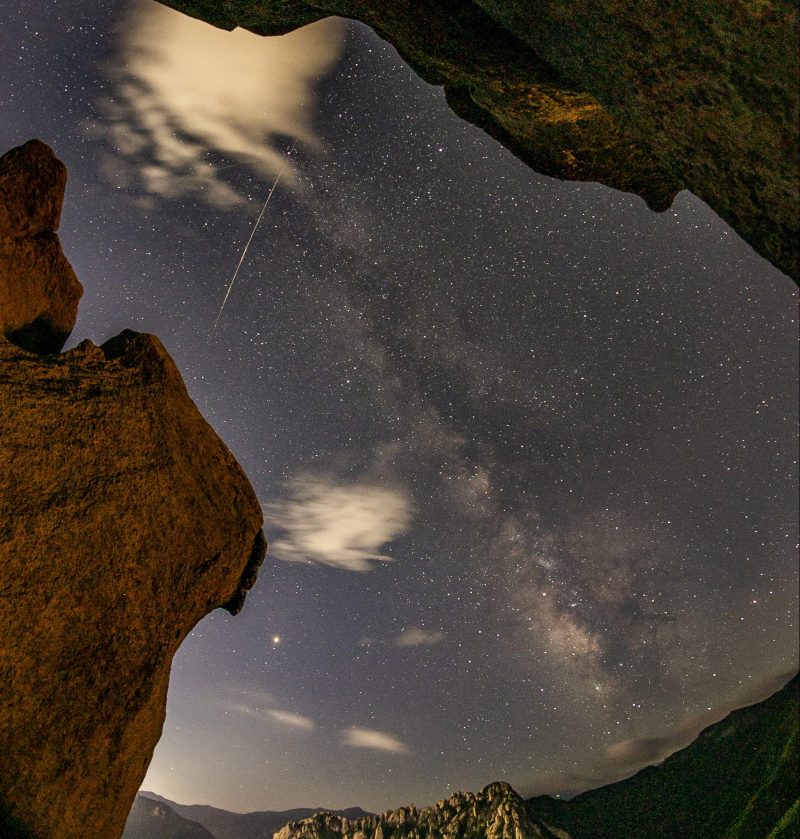
Moonlit night in July, 2018, over South Korea’s Mount Seoraksan – with Mars and a meteor – by Kang Min Lee. Mars is the brightest starlike object in the lower left of the photo. From Earth, Mars always appears starlike.

The 2003 event was part of that 15-year cycle for Mars, mentioned above.

Think of Earth and Mars in orbit around the sun again. Neither Earth nor Mars has a circular orbit. Both worlds have elliptical orbits … like squashed circles.

So both Earth and Mars have a closest point to the sun. Maybe you can see that – when Earth passes between the sun and Mars (opposition) around the time Mars is closest to the sun (perihelion) – Earth and Mars come closest.

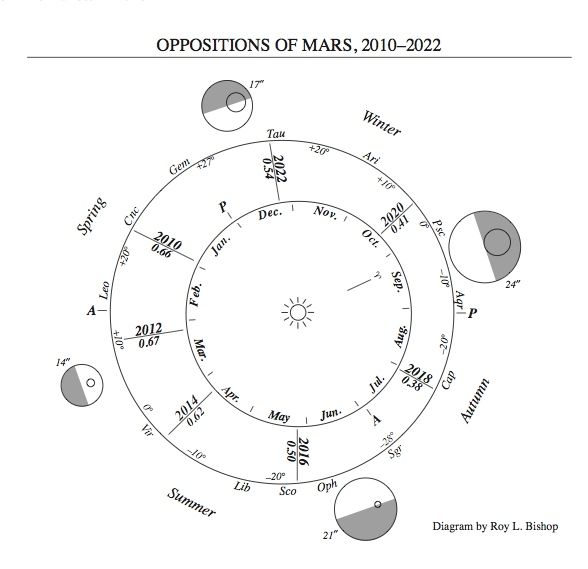
The diagram below, used with the kind permission of the Royal Astronomical Society of Canada, helps show why.

Diagram by Roy L. Bishop. Copyright Royal Astronomical Society of Canada. Used with permission. Visit the RASC estore to purchase the Observer’s Handbook, a necessary tool for all skywatchers. This diagram explains why, in 2016, Mars was closer than it had been in 10 years. In 2018, it was even closer … and in 2020 it’ll still be close when it reaches its once-in-2-years opposition in October. But Mars never has, and never will, appear moon-sized in Earth’s sky. Read more about why Mars is sometimes bright and sometimes faint.

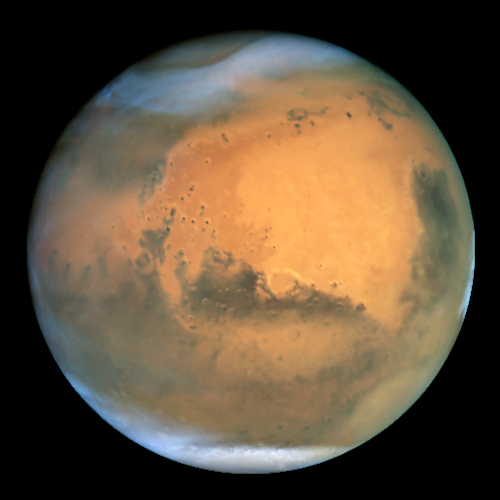
The red planet Mars, as seen by the Hubble Space Telescope. Can you imagine seeing this in our night sky? It’d be terrifying! Luckily, it can’t happen. Image via NASA.

Bottom line: Mars can never appear as large as a full moon in Earth’s sky. The email – or social media – claims to the contrary are a hoax. However, 2020 is an excellent year for Mars. It’s once-in-two-years opposition – middle of the best time of year to see it – will come in October.

Read more: Why is Mars sometimes bright and sometimes faint?


from EarthSky https://ift.tt/2F1NJJG
This image is circulating on Facebook, with the claim that Mars will appear as big and bright as a full moon on August 27, 2014. It's a hoax. Don't believe it. Mars never appears as large as a full moon in Earth's sky.

This image – or one like it – sometimes circulates on social media, with the claim that Mars will appear as big and bright as a full moon. It’s a hoax. Don’t believe it.

Will Mars and the moon will appear the same size on August 27, 2020? Will Mars ever appear as big as the moon, seen from Earth? No to both. This hoax has its roots in a real 15-year cycle of Mars, that’s peeking – giving us an excellent year to observe Mars – in 2020. Although it’s not true, you’re likely to see the claim as an email – or on social media – that Mars will appear as large as a full moon in Earth’s sky on a particular date, often August 27 of any given year. Sometimes there’s a suggestion that Mars and Earth’s moon will appear as a double moon. I’ve also seen the photo above, circulating on Facebook. And that is just not true. It’s not true in 2020. It’s never been true. It never will be true.

In this astronaut photo, taken from the International Space Station on June 30, 2018, Mars has been highlighted and enlarged 20 times. Read more about this image.

Here’s a sample of what the hoax typically says:

SEE MARS AS LARGE AS THE FULL MOON. Should be spectacular! Truly a once in a lifetime experience!

It sounds amazing! Can it possibly be true?

No. It can’t.

Mars can never appear as large as a full moon as seen from Earth. As seen from Earth, in months when Mars does appear side by side with a full moon, Mars’ diameter appears, on average, about 1/140th the diameter of the full moon.

In other words, you’d have to line up 140 planet Mars – side by side – to equal the moon’s diameter.

Earth and Mars had a particularly close opposition on on July 27, 2018. Beginning around July 7, Mars bumped Jupiter out of the second-brightest planet slot; Mars has been the second-brightest planet (after Venus) and will remain so until about September 7, 2018. Mars’ opposition happens whenever we pass between it and the sun in our smaller, faster orbit. Mars was closest to us on July 31, closer than it’s been since 2003! It’s been bright and very reddish! Like a dot of flame.

Thus the Mars-as-big-as-the-moon and double moon rumors are flying!

Chart showing moon passing Mars on August 7, 8 and 9, 2020.

In 2020, the moon will be sweeping past Mars on August 7, 8 and 9. You’ll find them ascending in the east late at night, or at their highest in the sky before sunrise. Read more.

Moon and Mars rising over the hills of the English Lake District on July 1, 2018, via Adrian Strand. In this photo, Mars is in the 5 o’clock position with respect to the moon. If you see Mars near the moon on August 7, 8 or 9, it’ll look about like this … a big round world (the moon) and a bright red dot (Mars).

Ah, Mars. World of dreams and visions. Mars is the world orbiting one step outward from Earth’s orbit. This world is slightly smaller than Earth – but slightly larger than Earth’s moon. Mars is also much much farther away than Earth’s moon. It’s hard to comprehend what little specks the planets and moons are in contrast to the vastness of space, but let me put it this way. Earth’s moon is about a light-second away. Traveling at 186,000 miles per second (300,000 km/sec), light bouncing from the moon’s surface takes about a second to reach us here on Earth. Meanwhile, light from Mars takes much much longer to reach Earth – from several minutes to about 20 minutes – with the difference being the result of Earth’s and Mars’ motions around the sun. In other words, when Mars is on the same side of the sun as Earth, its distance from us is less than when it’s on the far side of the sun from us.

The moon is much closer than Mars, and that’s why we see the moon as a bright disk in our sky. Meanwhile – to the eye – Mars never appears as anything but a reddish starlike point.

So how did this rumor of Mars-as-big-and-bright-as-the-moon get started? It started with an actual (though much more subtle) event in 2003. On August 27 of that year, Earth and Mars came very slightly closer than they’d been in nearly 60,000 years. Center-to-center, Earth and Mars were less than 35 million miles apart (about 56 million km) – just over three light-minutes apart. The last people to come so close to Mars were Neanderthals. Astronomy writers like me had a field day that year, talking about Mars at its closest. Was it a spectacular sight? Yes!

Was Mars as big and bright as the moon, even at its closest in 2003? Never. But the legend continues …

Moonlit night in July, 2018, over South Korea’s Mount Seoraksan – with Mars and a meteor – by Kang Min Lee. Mars is the brightest starlike object in the lower left of the photo. From Earth, Mars always appears starlike.

The 2003 event was part of that 15-year cycle for Mars, mentioned above.

Think of Earth and Mars in orbit around the sun again. Neither Earth nor Mars has a circular orbit. Both worlds have elliptical orbits … like squashed circles.

So both Earth and Mars have a closest point to the sun. Maybe you can see that – when Earth passes between the sun and Mars (opposition) around the time Mars is closest to the sun (perihelion) – Earth and Mars come closest.

The diagram below, used with the kind permission of the Royal Astronomical Society of Canada, helps show why.

Diagram by Roy L. Bishop. Copyright Royal Astronomical Society of Canada. Used with permission. Visit the RASC estore to purchase the Observer’s Handbook, a necessary tool for all skywatchers. This diagram explains why, in 2016, Mars was closer than it had been in 10 years. In 2018, it was even closer … and in 2020 it’ll still be close when it reaches its once-in-2-years opposition in October. But Mars never has, and never will, appear moon-sized in Earth’s sky. Read more about why Mars is sometimes bright and sometimes faint.

The red planet Mars, as seen by the Hubble Space Telescope. Can you imagine seeing this in our night sky? It’d be terrifying! Luckily, it can’t happen. Image via NASA.

Bottom line: Mars can never appear as large as a full moon in Earth’s sky. The email – or social media – claims to the contrary are a hoax. However, 2020 is an excellent year for Mars. It’s once-in-two-years opposition – middle of the best time of year to see it – will come in October.

Read more: Why is Mars sometimes bright and sometimes faint?


from EarthSky https://ift.tt/2F1NJJG

Top tips for watching the Perseids in 2020

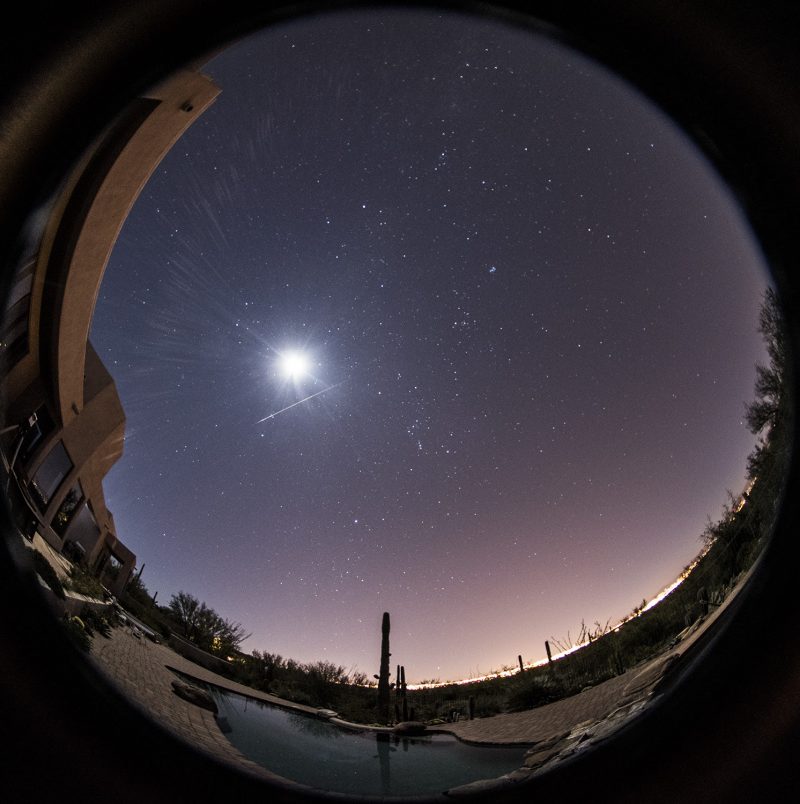
Circular panorama with stars, bright moon, and one meteor streak.

Moonlit meteor, November 1, 2015, via Eliot Herman in Tucson, Arizona. He wrote: “I have 2 rules for meteors: avoid the moon, if possible, and if not embrace the situation. Make the adjustments and accept that, while the photos probably won’t be epic, it’s possible to record the good ones. The moon isn’t so bad. Clouds are …”

EarthSky’s yearly crowd-funding campaign is in progress. In 2020, we are donating 8.5% to No Kids Hungry. Please donate to help us keep going, and help feed a kid!

On the expected peak mornings of August 11, 12 and 13, the Perseid meteor shower will be somewhat marred by the light of the waning moon. Check out the custom calendar at Sunrise Sunset Calendars, being sure to check the moonrise/moonset box, to get the exact time of moonrise at your location. Otherwise, here’s how to minimize the moon and optimize the 2020 Perseids.

1. Watch during the mid-to-late evening hours on August 10, 11 and 12, before moonrise. Take that, moon! You won’t see as many meteors as at the peak morning hours before dawn. But you will see some meteors! Moreover, the evening hours are more likely to present an earthgrazer: a long, slow, colorful meteor traveling horizontally across the evening sky.

2. Sprawl out in a moon shadow. If you plan to watch the Perseids in the light of the moon, notice that the moon casts shadows. Find a moon shadow somewhere that still provides you with a wide expanse of sky for meteor-viewing. A plateau area with high-standing mountains to block out the moon would work just fine. If you can’t do that, find a hedgerow of trees bordering a wide open field somewhere (though obtain permission, if it’s private land). Or simply sit in the shadow of a barn or other building. Ensconced within a moon shadow, and far from the glow of city lights, the night all of a sudden darkens while the meteors brighten.

3. Avoid city lights. This should go without saying, but just a reminder. A wide open area – a field or a lonely country road – is best if you’re serious about watching meteors. Visit EarthSky’s Best Places to Stargaze to find a dark location near you.

4. Watch with a friend or friends, and try facing in different directions so that if someone sees a meteor, that person can call out “Meteor!” to the rest.

5. Notice the speed and colors, if any, of the meteors.

6. Watch for meteor trains. A meteor train is a persistent glow in the air, left by some meteors after they have faded from view. Trains are caused by luminous ionized matter left in the wake of this incoming space debris. Hard to see in the moonlight, but watch for them!

7. Embrace the moon. We hear people bubble with excitement about seeing meteors in all sorts of conditions – moon or no moon – city lights or no city lights. And so, this week, try taking your lawn chair or blanket to a wide open location and bask in the moon’s bright light. You’ll see an occasional meteor streak by. It’ll be beautiful!

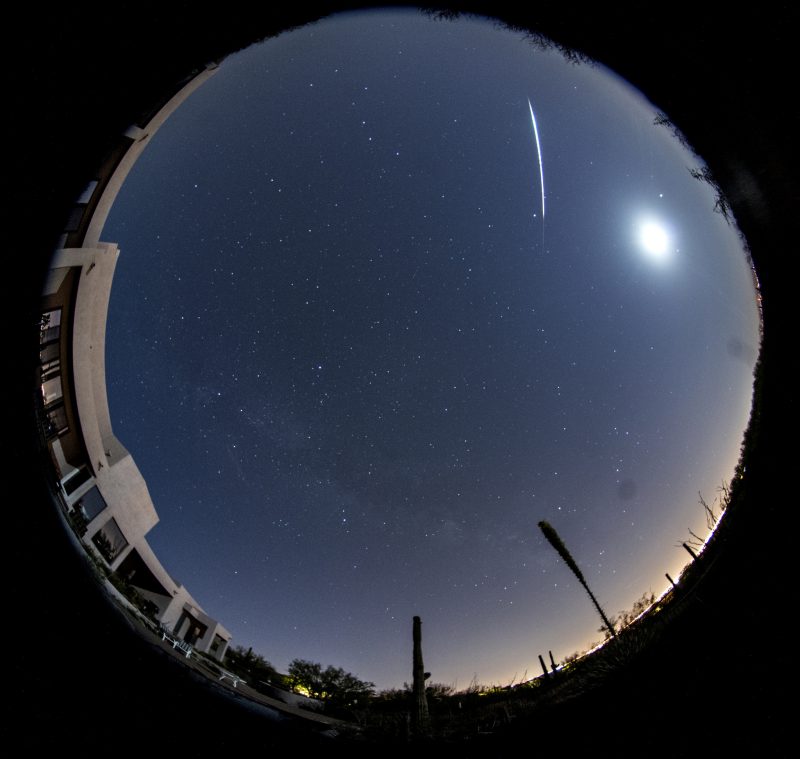
Circular panorama with bright moon and very bright meteor streak.

Eliot Herman in Tucson caught this image, as well as the image at the top of this post. He said this one – from early July 2017 – is one of the the brightest meteors he caught in 2017, despite the moon. When we asked him for tips for shooting meteors in bright moonlight, he answered: “I shoot my images so that it is bright i.e. ISO 2500 at F5 for 15 sec in RAW (this is critical) at 8 mm fisheye. Using the RAW images in Photoshop, I adjust the white balance to look like the sky color, and then adjust saturation, gamma, exposure, and levels until the stars appear against a background that looks closer to reality. It’s not difficult to do this, takes just a few minutes to process one image. There are aspects like moonlight reflections that one has to live with. I do not mask or otherwise hide anything, although that can be done with in Photoshop. But I like my images to be real, so no subtractions. Meteors at +2 magnitude can easily be seen even in full moonlight. In dark skies, I shoot ISO 3200 F 3.5 for 15 seconds, and it is, of course, much better.”

Bottom line: The waning moon will do its best to drown out the 2019 Perseid meteor shower. Here are 7 tips for enjoying the moonlit Perseids in 2020.


from EarthSky https://ift.tt/2YRT5PQ
Circular panorama with stars, bright moon, and one meteor streak.

Moonlit meteor, November 1, 2015, via Eliot Herman in Tucson, Arizona. He wrote: “I have 2 rules for meteors: avoid the moon, if possible, and if not embrace the situation. Make the adjustments and accept that, while the photos probably won’t be epic, it’s possible to record the good ones. The moon isn’t so bad. Clouds are …”

EarthSky’s yearly crowd-funding campaign is in progress. In 2020, we are donating 8.5% to No Kids Hungry. Please donate to help us keep going, and help feed a kid!

On the expected peak mornings of August 11, 12 and 13, the Perseid meteor shower will be somewhat marred by the light of the waning moon. Check out the custom calendar at Sunrise Sunset Calendars, being sure to check the moonrise/moonset box, to get the exact time of moonrise at your location. Otherwise, here’s how to minimize the moon and optimize the 2020 Perseids.

1. Watch during the mid-to-late evening hours on August 10, 11 and 12, before moonrise. Take that, moon! You won’t see as many meteors as at the peak morning hours before dawn. But you will see some meteors! Moreover, the evening hours are more likely to present an earthgrazer: a long, slow, colorful meteor traveling horizontally across the evening sky.

2. Sprawl out in a moon shadow. If you plan to watch the Perseids in the light of the moon, notice that the moon casts shadows. Find a moon shadow somewhere that still provides you with a wide expanse of sky for meteor-viewing. A plateau area with high-standing mountains to block out the moon would work just fine. If you can’t do that, find a hedgerow of trees bordering a wide open field somewhere (though obtain permission, if it’s private land). Or simply sit in the shadow of a barn or other building. Ensconced within a moon shadow, and far from the glow of city lights, the night all of a sudden darkens while the meteors brighten.

3. Avoid city lights. This should go without saying, but just a reminder. A wide open area – a field or a lonely country road – is best if you’re serious about watching meteors. Visit EarthSky’s Best Places to Stargaze to find a dark location near you.

4. Watch with a friend or friends, and try facing in different directions so that if someone sees a meteor, that person can call out “Meteor!” to the rest.

5. Notice the speed and colors, if any, of the meteors.

6. Watch for meteor trains. A meteor train is a persistent glow in the air, left by some meteors after they have faded from view. Trains are caused by luminous ionized matter left in the wake of this incoming space debris. Hard to see in the moonlight, but watch for them!

7. Embrace the moon. We hear people bubble with excitement about seeing meteors in all sorts of conditions – moon or no moon – city lights or no city lights. And so, this week, try taking your lawn chair or blanket to a wide open location and bask in the moon’s bright light. You’ll see an occasional meteor streak by. It’ll be beautiful!

Circular panorama with bright moon and very bright meteor streak.

Eliot Herman in Tucson caught this image, as well as the image at the top of this post. He said this one – from early July 2017 – is one of the the brightest meteors he caught in 2017, despite the moon. When we asked him for tips for shooting meteors in bright moonlight, he answered: “I shoot my images so that it is bright i.e. ISO 2500 at F5 for 15 sec in RAW (this is critical) at 8 mm fisheye. Using the RAW images in Photoshop, I adjust the white balance to look like the sky color, and then adjust saturation, gamma, exposure, and levels until the stars appear against a background that looks closer to reality. It’s not difficult to do this, takes just a few minutes to process one image. There are aspects like moonlight reflections that one has to live with. I do not mask or otherwise hide anything, although that can be done with in Photoshop. But I like my images to be real, so no subtractions. Meteors at +2 magnitude can easily be seen even in full moonlight. In dark skies, I shoot ISO 3200 F 3.5 for 15 seconds, and it is, of course, much better.”

Bottom line: The waning moon will do its best to drown out the 2019 Perseid meteor shower. Here are 7 tips for enjoying the moonlit Perseids in 2020.


from EarthSky https://ift.tt/2YRT5PQ

Could ice sheets, not rivers, have formed the channels on Mars?

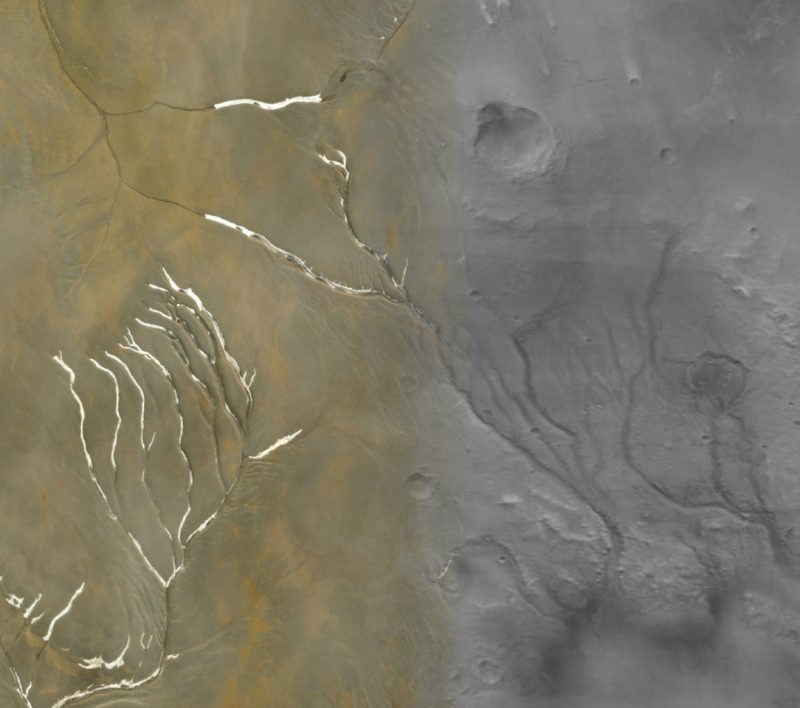
Meandering channel shapes on brown and grey terrain, with white highlights.

In this image, channels on Devon Island in the Canadian Arctic Archipelago (left) are superimposed with channels in Mars’ Maumee Valles region (right). The shapes and overall networks are quite similar. Image via Cal-Tech CTX mosaic/ MAXAR/Esri/ UBC.

EarthSky’s yearly crowd-funding campaign is in progress. In 2020, we are donating 8.5% of all incoming revenues to No Kids Hungry. Click to learn more and donate.

Thanks to orbiting spacecraft, we’ve now seen thousands of channels on Mars. They look like river channels, and most Mars researchers see them as evidence of a warmer, wetter Mars in the distant past. But, in early August 2020, Mars researchers announced that many of the channels weren’t carved by flowing river water at all. Instead, these scientists claim, the channels are due to the flow of meltwater beneath glacial ice sheets that crawled over Mars’ surface long ago.

The researchers are from the University of British Columbia (UBC), Western University (Western) and Arizona State University (ASU). Their peer-reviewed findings were published in Nature Geoscience on August 3, 2020.

From the paper:

The southern highlands of Mars are dissected by hundreds of valley networks, which are evidence that water once sculpted the surface. Characterizing the mechanisms of valley incision may constrain early Mars climate and the search for ancient life. Previous interpretations of the geological record require precipitation and surface water runoff to form the valley networks, in contradiction with climate simulations that predict a cold, icy ancient Mars. Here we present a global comparative study of valley network morphometry, using a principal-component-based analysis with physical models of fluvial, groundwater sapping and glacial and subglacial erosion. We found that valley formation involved all these processes, but that subglacial and fluvial erosion are the predominant mechanisms. This is supported by predictions from models of steady-state erosion and geomorphological comparisons to terrestrial analogues. The inference of subglacial channels among the valley networks supports the presence of ice sheets that covered the southern highlands during the time of valley network emplacement.

If the researchers are right, their conclusions would seem to pour cold water, literally, on the idea that Mars was warm and wet enough early in its history for flowing rivers, rain and oceans. So how did they determine that not all “river” channels on Mars were really made by rivers?
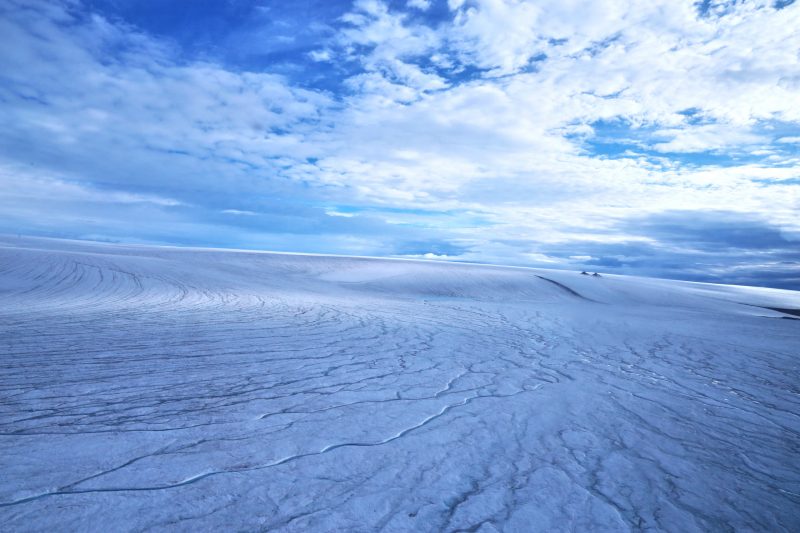
Icy landscape with blue sky and clouds above.

The Devon Island ice cap in the Canadian Arctic Archipelago, which is probably similar to how much of Mars looked when meltwater formed channels beneath ice sheets, according to the researchers. Image via Anna Grau Galofre/ UBC.

These scientists developed new techniques to study Mars channel formations. Over 10,000 Mars channels were studied, and they were then compared to the subglacial channels on Devon Island in the Canadian Arctic Archipelago. The researchers found a number of striking similarities. Anna Grau Galofre, formerly at UBC and now at ASU, and lead author of the study, stated:

For the last 40 years, since Mars’ valleys were first discovered, the assumption was that rivers once flowed on Mars, eroding and originating all of these valleys. But there are hundreds of valleys on Mars, and they look very different from each other. If you look at Earth from a satellite you see a lot of valleys: some of them made by rivers, some made by glaciers, some made by other processes, and each type has a distinctive shape. Mars is similar, in that valleys look very different from each other, suggesting that many processes were at play to carve them.

Many of the Martian channels resembled the ones in the Canadian Arctic Archipelago. So what does that tell scientists about Mars’ history? It would imply that those channels formed under cold, not warm conditions. Co-author Gordon Osinski at Western said:

Devon Island is one of the best analogs we have for Mars here on Earth; it is a cold, dry, polar desert, and the glaciation is largely cold-based.

Our study challenges the widely held view that most valley networks on Mars were formed by rivers fed by precipitation. While we found evidence consistent with a small handful of valley networks having formed in this way, our observations suggest that the majority formed beneath ice sheets.
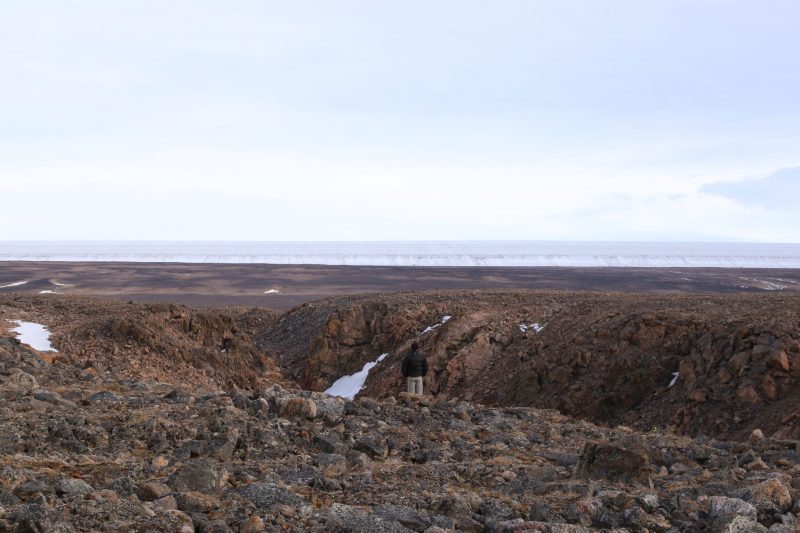
Inconspicuous man standing on rocky terrain looking at ice terrain in the distance, with overcast sky.

Study co-author Mark Jellinek of UBC looking towards the Devon Island ice cap. The rocks he is standing on are more than a million years old. Image via Anna Grau Galofre/ UBC.

These channels were most likely formed beneath glacial ice sheets, by meltwater underneath the ice. The same process happens beneath glaciers on Earth. As co-author Mark Jellinek at UBC explained:

These results are the first evidence for extensive subglacial erosion driven by channelized meltwater drainage beneath an ancient ice sheet on Mars. The findings demonstrate that only a fraction of valley networks match patterns typical of surface water erosion, which is in marked contrast to the conventional view. Using the geomorphology of Mars’ surface to rigorously reconstruct the character and evolution of the planet in a statistically meaningful way is, frankly, revolutionary.

The history of water on Mars and the warm and wet versus cold and wet scenarios have been the subjects of intense debate. We do know there used to be lakes on the surface, thanks to evidence from orbiting spacecraft and rovers such as Opportunity and Curiosity. But were the conditions warm or cold? Was there rain? Were there oceans? It should be noted that these new findings explain many of the channels, but others are still considered to be actual river channels. But then how and when did they form? NASA’s Perseverance rover will be landing at the location of one of these channels in February 2021, where a once-flowing river emptied into Jezero Crater and formed a striking delta that can still be easily seen today.
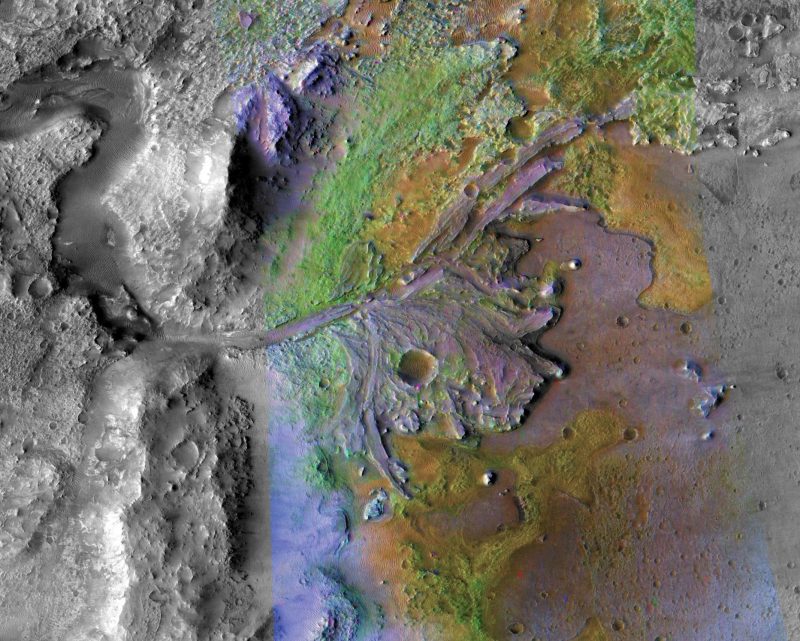
Colorful orbital view of rocky terrain with river channel and duck's foot shaped delta.

An ancient river delta in Jezero Crater on Mars (enhanced color). If the researchers are right, most of the river channels on Mars were actually formed by meltwater beneath ice sheets and not flowing water on the surface. But others are known to have been formed by flowing water, such as the channel that cut into the edge of the crater and created the delta. This is where NASA’s Perseverance rover will be landing in February 2021 to search for evidence of ancient life. Image via NASA/ JPL-Caltech/ ASU.

The subglacial channels fit with current climate models of Mars, which state that the planet should have been cooler when they formed about 3.8 billion years ago. This is due to the younger sun being less intense than it is now. Grau Galofre said:

Climate modeling predicts that Mars’ ancient climate was much cooler during the time of valley network formation. We tried to put everything together and bring up a hypothesis that hadn’t really been considered: that channels and valley networks can form under ice sheets, as part of the drainage system that forms naturally under an ice sheet when there’s water accumulated at the base.

While the concept of a colder and icier Mars instead of a warmer and wetter Mars may not sound as appealing for those hoping to find life, the new findings may actually bolster the chances of life having existed at the time. The researchers say that these regions of glacial meltwater would have provided better survival conditions. The ice sheets would have helped to protect and stabilize the water and provide shelter from solar radiation from the sun. The planet’s magnetic field, which protected it from the radiation, may have already disappeared by the time the glacial meltwater existed.

The new techniques developed by the researchers can also be used to learn more about the early history of Earth as well. Jellinek said:

Currently we can reconstruct rigorously the history of global glaciation on Earth going back about a million to five million years. Anna’s work will enable us to explore the advance and retreat of ice sheets back to at least 35 million years ago – to the beginnings of Antarctica, or earlier – back in time well before the age of our oldest ice cores. These are very elegant analytical tools.

Smiling woman in arctic gear, crouched on ice, giving a thumbs-up.

Anna Grau Galofre of UBC and ASU, lead author of the new study. Image via UBC.

If many of Mars’ river channels were actually formed by water from melting ice and not flowing surface water, that will provide more clues as to how much water Mars had in the past and how habitable the planet was a few billion years ago. And, even though this scenario may not seem as exciting as a warmer world covered with rivers, it could still have been quite habitable for tiny Martian microbes. Given other evidence for actual rivers, lakes and possibly even oceans, perhaps there were colder periods alternating with warmer ones? We still don’t know for sure, but the story of water on Mars is a fascinating and complicated one.

Bottom line: Many of Mars’ ancient river channels, thought to have been carved by flowing surface water, might have actually been formed by meltwater beneath glacial ice sheets.

Source: Valley formation on early Mars by subglacial and fluvial erosion

Via UBC

Via Western

Via ASU


from EarthSky https://ift.tt/2C7p59j
Meandering channel shapes on brown and grey terrain, with white highlights.

In this image, channels on Devon Island in the Canadian Arctic Archipelago (left) are superimposed with channels in Mars’ Maumee Valles region (right). The shapes and overall networks are quite similar. Image via Cal-Tech CTX mosaic/ MAXAR/Esri/ UBC.

EarthSky’s yearly crowd-funding campaign is in progress. In 2020, we are donating 8.5% of all incoming revenues to No Kids Hungry. Click to learn more and donate.

Thanks to orbiting spacecraft, we’ve now seen thousands of channels on Mars. They look like river channels, and most Mars researchers see them as evidence of a warmer, wetter Mars in the distant past. But, in early August 2020, Mars researchers announced that many of the channels weren’t carved by flowing river water at all. Instead, these scientists claim, the channels are due to the flow of meltwater beneath glacial ice sheets that crawled over Mars’ surface long ago.

The researchers are from the University of British Columbia (UBC), Western University (Western) and Arizona State University (ASU). Their peer-reviewed findings were published in Nature Geoscience on August 3, 2020.

From the paper:

The southern highlands of Mars are dissected by hundreds of valley networks, which are evidence that water once sculpted the surface. Characterizing the mechanisms of valley incision may constrain early Mars climate and the search for ancient life. Previous interpretations of the geological record require precipitation and surface water runoff to form the valley networks, in contradiction with climate simulations that predict a cold, icy ancient Mars. Here we present a global comparative study of valley network morphometry, using a principal-component-based analysis with physical models of fluvial, groundwater sapping and glacial and subglacial erosion. We found that valley formation involved all these processes, but that subglacial and fluvial erosion are the predominant mechanisms. This is supported by predictions from models of steady-state erosion and geomorphological comparisons to terrestrial analogues. The inference of subglacial channels among the valley networks supports the presence of ice sheets that covered the southern highlands during the time of valley network emplacement.

If the researchers are right, their conclusions would seem to pour cold water, literally, on the idea that Mars was warm and wet enough early in its history for flowing rivers, rain and oceans. So how did they determine that not all “river” channels on Mars were really made by rivers?

Icy landscape with blue sky and clouds above.

The Devon Island ice cap in the Canadian Arctic Archipelago, which is probably similar to how much of Mars looked when meltwater formed channels beneath ice sheets, according to the researchers. Image via Anna Grau Galofre/ UBC.

These scientists developed new techniques to study Mars channel formations. Over 10,000 Mars channels were studied, and they were then compared to the subglacial channels on Devon Island in the Canadian Arctic Archipelago. The researchers found a number of striking similarities. Anna Grau Galofre, formerly at UBC and now at ASU, and lead author of the study, stated:

For the last 40 years, since Mars’ valleys were first discovered, the assumption was that rivers once flowed on Mars, eroding and originating all of these valleys. But there are hundreds of valleys on Mars, and they look very different from each other. If you look at Earth from a satellite you see a lot of valleys: some of them made by rivers, some made by glaciers, some made by other processes, and each type has a distinctive shape. Mars is similar, in that valleys look very different from each other, suggesting that many processes were at play to carve them.

Many of the Martian channels resembled the ones in the Canadian Arctic Archipelago. So what does that tell scientists about Mars’ history? It would imply that those channels formed under cold, not warm conditions. Co-author Gordon Osinski at Western said:

Devon Island is one of the best analogs we have for Mars here on Earth; it is a cold, dry, polar desert, and the glaciation is largely cold-based.

Our study challenges the widely held view that most valley networks on Mars were formed by rivers fed by precipitation. While we found evidence consistent with a small handful of valley networks having formed in this way, our observations suggest that the majority formed beneath ice sheets.

Inconspicuous man standing on rocky terrain looking at ice terrain in the distance, with overcast sky.

Study co-author Mark Jellinek of UBC looking towards the Devon Island ice cap. The rocks he is standing on are more than a million years old. Image via Anna Grau Galofre/ UBC.

These channels were most likely formed beneath glacial ice sheets, by meltwater underneath the ice. The same process happens beneath glaciers on Earth. As co-author Mark Jellinek at UBC explained:

These results are the first evidence for extensive subglacial erosion driven by channelized meltwater drainage beneath an ancient ice sheet on Mars. The findings demonstrate that only a fraction of valley networks match patterns typical of surface water erosion, which is in marked contrast to the conventional view. Using the geomorphology of Mars’ surface to rigorously reconstruct the character and evolution of the planet in a statistically meaningful way is, frankly, revolutionary.

The history of water on Mars and the warm and wet versus cold and wet scenarios have been the subjects of intense debate. We do know there used to be lakes on the surface, thanks to evidence from orbiting spacecraft and rovers such as Opportunity and Curiosity. But were the conditions warm or cold? Was there rain? Were there oceans? It should be noted that these new findings explain many of the channels, but others are still considered to be actual river channels. But then how and when did they form? NASA’s Perseverance rover will be landing at the location of one of these channels in February 2021, where a once-flowing river emptied into Jezero Crater and formed a striking delta that can still be easily seen today.

Colorful orbital view of rocky terrain with river channel and duck's foot shaped delta.

An ancient river delta in Jezero Crater on Mars (enhanced color). If the researchers are right, most of the river channels on Mars were actually formed by meltwater beneath ice sheets and not flowing water on the surface. But others are known to have been formed by flowing water, such as the channel that cut into the edge of the crater and created the delta. This is where NASA’s Perseverance rover will be landing in February 2021 to search for evidence of ancient life. Image via NASA/ JPL-Caltech/ ASU.

The subglacial channels fit with current climate models of Mars, which state that the planet should have been cooler when they formed about 3.8 billion years ago. This is due to the younger sun being less intense than it is now. Grau Galofre said:

Climate modeling predicts that Mars’ ancient climate was much cooler during the time of valley network formation. We tried to put everything together and bring up a hypothesis that hadn’t really been considered: that channels and valley networks can form under ice sheets, as part of the drainage system that forms naturally under an ice sheet when there’s water accumulated at the base.

While the concept of a colder and icier Mars instead of a warmer and wetter Mars may not sound as appealing for those hoping to find life, the new findings may actually bolster the chances of life having existed at the time. The researchers say that these regions of glacial meltwater would have provided better survival conditions. The ice sheets would have helped to protect and stabilize the water and provide shelter from solar radiation from the sun. The planet’s magnetic field, which protected it from the radiation, may have already disappeared by the time the glacial meltwater existed.

The new techniques developed by the researchers can also be used to learn more about the early history of Earth as well. Jellinek said:

Currently we can reconstruct rigorously the history of global glaciation on Earth going back about a million to five million years. Anna’s work will enable us to explore the advance and retreat of ice sheets back to at least 35 million years ago – to the beginnings of Antarctica, or earlier – back in time well before the age of our oldest ice cores. These are very elegant analytical tools.

Smiling woman in arctic gear, crouched on ice, giving a thumbs-up.

Anna Grau Galofre of UBC and ASU, lead author of the new study. Image via UBC.

If many of Mars’ river channels were actually formed by water from melting ice and not flowing surface water, that will provide more clues as to how much water Mars had in the past and how habitable the planet was a few billion years ago. And, even though this scenario may not seem as exciting as a warmer world covered with rivers, it could still have been quite habitable for tiny Martian microbes. Given other evidence for actual rivers, lakes and possibly even oceans, perhaps there were colder periods alternating with warmer ones? We still don’t know for sure, but the story of water on Mars is a fascinating and complicated one.

Bottom line: Many of Mars’ ancient river channels, thought to have been carved by flowing surface water, might have actually been formed by meltwater beneath glacial ice sheets.

Source: Valley formation on early Mars by subglacial and fluvial erosion

Via UBC

Via Western

Via ASU


from EarthSky https://ift.tt/2C7p59j

Satellites discover new penguin colonies from space

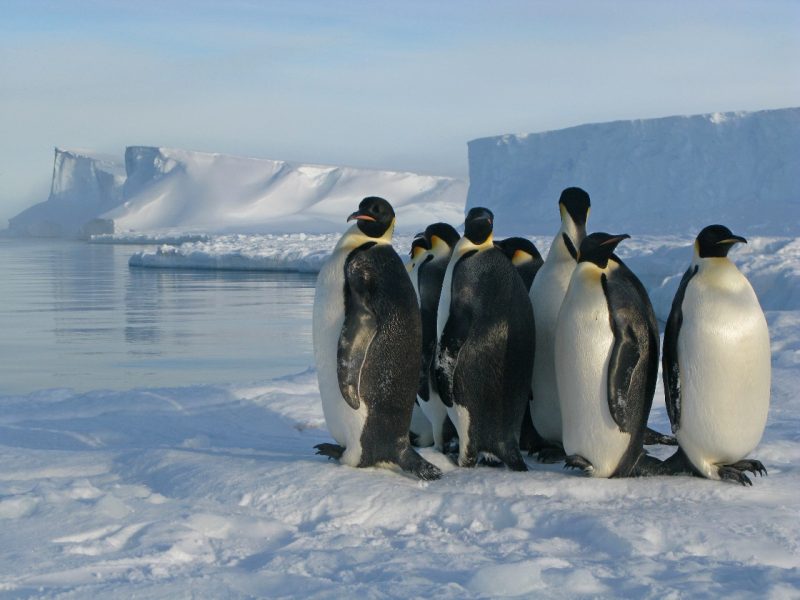
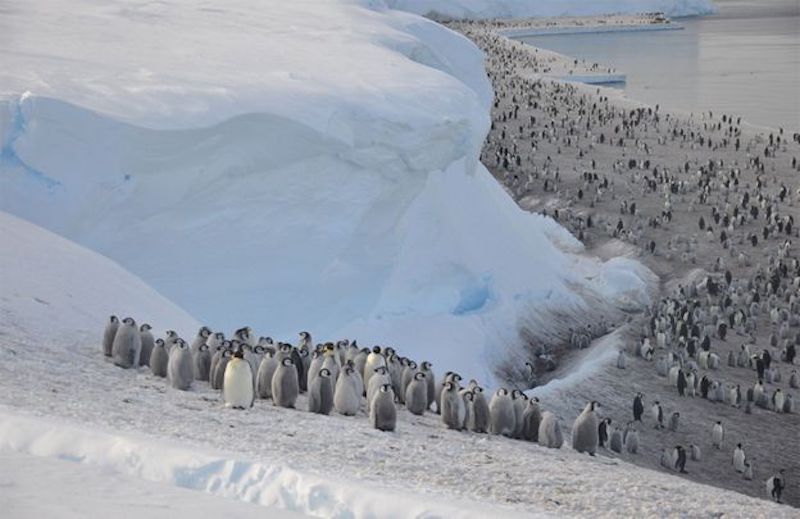
A group of penguins huddled together on the ice near open water, with ice cliffs in background.

Emperor penguins on sea ice at the Brunt ice shelf near the British Antarctic Survey’s Halley Research Station. Image via British Antarctic Survey.

EarthSky’s yearly crowd-funding campaign is in progress. In 2020, we are donating 8.5% of all incoming revenues to No Kids Hungry. Click to learn more and donate.

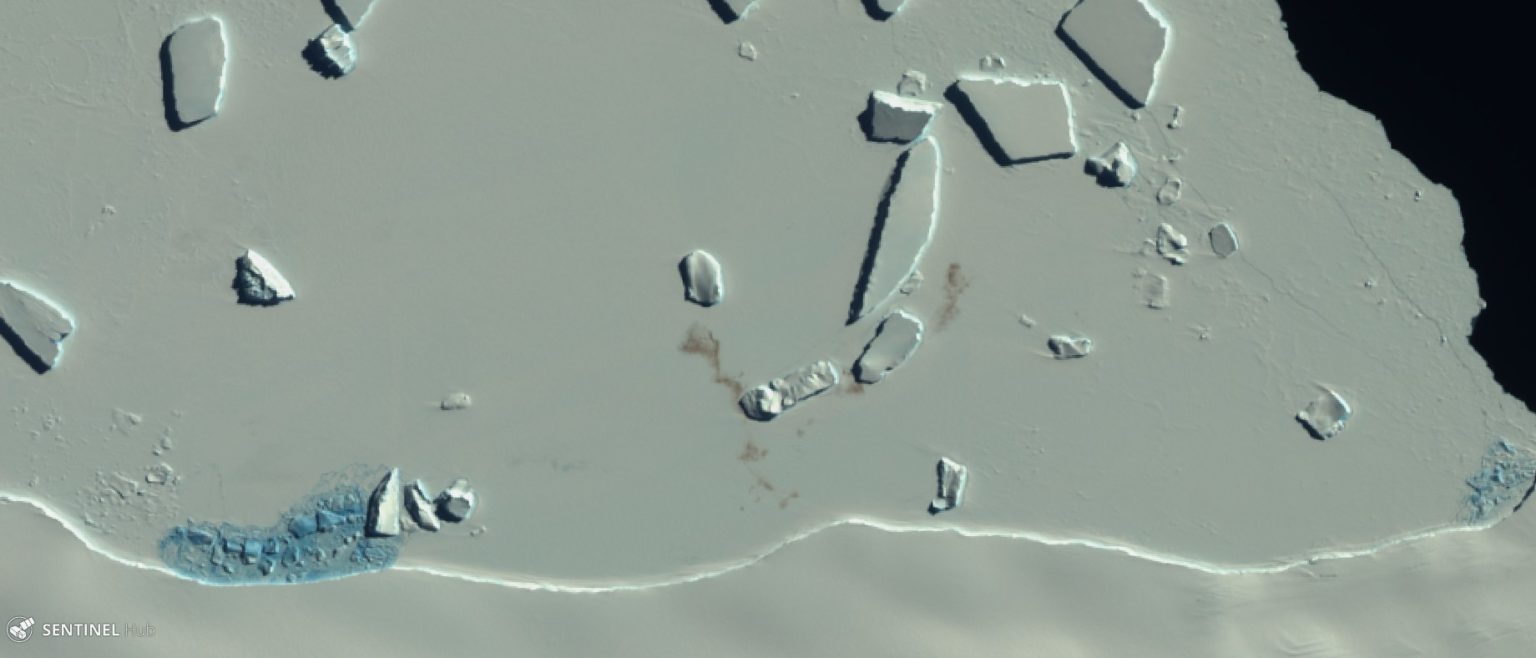
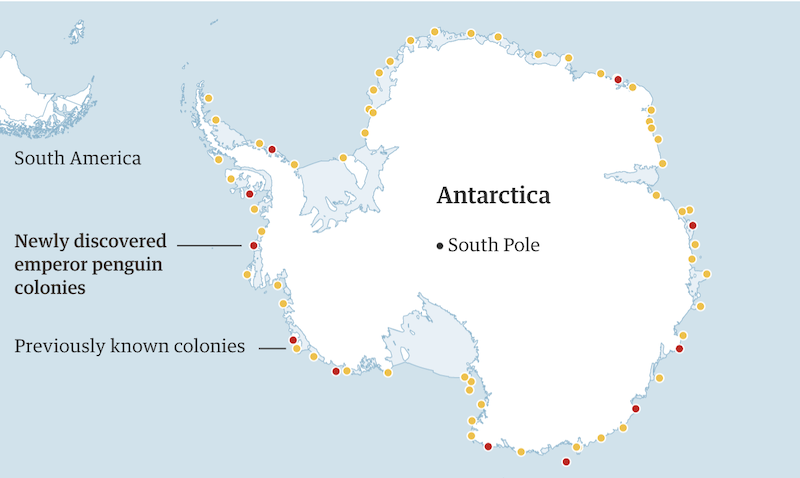
Satellite observations have found new emperor penguin breeding sites in the Antarctic. Scientists identified the locations by distinctive red-brown patches of the penguins’ guano – poo, that is – that stain the sea-ice.

The British Antarctic Survey (BAS) study has revealed there are nearly 20% more emperor penguin colonies in Antarctica than was previously thought. They found 11 new colonies, 3 of which were previously identified but never confirmed. The new discovery brings the global census to 61 emperor penguin colonies around the Antarctic continent.

BAS remote-sensing specialist Peter Fretwell is lead author of the study, published August 4, 2020 in the journal Remote Sensing in Ecology and Conservation. Fretwell told the BBC:

It’s good news because there are now more penguins than we thought. But this story comes with a strong caveat because the newly discovered sites are not in what we call the refugia – areas with stable sea-ice, such as in the Weddell Sea and the Ross Sea. They are all in more northerly, vulnerable locations that will likely lose their sea-ice.

Emperor penguins – the tallest and heaviest penguin species – are endemic to Antarctica and need sea ice to breed.

Orbital view of vast area of ice, next to deep blue sea, with small reddish smudges on the ice.

The smudges on the ice show the existence of an emperor penguin colony. Image taken from the European Commission’s Copernicus Sentinel-2 satellite. Image via BAS.

Emperor penguins are very difficult to study. They live in areas that are remote and often inaccessible, with temperatures as low as -58 degrees Fahrenheit (-50 degrees C). For the last 10 years, BAS scientists have been looking for new colonies by searching for their guano stains on the ice. For the new study, the researchers used images from the European Commission’s Copernicus Sentinel-2 satellite mission to locate the birds.

Fretwell said in a statement:

This is an exciting discovery. The new satellite images of Antarctica’s coastline have enabled us to find these new colonies. And whilst this is good news, the colonies are small and so only take the overall population count up by 5-10% to just over half a million penguins or around 265,500 – 278,500 breeding pairs.

Many penguins on ice beach under ice cliff.

Emperor penguins need a reliable and stable platform of sea-ice. Image via Christopher Walton/ BBC.

Emperor penguins are vulnerable to loss of sea ice, which is where they breed. With current projections of climate change, this habitat is likely to decline. Previous studies have estimated that 90% of known colonies will be lost by the end of the century if no further action is taken to cut the greenhouse gas emissions that drive global heating. Most of the newly found colonies are situated at the margins of the emperors’ breeding range. Therefore, these locations are likely to be lost as the climate warms.

Phil Trathan, Head of Conservation Biology at BAS, has been studying penguins for the last 3 decades. He said:

Whilst it’s good news that we’ve found these new colonies, the breeding sites are all in locations where recent model projections suggest emperors will decline. Birds in these sites are therefore probably the ‘canaries in the coal mine’ – we need to watch these sites carefully as climate change will affect this region.

Map of Antarctica with many yellow and about 10 red dots around the margin, representing known and newly discovered colonies respectively.

Antarctica’s emperor penguin colonies. Image via BAS/ The Guardian.

The study found a number of colonies located up to 100 miles (180 km) far offshore, situated on sea ice that has formed around icebergs that had grounded in shallow water.

Bottom line: Satellite images have revealed 11 previously unknown emperor penguin colonies in Antarctica, boosting the number of known colonies of the birds by 20%. Scientists made the discoveries by spotting patches of the telltale reddish-brown guano stains the birds leave on the ice.

Source: Discovery of new colonies by Sentinel2 reveals good and bad news for emperor penguins

Via British Antarctic Survey


from EarthSky https://ift.tt/33Cs9pu
A group of penguins huddled together on the ice near open water, with ice cliffs in background.

Emperor penguins on sea ice at the Brunt ice shelf near the British Antarctic Survey’s Halley Research Station. Image via British Antarctic Survey.

EarthSky’s yearly crowd-funding campaign is in progress. In 2020, we are donating 8.5% of all incoming revenues to No Kids Hungry. Click to learn more and donate.

Satellite observations have found new emperor penguin breeding sites in the Antarctic. Scientists identified the locations by distinctive red-brown patches of the penguins’ guano – poo, that is – that stain the sea-ice.

The British Antarctic Survey (BAS) study has revealed there are nearly 20% more emperor penguin colonies in Antarctica than was previously thought. They found 11 new colonies, 3 of which were previously identified but never confirmed. The new discovery brings the global census to 61 emperor penguin colonies around the Antarctic continent.

BAS remote-sensing specialist Peter Fretwell is lead author of the study, published August 4, 2020 in the journal Remote Sensing in Ecology and Conservation. Fretwell told the BBC:

It’s good news because there are now more penguins than we thought. But this story comes with a strong caveat because the newly discovered sites are not in what we call the refugia – areas with stable sea-ice, such as in the Weddell Sea and the Ross Sea. They are all in more northerly, vulnerable locations that will likely lose their sea-ice.

Emperor penguins – the tallest and heaviest penguin species – are endemic to Antarctica and need sea ice to breed.

Orbital view of vast area of ice, next to deep blue sea, with small reddish smudges on the ice.

The smudges on the ice show the existence of an emperor penguin colony. Image taken from the European Commission’s Copernicus Sentinel-2 satellite. Image via BAS.

Emperor penguins are very difficult to study. They live in areas that are remote and often inaccessible, with temperatures as low as -58 degrees Fahrenheit (-50 degrees C). For the last 10 years, BAS scientists have been looking for new colonies by searching for their guano stains on the ice. For the new study, the researchers used images from the European Commission’s Copernicus Sentinel-2 satellite mission to locate the birds.

Fretwell said in a statement:

This is an exciting discovery. The new satellite images of Antarctica’s coastline have enabled us to find these new colonies. And whilst this is good news, the colonies are small and so only take the overall population count up by 5-10% to just over half a million penguins or around 265,500 – 278,500 breeding pairs.

Many penguins on ice beach under ice cliff.

Emperor penguins need a reliable and stable platform of sea-ice. Image via Christopher Walton/ BBC.

Emperor penguins are vulnerable to loss of sea ice, which is where they breed. With current projections of climate change, this habitat is likely to decline. Previous studies have estimated that 90% of known colonies will be lost by the end of the century if no further action is taken to cut the greenhouse gas emissions that drive global heating. Most of the newly found colonies are situated at the margins of the emperors’ breeding range. Therefore, these locations are likely to be lost as the climate warms.

Phil Trathan, Head of Conservation Biology at BAS, has been studying penguins for the last 3 decades. He said:

Whilst it’s good news that we’ve found these new colonies, the breeding sites are all in locations where recent model projections suggest emperors will decline. Birds in these sites are therefore probably the ‘canaries in the coal mine’ – we need to watch these sites carefully as climate change will affect this region.

Map of Antarctica with many yellow and about 10 red dots around the margin, representing known and newly discovered colonies respectively.

Antarctica’s emperor penguin colonies. Image via BAS/ The Guardian.

The study found a number of colonies located up to 100 miles (180 km) far offshore, situated on sea ice that has formed around icebergs that had grounded in shallow water.

Bottom line: Satellite images have revealed 11 previously unknown emperor penguin colonies in Antarctica, boosting the number of known colonies of the birds by 20%. Scientists made the discoveries by spotting patches of the telltale reddish-brown guano stains the birds leave on the ice.

Source: Discovery of new colonies by Sentinel2 reveals good and bad news for emperor penguins

Via British Antarctic Survey


from EarthSky https://ift.tt/33Cs9pu

adds 2