aads

See the August waning gibbous moon now

Ilija Desic caught a waning gibbous moon with seagulls in Belgrade, Serbia.

Between full and last quarter moon, late at night or in the early morning, you may see the moon in its waning gibbous phase: less than full but more than half-lighted. A full moon rises just at sunset. A waning gibbous moon rises later at night and appears in the morning sky.

A waning gibbous moon can surprise you if you happen to be out late in the evening. It rises eerily some hours after sunset, glowing red like a full moon when it’s near the horizon.

Sometimes it looks like a misshapen clone of a full moon.

EarthSky’s yearly crowd-funding campaign is in progress. In 2020, we are donating 8.5% to No Kids Hungry. Please donate to help us keep going, and help feed a kid!

Wonderful photo of a waning gibbous moonrise over Toronto, via our friend Lunar 101-Moon Book.

A waning gibbous moon also initiates a rash of questions about seeing the moon during the day.

If it rises late at night, you know the waning gibbous moon must set after sunrise.

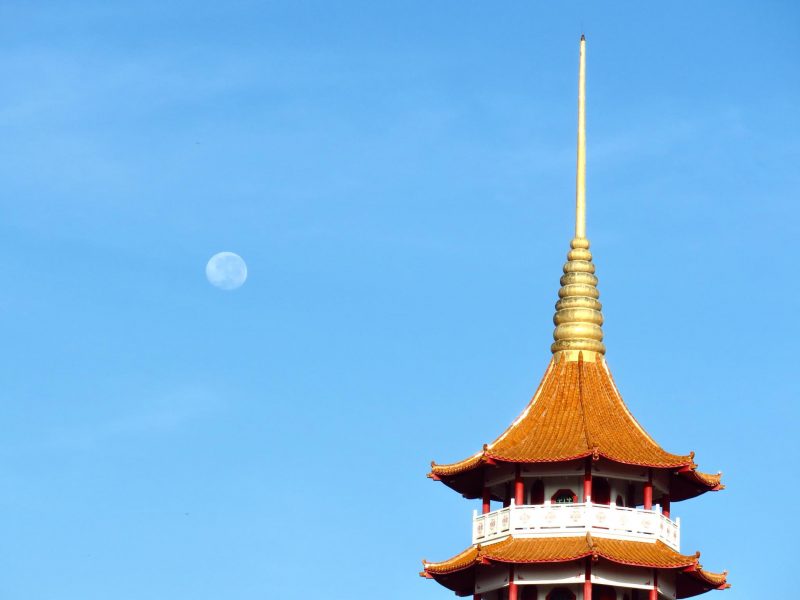
In fact, in the few days after full moon, you’ll often see the waning gibbous moon in the west in early morning, floating against the pale blue sky.

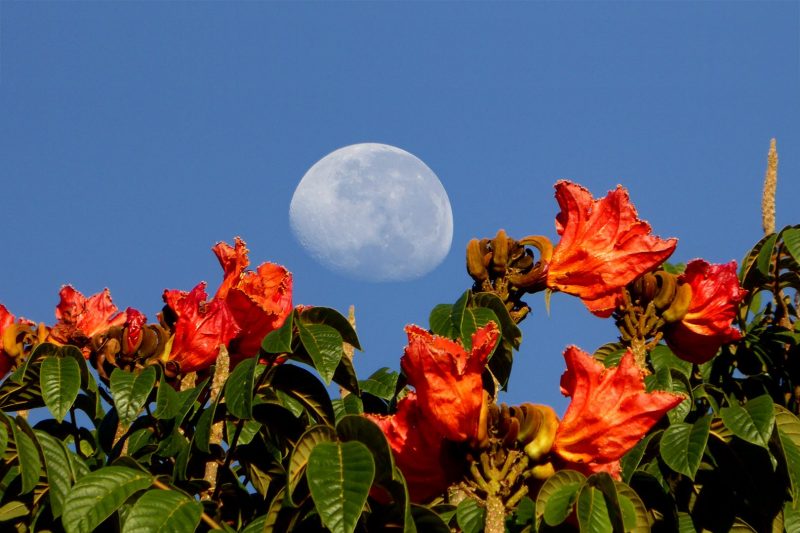
Jenney Disimon caught this daytime moon – a waning gibbous moon, 94.7% illuminated – from Sabah, North Borneo.

Bulging white moon in blue sky over orange-red flowers.

View at EarthSky Community Photos. | Peter Lowenstein caught the early morning waning gibbous moon from Mutare, Zimbabwe, on May 11, 2020. He said: “Three quarters of an hour after sunrise the daytime Waning Gibbous Moon was photographed descending towards the top of a flowering African Tulip (Spathodia campanulta) tree on Murambi Heights.”

As the moon orbits Earth, it changes phase in an orderly way. Follow the links below to understand the phases of the moon.

New moon
Waxing crescent moon
First quarter moon
Waxing gibbous moon
Full moon
Waning gibbous moon
Last quarter moon
Waning crescent moon

Read more: 4 keys to understanding moon phases

Bottom line: See the waning gibbous moon between the full and last quarter phases. It’s best viewed from late night through early morning.

EarthSky’s guide to the August bright planets.

Help EarthSky keep going! Please donate.


from EarthSky https://ift.tt/2qdoWrl

Ilija Desic caught a waning gibbous moon with seagulls in Belgrade, Serbia.

Between full and last quarter moon, late at night or in the early morning, you may see the moon in its waning gibbous phase: less than full but more than half-lighted. A full moon rises just at sunset. A waning gibbous moon rises later at night and appears in the morning sky.

A waning gibbous moon can surprise you if you happen to be out late in the evening. It rises eerily some hours after sunset, glowing red like a full moon when it’s near the horizon.

Sometimes it looks like a misshapen clone of a full moon.

EarthSky’s yearly crowd-funding campaign is in progress. In 2020, we are donating 8.5% to No Kids Hungry. Please donate to help us keep going, and help feed a kid!

Wonderful photo of a waning gibbous moonrise over Toronto, via our friend Lunar 101-Moon Book.

A waning gibbous moon also initiates a rash of questions about seeing the moon during the day.

If it rises late at night, you know the waning gibbous moon must set after sunrise.

In fact, in the few days after full moon, you’ll often see the waning gibbous moon in the west in early morning, floating against the pale blue sky.

Jenney Disimon caught this daytime moon – a waning gibbous moon, 94.7% illuminated – from Sabah, North Borneo.

Bulging white moon in blue sky over orange-red flowers.

View at EarthSky Community Photos. | Peter Lowenstein caught the early morning waning gibbous moon from Mutare, Zimbabwe, on May 11, 2020. He said: “Three quarters of an hour after sunrise the daytime Waning Gibbous Moon was photographed descending towards the top of a flowering African Tulip (Spathodia campanulta) tree on Murambi Heights.”

As the moon orbits Earth, it changes phase in an orderly way. Follow the links below to understand the phases of the moon.

New moon
Waxing crescent moon
First quarter moon
Waxing gibbous moon
Full moon
Waning gibbous moon
Last quarter moon
Waning crescent moon

Read more: 4 keys to understanding moon phases

Bottom line: See the waning gibbous moon between the full and last quarter phases. It’s best viewed from late night through early morning.

EarthSky’s guide to the August bright planets.

Help EarthSky keep going! Please donate.


from EarthSky https://ift.tt/2qdoWrl

In 2020, Venus and Perseid meteors!

EarthSky’s yearly crowd-funding campaign is in progress. In 2020, we are donating 8.5% to No Kids Hungry. Please donate to help us keep going, and help feed a kid!

Two major celestial events will happen almost concurrently in the predawn sky this month. The Perseid meteor shower will reach its annual peak on the mornings of August 11, 12 and 13. And the brightest planet, Venus, will swing out to its greatest elongation, or greatest apparent distance from the sun in our sky, in the east before sunup on August 12 or 13 (August 13 at 00:00 UTC. Translate UTC to your time.)

The Perseids are rising to their peak now. And Venus is already high and bright in the east at dawn. So – in the hours before sunup in the coming mornings, and especially around August 11, 12 and 13 – you can simultaneously be watching for Perseid meteors, and witness Venus at its most glorious.

The Perseid meteor shower is an annual event, its peak coming on or near the same date every year. Meanwhile, Venus has a regular 8-year cycle in our sky. Thus we won’t have a greatest morning elongation of Venus so closely coinciding with the peak of a Perseid meteor shower again until August 2028.

Now the bad news. This year’s Perseid peak will be somewhat obscured by moonlight. The moon reaches its last quarter phase on August 11. A last quarter moon rises at midnight, and, like most meteors in annual showers, the Perseids don’t kick into high gear each night until midnight or afterwards, when the shower’s radiant point has had a chance to ascend in your sky. Don’t let the moon discourage you, though. Perseid meteors tend to be bright. Some will overcome the moon’s glare. This post tells you how to minimize the moon and optimize your chances for seeing the most possible meteors in 2020.

Read more: Peak Perseid mornings: August 11, 12, 13

Read more: The 8-year cycle and 5 petals of Venus
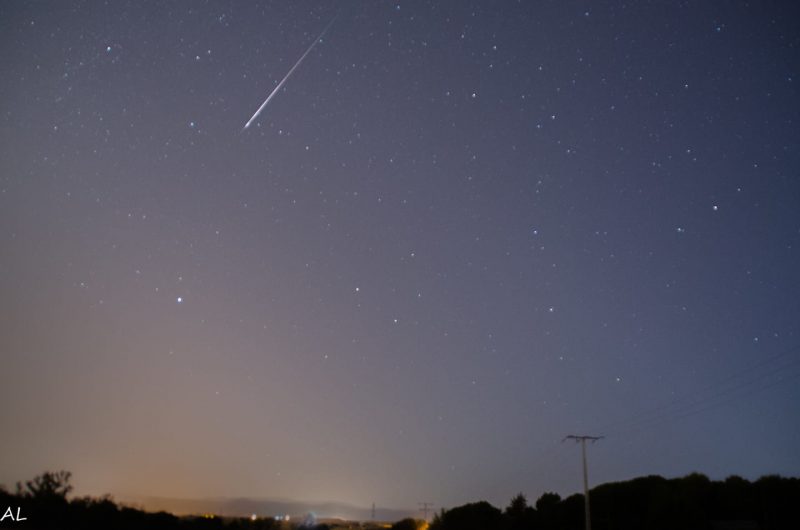
Star-sprinkled dawn sky with a high, thin white streak brighter at one end.

View larger. Annie Lewis told us, “Finally the clouds cleared. Perseid meteor just before dawn (August 13, 2019) in Madrid, Spain.” Thank you, Annie!

What causes a greatest morning elongation of Venus?

Because Venus orbits the sun inside our planet’s orbit, Venus appears rather closely tethered to the sun, as seen from Earth.

For instance, Venus can never be opposite (180 degrees from) the sun in our sky (like the full moon), or even be as far as 90 degrees from the sun (like a half-lit quarter moon).

At the end of its tether – at the outer edge of its orbit as seen from Earth – Venus, at most, swings a little over 47 degrees from the sun on the sky’s dome. That maximum distance is what astronomers call a greatest elongation. If, at such a time, Venus is shining east of the sun, we see Venus in the west after sunset. If Venus is shining west of the sun, we see Venus in the east before sunrise.

On August 12 or 13, 2020 (depending on your time zone) Venus swings 45.8 degrees west of the sun, exhibiting its greatest elongation in the morning sky.
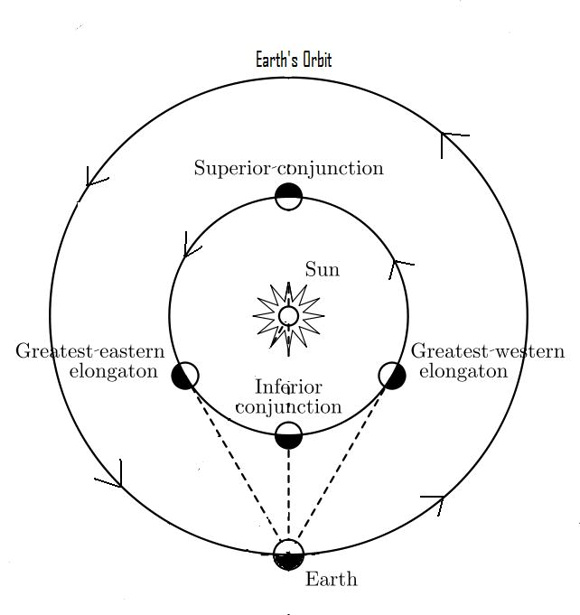
Diagram of orbits of Earth and Venus with lines drawn to greatest elongation locations.

Not to scale. The radius of Venus’ orbit is about 0.72 of Earth’s distance from the sun (0.72 of an astronomical unit). Venus appears in the evening sky at its greatest eastern elongation, and in the morning sky at its greatest western elongation.

The Golden Triangle and Venus’ cycles

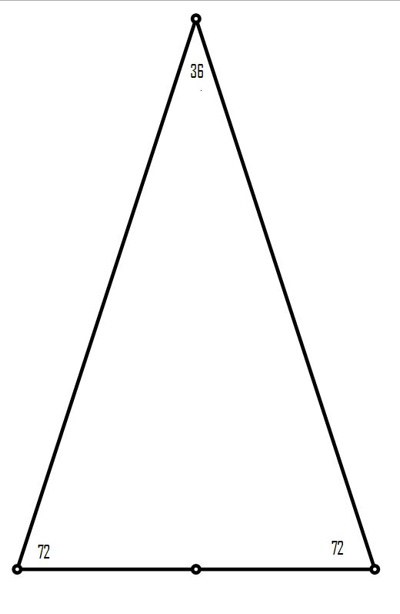
Once you become conversant with the Golden Triangle, you automatically possess the Rosetta Stone to Venus and her golden cycles. The Golden Triangle is an isosceles triangle with two of its angles = 72 degrees and the third angle = 36 degrees.

These two numbers, 72 and 36, give you the means to master Venusian cycles.

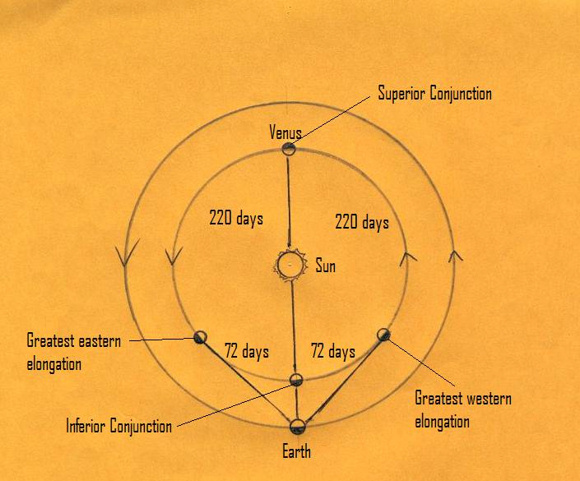
Look at the illustration below to see Venus’ orbit inside Earth’s orbit. We’re viewing the north side of the solar system plane, whereby the planets revolve counterclockwise around the sun. Venus is at its greatest eastern (evening) elongation at left and its greatest western (morning) elongation at right.

A greatest western (morning) elongation of Venus takes place some 144 days after Venus’ greatest eastern (evening) elongation.

Thus, about 72 days after reaching its greatest eastern elongation in the evening sky, Venus passes between the sun and Earth at inferior conjunction. Then 72 days after reaching inferior conjunction, Venus swings out to its greatest western elongation in the morning sky.

So, to remember Venus’ cycles, remember the Golden Triangle and the number 72!
Tall, narrow triangle with angles of joints marked in degrees.

The Golden Triangle, with the apex angle = 36 degrees and base angles = 72 degrees
Annotated diagram of Earth's and Venus' orbits.

The Earth and Venus orbit the sun counterclockwise as seen to the north of the solar system plane. When Venus is to the east (left) of the Earth-sun line, we see Venus as an evening “star” in the west after sunset. After Venus reaches its inferior conjunction, Venus then moves to the west (right) of the Earth- sun line, appearing as a morning “star” in the east before sunrise.

Look through the telescope, and you’ll see that Venus’ disk always displays a half-lit (50% illuminated) quarter phase at the vicinity of its greatest elongation, either in the evening or morning sky. It’s a waning quarter Venus in the evening sky and a waxing quarter Venus in the morning sky.

At its greatest elongation, Venus makes a right (90 degree) angle with the Earth and sun, with Venus residing at the vertex of this 90-degree angle. The innovative astronomer Copernicus used a greatest elongation and trigonometry to figure out that Venus’ distance from the sun equals 0.72 the Earth’s distance from the Sun. Uncanny how that number 72 keeps cropping up!

Don’t forget the number 36!

This may come as a surprise to you, but Venus shines at greatest brilliancy in the evening and morning sky when its disk is approximately one-quarter (25%) illuminated by sunshine. Midway between a greatest elongation and an inferior conjunction, Venus showcases its greatest illuminated extent, at which juncture the illuminated portion of Venus covers the greatest square area of sky. Venus reaches its greatest illuminated extent some 36 days before and after inferior conjunction. It also reaches its greatest illuminated extent some 36 days after its greatest evening elongation, and 36 days before its greatest morning elongation.

Venus and the Pentagram

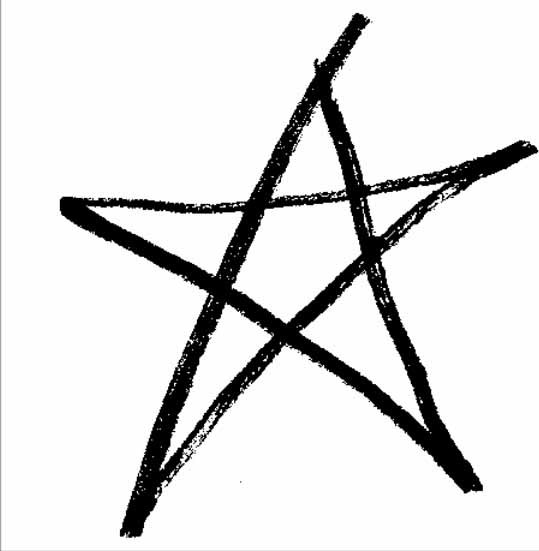
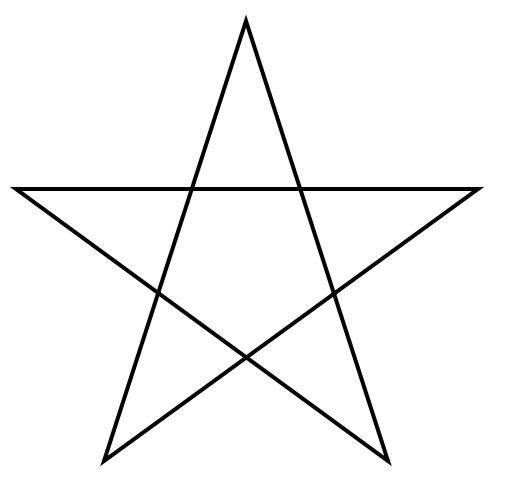
Venus is often represented by the Pentagram, which is composed of 5 Golden Triangles and a regular pentagon. The Pentagram well symbolizes Venus because all Venus’ milestones (greatest evening elongation, greatest illuminated extent in the evening sky, inferior conjunction, greatest illuminated extent in the morning sky, greatest morning elongation and superior conjunction) recur five times in eight Earth-years or 13 Venus-years. Some of you may recognize the 5:8:13 Fibonacci sequence, a tribute to the beauty of Venus and the Golden Ratio!
Five-pointed star.

Venus is often represented by the Pentagram, which is composed of 5 Golden Triangles and a pentagon in the center.

Bottom line: In 2020, the peak of the Perseid meteor shower nearly coincides with Venus’ greatest elongation, or greatest apparent distance from the sun in our sky. Both will fall around the mornings of August 11, 12 and 13.


from EarthSky https://ift.tt/2DBupSX

EarthSky’s yearly crowd-funding campaign is in progress. In 2020, we are donating 8.5% to No Kids Hungry. Please donate to help us keep going, and help feed a kid!

Two major celestial events will happen almost concurrently in the predawn sky this month. The Perseid meteor shower will reach its annual peak on the mornings of August 11, 12 and 13. And the brightest planet, Venus, will swing out to its greatest elongation, or greatest apparent distance from the sun in our sky, in the east before sunup on August 12 or 13 (August 13 at 00:00 UTC. Translate UTC to your time.)

The Perseids are rising to their peak now. And Venus is already high and bright in the east at dawn. So – in the hours before sunup in the coming mornings, and especially around August 11, 12 and 13 – you can simultaneously be watching for Perseid meteors, and witness Venus at its most glorious.

The Perseid meteor shower is an annual event, its peak coming on or near the same date every year. Meanwhile, Venus has a regular 8-year cycle in our sky. Thus we won’t have a greatest morning elongation of Venus so closely coinciding with the peak of a Perseid meteor shower again until August 2028.

Now the bad news. This year’s Perseid peak will be somewhat obscured by moonlight. The moon reaches its last quarter phase on August 11. A last quarter moon rises at midnight, and, like most meteors in annual showers, the Perseids don’t kick into high gear each night until midnight or afterwards, when the shower’s radiant point has had a chance to ascend in your sky. Don’t let the moon discourage you, though. Perseid meteors tend to be bright. Some will overcome the moon’s glare. This post tells you how to minimize the moon and optimize your chances for seeing the most possible meteors in 2020.

Read more: Peak Perseid mornings: August 11, 12, 13

Read more: The 8-year cycle and 5 petals of Venus

Star-sprinkled dawn sky with a high, thin white streak brighter at one end.

View larger. Annie Lewis told us, “Finally the clouds cleared. Perseid meteor just before dawn (August 13, 2019) in Madrid, Spain.” Thank you, Annie!

What causes a greatest morning elongation of Venus?

Because Venus orbits the sun inside our planet’s orbit, Venus appears rather closely tethered to the sun, as seen from Earth.

For instance, Venus can never be opposite (180 degrees from) the sun in our sky (like the full moon), or even be as far as 90 degrees from the sun (like a half-lit quarter moon).

At the end of its tether – at the outer edge of its orbit as seen from Earth – Venus, at most, swings a little over 47 degrees from the sun on the sky’s dome. That maximum distance is what astronomers call a greatest elongation. If, at such a time, Venus is shining east of the sun, we see Venus in the west after sunset. If Venus is shining west of the sun, we see Venus in the east before sunrise.

On August 12 or 13, 2020 (depending on your time zone) Venus swings 45.8 degrees west of the sun, exhibiting its greatest elongation in the morning sky.

Diagram of orbits of Earth and Venus with lines drawn to greatest elongation locations.

Not to scale. The radius of Venus’ orbit is about 0.72 of Earth’s distance from the sun (0.72 of an astronomical unit). Venus appears in the evening sky at its greatest eastern elongation, and in the morning sky at its greatest western elongation.

The Golden Triangle and Venus’ cycles

Once you become conversant with the Golden Triangle, you automatically possess the Rosetta Stone to Venus and her golden cycles. The Golden Triangle is an isosceles triangle with two of its angles = 72 degrees and the third angle = 36 degrees.

These two numbers, 72 and 36, give you the means to master Venusian cycles.

Look at the illustration below to see Venus’ orbit inside Earth’s orbit. We’re viewing the north side of the solar system plane, whereby the planets revolve counterclockwise around the sun. Venus is at its greatest eastern (evening) elongation at left and its greatest western (morning) elongation at right.

A greatest western (morning) elongation of Venus takes place some 144 days after Venus’ greatest eastern (evening) elongation.

Thus, about 72 days after reaching its greatest eastern elongation in the evening sky, Venus passes between the sun and Earth at inferior conjunction. Then 72 days after reaching inferior conjunction, Venus swings out to its greatest western elongation in the morning sky.

So, to remember Venus’ cycles, remember the Golden Triangle and the number 72!

Tall, narrow triangle with angles of joints marked in degrees.

The Golden Triangle, with the apex angle = 36 degrees and base angles = 72 degrees

Annotated diagram of Earth's and Venus' orbits.

The Earth and Venus orbit the sun counterclockwise as seen to the north of the solar system plane. When Venus is to the east (left) of the Earth-sun line, we see Venus as an evening “star” in the west after sunset. After Venus reaches its inferior conjunction, Venus then moves to the west (right) of the Earth- sun line, appearing as a morning “star” in the east before sunrise.

Look through the telescope, and you’ll see that Venus’ disk always displays a half-lit (50% illuminated) quarter phase at the vicinity of its greatest elongation, either in the evening or morning sky. It’s a waning quarter Venus in the evening sky and a waxing quarter Venus in the morning sky.

At its greatest elongation, Venus makes a right (90 degree) angle with the Earth and sun, with Venus residing at the vertex of this 90-degree angle. The innovative astronomer Copernicus used a greatest elongation and trigonometry to figure out that Venus’ distance from the sun equals 0.72 the Earth’s distance from the Sun. Uncanny how that number 72 keeps cropping up!

Don’t forget the number 36!

This may come as a surprise to you, but Venus shines at greatest brilliancy in the evening and morning sky when its disk is approximately one-quarter (25%) illuminated by sunshine. Midway between a greatest elongation and an inferior conjunction, Venus showcases its greatest illuminated extent, at which juncture the illuminated portion of Venus covers the greatest square area of sky. Venus reaches its greatest illuminated extent some 36 days before and after inferior conjunction. It also reaches its greatest illuminated extent some 36 days after its greatest evening elongation, and 36 days before its greatest morning elongation.

Venus and the Pentagram

Venus is often represented by the Pentagram, which is composed of 5 Golden Triangles and a regular pentagon. The Pentagram well symbolizes Venus because all Venus’ milestones (greatest evening elongation, greatest illuminated extent in the evening sky, inferior conjunction, greatest illuminated extent in the morning sky, greatest morning elongation and superior conjunction) recur five times in eight Earth-years or 13 Venus-years. Some of you may recognize the 5:8:13 Fibonacci sequence, a tribute to the beauty of Venus and the Golden Ratio!

Five-pointed star.

Venus is often represented by the Pentagram, which is composed of 5 Golden Triangles and a pentagon in the center.

Bottom line: In 2020, the peak of the Perseid meteor shower nearly coincides with Venus’ greatest elongation, or greatest apparent distance from the sun in our sky. Both will fall around the mornings of August 11, 12 and 13.


from EarthSky https://ift.tt/2DBupSX
Forecasters bump up hurricane predictions for 2020

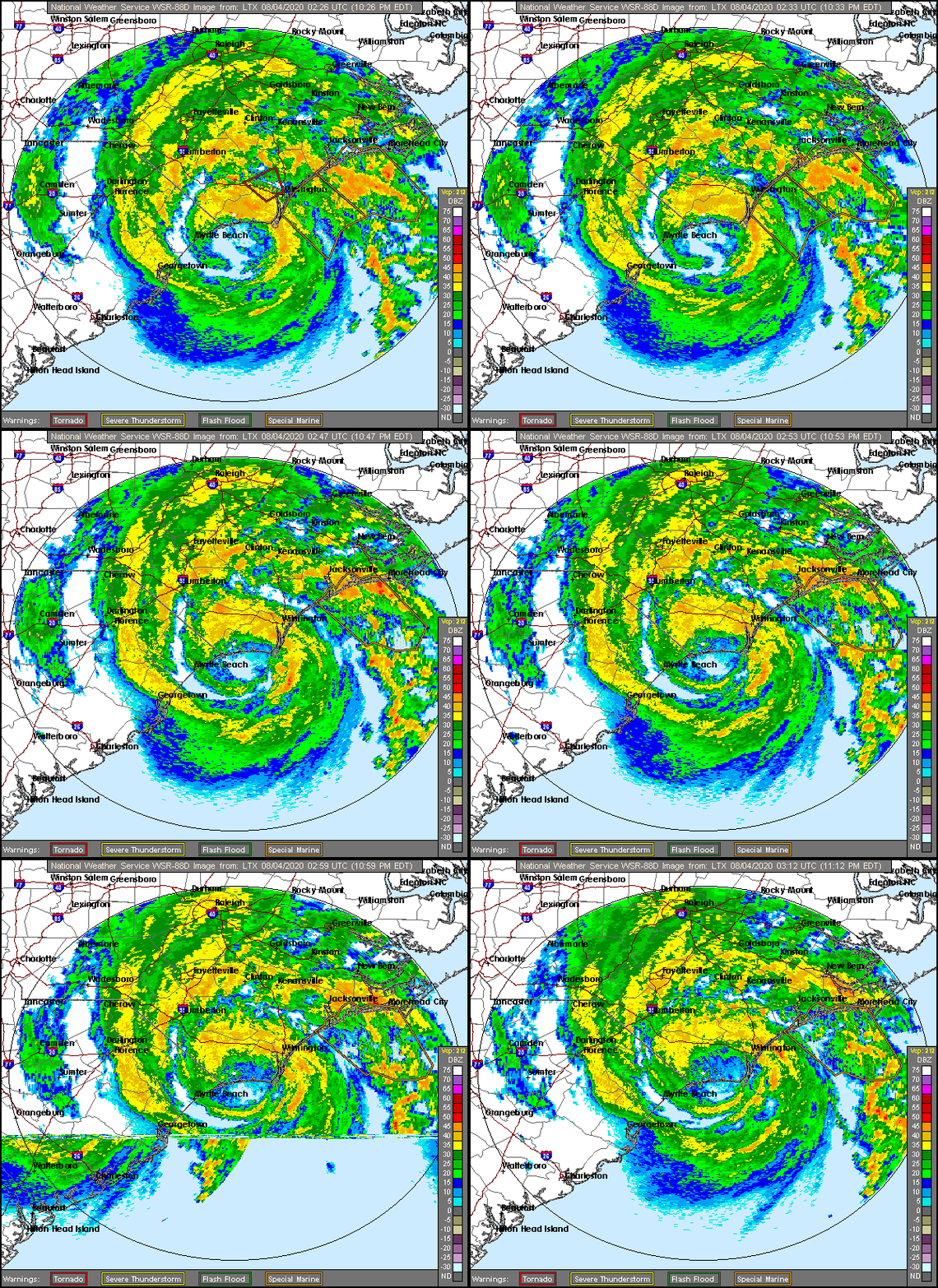
Animated gif of huge colorful spiral, traveling up the U.S. East Coast.

Hurricane Isaias as seen on weather radar, making landfall near Ocean Isle Beach, North Carolina on August 4, 2020. Image via National Weather Service Wilmington/ Wikimedia Commons.

EarthSky’s yearly crowd-funding campaign is in progress. In 2020, we are donating 8.5% to No Kids Hungry. Please donate to help us keep going, and help feed a kid!

2020 was already predicted as an active hurricane season. Now it’s looking extremely active. Forecasters with Colorado State’s Tropical Meteorology Project said on Wednesday (August 5, 2020) they now expect five major hurricanes and 24 named storms in the 2020 Atlantic hurricane season. That’s an increase from a prediction they made in early July of four major hurricanes and 20 named storms. Meanwhile, from 1981 to 2010, Atlantic hurricanes averaged 12 named storms per year.

What’ll happen if we run out of hurricane names this year? More about that below.

Atlantic hurricane season officially begins on June 1 each year, and most major hurricanes tend to come later in the season. However, in terms of numbers, the season got off to a roaring start this year. 2020 is the first hurricane season on record with nine named storms (two hurricanes) before August 1.

2020’s named tropical storms so far are Arthur, Bertha, Cristobal, Dolly, Edouard, Fay, Gonzalo, Hanna (a hurricane) and Isaias (a hurricane).

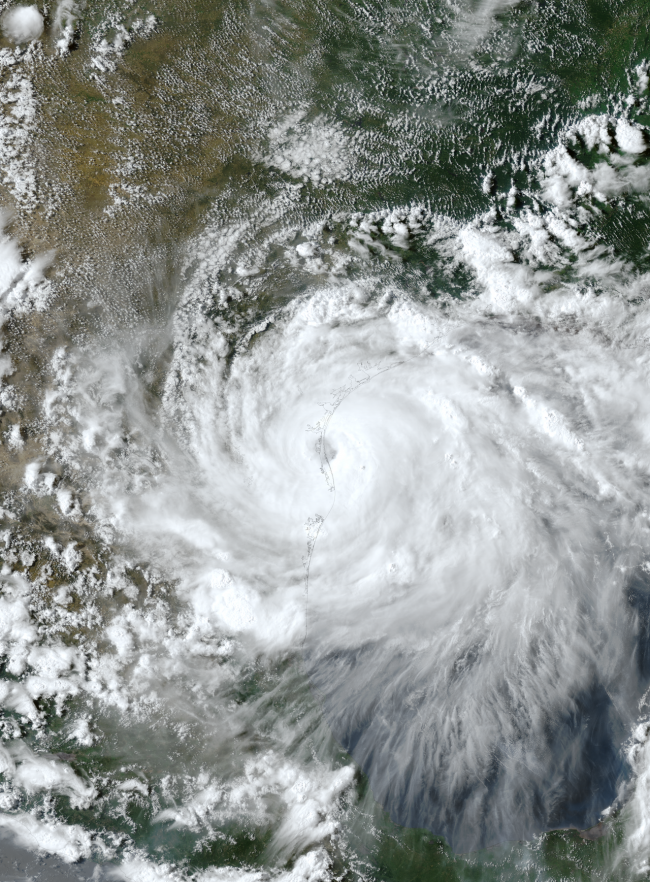
All were tropical storms, but Hanna and Isaias had maximum sustained winds strong enough (above 74 mph or 119 kph) to categorize them as hurricanes. Both Hanna and Isaias made landfall in the U.S. Hanna reached its peak intensity with winds at 90 miles per hour (140 km/h) on July 25, the same day it made its first landfall at Padre Island, Texas (Hanna had a second landfall in Kenedy County, Texas, at the same intensity). Isaias had sustained winds of 85 miles per hour (137 km/h) when it made landfall on Ocean Isle Beach, North Carolina, on August 4.

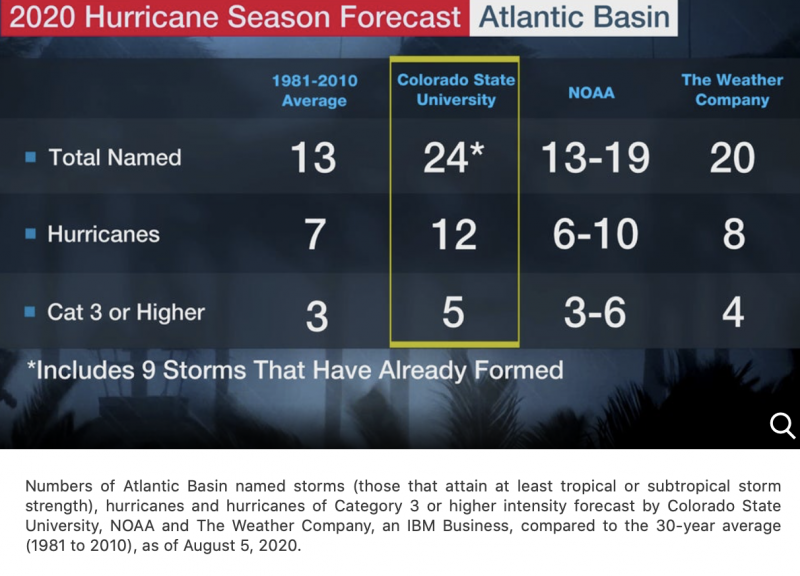
Colorado State’s Tropical Meteorology Project is not the only source of hurricane forecasts. The chart below shows some comparisons.

Table with columns of numbers representing a comparison of 2020 forecasts and long-term averages .

Chart via Weather.com.

What’ll happen if we run out of hurricane names in 2020? The Atlantic hurricane name list for 2020 contains a total of 21 names: Arthur, Bertha, Cristobal, Dolly, Edouard, Fay, Gonzalo, Hanna, Isaias, Josephine, Kyle, Laura, Marco, Nana, Omar, Paulette, Rene, Sally, Teddy, Vicky, and Wilfred.

If we run through those 21 Atlantic hurricane names, the rule of thumb is that any additional storms receive names from the Greek alphabet. So if we do have a tropical storm Wilfred in 2020, and another storm follows it, that storm will be Alpha. The next storm will be Beta, then Gamma, and so on.

So far, in the history of naming Atlantic hurricanes, we’ve gone to the Greek alphabet only once, in 2005. Remember that? It was the busiest hurricane season on record. There were 28 named storms that year.

Atlantic hurricane season will officially end on November 30; however, hurricanes can and do occur (as they did this year) before the official start of the season on June 1 and after its official end.

Read more: How do hurricanes get their names?

Orbital view of huge white spiral with dark dot in the middle next to Texas coastline.

Hurricane Hanna making its first landfall on Padre Island, Texas, on July 25, 2020. Image via NOAA/ Wikimedia Commons.

Bottom line: Forecasters with Colorado State’s Tropical Meteorology Project forecasters said on Wednesday (August 5, 2020) that they now expect five major hurricanes and 24 named storms in the 2020 Atlantic hurricane season.


from EarthSky https://ift.tt/33zr41I
Animated gif of huge colorful spiral, traveling up the U.S. East Coast.

Hurricane Isaias as seen on weather radar, making landfall near Ocean Isle Beach, North Carolina on August 4, 2020. Image via National Weather Service Wilmington/ Wikimedia Commons.

EarthSky’s yearly crowd-funding campaign is in progress. In 2020, we are donating 8.5% to No Kids Hungry. Please donate to help us keep going, and help feed a kid!

2020 was already predicted as an active hurricane season. Now it’s looking extremely active. Forecasters with Colorado State’s Tropical Meteorology Project said on Wednesday (August 5, 2020) they now expect five major hurricanes and 24 named storms in the 2020 Atlantic hurricane season. That’s an increase from a prediction they made in early July of four major hurricanes and 20 named storms. Meanwhile, from 1981 to 2010, Atlantic hurricanes averaged 12 named storms per year.

What’ll happen if we run out of hurricane names this year? More about that below.

Atlantic hurricane season officially begins on June 1 each year, and most major hurricanes tend to come later in the season. However, in terms of numbers, the season got off to a roaring start this year. 2020 is the first hurricane season on record with nine named storms (two hurricanes) before August 1.

2020’s named tropical storms so far are Arthur, Bertha, Cristobal, Dolly, Edouard, Fay, Gonzalo, Hanna (a hurricane) and Isaias (a hurricane).

All were tropical storms, but Hanna and Isaias had maximum sustained winds strong enough (above 74 mph or 119 kph) to categorize them as hurricanes. Both Hanna and Isaias made landfall in the U.S. Hanna reached its peak intensity with winds at 90 miles per hour (140 km/h) on July 25, the same day it made its first landfall at Padre Island, Texas (Hanna had a second landfall in Kenedy County, Texas, at the same intensity). Isaias had sustained winds of 85 miles per hour (137 km/h) when it made landfall on Ocean Isle Beach, North Carolina, on August 4.

Colorado State’s Tropical Meteorology Project is not the only source of hurricane forecasts. The chart below shows some comparisons.

Table with columns of numbers representing a comparison of 2020 forecasts and long-term averages .

Chart via Weather.com.

What’ll happen if we run out of hurricane names in 2020? The Atlantic hurricane name list for 2020 contains a total of 21 names: Arthur, Bertha, Cristobal, Dolly, Edouard, Fay, Gonzalo, Hanna, Isaias, Josephine, Kyle, Laura, Marco, Nana, Omar, Paulette, Rene, Sally, Teddy, Vicky, and Wilfred.

If we run through those 21 Atlantic hurricane names, the rule of thumb is that any additional storms receive names from the Greek alphabet. So if we do have a tropical storm Wilfred in 2020, and another storm follows it, that storm will be Alpha. The next storm will be Beta, then Gamma, and so on.

So far, in the history of naming Atlantic hurricanes, we’ve gone to the Greek alphabet only once, in 2005. Remember that? It was the busiest hurricane season on record. There were 28 named storms that year.

Atlantic hurricane season will officially end on November 30; however, hurricanes can and do occur (as they did this year) before the official start of the season on June 1 and after its official end.

Read more: How do hurricanes get their names?

Orbital view of huge white spiral with dark dot in the middle next to Texas coastline.

Hurricane Hanna making its first landfall on Padre Island, Texas, on July 25, 2020. Image via NOAA/ Wikimedia Commons.

Bottom line: Forecasters with Colorado State’s Tropical Meteorology Project forecasters said on Wednesday (August 5, 2020) that they now expect five major hurricanes and 24 named storms in the 2020 Atlantic hurricane season.


from EarthSky https://ift.tt/33zr41I

The 8-year cycle and 5 petals of Venus

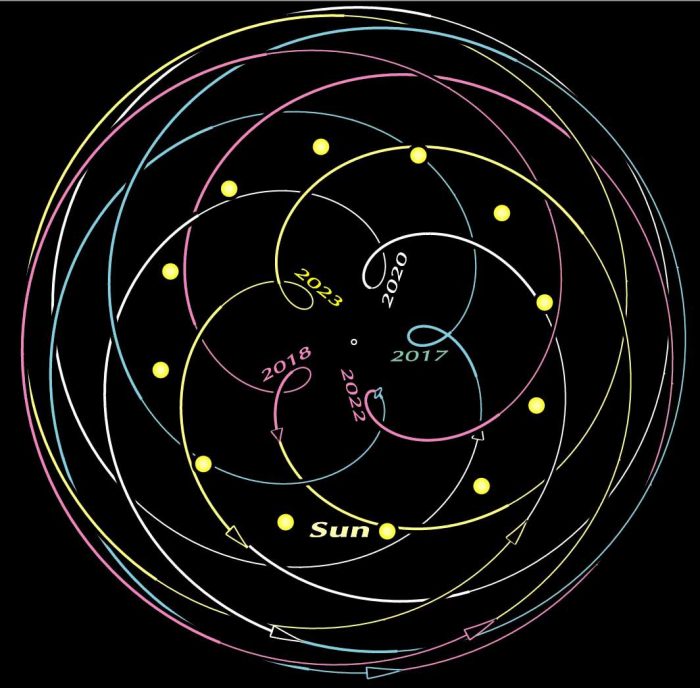
A geocentric - Earth-centered - plot of the orbit of Venus, 2016-2023, via Guy Ottewell.

A simplified geocentric – Earth-centered – plot of the orbit of Venus over 8 years – 2016-2023 – via Guy Ottewell.

Article written and published originally by Guy Ottewell at his blog. Re-printed here with permission.

In 2020: Venus and Perseid meteors!

When plotted geocentrically – from an Earth-centered perspective – there is a highly noticeable rhythm in the motion of Venus. After eight years, it returns to the same place in our sky on about the same date. This is known as the eight-year cycle of Venus, and stems from the fact that 13 Venusian orbits (8 x 224.8 days) very nearly equals eight Earth years. The cycle was known to, and of great interest to, ancient peoples such as the Maya. Today, many know it as the pentagram of Venus.

The word pentagram – or five-sided figure – is used because, over the eight years, each phenomenon – each relative position of Earth, Venus, and the sun – occurs five times. Then, over the next eight years, they repeat five times almost identically.

For Venus, the tight inward loops on the diagram above and animation below are the planet’s inferior conjunctions, in which Venus passes between us and the sun. The wide swings are centered on the superior conjunctions, when Venus passes around the far side of the sun from us. So the general pattern is (as Anthony Barreiro commented):

… a lovely five-petalled rose.

The tight loops are the stamens of the rose, the wide swings are the petals.

Below is an animation, showing the same thing … the orbit of Venus from an Earth-centered perspective. The smaller pale yellow dot is Venus, and the larger yellow ball is the sun:

When I tried to plot a geocentric picture over eight years (2016-2023) to show the complete rose, it was bewilderingly cluttered. It had five overlapping tracks, eight-times-twelve little Venus globes at monthly intervals – already too much without the ecliptic-plane grid and other details.

The image at the top of this post is a more simplified version: still calculated in three dimensions, but, by moving the viewpoint to the north ecliptic pole, it becomes a flat plan of Venus’s path.

Earth is in the middle; the vernal-equinox direction is to the right; the yellow spots are the sun at the beginning of each month.

The rest is the rhythmic motions of Venus.

You’ll still have trouble deciphering which part of the track is for which year (on the image at top, I’ve used white, cyan, magenta, yellow for 2016, 2017, 2018, 2019, and again for 2020, 2021, 2022, 2023) but it doesn’t matter greatly. You can see the five inferior conjunctions, in their five directions.

If you trace across the circle from each loop to the next, you see that they are not adjacent to each other but 2/5 pf the way around, like the five points of a pentagram.

A pentagram, from the cover picture story of Astronomical Calendar 2015, by Guy Ottewell.

A pentagram, from the cover picture story of Astronomical Calendar 2015, by Guy Ottewell.

The directions of the five inferior conjunctions of Venus determine their differing characters, by determining their places in Venus’s “true” (heliocentric) orbit, which is tilted and slightly elliptical.

2017 Mar 25: in Pisces; Venus passes 8 degrees north of the sun; distance from us 0.28 AU (astronomical units, aka sun-Earth distances); diameter of Venus’s (mostly dark) disk 60″ (arc seconds).
2018 Oct 26: in Virgo; 6° degree south of the sun; 0.27 AU; 62″.
2020 Jun 3: in Taurus; 0.5° north of the sun; 0.29 AU; 58″.
2022 Jan 9: in Sagittarius; 5° north of the sun; 0.27 AU; 63″.
2023 Aug 13: Cancer-Leo-Hydra border; 7° degrees south of the sun; 0.29 AU; 58″.

Bottom line: The highly noticeable rhythm in the motion of Venus from an geocentric perspective was famously mentioned in The Da Vinci Code by Dan Brown, and sometimes called the pentagram of Venus. Guy Ottewell provides a beautiful chart and explains more, here.


from EarthSky https://ift.tt/3ibVUBp
A geocentric - Earth-centered - plot of the orbit of Venus, 2016-2023, via Guy Ottewell.

A simplified geocentric – Earth-centered – plot of the orbit of Venus over 8 years – 2016-2023 – via Guy Ottewell.

Article written and published originally by Guy Ottewell at his blog. Re-printed here with permission.

In 2020: Venus and Perseid meteors!

When plotted geocentrically – from an Earth-centered perspective – there is a highly noticeable rhythm in the motion of Venus. After eight years, it returns to the same place in our sky on about the same date. This is known as the eight-year cycle of Venus, and stems from the fact that 13 Venusian orbits (8 x 224.8 days) very nearly equals eight Earth years. The cycle was known to, and of great interest to, ancient peoples such as the Maya. Today, many know it as the pentagram of Venus.

The word pentagram – or five-sided figure – is used because, over the eight years, each phenomenon – each relative position of Earth, Venus, and the sun – occurs five times. Then, over the next eight years, they repeat five times almost identically.

For Venus, the tight inward loops on the diagram above and animation below are the planet’s inferior conjunctions, in which Venus passes between us and the sun. The wide swings are centered on the superior conjunctions, when Venus passes around the far side of the sun from us. So the general pattern is (as Anthony Barreiro commented):

… a lovely five-petalled rose.

The tight loops are the stamens of the rose, the wide swings are the petals.

Below is an animation, showing the same thing … the orbit of Venus from an Earth-centered perspective. The smaller pale yellow dot is Venus, and the larger yellow ball is the sun:

When I tried to plot a geocentric picture over eight years (2016-2023) to show the complete rose, it was bewilderingly cluttered. It had five overlapping tracks, eight-times-twelve little Venus globes at monthly intervals – already too much without the ecliptic-plane grid and other details.

The image at the top of this post is a more simplified version: still calculated in three dimensions, but, by moving the viewpoint to the north ecliptic pole, it becomes a flat plan of Venus’s path.

Earth is in the middle; the vernal-equinox direction is to the right; the yellow spots are the sun at the beginning of each month.

The rest is the rhythmic motions of Venus.

You’ll still have trouble deciphering which part of the track is for which year (on the image at top, I’ve used white, cyan, magenta, yellow for 2016, 2017, 2018, 2019, and again for 2020, 2021, 2022, 2023) but it doesn’t matter greatly. You can see the five inferior conjunctions, in their five directions.

If you trace across the circle from each loop to the next, you see that they are not adjacent to each other but 2/5 pf the way around, like the five points of a pentagram.

A pentagram, from the cover picture story of Astronomical Calendar 2015, by Guy Ottewell.

A pentagram, from the cover picture story of Astronomical Calendar 2015, by Guy Ottewell.

The directions of the five inferior conjunctions of Venus determine their differing characters, by determining their places in Venus’s “true” (heliocentric) orbit, which is tilted and slightly elliptical.

2017 Mar 25: in Pisces; Venus passes 8 degrees north of the sun; distance from us 0.28 AU (astronomical units, aka sun-Earth distances); diameter of Venus’s (mostly dark) disk 60″ (arc seconds).
2018 Oct 26: in Virgo; 6° degree south of the sun; 0.27 AU; 62″.
2020 Jun 3: in Taurus; 0.5° north of the sun; 0.29 AU; 58″.
2022 Jan 9: in Sagittarius; 5° north of the sun; 0.27 AU; 63″.
2023 Aug 13: Cancer-Leo-Hydra border; 7° degrees south of the sun; 0.29 AU; 58″.

Bottom line: The highly noticeable rhythm in the motion of Venus from an geocentric perspective was famously mentioned in The Da Vinci Code by Dan Brown, and sometimes called the pentagram of Venus. Guy Ottewell provides a beautiful chart and explains more, here.


from EarthSky https://ift.tt/3ibVUBp

It’s time to watch a meteor shower

Meteors falling in a dark sky.

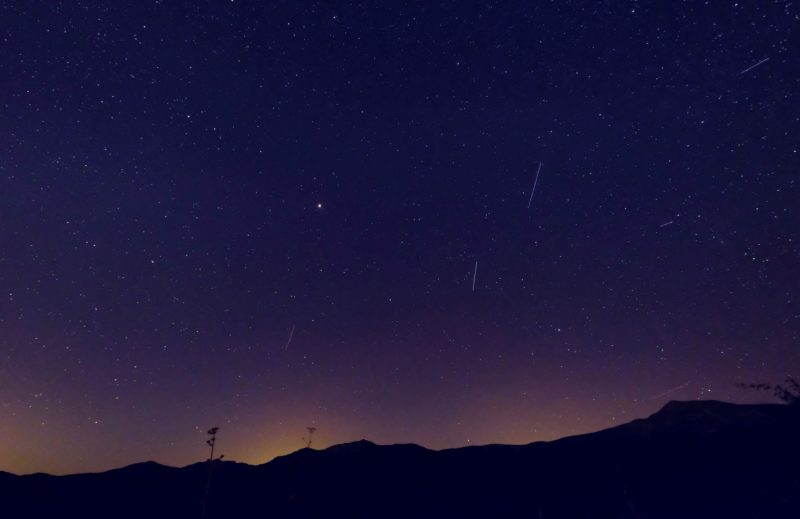
View at EarthSky Community Photos. | Bass Seckin in Bursa, Turkey captured these meteors on July 29 and wrote: “Bursa, in northwestern Turkey, has a population of 3 million. It’s almost impossible to see meteors there.I went 100 kilometers (60 miles) eastward … Interestingly I had seen only 1 or 2 meteors with the unaided eye, but when I checked frames, I saw there were 4 to 6 meteors on a single frame. The reddish spot at the center of the image is Mars, and Delta Aquariid meteors’ traces are from the upper-right corner toward the bottom.” Thank you, Bass!

Delta Aquarid meteor shower 2020: All you need to know

Perseid meteor shower 2020: All you need to know

Bottom line: This is where we’ll be posting photos of meteors from the EarthSky Community in 2020.


from EarthSky https://ift.tt/3a0acSN
Meteors falling in a dark sky.

View at EarthSky Community Photos. | Bass Seckin in Bursa, Turkey captured these meteors on July 29 and wrote: “Bursa, in northwestern Turkey, has a population of 3 million. It’s almost impossible to see meteors there.I went 100 kilometers (60 miles) eastward … Interestingly I had seen only 1 or 2 meteors with the unaided eye, but when I checked frames, I saw there were 4 to 6 meteors on a single frame. The reddish spot at the center of the image is Mars, and Delta Aquariid meteors’ traces are from the upper-right corner toward the bottom.” Thank you, Bass!

Delta Aquarid meteor shower 2020: All you need to know

Perseid meteor shower 2020: All you need to know

Bottom line: This is where we’ll be posting photos of meteors from the EarthSky Community in 2020.


from EarthSky https://ift.tt/3a0acSN

Mars landings: ‘7 minutes of terror’

EarthSky’s yearly crowd-funding campaign is in progress. In 2020, we are donating 8.5% to No Kids Hungry. Please donate to help us keep going, and help feed a kid!

Today is the 8-year anniversary of the Curiosity rover’s successful landing on the planet Mars. The landing was unprecedented for its use of new technologies designed to get the rover to Mars’ surface safely. To the great relief of space engineers, those technologies worked, and the rover successfully set down in Gale Crater on Mars at 10:31 p.m. Pacific Daylight Time on August 5, 2012 (05:31 UTC on August 6). Curiosity hit the top of Mars’ thin atmosphere at a velocity of about 5,900 meters per second (about 13,000 miles per hour). In seven minutes, it had to decelerate and then set down, hopefully gently, on the surface of the red planet. The rover’s entry, descent and landing phase lasted approximately seven minutes, which space engineers at the time described as:

… seven minutes of terror.

Going to the red planet is relatively easy. But landing on Mars is hard. In 2003, veteran NASA official Firouz Naderi commented:

Mars is a favorite target.

We – the United States and former USSR – have been going to Mars for 40 years. The first time we flew by a planet, it was Mars. The first time we orbited a planet, it was Mars. The first time we landed on a planet it was Mars, and the first time we roved around the surface of a planet, it was Mars. We go there often.

Around that time – around the turn of this century – the world was averaging about two failures for every three spacecraft launched toward Mars, according to NASA. There were a total of 39 Mars missions launched, and 25 failures or partial failures by the year 2000, according to Wikipedia.

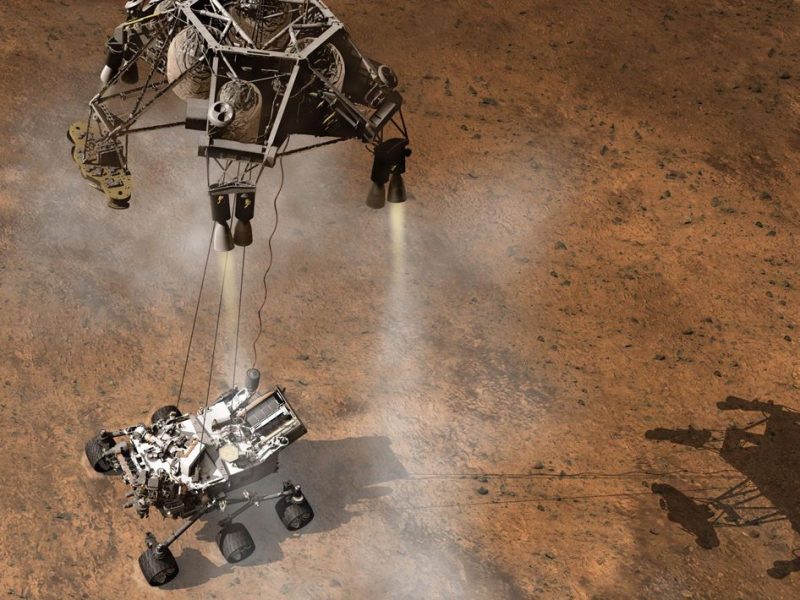
But then we got better at it. As the video above shows, Curiosity’s landing used a combination of complicated new technologies, including a new guided entry system and a rocket-powered sky crane that used cables to lower the 1-ton robot rover to the Martian surface.

Since 2012, Curiosity has been crawling across Mars’ surface serving as a robot extension of our human senses in exploring Gale Crater on Mars. The rover has learned, among many other things, that Gale Crater might once have held a great salty lake.

Visit NASA’s Mars Curiosity rover page

A spacecraft hovering above the surface, firing retrorockets, with cables from the craft lowering the rover to the surface.

Artist’s concept of Curiosity rover’s landing on Mars, via a “sky crane” and cables. The new rover headed for Mars now – Perseverance – will also land on Mars via sky crane. Image via NASA.

Dusty 6-wheeled rover looking our way with a camera on a pole, in reddish Martian desert.

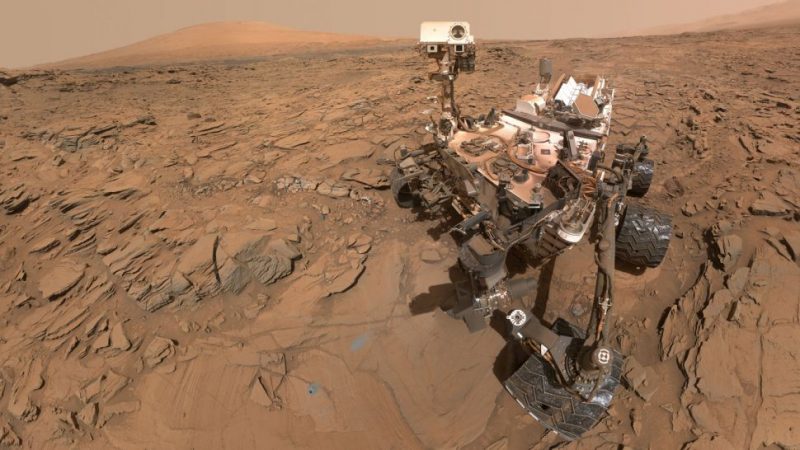
NASA’s Mars rover Curiosity took this self-portrait on May 11, 2016, at the “Okoruso” drilling site in the foothills of Mount Sharp, the central peak of Gale Crater. If Gale Crater once held a lake, Mount Sharp might have been an island in the middle of that lake. This self-portrait combines multiple images taken with the rover’s Mars Hand Lens Imager (MAHLI), during the 1,338th Martian day, or sol, of the rover’s work on Mars. Image via NASA.

Curiosity is now being followed to Mars by another robot rover, Perseverance, which launched from Earth only days ago, on July 30, 2020, at 11:50 UTC. (EarthSky’s yearly crowd-funding campaign is in progress. In 2020, we are donating 8.5% to No Kids Hungry. Please donate to help us keep going, and help feed a kid! ” rel=”noopener” target=”_blank”>Translate UTC to your time.) Perseverance is due to touch down in Jezero crater on Mars on February 18, 2021. Perseverance is largely the same design as Curiosity. When the $2.4 billion spacecraft carrying it reaches in Mars, it will also hit the atmosphere at high speed (more than 12,000 miles per hour or 19,000 kph) and then come to a complete stop on Mars’ surface seven minutes later. Like Curiosity, it’ll land via “sky crane,” but with one big difference: the sky crane technology is now now tried-and-true.

Still, as with Curiosity, space engineers will doubtless experience a nail-biting seven minutes, waiting to hear that the Perseverance rover has set down successfully, as gently as it can, on Mars’ surface.

There, it’ll join the other Mars rovers in the search for life on Mars, and an exploration of the planet’s surface, atmosphere and history.

Visit NASA’s Mars Perseverance rover page

Read more from the NY Times: Too much Mars? An interesting discussion between two veteran space journalists about why Mars seems to absorb so much of the oxygen – and budgetary resources – in the rooms where explorations of our solar system are decided.

Animated view of a parachute opening, seen from below.

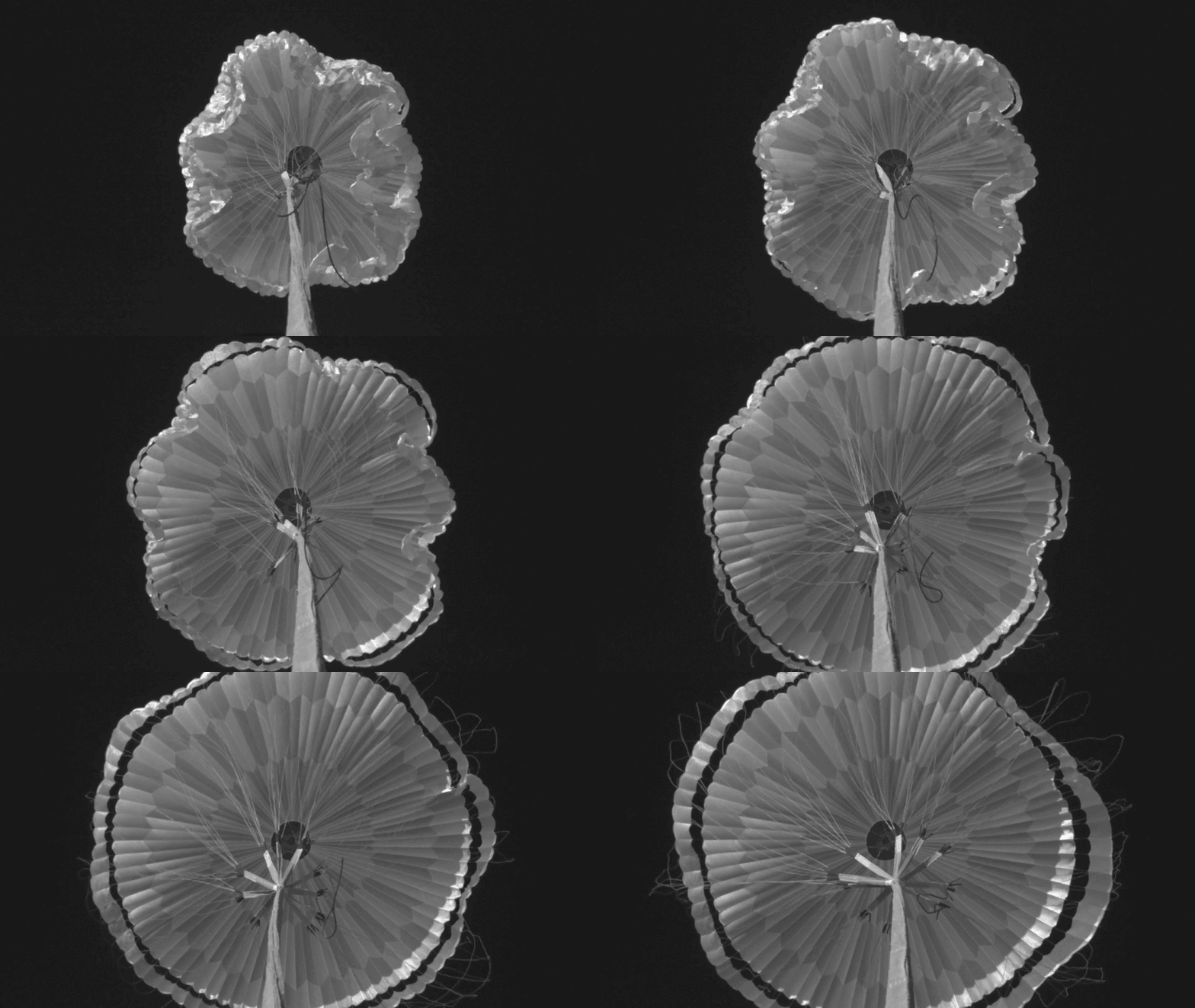
Parachute test for Mars Perseverance rover, now en route to Mars. The images were taken on September 7, 2018, during the third and final flight of the Advanced Supersonic Parachute Inflation Research Experiment (ASPIRE) project. Read more about this image via NASA/ JPL-Caltech.

Why is landing on Mars so hard? This 2017 video from MinutePhysics does a great job explaining it:

Bottom line: Watch a NASA video describing the final 7 minutes of the Curiosity rover’s chilling descent to the surface of Mars on August 5-6, 2012. And learn a bit about how the rover in route to Mars now – Perseverance – will land.

Read more from NASA: Curiosity’s Entry, Descent and Landing

Enjoying EarthSky? Sign up for our free daily newsletter today!


from EarthSky https://ift.tt/3i2qg9s

EarthSky’s yearly crowd-funding campaign is in progress. In 2020, we are donating 8.5% to No Kids Hungry. Please donate to help us keep going, and help feed a kid!

Today is the 8-year anniversary of the Curiosity rover’s successful landing on the planet Mars. The landing was unprecedented for its use of new technologies designed to get the rover to Mars’ surface safely. To the great relief of space engineers, those technologies worked, and the rover successfully set down in Gale Crater on Mars at 10:31 p.m. Pacific Daylight Time on August 5, 2012 (05:31 UTC on August 6). Curiosity hit the top of Mars’ thin atmosphere at a velocity of about 5,900 meters per second (about 13,000 miles per hour). In seven minutes, it had to decelerate and then set down, hopefully gently, on the surface of the red planet. The rover’s entry, descent and landing phase lasted approximately seven minutes, which space engineers at the time described as:

… seven minutes of terror.

Going to the red planet is relatively easy. But landing on Mars is hard. In 2003, veteran NASA official Firouz Naderi commented:

Mars is a favorite target.

We – the United States and former USSR – have been going to Mars for 40 years. The first time we flew by a planet, it was Mars. The first time we orbited a planet, it was Mars. The first time we landed on a planet it was Mars, and the first time we roved around the surface of a planet, it was Mars. We go there often.

Around that time – around the turn of this century – the world was averaging about two failures for every three spacecraft launched toward Mars, according to NASA. There were a total of 39 Mars missions launched, and 25 failures or partial failures by the year 2000, according to Wikipedia.

But then we got better at it. As the video above shows, Curiosity’s landing used a combination of complicated new technologies, including a new guided entry system and a rocket-powered sky crane that used cables to lower the 1-ton robot rover to the Martian surface.

Since 2012, Curiosity has been crawling across Mars’ surface serving as a robot extension of our human senses in exploring Gale Crater on Mars. The rover has learned, among many other things, that Gale Crater might once have held a great salty lake.

Visit NASA’s Mars Curiosity rover page

A spacecraft hovering above the surface, firing retrorockets, with cables from the craft lowering the rover to the surface.

Artist’s concept of Curiosity rover’s landing on Mars, via a “sky crane” and cables. The new rover headed for Mars now – Perseverance – will also land on Mars via sky crane. Image via NASA.

Dusty 6-wheeled rover looking our way with a camera on a pole, in reddish Martian desert.

NASA’s Mars rover Curiosity took this self-portrait on May 11, 2016, at the “Okoruso” drilling site in the foothills of Mount Sharp, the central peak of Gale Crater. If Gale Crater once held a lake, Mount Sharp might have been an island in the middle of that lake. This self-portrait combines multiple images taken with the rover’s Mars Hand Lens Imager (MAHLI), during the 1,338th Martian day, or sol, of the rover’s work on Mars. Image via NASA.

Curiosity is now being followed to Mars by another robot rover, Perseverance, which launched from Earth only days ago, on July 30, 2020, at 11:50 UTC. (EarthSky’s yearly crowd-funding campaign is in progress. In 2020, we are donating 8.5% to No Kids Hungry. Please donate to help us keep going, and help feed a kid! ” rel=”noopener” target=”_blank”>Translate UTC to your time.) Perseverance is due to touch down in Jezero crater on Mars on February 18, 2021. Perseverance is largely the same design as Curiosity. When the $2.4 billion spacecraft carrying it reaches in Mars, it will also hit the atmosphere at high speed (more than 12,000 miles per hour or 19,000 kph) and then come to a complete stop on Mars’ surface seven minutes later. Like Curiosity, it’ll land via “sky crane,” but with one big difference: the sky crane technology is now now tried-and-true.

Still, as with Curiosity, space engineers will doubtless experience a nail-biting seven minutes, waiting to hear that the Perseverance rover has set down successfully, as gently as it can, on Mars’ surface.

There, it’ll join the other Mars rovers in the search for life on Mars, and an exploration of the planet’s surface, atmosphere and history.

Visit NASA’s Mars Perseverance rover page

Read more from the NY Times: Too much Mars? An interesting discussion between two veteran space journalists about why Mars seems to absorb so much of the oxygen – and budgetary resources – in the rooms where explorations of our solar system are decided.

Animated view of a parachute opening, seen from below.

Parachute test for Mars Perseverance rover, now en route to Mars. The images were taken on September 7, 2018, during the third and final flight of the Advanced Supersonic Parachute Inflation Research Experiment (ASPIRE) project. Read more about this image via NASA/ JPL-Caltech.

Why is landing on Mars so hard? This 2017 video from MinutePhysics does a great job explaining it:

Bottom line: Watch a NASA video describing the final 7 minutes of the Curiosity rover’s chilling descent to the surface of Mars on August 5-6, 2012. And learn a bit about how the rover in route to Mars now – Perseverance – will land.

Read more from NASA: Curiosity’s Entry, Descent and Landing

Enjoying EarthSky? Sign up for our free daily newsletter today!


from EarthSky https://ift.tt/3i2qg9s

An evening storm, and a morning storm

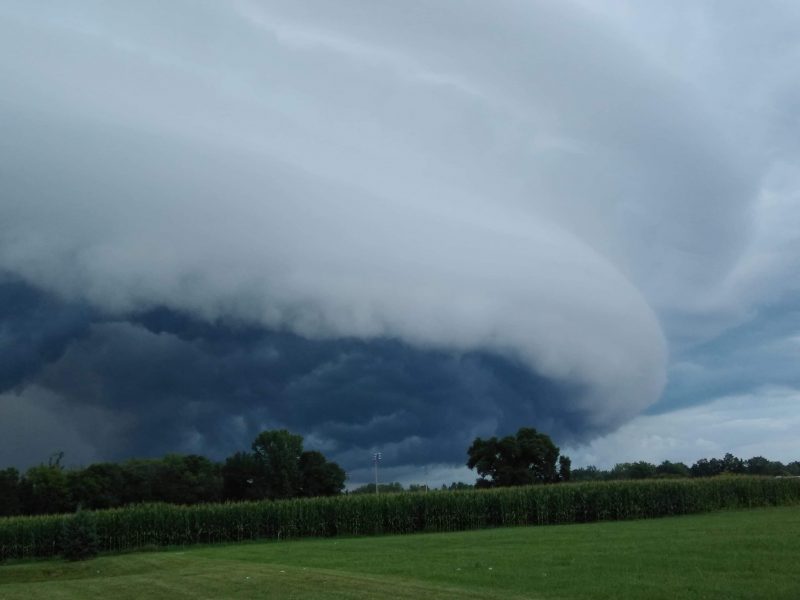
A shelf cloud moving over a green pasture.

View at EarthSky Community Photos. | Sarah Iler of Birch Run, Michigan captured this image on August 2, 2020 at 8:39 p.m. She wrote, “Thunderstorms all afternoon and then this shelf cloud formed in the evening. It was amazing.”

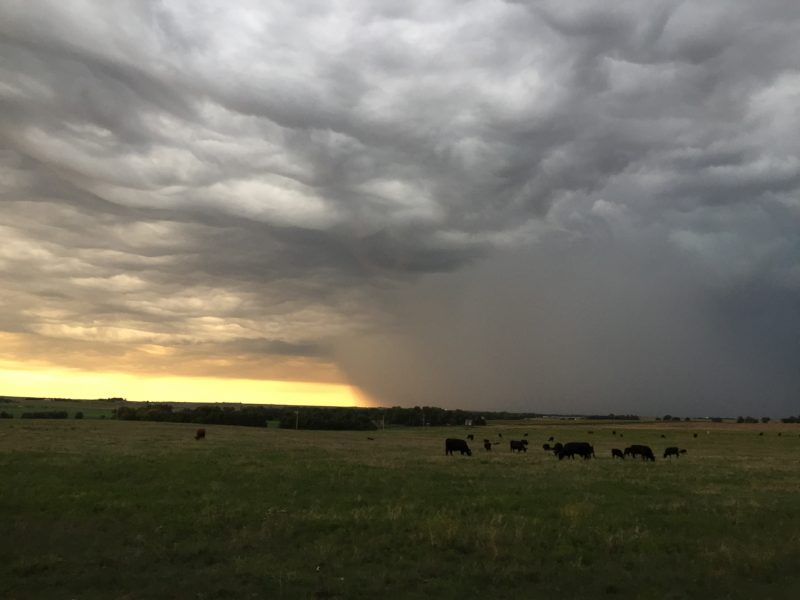
A storm pouring rain on a field, with cows.

View at EarthSky Community Photos. | The next morning – August 3, 2020 – Diana Cottrell of Meade, Kansas captured this image. She wrote: “Enjoying watching the cattle in the pasture directly behind my backyard as a mild storm passes us by.

Bottom line: Two beautiful images from the EarthSky community, showing early August 2020 storms in the U.S. midwest.


from EarthSky https://ift.tt/2XuJBIF
A shelf cloud moving over a green pasture.

View at EarthSky Community Photos. | Sarah Iler of Birch Run, Michigan captured this image on August 2, 2020 at 8:39 p.m. She wrote, “Thunderstorms all afternoon and then this shelf cloud formed in the evening. It was amazing.”

A storm pouring rain on a field, with cows.

View at EarthSky Community Photos. | The next morning – August 3, 2020 – Diana Cottrell of Meade, Kansas captured this image. She wrote: “Enjoying watching the cattle in the pasture directly behind my backyard as a mild storm passes us by.

Bottom line: Two beautiful images from the EarthSky community, showing early August 2020 storms in the U.S. midwest.


from EarthSky https://ift.tt/2XuJBIF

adds 2