aads

Top 10 tips for meteor-watchers

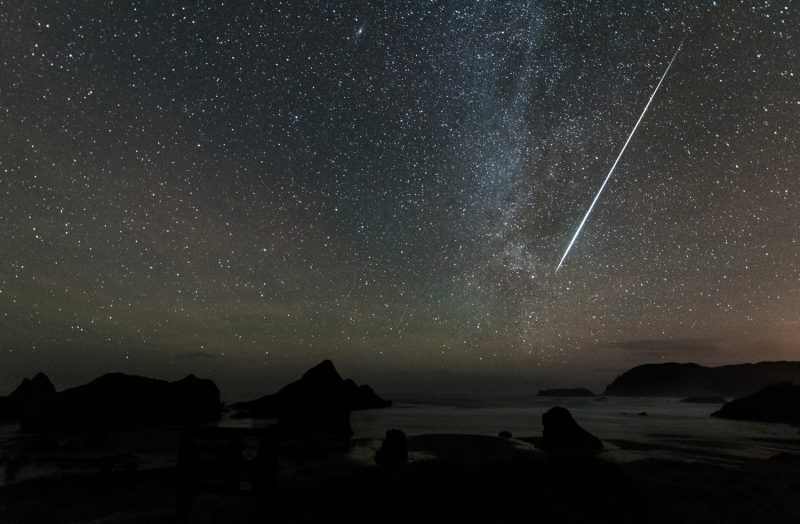
Very bright streak from upper right to lower center against dark sky.

Randy Baumhover captured this image at Meyers Creek Beach on the Oregon coast.

EarthSky’s yearly crowd-funding campaign is in progress. In 2020, we are donating 8.5% of all incoming revenues to No Kids Hungry. Click to learn more and donate.

The annual Perseid meteor shower is one of the most beloved meteor showers of the year. It’s rising to its peak now and will probably produce the greatest number of meteors on the mornings of August 11, 12 and 13.

Let’s say your goal is to observe the Perseids, or any upcoming meteor shower, and you want to see as many meteors as possible. You want to see the sky rain meteors like hailstones at an apocalyptic rate. You want exploding fireballs, peals of meteoric thunder, celestial mayhem. Well … that likely won’t happen. Meteor showers, for the most part, aren’t like a shower of rain, and a meteor rate of one a minute is a very, very good shower. Meteor showers are wonderful natural phenomena, a chance to commune with the outdoors and see something beautiful. How can you optimize your chances for seeing the most meteors? Follow the links below for EarthSky’s top 10 tips for meteor-watchers!

1. Be sure you know which days the shower will peak.

2. Find out the time of the shower’s peak in your time zone.

3. Watch on the nights around the peak, too.

4. Understanding the shower’s radiant point can help.

5. Find out the shower’s expected rate, or number of meteors per hour.

6. You must be aware of the phase of the moon.

7. Dress warmly.

8. Bring along that thermos of hot coffee or tea.

9. Bring a blanket or lawn chair.

10. Relax and enjoy the night sky.
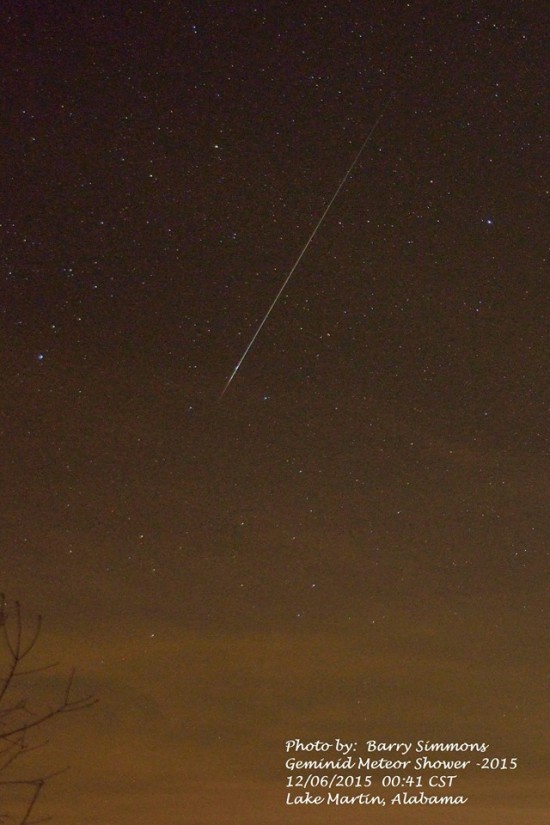
Starry sky with long thin white streak with small white glowing spot near its end.

Early Geminid meteor caught on the night of December 6, 2015, by Barry Simmons in Lake Martin, Alabama.

1. Be sure you know which days the shower will peak. Meteor showers happen over many days, as Earth encounters a wide stream of icy particles in space: debris left behind by a comet. The peak is just what it implies. It’s a point in time when Earth is expected to encounter the greatest number of particles from a particular meteor stream. To find the peak dates, try EarthSky’s meteor guide for 2020. Be aware that most, but not all, meteor showers are best after midnight.

And here’s the catch …

The peak of the shower comes at the same time for all of us on Earth. Meanwhile, our clocks are saying different times. So …

2. Find out the time of the shower’s peak in your timezone. You don’t need to watch exactly at the peak time. But it can help you decide which night is absolutely best for you.

Different sources might list different times for the peak of a meteor shower. In that case, go with a source you trust. Here at EarthSky, we trust the Observer’s Handbook from the Royal Astronomical Society of Canada. Predictions are not always spot on, and the peak typically stretches over a day or so.

See how it works?

The time of the peak will nearly always be given in UTC. That stands for Coordinated Universal Time, and it’s the primary time standard by which the world regulates clocks and time. Learn to translate UTC to your time zone in this article.

3. Watch on the nights around the peak, too. If you miss a shower’s peak, you might not see as many meteors. But don’t let that discourage you! As we’ve mentioned before, predictions for meteor shower peaks are not always right on the money. It’s possible to see very nice meteor displays hours before or after the published peak.

For example, who can forget the famous 1998 Leonid meteor shower? The predicted peak favored observers in Europe, and yet those of us in the states were nevertheless treated to wonderful displays of Leonids on the nights before and after the predicted peak.

Just remember, meteor showers are part of nature. They often defy prediction.
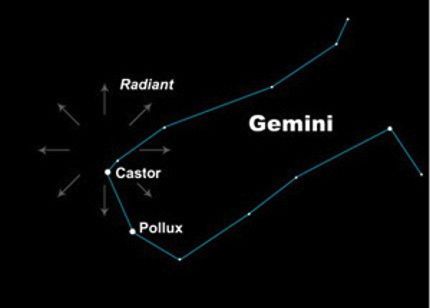
Diagram of constellation Gemini with radial arrows near one end.

The Geminid meteors radiate from near the star Castor in Gemini.

4. Understanding the shower’s radiant point can help. A meteor shower’s radiant point is that point in the sky from which the meteors will appear to radiate. Some people seem to think they have to be able to identify the radiant point in order to be able to watch the shower, but that is a serious misconception.

You can see meteors shoot up from the horizon before a shower’s radiant has even risen into the sky.

Here’s the power of the radiant point. Once it has risen into your sky, you’ll see more meteors. When it’s at its highest overhead – assuming you’re watching at a time when the shower has been producing meteors steadily over many hours – you’ll see the most meteors.

So find out the radiant point’s rising time. It can help you pinpoint the best time of night to watch the shower.
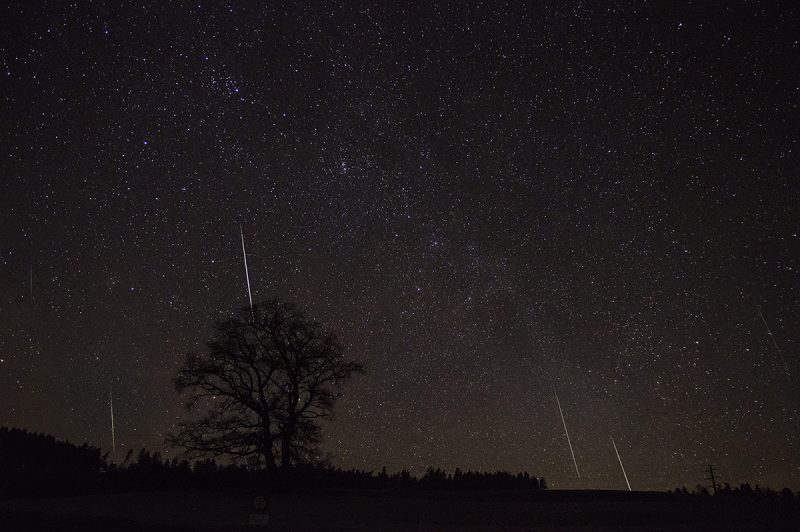
Starry sky, silhouetted bare tree, 4 white streaks coming down.

Gregor in Switzerland submitted this composite image from the morning of December 15, 2015.

5. Find out the shower’s expected rate, or number of meteors per hour. Here we touch on a topic that often leads to some bad feelings, especially among novice meteor watchers. Tables of meteor showers almost always list what is known as the zenithal hourly rate (ZHR) for each shower.

The ZHR is the number of meteors you’ll see if you’re watching in a very dark sky, with the radiant overhead, when the shower is at its peak.

In other words, the ZHR represents the number of meteors you might see per hour given the very best observing conditions during the shower’s maximum.

Now let’s apply this term to a real world example. Let’s say the December Geminid meteor shower has a ZHR of 120 meteors per hour. That doesn’t mean you’ll see 120 meteors per hour, but it does mean you might if you’re watching on a peak night in a dark sky, when the radiant is highest.

If the peak occurs when it’s still daylight at your location, if most of the meteors are predominantly faint, if a bright moon is out , or if you’re located in a light-polluted area, the total number of meteors you see will be considerably reduced.

Also know that most meteor showers have bursts of activity, with lulls in between. That’s why you should plan to watch the shower, from a dark location, for at least an hour or more. Several hours per night for several nights will give you the best chance of seeing the best show.

And that brings us to one of the most important factors of all for meteor-watchers …

6. You must be aware of the phase of the moon. If the moon is at a quarter phase or greater, you’re going to miss meteors, even if your skies are otherwise dark. It’s okay if the moon sets before the radiant rises, because the Earth blocks the moon’s light from the sky. But nothing dampens the display of a meteor shower more effectively than the presence of a bright moon.

Now you’re almost ready. Just a few final tips.

7. Dress warmly. The nights can be cool or cold, even during the spring and summer months.

8. Bring along that thermos of hot coffee or tea. It’ll be your friend at 3 a.m.

9. Bring a blanket or lawn chair for reclining comfortably while looking up at the sky. If you’re observing with a friend, set your chairs out back to back, and look at different parts of the sky. Then when one of you sees a meteors, he or she can call out “meteor,” and everyone can turn and look.

10. Relax and enjoy the night sky. Not every meteor shower is a winner. Sometimes, you may come away from a shower seeing only one meteor. But consider this. If that one meteor is a bright one that takes a slow path across a starry night sky … it’ll be worth it.

To be really successful at observing any meteor shower, you need to get into a kind of Zen state, waiting and expecting the meteors to come to you if you place yourself in the position to see them. Or forget the Zen state, and let yourself be guided by this old meteor watcher’s motto:

You might see a lot or you might not see many, but if you stay in the house, you won’t see any.

By the way, if you’re interested in learning more about meteor showers, or want to contribute meteor counts and brightness estimations, contact the following organizations: The American Meteor Society and the International Meteor Organization. Both provide the latest predictions as well as information to guide you in serious meteor observing.
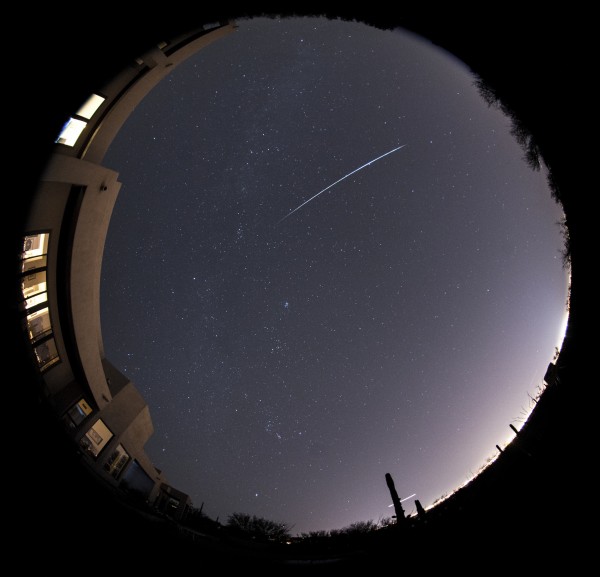
Circular panorama of sky with bright streak.

View larger. | Early Geminid fireball caught on December 2, 2015, at 10:34 p.m. from the Tucson, Arizona, foothills. Photo via Eliot Herman.

Bottom line: Tips for watching a meteor shower.

EarthSky’s meteor guide for 2020


from EarthSky https://ift.tt/2Ql6pY4
Very bright streak from upper right to lower center against dark sky.

Randy Baumhover captured this image at Meyers Creek Beach on the Oregon coast.

EarthSky’s yearly crowd-funding campaign is in progress. In 2020, we are donating 8.5% of all incoming revenues to No Kids Hungry. Click to learn more and donate.

The annual Perseid meteor shower is one of the most beloved meteor showers of the year. It’s rising to its peak now and will probably produce the greatest number of meteors on the mornings of August 11, 12 and 13.

Let’s say your goal is to observe the Perseids, or any upcoming meteor shower, and you want to see as many meteors as possible. You want to see the sky rain meteors like hailstones at an apocalyptic rate. You want exploding fireballs, peals of meteoric thunder, celestial mayhem. Well … that likely won’t happen. Meteor showers, for the most part, aren’t like a shower of rain, and a meteor rate of one a minute is a very, very good shower. Meteor showers are wonderful natural phenomena, a chance to commune with the outdoors and see something beautiful. How can you optimize your chances for seeing the most meteors? Follow the links below for EarthSky’s top 10 tips for meteor-watchers!

1. Be sure you know which days the shower will peak.

2. Find out the time of the shower’s peak in your time zone.

3. Watch on the nights around the peak, too.

4. Understanding the shower’s radiant point can help.

5. Find out the shower’s expected rate, or number of meteors per hour.

6. You must be aware of the phase of the moon.

7. Dress warmly.

8. Bring along that thermos of hot coffee or tea.

9. Bring a blanket or lawn chair.

10. Relax and enjoy the night sky.

Starry sky with long thin white streak with small white glowing spot near its end.

Early Geminid meteor caught on the night of December 6, 2015, by Barry Simmons in Lake Martin, Alabama.

1. Be sure you know which days the shower will peak. Meteor showers happen over many days, as Earth encounters a wide stream of icy particles in space: debris left behind by a comet. The peak is just what it implies. It’s a point in time when Earth is expected to encounter the greatest number of particles from a particular meteor stream. To find the peak dates, try EarthSky’s meteor guide for 2020. Be aware that most, but not all, meteor showers are best after midnight.

And here’s the catch …

The peak of the shower comes at the same time for all of us on Earth. Meanwhile, our clocks are saying different times. So …

2. Find out the time of the shower’s peak in your timezone. You don’t need to watch exactly at the peak time. But it can help you decide which night is absolutely best for you.

Different sources might list different times for the peak of a meteor shower. In that case, go with a source you trust. Here at EarthSky, we trust the Observer’s Handbook from the Royal Astronomical Society of Canada. Predictions are not always spot on, and the peak typically stretches over a day or so.

See how it works?

The time of the peak will nearly always be given in UTC. That stands for Coordinated Universal Time, and it’s the primary time standard by which the world regulates clocks and time. Learn to translate UTC to your time zone in this article.

3. Watch on the nights around the peak, too. If you miss a shower’s peak, you might not see as many meteors. But don’t let that discourage you! As we’ve mentioned before, predictions for meteor shower peaks are not always right on the money. It’s possible to see very nice meteor displays hours before or after the published peak.

For example, who can forget the famous 1998 Leonid meteor shower? The predicted peak favored observers in Europe, and yet those of us in the states were nevertheless treated to wonderful displays of Leonids on the nights before and after the predicted peak.

Just remember, meteor showers are part of nature. They often defy prediction.

Diagram of constellation Gemini with radial arrows near one end.

The Geminid meteors radiate from near the star Castor in Gemini.

4. Understanding the shower’s radiant point can help. A meteor shower’s radiant point is that point in the sky from which the meteors will appear to radiate. Some people seem to think they have to be able to identify the radiant point in order to be able to watch the shower, but that is a serious misconception.

You can see meteors shoot up from the horizon before a shower’s radiant has even risen into the sky.

Here’s the power of the radiant point. Once it has risen into your sky, you’ll see more meteors. When it’s at its highest overhead – assuming you’re watching at a time when the shower has been producing meteors steadily over many hours – you’ll see the most meteors.

So find out the radiant point’s rising time. It can help you pinpoint the best time of night to watch the shower.

Starry sky, silhouetted bare tree, 4 white streaks coming down.

Gregor in Switzerland submitted this composite image from the morning of December 15, 2015.

5. Find out the shower’s expected rate, or number of meteors per hour. Here we touch on a topic that often leads to some bad feelings, especially among novice meteor watchers. Tables of meteor showers almost always list what is known as the zenithal hourly rate (ZHR) for each shower.

The ZHR is the number of meteors you’ll see if you’re watching in a very dark sky, with the radiant overhead, when the shower is at its peak.

In other words, the ZHR represents the number of meteors you might see per hour given the very best observing conditions during the shower’s maximum.

Now let’s apply this term to a real world example. Let’s say the December Geminid meteor shower has a ZHR of 120 meteors per hour. That doesn’t mean you’ll see 120 meteors per hour, but it does mean you might if you’re watching on a peak night in a dark sky, when the radiant is highest.

If the peak occurs when it’s still daylight at your location, if most of the meteors are predominantly faint, if a bright moon is out , or if you’re located in a light-polluted area, the total number of meteors you see will be considerably reduced.

Also know that most meteor showers have bursts of activity, with lulls in between. That’s why you should plan to watch the shower, from a dark location, for at least an hour or more. Several hours per night for several nights will give you the best chance of seeing the best show.

And that brings us to one of the most important factors of all for meteor-watchers …

6. You must be aware of the phase of the moon. If the moon is at a quarter phase or greater, you’re going to miss meteors, even if your skies are otherwise dark. It’s okay if the moon sets before the radiant rises, because the Earth blocks the moon’s light from the sky. But nothing dampens the display of a meteor shower more effectively than the presence of a bright moon.

Now you’re almost ready. Just a few final tips.

7. Dress warmly. The nights can be cool or cold, even during the spring and summer months.

8. Bring along that thermos of hot coffee or tea. It’ll be your friend at 3 a.m.

9. Bring a blanket or lawn chair for reclining comfortably while looking up at the sky. If you’re observing with a friend, set your chairs out back to back, and look at different parts of the sky. Then when one of you sees a meteors, he or she can call out “meteor,” and everyone can turn and look.

10. Relax and enjoy the night sky. Not every meteor shower is a winner. Sometimes, you may come away from a shower seeing only one meteor. But consider this. If that one meteor is a bright one that takes a slow path across a starry night sky … it’ll be worth it.

To be really successful at observing any meteor shower, you need to get into a kind of Zen state, waiting and expecting the meteors to come to you if you place yourself in the position to see them. Or forget the Zen state, and let yourself be guided by this old meteor watcher’s motto:

You might see a lot or you might not see many, but if you stay in the house, you won’t see any.

By the way, if you’re interested in learning more about meteor showers, or want to contribute meteor counts and brightness estimations, contact the following organizations: The American Meteor Society and the International Meteor Organization. Both provide the latest predictions as well as information to guide you in serious meteor observing.

Circular panorama of sky with bright streak.

View larger. | Early Geminid fireball caught on December 2, 2015, at 10:34 p.m. from the Tucson, Arizona, foothills. Photo via Eliot Herman.

Bottom line: Tips for watching a meteor shower.

EarthSky’s meteor guide for 2020


from EarthSky https://ift.tt/2Ql6pY4

Does coronavirus linger in the body?

Blue balls with golf tee shaped spikes protruding from them.

Are there places in the body where SARS-CoV-2 can hide from the immune system? Image via fotograzia/ Getty Images.

EarthSky’s yearly crowd-funding campaign is in progress. In 2020, we are donating 8.5% to No Kids Hungry. Please donate to help us keep going, and help feed a kid!

By William Petri, University of Virginia

As millions of people are recovering from Covid-19, an unanswered question is the extent to which the virus can “hide out” in seemingly recovered individuals. If it does, could this explain some of the lingering symptoms of Covid-19 or pose a risk for transmission of infection to others even after recovery?

I am a physician-scientist of infectious diseases at the University of Virginia, where I care for patients with infections and conduct research on Covid-19. Here I will briefly review what is known today about chronic or persistent Covid-19.

What is a chronic or persistent viral infection?

A chronic or persistent infection continues for months or even years, during which time virus is being continually produced, albeit in many cases at low levels. Frequently these infections occur in a so-called immune privileged site.

What is an immune privileged site?

There are a few places in the body that are less accessible to the immune system and where it is difficult to eradicate all viral infections. These include the central nervous system, the testes and the eye. It is thought that the evolutionary advantage to having an immune privileged region is that it protects a site like the brain, for example, from being damaged by the inflammation that results when the immune system battles an infection.

An immune privileged site not only is difficult for the immune system to enter, it also limits proteins that increase inflammation. The reason is that while inflammation helps kill a pathogen, it can also damage an organ such as the eye, brain or testes. The result is an uneasy truce where inflammation is limited but infection continues to fester.

A latent infection versus a persistent viral infection

But there is another way that a virus can hide in the body and reemerge later.

A latent viral infection occurs when the virus is present within an infected cell but dormant and not multiplying. In a latent virus, the entire viral genome is present, and infectious virus can be produced if latency ends and the infections becomes active. The latent virus may integrate into the human genome – as does HIV, for example – or exist in the nucleus as a self-replicating piece of DNA called an episome.

A latent virus can reactivate and produce infectious viruses, and this can occur months to decades after the initial infection. Perhaps the best example of this is chickenpox, which although seemingly eradicated by the immune system can reactivate and cause herpes zoster decades later. Fortunately, chickenpox and zoster are now prevented by vaccination. To be infected with a virus capable of producing a latent infection is to be infected for the rest of your life.

Two spheres with double helixes in them, one with fragments escaping through surface.

Latent infection (left) is when a cell is infected and the virus has inserted its genetic code into our human DNA. The immune system cannot detect this cell as being infected. An HIV infection can shift from latent to active if the infected cell is producing new viruses. Image via ttsz/ Getty Images.

How does a virus become a latent infection?

Herpes viruses are by far the most common viral infections that establish latency.

This is a large family of viruses whose genetic material, or genome, is encoded by DNA (and not RNA such as the new coronavirus). Herpes viruses include not only herpes simplex viruses 1 and 2 – which cause oral and genital herpes – but also chickenpox. Other herpes viruses, such as Epstein Barr virus, the cause of mononucleosis, and cytomegalovirus, which is a particular problem in immunodeficient individuals, can also emerge after latency.

Retroviruses are another common family of viruses that establish latency but by a different mechanism than the herpes viruses. Retroviruses such as HIV, which causes AIDS, can insert a copy of their genome into the human DNA that is part of the human genome. There the virus can exist in a latent state indefinitely in the infected human since the virus genome is copied every time DNA is replicated and a cell divides.

Viruses that establish latency in humans are difficult or impossible for the immune system to eradicate. That is because during latency there can be little or no viral protein production in the infected cell, making the infection invisible to the immune system. Fortunately coronaviruses do not establish a latent infection.

Man and woman kissing in bed wearing masks.

Is it safe for a man to have sex after recovering from COVID-19? Image via Andrey Zhuravlev/ Getty Images.

Could you catch SARS-CoV-2 from a male sexual partner who has recovered from COVID-19?

In one small study, the new coronavirus has been detected in semen in a quarter of patients during active infection and in a bit less than 10% of patients who apparently recovered. In this study, viral RNA was what was detected, and it is not yet known if this RNA was from still infectious or dead virus in the semen; and if alive whether the virus can be sexually transmitted. So many important questions remain unanswered.

Ebola is a very different virus from SARS-C0V-2 yet serves as an example of viral persistence in immune privileged sites. In some individuals, Ebola virus survives in immune privileged sites for months after resolution of the acute illness. Survivors of Ebola have been documented with persistent infections in the testes, eyes, placenta and central nervous system.

The WHO recommends for male Ebola survivors that semen be tested for virus every three months. They also suggest that couples abstain from sex for 12 months after recovery or until their semen tests negative for Ebola twice. As noted above, we need to learn more about persistent new coronavirus infections before similar recommendations can be considered.

Could persistent symptoms after COVID-19 be due to viral persistence?

Recovery from COVID-19 is delayed or incomplete in many individuals, with symptoms including cough, shortness of breath and fatigue. It seems unlikely that these constitutional symptoms are due to viral persistence as the symptoms are not coming from immune privileged sites.

Where else could the new coronavirus persist after recovery from COVID-19?

Other sites where coronavirus has been detected include the placenta, intestines, blood and of course the respiratory tract. In women who catch Covid-19 while pregnant, the placenta develops defects in the mother’s blood vessels supplying the placenta. However, the significance of this on fetal health is yet to be determined.

The new coronavirus can also infect the fetus via the placenta. Finally, the new coronavirus is also present in the blood and the nasal cavity and palate for up to a month or more after infection.

The mounting evidence suggests that SARS-CoV-2 can infect immune privileged sites and, from there, result in chronic persistent – but not latent – infections. It is too early to know the extent to which these persistent infections affect the health of an individual like the pregnant mother, for example, nor the extent to which they contribute to the spread of Covid-19.

Like many things in the pandemic, what is unknown today is known tomorrow, so stay tuned and be cautious so as not to catch the infection or, worse yet, spread it to someone else.

William Petri, Professor of Medicine, University of Virginia

This article is republished from The Conversation under a Creative Commons license. Read the original article.

Bottom line: Are there places in the body where the coronavirus can hide from the immune system?

The Conversation


from EarthSky https://ift.tt/33rwkUK
Blue balls with golf tee shaped spikes protruding from them.

Are there places in the body where SARS-CoV-2 can hide from the immune system? Image via fotograzia/ Getty Images.

EarthSky’s yearly crowd-funding campaign is in progress. In 2020, we are donating 8.5% to No Kids Hungry. Please donate to help us keep going, and help feed a kid!

By William Petri, University of Virginia

As millions of people are recovering from Covid-19, an unanswered question is the extent to which the virus can “hide out” in seemingly recovered individuals. If it does, could this explain some of the lingering symptoms of Covid-19 or pose a risk for transmission of infection to others even after recovery?

I am a physician-scientist of infectious diseases at the University of Virginia, where I care for patients with infections and conduct research on Covid-19. Here I will briefly review what is known today about chronic or persistent Covid-19.

What is a chronic or persistent viral infection?

A chronic or persistent infection continues for months or even years, during which time virus is being continually produced, albeit in many cases at low levels. Frequently these infections occur in a so-called immune privileged site.

What is an immune privileged site?

There are a few places in the body that are less accessible to the immune system and where it is difficult to eradicate all viral infections. These include the central nervous system, the testes and the eye. It is thought that the evolutionary advantage to having an immune privileged region is that it protects a site like the brain, for example, from being damaged by the inflammation that results when the immune system battles an infection.

An immune privileged site not only is difficult for the immune system to enter, it also limits proteins that increase inflammation. The reason is that while inflammation helps kill a pathogen, it can also damage an organ such as the eye, brain or testes. The result is an uneasy truce where inflammation is limited but infection continues to fester.

A latent infection versus a persistent viral infection

But there is another way that a virus can hide in the body and reemerge later.

A latent viral infection occurs when the virus is present within an infected cell but dormant and not multiplying. In a latent virus, the entire viral genome is present, and infectious virus can be produced if latency ends and the infections becomes active. The latent virus may integrate into the human genome – as does HIV, for example – or exist in the nucleus as a self-replicating piece of DNA called an episome.

A latent virus can reactivate and produce infectious viruses, and this can occur months to decades after the initial infection. Perhaps the best example of this is chickenpox, which although seemingly eradicated by the immune system can reactivate and cause herpes zoster decades later. Fortunately, chickenpox and zoster are now prevented by vaccination. To be infected with a virus capable of producing a latent infection is to be infected for the rest of your life.

Two spheres with double helixes in them, one with fragments escaping through surface.

Latent infection (left) is when a cell is infected and the virus has inserted its genetic code into our human DNA. The immune system cannot detect this cell as being infected. An HIV infection can shift from latent to active if the infected cell is producing new viruses. Image via ttsz/ Getty Images.

How does a virus become a latent infection?

Herpes viruses are by far the most common viral infections that establish latency.

This is a large family of viruses whose genetic material, or genome, is encoded by DNA (and not RNA such as the new coronavirus). Herpes viruses include not only herpes simplex viruses 1 and 2 – which cause oral and genital herpes – but also chickenpox. Other herpes viruses, such as Epstein Barr virus, the cause of mononucleosis, and cytomegalovirus, which is a particular problem in immunodeficient individuals, can also emerge after latency.

Retroviruses are another common family of viruses that establish latency but by a different mechanism than the herpes viruses. Retroviruses such as HIV, which causes AIDS, can insert a copy of their genome into the human DNA that is part of the human genome. There the virus can exist in a latent state indefinitely in the infected human since the virus genome is copied every time DNA is replicated and a cell divides.

Viruses that establish latency in humans are difficult or impossible for the immune system to eradicate. That is because during latency there can be little or no viral protein production in the infected cell, making the infection invisible to the immune system. Fortunately coronaviruses do not establish a latent infection.

Man and woman kissing in bed wearing masks.

Is it safe for a man to have sex after recovering from COVID-19? Image via Andrey Zhuravlev/ Getty Images.

Could you catch SARS-CoV-2 from a male sexual partner who has recovered from COVID-19?

In one small study, the new coronavirus has been detected in semen in a quarter of patients during active infection and in a bit less than 10% of patients who apparently recovered. In this study, viral RNA was what was detected, and it is not yet known if this RNA was from still infectious or dead virus in the semen; and if alive whether the virus can be sexually transmitted. So many important questions remain unanswered.

Ebola is a very different virus from SARS-C0V-2 yet serves as an example of viral persistence in immune privileged sites. In some individuals, Ebola virus survives in immune privileged sites for months after resolution of the acute illness. Survivors of Ebola have been documented with persistent infections in the testes, eyes, placenta and central nervous system.

The WHO recommends for male Ebola survivors that semen be tested for virus every three months. They also suggest that couples abstain from sex for 12 months after recovery or until their semen tests negative for Ebola twice. As noted above, we need to learn more about persistent new coronavirus infections before similar recommendations can be considered.

Could persistent symptoms after COVID-19 be due to viral persistence?

Recovery from COVID-19 is delayed or incomplete in many individuals, with symptoms including cough, shortness of breath and fatigue. It seems unlikely that these constitutional symptoms are due to viral persistence as the symptoms are not coming from immune privileged sites.

Where else could the new coronavirus persist after recovery from COVID-19?

Other sites where coronavirus has been detected include the placenta, intestines, blood and of course the respiratory tract. In women who catch Covid-19 while pregnant, the placenta develops defects in the mother’s blood vessels supplying the placenta. However, the significance of this on fetal health is yet to be determined.

The new coronavirus can also infect the fetus via the placenta. Finally, the new coronavirus is also present in the blood and the nasal cavity and palate for up to a month or more after infection.

The mounting evidence suggests that SARS-CoV-2 can infect immune privileged sites and, from there, result in chronic persistent – but not latent – infections. It is too early to know the extent to which these persistent infections affect the health of an individual like the pregnant mother, for example, nor the extent to which they contribute to the spread of Covid-19.

Like many things in the pandemic, what is unknown today is known tomorrow, so stay tuned and be cautious so as not to catch the infection or, worse yet, spread it to someone else.

William Petri, Professor of Medicine, University of Virginia

This article is republished from The Conversation under a Creative Commons license. Read the original article.

Bottom line: Are there places in the body where the coronavirus can hide from the immune system?

The Conversation


from EarthSky https://ift.tt/33rwkUK

Deneb is distant and very luminous

Image via Fred Espanak

Image via Fred Espenak.

The star Deneb in the constellation Cygnus is one of the most distant stars you’ll ever see with your eye alone. That’s because it’s one of our Milky Way galaxy’s most luminous stars.

Deneb is somewhere around 2,600 light-years away, although astronomers still aren’t certain of the star’s exact distance. For now, just know that, when you gaze at this bright star, you’re gazing across thousands of light-years of space. That’s in contrast to most visible stars in our sky, located tens to hundreds of light-years away.

Want to see Deneb? You can gaze at this faraway star in the evening starting around around May, or late spring in the Northern Hemisphere. From this hemisphere, at this time of year (early August), Deneb shines rather high in the northeastern/eastern sky at nightfall, and appears at its highest point in the sky around midnight (1 a.m. daylight saving time). Like all stars, Deneb is found about one degree farther west at the same time each day, and climbs to its highest point about 4 minutes earlier per day, one-half hour earlier per week, or two hours earlier per month.

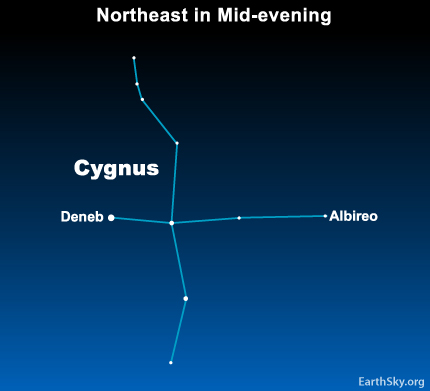
Deneb is part of several famous star patterns which overlap each other. It’s the brightest of the stars composing the constellation Cygnus the Swan, where it marks the Swan’s Tail. When you hear deneb in a star name, it always means tail.

Deneb marks the Tail of Cynus the Swan … and the head of a crosslike pattern known as the Northern Cross.

Simultaneously, Deneb marks the head of an asterism (a readily recognizable grouping of stars that is not an official constellation), known as the Northern Cross.

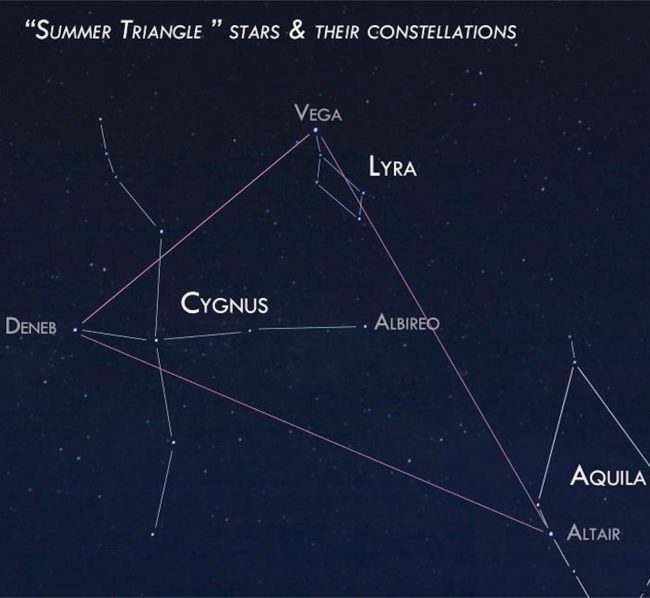
Plus it is one of the three stars known as the Summer Triangle. The other two stars are Vega and Altair. Deneb is the northernmost and dimmest of the three Triangle stars, but its association with the other bright stars makes it easy to identify.

The Summer Triangle by Susan Jensen in Odessa, Washington.

Deneb is circumpolar as seen from locations of about 45 degrees north latitude, roughly the northern tier of U.S. states. In other words, from the northern U.S. and similar latitudes, Deneb never sets but instead circles round and round the pole star. It cannot ever be seen south of about 45 degrees south latitude. That includes Antarctica, far southern Argentina and Chile, and perhaps the far southern tip of New Zealand’s South Island. Aside from that, just about anyone should have a chance to see Deneb at one time or another.

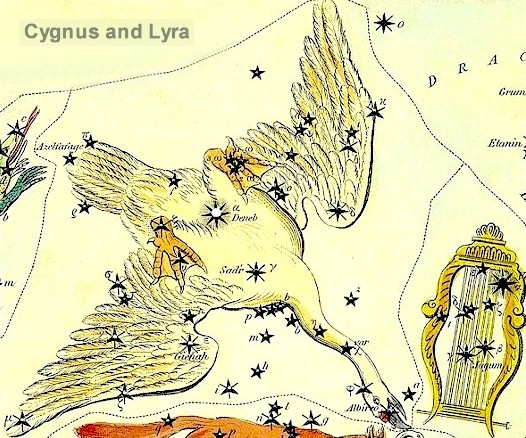
The constellation Cygnus the Swan. The bright star Deneb represents the Tail of Cygnus. Image via Constellation of Words.

Why don’t astronomers know the distance to Deneb exactly? Why are there varying estimates for this very luminous star’s distance?

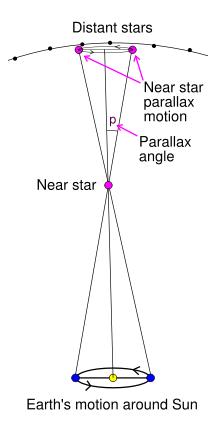
Astronomers can directly measure the distance to nearby stars using the parallax method. But Deneb is too far away for accurate parallax measurements from Earth’s surface.

For some decades, the most important distance measurement for Deneb is that from ESA’s Earth-orbiting Hipparcos satellite, which operated from 1989 to 1993. Hipparcos was the predecessor to Gaia. Both Hipparcos and Gaia gather astrometric data on the stars, measuring stars’ positions, motions and brightnesses so that astronomers back on Earth can later calculate a distance.

Early analyses of Hipparcos data indicated a distance of somewhere around 2,600 light-years for Deneb. Then, in 2009, a newer study – which used more powerful analysis techniques on Hipparcos data – gave a distance for Deneb that’s about half the widely accepted value, closer to 1,500 light-years. Today, that value – around 1,500 light-years – is the most widely accepted value for Deneb’s distance.

Why – with its recent large data release – hasn’t Gaia enabled astronomers to measure Deneb’s distance more precisely? Astronomer Anthony G.A. Brown of Leiden Observatory in the Netherlands – a member of the Gaia team – told us in May 2018:

Deneb is too bright to appear in Gaia’s second data release so we have no updated distance available. This holds for all stars brighter than about 2nd magnitude.

Gaia Project Scientist Timo Prusti added that a more accurate distance for Deneb might not be forthcoming in the Gaia data. The satellite just isn’t designed for that sort of work. He explained:

We have collected data also of the brightest stars. However, those fall out of the nominal dynamic range of Gaia and the data is heavily saturated. At a later stage, when the main mission data processing software has been finalized, we will have a look to those data, but, due to the saturation, it is not sure if we can get useful parallaxes for the brightest stars.

So, for now, the Hipparcos catalog is still the best source for Deneb’s distance and for the distance to other bright stars. Approximately 1,500 light-years for Deneb, for now.

And that’s impressive. In order for us to see a star shine so brightly in our sky, from this great distance away, the star must be very powerful. Deneb is thought to be one of the most luminous stars – one of the brightest stars, intrinsically – that we can see with the eye.

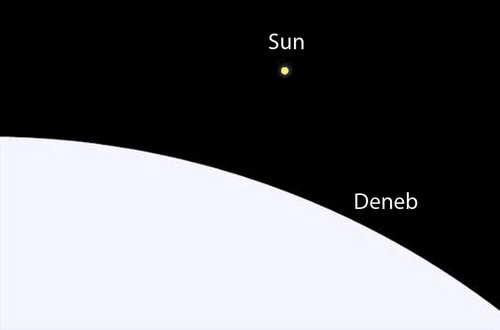
Deneb (bottom half of frame) is some 200 times bigger than our sun. Image via AstroBob.

The name Deneb derives from the Arabic Al Dhanab al Dajajah meaning Tail of the Hen. It obviously dates from an earlier incarnation of Cygnus not as a swan but as a chicken. Like many bright stars, Deneb has been called by a number of other names, but the oddest, according the Richard Hinckley Allen, who cites the Arabic name above, was Uropygium, meaning the posterior part of a bird’s body from which feathers grow, and oddly sometimes called the “Pope’s nose.”

In Chinese mythology Deneb is associated with the story of the Celestial Princess or the Weaver Girl. In this story a Girl (the star Vega) is separated from her beloved (a cowherd represented by the star Altair) by the Milky Way. Once a year, the girl and the cowherd are allowed to meet briefly when a large flock of magpies form a bridge across the starry river. Deneb represents the bridge.

Deneb’s position is RA: 20h 41m 26s, dec: +45° 16′ 49″.

Bottom line: Information on the star Deneb, plus how to see it in your sky.


from EarthSky https://ift.tt/2XrWqmI
Image via Fred Espanak

Image via Fred Espenak.

The star Deneb in the constellation Cygnus is one of the most distant stars you’ll ever see with your eye alone. That’s because it’s one of our Milky Way galaxy’s most luminous stars.

Deneb is somewhere around 2,600 light-years away, although astronomers still aren’t certain of the star’s exact distance. For now, just know that, when you gaze at this bright star, you’re gazing across thousands of light-years of space. That’s in contrast to most visible stars in our sky, located tens to hundreds of light-years away.

Want to see Deneb? You can gaze at this faraway star in the evening starting around around May, or late spring in the Northern Hemisphere. From this hemisphere, at this time of year (early August), Deneb shines rather high in the northeastern/eastern sky at nightfall, and appears at its highest point in the sky around midnight (1 a.m. daylight saving time). Like all stars, Deneb is found about one degree farther west at the same time each day, and climbs to its highest point about 4 minutes earlier per day, one-half hour earlier per week, or two hours earlier per month.

Deneb is part of several famous star patterns which overlap each other. It’s the brightest of the stars composing the constellation Cygnus the Swan, where it marks the Swan’s Tail. When you hear deneb in a star name, it always means tail.

Deneb marks the Tail of Cynus the Swan … and the head of a crosslike pattern known as the Northern Cross.

Simultaneously, Deneb marks the head of an asterism (a readily recognizable grouping of stars that is not an official constellation), known as the Northern Cross.

Plus it is one of the three stars known as the Summer Triangle. The other two stars are Vega and Altair. Deneb is the northernmost and dimmest of the three Triangle stars, but its association with the other bright stars makes it easy to identify.

The Summer Triangle by Susan Jensen in Odessa, Washington.

Deneb is circumpolar as seen from locations of about 45 degrees north latitude, roughly the northern tier of U.S. states. In other words, from the northern U.S. and similar latitudes, Deneb never sets but instead circles round and round the pole star. It cannot ever be seen south of about 45 degrees south latitude. That includes Antarctica, far southern Argentina and Chile, and perhaps the far southern tip of New Zealand’s South Island. Aside from that, just about anyone should have a chance to see Deneb at one time or another.

The constellation Cygnus the Swan. The bright star Deneb represents the Tail of Cygnus. Image via Constellation of Words.

Why don’t astronomers know the distance to Deneb exactly? Why are there varying estimates for this very luminous star’s distance?

Astronomers can directly measure the distance to nearby stars using the parallax method. But Deneb is too far away for accurate parallax measurements from Earth’s surface.

For some decades, the most important distance measurement for Deneb is that from ESA’s Earth-orbiting Hipparcos satellite, which operated from 1989 to 1993. Hipparcos was the predecessor to Gaia. Both Hipparcos and Gaia gather astrometric data on the stars, measuring stars’ positions, motions and brightnesses so that astronomers back on Earth can later calculate a distance.

Early analyses of Hipparcos data indicated a distance of somewhere around 2,600 light-years for Deneb. Then, in 2009, a newer study – which used more powerful analysis techniques on Hipparcos data – gave a distance for Deneb that’s about half the widely accepted value, closer to 1,500 light-years. Today, that value – around 1,500 light-years – is the most widely accepted value for Deneb’s distance.

Why – with its recent large data release – hasn’t Gaia enabled astronomers to measure Deneb’s distance more precisely? Astronomer Anthony G.A. Brown of Leiden Observatory in the Netherlands – a member of the Gaia team – told us in May 2018:

Deneb is too bright to appear in Gaia’s second data release so we have no updated distance available. This holds for all stars brighter than about 2nd magnitude.

Gaia Project Scientist Timo Prusti added that a more accurate distance for Deneb might not be forthcoming in the Gaia data. The satellite just isn’t designed for that sort of work. He explained:

We have collected data also of the brightest stars. However, those fall out of the nominal dynamic range of Gaia and the data is heavily saturated. At a later stage, when the main mission data processing software has been finalized, we will have a look to those data, but, due to the saturation, it is not sure if we can get useful parallaxes for the brightest stars.

So, for now, the Hipparcos catalog is still the best source for Deneb’s distance and for the distance to other bright stars. Approximately 1,500 light-years for Deneb, for now.

And that’s impressive. In order for us to see a star shine so brightly in our sky, from this great distance away, the star must be very powerful. Deneb is thought to be one of the most luminous stars – one of the brightest stars, intrinsically – that we can see with the eye.

Deneb (bottom half of frame) is some 200 times bigger than our sun. Image via AstroBob.

The name Deneb derives from the Arabic Al Dhanab al Dajajah meaning Tail of the Hen. It obviously dates from an earlier incarnation of Cygnus not as a swan but as a chicken. Like many bright stars, Deneb has been called by a number of other names, but the oddest, according the Richard Hinckley Allen, who cites the Arabic name above, was Uropygium, meaning the posterior part of a bird’s body from which feathers grow, and oddly sometimes called the “Pope’s nose.”

In Chinese mythology Deneb is associated with the story of the Celestial Princess or the Weaver Girl. In this story a Girl (the star Vega) is separated from her beloved (a cowherd represented by the star Altair) by the Milky Way. Once a year, the girl and the cowherd are allowed to meet briefly when a large flock of magpies form a bridge across the starry river. Deneb represents the bridge.

Deneb’s position is RA: 20h 41m 26s, dec: +45° 16′ 49″.

Bottom line: Information on the star Deneb, plus how to see it in your sky.


from EarthSky https://ift.tt/2XrWqmI

LIDAR over Antarctica

Image via ESA

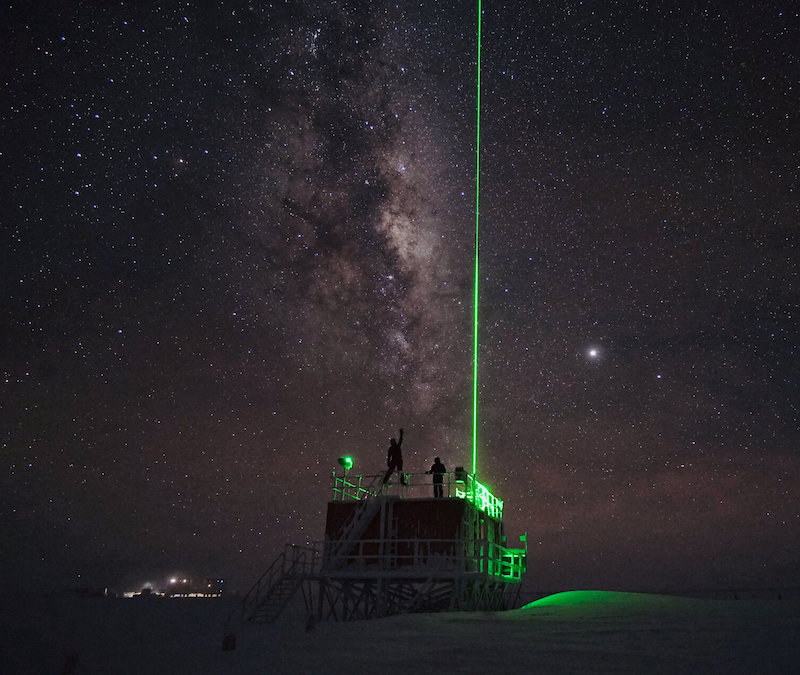
On Monday (August 4, 2020) the European Space Agency (ESA) released this image of a laser shooting into the sky to study the atmosphere at Concordia Research Station in Antarctica.

The Light Detection and Ranging instrument, or LIDAR, measures distances by aiming a pulsed laser beam at a target, and then records properties of the resulting scattered light with special sensors. Researchers use the measurements to collect information about the atmosphere, including density, temperature, wind speed, cloud formation and aerosol particles.

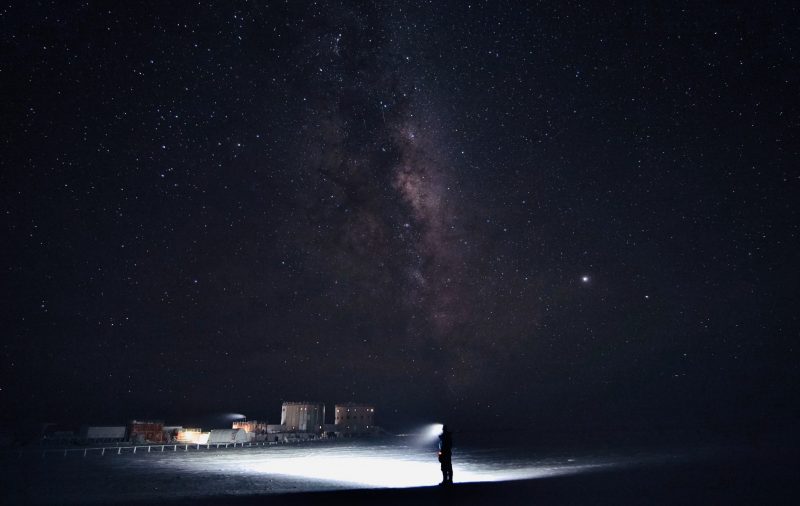
Concordia Research Station in July 2020. While hints of daylight can be spotted on the horizon around noon, there won’t be any sun for another 1 1/2 months. Read more on the Concordia blog. Image via ESA/ IPEV/ PNRA–S. Thoolen

The Concordia Research Station operates 2 LIDAR instruments. The one imaged is the smaller one, located 1,600 feet (500 meters) south of the station. A laser beam is emitted daily for 1 minute every 5 minutes at this time of year – Southern Hemisphere winter.

The station uses both LIDAR and SONAR (sonic detection and ranging) instruments to monitor the atmospheric boundary layer, the .6 mile (1 km) thick bottom layer of the troposphere where changes on Earth’s surface strongly influence temperature, moisture and wind. According to an ESA statement:

These changes to Earth’s surface are largely caused by human activity. Increased greenhouse gas emissions are raising temperatures and the release of chlorofluorocarbons is thinning the ozone layer, particularly in the polar regions.

Bottom line: ESA image of a LIDAR laser shooting into the sky to study the atmosphere at Concordia research station in Antarctica.

Via ESA


from EarthSky https://ift.tt/33sykw7

Image via ESA

On Monday (August 4, 2020) the European Space Agency (ESA) released this image of a laser shooting into the sky to study the atmosphere at Concordia Research Station in Antarctica.

The Light Detection and Ranging instrument, or LIDAR, measures distances by aiming a pulsed laser beam at a target, and then records properties of the resulting scattered light with special sensors. Researchers use the measurements to collect information about the atmosphere, including density, temperature, wind speed, cloud formation and aerosol particles.

Concordia Research Station in July 2020. While hints of daylight can be spotted on the horizon around noon, there won’t be any sun for another 1 1/2 months. Read more on the Concordia blog. Image via ESA/ IPEV/ PNRA–S. Thoolen

The Concordia Research Station operates 2 LIDAR instruments. The one imaged is the smaller one, located 1,600 feet (500 meters) south of the station. A laser beam is emitted daily for 1 minute every 5 minutes at this time of year – Southern Hemisphere winter.

The station uses both LIDAR and SONAR (sonic detection and ranging) instruments to monitor the atmospheric boundary layer, the .6 mile (1 km) thick bottom layer of the troposphere where changes on Earth’s surface strongly influence temperature, moisture and wind. According to an ESA statement:

These changes to Earth’s surface are largely caused by human activity. Increased greenhouse gas emissions are raising temperatures and the release of chlorofluorocarbons is thinning the ozone layer, particularly in the polar regions.

Bottom line: ESA image of a LIDAR laser shooting into the sky to study the atmosphere at Concordia research station in Antarctica.

Via ESA


from EarthSky https://ift.tt/33sykw7

See 4 bright planets in August

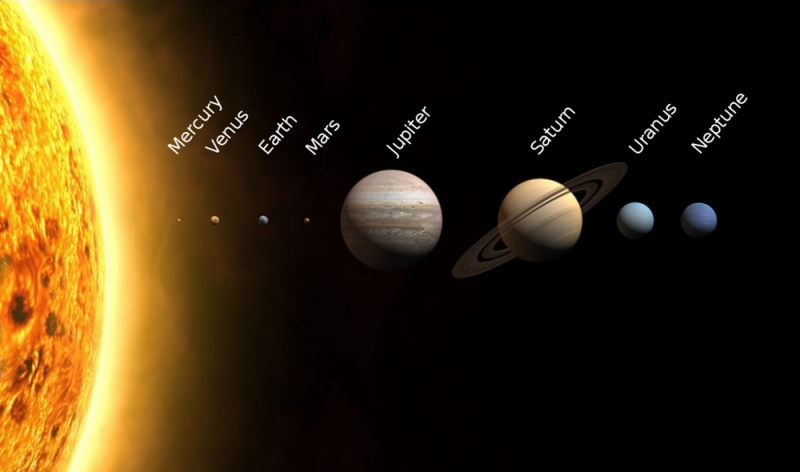
The five bright solar system planets, in their outward order from the sun, are Mercury, Venus, (Earth), Mars, Jupiter and Saturn. Four of these five planets are in display in August 2020. Mercury, the lone exception, is nominally a morning planet until mid-August, at which juncture it’ll transition over to the evening sky.

Two gas giant planets come out out first thing at dusk/nightfall: Jupiter and Saturn. Jupiter, the brighter of these two worlds, ranks as the 4th-brightest celestial body in all the heavens, after the sun, moon and the planet Venus. But there’s no way to mistake Jupiter for Venus in the evening sky, because Venus is only out during the predawn/dawn hours.

The planets of the solar system to scale by size (but not distance). In their order going outward from the sun: Mercury, Venus, Earth, Mars, Jupiter, Saturn, Uranus, and Neptune. To know the planetary distances in astronomical units, click on Heavens-Above: Solar system.

There’s no way to mistake Jupiter for nearby Saturn in the evening sky, either. Although Saturn is easily as bright as a 1st-magnitude star, the king Jupiter outshines the ringed planet Saturn by a good 14 times. With a modest backyard telescope, you can readily see Saturn’s rings and Jupiter’s four major moons: Io, Europa, Ganymede and Callisto.

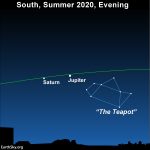
Both Jupiter and Saturn reside in front of the constellation Sagittarius, and will continue to do so till nearly the end of the year. If you’re blessed with a dark sky, look at “The Teapot” star pattern in the western half of the constellation Sagittarius. The Teapot lodges to the west of these Jupiter and Saturn throughout 2020.

Read more: The Teapot, and the galaxy’s center

Depending where you live worldwide, the red planet Mars will rise over your eastern horizon by mid-to-late evening. If you’re not one to stay up late, get up early to view Mars much higher up the predawn/dawn sky. Mars, though not as bright as Jupiter and Venus, beams more brilliantly than most any star in the starry heavens. Mars is brightening by the day and will actually outshine Jupiter by October 2020.

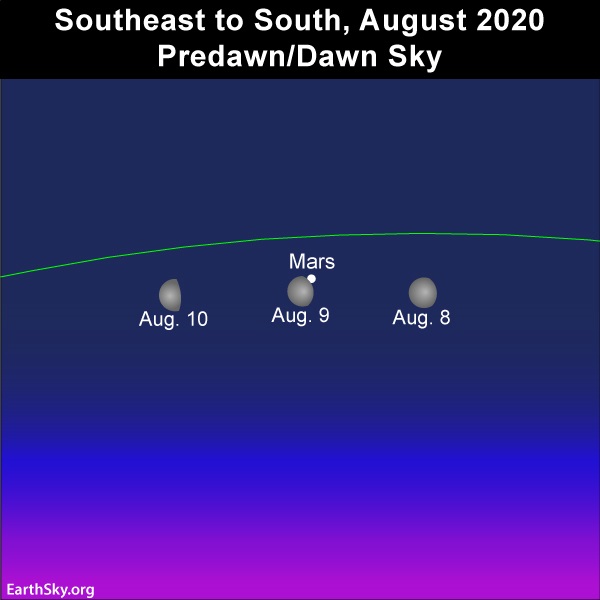
The moon, in its monthly trip through the constellations of the zodiac, is moving toward Mars as we speak, and will be joining up with Mars on the sky’s dome is a few more days. If you can’t find Mars otherwise, let the waning moon guide you for several days, centered on or near August 9.

Find out the moon’s position in front of the constellations of the zodiac via Heavens-Above

Moon and Mars in the August 2020 predawn/dawn sky.

If you’re more of an early bird than a night owl, look for the moon and Mars much higher up in the predawn/dawn sky. Note: the moon appears larger on the sky chart than it does in the real sky.

In the wee hours before dawn, you’ll have a chance to see Jupiter and Venus in the same sky together. The queen planet Venus rises before the king planet Jupiter sets, as seen from almost everywhere worldwide. But you’ll need an unobstructed horizon both east and west. Jupiter will be sitting low in the west, directly opposite of Venus when she rises in the east.

Live in the US or Canada? Find out when Venus rises and Jupiter sets via Farmer’s Almanac

For virtually anyplace worldwide, find out when Venus rises and Jupiter sets via TimeandDate

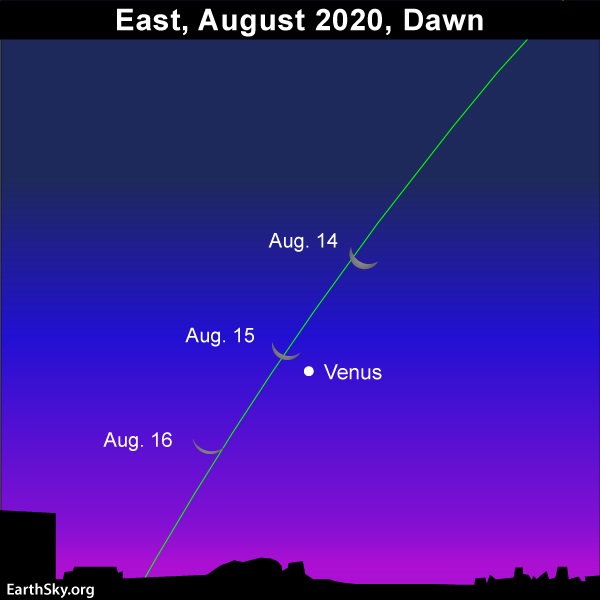
Venus and Mars will both be easy to view in the predawn/dawn sky, whether you catch Jupiter before it sets or not. You simply can’t miss Venus because it’s the 3rd-brightest heavenly body to light up the sky after the sun and moon. Should you have any doubt whether it’s Venus that you’re looking at or not, let the moon confirm it for you, as the queen of the night sky meets up with the queen planet in mid-August 2020!

Waning crescent moon and Venus adorn the morning sky in mid-August 2020.

It’ll be worth getting up for, as the waning crescent moon rendezvous with the queen planet Venus on the sky’s dome. Read more.

August 2020 presents a fine time to view four of the five bright planets. Best of all, you don’t have to stay out all night long to enjoy their company. Jupiter and Saturn pop out first thing after sunset, and stay out almost all night long. Then before sunrise, enjoy an eyeful of Mars and Venus in the predawn/dawn sky.


from EarthSky https://ift.tt/2DyI4tX

The five bright solar system planets, in their outward order from the sun, are Mercury, Venus, (Earth), Mars, Jupiter and Saturn. Four of these five planets are in display in August 2020. Mercury, the lone exception, is nominally a morning planet until mid-August, at which juncture it’ll transition over to the evening sky.

Two gas giant planets come out out first thing at dusk/nightfall: Jupiter and Saturn. Jupiter, the brighter of these two worlds, ranks as the 4th-brightest celestial body in all the heavens, after the sun, moon and the planet Venus. But there’s no way to mistake Jupiter for Venus in the evening sky, because Venus is only out during the predawn/dawn hours.

The planets of the solar system to scale by size (but not distance). In their order going outward from the sun: Mercury, Venus, Earth, Mars, Jupiter, Saturn, Uranus, and Neptune. To know the planetary distances in astronomical units, click on Heavens-Above: Solar system.

There’s no way to mistake Jupiter for nearby Saturn in the evening sky, either. Although Saturn is easily as bright as a 1st-magnitude star, the king Jupiter outshines the ringed planet Saturn by a good 14 times. With a modest backyard telescope, you can readily see Saturn’s rings and Jupiter’s four major moons: Io, Europa, Ganymede and Callisto.

Both Jupiter and Saturn reside in front of the constellation Sagittarius, and will continue to do so till nearly the end of the year. If you’re blessed with a dark sky, look at “The Teapot” star pattern in the western half of the constellation Sagittarius. The Teapot lodges to the west of these Jupiter and Saturn throughout 2020.

Read more: The Teapot, and the galaxy’s center

Depending where you live worldwide, the red planet Mars will rise over your eastern horizon by mid-to-late evening. If you’re not one to stay up late, get up early to view Mars much higher up the predawn/dawn sky. Mars, though not as bright as Jupiter and Venus, beams more brilliantly than most any star in the starry heavens. Mars is brightening by the day and will actually outshine Jupiter by October 2020.

The moon, in its monthly trip through the constellations of the zodiac, is moving toward Mars as we speak, and will be joining up with Mars on the sky’s dome is a few more days. If you can’t find Mars otherwise, let the waning moon guide you for several days, centered on or near August 9.

Find out the moon’s position in front of the constellations of the zodiac via Heavens-Above

Moon and Mars in the August 2020 predawn/dawn sky.

If you’re more of an early bird than a night owl, look for the moon and Mars much higher up in the predawn/dawn sky. Note: the moon appears larger on the sky chart than it does in the real sky.

In the wee hours before dawn, you’ll have a chance to see Jupiter and Venus in the same sky together. The queen planet Venus rises before the king planet Jupiter sets, as seen from almost everywhere worldwide. But you’ll need an unobstructed horizon both east and west. Jupiter will be sitting low in the west, directly opposite of Venus when she rises in the east.

Live in the US or Canada? Find out when Venus rises and Jupiter sets via Farmer’s Almanac

For virtually anyplace worldwide, find out when Venus rises and Jupiter sets via TimeandDate

Venus and Mars will both be easy to view in the predawn/dawn sky, whether you catch Jupiter before it sets or not. You simply can’t miss Venus because it’s the 3rd-brightest heavenly body to light up the sky after the sun and moon. Should you have any doubt whether it’s Venus that you’re looking at or not, let the moon confirm it for you, as the queen of the night sky meets up with the queen planet in mid-August 2020!

Waning crescent moon and Venus adorn the morning sky in mid-August 2020.

It’ll be worth getting up for, as the waning crescent moon rendezvous with the queen planet Venus on the sky’s dome. Read more.

August 2020 presents a fine time to view four of the five bright planets. Best of all, you don’t have to stay out all night long to enjoy their company. Jupiter and Saturn pop out first thing after sunset, and stay out almost all night long. Then before sunrise, enjoy an eyeful of Mars and Venus in the predawn/dawn sky.


from EarthSky https://ift.tt/2DyI4tX

COVID-19: “We’ve got so much on our plates”

From labs closing to funding cuts, the impact of COVID-19 on research has been vast. But while COVID-19 has slowed us down, we will never stop.   

We caught up with Dr Amanda Cross and Dr Becki Lee about how COVID-19 has impacted their work, and what the next few months looks like for them. 

Dr Amanda Cross: “We’ve managed to continue to be very productive, I’m very proud of my team”

Dr Amanda Cross is a Professor in cancer epidemiology and leads a group focused on bower cancer screening and prevention at Imperial College London. Her team runs multiple large observational studies and trials, primarily looking into screening and surveillance.  

Unlike some researchers, Cross’s current work isn’t based in a lab, and for this she considers her team lucky to be to be able to continue relatively unaffected. 

Dr Amanda Cross leads a group focused on bowel cancer screening and prevention.

“When the lockdown started, we happened to be in a period where we weren’t actively recruiting to a study. So in that regard, it hasn’t messed up a study in the middle.”  

The onset of the pandemic has by no means left them with nothing to do. “Everyone has really stepped up and been able to get on with their work,” says Cross. “We’ve managed to continue to be very productive, I’m very proud of my team.” 

But while the team has been able to carry on with data collection and analysis for their existing studies, other vital work has had to be put on hold.  

In England bowel cancer screening is available to people aged 60-74 – it aims to detect the early signs of bowel cancer in people without any symptoms. Back in January, Cross and her team were granted funding for a 10-year study embedded in the bowel cancer screening programme, which was due to begin in April this year.  

The traditional test for bowel cancer in the national screening programme was replaced by a new Faecal Immunochemical Test (FIT). FIT detects and quantifies the amount of human blood in a sample of poo, with a positive test suggesting gastrointestinal bleeding, a common sign of bowel cancer.  

But while FIT has been rolled out in multiple countries, including England, Wales and Scotland, the threshold for what’s considered a positive result can be different in each country. 

Cross and her team were about to begin a trial embedded in the screening program to see how many more cases of bowel cancer could be detected earlier by lowering the threshold for a positive FIT test.  

“The purpose of this study is to look at how many more cancers we can detect, if we apply a much lower threshold and how cost-effective that would be.” 

But just as the study was about to start, the COVID-19 outbreak began and the bowel cancer screening programme was effectively paused in terms of sending out FIT kits.  

And until screening is fully back up and running, the team are left waiting.  

“If the screening programme aren’t sending out their stool tests, we can’t recruit either,” Cross explains.  

The team has used the time to get as prepared as possible with the paperwork and approvals behind the study. “But all of those committees are inundated with COVID-related proposals. And so,not suprisingly, anything non-COVID is getting pushed down the queue.  

 There is a definite feeling of frustration regarding the impact of COVID-19 on the screening programme itself and on research associated with screening.  

“Thankfully, screening is resuming, and we hope to be able to get started with our study as soon as the screening programme reaches some level of normality” says Cross. “But the more delays we have, the longer it is before we have data that can help inform the national screening programme”.  

Dr Becki Lee: “It has really massively changed my whole life”  

For researchers who are also clinicians, the pandemic has left no area of their work unaffected.   

Dr Becki Lee is a clinician scientist who is completing a year-long project at The Francis Crick Institute, researching melanoma in the liver.   

Lee had been working as a cancer doctor at The Christie in Manchester before she moved to London in December 2019. A few months into her work in the capital, Becki, like the rest of us, began to witness the pandemic unfolding.   

“I was quite aware of COVID-19 when we were starting to get more cases. So I emailed The Christie, fairly early actually, to check what they wanted to do and to see whether I was going to be needed.”   

The situation developed rapidly, and there was a great demand for healthcare professionals to return to clinical work. “I had about a week or two’s notice and I moved everything from London back to Manchester. It has really massively changed my whole life.”   

Working as a registrar again, Lee has also had to adapt to an entirely new way of working. “Back in hospital we’re doing things like telephone clinics, which has been a completely new thing that we’ve ended up undertaking to try and reduce the number of physical visits”.   

Lee describes how phone calls are beneficial for some patients, who have trouble travelling. But for other, more sensitive conversations, talking on the phone can be very difficult.   

Returning to the front-line of the pandemic meant that Lee had to leave her research project very

suddenly, just as the Crick itself was temporarily closing. “I was at a bit of an unfortunate stage in terms of it was quite early in the project, I’d only really just started. So I was quite pleased with the progress I had made, but I didn’t really have loads of data to analyse at home.”   

Because of the stage Lee left her research project, and how busy she has been working at the hospital, Lee has not had a chance to continue with any of her laboratory research from home.   

But that’s beginning to change. As the number of COVID-19 cases continues to remain low, and lockdown measures continue to ease, Lee is looking to return to the Crick in August. “I’m hoping that I’ll

Dr Becki Lee is hoping to return to her lab work at the Francis Crick institute at some point in August.

be able to kind of pick up my research back where I paused it completely,” says Lee. “But I guess it will be a few weeks before I can properly get back up and running, because it takes a while to grow up your cells and get experiments set up”.    

Lee has also been involved in a number of clinical trials that have been impacted by COVID-19.   

One trial has been forced to halt recruitment of patients. “It’s such a shame because with trials you do feel like you’re gaining momentum with recruitment and then just to shut all that down is quite a big deal”.  

And it’s not just recruitment that has been affected. Lee is also setting up another trial funded by Cancer Research UK at the minute. “It’s amazing and we’re massively grateful for the support.”  

 The trial aims to use blood tests to monitor people with early stage melanoma after surgery. “If we detect circulating tumour DNA in the samples, we will either keep the person on standard care or treat them early with immunotherapy. And the question is whether early treatment with immunotherapy improves survival.”   

Lee and the team had been keen to collect and process additional samples during the trial, which would allow them to learn more about melanoma relapse and response to treatment. But that application has been held up by COVID-19.   

“We’d put in a sample collection grant, and it was at that final stage. And it had already had good peer review, so we were quite hopeful.” The grant was about to go through the final stages before it could be accepted just as COVID hit, but Lee says the decision has been delayed now until May next year.   

Lee describes how they’re in a state of limbo, and currently the team are planning on opening the trial without knowing whether they’ll get the grant for additional sample collection.   

It’s been a busy period for Lee, but she’s looking forward to getting back in the lab. “I had a model set up in mice, so probably the first thing I’ll do is get that set up again and start to get some data, which will be exciting. Hopefully I can understand melanoma in the liver better so we can improve treatment in the future” 

Lilly

Read more:


from Cancer Research UK – Science blog https://ift.tt/3fprsBR

From labs closing to funding cuts, the impact of COVID-19 on research has been vast. But while COVID-19 has slowed us down, we will never stop.   

We caught up with Dr Amanda Cross and Dr Becki Lee about how COVID-19 has impacted their work, and what the next few months looks like for them. 

Dr Amanda Cross: “We’ve managed to continue to be very productive, I’m very proud of my team”

Dr Amanda Cross is a Professor in cancer epidemiology and leads a group focused on bower cancer screening and prevention at Imperial College London. Her team runs multiple large observational studies and trials, primarily looking into screening and surveillance.  

Unlike some researchers, Cross’s current work isn’t based in a lab, and for this she considers her team lucky to be to be able to continue relatively unaffected. 

Dr Amanda Cross leads a group focused on bowel cancer screening and prevention.

“When the lockdown started, we happened to be in a period where we weren’t actively recruiting to a study. So in that regard, it hasn’t messed up a study in the middle.”  

The onset of the pandemic has by no means left them with nothing to do. “Everyone has really stepped up and been able to get on with their work,” says Cross. “We’ve managed to continue to be very productive, I’m very proud of my team.” 

But while the team has been able to carry on with data collection and analysis for their existing studies, other vital work has had to be put on hold.  

In England bowel cancer screening is available to people aged 60-74 – it aims to detect the early signs of bowel cancer in people without any symptoms. Back in January, Cross and her team were granted funding for a 10-year study embedded in the bowel cancer screening programme, which was due to begin in April this year.  

The traditional test for bowel cancer in the national screening programme was replaced by a new Faecal Immunochemical Test (FIT). FIT detects and quantifies the amount of human blood in a sample of poo, with a positive test suggesting gastrointestinal bleeding, a common sign of bowel cancer.  

But while FIT has been rolled out in multiple countries, including England, Wales and Scotland, the threshold for what’s considered a positive result can be different in each country. 

Cross and her team were about to begin a trial embedded in the screening program to see how many more cases of bowel cancer could be detected earlier by lowering the threshold for a positive FIT test.  

“The purpose of this study is to look at how many more cancers we can detect, if we apply a much lower threshold and how cost-effective that would be.” 

But just as the study was about to start, the COVID-19 outbreak began and the bowel cancer screening programme was effectively paused in terms of sending out FIT kits.  

And until screening is fully back up and running, the team are left waiting.  

“If the screening programme aren’t sending out their stool tests, we can’t recruit either,” Cross explains.  

The team has used the time to get as prepared as possible with the paperwork and approvals behind the study. “But all of those committees are inundated with COVID-related proposals. And so,not suprisingly, anything non-COVID is getting pushed down the queue.  

 There is a definite feeling of frustration regarding the impact of COVID-19 on the screening programme itself and on research associated with screening.  

“Thankfully, screening is resuming, and we hope to be able to get started with our study as soon as the screening programme reaches some level of normality” says Cross. “But the more delays we have, the longer it is before we have data that can help inform the national screening programme”.  

Dr Becki Lee: “It has really massively changed my whole life”  

For researchers who are also clinicians, the pandemic has left no area of their work unaffected.   

Dr Becki Lee is a clinician scientist who is completing a year-long project at The Francis Crick Institute, researching melanoma in the liver.   

Lee had been working as a cancer doctor at The Christie in Manchester before she moved to London in December 2019. A few months into her work in the capital, Becki, like the rest of us, began to witness the pandemic unfolding.   

“I was quite aware of COVID-19 when we were starting to get more cases. So I emailed The Christie, fairly early actually, to check what they wanted to do and to see whether I was going to be needed.”   

The situation developed rapidly, and there was a great demand for healthcare professionals to return to clinical work. “I had about a week or two’s notice and I moved everything from London back to Manchester. It has really massively changed my whole life.”   

Working as a registrar again, Lee has also had to adapt to an entirely new way of working. “Back in hospital we’re doing things like telephone clinics, which has been a completely new thing that we’ve ended up undertaking to try and reduce the number of physical visits”.   

Lee describes how phone calls are beneficial for some patients, who have trouble travelling. But for other, more sensitive conversations, talking on the phone can be very difficult.   

Returning to the front-line of the pandemic meant that Lee had to leave her research project very

suddenly, just as the Crick itself was temporarily closing. “I was at a bit of an unfortunate stage in terms of it was quite early in the project, I’d only really just started. So I was quite pleased with the progress I had made, but I didn’t really have loads of data to analyse at home.”   

Because of the stage Lee left her research project, and how busy she has been working at the hospital, Lee has not had a chance to continue with any of her laboratory research from home.   

But that’s beginning to change. As the number of COVID-19 cases continues to remain low, and lockdown measures continue to ease, Lee is looking to return to the Crick in August. “I’m hoping that I’ll

Dr Becki Lee is hoping to return to her lab work at the Francis Crick institute at some point in August.

be able to kind of pick up my research back where I paused it completely,” says Lee. “But I guess it will be a few weeks before I can properly get back up and running, because it takes a while to grow up your cells and get experiments set up”.    

Lee has also been involved in a number of clinical trials that have been impacted by COVID-19.   

One trial has been forced to halt recruitment of patients. “It’s such a shame because with trials you do feel like you’re gaining momentum with recruitment and then just to shut all that down is quite a big deal”.  

And it’s not just recruitment that has been affected. Lee is also setting up another trial funded by Cancer Research UK at the minute. “It’s amazing and we’re massively grateful for the support.”  

 The trial aims to use blood tests to monitor people with early stage melanoma after surgery. “If we detect circulating tumour DNA in the samples, we will either keep the person on standard care or treat them early with immunotherapy. And the question is whether early treatment with immunotherapy improves survival.”   

Lee and the team had been keen to collect and process additional samples during the trial, which would allow them to learn more about melanoma relapse and response to treatment. But that application has been held up by COVID-19.   

“We’d put in a sample collection grant, and it was at that final stage. And it had already had good peer review, so we were quite hopeful.” The grant was about to go through the final stages before it could be accepted just as COVID hit, but Lee says the decision has been delayed now until May next year.   

Lee describes how they’re in a state of limbo, and currently the team are planning on opening the trial without knowing whether they’ll get the grant for additional sample collection.   

It’s been a busy period for Lee, but she’s looking forward to getting back in the lab. “I had a model set up in mice, so probably the first thing I’ll do is get that set up again and start to get some data, which will be exciting. Hopefully I can understand melanoma in the liver better so we can improve treatment in the future” 

Lilly

Read more:


from Cancer Research UK – Science blog https://ift.tt/3fprsBR

Find M4 near the Scorpion’s Heart

Star chart of hook-shaped constellation Scorpius with Antares and cluster M4 marked.

Assuming you have a dark sky, look just to the right of Antares for M4.

EarthSky’s yearly crowd-funding campaign is in progress. In 2020, we are donating 8.5% of all incoming revenues to No Kids Hungry. Click to learn more and donate.

Red Antares – the brightest star in Scorpius the Scorpion and often called the Heart of the Scorpion – is up in the evening now. It’s a bright red star known for twinkling rapidly. If you have binoculars, sweep for an object near Antares on the sky’s dome. This object is called Messier 4 or M4. It’s a globular cluster, one of our galaxy’s oldest inhabitants. M4 has an estimated age of 12.2 billion years, in contrast to about 4.5 billion years for our sun.

If you’ve never found a deep-sky object on your own before, M4 is a grand place to start. Northern Hemisphere summer evenings – or Southern Hemisphere winter evenings – are probably your best bet for catching M4. The M4 globular star cluster is easy to find, because it’s right next to the first-magnitude star Antares, the brightest in the constellation Scorpius the Scorpion.

Your first step to locating M4 is to find Antares, the Scorpion’s heart star.

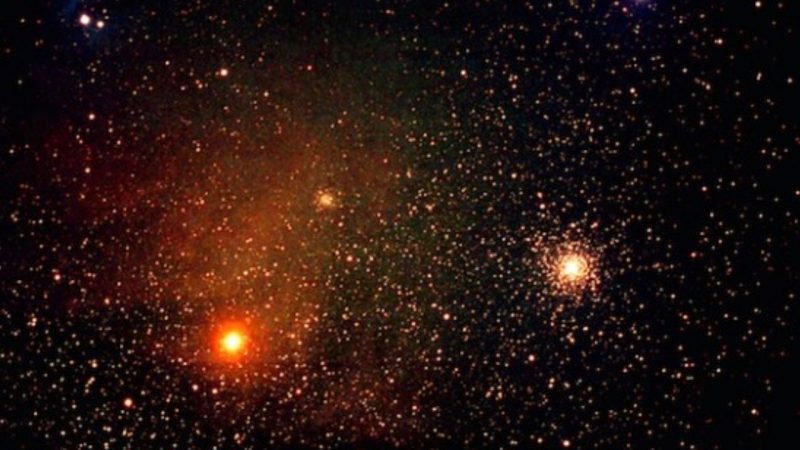
A bright red star, with a symmetrical round star cluster next to it.

View at EarthSky Community Photos. | EarthSky friend Dr Ski in the Philippines caught M4 near the red star Antares back in April, when they were in the morning sky. He wrote: “Red giant Antares with its globular cluster companion M4. A feast for the eyes through any instrument!” Thank you, Dr Ski!

Antares and M4 are best seen from around the globe in the months around July. In early June, Antares is highest in the sky around midnight (1 a.m. daylight saving time). That means it’s high in the south for Northern Hemisphere viewers, and overhead for Southern Hemisphere viewers.

The stars return to the same place in the sky some two hours earlier every month. So Antares is highest up around 10 p.m. (11 p.m. daylight saving time) in early July, and 8 p.m. (9 p.m. daylight saving time) in early August.

Dense starfield photo, 1 orange star, 1 much larger reddish star, and 1 large white fuzzy object.

Red star Antares (l) and nearby star cluster M4. Image via StargazerBob@aol.com.

You might glimpse M4 with the unaided eye on a very dark, moonless night, from a country location. If you can’t spot it, use binoculars to sweep for it.

Antares and M4 readily fit inside the same binocular field of view, with M4 appearing a bit more than 1 degree to the west (or right) of Antares. For reference, a typical binocular field has a diameter of 5 to 6 degrees. M4 looks like a rather dim, hazy star in binoculars.

Once you spot it, you might begin longing for a telescope to be able to resolve this fuzzy cluster into a clump of starry pinpoints.

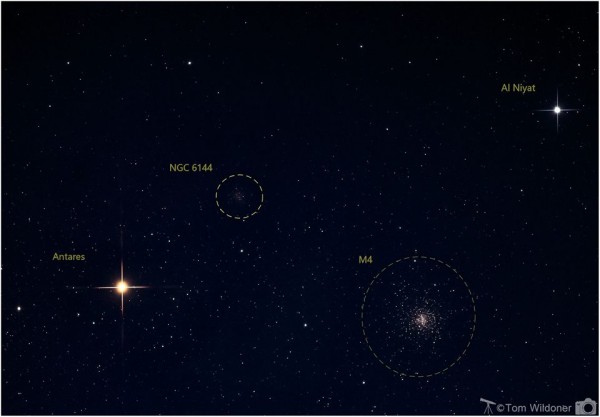
Star photo. Bright Antares, large fuzzy M4, dim NGC 6144, and another star labeled.

A 5-minute stacked image of Antares and the surrounding region including the globular cluster Messier 4 (M4). Photo by our friend Tom Wildoner at the Dark Side Observatory.

History and science of M4. The comet hunter Charles Messier (1730-1817) listed M4 as object #4 in his famous Messier catalog. The Messier catalog listed over 100 deep-sky objects that look like comets, but really aren’t. Charles Messier wanted to steer comet hunters away from these faint fuzzies that masquerade as comets.

Modern astronomy tells us that M4 is a globular star cluster – a globe-shape stellar city packed with perhaps a hundred thousand stars. Unlike open star clusters – such as the Pleiades and the Hyades – the Milky Way galaxy’s 200 or so globular star clusters are not part of the galactic disk.

Instead, globular clusters populate the galactic halo – the sphere-shaped region of the Milky Way circling above and below the pancake-shaped galactic disk.

At about 7,000 light-years from Earth, M4 is one of the two closest globular clusters to our sun and Earth (the other is NGC 6397). That’s among the Milky Way’s 200 or so globular clusters. Most globulars reside tens of thousands of light-years away. The farthest of globular clusters, M54, is thought to be 70,000 light-years distant.

M4 is about 75 light-years across.

Globular clusters are tightly packed with tens to hundreds of thousands of stars, whereas open clusters are loosely-bound stellar confederations with only a few hundred to a thousand stars. Globular clusters contain primitive stars that are billions of years old and almost as old as the universe itself. On the other hand, open clusters consist of young, hot stars that tend to disperse after hundreds of millions of years.

Dense globe of stars with increasing distance between them farther from center.

Messier 4 or M4. Image via European Southern Observatory.

M4’s position is at Right Ascension: 16h 23.6m; Declination: 26 degrees 32′ south

Bottom line: M4 or Messier 4 is a globular star cluster, one of the nearest to our solar system. It’s also one of the easiest of all globular clusters to find.


from EarthSky https://ift.tt/30SdRw8
Star chart of hook-shaped constellation Scorpius with Antares and cluster M4 marked.

Assuming you have a dark sky, look just to the right of Antares for M4.

EarthSky’s yearly crowd-funding campaign is in progress. In 2020, we are donating 8.5% of all incoming revenues to No Kids Hungry. Click to learn more and donate.

Red Antares – the brightest star in Scorpius the Scorpion and often called the Heart of the Scorpion – is up in the evening now. It’s a bright red star known for twinkling rapidly. If you have binoculars, sweep for an object near Antares on the sky’s dome. This object is called Messier 4 or M4. It’s a globular cluster, one of our galaxy’s oldest inhabitants. M4 has an estimated age of 12.2 billion years, in contrast to about 4.5 billion years for our sun.

If you’ve never found a deep-sky object on your own before, M4 is a grand place to start. Northern Hemisphere summer evenings – or Southern Hemisphere winter evenings – are probably your best bet for catching M4. The M4 globular star cluster is easy to find, because it’s right next to the first-magnitude star Antares, the brightest in the constellation Scorpius the Scorpion.

Your first step to locating M4 is to find Antares, the Scorpion’s heart star.

A bright red star, with a symmetrical round star cluster next to it.

View at EarthSky Community Photos. | EarthSky friend Dr Ski in the Philippines caught M4 near the red star Antares back in April, when they were in the morning sky. He wrote: “Red giant Antares with its globular cluster companion M4. A feast for the eyes through any instrument!” Thank you, Dr Ski!

Antares and M4 are best seen from around the globe in the months around July. In early June, Antares is highest in the sky around midnight (1 a.m. daylight saving time). That means it’s high in the south for Northern Hemisphere viewers, and overhead for Southern Hemisphere viewers.

The stars return to the same place in the sky some two hours earlier every month. So Antares is highest up around 10 p.m. (11 p.m. daylight saving time) in early July, and 8 p.m. (9 p.m. daylight saving time) in early August.

Dense starfield photo, 1 orange star, 1 much larger reddish star, and 1 large white fuzzy object.

Red star Antares (l) and nearby star cluster M4. Image via StargazerBob@aol.com.

You might glimpse M4 with the unaided eye on a very dark, moonless night, from a country location. If you can’t spot it, use binoculars to sweep for it.

Antares and M4 readily fit inside the same binocular field of view, with M4 appearing a bit more than 1 degree to the west (or right) of Antares. For reference, a typical binocular field has a diameter of 5 to 6 degrees. M4 looks like a rather dim, hazy star in binoculars.

Once you spot it, you might begin longing for a telescope to be able to resolve this fuzzy cluster into a clump of starry pinpoints.

Star photo. Bright Antares, large fuzzy M4, dim NGC 6144, and another star labeled.

A 5-minute stacked image of Antares and the surrounding region including the globular cluster Messier 4 (M4). Photo by our friend Tom Wildoner at the Dark Side Observatory.

History and science of M4. The comet hunter Charles Messier (1730-1817) listed M4 as object #4 in his famous Messier catalog. The Messier catalog listed over 100 deep-sky objects that look like comets, but really aren’t. Charles Messier wanted to steer comet hunters away from these faint fuzzies that masquerade as comets.

Modern astronomy tells us that M4 is a globular star cluster – a globe-shape stellar city packed with perhaps a hundred thousand stars. Unlike open star clusters – such as the Pleiades and the Hyades – the Milky Way galaxy’s 200 or so globular star clusters are not part of the galactic disk.

Instead, globular clusters populate the galactic halo – the sphere-shaped region of the Milky Way circling above and below the pancake-shaped galactic disk.

At about 7,000 light-years from Earth, M4 is one of the two closest globular clusters to our sun and Earth (the other is NGC 6397). That’s among the Milky Way’s 200 or so globular clusters. Most globulars reside tens of thousands of light-years away. The farthest of globular clusters, M54, is thought to be 70,000 light-years distant.

M4 is about 75 light-years across.

Globular clusters are tightly packed with tens to hundreds of thousands of stars, whereas open clusters are loosely-bound stellar confederations with only a few hundred to a thousand stars. Globular clusters contain primitive stars that are billions of years old and almost as old as the universe itself. On the other hand, open clusters consist of young, hot stars that tend to disperse after hundreds of millions of years.

Dense globe of stars with increasing distance between them farther from center.

Messier 4 or M4. Image via European Southern Observatory.

M4’s position is at Right Ascension: 16h 23.6m; Declination: 26 degrees 32′ south

Bottom line: M4 or Messier 4 is a globular star cluster, one of the nearest to our solar system. It’s also one of the easiest of all globular clusters to find.


from EarthSky https://ift.tt/30SdRw8

adds 2