aads

A ‘sponge on a string’ test to detect oesophageal cancer earlier

The Cytosponge

Around 9,100 people are diagnosed with oesophageal cancer each year in the UK. 

A big challenge with this type of cancer is that many people don’t realise there’s a problem until they start to have trouble swallowing. Often, these symptoms aren’t recognisable until a later stage in the disease.  

But there may be an opportunity to detect the disease earlier. Some people develop a condition – called Barrett’s oesophagus – prior to developing into cancer. 

Barrett’s oesophagus is much more common than oesophageal cancer, and although it will only become cancer in a handful of cases, it presents an opportunity for doctors to spot a problem early and intervene before cancer develops. But the typical test for Barrett’s oesophagus, endoscopy, is both invasive and expensive. 

Enter the Cytosponge.  

Cytosponge-TFF3 test is a ‘sponge on a string’ device coupled with a laboratory test called TFF3 developed by scientists funded by the Medical Research Council (MRC) and Cancer Research UK – a simple, quick and affordable test for Barrett’s oesophagus that can be done in a GP surgery.  

And the latest results, published in The Lancet, suggest this Cytosponge-TFF3 test can identify ten times more people with Barrett’s oesophagus than current GP care. 

We caught up with Professor Rebecca Fitzgerald, based at the University of Cambridge, whose team studies oesophageal cancer and has worked hard over the last decade to develop this innovative test.

How does it work?

Cytosponge is a small coated pill-on-a-string that contains the sponge. It’s easy for people to swallow, and when the pill reaches the stomach, the coating dissolves and the sponge expands.  

When the sponge is pulled back up, it collects some of the cells lining the oesophagus on its way. The sponge is sent off for analysis in the lab, “where we have developed a simple antibody test called TFF3 so that pathologists can easily spot the signs precancerous condition”.  

Planting the seeds 

A seed was planted for the idea for the Cytosponge in around 2000, whilst Fitzgerald was still in London.  

“I was talking with my boss, Professor Mike Farthing, about how an endoscopy isn’t ideal for patients and for sampling, and how what you really need is some kind of bottle brush for easy collection of cells.”  

But it was when Fitzgerald moved her research to Cambridge in 2002 that she began a prototype for this ‘bottle-brush’ idea. Over the years, the prototype evolved into what’s now recognised as the Cytosponge, which has been tested on thousands of people across the country.  

The first real test for Cytosponge was to see if people were willing to try the sponge-on-a-string, and whether the process was feasible in a GP surgery.  

And once that hurdle was cleared, it was time to test the accuracy of Cytosponge in clinical trials.

The latest results  

The latest Cytosponge trial compared Cytosponge to the current model for managing people with heartburn symptoms, the main risk factor for Barrett’s and cancer of the oesophagus.  

“What GPs ordinarily do if you’ve got reflux symptoms is to give you medication to get rid of the heartburn. So, most patients that see their GP with heartburn won’t get an endoscopy test,” Fitzgerald explains.  

“Because the Cytosponge is such a simple test that you can do, basically in 10 minutes in a GP surgery, we wanted to compare what GP’s ordinarily do, with offering all patients who usually receive medication for heartburn the Cytosponge test.” 

13,000 patients were enrolled in the study from GP surgeries across England. Half of these patients were offered the standard clinical care, while the other half were offered the Cytosponge.  

At the end of the trial, the team analysed how many cases of Barrett’s oesophagus were picked up in each of the two arms of the trial, and the results were quite remarkable.  

“We found 10 times more cases of Barrett’s oesophagus in the people that were offered a Cytosponge compared with what GP’s ordinarily do,” says Fitzgerald.  

What’s more, the trial picked up a number of early stage cancers too.  

“If the cancer is detected early you can cure the disease. You can remove it completely at endoscopy and the patient may not need to have chemotherapy and surgery to remove the oesophagus,” Fitzgerald explains.  

The results will not only change the way Barrett’s oesophagus and oesophageal cancer is detected in the future, the success of the BEST3 trial has meant that cancers have been successfully detected and treated in those who took part.  

Liz is one of those cases.

Liz’s story 

Woman doing pottery

Liz took part in the BEST3 trial in 2017.

Liz had suffered with acid reflux for many years. When she received a letter from her GP about the BEST3 trial, she signed up out of pure curiosity.  

“I was curious about the trial because I’d never heard of Barrett’s oesophagus and so I just took part out of interest,” Liz explains.   

A fortnight after having the Cytosponge test at her local GP surgery, Liz received a letter saying that the test indicated she did have Barrett’s oesophagus. Next, Liz required an endoscopy to clarify the results.  

“I went and had an endoscopy and even I could see that things were not very good in my oesophagus. It was extremely inflamed and bleeding and not healthy looking at all.”  

The endoscopy also revealed that she had early stage oesophageal cancer, “that was the moment when you suddenly think, oh, this is bad”.  

Thankfully, the cancer had been caught early by the Cytosponge. “I didn’t have to have any harmful treatments at all. They could remove it by doing an endoscopic resection,” says Liz.  

Liz is a retired scientist, who has experience of working in research labs. “I understood about a lot of the processes,” she explains, “there’s a huge amount of science behind it, but the procedure itself is so simple. It is, to my mind, a perfect test that could easily be carried out widely in the community.” 

This was in 2017, at the beginning of the BEST3 trial. Since then, Liz has been busy enjoying life to the full. “Last year, as well as enjoying a 90-mile walk along the Ridgeway, I was able to put my hobby of pottery to good use by making a hundred coasters bearing an image of the Cytosponge. These were sent as a small thank you gift to the research nurses involved in the BEST3 trial.”  

A COVID-response Cytosponge clinic 

The team recently received a grant to begin implementing the Cytosponge test, both in GPs and in secondary care across England in the coming years.  

But the onset of the coronavirus pandemic meant that plans were quickly adjusted. 

“COVID-19 means that endoscopy services were pretty much shut down,” Fitzgerald explains, “it means that there are people out there who just weren’t being referred, or who had been referred and were being stalled and not getting access to diagnostic tests.” 

The team received permission to begin procedures immediately, setting up a ‘COVID Cytosponge clinic’ at the Addenbrooke’s hospital in Cambridge.  

“We were taking patients referred by the two week wait from their GP,” says Fitzgerald. “These are people who can still swallow capsules, who don’t sound quite so poorly, but otherwise would have had a delay in getting the endoscopy, who got the Cytosponge test.” 

This is a different way of using Cytosponge than had been tested in the previous trials, but analysing the data collected in this Addenbrooke’s pilot will help to find out if Cytosponge can play a useful role in working out who would benefit from an endoscopy the soonest.  

The Cytosponge test has reaffirmed the need to continue searching for innovative diagnostic tools, that detect pre-cancerous conditions quickly and non-invasively. One that can help save lives in today’s uncertain circumstances and into the future.   

Lilly

Read more


from Cancer Research UK – Science blog https://ift.tt/39MpQRM
The Cytosponge

Around 9,100 people are diagnosed with oesophageal cancer each year in the UK. 

A big challenge with this type of cancer is that many people don’t realise there’s a problem until they start to have trouble swallowing. Often, these symptoms aren’t recognisable until a later stage in the disease.  

But there may be an opportunity to detect the disease earlier. Some people develop a condition – called Barrett’s oesophagus – prior to developing into cancer. 

Barrett’s oesophagus is much more common than oesophageal cancer, and although it will only become cancer in a handful of cases, it presents an opportunity for doctors to spot a problem early and intervene before cancer develops. But the typical test for Barrett’s oesophagus, endoscopy, is both invasive and expensive. 

Enter the Cytosponge.  

Cytosponge-TFF3 test is a ‘sponge on a string’ device coupled with a laboratory test called TFF3 developed by scientists funded by the Medical Research Council (MRC) and Cancer Research UK – a simple, quick and affordable test for Barrett’s oesophagus that can be done in a GP surgery.  

And the latest results, published in The Lancet, suggest this Cytosponge-TFF3 test can identify ten times more people with Barrett’s oesophagus than current GP care. 

We caught up with Professor Rebecca Fitzgerald, based at the University of Cambridge, whose team studies oesophageal cancer and has worked hard over the last decade to develop this innovative test.

How does it work?

Cytosponge is a small coated pill-on-a-string that contains the sponge. It’s easy for people to swallow, and when the pill reaches the stomach, the coating dissolves and the sponge expands.  

When the sponge is pulled back up, it collects some of the cells lining the oesophagus on its way. The sponge is sent off for analysis in the lab, “where we have developed a simple antibody test called TFF3 so that pathologists can easily spot the signs precancerous condition”.  

Planting the seeds 

A seed was planted for the idea for the Cytosponge in around 2000, whilst Fitzgerald was still in London.  

“I was talking with my boss, Professor Mike Farthing, about how an endoscopy isn’t ideal for patients and for sampling, and how what you really need is some kind of bottle brush for easy collection of cells.”  

But it was when Fitzgerald moved her research to Cambridge in 2002 that she began a prototype for this ‘bottle-brush’ idea. Over the years, the prototype evolved into what’s now recognised as the Cytosponge, which has been tested on thousands of people across the country.  

The first real test for Cytosponge was to see if people were willing to try the sponge-on-a-string, and whether the process was feasible in a GP surgery.  

And once that hurdle was cleared, it was time to test the accuracy of Cytosponge in clinical trials.

The latest results  

The latest Cytosponge trial compared Cytosponge to the current model for managing people with heartburn symptoms, the main risk factor for Barrett’s and cancer of the oesophagus.  

“What GPs ordinarily do if you’ve got reflux symptoms is to give you medication to get rid of the heartburn. So, most patients that see their GP with heartburn won’t get an endoscopy test,” Fitzgerald explains.  

“Because the Cytosponge is such a simple test that you can do, basically in 10 minutes in a GP surgery, we wanted to compare what GP’s ordinarily do, with offering all patients who usually receive medication for heartburn the Cytosponge test.” 

13,000 patients were enrolled in the study from GP surgeries across England. Half of these patients were offered the standard clinical care, while the other half were offered the Cytosponge.  

At the end of the trial, the team analysed how many cases of Barrett’s oesophagus were picked up in each of the two arms of the trial, and the results were quite remarkable.  

“We found 10 times more cases of Barrett’s oesophagus in the people that were offered a Cytosponge compared with what GP’s ordinarily do,” says Fitzgerald.  

What’s more, the trial picked up a number of early stage cancers too.  

“If the cancer is detected early you can cure the disease. You can remove it completely at endoscopy and the patient may not need to have chemotherapy and surgery to remove the oesophagus,” Fitzgerald explains.  

The results will not only change the way Barrett’s oesophagus and oesophageal cancer is detected in the future, the success of the BEST3 trial has meant that cancers have been successfully detected and treated in those who took part.  

Liz is one of those cases.

Liz’s story 

Woman doing pottery

Liz took part in the BEST3 trial in 2017.

Liz had suffered with acid reflux for many years. When she received a letter from her GP about the BEST3 trial, she signed up out of pure curiosity.  

“I was curious about the trial because I’d never heard of Barrett’s oesophagus and so I just took part out of interest,” Liz explains.   

A fortnight after having the Cytosponge test at her local GP surgery, Liz received a letter saying that the test indicated she did have Barrett’s oesophagus. Next, Liz required an endoscopy to clarify the results.  

“I went and had an endoscopy and even I could see that things were not very good in my oesophagus. It was extremely inflamed and bleeding and not healthy looking at all.”  

The endoscopy also revealed that she had early stage oesophageal cancer, “that was the moment when you suddenly think, oh, this is bad”.  

Thankfully, the cancer had been caught early by the Cytosponge. “I didn’t have to have any harmful treatments at all. They could remove it by doing an endoscopic resection,” says Liz.  

Liz is a retired scientist, who has experience of working in research labs. “I understood about a lot of the processes,” she explains, “there’s a huge amount of science behind it, but the procedure itself is so simple. It is, to my mind, a perfect test that could easily be carried out widely in the community.” 

This was in 2017, at the beginning of the BEST3 trial. Since then, Liz has been busy enjoying life to the full. “Last year, as well as enjoying a 90-mile walk along the Ridgeway, I was able to put my hobby of pottery to good use by making a hundred coasters bearing an image of the Cytosponge. These were sent as a small thank you gift to the research nurses involved in the BEST3 trial.”  

A COVID-response Cytosponge clinic 

The team recently received a grant to begin implementing the Cytosponge test, both in GPs and in secondary care across England in the coming years.  

But the onset of the coronavirus pandemic meant that plans were quickly adjusted. 

“COVID-19 means that endoscopy services were pretty much shut down,” Fitzgerald explains, “it means that there are people out there who just weren’t being referred, or who had been referred and were being stalled and not getting access to diagnostic tests.” 

The team received permission to begin procedures immediately, setting up a ‘COVID Cytosponge clinic’ at the Addenbrooke’s hospital in Cambridge.  

“We were taking patients referred by the two week wait from their GP,” says Fitzgerald. “These are people who can still swallow capsules, who don’t sound quite so poorly, but otherwise would have had a delay in getting the endoscopy, who got the Cytosponge test.” 

This is a different way of using Cytosponge than had been tested in the previous trials, but analysing the data collected in this Addenbrooke’s pilot will help to find out if Cytosponge can play a useful role in working out who would benefit from an endoscopy the soonest.  

The Cytosponge test has reaffirmed the need to continue searching for innovative diagnostic tools, that detect pre-cancerous conditions quickly and non-invasively. One that can help save lives in today’s uncertain circumstances and into the future.   

Lilly

Read more


from Cancer Research UK – Science blog https://ift.tt/39MpQRM

How astronomers rediscovered a ‘lost world’

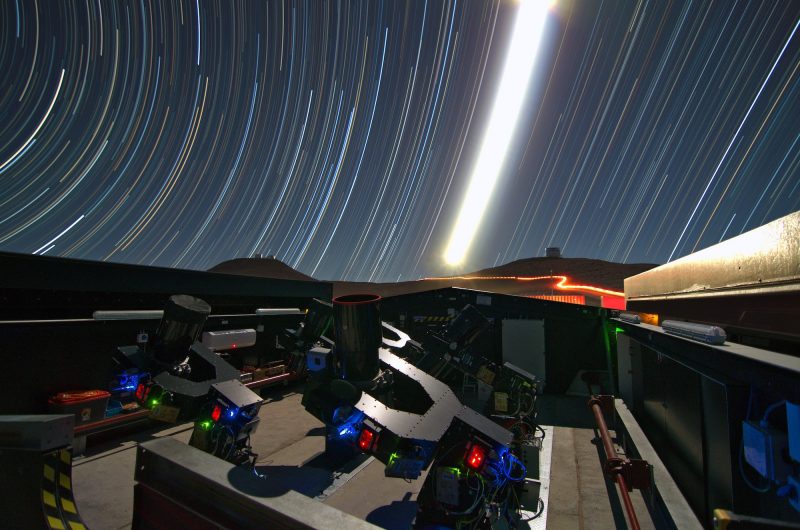
Telescopes on ground with long, bright, concentric curved lines in the sky.

Telescopes at the Next-Generation Transit Survey (NGTS) in Chile. Astronomers used these telescopes to find the “lost” world NGTS-11b. This image shows star trails; the bright streak is the moon. Image via University of Warwick.

EarthSky’s yearly crowd-funding campaign is in progress. In 2020, we are donating 8.5% to No Kids Hungry. Please donate to help us keep going, and help feed a kid!

The habitable zone – or Goldilocks zone – around a star is of great interest to astrobiologists, those scientists probing for life beyond Earth. It is the region where temperatures on a rocky world are suitable for liquid water to exist. Astronomers have been discovering many exoplanets orbiting within habitable zones. But they wonder, just what percentage of exoplanets in our Milky Way galaxy might orbit within a habitable zone? In other words, what is the potential for life in our galaxy? Now, a new method devised and announced by scientists at the University of Warwick in the U.K. has found a cooler planet that had been previously “lost” close to its star’s habitable zone. The planet is called NGTS-11b. These scientists say their method promises to help find many more such worlds orbiting in the habitable zones of their stars.

This rediscovery was published in the peer-reviewed journal The Astrophysical Journal Letters on July 20, 2020.

NGTS-11b is about the size and mass of Saturn. It orbits its star every 35 days. It is five times closer to its star than Earth is to the sun and is 620 light-years away.

Astronomers think that that it is just one of hundreds of “lost worlds” that this new technique can help rediscover.

Smiling young man with grassy field behind him.

Samuel Gill at the University of Warwick, lead author of the new study, is searching for “lost” worlds. Image via ResearchGate.

What do scientists mean by lost worlds?

Basically, they are exoplanets discovered by the Transiting Exoplanet Survey Satellite (TESS) space telescope but detected only once. TESS finds planets by observing them transit in front of their stars, but only scans most sections of the sky for 27 days. Any planets that have orbital periods longer than 27 days would only appear once in the observations. If a second observation cannot be obtained, the planet is considered “lost” as it were. But the researchers at the University of Warwick were able to reobserve some of these stars, using the Next-Generation Transit Survey (NGTS) in Chile, for up to 72 days. That way, planets with longer orbits could be detected. That’s how NGTS-11b was refound, by catching it transiting a second time. Samuel Gill, lead author of the paper, explained:

By chasing that second transit down we’ve found a longer period planet. It’s the first of hopefully many such finds pushing to longer periods.

These discoveries are rare but important, since they allow us to find longer period planets than other astronomers are finding. Longer period planets are cooler, more like the planets in our own solar system.

NGTS-11b has a temperature of only 160 degrees Celsius (320 degrees Fahrenheit), cooler than Mercury and Venus. Although this is still too hot to support life as we know it, it is closer to the Goldilocks zone than many previously discovered planets which typically have temperatures above 1000 degrees Celsius (1800 F).

Co-author Daniel Bayliss said:

This planet is out at a thirty-five-day orbit, which is a much longer period than we usually find them. It is exciting to see the Goldilocks zone within our sights.

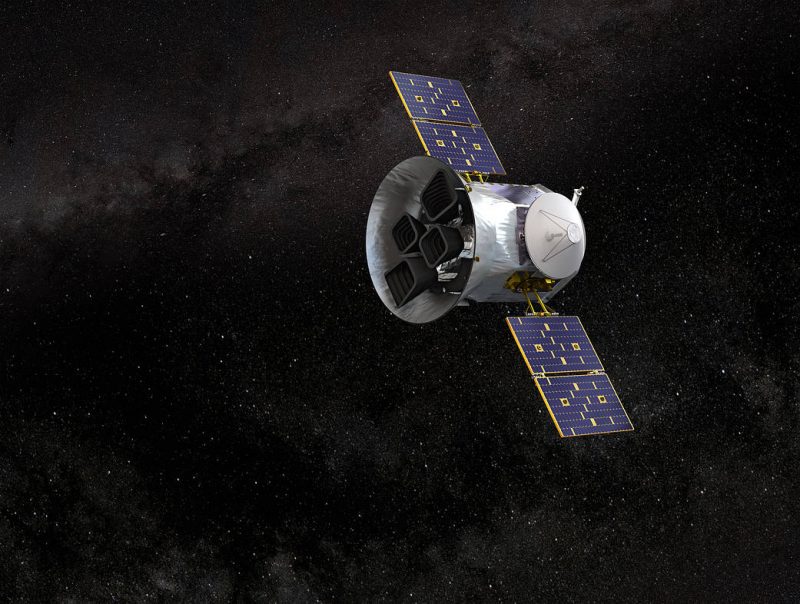
Cylindrical satellite with wide, flat solar panel on each side in space with stars in background.

Artist’s illustration of the Transiting Exoplanet Survey Satellite (TESS). Some of the exoplanets found by TESS are categorized as “lost” when they can’t be detected in a second transit of their star. Image via NASA/ Goddard Space Flight Center.

Another co-author, Pete Wheatley, added:

The original transit appeared just once in the TESS data, and it was our team’s painstaking detective work that allowed us to find it again a year later with NGTS.

NGTS has twelve state-of-the-art telescopes, which means that we can monitor multiple stars for months on end, searching for lost planets. The dip in light from the transit is only 1% deep and occurs only once every 35 days, putting it out of reach of other telescopes.

The researchers expect that NGTS-11b will be just the first of hundreds of lost worlds found once again. Gill said:

There are hundreds of single transits detected by TESS that we will be monitoring using this method. This will allow us to discover cooler exoplanets of all sizes, including planets more like those in our own solar system. Some of these will be small rocky planets in the Goldilocks zone that are cool enough to host liquid water oceans and potentially extraterrestrial life.

Being able to detect multiple transits of a planet is crucial for determining its orbital period and mass, which cannot always be done by TESS alone. From the paper:

It is important to note that we have been able to determine the mass and radius of this relatively long-period exoplanet with a very modest number of radial-velocity measurements (nine with HARPS and six with FEROS). The detection of the second transit with NGTS was crucial for tightly constraining the possible orbital periods, and this serves to demonstrate the value of intense photometric monitoring in following up single-transit events. Without this second transit detection we would have required many more radial-velocity measurements in order to confirm the planet, determine its orbital period, and measure its mass (e.g., Díaz et al. 2020). The strategy of large investments of photometric follow-up with instruments such as NGTS thereby allows efficient confirmation of single-transit events without adding to the considerable pressure on high-precision radial-velocity instruments. This highlights the power of high-precision ground-based photometric facilities in revealing longer-period transiting exoplanets that TESS alone cannot discover.

Many exoplanets discovered so far orbit very close to their stars, including hot Jupiters. Such objects are relatively easy to detect, but their nearness to their stars also makes them unlikely to be habitable. Finding more planets farther out from their stars, including those in their stars’ habitable zones, is important in the search for habitable worlds.

Telescopes like those at NGTS will help to find more habitable zone exoplanets, these scientists say.

Later, other telescopes like the upcoming James Webb Space Telescope – now scheduled for launch in October 2021 – will be able to analyze these planets’ atmospheres for possible biosignatures. By conducting research such as this, on Earth and in space, astronomers are stepping closer to finding other life in the galaxy, if it exists.

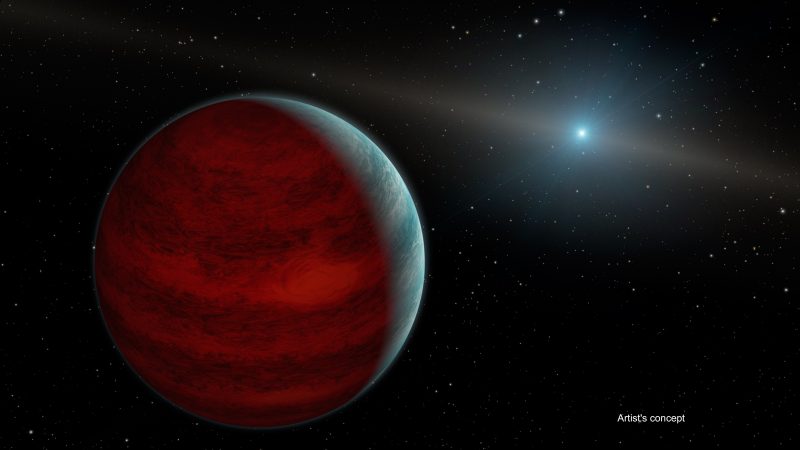
Banded giant planet with its star in background.

Artist’s concept of a gas giant planet orbiting its star. Researchers at the University of Warwick have rediscovered a planet about the size and mass of Saturn orbiting near the habitable zone of its star. Image via NASA/ JPL-Caltech.

Bottom line: Astronomers rediscover a previously “lost” exoplanet that is relatively cool and close to its star’s habitable zone.

Source: NGTS-11 b (TOI-1847 b): A Transiting Warm Saturn Recovered from a TESS Single-transit Event

Via University of Warwick


from EarthSky https://ift.tt/39D4VAs
Telescopes on ground with long, bright, concentric curved lines in the sky.

Telescopes at the Next-Generation Transit Survey (NGTS) in Chile. Astronomers used these telescopes to find the “lost” world NGTS-11b. This image shows star trails; the bright streak is the moon. Image via University of Warwick.

EarthSky’s yearly crowd-funding campaign is in progress. In 2020, we are donating 8.5% to No Kids Hungry. Please donate to help us keep going, and help feed a kid!

The habitable zone – or Goldilocks zone – around a star is of great interest to astrobiologists, those scientists probing for life beyond Earth. It is the region where temperatures on a rocky world are suitable for liquid water to exist. Astronomers have been discovering many exoplanets orbiting within habitable zones. But they wonder, just what percentage of exoplanets in our Milky Way galaxy might orbit within a habitable zone? In other words, what is the potential for life in our galaxy? Now, a new method devised and announced by scientists at the University of Warwick in the U.K. has found a cooler planet that had been previously “lost” close to its star’s habitable zone. The planet is called NGTS-11b. These scientists say their method promises to help find many more such worlds orbiting in the habitable zones of their stars.

This rediscovery was published in the peer-reviewed journal The Astrophysical Journal Letters on July 20, 2020.

NGTS-11b is about the size and mass of Saturn. It orbits its star every 35 days. It is five times closer to its star than Earth is to the sun and is 620 light-years away.

Astronomers think that that it is just one of hundreds of “lost worlds” that this new technique can help rediscover.

Smiling young man with grassy field behind him.

Samuel Gill at the University of Warwick, lead author of the new study, is searching for “lost” worlds. Image via ResearchGate.

What do scientists mean by lost worlds?

Basically, they are exoplanets discovered by the Transiting Exoplanet Survey Satellite (TESS) space telescope but detected only once. TESS finds planets by observing them transit in front of their stars, but only scans most sections of the sky for 27 days. Any planets that have orbital periods longer than 27 days would only appear once in the observations. If a second observation cannot be obtained, the planet is considered “lost” as it were. But the researchers at the University of Warwick were able to reobserve some of these stars, using the Next-Generation Transit Survey (NGTS) in Chile, for up to 72 days. That way, planets with longer orbits could be detected. That’s how NGTS-11b was refound, by catching it transiting a second time. Samuel Gill, lead author of the paper, explained:

By chasing that second transit down we’ve found a longer period planet. It’s the first of hopefully many such finds pushing to longer periods.

These discoveries are rare but important, since they allow us to find longer period planets than other astronomers are finding. Longer period planets are cooler, more like the planets in our own solar system.

NGTS-11b has a temperature of only 160 degrees Celsius (320 degrees Fahrenheit), cooler than Mercury and Venus. Although this is still too hot to support life as we know it, it is closer to the Goldilocks zone than many previously discovered planets which typically have temperatures above 1000 degrees Celsius (1800 F).

Co-author Daniel Bayliss said:

This planet is out at a thirty-five-day orbit, which is a much longer period than we usually find them. It is exciting to see the Goldilocks zone within our sights.

Cylindrical satellite with wide, flat solar panel on each side in space with stars in background.

Artist’s illustration of the Transiting Exoplanet Survey Satellite (TESS). Some of the exoplanets found by TESS are categorized as “lost” when they can’t be detected in a second transit of their star. Image via NASA/ Goddard Space Flight Center.

Another co-author, Pete Wheatley, added:

The original transit appeared just once in the TESS data, and it was our team’s painstaking detective work that allowed us to find it again a year later with NGTS.

NGTS has twelve state-of-the-art telescopes, which means that we can monitor multiple stars for months on end, searching for lost planets. The dip in light from the transit is only 1% deep and occurs only once every 35 days, putting it out of reach of other telescopes.

The researchers expect that NGTS-11b will be just the first of hundreds of lost worlds found once again. Gill said:

There are hundreds of single transits detected by TESS that we will be monitoring using this method. This will allow us to discover cooler exoplanets of all sizes, including planets more like those in our own solar system. Some of these will be small rocky planets in the Goldilocks zone that are cool enough to host liquid water oceans and potentially extraterrestrial life.

Being able to detect multiple transits of a planet is crucial for determining its orbital period and mass, which cannot always be done by TESS alone. From the paper:

It is important to note that we have been able to determine the mass and radius of this relatively long-period exoplanet with a very modest number of radial-velocity measurements (nine with HARPS and six with FEROS). The detection of the second transit with NGTS was crucial for tightly constraining the possible orbital periods, and this serves to demonstrate the value of intense photometric monitoring in following up single-transit events. Without this second transit detection we would have required many more radial-velocity measurements in order to confirm the planet, determine its orbital period, and measure its mass (e.g., Díaz et al. 2020). The strategy of large investments of photometric follow-up with instruments such as NGTS thereby allows efficient confirmation of single-transit events without adding to the considerable pressure on high-precision radial-velocity instruments. This highlights the power of high-precision ground-based photometric facilities in revealing longer-period transiting exoplanets that TESS alone cannot discover.

Many exoplanets discovered so far orbit very close to their stars, including hot Jupiters. Such objects are relatively easy to detect, but their nearness to their stars also makes them unlikely to be habitable. Finding more planets farther out from their stars, including those in their stars’ habitable zones, is important in the search for habitable worlds.

Telescopes like those at NGTS will help to find more habitable zone exoplanets, these scientists say.

Later, other telescopes like the upcoming James Webb Space Telescope – now scheduled for launch in October 2021 – will be able to analyze these planets’ atmospheres for possible biosignatures. By conducting research such as this, on Earth and in space, astronomers are stepping closer to finding other life in the galaxy, if it exists.

Banded giant planet with its star in background.

Artist’s concept of a gas giant planet orbiting its star. Researchers at the University of Warwick have rediscovered a planet about the size and mass of Saturn orbiting near the habitable zone of its star. Image via NASA/ JPL-Caltech.

Bottom line: Astronomers rediscover a previously “lost” exoplanet that is relatively cool and close to its star’s habitable zone.

Source: NGTS-11 b (TOI-1847 b): A Transiting Warm Saturn Recovered from a TESS Single-transit Event

Via University of Warwick


from EarthSky https://ift.tt/39D4VAs

Earth’s magnetic field may change faster than we thought

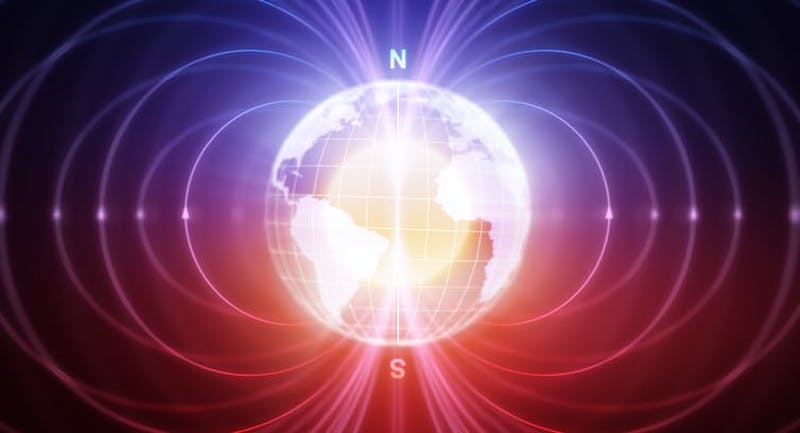
Translucent Earth with yellow core and long arc shaped lines from pole to pole.

It’s long been a mystery how fast the Earth’s magnetic field changes. Image via Andrey VP/ Shutterstock.

EarthSky’s yearly crowd-funding campaign is in progress. In 2020, we are donating 8.5% to No Kids Hungry. Please donate to help us keep going, and help feed a kid!

By Christopher Davies, University of Leeds

The Earth’s magnetic field, generated 1,800 miles (3,000 km) below our feet in the liquid iron core, is crucially important to life on our planet. It extends out into space, wrapping us in an electromagnetic blanket that shields the atmosphere and satellites from solar radiation.

Yet the magnetic field is constantly changing in both its strength and direction and has undergone some dramatic shifts in the past. This includes enigmatic reversals of the magnetic poles, with the south pole becoming the north pole and vice versa.

A long-standing question has been how fast the field can change. Our new study, published in Nature Communications, has uncovered some answers.

Rapid changes of the magnetic field are of great interest because they represent the most extreme behavior of the ocean of molten iron in the liquid core. By tying the observed changes to core processes, we can learn important information about an otherwise inaccessible region of our planet.

Historically, the fastest changes in Earth’s magnetic field have been associated with reversals, which occur at irregular intervals a few times every million years. But we discovered field changes that are much faster and more recent than any of the data associated with actual reversals.

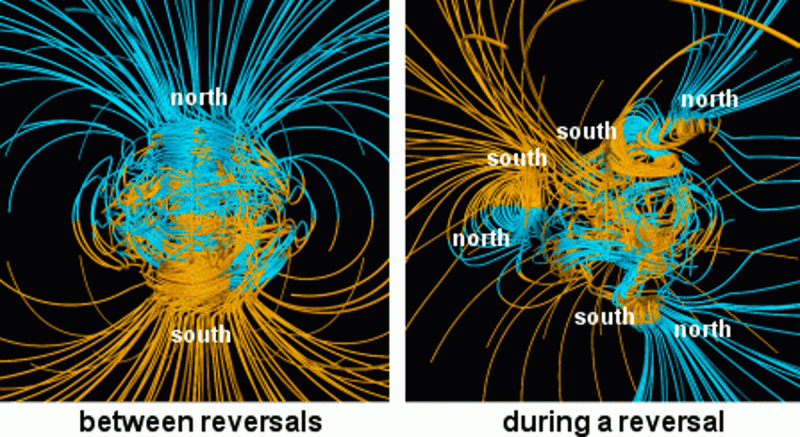
Left: Earth with orderly arc shaped lines. Right: Earth with tangle of lines.

Magnetic reversal. Image via NASA.

Nowadays satellites help monitor changes in the field in both space and time, complemented by navigational records and ground-based observatories. This information reveals that changes in the modern field are rather ponderous, around a tenth of a degree per year. But, while we know that the field has existed for at least 3.5 billion years, we don’t know much about its behavior prior to 400 years ago.

To track the ancient field, scientists analyse the magnetism recorded by sediments, lava flows and human-made artifacts. That’s because these materials contain microscopic magnetic grains that record the signature of Earth’s field at the time they cooled (for lavas) or were added to the landmass (for sediments). Sediment records from central Italy around the time of the last polarity reversal almost 800,000 years ago suggest relatively rapid field changes reaching one degree per year.

Such measurements, however, are extremely challenging, with results still being debated. For example, there are uncertainties in the process by which sediments acquire their magnetism.

Improved measurements

Our research takes a different approach by using computer models based on the physics of the field generation process. This is combined with a recently published reconstruction of global variations in Earth’s magnetic field spanning the last 100,000 years, based on a compilation of measurements from sediments, lavas and artifacts.

This shows that changes in the direction of Earth’s magnetic field reached rates that are up to 10 degrees per year – 10 times larger than the fastest currently reported variations.

The fastest observed changes in the geomagnetic field direction occurred around 39,000 years ago. This shift was associated with a locally weak field in a confined region just off the west coast of central America. The event followed the global “Laschamp excursion” – a “failed reversal” of the Earth’s magnetic field around 41,000 years ago in which the magnetic poles briefly moved far from the geographic poles before returning.

The fastest changes appear to be associated with local weakening of the magnetic field. Our model suggests this is caused by movement of patches of intense magnetic field across the surface of the liquid core. These patches are more prevalent at lower latitudes, suggesting that future searches for rapid changes in direction should focus on these areas.

The impact on society

Changes in the magnetic field, such as reversals, probably don’t pose a threat to life. Humans did manage to live through the dramatic Laschamp excursion. Today, the threat is mainly down to our reliance on electronic infrastructure. Space weather events such as geomagnetic storms, arising from the interaction between the magnetic field and incoming solar radiation, could disrupt satellite communications, GPS and power grids.

Cylindrical spacecraft with wide solar panel wings in orbit above blue and white partial view of Earth.

Satellites are at risk from space weather. Image via Andrey Armyagov/ Shutterstock

This is troubling – the economic cost of a collapse of the U.S. power grid due to a space-weather event has been estimated at around one trillion dollars. The threat is serious enough for space weather to appear as a high priority on the U.K. national risk register.

Space weather events tend to be more prevalent in regions where the magnetic field is weak – something we know can happen when the field is changing rapidly. Unfortunately, computer simulations suggest that directional changes arise after the field strength begins to weaken, meaning we cannot predict dips in field strength by just monitoring the field direction. Future work using more advanced simulations can shed more light on this issue.

Is another rapid change in the magnetic field on its way? This is very hard to answer. The fastest changes are also the rarest events: for example, the changes identified around the Laschamp excursion are over two times faster than any other changes occurring over the last 100,000 years.

This makes it difficult for scientists to predict rapid changes – they are “black swan events” that come as a surprise and have a big impact. One possible route forward is to use physics-based models of how the field behaves as part of the forecast.

We still have a lot to learn about the “speed limit” of Earth’s magnetic field. Rapid changes have not yet been directly observed during a polarity reversal, but they should be expected since the field is thought to become globally weak at these times.

Christopher Davies, Associate professor, University of Leeds

This article is republished from The Conversation under a Creative Commons license. Read the original article.

Bottom line: The authors of a new study say they’ve uncovered some answers to the long-standing question about how fast Earth’s magnetic field can change.

The Conversation


from EarthSky https://ift.tt/3hQNy1O
Translucent Earth with yellow core and long arc shaped lines from pole to pole.

It’s long been a mystery how fast the Earth’s magnetic field changes. Image via Andrey VP/ Shutterstock.

EarthSky’s yearly crowd-funding campaign is in progress. In 2020, we are donating 8.5% to No Kids Hungry. Please donate to help us keep going, and help feed a kid!

By Christopher Davies, University of Leeds

The Earth’s magnetic field, generated 1,800 miles (3,000 km) below our feet in the liquid iron core, is crucially important to life on our planet. It extends out into space, wrapping us in an electromagnetic blanket that shields the atmosphere and satellites from solar radiation.

Yet the magnetic field is constantly changing in both its strength and direction and has undergone some dramatic shifts in the past. This includes enigmatic reversals of the magnetic poles, with the south pole becoming the north pole and vice versa.

A long-standing question has been how fast the field can change. Our new study, published in Nature Communications, has uncovered some answers.

Rapid changes of the magnetic field are of great interest because they represent the most extreme behavior of the ocean of molten iron in the liquid core. By tying the observed changes to core processes, we can learn important information about an otherwise inaccessible region of our planet.

Historically, the fastest changes in Earth’s magnetic field have been associated with reversals, which occur at irregular intervals a few times every million years. But we discovered field changes that are much faster and more recent than any of the data associated with actual reversals.

Left: Earth with orderly arc shaped lines. Right: Earth with tangle of lines.

Magnetic reversal. Image via NASA.

Nowadays satellites help monitor changes in the field in both space and time, complemented by navigational records and ground-based observatories. This information reveals that changes in the modern field are rather ponderous, around a tenth of a degree per year. But, while we know that the field has existed for at least 3.5 billion years, we don’t know much about its behavior prior to 400 years ago.

To track the ancient field, scientists analyse the magnetism recorded by sediments, lava flows and human-made artifacts. That’s because these materials contain microscopic magnetic grains that record the signature of Earth’s field at the time they cooled (for lavas) or were added to the landmass (for sediments). Sediment records from central Italy around the time of the last polarity reversal almost 800,000 years ago suggest relatively rapid field changes reaching one degree per year.

Such measurements, however, are extremely challenging, with results still being debated. For example, there are uncertainties in the process by which sediments acquire their magnetism.

Improved measurements

Our research takes a different approach by using computer models based on the physics of the field generation process. This is combined with a recently published reconstruction of global variations in Earth’s magnetic field spanning the last 100,000 years, based on a compilation of measurements from sediments, lavas and artifacts.

This shows that changes in the direction of Earth’s magnetic field reached rates that are up to 10 degrees per year – 10 times larger than the fastest currently reported variations.

The fastest observed changes in the geomagnetic field direction occurred around 39,000 years ago. This shift was associated with a locally weak field in a confined region just off the west coast of central America. The event followed the global “Laschamp excursion” – a “failed reversal” of the Earth’s magnetic field around 41,000 years ago in which the magnetic poles briefly moved far from the geographic poles before returning.

The fastest changes appear to be associated with local weakening of the magnetic field. Our model suggests this is caused by movement of patches of intense magnetic field across the surface of the liquid core. These patches are more prevalent at lower latitudes, suggesting that future searches for rapid changes in direction should focus on these areas.

The impact on society

Changes in the magnetic field, such as reversals, probably don’t pose a threat to life. Humans did manage to live through the dramatic Laschamp excursion. Today, the threat is mainly down to our reliance on electronic infrastructure. Space weather events such as geomagnetic storms, arising from the interaction between the magnetic field and incoming solar radiation, could disrupt satellite communications, GPS and power grids.

Cylindrical spacecraft with wide solar panel wings in orbit above blue and white partial view of Earth.

Satellites are at risk from space weather. Image via Andrey Armyagov/ Shutterstock

This is troubling – the economic cost of a collapse of the U.S. power grid due to a space-weather event has been estimated at around one trillion dollars. The threat is serious enough for space weather to appear as a high priority on the U.K. national risk register.

Space weather events tend to be more prevalent in regions where the magnetic field is weak – something we know can happen when the field is changing rapidly. Unfortunately, computer simulations suggest that directional changes arise after the field strength begins to weaken, meaning we cannot predict dips in field strength by just monitoring the field direction. Future work using more advanced simulations can shed more light on this issue.

Is another rapid change in the magnetic field on its way? This is very hard to answer. The fastest changes are also the rarest events: for example, the changes identified around the Laschamp excursion are over two times faster than any other changes occurring over the last 100,000 years.

This makes it difficult for scientists to predict rapid changes – they are “black swan events” that come as a surprise and have a big impact. One possible route forward is to use physics-based models of how the field behaves as part of the forecast.

We still have a lot to learn about the “speed limit” of Earth’s magnetic field. Rapid changes have not yet been directly observed during a polarity reversal, but they should be expected since the field is thought to become globally weak at these times.

Christopher Davies, Associate professor, University of Leeds

This article is republished from The Conversation under a Creative Commons license. Read the original article.

Bottom line: The authors of a new study say they’ve uncovered some answers to the long-standing question about how fast Earth’s magnetic field can change.

The Conversation


from EarthSky https://ift.tt/3hQNy1O

Orion the Hunter returns before dawn

EarthSky’s yearly crowd-funding campaign is in progress. In 2020, we are donating 8.5% of all incoming revenues to No Kids Hungry. Click to learn more and donate.

Around late July and early August, if you’re up early and have an unobstructed view to the east, be sure to look in that direction in the hour before dawn. You might find a familiar figure – the beautiful constellation Orion the Hunter – recently behind the sun as seen from our earthly vantage point and now ascending once more in the east before sunrise. The Hunter rises on his side, with his three Belt stars – Mintaka, Alnitak and Alnilam – pointing straight up. In 2020, there’s a very bright object not far from the Hunter, also in the east before sunup. It’s the planet Venus. Watch for them both.

The Hunter appears each northern winter as a mighty constellation arcing across the south during the evening hours. Many people see it then, and notice it, because the pattern of Orion’s stars is so distinctive.

But, at the crack of dawn in late summer, you can spot Orion in the east. Thus Orion has been called the ghost of the shimmering summer dawn.

It’s meteor season. Everything you need to know: Perseid meteor shower
Enjoying EarthSky so far? Sign up for our free daily newsletter today!

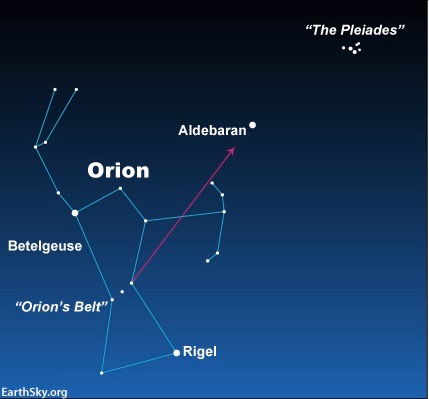
Sky chart showing an arrow from Orion's Belt to the star Aldebaran.

Whenever you see the constellation Orion, look also for the bright red star Aldebaran. Orion’s Belt always points to Aldebaran. Extending that line takes you generally toward the Pleiades, or Seven Sisters. Look east before sunrise in late July and August for these stars. Check Stellarium for the view at your location.

Also, notice the star Aldebaran in the constellation Taurus the Bull. Aldebaran is the brightest star in Taurus the Bull. It’s said to represent the fiery Eye of the Bull.

In a dark sky, you can see a V-shaped pattern of stars around Aldebaran. This pattern represents the Bull’s face.

In skylore, Orion is said to be holding up a great shield … fending off the charging Bull. It’s easy to imagine when you look eastward before sunup at this time of year, or anytime you spot Orion.

Photo: bright stars of Orion seen to the side and over a round dark hill.

The constellation Orion as viewed at morning dawn in early August. Image via Flickr user Michael C. Rael.

Bottom line: The return of Orion and Taurus to your predawn sky happens around late July or early August every year. In the Northern Hemisphere, Orion is sometimes called the ghost of the summer dawn.


from EarthSky https://ift.tt/2GBhcrM

EarthSky’s yearly crowd-funding campaign is in progress. In 2020, we are donating 8.5% of all incoming revenues to No Kids Hungry. Click to learn more and donate.

Around late July and early August, if you’re up early and have an unobstructed view to the east, be sure to look in that direction in the hour before dawn. You might find a familiar figure – the beautiful constellation Orion the Hunter – recently behind the sun as seen from our earthly vantage point and now ascending once more in the east before sunrise. The Hunter rises on his side, with his three Belt stars – Mintaka, Alnitak and Alnilam – pointing straight up. In 2020, there’s a very bright object not far from the Hunter, also in the east before sunup. It’s the planet Venus. Watch for them both.

The Hunter appears each northern winter as a mighty constellation arcing across the south during the evening hours. Many people see it then, and notice it, because the pattern of Orion’s stars is so distinctive.

But, at the crack of dawn in late summer, you can spot Orion in the east. Thus Orion has been called the ghost of the shimmering summer dawn.

It’s meteor season. Everything you need to know: Perseid meteor shower
Enjoying EarthSky so far? Sign up for our free daily newsletter today!

Sky chart showing an arrow from Orion's Belt to the star Aldebaran.

Whenever you see the constellation Orion, look also for the bright red star Aldebaran. Orion’s Belt always points to Aldebaran. Extending that line takes you generally toward the Pleiades, or Seven Sisters. Look east before sunrise in late July and August for these stars. Check Stellarium for the view at your location.

Also, notice the star Aldebaran in the constellation Taurus the Bull. Aldebaran is the brightest star in Taurus the Bull. It’s said to represent the fiery Eye of the Bull.

In a dark sky, you can see a V-shaped pattern of stars around Aldebaran. This pattern represents the Bull’s face.

In skylore, Orion is said to be holding up a great shield … fending off the charging Bull. It’s easy to imagine when you look eastward before sunup at this time of year, or anytime you spot Orion.

Photo: bright stars of Orion seen to the side and over a round dark hill.

The constellation Orion as viewed at morning dawn in early August. Image via Flickr user Michael C. Rael.

Bottom line: The return of Orion and Taurus to your predawn sky happens around late July or early August every year. In the Northern Hemisphere, Orion is sometimes called the ghost of the summer dawn.


from EarthSky https://ift.tt/2GBhcrM

Butterfly genomics: Monarchs fly differently, but meet up and mate

An eastern monarch butterfly rests in Saint Marks, Florida, on its way to overwinter in Mexico. (Photo by Venkat Talla)

Each year, millions of monarch butterflies migrate across eastern North America to fly from as far north as the U.S.-Canadian border to overwinter in central Mexico — covering as much as 3,000 miles. Meanwhile, on the other side of the Rocky Mountains, western monarchs generally fly 300 miles down to the Pacific Coast to spend the winter in California. It was long believed that the eastern and western monarchs were genetically distinct populations.

A new study, however, confirms that while the eastern and western butterflies fly differently, they are genetically the same. The journal Molecular Ecology published the findings, led by evolutionary biologists at Emory University.

“It was surprising,” says Jaap de Roode, Emory professor of biology and senior author of the study. His lab is one of a handful in the world that studies monarch butterflies.

“You would expect that organisms with different behaviors and ecologies would show some genetic differences,” de Roode says. “But we found that you cannot distinguish genetically between the western and eastern butterflies.”

Read the whole story here.

Related:
Mystery of monarch migration takes new turn
The monarch butterfly's medicine kit

from eScienceCommons https://ift.tt/30YLPRl
An eastern monarch butterfly rests in Saint Marks, Florida, on its way to overwinter in Mexico. (Photo by Venkat Talla)

Each year, millions of monarch butterflies migrate across eastern North America to fly from as far north as the U.S.-Canadian border to overwinter in central Mexico — covering as much as 3,000 miles. Meanwhile, on the other side of the Rocky Mountains, western monarchs generally fly 300 miles down to the Pacific Coast to spend the winter in California. It was long believed that the eastern and western monarchs were genetically distinct populations.

A new study, however, confirms that while the eastern and western butterflies fly differently, they are genetically the same. The journal Molecular Ecology published the findings, led by evolutionary biologists at Emory University.

“It was surprising,” says Jaap de Roode, Emory professor of biology and senior author of the study. His lab is one of a handful in the world that studies monarch butterflies.

“You would expect that organisms with different behaviors and ecologies would show some genetic differences,” de Roode says. “But we found that you cannot distinguish genetically between the western and eastern butterflies.”

Read the whole story here.

Related:
Mystery of monarch migration takes new turn
The monarch butterfly's medicine kit

from eScienceCommons https://ift.tt/30YLPRl

The awesome beauty of the Eagle Nebula

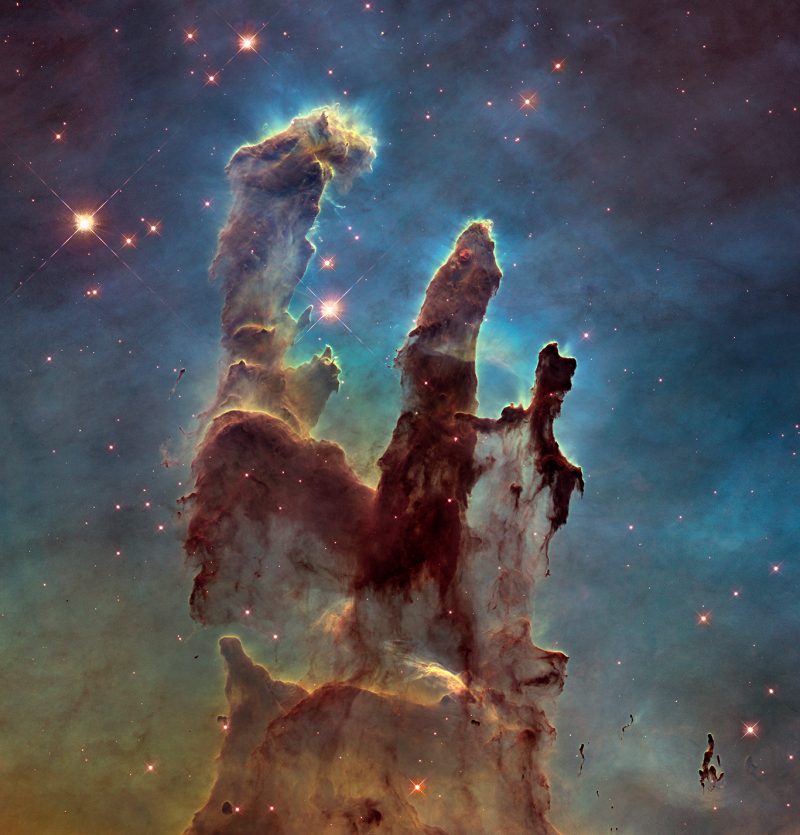
Towering plumes of gas and dust with stars in background.

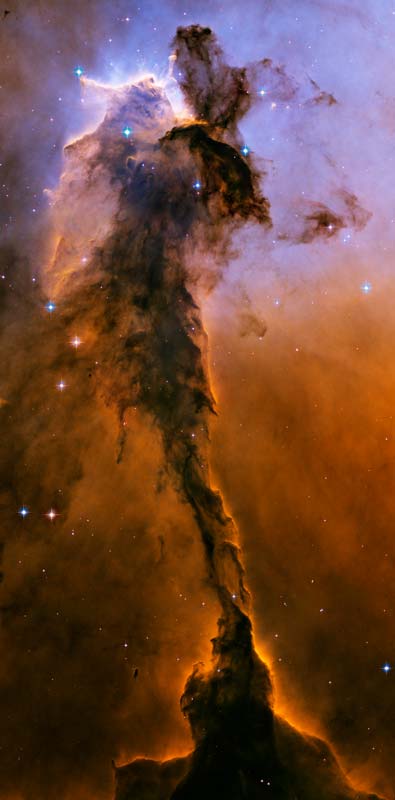
The beautiful Pillars of Creation, part of an active star-forming region within the Eagle Nebula. This image – from the Hubble Space Telescope in 2017 – is one of the most highly detailed to date. Image via NASA/ ESA/ Hubble Heritage Team (STScI/AURA).

The Eagle Nebula, also known as Messier 16 or M16, is one of the most amazing sights that can be seen in a large telescope. It’s the location of several famous structures including the stunning Pillars of Creation, an active star-forming region of gas and dust, depicted in the image above. The Eagle Nebula contains not only the Pillars of Creation but several other star-forming regions as well. It also has many emission nebulae, or clouds in space that shine with their own light. And it has some dark nebulae, which don’t shine themselves, but which can be seen because they obscure light from other sources.

The Eagle Nebula lies in the direction of the constellation Serpens the Serpent. It’s about 7,000 light-years away, and it’s visible in our sky at this time of year.

Take a look at the photos here, and delve deeper into this region of space, which is one of the most interesting and beautiful we know.

EarthSky’s yearly crowd-funding campaign is in progress. In 2020, we are donating 8.5% of all incoming revenues to No Kids Hungry. Click to learn more and donate.

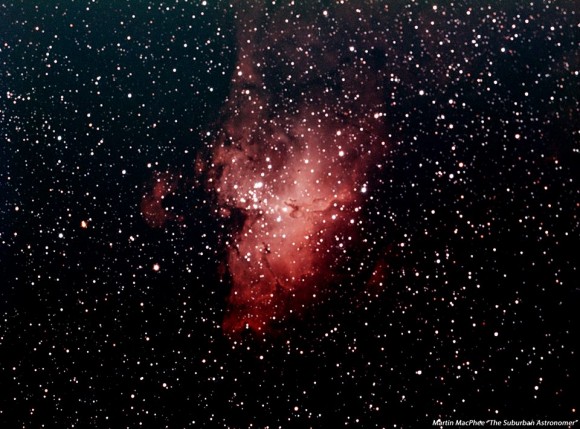
Irregular red cloud of gas in a dense star field.

View larger. | The Eagle Nebula, aka M16. Photo via Martin MacPhee.

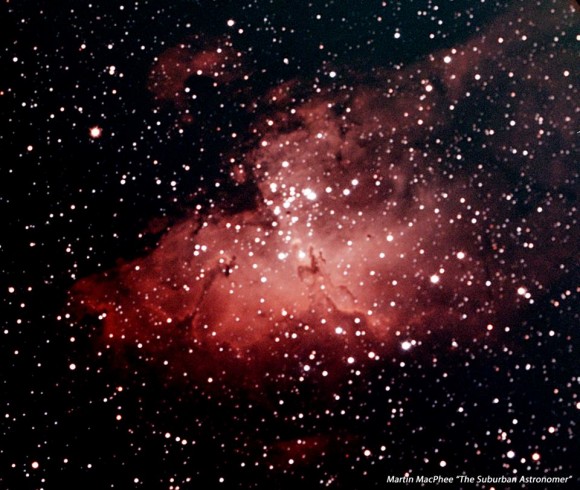
Reddish nebula with many stars in background.

View larger. | A closer look at the Eagle Nebula. Image via Martin MacPhee.

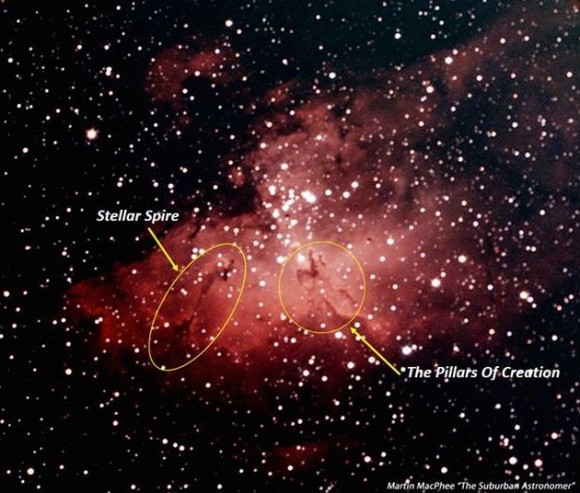
Reddish nebula with many stars in background and oval lines around two dark features.

View larger. | Labelled map showing both the Pillars of Creation and the Stellar Spire within the Eagle Nebula. Image via Martin MacPhee.

In the late 18th century, when this object began to be catalogued by astronomers – discovered by Jean-Philippe de Cheseaux in 1745–46 – only the star cluster could be seen, and it was designated as M16 in Messier’s catalog of things not to be confused with comets. This star cluster later became known as the Snow Queen Nebula.

Even later, the advent of astrophotography revealed a large area of glowing hydrogen gas that was invisible to the unaided eye, and the nebula looked somewhat like an eagle with outstretched wings, giving rise to the current common name of Eagle Nebula.

As higher resolution photography and then digital photography began to reveal more and more features, particularly the dark patches (aka dark nebulae), many distinct features within the Eagle Nebula were given individual names. Today, the informal name of the Eagle Nebula is taken as referring to all of these in one collective designation.

Some of them are famous, and all are beautiful.

The Eagle Nebula suddenly burst upon the world’s collective consciousness in 1995, when the Hubble focused its attention on a dark nebula in the center of the Eagle, which you can see in the (updated) photo at the top of this post.

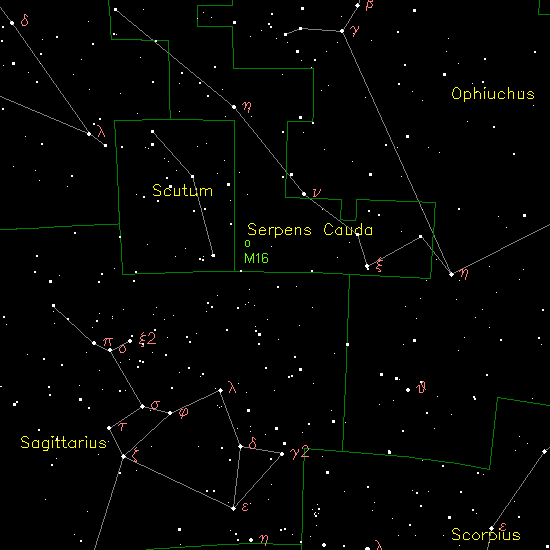
Star chart of Sagittarius area with many stars and objects labeled.

As viewed from the Northern Hemisphere, you’ll find the Eagle Nebula, or M16, above and to the left of the famous Teapot asterism of the constellation Sagittarius. Image via Tammy Plotner/ Universe Today.

The mesmerizing dark protrusions of dense gas were found to be the site of the formation of new stars and solar systems, and the resulting photograph became known as the Pillars of Creation and gave most people their first view of newly born stars and solar systems at the dawn of their creation. The Pillars of Creation are immense, about four to five light-years tall. The Eagle Nebula itself spans about 70 by 55 light-years.

Similar areas, such as the Stellar Spire on the left side of the Eagle, are also forming new stars, through a combination of processes. The cold, mostly hydrogen, gas of the nebula has already fueled the formation of a series of young, hot stars. As the gas continues to collapse under its own gravity into the dark forms we see, new stars and solar systems are formed and continue to grow as they attract more and more gas to them. However, the intense light pressure from the new stars that have formed and their solar winds are eroding away the dense, cold gas pockets, diminishing new star formation and dispersing the nebulae.

At the same time however, the shock waves where the light and solar wind impacts the cold gas, heat and compress some of the cold gasses at the same time, resulting in a new set of star forming environments.

Long, thin, very irregular dark cloud among stars.

The Stellar Spire, also located in the Eagle Nebula, as seen by the Hubble Space Telescope. The “spire” is about 9.5 light-years long. Image via NASA/ ESA/ The Hubble Heritage Team (STScI/AURA)/ Wikipedia.

Colorful nebula with stars and highlighted squares and rectangles around interesting features.

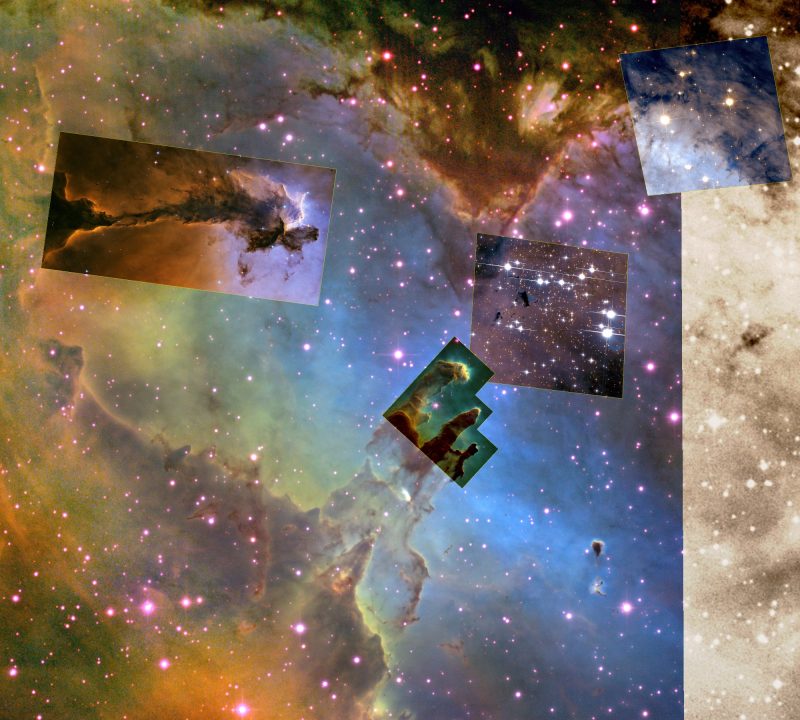
These are some of the best well-known areas inside the Eagle Nebula. Image via NASA/ STScI/ WikiSky/ Wikipedia.

More than 20 extra-bright stars on starry background also with a few tiny dark nebulae.

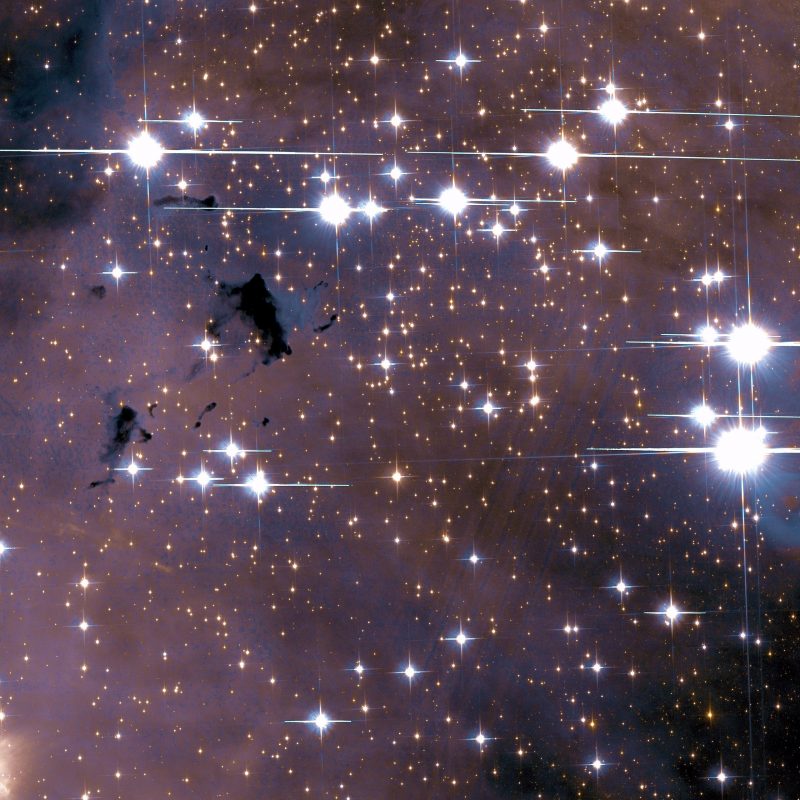
Closer view of an open star cluster in the nebula (highlighted in image above this one). Image via NASA/ STScI/ WikiSky/ Wikipedia.

As EarthSky writer Martin MacPhee recounted some years ago:

I am very pleased I can see these structures in my ‘scope, which is only 8″ in diameter, especially given that they are located around 7,000 light-years away, and the Stellar Spire is roughly 9.5 light-years (~ 9 trillion kilometers) tall – about twice the diameter of our solar system. In seeing them from my driveway in the heavily light-polluted Maryland suburbs of Washington D.C., I’m doing very well. And for approximately $10,000,000,000 less than the Hubble telescope cost, which makes my wife very happy too!

And there’s more. In 2015, some scientists suggested that the Pillars and Spire were likely already gone, victims of a massive shock wave from a supernova explosion that happened 6,000 years ago and destroyed them. The idea was that its light had already gone past us, but the slower-moving shock waves would have taken thousands of years more to sweep through the Eagle Nebula, destroying the delicate structures we find so entrancing.

Then, in 2018, that view changed again. Another update suggested the data suggesting destruction were in error. Instead, it seems, these structures – the Pillars and Spire – likely will remain for hundreds of thousands of years more before slowly evaporating away.

Bottom line: The Eagle Nebula, or M16, is home to at least two famous and awe-inspiring cosmic structures: the Pillars of Creation and the Stellar Spire.

Read about how the Pillars of Creation were created

EarthSky’s yearly crowd-funding campaign is in progress. In 2020, we are donating 8.5% of all incoming revenues to No Kids Hungry. Click to learn more and donate.


from EarthSky https://ift.tt/3g4WrEB
Towering plumes of gas and dust with stars in background.

The beautiful Pillars of Creation, part of an active star-forming region within the Eagle Nebula. This image – from the Hubble Space Telescope in 2017 – is one of the most highly detailed to date. Image via NASA/ ESA/ Hubble Heritage Team (STScI/AURA).

The Eagle Nebula, also known as Messier 16 or M16, is one of the most amazing sights that can be seen in a large telescope. It’s the location of several famous structures including the stunning Pillars of Creation, an active star-forming region of gas and dust, depicted in the image above. The Eagle Nebula contains not only the Pillars of Creation but several other star-forming regions as well. It also has many emission nebulae, or clouds in space that shine with their own light. And it has some dark nebulae, which don’t shine themselves, but which can be seen because they obscure light from other sources.

The Eagle Nebula lies in the direction of the constellation Serpens the Serpent. It’s about 7,000 light-years away, and it’s visible in our sky at this time of year.

Take a look at the photos here, and delve deeper into this region of space, which is one of the most interesting and beautiful we know.

EarthSky’s yearly crowd-funding campaign is in progress. In 2020, we are donating 8.5% of all incoming revenues to No Kids Hungry. Click to learn more and donate.

Irregular red cloud of gas in a dense star field.

View larger. | The Eagle Nebula, aka M16. Photo via Martin MacPhee.

Reddish nebula with many stars in background.

View larger. | A closer look at the Eagle Nebula. Image via Martin MacPhee.

Reddish nebula with many stars in background and oval lines around two dark features.

View larger. | Labelled map showing both the Pillars of Creation and the Stellar Spire within the Eagle Nebula. Image via Martin MacPhee.

In the late 18th century, when this object began to be catalogued by astronomers – discovered by Jean-Philippe de Cheseaux in 1745–46 – only the star cluster could be seen, and it was designated as M16 in Messier’s catalog of things not to be confused with comets. This star cluster later became known as the Snow Queen Nebula.

Even later, the advent of astrophotography revealed a large area of glowing hydrogen gas that was invisible to the unaided eye, and the nebula looked somewhat like an eagle with outstretched wings, giving rise to the current common name of Eagle Nebula.

As higher resolution photography and then digital photography began to reveal more and more features, particularly the dark patches (aka dark nebulae), many distinct features within the Eagle Nebula were given individual names. Today, the informal name of the Eagle Nebula is taken as referring to all of these in one collective designation.

Some of them are famous, and all are beautiful.

The Eagle Nebula suddenly burst upon the world’s collective consciousness in 1995, when the Hubble focused its attention on a dark nebula in the center of the Eagle, which you can see in the (updated) photo at the top of this post.

Star chart of Sagittarius area with many stars and objects labeled.

As viewed from the Northern Hemisphere, you’ll find the Eagle Nebula, or M16, above and to the left of the famous Teapot asterism of the constellation Sagittarius. Image via Tammy Plotner/ Universe Today.

The mesmerizing dark protrusions of dense gas were found to be the site of the formation of new stars and solar systems, and the resulting photograph became known as the Pillars of Creation and gave most people their first view of newly born stars and solar systems at the dawn of their creation. The Pillars of Creation are immense, about four to five light-years tall. The Eagle Nebula itself spans about 70 by 55 light-years.

Similar areas, such as the Stellar Spire on the left side of the Eagle, are also forming new stars, through a combination of processes. The cold, mostly hydrogen, gas of the nebula has already fueled the formation of a series of young, hot stars. As the gas continues to collapse under its own gravity into the dark forms we see, new stars and solar systems are formed and continue to grow as they attract more and more gas to them. However, the intense light pressure from the new stars that have formed and their solar winds are eroding away the dense, cold gas pockets, diminishing new star formation and dispersing the nebulae.

At the same time however, the shock waves where the light and solar wind impacts the cold gas, heat and compress some of the cold gasses at the same time, resulting in a new set of star forming environments.

Long, thin, very irregular dark cloud among stars.

The Stellar Spire, also located in the Eagle Nebula, as seen by the Hubble Space Telescope. The “spire” is about 9.5 light-years long. Image via NASA/ ESA/ The Hubble Heritage Team (STScI/AURA)/ Wikipedia.

Colorful nebula with stars and highlighted squares and rectangles around interesting features.

These are some of the best well-known areas inside the Eagle Nebula. Image via NASA/ STScI/ WikiSky/ Wikipedia.

More than 20 extra-bright stars on starry background also with a few tiny dark nebulae.

Closer view of an open star cluster in the nebula (highlighted in image above this one). Image via NASA/ STScI/ WikiSky/ Wikipedia.

As EarthSky writer Martin MacPhee recounted some years ago:

I am very pleased I can see these structures in my ‘scope, which is only 8″ in diameter, especially given that they are located around 7,000 light-years away, and the Stellar Spire is roughly 9.5 light-years (~ 9 trillion kilometers) tall – about twice the diameter of our solar system. In seeing them from my driveway in the heavily light-polluted Maryland suburbs of Washington D.C., I’m doing very well. And for approximately $10,000,000,000 less than the Hubble telescope cost, which makes my wife very happy too!

And there’s more. In 2015, some scientists suggested that the Pillars and Spire were likely already gone, victims of a massive shock wave from a supernova explosion that happened 6,000 years ago and destroyed them. The idea was that its light had already gone past us, but the slower-moving shock waves would have taken thousands of years more to sweep through the Eagle Nebula, destroying the delicate structures we find so entrancing.

Then, in 2018, that view changed again. Another update suggested the data suggesting destruction were in error. Instead, it seems, these structures – the Pillars and Spire – likely will remain for hundreds of thousands of years more before slowly evaporating away.

Bottom line: The Eagle Nebula, or M16, is home to at least two famous and awe-inspiring cosmic structures: the Pillars of Creation and the Stellar Spire.

Read about how the Pillars of Creation were created

EarthSky’s yearly crowd-funding campaign is in progress. In 2020, we are donating 8.5% of all incoming revenues to No Kids Hungry. Click to learn more and donate.


from EarthSky https://ift.tt/3g4WrEB

Perseverance, newest Mars rover, to launch July 30


NASA’s Mars Perseverance Rover will launch on a United Launch Alliance Atlas V 541 rocket from Space Launch Complex 41 at Cape Canaveral Air Force Station in Florida. Watch the event live right here!

EarthSky’s yearly crowd-funding campaign is in progress. In 2020, we are donating 8.5% of all incoming revenues to No Kids Hungry. Click to learn more and donate.

NASA is targeting 11:50 UTC (7:50 a.m. EDT) on Thursday, July 30, 2020, for the launch of its Mars 2020 Perseverance rover on a United Launch Alliance Atlas V rocket from Cape Canaveral Air Force Station in Florida. The launch window is approximately two hours, with a launch opportunity every five minutes. Translate UTC to your time.

Live launch coverage will begin at 11:00 UTC (7 a.m. EDT), on NASA Television and the agency’s website. The launch date could change, depending on weather and technical factors. It was previously delayed from earlier in the month because of technical issues.

Perseverance will land in Jezero Crater on the Red Planet on February 18, 2021. Scientists say arid Jezero Crater, about 30 miles (48 km) wide, was a liquid water lake around 3.5 billion years ago. That makes it a good spot to search for signs of habitable conditions on Mars in the ancient past and for signs of past microbial life itself.


Getting the Perseverance Mars Rover to the launch pad

On July 22, NASA announced that the mission had passed its flight readiness review, which includes a preparedeness assessment of the spacecraft, rocket, procedures and personnel.

Large multi-wheeled device rolling over wedge-shaped obstacles with white-suited people watching.

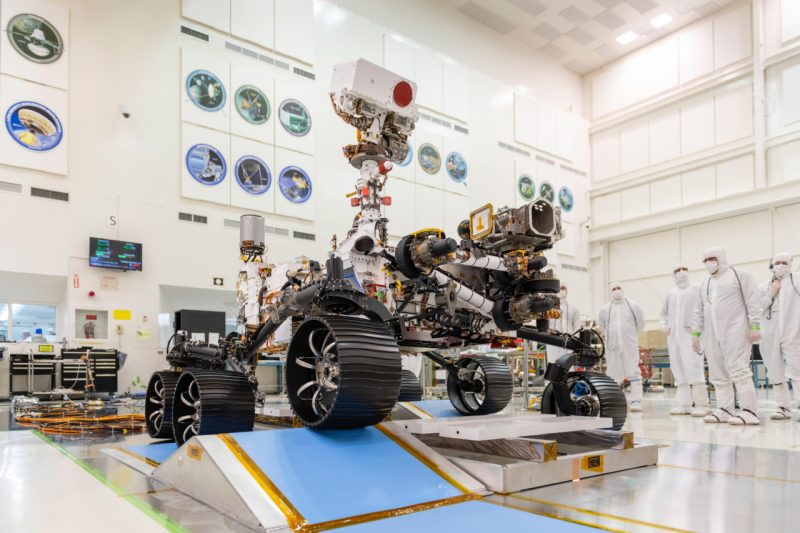
Engineers observe the first driving test for NASA’s Mars 2020 Perseverance rover in a clean room at NASA’s Jet Propulsion Laboratory in Pasadena, California, on December 17, 2019. Image via NASA/ JPL-Caltech

About the size of a car, Perseverance weighs just under 2,300 pounds (1,043 kilograms), with dimensions similar to the Curiosity rover. The mission will carry 7 different scientific instruments. According to a NASA statement:

The mission – designed to better understand the geology and climate of Mars and seek signs of ancient life on the Red Planet – will use the robotic scientist to collect and store a set of rock and soil samples that could be returned to Earth by future Mars sample return missions. It also will test new technologies to benefit future robotic and human exploration of Mars.

Perseverance will also ferry a separate technology experiment to the surface of Mars — a helicopter weighing less that 4 pounds, named Ingenuity – the first aircraft to fly on another planet.

Device with four spidery legs and two rotors flying above reddish Martian landscape.

Mars helicopter Ingenuity. Image via DLR/ NASA.

Mars 2020 Perseverance is part of America’s larger moon to Mars exploration approach that includes missions to the moon as a way to prepare for human exploration of the red planet. Charged with sending the first woman and next man to the moon by 2024, NASA plans to establish a sustained human presence on and around the moon by 2028 through NASA’s Artemis program.

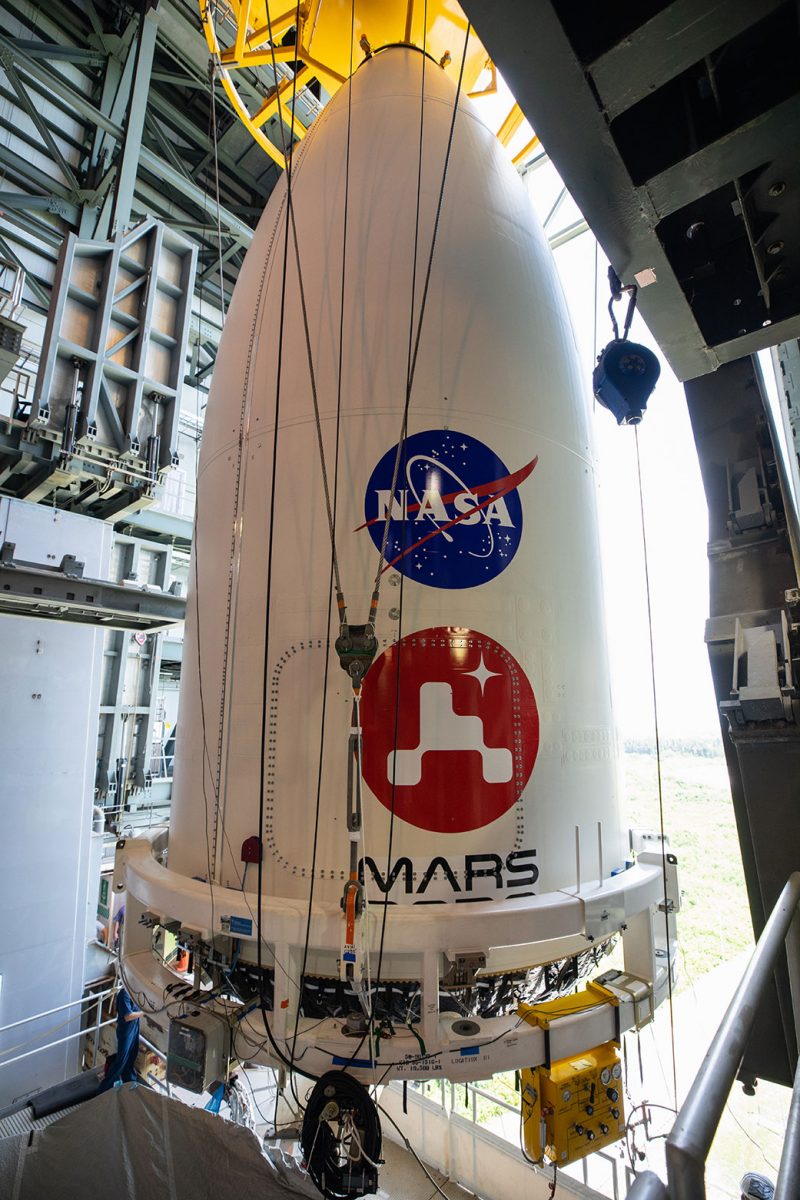
Tall, rounded, white cone with NASA and Perseverance logos on it.

The Mars Perseverance rover will lift off aboard a United Launch Alliance Atlas V 541 rocket from Space Launch Complex 41 at Cape Canaveral Air Force Station on Thursday, July 30. Image via NASA.

Bottom line: The Perseverance Mars rover is scheduled to launch Thursday, July 30, 2020, on a United Launch Alliance Atlas V rocket from Cape Canaveral Air Force Station in Florida. How to watch live.

Via NASA


from EarthSky https://ift.tt/30UwH7D


NASA’s Mars Perseverance Rover will launch on a United Launch Alliance Atlas V 541 rocket from Space Launch Complex 41 at Cape Canaveral Air Force Station in Florida. Watch the event live right here!

EarthSky’s yearly crowd-funding campaign is in progress. In 2020, we are donating 8.5% of all incoming revenues to No Kids Hungry. Click to learn more and donate.

NASA is targeting 11:50 UTC (7:50 a.m. EDT) on Thursday, July 30, 2020, for the launch of its Mars 2020 Perseverance rover on a United Launch Alliance Atlas V rocket from Cape Canaveral Air Force Station in Florida. The launch window is approximately two hours, with a launch opportunity every five minutes. Translate UTC to your time.

Live launch coverage will begin at 11:00 UTC (7 a.m. EDT), on NASA Television and the agency’s website. The launch date could change, depending on weather and technical factors. It was previously delayed from earlier in the month because of technical issues.

Perseverance will land in Jezero Crater on the Red Planet on February 18, 2021. Scientists say arid Jezero Crater, about 30 miles (48 km) wide, was a liquid water lake around 3.5 billion years ago. That makes it a good spot to search for signs of habitable conditions on Mars in the ancient past and for signs of past microbial life itself.


Getting the Perseverance Mars Rover to the launch pad

On July 22, NASA announced that the mission had passed its flight readiness review, which includes a preparedeness assessment of the spacecraft, rocket, procedures and personnel.

Large multi-wheeled device rolling over wedge-shaped obstacles with white-suited people watching.

Engineers observe the first driving test for NASA’s Mars 2020 Perseverance rover in a clean room at NASA’s Jet Propulsion Laboratory in Pasadena, California, on December 17, 2019. Image via NASA/ JPL-Caltech

About the size of a car, Perseverance weighs just under 2,300 pounds (1,043 kilograms), with dimensions similar to the Curiosity rover. The mission will carry 7 different scientific instruments. According to a NASA statement:

The mission – designed to better understand the geology and climate of Mars and seek signs of ancient life on the Red Planet – will use the robotic scientist to collect and store a set of rock and soil samples that could be returned to Earth by future Mars sample return missions. It also will test new technologies to benefit future robotic and human exploration of Mars.

Perseverance will also ferry a separate technology experiment to the surface of Mars — a helicopter weighing less that 4 pounds, named Ingenuity – the first aircraft to fly on another planet.

Device with four spidery legs and two rotors flying above reddish Martian landscape.

Mars helicopter Ingenuity. Image via DLR/ NASA.

Mars 2020 Perseverance is part of America’s larger moon to Mars exploration approach that includes missions to the moon as a way to prepare for human exploration of the red planet. Charged with sending the first woman and next man to the moon by 2024, NASA plans to establish a sustained human presence on and around the moon by 2028 through NASA’s Artemis program.

Tall, rounded, white cone with NASA and Perseverance logos on it.

The Mars Perseverance rover will lift off aboard a United Launch Alliance Atlas V 541 rocket from Space Launch Complex 41 at Cape Canaveral Air Force Station on Thursday, July 30. Image via NASA.

Bottom line: The Perseverance Mars rover is scheduled to launch Thursday, July 30, 2020, on a United Launch Alliance Atlas V rocket from Cape Canaveral Air Force Station in Florida. How to watch live.

Via NASA


from EarthSky https://ift.tt/30UwH7D

adds 2