aads

Small asteroid passed extremely close earlier today

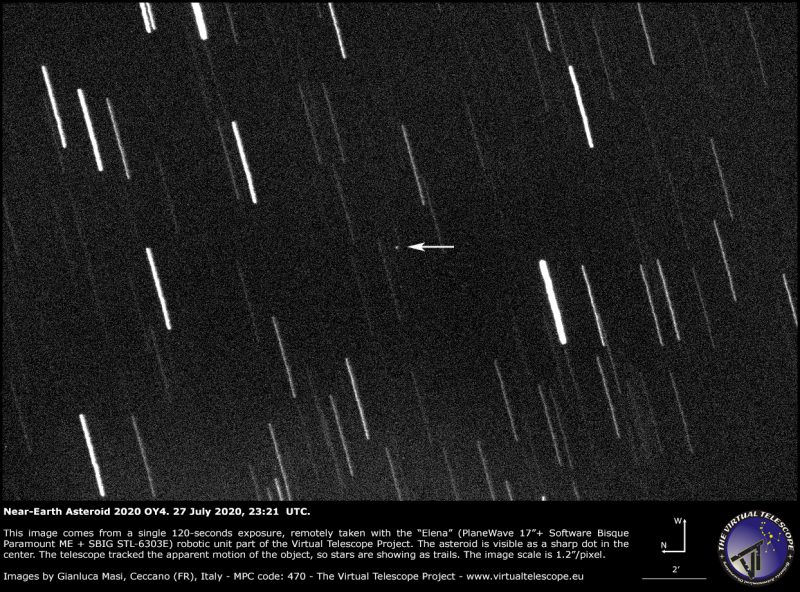
Many thin white streaks on gray background with the asteroid appearing as a dot. An arrow points to it.

View larger. | Near-Earth asteroid 2020 OY4 on July 27, 2020. At the imaging time, the asteroid was about 155,000 miles (250,000 km) from Earth, 2/3s of the lunar distance, and it was still safely approaching us. Image via the Virtual Telescope Project.

Gianluca Masi of the Virtual Telescope Project reports from Rome, Italy. Article reprinted with permission.

Earlier today (July 28, 2020), near-Earth asteroid 2020 OY4 had a extremely close, but safe, encounter with our planet, reaching a minimum distance from the Earth of about 26,000 miles (42,000 km), less than 11% of the average distance of the moon. We managed to capture its image as it swept past.

This space rock is estimated to be about 7.5 to 17 feet (2.3 to 5.2 meters) across. It reached its minimum distance from us earlier today on July 28, 2020, at 05:32 UTC (translate UTC to your time). Of course, there were no risks at all to our planet. According to NASA’s Jet Propulsion Laboratory:

Space rocks smaller than about 25 meters (about 82 feet) will most likely burn up as they enter the Earth’s atmosphere and cause little or no damage.

If a rocky meteoroid larger than 25 meters but smaller than one kilometer ( a little more than 1/2 mile) were to hit Earth, it would likely cause local damage to the impact area.

The Mt. Lemmon survey discovered the asteroid on July 26, 2020.

The image above comes from a single, 120-second exposure, remotely taken with the “Elena” (PlaneWave 17?+Paramount ME+SBIG STL-6303E) robotic unit available at Virtual Telescope.

The telescope tracked the fast apparent motion of the asteroid. This is why stars show as long trails, while the asteroid looks like a bright and sharp dot of light in the center of the image, marked by an arrow.

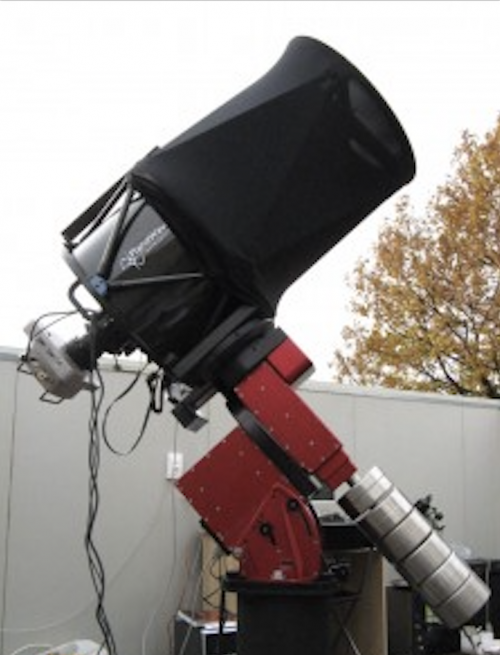
Short, thick black telescope outside in front of a telescope shelter.

The Planewave 17?-f/6.8 (432/2939 mm) Corrected Dall-Kirkham Astrograph telescope of the Virtual Telescope Project was used to capture the image above of asteroid 2020 OY4. It is named “Elena” for Gianluca Masi’s mother. Read more about this telescope.

Bottom line: Image and information about asteroid 2020 OY4, which swept within 11% of the moon’s distance on July 28, 2020.

Help Support The Virtual Telescope Project! Its fund-raiser is going on now. Please, click here to donate and receive unique, LIMITED EDITION set of images of stunning Potentially Hazardous Asteroid 1998 OR2, images of the International Space Station above Rome and more, specifically made for supporters like you!

EarthSky’s yearly crowd-funding campaign is also in progress. In 2020, we are donating 8.5% of all incoming revenues to No Kids Hungry. Click to learn more and donate.


from EarthSky https://ift.tt/2PfvOkJ
Many thin white streaks on gray background with the asteroid appearing as a dot. An arrow points to it.

View larger. | Near-Earth asteroid 2020 OY4 on July 27, 2020. At the imaging time, the asteroid was about 155,000 miles (250,000 km) from Earth, 2/3s of the lunar distance, and it was still safely approaching us. Image via the Virtual Telescope Project.

Gianluca Masi of the Virtual Telescope Project reports from Rome, Italy. Article reprinted with permission.

Earlier today (July 28, 2020), near-Earth asteroid 2020 OY4 had a extremely close, but safe, encounter with our planet, reaching a minimum distance from the Earth of about 26,000 miles (42,000 km), less than 11% of the average distance of the moon. We managed to capture its image as it swept past.

This space rock is estimated to be about 7.5 to 17 feet (2.3 to 5.2 meters) across. It reached its minimum distance from us earlier today on July 28, 2020, at 05:32 UTC (translate UTC to your time). Of course, there were no risks at all to our planet. According to NASA’s Jet Propulsion Laboratory:

Space rocks smaller than about 25 meters (about 82 feet) will most likely burn up as they enter the Earth’s atmosphere and cause little or no damage.

If a rocky meteoroid larger than 25 meters but smaller than one kilometer ( a little more than 1/2 mile) were to hit Earth, it would likely cause local damage to the impact area.

The Mt. Lemmon survey discovered the asteroid on July 26, 2020.

The image above comes from a single, 120-second exposure, remotely taken with the “Elena” (PlaneWave 17?+Paramount ME+SBIG STL-6303E) robotic unit available at Virtual Telescope.

The telescope tracked the fast apparent motion of the asteroid. This is why stars show as long trails, while the asteroid looks like a bright and sharp dot of light in the center of the image, marked by an arrow.

Short, thick black telescope outside in front of a telescope shelter.

The Planewave 17?-f/6.8 (432/2939 mm) Corrected Dall-Kirkham Astrograph telescope of the Virtual Telescope Project was used to capture the image above of asteroid 2020 OY4. It is named “Elena” for Gianluca Masi’s mother. Read more about this telescope.

Bottom line: Image and information about asteroid 2020 OY4, which swept within 11% of the moon’s distance on July 28, 2020.

Help Support The Virtual Telescope Project! Its fund-raiser is going on now. Please, click here to donate and receive unique, LIMITED EDITION set of images of stunning Potentially Hazardous Asteroid 1998 OR2, images of the International Space Station above Rome and more, specifically made for supporters like you!

EarthSky’s yearly crowd-funding campaign is also in progress. In 2020, we are donating 8.5% of all incoming revenues to No Kids Hungry. Click to learn more and donate.


from EarthSky https://ift.tt/2PfvOkJ

Gulf of Mexico dead zone: Summer 2020 forecast

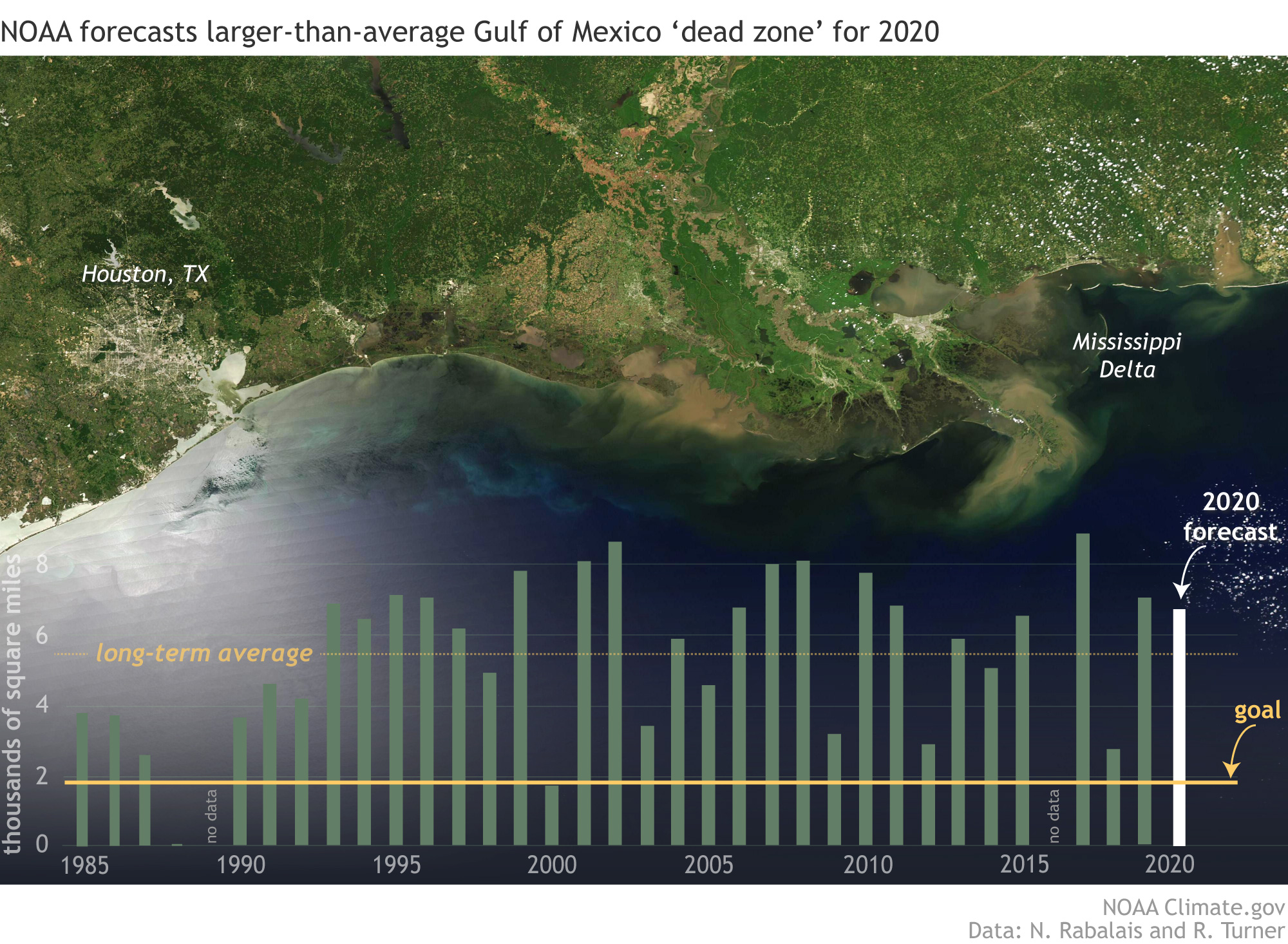
Orbital view of Gulf Coast from Texas to Mississippi with bar graph at bottom.

View larger.| Background: Sediment colors the water around the Mississippi Delta on April 30, 2020. NASA Aqua satellite image from Worldview. Graph: Annual area of low- or no-oxygen water (green bars) measured during ship surveys since 1985, including the forecast for 2020 (white bar), and the 5-year average goal (yellow line) established by the Gulf task force. Data from N. N. Rabalais and R. E. Turner, Louisiana State University & Louisiana Universities Marine Consortium, with funding from NOAA, National Centers for Coastal Ocean Science. Image via NOAA.

EarthSky’s yearly crowd-funding campaign is in progress. In 2020, we are donating 8.5% of all incoming revenues to No Kids Hungry. Click to learn more and donate.

In June, scientists from the National Oceanic and Atmospheric Administration (NOAA) forecast that the 2020 summer Gulf of Mexico hypoxic area or “dead zone” – an area of low to no oxygen that can kill fish and other marine life – will be approximately 6,700 square miles (17,000 square km). That’s larger than the long-term average size of 5,387 square miles (13,952 square km) but substantially less than the record of 8,776 square miles (22,730 square km) set in 2017.

A monitoring survey, scheduled for later this summer, will confirm the size of the 2020 dead zone, and is a key test of the accuracy of NOAA’s models.

The Gulf of Mexico dead zone occurs every summer. It’s primarily caused by excess nutrient pollution from human activities in urban and agricultural areas throughout the Mississippi River watershed. When the excess nutrients reach the Gulf, they stimulate an overgrowth of algae, which eventually die and decompose, depleting oxygen as they sink to the bottom. The resulting low oxygen levels near the bottom of the Gulf cannot support most marine life. Fish, shrimp and crabs often swim out of the area, but animals that are unable to swim or move away are stressed or killed by the low oxygen.

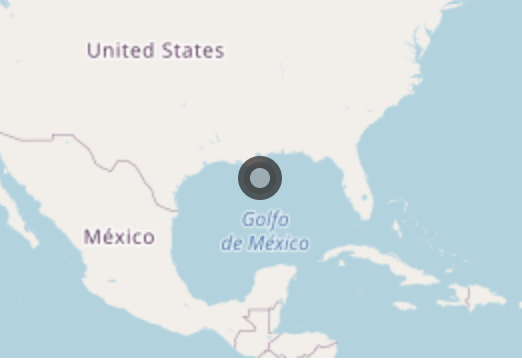
Map of United States and Mexico with bull's eye circle in Gulf off mouth of Mississippi River.

Location of Gulf of Mexico hypoxic zone – aka dead zone.

Although the Gulf of Mexico’s dead zone is perhaps the most well-know, there are hypoxic zones in many other places around the U.S. and the world where nutrient runoff contributes to low oxygen. NOAA physical scientist David M. Kidwell told the New York Times:

It’s not unique to the Gulf. It is likely occurring in someone’s back yard, but they don’t know it or have not heard about it yet.

Nicole LeBoeuf is acting director of NOAA’s National Ocean Service. She said in a statement:

The annual dead zone makes large areas unavailable for species that depend on them for their survival and places continued strain on the region’s living resources and coastal economies.

Map of US with large green area with yellow and red patches and many rivers in blue.

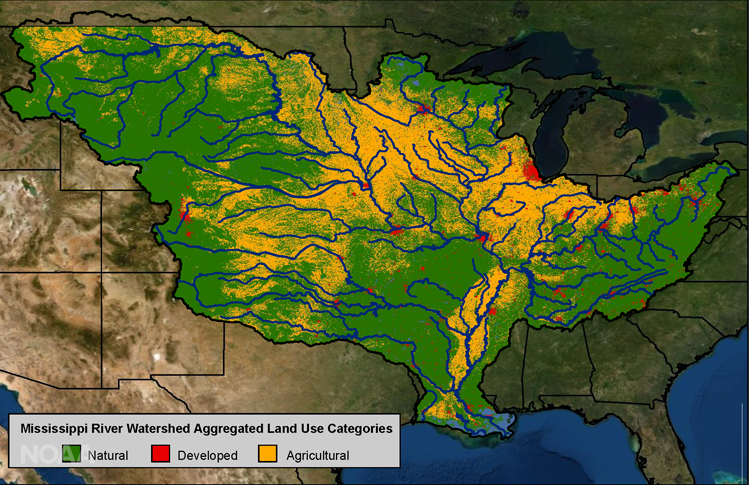
The Mississippi River watershed encompasses over 40% of the continental U.S and crosses 22 state boundaries. Nitrogen and phosphorus pollution in runoff and discharges from agricultural and urban areas are the major contributors to the annual summer hypoxic or dead zone in the Gulf of Mexico. Image shows the 3 major aggregated land use categories across the Mississippi River Watershed: agriculture (yellow), developed (red), and natural (green). Image via NOAA.

A major factor contributing to this year’s above-average hypoxic zone are the high river flows and nutrient loads delivered to the Gulf this spring, primarily from the Mississippi and Atchafalaya rivers. In May 2020, discharge in the Mississippi and Atchafalaya rivers was about 30% above the long-term average between 1980 and 2019. The USGS estimates that this larger-than average river discharge carried 136,000 metric tons of nitrate and 21,400 metric tons of phosphorus into the Gulf of Mexico in May alone. These nitrate loads were about 2% above the long-term average, and phosphorus loads were about 25% above the long-term average.

Don Cline is associate director for the USGS Water Resources Mission Area. Cline said:

The annually recurring Gulf of Mexico hypoxic zone is primarily caused by excess nutrient pollution occurring throughout the Mississippi River watershed.

According to Michon Scott at Climate.gov:

Since the mid-1980s, the long-term average dead zone size has been 5,387 square miles. Years with smaller dead zones may be linked to dry springs, such as the drought of 1988, or to summers with hurricanes or other wind events that mix the water column in the Gulf, disrupting the low-oxygen waters and driving oxygen-rich surface water down into the depths. The record-setting 2017 dead zone followed an extremely wet spring across the Great Plains and Midwest, while the below-average 2018 dead zone was a result of persistent winds from the west and northwest the weeks preceding the monitoring cruise, pushing the low oxygen water mass to the east and restricting flow across the Louisiana-Texas shelf.

NOAA’s hypoxic zone forecast assumes typical coastal weather conditions, but the actual measured dead zone size could be disrupted and its size could be changed by major weather events, such as hurricanes and tropical storms, which mix ocean waters, as occurred in 2018 and 2019.

Bottom line: A larger-than-average ‘dead zone’ is expected for Gulf of Mexico in summer 2020, according to a NOAA forecast.

Via NOAA


from EarthSky https://ift.tt/2X4E0Zg
Orbital view of Gulf Coast from Texas to Mississippi with bar graph at bottom.

View larger.| Background: Sediment colors the water around the Mississippi Delta on April 30, 2020. NASA Aqua satellite image from Worldview. Graph: Annual area of low- or no-oxygen water (green bars) measured during ship surveys since 1985, including the forecast for 2020 (white bar), and the 5-year average goal (yellow line) established by the Gulf task force. Data from N. N. Rabalais and R. E. Turner, Louisiana State University & Louisiana Universities Marine Consortium, with funding from NOAA, National Centers for Coastal Ocean Science. Image via NOAA.

EarthSky’s yearly crowd-funding campaign is in progress. In 2020, we are donating 8.5% of all incoming revenues to No Kids Hungry. Click to learn more and donate.

In June, scientists from the National Oceanic and Atmospheric Administration (NOAA) forecast that the 2020 summer Gulf of Mexico hypoxic area or “dead zone” – an area of low to no oxygen that can kill fish and other marine life – will be approximately 6,700 square miles (17,000 square km). That’s larger than the long-term average size of 5,387 square miles (13,952 square km) but substantially less than the record of 8,776 square miles (22,730 square km) set in 2017.

A monitoring survey, scheduled for later this summer, will confirm the size of the 2020 dead zone, and is a key test of the accuracy of NOAA’s models.

The Gulf of Mexico dead zone occurs every summer. It’s primarily caused by excess nutrient pollution from human activities in urban and agricultural areas throughout the Mississippi River watershed. When the excess nutrients reach the Gulf, they stimulate an overgrowth of algae, which eventually die and decompose, depleting oxygen as they sink to the bottom. The resulting low oxygen levels near the bottom of the Gulf cannot support most marine life. Fish, shrimp and crabs often swim out of the area, but animals that are unable to swim or move away are stressed or killed by the low oxygen.

Map of United States and Mexico with bull's eye circle in Gulf off mouth of Mississippi River.

Location of Gulf of Mexico hypoxic zone – aka dead zone.

Although the Gulf of Mexico’s dead zone is perhaps the most well-know, there are hypoxic zones in many other places around the U.S. and the world where nutrient runoff contributes to low oxygen. NOAA physical scientist David M. Kidwell told the New York Times:

It’s not unique to the Gulf. It is likely occurring in someone’s back yard, but they don’t know it or have not heard about it yet.

Nicole LeBoeuf is acting director of NOAA’s National Ocean Service. She said in a statement:

The annual dead zone makes large areas unavailable for species that depend on them for their survival and places continued strain on the region’s living resources and coastal economies.

Map of US with large green area with yellow and red patches and many rivers in blue.

The Mississippi River watershed encompasses over 40% of the continental U.S and crosses 22 state boundaries. Nitrogen and phosphorus pollution in runoff and discharges from agricultural and urban areas are the major contributors to the annual summer hypoxic or dead zone in the Gulf of Mexico. Image shows the 3 major aggregated land use categories across the Mississippi River Watershed: agriculture (yellow), developed (red), and natural (green). Image via NOAA.

A major factor contributing to this year’s above-average hypoxic zone are the high river flows and nutrient loads delivered to the Gulf this spring, primarily from the Mississippi and Atchafalaya rivers. In May 2020, discharge in the Mississippi and Atchafalaya rivers was about 30% above the long-term average between 1980 and 2019. The USGS estimates that this larger-than average river discharge carried 136,000 metric tons of nitrate and 21,400 metric tons of phosphorus into the Gulf of Mexico in May alone. These nitrate loads were about 2% above the long-term average, and phosphorus loads were about 25% above the long-term average.

Don Cline is associate director for the USGS Water Resources Mission Area. Cline said:

The annually recurring Gulf of Mexico hypoxic zone is primarily caused by excess nutrient pollution occurring throughout the Mississippi River watershed.

According to Michon Scott at Climate.gov:

Since the mid-1980s, the long-term average dead zone size has been 5,387 square miles. Years with smaller dead zones may be linked to dry springs, such as the drought of 1988, or to summers with hurricanes or other wind events that mix the water column in the Gulf, disrupting the low-oxygen waters and driving oxygen-rich surface water down into the depths. The record-setting 2017 dead zone followed an extremely wet spring across the Great Plains and Midwest, while the below-average 2018 dead zone was a result of persistent winds from the west and northwest the weeks preceding the monitoring cruise, pushing the low oxygen water mass to the east and restricting flow across the Louisiana-Texas shelf.

NOAA’s hypoxic zone forecast assumes typical coastal weather conditions, but the actual measured dead zone size could be disrupted and its size could be changed by major weather events, such as hurricanes and tropical storms, which mix ocean waters, as occurred in 2018 and 2019.

Bottom line: A larger-than-average ‘dead zone’ is expected for Gulf of Mexico in summer 2020, according to a NOAA forecast.

Via NOAA


from EarthSky https://ift.tt/2X4E0Zg

New obesity strategy is a ‘landmark day for the nation’s health’ and our ambition to beat cancer

Woman riding a bike

Today, the UK Government launched a new strategy to tackle obesity.

A raft of measures – including restricting junk food marketing on TV and online, and promotions in-store – have been announced to help people get healthy, protect themselves against COVID-19 and protect the NHS. Some of these will apply UK-wide, and others just to England.

It’s been described as a ‘landmark day’ for the nation’s health, after years of campaigning by Cancer Research UK, our supporters, Obesity Health Alliance and the wider public health community.

Why is this important for cancer?

Overweight and obesity is the second biggest cause of cancer in the UK.

Obesity is a complex issue with many causes, but one of the biggest influences is the world we live in. The less healthy choice has become the easier, cheaper choice for the consumer, while advertising and marketing have become more sophisticated – creating an ‘obesogenic environment’.

Copy this link and share our graphic. Credit: Cancer Research UK

Because of this, reducing obesity levels requires a comprehensive approach that addresses the environmental causes, improves availability of healthy options, empowers people to make and maintain healthier habits, and provides evidence-based treatment to those who need it.

We have always maintained that such an approach is achievable, provided there is the political will to enact the necessary policies. Successive governments have taken steps in the right direction, but until now the aspiration for the UK to be ‘world-leading’ has remained just that.

The size of the prize is significant. According to our estimates, around 1.3 million fewer children and teenagers in the UK would be overweight or obese if we matched the lowest overweight and obesity prevalence for these age groups in Europe.

The latest measures

One of the headline measures is a ban on TV and online adverts for food high in fat, sugar and salt before 9pm, something we’ve been campaigning on for many years.

Endless adverts and promotions for junk food give us cravings and normalise bad diets. And young people, in particular, find this marketing pervasive. Over 40% feel “under pressure” by such marketing, according to a 2018 report.

Read more: Our evidence on junk food marketing and childhood obesity

And these little pressures add up. Excess weight is often caused by consuming as little as 47-73 excess calories daily. And food marketing could lead to 50 extra calories daily, which is why we’re thrilled that the Government has announced a TV watershed and online restrictions.

This measure will also play an important role in helping to reduce health inequalities, as young people from more deprived backgrounds in UK are also more likely to be obese, consume a range of less healthy products and be exposed to junk food adverts.

Encouragingly the new measures will also push industry to focus on promoting healthier products in their place. And we know they can do it: our research found that most brands advertising unhealthy food and drink before 9pm made a healthier product they could advertise instead. The success of the Soft Drinks Industry Levy in driving reformulation also shows what is possible when brands and retailers are incentivised to do that too.

It may seem like a small change to some, but the 9pm watershed alone could lead to 160,000 healthier children in UK and a £7.4bn benefit to society.

That’s a big incentive to hold the government to this commitment, and it’s supported by 74% of the public.

It’s not over yet

The Government will hold a consultation later this year on how to introduce a total advertising ban on foods high in fat, sugar or salt online. Their intention is to implement both TV and online measures at the same time, by the end of 2022 at the latest.

But it isn’t quite a done deal. We know there will be a big push back from the advertising industry, but the evidence is strong. We need to maintain public and parliamentary pressure to make sure these measures don’t get watered down or forgotten.

The same is true for many of the other measures the Government announced as part of its obesity plan. In particular, there is work to ensure that important legislation is passed to restrict the promotion of less healthy food and drink, such as through ‘buy one get one free’ offers. These offers encourage people to spend more and consume more foods high in fat, salt or sugar than they otherwise would have.

We’ll also been keeping up pressure for these items to be removed from prominent locations in stores, such as at checkouts and entrances, and online.

Initiatives to help people find healthier options are also welcome additions and we look forward to them being implemented. From front-of-pack ‘traffic light’ nutrition labelling, to calorie labelling for food sold in restaurants and takeaways, to alcohol calorie labelling – these measures will help make it easier for people to identify healthier food and drink.

The Government’s pledge to expand weight management services available through the NHS is also positive. As well as preventing future obesity, we need to support people to lose weight too. Though we hope to hear more on how local authorities will be provided with sustainable public health funding that ensures important public health and preventative services, including effective weight management services, are available to those who need them.

While there’s still a long way to go, this is a huge step forward from the Government and comes after years of campaigning from our supporters, e-campaigners and ambassadors, who have helped us make the case so effectively.

Together we have positively changed the obesity policy landscape in the UK, and, if delivered, that should have a positive and lasting impact on cancers related to excess weight in years to come.

Malcolm Clark is cancer prevention policy manager at Cancer Research UK


from Cancer Research UK – Science blog https://ift.tt/32X8ujs
Woman riding a bike

Today, the UK Government launched a new strategy to tackle obesity.

A raft of measures – including restricting junk food marketing on TV and online, and promotions in-store – have been announced to help people get healthy, protect themselves against COVID-19 and protect the NHS. Some of these will apply UK-wide, and others just to England.

It’s been described as a ‘landmark day’ for the nation’s health, after years of campaigning by Cancer Research UK, our supporters, Obesity Health Alliance and the wider public health community.

Why is this important for cancer?

Overweight and obesity is the second biggest cause of cancer in the UK.

Obesity is a complex issue with many causes, but one of the biggest influences is the world we live in. The less healthy choice has become the easier, cheaper choice for the consumer, while advertising and marketing have become more sophisticated – creating an ‘obesogenic environment’.

Copy this link and share our graphic. Credit: Cancer Research UK

Because of this, reducing obesity levels requires a comprehensive approach that addresses the environmental causes, improves availability of healthy options, empowers people to make and maintain healthier habits, and provides evidence-based treatment to those who need it.

We have always maintained that such an approach is achievable, provided there is the political will to enact the necessary policies. Successive governments have taken steps in the right direction, but until now the aspiration for the UK to be ‘world-leading’ has remained just that.

The size of the prize is significant. According to our estimates, around 1.3 million fewer children and teenagers in the UK would be overweight or obese if we matched the lowest overweight and obesity prevalence for these age groups in Europe.

The latest measures

One of the headline measures is a ban on TV and online adverts for food high in fat, sugar and salt before 9pm, something we’ve been campaigning on for many years.

Endless adverts and promotions for junk food give us cravings and normalise bad diets. And young people, in particular, find this marketing pervasive. Over 40% feel “under pressure” by such marketing, according to a 2018 report.

Read more: Our evidence on junk food marketing and childhood obesity

And these little pressures add up. Excess weight is often caused by consuming as little as 47-73 excess calories daily. And food marketing could lead to 50 extra calories daily, which is why we’re thrilled that the Government has announced a TV watershed and online restrictions.

This measure will also play an important role in helping to reduce health inequalities, as young people from more deprived backgrounds in UK are also more likely to be obese, consume a range of less healthy products and be exposed to junk food adverts.

Encouragingly the new measures will also push industry to focus on promoting healthier products in their place. And we know they can do it: our research found that most brands advertising unhealthy food and drink before 9pm made a healthier product they could advertise instead. The success of the Soft Drinks Industry Levy in driving reformulation also shows what is possible when brands and retailers are incentivised to do that too.

It may seem like a small change to some, but the 9pm watershed alone could lead to 160,000 healthier children in UK and a £7.4bn benefit to society.

That’s a big incentive to hold the government to this commitment, and it’s supported by 74% of the public.

It’s not over yet

The Government will hold a consultation later this year on how to introduce a total advertising ban on foods high in fat, sugar or salt online. Their intention is to implement both TV and online measures at the same time, by the end of 2022 at the latest.

But it isn’t quite a done deal. We know there will be a big push back from the advertising industry, but the evidence is strong. We need to maintain public and parliamentary pressure to make sure these measures don’t get watered down or forgotten.

The same is true for many of the other measures the Government announced as part of its obesity plan. In particular, there is work to ensure that important legislation is passed to restrict the promotion of less healthy food and drink, such as through ‘buy one get one free’ offers. These offers encourage people to spend more and consume more foods high in fat, salt or sugar than they otherwise would have.

We’ll also been keeping up pressure for these items to be removed from prominent locations in stores, such as at checkouts and entrances, and online.

Initiatives to help people find healthier options are also welcome additions and we look forward to them being implemented. From front-of-pack ‘traffic light’ nutrition labelling, to calorie labelling for food sold in restaurants and takeaways, to alcohol calorie labelling – these measures will help make it easier for people to identify healthier food and drink.

The Government’s pledge to expand weight management services available through the NHS is also positive. As well as preventing future obesity, we need to support people to lose weight too. Though we hope to hear more on how local authorities will be provided with sustainable public health funding that ensures important public health and preventative services, including effective weight management services, are available to those who need them.

While there’s still a long way to go, this is a huge step forward from the Government and comes after years of campaigning from our supporters, e-campaigners and ambassadors, who have helped us make the case so effectively.

Together we have positively changed the obesity policy landscape in the UK, and, if delivered, that should have a positive and lasting impact on cancers related to excess weight in years to come.

Malcolm Clark is cancer prevention policy manager at Cancer Research UK


from Cancer Research UK – Science blog https://ift.tt/32X8ujs

Meet the Scorpion’s Stinger stars, Shaula and Lesath

Photo of the Milky Way, Sagittarius and Scorpius.

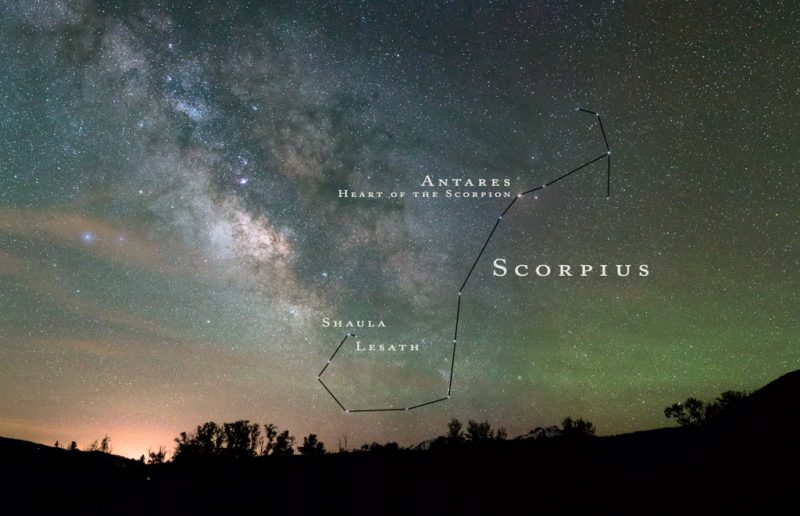
View larger. | Constellation Scorpius by Daniel McVey. The bright red star Antares represents the Scorpion’s Heart. The Stinger stars – Shaula and Lesath – can be found at the end of the Scorpion’s curved Tail.

The zodiacal constellation Scorpius the Scorpion is one of the few constellations that look like their names. It has a graceful, J-shaped pattern of stars resembling a real scorpion’s curved tail. At the end of this graceful line of stars are two stars noticeable for their nearness to each other. They are Shaula and Lesath, and they represent the Stinger of the Scorpion. It’s fun to see the curved tail of Scorpius, and Shaula and Lesath make a perfect celestial Stinger!

Shaula and Lesath appear close together. But they’re only close along our line of sight. In reality, these two stars are separated by a few tens of light-years.

Shaula, the second-brightest star in the constellation Scorpius, is actually a triple star system.

Lesath, the fainter star of the Stinger pair, doesn’t have any known companions, so far.
Star chart with stars in black on white.

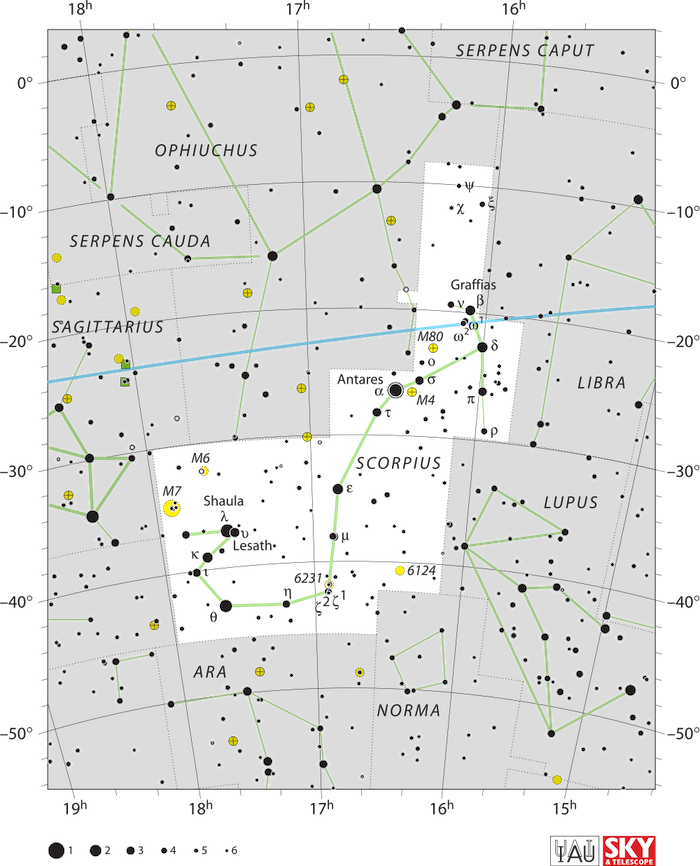
A map of Scorpius showing the location of the Stinger stars, Shaula and Lesath, at the tip of the Scorpion’s curved tail. Image via IAU/ Sky & Telescope/ Wikimedia Commons.

How to see Shaula and Lesath. The best time to see Scorpius and its stinger stars in the evening sky is during the Northern Hemisphere summer and early autumn. In the Southern Hemisphere, these stars are a feature of winter and spring.

Shaula is the second-brightest star in the constellation Scorpius, after Antares. Shaula is also the 24th brightest star in the sky. But it’s hard to think of Shaula without Lesath. These two stars are very noticeable on the sky’s dome – glittering together brighter than most other stars, and conspicuously located in an easy-to-see constellation.

From the Northern Hemisphere, Scorpius will be in your southern sky; in that case, Shaula is the star on the left. Shaula is also the brighter of the two stars. These two noticeable stars are sometimes referred to as the Stinger of Scorpius, and sometimes as the Cat’s Eyes.

At mid-northern latitudes, Lesath and Shaula never climb very high in the sky. They are highest in the sky when they’re due south. Even then, from the northern U.S., Scorpius’ stinger stars are barely a fist-width above your horizon (hold your fist an arm’s length away). They are higher in the sky as seen from the southern U.S., where Scorpius becomes a glorious sight. And from the Southern Hemisphere, all of Scorpius prominently arcs high overhead.
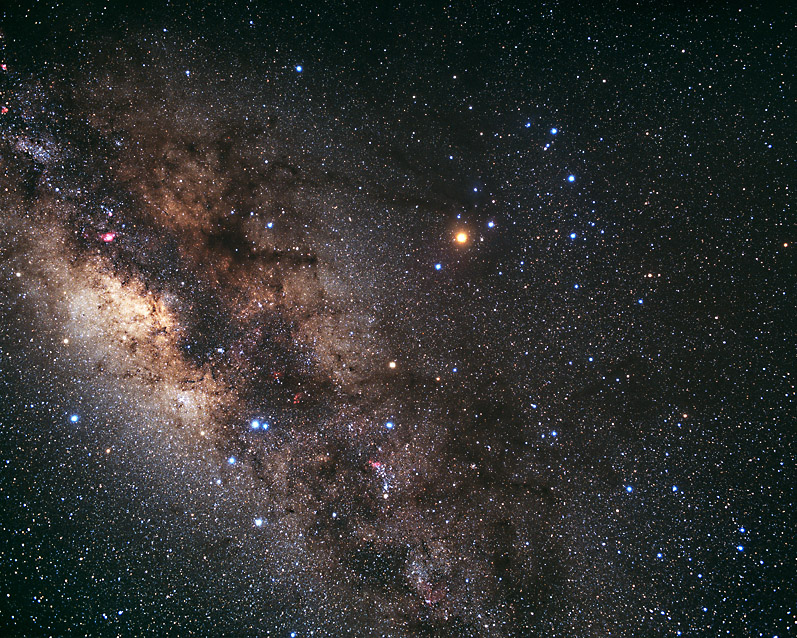
Photo of constellation Scorpius with fuzzy white band across background.

The constellation Scorpius with the Milky Way in the background. The bright reddish star is Antares. Shaula and Lesath are at the end of the J-shaped constellation, the scorpion’s stinger. Image via Akira Fujii/ David Malin Images.

Shaula and Lesath throughout the year. In the Northern Hemisphere, Scorpius is highest in the evening sky and is therefore thought of as a summer constellation. In the Southern Hemisphere, it’s considered a winter constellation.

For both hemispheres, Scorpius and its stinger stars are highest in the sky around midnight local time in mid-June. By mid-July, Lesath and Shaula are at their highest in the sky around 10 p.m. For mid-August, it’s around 8 p.m. And by mid-September, 6 p.m. Remember, the time will vary by up to an hour, depending on how far east or west you are in your time zone.

Science of Shaula and Lesath. Although these two stars look like a close-knit pair, they’re actually far apart in space. Shaula is about 570 light-years distant, whereas Lesath is some 580 light-years away. Like all individual stars we see in our night sky, these two are members of our Milky Way galaxy.

Shaula, also known as Lambda Scorpii, is actually a triple system. The largest star, which has a blue-white color, is about nine times the sun’s diameter and 14 times the sun’s mass. It is a Beta Cephei variable star, a class of stars characterized by rapid but small variations in brightness. There’s another blue-white star in that system. It’s over ten times the sun’s mass and almost five times its diameter. The third object in the system is what’s known as a pre-main sequence star, an object that has enough mass from the surrounding dust and gas to become a star but has not started nuclear fusion at its core, which would define it as a star.

Lesath’s other name is Upsilon Scorpii. It is also a hot blue-white star, about 11 times the sun’s mass and six times its diameter.

On a dark, moonless night, you can see a glowing band of stars running from Scorpius’ tail and upward through the Summer Triangle. It’s called the Milky Way, a roadway of stars arcing across the sky from horizon to horizon in northern summer. What you’re actually seeing is the edgewise view of our galaxy’s flat disk. The “haze” is really the combined light of millions upon millions of stars.

Two maps in circles, showing all the constellation patterns. The Milky Way is shaded in blue.

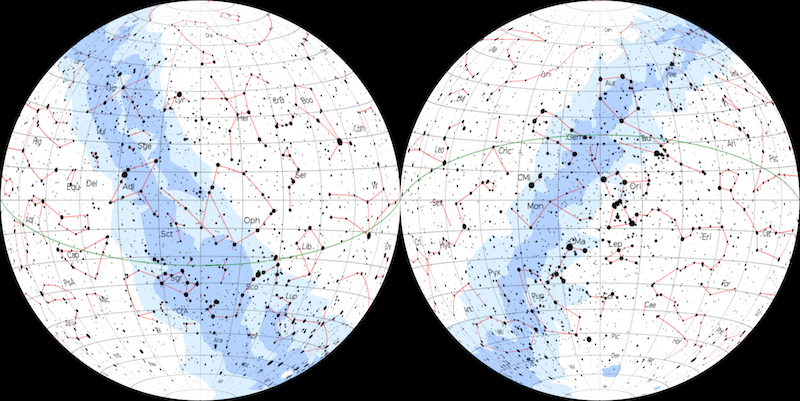
View larger. | A whole-sky map of the Milky Way overlaid on the constellations. Image via Tfr000/ Wikimedia Commons.

Earth has an equator, and the Milky Way galaxy does, too. The galactic equator runs through Scorpius and also its neighboring constellation to the east – Sagittarius the Archer.

And now shift your perspective from our great galaxy to our own local solar system, our sun’s family in space. The ecliptic is our sun’s annual path in front of the background stars, and it also runs through Scorpius and Sagittarius. Check out the star chart below to see the whereabouts of the ecliptic with respect to this constellation.
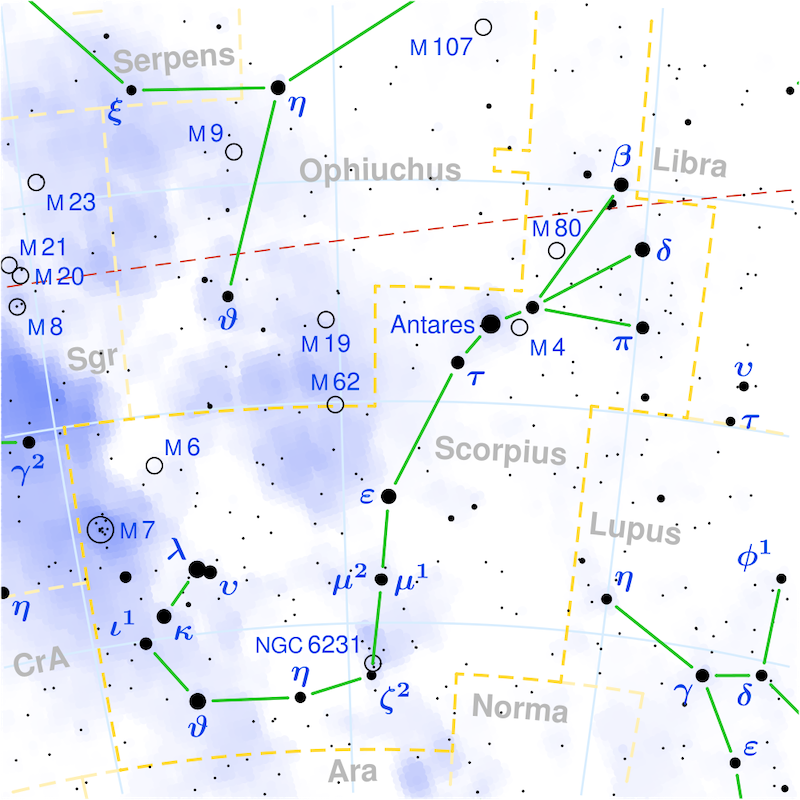
Chart of many labeled sky objects, with light blue shaded areas and nearly horizontal dashed line.

A map of the constellation Scorpius with a red dashed line showing the position of the ecliptic. The areas shaded in blue represent the Milky Way. Image via Torsten Bronger/ Wikimedia Commons.
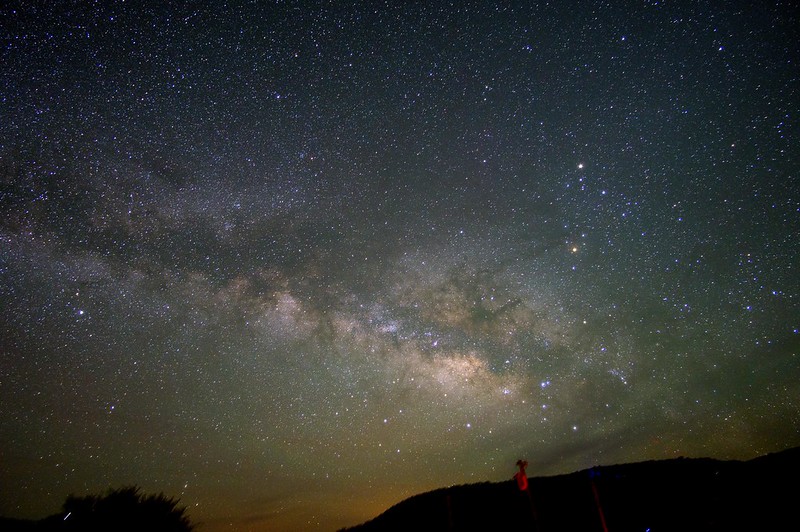
Photo: nebulous band, with sections of subdued red, white, and orange, dark dust lanes, and dense foreground stars.

The Milky Way galaxy runs through Sagittarius and Scorpius. This image, taken in West Texas, is a long exposure that brings out the colors in the Milky Way. If you were to view it at a dark location with the unaided eye, the Milky Way will appear exactly as its name describes, a faint milky glow across the sky. Can you pick out the scorpion’s stinger in this image? (Hint: look at the lower right of the image.) Image via Rob Pettengill/ Flickr.

History of the names Shaula and Lesath. Shaula is an Arabic name meaning The Scorpion’s Stinger. Lesath’s name is less straightforward. According to Paul Kunitach and Tim Smart, authors of “A Dictionary of Modern Star Names,” the name Lesath is the final result of a long and convoluted history, initially derived from a Greek word meaning a (foggy) conglomeration.
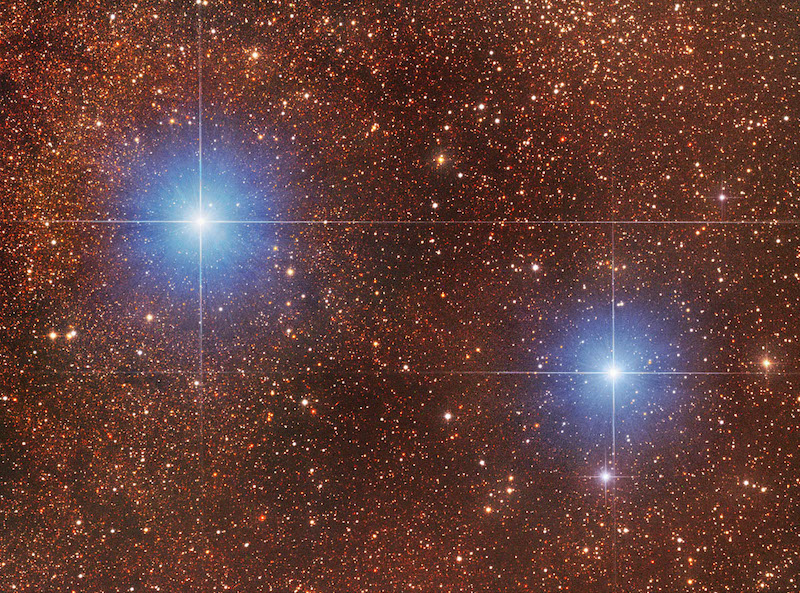
A image of two brilliant blue-white stars in a field of extremely many fainter reddish stars.

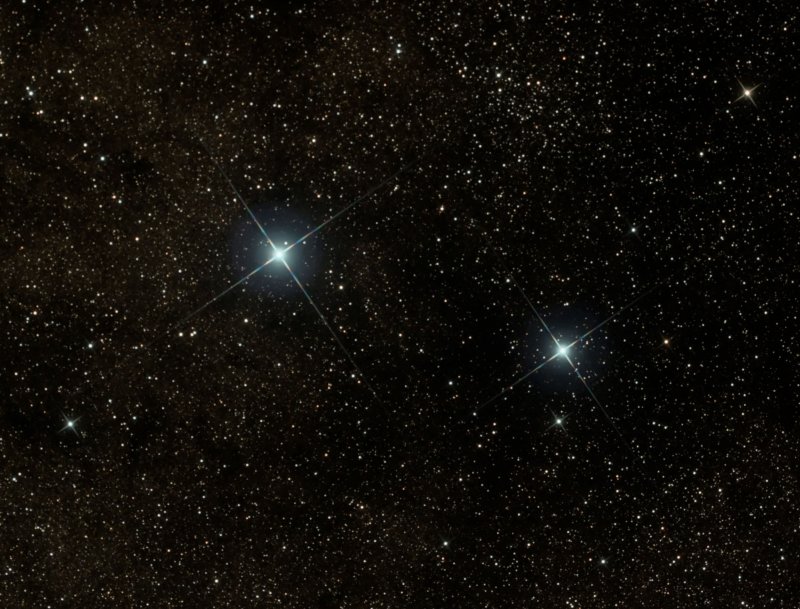
Shaula and Lesath, Scorpius’ stinger stars. Shaula is a triple system with 2 young blue-white stars that are not resolved in this image. Lesath is a single blue-white star. Even though they appear close in the sky, they are actually many light-years apart. Image via Sergio Eguivar.
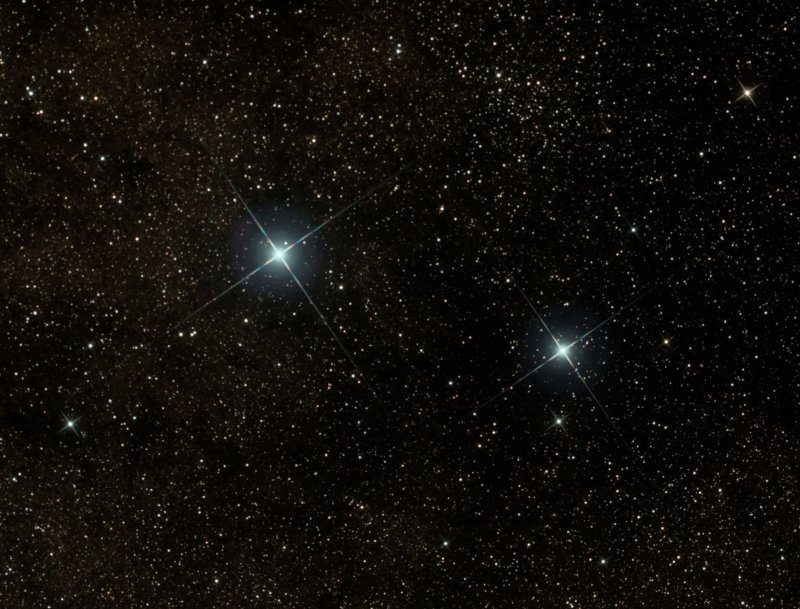
Photo showing two bright blue stars against a backdrop of very many fainter white stars.

Another beautiful shot of Shaula and Lesath. Image via John Glossop.

Bottom line: Shaula and Lesath, known as the “stinger stars,” mark the location of the scorpion’s stinger in the zodiacal constellation Scorpius.


from EarthSky https://ift.tt/3jDehkl
Photo of the Milky Way, Sagittarius and Scorpius.

View larger. | Constellation Scorpius by Daniel McVey. The bright red star Antares represents the Scorpion’s Heart. The Stinger stars – Shaula and Lesath – can be found at the end of the Scorpion’s curved Tail.

The zodiacal constellation Scorpius the Scorpion is one of the few constellations that look like their names. It has a graceful, J-shaped pattern of stars resembling a real scorpion’s curved tail. At the end of this graceful line of stars are two stars noticeable for their nearness to each other. They are Shaula and Lesath, and they represent the Stinger of the Scorpion. It’s fun to see the curved tail of Scorpius, and Shaula and Lesath make a perfect celestial Stinger!

Shaula and Lesath appear close together. But they’re only close along our line of sight. In reality, these two stars are separated by a few tens of light-years.

Shaula, the second-brightest star in the constellation Scorpius, is actually a triple star system.

Lesath, the fainter star of the Stinger pair, doesn’t have any known companions, so far.

Star chart with stars in black on white.

A map of Scorpius showing the location of the Stinger stars, Shaula and Lesath, at the tip of the Scorpion’s curved tail. Image via IAU/ Sky & Telescope/ Wikimedia Commons.

How to see Shaula and Lesath. The best time to see Scorpius and its stinger stars in the evening sky is during the Northern Hemisphere summer and early autumn. In the Southern Hemisphere, these stars are a feature of winter and spring.

Shaula is the second-brightest star in the constellation Scorpius, after Antares. Shaula is also the 24th brightest star in the sky. But it’s hard to think of Shaula without Lesath. These two stars are very noticeable on the sky’s dome – glittering together brighter than most other stars, and conspicuously located in an easy-to-see constellation.

From the Northern Hemisphere, Scorpius will be in your southern sky; in that case, Shaula is the star on the left. Shaula is also the brighter of the two stars. These two noticeable stars are sometimes referred to as the Stinger of Scorpius, and sometimes as the Cat’s Eyes.

At mid-northern latitudes, Lesath and Shaula never climb very high in the sky. They are highest in the sky when they’re due south. Even then, from the northern U.S., Scorpius’ stinger stars are barely a fist-width above your horizon (hold your fist an arm’s length away). They are higher in the sky as seen from the southern U.S., where Scorpius becomes a glorious sight. And from the Southern Hemisphere, all of Scorpius prominently arcs high overhead.

Photo of constellation Scorpius with fuzzy white band across background.

The constellation Scorpius with the Milky Way in the background. The bright reddish star is Antares. Shaula and Lesath are at the end of the J-shaped constellation, the scorpion’s stinger. Image via Akira Fujii/ David Malin Images.

Shaula and Lesath throughout the year. In the Northern Hemisphere, Scorpius is highest in the evening sky and is therefore thought of as a summer constellation. In the Southern Hemisphere, it’s considered a winter constellation.

For both hemispheres, Scorpius and its stinger stars are highest in the sky around midnight local time in mid-June. By mid-July, Lesath and Shaula are at their highest in the sky around 10 p.m. For mid-August, it’s around 8 p.m. And by mid-September, 6 p.m. Remember, the time will vary by up to an hour, depending on how far east or west you are in your time zone.

Science of Shaula and Lesath. Although these two stars look like a close-knit pair, they’re actually far apart in space. Shaula is about 570 light-years distant, whereas Lesath is some 580 light-years away. Like all individual stars we see in our night sky, these two are members of our Milky Way galaxy.

Shaula, also known as Lambda Scorpii, is actually a triple system. The largest star, which has a blue-white color, is about nine times the sun’s diameter and 14 times the sun’s mass. It is a Beta Cephei variable star, a class of stars characterized by rapid but small variations in brightness. There’s another blue-white star in that system. It’s over ten times the sun’s mass and almost five times its diameter. The third object in the system is what’s known as a pre-main sequence star, an object that has enough mass from the surrounding dust and gas to become a star but has not started nuclear fusion at its core, which would define it as a star.

Lesath’s other name is Upsilon Scorpii. It is also a hot blue-white star, about 11 times the sun’s mass and six times its diameter.

On a dark, moonless night, you can see a glowing band of stars running from Scorpius’ tail and upward through the Summer Triangle. It’s called the Milky Way, a roadway of stars arcing across the sky from horizon to horizon in northern summer. What you’re actually seeing is the edgewise view of our galaxy’s flat disk. The “haze” is really the combined light of millions upon millions of stars.

Two maps in circles, showing all the constellation patterns. The Milky Way is shaded in blue.

View larger. | A whole-sky map of the Milky Way overlaid on the constellations. Image via Tfr000/ Wikimedia Commons.

Earth has an equator, and the Milky Way galaxy does, too. The galactic equator runs through Scorpius and also its neighboring constellation to the east – Sagittarius the Archer.

And now shift your perspective from our great galaxy to our own local solar system, our sun’s family in space. The ecliptic is our sun’s annual path in front of the background stars, and it also runs through Scorpius and Sagittarius. Check out the star chart below to see the whereabouts of the ecliptic with respect to this constellation.

Chart of many labeled sky objects, with light blue shaded areas and nearly horizontal dashed line.

A map of the constellation Scorpius with a red dashed line showing the position of the ecliptic. The areas shaded in blue represent the Milky Way. Image via Torsten Bronger/ Wikimedia Commons.

Photo: nebulous band, with sections of subdued red, white, and orange, dark dust lanes, and dense foreground stars.

The Milky Way galaxy runs through Sagittarius and Scorpius. This image, taken in West Texas, is a long exposure that brings out the colors in the Milky Way. If you were to view it at a dark location with the unaided eye, the Milky Way will appear exactly as its name describes, a faint milky glow across the sky. Can you pick out the scorpion’s stinger in this image? (Hint: look at the lower right of the image.) Image via Rob Pettengill/ Flickr.

History of the names Shaula and Lesath. Shaula is an Arabic name meaning The Scorpion’s Stinger. Lesath’s name is less straightforward. According to Paul Kunitach and Tim Smart, authors of “A Dictionary of Modern Star Names,” the name Lesath is the final result of a long and convoluted history, initially derived from a Greek word meaning a (foggy) conglomeration.

A image of two brilliant blue-white stars in a field of extremely many fainter reddish stars.

Shaula and Lesath, Scorpius’ stinger stars. Shaula is a triple system with 2 young blue-white stars that are not resolved in this image. Lesath is a single blue-white star. Even though they appear close in the sky, they are actually many light-years apart. Image via Sergio Eguivar.

Photo showing two bright blue stars against a backdrop of very many fainter white stars.

Another beautiful shot of Shaula and Lesath. Image via John Glossop.

Bottom line: Shaula and Lesath, known as the “stinger stars,” mark the location of the scorpion’s stinger in the zodiacal constellation Scorpius.


from EarthSky https://ift.tt/3jDehkl

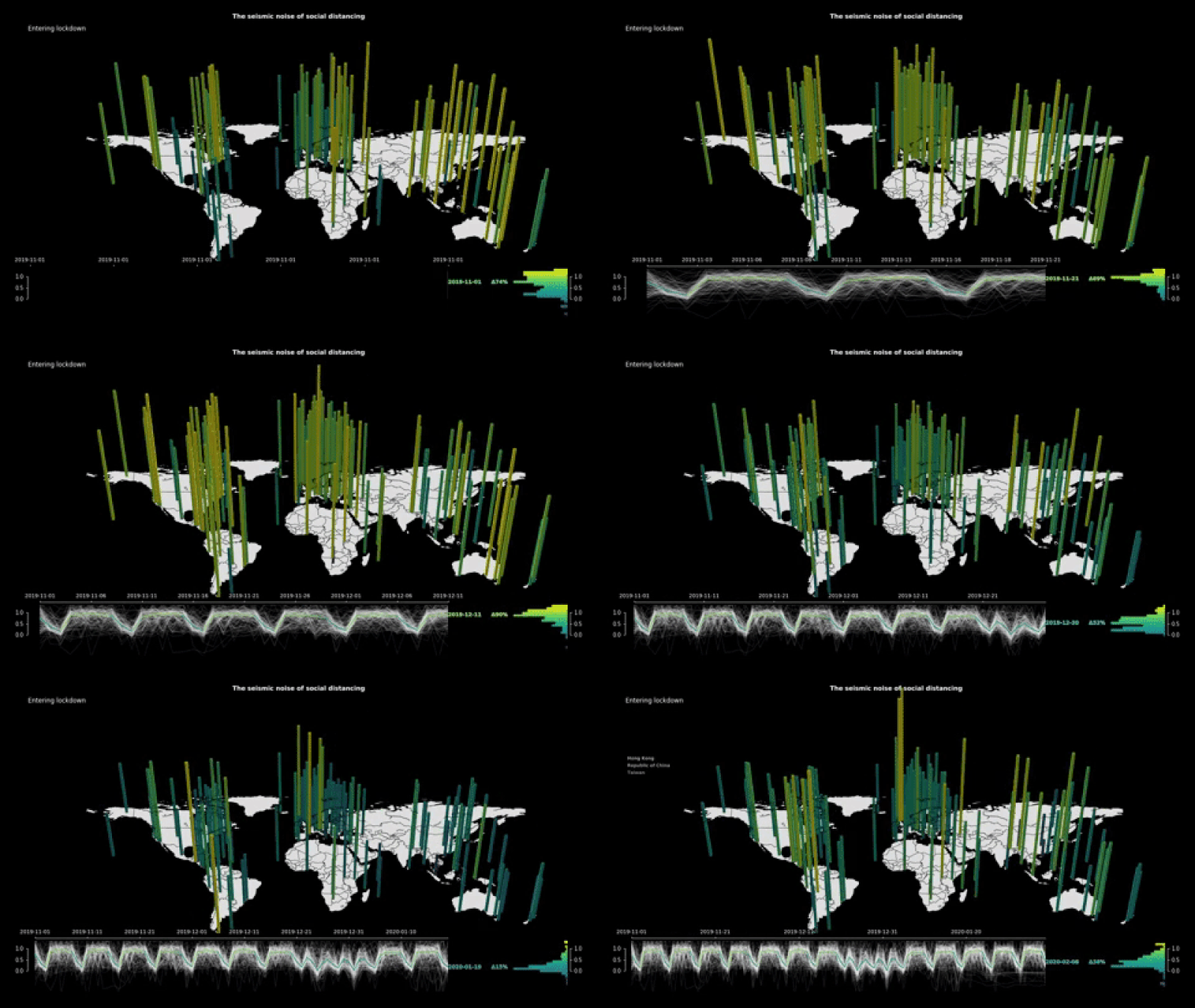
Human-linked Earth vibrations dropped 50% during Covid-19 lockdown

You can see the human signal fall away as the world goes into lockdown. The first clip shows the ‘wave’ of noise dampening as the world locks down. The second shows the UK’s seismic noise

EarthSky’s yearly crowd-funding campaign is in progress. In 2020, we are donating 8.5% of all incoming revenues to No Kids Hungry. Click to learn more and donate.

Seismometers measure seismic waves from big events such as earthquakes, volcanos, bombs and so on. At the same time, they pick up what’s called seismic noise – ambient vibrations – from things like wind, rivers, ocean waves and human activities (especially travel and industry). According to a new study by an international team of researchers, Earth’s seismic noise level dropped by an average of 50% between March and May 2020, during the Covid-19 lockdown.

In a July 23, 2020, statement from Imperial College London, which took part in the study, researchers said this quiet period was likely caused by the total global effect of social distancing measures, closure of services and industry, and drops in tourism and travel.

They said it is the longest and most pronounced quiet period of seismic noise in recorded history.

Before this study, scientists knew that human-generated noise tends to dampen during quiet periods, for example, over the Christmas and New Year holidays in the western hemisphere, over Chinese New Year in Asia, and even during weekends and overnight. However, the researchers said that the drop in vibrations caused by Covid-19 lockdown measures eclipse those seen during such periods.

Map of world with with small red and blue squares scattered across it.

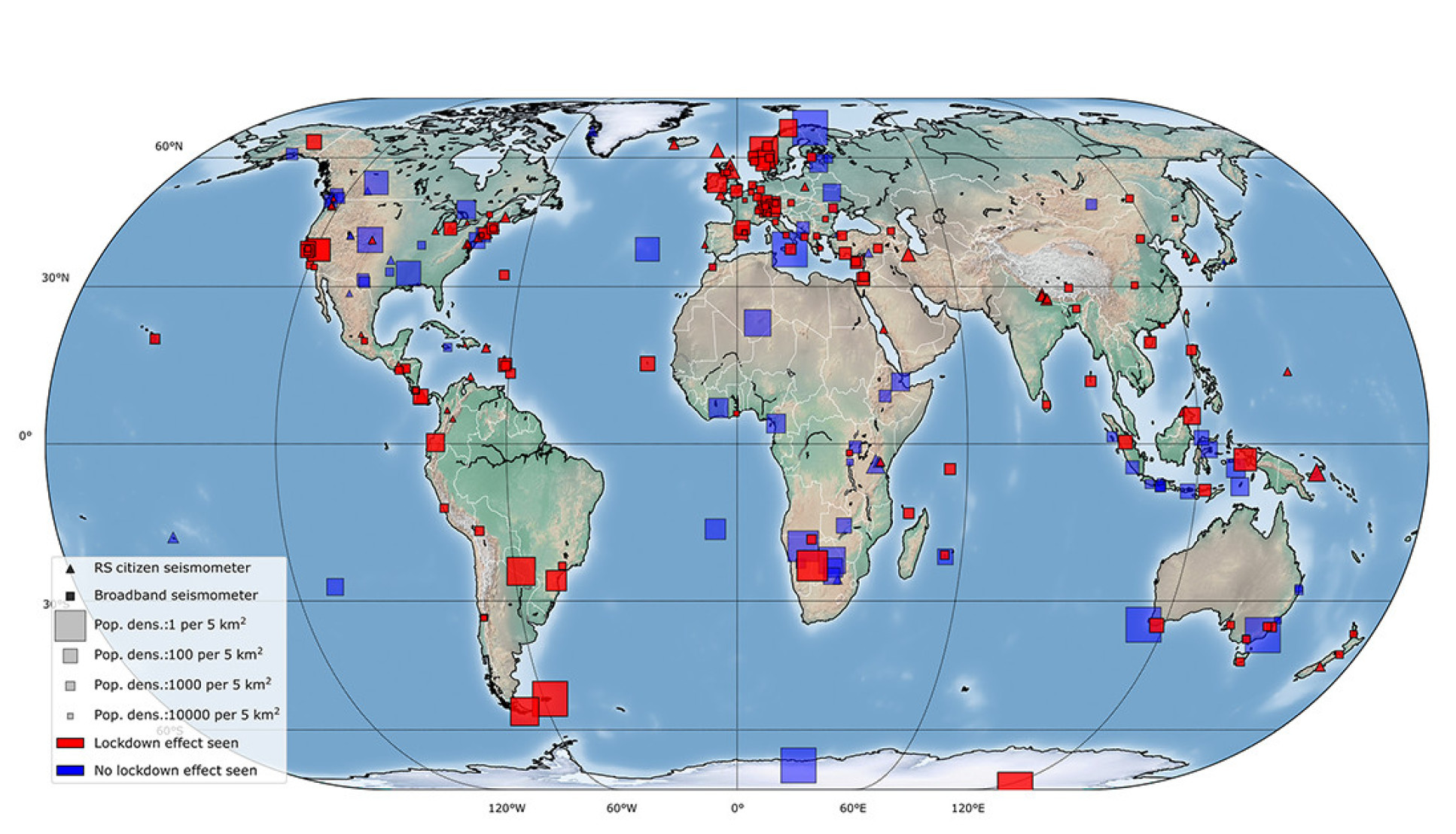
View larger. | This map shows 268 seismometers in 117 countries, 185 of which detected a drop on seismic noise between March and May 2020. Image via Imperial College London.

The new research showed that the largest drops in vibrations were seen in the most densely populated areas, for example, Singapore and New York City. Drops in vibrations were also recorded in remote areas, such as Germany’s Black Forest and Rundu in Namibia. The statement explained:

The strongest drops were found in urban areas, but the study also found signatures of the lockdown on sensors buried hundreds of meters underground …

Stephen Hicks from Imperial College London is a co-author of the study, which was published July 23 in the peer-reviewed journal Science. Hicks said in the scientists’ statement:

Our study uniquely highlights just how much human activities impact the solid Earth.

He added that the study could also let scientists see more clearly than ever what differentiates human and natural noise.

For this study, researchers looked at seismic data from a global network of 268 seismic stations in 117 countries. They found significant noise reductions compared to before any lockdown at 185 of those stations.

Beginning in China in late January 2020, and followed by Europe and the rest of the world in March to April 2020, researchers tracked the “wave” of quietening between March and May as worldwide lockdown measures took hold.

Clear plastic box containing electronics and two cylinders at right angles.

Citizen-owned seismometers (like the one pictured above), which tend to measure more localized noise, noted large drops around universities and schools around Cornwall in the U.K. and Boston in the U.S., a drop in noise 20% larger than seen during school holidays. Image via Imperial College London.

Countries like Barbados, where lockdown coincided with the tourist season, saw a 50% decrease in noise. This coincided with flight data that suggested tourists returned home in the weeks before official lockdown.

The study reports the first evidence that previously concealed earthquake signals, especially during daytime, appeared much clearer on seismometers in urban areas during lockdown. The study’s authors hope that their work will spawn further research on the seismic lockdown, as well as finding previously hidden signals from earthquakes and volcanoes. Hicks said:

The lockdowns caused by the coronavirus pandemic may have given us a glimmer of insight into how human and natural noise interacts with the Earth. We hope this insight will spawn new studies that help us listen better to the Earth and understand natural signals we would otherwise have missed.

Bottom line: The Covid-19 lockdown caused a 50% global reduction in human-linked Earth vibrations between March and May 2020.

Source: Global quieting of high-frequency seismic noise due to COVID-19 pandemic lockdown measures

Via Imperial College London


from EarthSky https://ift.tt/3hFCEfe

You can see the human signal fall away as the world goes into lockdown. The first clip shows the ‘wave’ of noise dampening as the world locks down. The second shows the UK’s seismic noise

EarthSky’s yearly crowd-funding campaign is in progress. In 2020, we are donating 8.5% of all incoming revenues to No Kids Hungry. Click to learn more and donate.

Seismometers measure seismic waves from big events such as earthquakes, volcanos, bombs and so on. At the same time, they pick up what’s called seismic noise – ambient vibrations – from things like wind, rivers, ocean waves and human activities (especially travel and industry). According to a new study by an international team of researchers, Earth’s seismic noise level dropped by an average of 50% between March and May 2020, during the Covid-19 lockdown.

In a July 23, 2020, statement from Imperial College London, which took part in the study, researchers said this quiet period was likely caused by the total global effect of social distancing measures, closure of services and industry, and drops in tourism and travel.

They said it is the longest and most pronounced quiet period of seismic noise in recorded history.

Before this study, scientists knew that human-generated noise tends to dampen during quiet periods, for example, over the Christmas and New Year holidays in the western hemisphere, over Chinese New Year in Asia, and even during weekends and overnight. However, the researchers said that the drop in vibrations caused by Covid-19 lockdown measures eclipse those seen during such periods.

Map of world with with small red and blue squares scattered across it.

View larger. | This map shows 268 seismometers in 117 countries, 185 of which detected a drop on seismic noise between March and May 2020. Image via Imperial College London.

The new research showed that the largest drops in vibrations were seen in the most densely populated areas, for example, Singapore and New York City. Drops in vibrations were also recorded in remote areas, such as Germany’s Black Forest and Rundu in Namibia. The statement explained:

The strongest drops were found in urban areas, but the study also found signatures of the lockdown on sensors buried hundreds of meters underground …

Stephen Hicks from Imperial College London is a co-author of the study, which was published July 23 in the peer-reviewed journal Science. Hicks said in the scientists’ statement:

Our study uniquely highlights just how much human activities impact the solid Earth.

He added that the study could also let scientists see more clearly than ever what differentiates human and natural noise.

For this study, researchers looked at seismic data from a global network of 268 seismic stations in 117 countries. They found significant noise reductions compared to before any lockdown at 185 of those stations.

Beginning in China in late January 2020, and followed by Europe and the rest of the world in March to April 2020, researchers tracked the “wave” of quietening between March and May as worldwide lockdown measures took hold.

Clear plastic box containing electronics and two cylinders at right angles.

Citizen-owned seismometers (like the one pictured above), which tend to measure more localized noise, noted large drops around universities and schools around Cornwall in the U.K. and Boston in the U.S., a drop in noise 20% larger than seen during school holidays. Image via Imperial College London.

Countries like Barbados, where lockdown coincided with the tourist season, saw a 50% decrease in noise. This coincided with flight data that suggested tourists returned home in the weeks before official lockdown.

The study reports the first evidence that previously concealed earthquake signals, especially during daytime, appeared much clearer on seismometers in urban areas during lockdown. The study’s authors hope that their work will spawn further research on the seismic lockdown, as well as finding previously hidden signals from earthquakes and volcanoes. Hicks said:

The lockdowns caused by the coronavirus pandemic may have given us a glimmer of insight into how human and natural noise interacts with the Earth. We hope this insight will spawn new studies that help us listen better to the Earth and understand natural signals we would otherwise have missed.

Bottom line: The Covid-19 lockdown caused a 50% global reduction in human-linked Earth vibrations between March and May 2020.

Source: Global quieting of high-frequency seismic noise due to COVID-19 pandemic lockdown measures

Via Imperial College London


from EarthSky https://ift.tt/3hFCEfe

Watch for the moon and the Scorpion

July is a grand time of year to learn to recognize the constellation Scorpius the Scorpion. If you’re in the city – with no dark sky – you probably won’t see the entire constellation. But you can still see the star that represents the Scorpion’s Heart, a bright red star called Antares. Our chart shows the nights of July 27, 28 and 29, 2020, when the moon will approaching this star and then passing it. Watch for the moon on these nights! Despite its glare, Antares’ red color will likely be noticeable to you.

If you do have a dark sky, you can see the graceful shape of Antares’ constellation Scorpius. The constellation has a J-shape. From the Northern Hemisphere, the bottom half of Scorpius – the curved part of the J – is close to the southern horizon when Scorpius is at its highest in the sky, as it is in the evening in July.

From the Southern Hemisphere, the graceful shape of Scorpius appears higher in the sky, closer to overhead.

But – from either hemisphere, assuming you have a dark sky – you can recognize this constellation and its bright red star Antares.

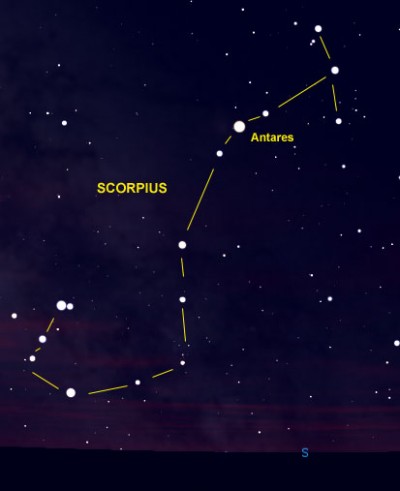
Star chart with stars and connecting lines making up constellation Scorpius.

Scorpius is one of the few constellations that looks like its namesake. The bright red star Antares marks the Scorpion’s Heart. Notice also the 2 stars at the tip of the Scorpion’s Tail. These 2 stars – Shaula and Lesath – are known as The Stinger.

When Scorpius is high in the sky in the evening, you know it’s time to look for another constellation, Orion the Hunter, before dawn. Orion and Scorpius are never in the sky at the same time. In one of skylore’s most charming legends, it’s said that vain Orion grew so boastful about his hunting skills that he claimed there was no animal he could not kill. When he boasted he would kill every animal on earth, Gaia, the Goddess of the Earth, sent Scorpius the Scorpion to sting and kill Orion. It’s said that Zeus, the ruler of the gods in Greek mythology, placed Orion and the Scorpion in the heavens in such a way that the two enemies would never meet. Thus when the Scorpion is at its peak in visibility in the evening sky – high in the sky on late July evenings – Orion is just returning to the east before sunrise. Read more: Orion the Hunter returns before dawn.

Bottom line: July is a good month for learning to recognize the J-shaped constellation Scorpius. The moon will be approaching and then sweeping past the brighest star in Scorpius, red Antares, on July 27, 28 and 29, 2020.


from EarthSky https://ift.tt/2X11kqH

July is a grand time of year to learn to recognize the constellation Scorpius the Scorpion. If you’re in the city – with no dark sky – you probably won’t see the entire constellation. But you can still see the star that represents the Scorpion’s Heart, a bright red star called Antares. Our chart shows the nights of July 27, 28 and 29, 2020, when the moon will approaching this star and then passing it. Watch for the moon on these nights! Despite its glare, Antares’ red color will likely be noticeable to you.

If you do have a dark sky, you can see the graceful shape of Antares’ constellation Scorpius. The constellation has a J-shape. From the Northern Hemisphere, the bottom half of Scorpius – the curved part of the J – is close to the southern horizon when Scorpius is at its highest in the sky, as it is in the evening in July.

From the Southern Hemisphere, the graceful shape of Scorpius appears higher in the sky, closer to overhead.

But – from either hemisphere, assuming you have a dark sky – you can recognize this constellation and its bright red star Antares.

Star chart with stars and connecting lines making up constellation Scorpius.

Scorpius is one of the few constellations that looks like its namesake. The bright red star Antares marks the Scorpion’s Heart. Notice also the 2 stars at the tip of the Scorpion’s Tail. These 2 stars – Shaula and Lesath – are known as The Stinger.

When Scorpius is high in the sky in the evening, you know it’s time to look for another constellation, Orion the Hunter, before dawn. Orion and Scorpius are never in the sky at the same time. In one of skylore’s most charming legends, it’s said that vain Orion grew so boastful about his hunting skills that he claimed there was no animal he could not kill. When he boasted he would kill every animal on earth, Gaia, the Goddess of the Earth, sent Scorpius the Scorpion to sting and kill Orion. It’s said that Zeus, the ruler of the gods in Greek mythology, placed Orion and the Scorpion in the heavens in such a way that the two enemies would never meet. Thus when the Scorpion is at its peak in visibility in the evening sky – high in the sky on late July evenings – Orion is just returning to the east before sunrise. Read more: Orion the Hunter returns before dawn.

Bottom line: July is a good month for learning to recognize the J-shaped constellation Scorpius. The moon will be approaching and then sweeping past the brighest star in Scorpius, red Antares, on July 27, 28 and 29, 2020.


from EarthSky https://ift.tt/2X11kqH

1st direct image of 2 giant exoplanets orbiting a sunlike star

EarthSky’s yearly crowd-funding campaign is in progress. In 2020, we are donating 8.5% of all incoming revenues to No Kids Hungry. Click to learn more and donate.

How would our solar system look from the vicinity of another star? Using technologies similar to ours, alien astronomers would have a tough time photographing our small, rocky Earth. They might more easily manage to capture images of our solar system’s biggest planets, the large gaseous worlds Jupiter and Saturn. Of the thousands of exoplanets discovered so far orbiting distant stars, earthly astronomers have captured direct images of only a very few. In each of these images, only one planet can be seen. Now astronomers say they’ve acquired a first-ever direct image of two giant exoplanets, orbiting a sunlike star.

The astronomers were using the SPHERE instrument on the Very Large Telescope (VLT) of the European Southern Observatory. The exciting peer-reviewed results were published in The Astrophysical Journal Letters on July 22, 2020.

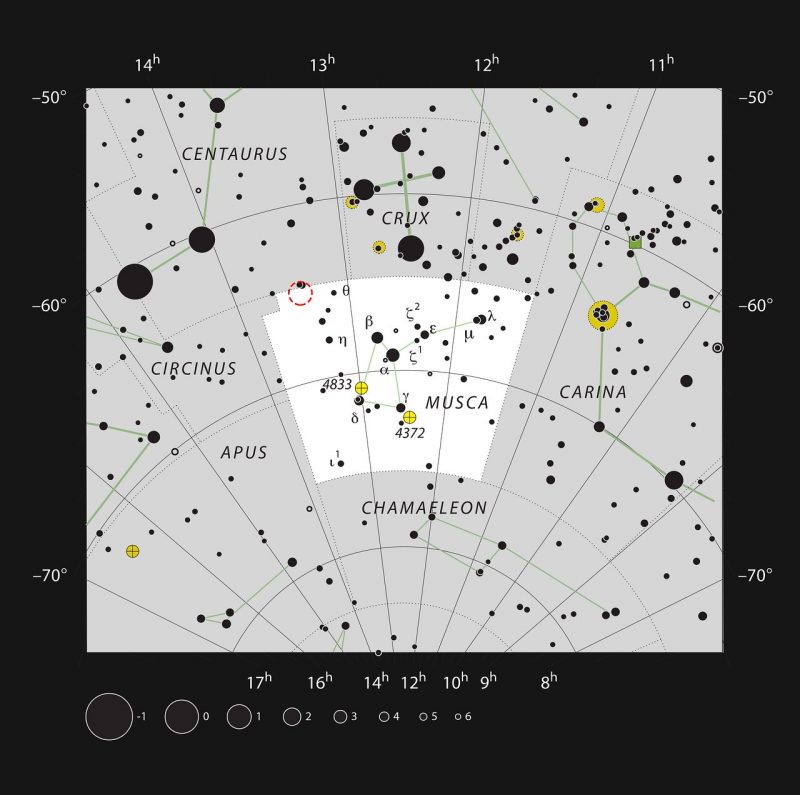
This planetary system orbits the star TYC 8998-760-1. It’s 300 light-years away in the direction of the southern constellation Musca the Fly. The system seems to resemble our own solar system, but is much younger.

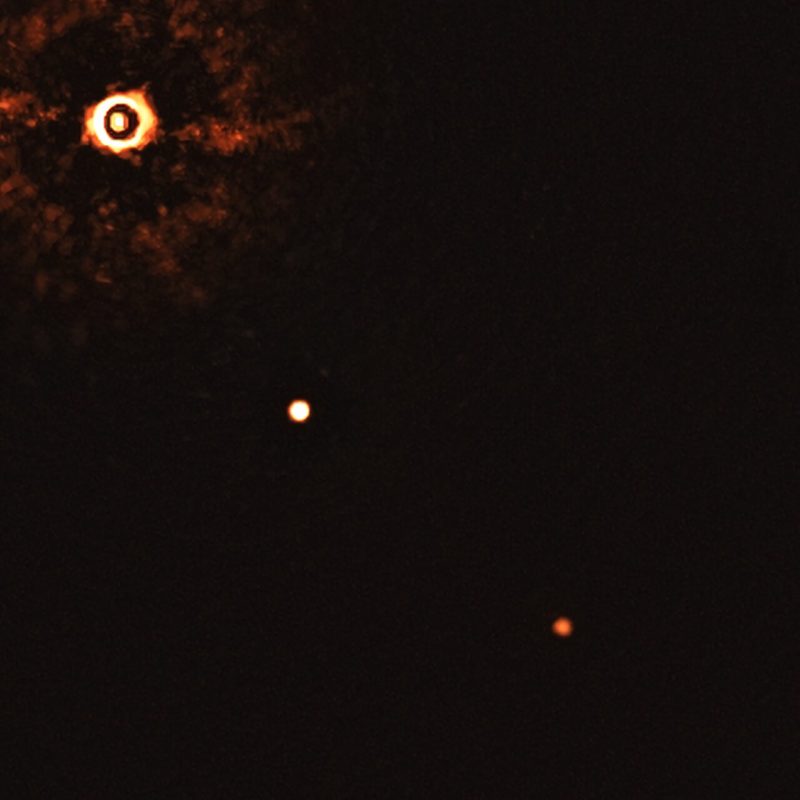
Bright ring and 2 smaller bright dots on black background.

Here’s the young star TYC 8998-760-1, in the upper left. Astronomers blocked its light via a coronagraph; the bright and dark rings around it are optical artifacts (imperfections in the image, not part of the star itself). The 2 bright orbs in the center and bottom right are giant exoplanets, orbiting this star, 300 light-years away. This is the 1st time astronomers have directly photographed more than 1 planet orbiting a sunlike star. Image via ESO/ Bohn et al.

Alexander Bohn, who led the research, is a Ph.D. student at Leiden University in the Netherlands. He stated:

This discovery is a snapshot of an environment that is very similar to our solar system, but at a much earlier stage of its evolution.

While there are several methods for detecting exoplanets by how they affect their stars’ light during a transit or how their gravity slightly tugs at their stars, imaging them directly is still difficult due to the immense distances involved, even for large gas giant-type planets. According to co-author Matthew Kenworthy:

Even though astronomers have indirectly detected thousands of planets in our galaxy, only a tiny fraction of these exoplanets have been directly imaged. Direct observations are important in the search for environments that can support life.

Two other planetary systems had been photographed before with more than one planet each, but neither of the stars were sunlike. VLT had also photographed an exoplanet orbiting a brown dwarf – a type of “failed star” – back in 2004. This, however, is the first time that two planets have ever been imaged around a sunlike star. Maddalena Reggiani, a postdoctoral researcher from Belgium, said:

Our team has now been able to take the first image of two gas giant companions that are orbiting a young, solar analog.

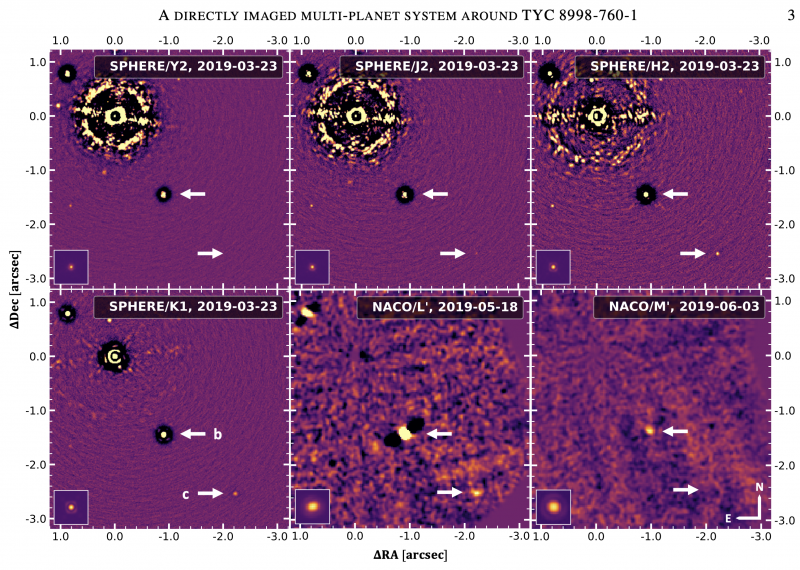
Six with bright rings and dots, with text annotations on white background.

The two planets as seen through several filters on SPHERE and NACO. Image via ESO/ Bohn et al.

What might these newly discovered worlds be like?

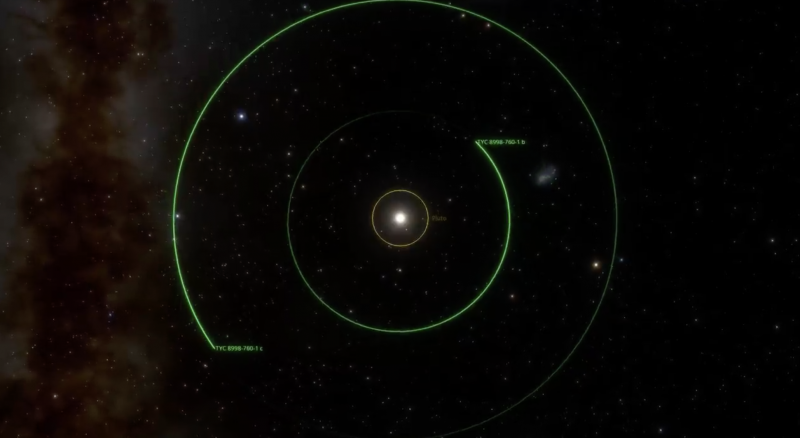
They are gas giants, like Jupiter and Saturn, but are larger and more massive. One of the planets is about 14 times more massive than Jupiter, while the other is six times more massive. They also orbit farther away from their star than Jupiter and Saturn do around the sun. Jupiter and Saturn orbit at five and 10 times the Earth-sun distance, while these other alien worlds orbit their star at a whopping 160 and 320 times the Earth-sun distance.

The TYC 8998-760-1 system seems to have a general similar appearance to our own solar system, but is much younger, only an estimated 17 million years old. That’s like being a toddler compared to our 4.6 billion-year-old solar system.

In the new image, the two planets can be seen as small, bright dots. The star is the larger and brighter “ring” in the upper-left of the image. It looks that way because the SPHERE instrument on VLT blocks the brightest light coming from the star using a coronograph. This way, the smaller and fainter planets can be seen. The researchers took different images at different times, and so were able to see the planets’ movements against the background of stars.

Gray square filled with many black or yellow dots, lines and text annotations on black background.

The location of the TYC 8998-760-1 system in the constellation Musca the Fly. Image via ESO.

It was also easier to image these planets because they are young, and therefore a lot warmer, making them glow brighter in infrared light.

The new planets were discovered as part of a search for giant planets around younger, sunlike stars.

Of course, the researchers want to continue to study these young worlds. One question they have is whether they formed where they currently are around the star or if they migrated from somewhere else in the system. ESO’s upcoming Extremely Large Telescope (ELT) will be able to help with this, as well as study how the two planets interact with each other. Bohn said:

The possibility that future instruments, such as those available on the ELT, will be able to detect even lower-mass planets around this star marks an important milestone in understanding multi-planet systems, with potential implications for the history of our own solar system.

Smiling young man with eyeglasses and buildings in background.

Alexander Bohn at Leiden University, who led the new research. Image via Leiden University.

On June 3, 2013, ESO announced the successful imaging of the exoplanet HD 95086 b, also about 300 light-years away, which is another giant world four to five times more massive than Jupiter. It was also found using VLT. That planet orbits at its star at 56 times the distance from the Earth to the sun, and twice the sun-Neptune distance. The star is a little more massive than the sun and is surrounded by a debris disk, and like TYC 8998-760-1, is a very young star. It is estimated to be only 10 to 17 million years old.

In 2018, a congressionally-mandated report recommended that NASA lead the effort to directly image Earth-sized (or even Earth-like?) exoplanets using new and upcoming technologies.

The newest image is exciting since it is another step toward being able to actually photograph smaller alien worlds, such as super-Earths and planets about the same size as Earth. Will we eventually find another “pale blue dot“?

Artist's depiction of a yellow sun in the center, with circular green lines representing the 2 giant exoplanets' orbits.

Orbits of the 2 giant exoplanets orbiting the star TYC 8998-760-1. They are gas giant worlds, much like Jupiter and Saturn, but are larger and more massive. Jupiter and Saturn orbit at 5 and 10 times the Earth-sun distance. The 2 giant exoplanets orbiting TYC 8998-760-1 are a whopping 160 and 320 times the Earth-sun distance.

Bottom line: For the first time, astronomers have obtained direct images of two giant exoplanets orbiting a sunlike star. The star is TYC 8998-760-1, 300 light-years from Earth.

Source: Two directly-imaged, wide-orbit giant planets around the young, solar analogue TYC 8998-760-1?

Via European Southern Observatory

EarthSky’s yearly crowd-funding campaign is in progress. In 2020, we are donating 8.5% of all incoming revenues to No Kids Hungry. Click to learn more and donate.


from EarthSky https://ift.tt/2WWsqPP

EarthSky’s yearly crowd-funding campaign is in progress. In 2020, we are donating 8.5% of all incoming revenues to No Kids Hungry. Click to learn more and donate.

How would our solar system look from the vicinity of another star? Using technologies similar to ours, alien astronomers would have a tough time photographing our small, rocky Earth. They might more easily manage to capture images of our solar system’s biggest planets, the large gaseous worlds Jupiter and Saturn. Of the thousands of exoplanets discovered so far orbiting distant stars, earthly astronomers have captured direct images of only a very few. In each of these images, only one planet can be seen. Now astronomers say they’ve acquired a first-ever direct image of two giant exoplanets, orbiting a sunlike star.

The astronomers were using the SPHERE instrument on the Very Large Telescope (VLT) of the European Southern Observatory. The exciting peer-reviewed results were published in The Astrophysical Journal Letters on July 22, 2020.

This planetary system orbits the star TYC 8998-760-1. It’s 300 light-years away in the direction of the southern constellation Musca the Fly. The system seems to resemble our own solar system, but is much younger.

Bright ring and 2 smaller bright dots on black background.

Here’s the young star TYC 8998-760-1, in the upper left. Astronomers blocked its light via a coronagraph; the bright and dark rings around it are optical artifacts (imperfections in the image, not part of the star itself). The 2 bright orbs in the center and bottom right are giant exoplanets, orbiting this star, 300 light-years away. This is the 1st time astronomers have directly photographed more than 1 planet orbiting a sunlike star. Image via ESO/ Bohn et al.

Alexander Bohn, who led the research, is a Ph.D. student at Leiden University in the Netherlands. He stated:

This discovery is a snapshot of an environment that is very similar to our solar system, but at a much earlier stage of its evolution.

While there are several methods for detecting exoplanets by how they affect their stars’ light during a transit or how their gravity slightly tugs at their stars, imaging them directly is still difficult due to the immense distances involved, even for large gas giant-type planets. According to co-author Matthew Kenworthy:

Even though astronomers have indirectly detected thousands of planets in our galaxy, only a tiny fraction of these exoplanets have been directly imaged. Direct observations are important in the search for environments that can support life.

Two other planetary systems had been photographed before with more than one planet each, but neither of the stars were sunlike. VLT had also photographed an exoplanet orbiting a brown dwarf – a type of “failed star” – back in 2004. This, however, is the first time that two planets have ever been imaged around a sunlike star. Maddalena Reggiani, a postdoctoral researcher from Belgium, said:

Our team has now been able to take the first image of two gas giant companions that are orbiting a young, solar analog.

Six with bright rings and dots, with text annotations on white background.

The two planets as seen through several filters on SPHERE and NACO. Image via ESO/ Bohn et al.

What might these newly discovered worlds be like?

They are gas giants, like Jupiter and Saturn, but are larger and more massive. One of the planets is about 14 times more massive than Jupiter, while the other is six times more massive. They also orbit farther away from their star than Jupiter and Saturn do around the sun. Jupiter and Saturn orbit at five and 10 times the Earth-sun distance, while these other alien worlds orbit their star at a whopping 160 and 320 times the Earth-sun distance.

The TYC 8998-760-1 system seems to have a general similar appearance to our own solar system, but is much younger, only an estimated 17 million years old. That’s like being a toddler compared to our 4.6 billion-year-old solar system.

In the new image, the two planets can be seen as small, bright dots. The star is the larger and brighter “ring” in the upper-left of the image. It looks that way because the SPHERE instrument on VLT blocks the brightest light coming from the star using a coronograph. This way, the smaller and fainter planets can be seen. The researchers took different images at different times, and so were able to see the planets’ movements against the background of stars.

Gray square filled with many black or yellow dots, lines and text annotations on black background.

The location of the TYC 8998-760-1 system in the constellation Musca the Fly. Image via ESO.

It was also easier to image these planets because they are young, and therefore a lot warmer, making them glow brighter in infrared light.

The new planets were discovered as part of a search for giant planets around younger, sunlike stars.

Of course, the researchers want to continue to study these young worlds. One question they have is whether they formed where they currently are around the star or if they migrated from somewhere else in the system. ESO’s upcoming Extremely Large Telescope (ELT) will be able to help with this, as well as study how the two planets interact with each other. Bohn said:

The possibility that future instruments, such as those available on the ELT, will be able to detect even lower-mass planets around this star marks an important milestone in understanding multi-planet systems, with potential implications for the history of our own solar system.

Smiling young man with eyeglasses and buildings in background.

Alexander Bohn at Leiden University, who led the new research. Image via Leiden University.

On June 3, 2013, ESO announced the successful imaging of the exoplanet HD 95086 b, also about 300 light-years away, which is another giant world four to five times more massive than Jupiter. It was also found using VLT. That planet orbits at its star at 56 times the distance from the Earth to the sun, and twice the sun-Neptune distance. The star is a little more massive than the sun and is surrounded by a debris disk, and like TYC 8998-760-1, is a very young star. It is estimated to be only 10 to 17 million years old.

In 2018, a congressionally-mandated report recommended that NASA lead the effort to directly image Earth-sized (or even Earth-like?) exoplanets using new and upcoming technologies.

The newest image is exciting since it is another step toward being able to actually photograph smaller alien worlds, such as super-Earths and planets about the same size as Earth. Will we eventually find another “pale blue dot“?

Artist's depiction of a yellow sun in the center, with circular green lines representing the 2 giant exoplanets' orbits.

Orbits of the 2 giant exoplanets orbiting the star TYC 8998-760-1. They are gas giant worlds, much like Jupiter and Saturn, but are larger and more massive. Jupiter and Saturn orbit at 5 and 10 times the Earth-sun distance. The 2 giant exoplanets orbiting TYC 8998-760-1 are a whopping 160 and 320 times the Earth-sun distance.

Bottom line: For the first time, astronomers have obtained direct images of two giant exoplanets orbiting a sunlike star. The star is TYC 8998-760-1, 300 light-years from Earth.

Source: Two directly-imaged, wide-orbit giant planets around the young, solar analogue TYC 8998-760-1?

Via European Southern Observatory

EarthSky’s yearly crowd-funding campaign is in progress. In 2020, we are donating 8.5% of all incoming revenues to No Kids Hungry. Click to learn more and donate.


from EarthSky https://ift.tt/2WWsqPP

adds 2