aads

New fairy lantern plant discovered at popular Malaysian park

Two images. Left image shows two women with fairy lantern specimens. Right image is closeup of plant.
On the left, the 2 women integral to this discovery. Siti-Munirah Mat Yunoh, the paper’s lead author, holds specimens of the new fairy lantern Thismia selangorensis. Next to her is Gim Siew Tan, who found the new species. On the right is a closeup of the plant. Images via Pensoft Publishers.

EarthSky’s 2026 lunar calendar is available now. Get yours today! Makes a great gift.

  • A naturalist in Malaysia discovered a new fairy lantern plant. Scientists named it Thismia selangorensis.
  • The tiny, delicate species is extremely rare, with fewer than 20 known plants.
  • Scientists warn it is critically endangered and needs careful protection.

Extraordinary new plant species discovered at busy park

In November 2023, naturalist Gim Siew Tan was exploring a local nature reserve near Kuala Lumpur, the capital of Malaysia. It is a popular picnic and camping destination, the last place she would expect to find a new plant species. Yet, there it was, growing against the odds, in a park frequented by many people. Tan had discovered the delicate flower of a diminutive plant that is a new species of fairy lantern. Scientists described this exquisite new species in a paper published in late November 2025. They named it Thismia selangorensis.

Siti-Munirah Mat Yunoh, of the Forest Research Institute Malaysia, is the paper’s lead author. She said, in a blog by Pensoft Publishers:

This discovery shows that significant scientific finds are not limited to remote jungles; they can also be made in ordinary environments where constant human activity leaves little room for expectation. Protecting Thismia selangorensis will require cooperation among researchers, the forest department, stakeholders, and the public, as its survival depends on how carefully we tread in its habitat.

The researchers published their study in the peer-reviewed journal PhytoKeys on November 28, 2025.

Fairy lanterns are parasitic plants

Fairy lanterns – which belong to the genus Thismia – are myco-heterotrophic plants. That means they don’t have chlorophyll like most plants. Therefore, they don’t get their energy from the sun. Instead, they’re parasites, stealing nutrients from fungi living in the soil.

There are 120 known Thismia plants, found in East Asia, Southeast Asia, New Guinea, Australia, New Zealand and the Americas. They usually grow in undisturbed tropical forests and in moist shaded soil, surrounded by leaf litter. These plants are tuberous, which means they store food in swollen underground structures called tubers. They are most visible when they produce flowers. In addition, fungus gnats pollinate many types of Thismia flowers.

A rare new fairy lantern

Scientists named this new fairy lantern species Thismia selangorensis, after the Malaysian state – Selangor – where they found it.

Thismia selangorensis produces flowers between October and February. When flowering, the plant is only 4 inches (10 cm) tall. As a result, it is only visible when the flowers are out. Moreover, each plant produces one flower, colored a peach-pink shade.

Each flower has a lower cup with stripes. Above it grows an umbrella-like mitre. In addition, three slim club-like appendages emerge from that mitre. The flower itself is connected to a short stem which ends in stubby coralliform roots (small roots having the branching structure of corals).

Two flowers, light peach colored, that have three long appendages protruding from it.
Discoverer Gim Siew Tan photographed these 2 Thismia selangorensis fairy lanterns. Image via Gim Siew Tan/ Pensoft Publishers.

Finding this new fairy lantern species

Despite decades of human activity in the area, the new species remained undiscovered until naturalist Gim Siew Tan found it in November 2023. At the time, Tan was on a routine photography excursion at Taman Eko Rimba Sungai Chongkak, part of the Hulu Langat Forest Reserve, not far from Kuala Lumpur. She first spotted the plant’s delicate flower nestled in a hole at the base of a riverside tree, like it was living in a tiny cave.

Subsequently, Tan and other researchers found more plants growing in moist soil among fallen leaves and along roots near the bases of riverside trees. There are less than 20 known individual plants, all within just a 1.5-square-mile area (4 square km). That’s a tiny population in an area that many people visit. As a result, scientists consider Thismia selangorensis a critically endangered species, following standards in the IUCN Red List.

A flower in bud form, orange in color. It has a bulbous form with three long appendages curled at the top.
This is the new fairy lantern, Thismia selangorensis, as an undeveloped flower. Image via Gim Siew Tan/ MY Siti-Munirah, et al.

An urgent need to conserve this rare species

Researchers found the plants in a part of the forest that has remained relatively undisturbed. However, these fairy lanterns are growing close to campsites and picnic areas. As a result, people may inadvertently trample on them. Furthermore, the plants are vulnerable to flooding.

Scientists strongly recommend careful management of the area to preserve Thismia selangorensis. They also plan to continue monitoring the plants they have already discovered and search for more specimens outside its currently known range.

Siti-Munirah commented:

The most important effort now is to raise awareness about this species so the public realizes that it exists – right here, in this small corner of the world, and nowhere else, at least for now. Understanding its presence is the first step towards ensuring that this extraordinary plant is not lost before many people even know it exists.

Bottom line: Scientists have discovered an exquisite new species of fairy lantern – called Thismia selangorensis – at a park near Kuala Lumpur, Malaysia.

Source: Thismia selangorensis (Thismiaceae): a new mitriform fairy lantern species from Selangor, Malaysia

Via Pensoft Publishers

Read more: Frog saunas could help frogs threatened by fungus

Dead man’s fingers are our creepy lifeform of the week

The post New fairy lantern plant discovered at popular Malaysian park first appeared on EarthSky.


from EarthSky https://ift.tt/21UdzZ9
Two images. Left image shows two women with fairy lantern specimens. Right image is closeup of plant.
On the left, the 2 women integral to this discovery. Siti-Munirah Mat Yunoh, the paper’s lead author, holds specimens of the new fairy lantern Thismia selangorensis. Next to her is Gim Siew Tan, who found the new species. On the right is a closeup of the plant. Images via Pensoft Publishers.

EarthSky’s 2026 lunar calendar is available now. Get yours today! Makes a great gift.

  • A naturalist in Malaysia discovered a new fairy lantern plant. Scientists named it Thismia selangorensis.
  • The tiny, delicate species is extremely rare, with fewer than 20 known plants.
  • Scientists warn it is critically endangered and needs careful protection.

Extraordinary new plant species discovered at busy park

In November 2023, naturalist Gim Siew Tan was exploring a local nature reserve near Kuala Lumpur, the capital of Malaysia. It is a popular picnic and camping destination, the last place she would expect to find a new plant species. Yet, there it was, growing against the odds, in a park frequented by many people. Tan had discovered the delicate flower of a diminutive plant that is a new species of fairy lantern. Scientists described this exquisite new species in a paper published in late November 2025. They named it Thismia selangorensis.

Siti-Munirah Mat Yunoh, of the Forest Research Institute Malaysia, is the paper’s lead author. She said, in a blog by Pensoft Publishers:

This discovery shows that significant scientific finds are not limited to remote jungles; they can also be made in ordinary environments where constant human activity leaves little room for expectation. Protecting Thismia selangorensis will require cooperation among researchers, the forest department, stakeholders, and the public, as its survival depends on how carefully we tread in its habitat.

The researchers published their study in the peer-reviewed journal PhytoKeys on November 28, 2025.

Fairy lanterns are parasitic plants

Fairy lanterns – which belong to the genus Thismia – are myco-heterotrophic plants. That means they don’t have chlorophyll like most plants. Therefore, they don’t get their energy from the sun. Instead, they’re parasites, stealing nutrients from fungi living in the soil.

There are 120 known Thismia plants, found in East Asia, Southeast Asia, New Guinea, Australia, New Zealand and the Americas. They usually grow in undisturbed tropical forests and in moist shaded soil, surrounded by leaf litter. These plants are tuberous, which means they store food in swollen underground structures called tubers. They are most visible when they produce flowers. In addition, fungus gnats pollinate many types of Thismia flowers.

A rare new fairy lantern

Scientists named this new fairy lantern species Thismia selangorensis, after the Malaysian state – Selangor – where they found it.

Thismia selangorensis produces flowers between October and February. When flowering, the plant is only 4 inches (10 cm) tall. As a result, it is only visible when the flowers are out. Moreover, each plant produces one flower, colored a peach-pink shade.

Each flower has a lower cup with stripes. Above it grows an umbrella-like mitre. In addition, three slim club-like appendages emerge from that mitre. The flower itself is connected to a short stem which ends in stubby coralliform roots (small roots having the branching structure of corals).

Two flowers, light peach colored, that have three long appendages protruding from it.
Discoverer Gim Siew Tan photographed these 2 Thismia selangorensis fairy lanterns. Image via Gim Siew Tan/ Pensoft Publishers.

Finding this new fairy lantern species

Despite decades of human activity in the area, the new species remained undiscovered until naturalist Gim Siew Tan found it in November 2023. At the time, Tan was on a routine photography excursion at Taman Eko Rimba Sungai Chongkak, part of the Hulu Langat Forest Reserve, not far from Kuala Lumpur. She first spotted the plant’s delicate flower nestled in a hole at the base of a riverside tree, like it was living in a tiny cave.

Subsequently, Tan and other researchers found more plants growing in moist soil among fallen leaves and along roots near the bases of riverside trees. There are less than 20 known individual plants, all within just a 1.5-square-mile area (4 square km). That’s a tiny population in an area that many people visit. As a result, scientists consider Thismia selangorensis a critically endangered species, following standards in the IUCN Red List.

A flower in bud form, orange in color. It has a bulbous form with three long appendages curled at the top.
This is the new fairy lantern, Thismia selangorensis, as an undeveloped flower. Image via Gim Siew Tan/ MY Siti-Munirah, et al.

An urgent need to conserve this rare species

Researchers found the plants in a part of the forest that has remained relatively undisturbed. However, these fairy lanterns are growing close to campsites and picnic areas. As a result, people may inadvertently trample on them. Furthermore, the plants are vulnerable to flooding.

Scientists strongly recommend careful management of the area to preserve Thismia selangorensis. They also plan to continue monitoring the plants they have already discovered and search for more specimens outside its currently known range.

Siti-Munirah commented:

The most important effort now is to raise awareness about this species so the public realizes that it exists – right here, in this small corner of the world, and nowhere else, at least for now. Understanding its presence is the first step towards ensuring that this extraordinary plant is not lost before many people even know it exists.

Bottom line: Scientists have discovered an exquisite new species of fairy lantern – called Thismia selangorensis – at a park near Kuala Lumpur, Malaysia.

Source: Thismia selangorensis (Thismiaceae): a new mitriform fairy lantern species from Selangor, Malaysia

Via Pensoft Publishers

Read more: Frog saunas could help frogs threatened by fungus

Dead man’s fingers are our creepy lifeform of the week

The post New fairy lantern plant discovered at popular Malaysian park first appeared on EarthSky.


from EarthSky https://ift.tt/21UdzZ9

Did a lost moon of Mars create tides in an ancient lake?

Lost moon of Mars: Reddish-brown landscape with a river feeding into a circular lake with an island in the middle.
View larger. | Artist’s concept of the ancient lake in Gale crater on Mars and the river that flowed into it. Evidence from thinly layered sediments in Gale crater, studied by the Curiosity rover, suggests that Mars once had a much larger moon. This big, lost moon of Mars might have created tides in the lake 3.8 billion years ago. Image via Kevin Gill/ Flickr.
  • Mars has two tiny moons, Phobos and Deimos. Could it have had a larger moon in the past?
  • Thin, repeating layers in sedimentary rock – found by the Curiosity rover in Gale crater – might be evidence of tides in the ancient lake that once filled the crater.
  • Only a former larger moon could have created such tides, because Phobos and Deimos are much too small.

EarthSky’s 2026 lunar calendar is available now. Get yours today! Makes a great gift.

A larger, lost moon of Mars?

Mars is well-known for its two tiny moons, Phobos and Deimos. But did it ever have any larger moons? A team of researchers from Germany, India and the U.S. has found evidence for a possible lost moon in Mars’ distant past that was much larger than the moons that orbit the planet today. The researchers said on November 20, 2025, that the clues come from thin, repeating layers of sedimentary rock in a rocky outcrop called Jura in Gale crater, where NASA’s Curiosity rover has been exploring since 2012. The researchers said they are likely tidal rhythmites, sediments deposited by the regular sloshing of tides in water when Gale crater was a lake 3.8 billion years ago.

The team, led by Ranjan Sarkar at the Max Planck Institute for Solar System Research in Germany, will present its findings at the AGU25 meeting on December 17, 2025.

Damond Benningfield wrote about the intriguing findings for Eos on November 20, 2025.

Thin layers of sedimentary rock on Mars suggest that the planet once had a moon much larger than the two that orbit it today. #AGU25

Eos (@eos.org) 2025-11-23T16:24:00.685Z

Curiosity finds intriguing layers in rocky outcrop

The Curiosity rover landed in 2012 and has been exploring its new home of Gale crater ever since. In late 2017 and early 2018, it studied a rocky outcrop at Vera Rubin Ridge. This ridge is on the lower flank of Mount Sharp, a massive hill in the center of Gale crater. The rover took a close look at the rocky outcrop – including with its Mars Hand Lens Imager – and found something interesting. There were very fine, repeating layers of sediments in the outcrop. They alternated between bright and dark colors.

The rover inspected an area about 14 inches (35 centimeters) long and 8 inches (20 centimeters) wide. The thickness of individual layers in the rock ranged from submillimeters to millimeters thick. There were wider, light-toned layers and darker, thinner layers.

Notably, such layers often indicate the presence of past water. In this case, however, they hinted at something more, too.

4 images in a row showing a route map and 3 closeup views of thin layers in rock.
View larger. | This graphic traces Curiosity’s path to the Jura outcrop on Vera Rubin Ridge. The color-enhanced images from the rover show the thin sedimentary layers in the Jura outcrop. Scientists think these are evidence of tidal rhythmites. At right are similar layers on Earth for comparison. Image via Ranjan Sarkar/ Priyabrata Das/ Suniti Karunatillake/ AGU25/ Eos.

Did a lost moon of Mars create tides in ancient bodies of water?

Analysis of the thin, repeating layers suggested they were tidal rhythmites. The rhythmites are layers of sediments deposited by tides. Scientists already knew Gale crater used to be a lake a few billion years ago. And the layers were deposited about 3.8 billion years ago, the researchers said. So evidence of tides themselves wasn’t too weird. But what caused the tides?

The researchers said a larger moon was the most likely answer. Sarkar told Eos:

Our study provides sedimentary evidence for the case of tidally deposited rhythmites, hinting at a past larger moon for Mars. This, in turn, aligns with the hypothesis that Mars has repeatedly had larger moons that were tidally destroyed into rings, which then reformed into successively smaller moons.

Mountainous rocky ridge in brown terrain, with dusty bluish sky in background.
View larger. | Curiosity’s view of Vera Rubin Ridge in 2017. If you look closely, you can see many very thin layers throughout the ridge. View the complete panorama here. Image via NASA/ JPL-Caltech/ MSSS.

What kind of rhythmites?

So how did the researchers conclude that tides created these rhythmites? They noted that rhythmites can form in different ways, not just tidally. Winds, seasonal variations in climate and melting glaciers can also create them. As the saying goes, the devil is in the details.

Bob Craddock, a geologist at the National Air and Space Museum, who was not involved in the study, suggested that the rhythmites in Gale crater were probably formed through seasonal changes in climate. As quoted in Eos, he said:

The finely laminated rhythmites in this crater are most likely varves, or deposits that reflect seasonal changes in the climate.

More water would have flowed into Gale crater lake during the warmer summer months. This would produce thicker sediment layers with larger grains compared to those formed during winter.

As this continues through time, you get rhythmites.

Making the case for tidal rhythmites

But Sarkar disagreed, saying:

Annual varves usually show simple light-dark couplets, but we observe alternating thick-thin bands showing paired dark laminae.

Those kinds of patterns …

are commonly used as markers of tidal sedimentary signatures on Earth.

As the presentation abstract also stated:

Notably, the paired dark-toned laminae closely resemble slackwater mud drapes and double mud layers typical of tidal rhythmites on Earth.

Determining the actual cause of the rhythmites far away on Mars isn’t necessarily easy, to be sure. Co-author Suniti Karunatillake at Louisiana State University added:

It’s very tricky. We can’t be decisive, so our argument is one of consistency. We felt that the observations are generally more consistent with a tidal setting.

2 irregular rocky objects, 1 twice the apparent size of the other, next to each other on black background with stars.
Phobos (left) and Deimos (right) are the 2 tiny moons of Mars. Did Mars once have a much larger moon? Image via NASA.

A monthly cycle

The data also suggest the layers were deposited in cycles of about 30 days. But there’s a problem if they were tidal cycles. Both Phobos and Deimos are far too tiny to be able to create such tides. So, if these really are tidal rhythmites, then there must have been a moon that was much larger. The researchers calculated that it would have to be at least 18 times the mass of Phobos. It also would have orbited at a distance about three times the radius of Mars. Karunatillake said:

That’s our back-of-the-envelope calculation. Anything smaller and it would be difficult to induce this type of tidal activity, especially when you consider that Gale crater is quite small as a water body on the planetary scale.

If there was indeed a larger moon, that would fit with the longstanding hypothesis that Mars had more than one larger moon in its past. Mars’ gravity destroyed those moons, forming temporary rings around Mars. The resulting debris then gradually formed smaller moons, including Phobos and Deimos. Scientists think that cycle could have happened many times during Mars’ history. As Sarkar noted:

Our study provides actual (ground) evidence, from measured laminae periodicities, for the predicted/hypothesized past larger moon.

Similar layers elsewhere in Gale crater

The existence of a prior larger moon isn’t proven yet, so the researchers are being cautious in their analysis of the data. With this in mind, they are now examining two other sites in Gale crater that have similar fine layering. Karunatillake noted that if it turns out there are inconsistencies among the three sites, then that would …

dispute our model, and possibly falsify it. But any agreement would take us toward a stronger argument for an ancient large moon.

Bottom line: Thin, repeating sedimentary layers examined by the Curiosity rover suggest that a large, lost moon of Mars created tides in the ancient lake of Gale crater.

Source: Possible Tidal Rhythmites in Gale Crater, Mars: Traces of a Lost Moon?

Via EOS

Read more: Lakes on Mars had ripples! They must have been ice-free

Read more: Corals on Mars? NASA rover finds more remarkably weird rocks

The post Did a lost moon of Mars create tides in an ancient lake? first appeared on EarthSky.


from EarthSky https://ift.tt/hrVdPt7
Lost moon of Mars: Reddish-brown landscape with a river feeding into a circular lake with an island in the middle.
View larger. | Artist’s concept of the ancient lake in Gale crater on Mars and the river that flowed into it. Evidence from thinly layered sediments in Gale crater, studied by the Curiosity rover, suggests that Mars once had a much larger moon. This big, lost moon of Mars might have created tides in the lake 3.8 billion years ago. Image via Kevin Gill/ Flickr.
  • Mars has two tiny moons, Phobos and Deimos. Could it have had a larger moon in the past?
  • Thin, repeating layers in sedimentary rock – found by the Curiosity rover in Gale crater – might be evidence of tides in the ancient lake that once filled the crater.
  • Only a former larger moon could have created such tides, because Phobos and Deimos are much too small.

EarthSky’s 2026 lunar calendar is available now. Get yours today! Makes a great gift.

A larger, lost moon of Mars?

Mars is well-known for its two tiny moons, Phobos and Deimos. But did it ever have any larger moons? A team of researchers from Germany, India and the U.S. has found evidence for a possible lost moon in Mars’ distant past that was much larger than the moons that orbit the planet today. The researchers said on November 20, 2025, that the clues come from thin, repeating layers of sedimentary rock in a rocky outcrop called Jura in Gale crater, where NASA’s Curiosity rover has been exploring since 2012. The researchers said they are likely tidal rhythmites, sediments deposited by the regular sloshing of tides in water when Gale crater was a lake 3.8 billion years ago.

The team, led by Ranjan Sarkar at the Max Planck Institute for Solar System Research in Germany, will present its findings at the AGU25 meeting on December 17, 2025.

Damond Benningfield wrote about the intriguing findings for Eos on November 20, 2025.

Thin layers of sedimentary rock on Mars suggest that the planet once had a moon much larger than the two that orbit it today. #AGU25

Eos (@eos.org) 2025-11-23T16:24:00.685Z

Curiosity finds intriguing layers in rocky outcrop

The Curiosity rover landed in 2012 and has been exploring its new home of Gale crater ever since. In late 2017 and early 2018, it studied a rocky outcrop at Vera Rubin Ridge. This ridge is on the lower flank of Mount Sharp, a massive hill in the center of Gale crater. The rover took a close look at the rocky outcrop – including with its Mars Hand Lens Imager – and found something interesting. There were very fine, repeating layers of sediments in the outcrop. They alternated between bright and dark colors.

The rover inspected an area about 14 inches (35 centimeters) long and 8 inches (20 centimeters) wide. The thickness of individual layers in the rock ranged from submillimeters to millimeters thick. There were wider, light-toned layers and darker, thinner layers.

Notably, such layers often indicate the presence of past water. In this case, however, they hinted at something more, too.

4 images in a row showing a route map and 3 closeup views of thin layers in rock.
View larger. | This graphic traces Curiosity’s path to the Jura outcrop on Vera Rubin Ridge. The color-enhanced images from the rover show the thin sedimentary layers in the Jura outcrop. Scientists think these are evidence of tidal rhythmites. At right are similar layers on Earth for comparison. Image via Ranjan Sarkar/ Priyabrata Das/ Suniti Karunatillake/ AGU25/ Eos.

Did a lost moon of Mars create tides in ancient bodies of water?

Analysis of the thin, repeating layers suggested they were tidal rhythmites. The rhythmites are layers of sediments deposited by tides. Scientists already knew Gale crater used to be a lake a few billion years ago. And the layers were deposited about 3.8 billion years ago, the researchers said. So evidence of tides themselves wasn’t too weird. But what caused the tides?

The researchers said a larger moon was the most likely answer. Sarkar told Eos:

Our study provides sedimentary evidence for the case of tidally deposited rhythmites, hinting at a past larger moon for Mars. This, in turn, aligns with the hypothesis that Mars has repeatedly had larger moons that were tidally destroyed into rings, which then reformed into successively smaller moons.

Mountainous rocky ridge in brown terrain, with dusty bluish sky in background.
View larger. | Curiosity’s view of Vera Rubin Ridge in 2017. If you look closely, you can see many very thin layers throughout the ridge. View the complete panorama here. Image via NASA/ JPL-Caltech/ MSSS.

What kind of rhythmites?

So how did the researchers conclude that tides created these rhythmites? They noted that rhythmites can form in different ways, not just tidally. Winds, seasonal variations in climate and melting glaciers can also create them. As the saying goes, the devil is in the details.

Bob Craddock, a geologist at the National Air and Space Museum, who was not involved in the study, suggested that the rhythmites in Gale crater were probably formed through seasonal changes in climate. As quoted in Eos, he said:

The finely laminated rhythmites in this crater are most likely varves, or deposits that reflect seasonal changes in the climate.

More water would have flowed into Gale crater lake during the warmer summer months. This would produce thicker sediment layers with larger grains compared to those formed during winter.

As this continues through time, you get rhythmites.

Making the case for tidal rhythmites

But Sarkar disagreed, saying:

Annual varves usually show simple light-dark couplets, but we observe alternating thick-thin bands showing paired dark laminae.

Those kinds of patterns …

are commonly used as markers of tidal sedimentary signatures on Earth.

As the presentation abstract also stated:

Notably, the paired dark-toned laminae closely resemble slackwater mud drapes and double mud layers typical of tidal rhythmites on Earth.

Determining the actual cause of the rhythmites far away on Mars isn’t necessarily easy, to be sure. Co-author Suniti Karunatillake at Louisiana State University added:

It’s very tricky. We can’t be decisive, so our argument is one of consistency. We felt that the observations are generally more consistent with a tidal setting.

2 irregular rocky objects, 1 twice the apparent size of the other, next to each other on black background with stars.
Phobos (left) and Deimos (right) are the 2 tiny moons of Mars. Did Mars once have a much larger moon? Image via NASA.

A monthly cycle

The data also suggest the layers were deposited in cycles of about 30 days. But there’s a problem if they were tidal cycles. Both Phobos and Deimos are far too tiny to be able to create such tides. So, if these really are tidal rhythmites, then there must have been a moon that was much larger. The researchers calculated that it would have to be at least 18 times the mass of Phobos. It also would have orbited at a distance about three times the radius of Mars. Karunatillake said:

That’s our back-of-the-envelope calculation. Anything smaller and it would be difficult to induce this type of tidal activity, especially when you consider that Gale crater is quite small as a water body on the planetary scale.

If there was indeed a larger moon, that would fit with the longstanding hypothesis that Mars had more than one larger moon in its past. Mars’ gravity destroyed those moons, forming temporary rings around Mars. The resulting debris then gradually formed smaller moons, including Phobos and Deimos. Scientists think that cycle could have happened many times during Mars’ history. As Sarkar noted:

Our study provides actual (ground) evidence, from measured laminae periodicities, for the predicted/hypothesized past larger moon.

Similar layers elsewhere in Gale crater

The existence of a prior larger moon isn’t proven yet, so the researchers are being cautious in their analysis of the data. With this in mind, they are now examining two other sites in Gale crater that have similar fine layering. Karunatillake noted that if it turns out there are inconsistencies among the three sites, then that would …

dispute our model, and possibly falsify it. But any agreement would take us toward a stronger argument for an ancient large moon.

Bottom line: Thin, repeating sedimentary layers examined by the Curiosity rover suggest that a large, lost moon of Mars created tides in the ancient lake of Gale crater.

Source: Possible Tidal Rhythmites in Gale Crater, Mars: Traces of a Lost Moon?

Via EOS

Read more: Lakes on Mars had ripples! They must have been ice-free

Read more: Corals on Mars? NASA rover finds more remarkably weird rocks

The post Did a lost moon of Mars create tides in an ancient lake? first appeared on EarthSky.


from EarthSky https://ift.tt/hrVdPt7

Schedar shines brightly at the Queen’s heart

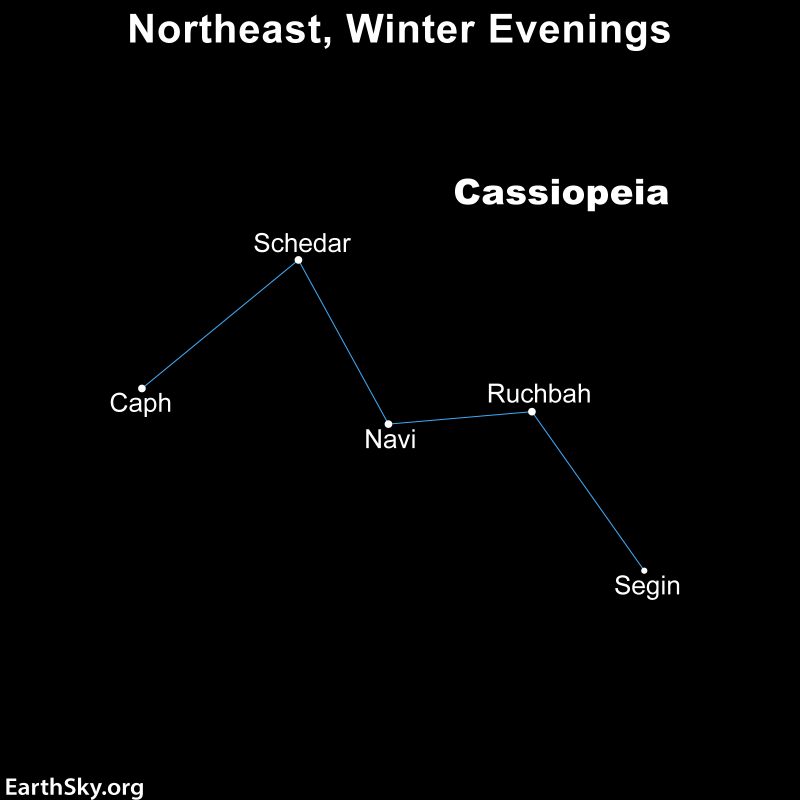
Star chart of the M-shaped constellation Cassiopeia with 5 stars labeled.
The constellation Cassiopeia the Queen, with Schedar, its brightest star. It’s at the bottom right when you see Cassiopeia as a W. And it’s at the upper left when you see her as an M.

Cassiopeia the Queen, a constellation of bright stars in the northern hemisphere, is a well-loved fixture of fall and winter evening skies.

Also known as Alpha (α) Cassiopeiae, Schedar is its brightest star. And with the help of a star map, this orange-colored star is easy to find and is often used by stargazers to locate the Andromeda galaxy.

Available now! 2026 EarthSky lunar calendar. A unique and beautiful poster-sized calendar showing phases of the moon every night of the year! And it makes a great gift.

How to find Schedar

By the way, from mid-northern latitudes, Cassiopeia is circumpolar. As a result, it circles endlessly around the north celestial pole, never (or rarely, depending on your latitude) dipping below your horizon. However, the best time to see Cassiopeia is during fall and winter evenings, since that’s when the constellation rides highest in the sky.

Basically, the bright stars of Cassiopeia trace out an M or W, depending on its position in the sky and your perspective. And Schedar, the brightest star in Cassiopeia, is located at the W’s bottom-right tip (or the M’s upper-left tip).

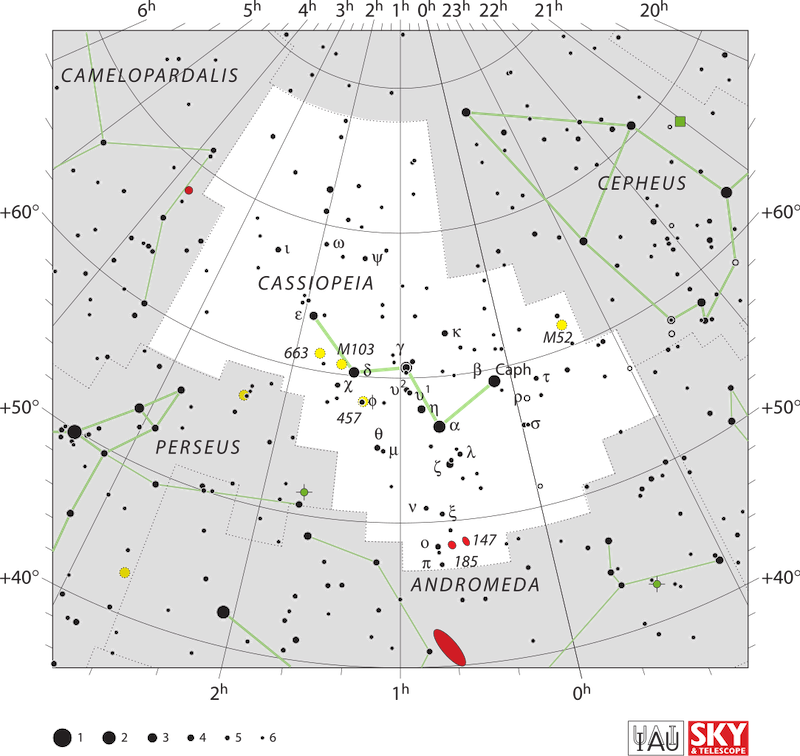
Star chart with stars in black on white and small red oblong for Andromeda.
A map of the constellation Cassiopeia the Queen. And here, Cassiopeia looks like a W, with Schedar (Alpha Cassiopeiae) pointing toward the Andromeda galaxy, shown as a red oval at the bottom of the map. Image via IAU/ Sky & Telescope/ Wikimedia Commons (CC BY 3.0).

Science of Schedar

The star Schedar is 228 light-years away and shines steadily at magnitude 2.2. Even though skywatchers a couple of centuries ago suggested that the star varied in brightness, modern astronomers have discerned no fluctuations.

Additionally, Schedar is about four times the mass of our sun. But, Schedar is cooler than our sun. That’s because it is a red giant star. Plus, like all giant stars, it rotates slowly on its axis. Thus, Schedar takes approximately 102 days to rotate once, in contrast to about 25 days for our sun. Now that it is in the late stages of stellar evolution, Schedar is about 45 times the sun’s diameter due to the expansion of its outer layers.

The sky lore of Alpha Cassiopeiae

Even though it is brightest star in the constellation Cassiopeia the Queen, Schedar doesn’t have any fantastic stories behind it. But, like all stars, it has its own interesting history. In fact, the star’s name, Schedar, derives from the Arabic word for breast.

Section of antique globe with drawing of Greek-garbed woman in a chair, Schedar marked on her chest.
Upside-down Cassiopeia, as depicted on Mercator celestial globe in 1551. Image via Harvard Map Collection/ Wikimedia Commons (public domain).

Schedar’s position is: R.A. 00h 40m 30s, Dec. +56° 32′ 14″

Bottom line: Schedar, the brightest star in the prominent northern constellation Cassiopeia, is easily visible most of the year from northern latitudes.

Read more about Cassiopeia and the Big Dipper in January skies

The post Schedar shines brightly at the Queen’s heart first appeared on EarthSky.


from EarthSky https://ift.tt/2NfYl8K
Star chart of the M-shaped constellation Cassiopeia with 5 stars labeled.
The constellation Cassiopeia the Queen, with Schedar, its brightest star. It’s at the bottom right when you see Cassiopeia as a W. And it’s at the upper left when you see her as an M.

Cassiopeia the Queen, a constellation of bright stars in the northern hemisphere, is a well-loved fixture of fall and winter evening skies.

Also known as Alpha (α) Cassiopeiae, Schedar is its brightest star. And with the help of a star map, this orange-colored star is easy to find and is often used by stargazers to locate the Andromeda galaxy.

Available now! 2026 EarthSky lunar calendar. A unique and beautiful poster-sized calendar showing phases of the moon every night of the year! And it makes a great gift.

How to find Schedar

By the way, from mid-northern latitudes, Cassiopeia is circumpolar. As a result, it circles endlessly around the north celestial pole, never (or rarely, depending on your latitude) dipping below your horizon. However, the best time to see Cassiopeia is during fall and winter evenings, since that’s when the constellation rides highest in the sky.

Basically, the bright stars of Cassiopeia trace out an M or W, depending on its position in the sky and your perspective. And Schedar, the brightest star in Cassiopeia, is located at the W’s bottom-right tip (or the M’s upper-left tip).

Star chart with stars in black on white and small red oblong for Andromeda.
A map of the constellation Cassiopeia the Queen. And here, Cassiopeia looks like a W, with Schedar (Alpha Cassiopeiae) pointing toward the Andromeda galaxy, shown as a red oval at the bottom of the map. Image via IAU/ Sky & Telescope/ Wikimedia Commons (CC BY 3.0).

Science of Schedar

The star Schedar is 228 light-years away and shines steadily at magnitude 2.2. Even though skywatchers a couple of centuries ago suggested that the star varied in brightness, modern astronomers have discerned no fluctuations.

Additionally, Schedar is about four times the mass of our sun. But, Schedar is cooler than our sun. That’s because it is a red giant star. Plus, like all giant stars, it rotates slowly on its axis. Thus, Schedar takes approximately 102 days to rotate once, in contrast to about 25 days for our sun. Now that it is in the late stages of stellar evolution, Schedar is about 45 times the sun’s diameter due to the expansion of its outer layers.

The sky lore of Alpha Cassiopeiae

Even though it is brightest star in the constellation Cassiopeia the Queen, Schedar doesn’t have any fantastic stories behind it. But, like all stars, it has its own interesting history. In fact, the star’s name, Schedar, derives from the Arabic word for breast.

Section of antique globe with drawing of Greek-garbed woman in a chair, Schedar marked on her chest.
Upside-down Cassiopeia, as depicted on Mercator celestial globe in 1551. Image via Harvard Map Collection/ Wikimedia Commons (public domain).

Schedar’s position is: R.A. 00h 40m 30s, Dec. +56° 32′ 14″

Bottom line: Schedar, the brightest star in the prominent northern constellation Cassiopeia, is easily visible most of the year from northern latitudes.

Read more about Cassiopeia and the Big Dipper in January skies

The post Schedar shines brightly at the Queen’s heart first appeared on EarthSky.


from EarthSky https://ift.tt/2NfYl8K

Thinking of buying a telescope? Read these tips 1st

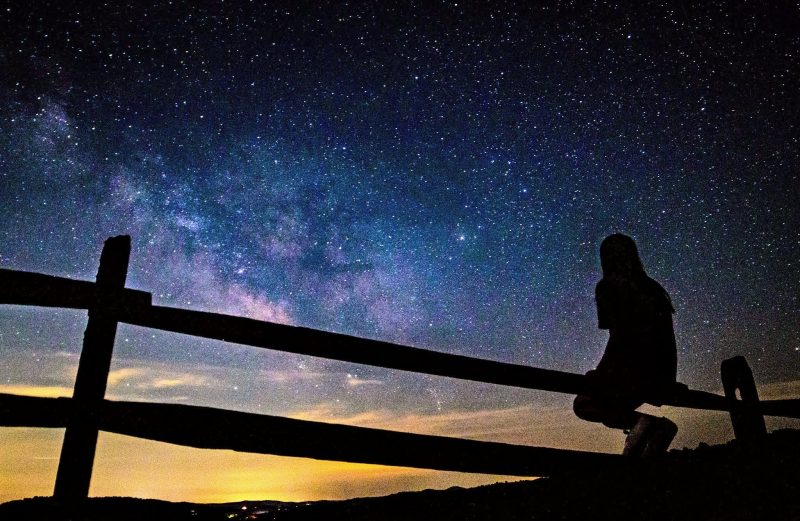
Buying a telescope: Kid sitting on a rail fence and looking at the cloudy, glowing Milky Way in a very starry sky.
View at EarthSky Community Photos. | Thomas Frazier in Virginia took this wonderful image of his daughter on June 30, 2022, while contemplating the amazing Milky Way. Thank you, Thomas! Are you thinking of buying a telescope? How do you know if you’re ready? If you’re familiar with the night sky and have needs beyond binoculars, then a telescope might be right for you.

EarthSky’s 2026 lunar calendar is available now. Get yours today! Makes a great gift.

What to know before buying a telescope

Before you buy, ask yourself this question. Can you identify a few bright planets and some bright stars and constellations? Buying a telescope is one thing; learning where and how to aim it is another. It’s fun to spend a year coming to know the stars and planets as they shift across Earth’s seasons. But do you need a telescope for that? Or would binoculars be better?

It’s the wise beginner who spends a year with some simple star charts or a planisphere – and maybe a pair of binoculars – before investing in a telescope.

Try binoculars first for stargazing

First, the pro for binoculars is their ease of use. Most of us have already held and pointed binoculars at distant objects. What’s the best choice for the beginning stargazer? Try a pair of 7×35, 8×40 or 7×50 binoculars.

The first number tells you the binoculars’ strength (magnification power) and the second number is the diameter of the objective lens in millimeters. In fact, binoculars can be used for stargazing up to a magnification of 10 without the support of a tripod. They won’t show you meaningful detail on the planets, but they’ll bring out some detail on the moon, let you glimpse some of Jupiter’s moons and enhance the colors and brightnesses of sky objects. Binoculars are particularly useful for deep-sky observing of star clusters, nebulae and galaxies.

The con for binoculars is that, because they work so well for beginning deep-sky observing, stargazers enjoy them most when they have regular access to darker skies. What’s more, binoculars use complicated optics based on internal prisms that work to provide an erect image. With time – maybe a few years – the prisms may lose their factory-set alignment. Plus, in humid climates both the prisms and the lenses may start developing mold.

Luckily, binoculars are a smaller financial investment than telescopes. A reasonable budget for beginners can range from about $100 to $200. Of course, you can spend more.

Read more: Top tips for binocular stargazing

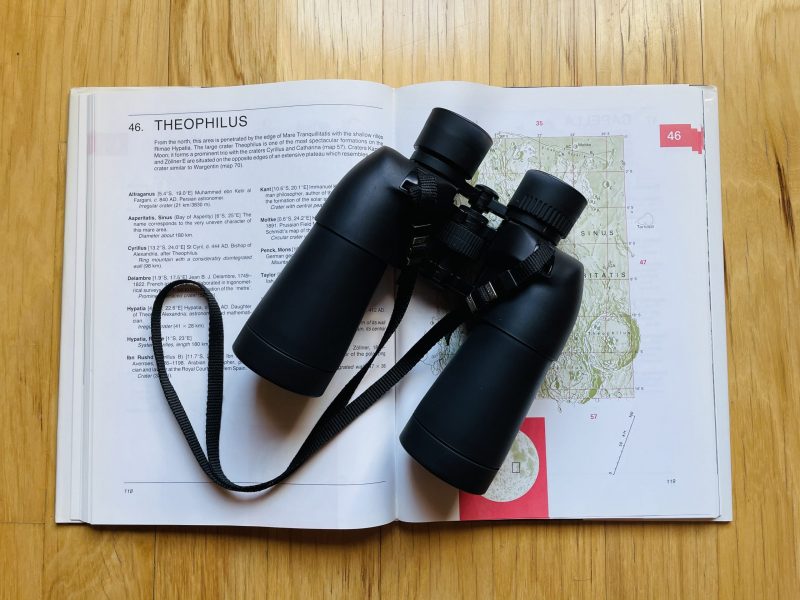
Binoculars lying on a book open to a map of part of the moon.
Binoculars are perfect for the beginning stargazer because they’re reasonably priced, easy to use, and easy to transport. Image via Kelly Kizer Whitt.

Buying a beginner’s telescope

Once you know some bright stars and constellations, you’re ready to consider buying a telescope. Telescopes are either refractors (using lenses) or reflectors (using mirrors). Both are excellent.

If you want a refractor, consider a 3- to 4-inch (75- to 100-millimeter) long-tube achromatic refractor. Don’t confuse an achromatic refractor with an apochromatic. Those two seemingly inconspicuous letters can make a huge difference in cost.

If you want a reflector, consider a 6- to 8-inch (150- to 200-millimeter) with a Dobsonian mounting. This type of mounting was popularized by John Dobson in the 1960s. It’s easy to use and more portable than classical equatorial mounts. It is also cost-effective, giving you the best possible optical quality for the least money. Note, however, that Dobsonian mounts don’t use clock drives. To compensate for Earth’s spin, you have to “nudge” the telescope every few minutes along both axes to keep an object in view.

If your primary goal is astrophotography, you’ll need an equatorial mount and a clock drive. On the other hand, if you want a solid first telescope for learning the sky, a Dobsonian mount is for you. The budget for a beginner’s Dobsonian might range from $300 to $600. As always, you can spend more.

6 tips for 1st-telescope buyers

1. A beginner should be concerned more with aperture (tube diameter) than with magnifying power. The primary purpose of an astronomical telescope is to collect light; its magnifying power is a by-product. For example, a 6-inch (150-mm) telescope has twice the diameter of a 3-inch (75-mm) unit, meaning that its optical surface will be four times larger. In turn, this tells us that the 6-inch instrument will gather four times as much light as the 3-inch, making it four times more powerful. Given equal optical quality, a larger aperture is preferable, if the budget allows.

2. Consider who will use the telescope, and how. Telescopes are big and bulky, requiring setup each time. Purchase a telescope that is manageable for the person who will be using it. Children and older stargazers might get more use out of smaller, lighter instruments.

3. Spend a year just observing, and not taking pictures. Learning to see fine detail on planets and the moon, and in the vast array of objects in the deep sky, is an art. With practice, your eyes will learn to see. Budding astronomers will benefit from putting lots of time at the eyepiece. So, a first telescope should be optimized for visual astronomy and not photography. You might try sketching what you see through a telescope. It’ll improve your observing skills and help you look for fine detail in an object.

4. Consider what else you need for an observing session. Many stargazers bring along lawn chairs, perhaps a small table to spread out your charts, a thermos of coffee, and snacks. And, of course, you will need a red flashlight in order to read your charts without ruining your night vision.

5. Keep your expectations reasonable. A planet will not appear through your eyepiece as it looks on your wall poster! Also, forget about colorful nebulae. Light collected by a telescope is seen differently by cameras versus the human eye. All of that said, if you patiently train your eye to see – and allow yourself some visits to dark-sky locations – you might find yourself falling in love with the silence, the night air, and the wonder of peering upward, through a telescope, at the universe’s marvels.

6. Connect with other amateur astronomers. Get in touch with your local astronomy club. Take a peek through the eyepiece of every telescope you encounter. Speak to the owners and ask them about the pros and cons. They’ll love to tell you about it. In this way, you can become familiar ahead of time with the basic setup and operation of an astronomical instrument. To find a group near you worldwide, visit this list at Skyandtelescope.com. For the U.S., visit this list from NASA.

And then there’s smart telescopes

A recent addition to the telescope market is smart telescopes. They are portable, they are run through an app on your phone and many require little or no setup. Plus, prior knowledge of the sky isn’t necessary. You turn them on and tell them to find a star or object and they go find it. You can run them remotely and you can watch them update images on your phone. Their software often allows you to record, stack and process your images right in the app.

Like any telescope or binocular, prices and quality vary. They are a great way to start observing and you can even jump in right away to taking your own astrophotos.

See the best deep-sky photos of November 2025 here

Good luck and have fun!

Bottom line: Binoculars are excellent for learning the sky, providing good views of the solar system and deep sky objects for beginners. When you finally decide to buy your 1st-ever telescope, keep it simple! A telescope that is easy to set up and use is key to a solid beginning in amateur astronomy.

Read more: Top tips for binocular stargazing

Read more: Planisphere: Your friend to find stars and constellations

The post Thinking of buying a telescope? Read these tips 1st first appeared on EarthSky.


from EarthSky https://ift.tt/lxPpQ9X
Buying a telescope: Kid sitting on a rail fence and looking at the cloudy, glowing Milky Way in a very starry sky.
View at EarthSky Community Photos. | Thomas Frazier in Virginia took this wonderful image of his daughter on June 30, 2022, while contemplating the amazing Milky Way. Thank you, Thomas! Are you thinking of buying a telescope? How do you know if you’re ready? If you’re familiar with the night sky and have needs beyond binoculars, then a telescope might be right for you.

EarthSky’s 2026 lunar calendar is available now. Get yours today! Makes a great gift.

What to know before buying a telescope

Before you buy, ask yourself this question. Can you identify a few bright planets and some bright stars and constellations? Buying a telescope is one thing; learning where and how to aim it is another. It’s fun to spend a year coming to know the stars and planets as they shift across Earth’s seasons. But do you need a telescope for that? Or would binoculars be better?

It’s the wise beginner who spends a year with some simple star charts or a planisphere – and maybe a pair of binoculars – before investing in a telescope.

Try binoculars first for stargazing

First, the pro for binoculars is their ease of use. Most of us have already held and pointed binoculars at distant objects. What’s the best choice for the beginning stargazer? Try a pair of 7×35, 8×40 or 7×50 binoculars.

The first number tells you the binoculars’ strength (magnification power) and the second number is the diameter of the objective lens in millimeters. In fact, binoculars can be used for stargazing up to a magnification of 10 without the support of a tripod. They won’t show you meaningful detail on the planets, but they’ll bring out some detail on the moon, let you glimpse some of Jupiter’s moons and enhance the colors and brightnesses of sky objects. Binoculars are particularly useful for deep-sky observing of star clusters, nebulae and galaxies.

The con for binoculars is that, because they work so well for beginning deep-sky observing, stargazers enjoy them most when they have regular access to darker skies. What’s more, binoculars use complicated optics based on internal prisms that work to provide an erect image. With time – maybe a few years – the prisms may lose their factory-set alignment. Plus, in humid climates both the prisms and the lenses may start developing mold.

Luckily, binoculars are a smaller financial investment than telescopes. A reasonable budget for beginners can range from about $100 to $200. Of course, you can spend more.

Read more: Top tips for binocular stargazing

Binoculars lying on a book open to a map of part of the moon.
Binoculars are perfect for the beginning stargazer because they’re reasonably priced, easy to use, and easy to transport. Image via Kelly Kizer Whitt.

Buying a beginner’s telescope

Once you know some bright stars and constellations, you’re ready to consider buying a telescope. Telescopes are either refractors (using lenses) or reflectors (using mirrors). Both are excellent.

If you want a refractor, consider a 3- to 4-inch (75- to 100-millimeter) long-tube achromatic refractor. Don’t confuse an achromatic refractor with an apochromatic. Those two seemingly inconspicuous letters can make a huge difference in cost.

If you want a reflector, consider a 6- to 8-inch (150- to 200-millimeter) with a Dobsonian mounting. This type of mounting was popularized by John Dobson in the 1960s. It’s easy to use and more portable than classical equatorial mounts. It is also cost-effective, giving you the best possible optical quality for the least money. Note, however, that Dobsonian mounts don’t use clock drives. To compensate for Earth’s spin, you have to “nudge” the telescope every few minutes along both axes to keep an object in view.

If your primary goal is astrophotography, you’ll need an equatorial mount and a clock drive. On the other hand, if you want a solid first telescope for learning the sky, a Dobsonian mount is for you. The budget for a beginner’s Dobsonian might range from $300 to $600. As always, you can spend more.

6 tips for 1st-telescope buyers

1. A beginner should be concerned more with aperture (tube diameter) than with magnifying power. The primary purpose of an astronomical telescope is to collect light; its magnifying power is a by-product. For example, a 6-inch (150-mm) telescope has twice the diameter of a 3-inch (75-mm) unit, meaning that its optical surface will be four times larger. In turn, this tells us that the 6-inch instrument will gather four times as much light as the 3-inch, making it four times more powerful. Given equal optical quality, a larger aperture is preferable, if the budget allows.

2. Consider who will use the telescope, and how. Telescopes are big and bulky, requiring setup each time. Purchase a telescope that is manageable for the person who will be using it. Children and older stargazers might get more use out of smaller, lighter instruments.

3. Spend a year just observing, and not taking pictures. Learning to see fine detail on planets and the moon, and in the vast array of objects in the deep sky, is an art. With practice, your eyes will learn to see. Budding astronomers will benefit from putting lots of time at the eyepiece. So, a first telescope should be optimized for visual astronomy and not photography. You might try sketching what you see through a telescope. It’ll improve your observing skills and help you look for fine detail in an object.

4. Consider what else you need for an observing session. Many stargazers bring along lawn chairs, perhaps a small table to spread out your charts, a thermos of coffee, and snacks. And, of course, you will need a red flashlight in order to read your charts without ruining your night vision.

5. Keep your expectations reasonable. A planet will not appear through your eyepiece as it looks on your wall poster! Also, forget about colorful nebulae. Light collected by a telescope is seen differently by cameras versus the human eye. All of that said, if you patiently train your eye to see – and allow yourself some visits to dark-sky locations – you might find yourself falling in love with the silence, the night air, and the wonder of peering upward, through a telescope, at the universe’s marvels.

6. Connect with other amateur astronomers. Get in touch with your local astronomy club. Take a peek through the eyepiece of every telescope you encounter. Speak to the owners and ask them about the pros and cons. They’ll love to tell you about it. In this way, you can become familiar ahead of time with the basic setup and operation of an astronomical instrument. To find a group near you worldwide, visit this list at Skyandtelescope.com. For the U.S., visit this list from NASA.

And then there’s smart telescopes

A recent addition to the telescope market is smart telescopes. They are portable, they are run through an app on your phone and many require little or no setup. Plus, prior knowledge of the sky isn’t necessary. You turn them on and tell them to find a star or object and they go find it. You can run them remotely and you can watch them update images on your phone. Their software often allows you to record, stack and process your images right in the app.

Like any telescope or binocular, prices and quality vary. They are a great way to start observing and you can even jump in right away to taking your own astrophotos.

See the best deep-sky photos of November 2025 here

Good luck and have fun!

Bottom line: Binoculars are excellent for learning the sky, providing good views of the solar system and deep sky objects for beginners. When you finally decide to buy your 1st-ever telescope, keep it simple! A telescope that is easy to set up and use is key to a solid beginning in amateur astronomy.

Read more: Top tips for binocular stargazing

Read more: Planisphere: Your friend to find stars and constellations

The post Thinking of buying a telescope? Read these tips 1st first appeared on EarthSky.


from EarthSky https://ift.tt/lxPpQ9X

Humpback whales thrive by not being picky eaters

Humpback whales, once teetering on the edge of extinction, are now thriving. These giants of the sea once numbered just 10,000. But now the Endangered Species Coalition estimates their population at around 80,000. On November 24, 2025, scientists from the University of Southern Denmark said they’ve examined how humpback whales in far eastern Russia have re-established themselves after decades of near disappearance. The banning of commercial whaling in 1986 was one key. And another, said the scientists, was the humpback whale’s willingness to eat whatever is available.

Olga Filatova of the the University of Southern Denmark led the research, which took place between 2017 and 2021. The research team visited an area in the Senyavin Strait near the Chukotka Peninsula – north of the Bering Sea – during summer and autumn to observe feeding behavior. Their central question was clear: How did humpback whales recover so successfully while so many other marine species still struggle?

The scientists published their study in the peer-reviewed journal Marine Mammal Science on September 13, 2025.

Humpback whales: From almost gone to almost everywhere

When Filatova embarked on her first field trip in 2000, she spent five years searching before spotting a single humpback. It’s a reminder of how dire the situation once was. Their rebound has been astonishing. Filatova said:

It was incredibly rare to spot one back then. Today, we see them almost every day when we’re in the field.

A large animal with a white belly and a black back is breaching.
Humpback whales were once in a dire situation due to extensive hunting. However, since whaling was banned and thanks to their adaptability, their populations are now on the rise. Image via Pexels/ Pixabay.

Flexible eaters win

Humpback whales don’t rely on a single prey species. If cod disappears, they switch to krill. And if krill dwindles, they’ll shift again. As Filatova explained:

We’ve seen humpback whales hunt cod in an area, and when the cod disappeared, they switched to krill.

Between 2017 and 2021, her team observed roughly 100 humpbacks shifting from hunting polar cod one year to feeding on dense krill swarms the next. This ability to change feeding strategies without leaving an area sets them apart from fin whales, which often travel long distances to chase preferred prey.

Humpbacks are energy-saving specialists. They’re not built for speed, so they rely on creativity instead. Scientists have begun cataloging their wide range of inventive hunting strategies – from bubble-net feeding to cooperative corralling – including the technique known as trap feeding.

In trap feeding, a whale floats at the surface with its mouth open in the vicinity of feeding gulls. The fish flee the gulls and swim toward what appears to be a safe shelter … until the jaws close.

Read more: Humpback whales manufacture and wield tools

A large animal with an open mouth. There are gulls around, touching the water.
Humpback whales are masters of adaptability. Plus, they use clever strategies to feed. From bubble-net feeding to cooperative hunting and the remarkable trap-feeding technique, their innovative behaviors reveal some of the most sophisticated examples of learned and culturally shared practices in the animal kingdom. Image via Bob Wright/ Pixabay.

Expanding into new seas

As Arctic conditions shift, humpback whales are appearing in regions where they were previously unknown. Melting sea ice has opened new foraging opportunities. It’s a development that threatens many Arctic species but seems to benefit humpbacks. Filatova said:

We are getting more and more reports of humpbacks in Arctic waters where they have never been seen before.

Their annual migrations already span tropical breeding grounds and polar feeding areas, and emerging research suggests they may soon establish entirely new seasonal routes as northern waters continue to warm.

Read more: Humpback whale breaks record for longest migration

A whale’s head hovers near the surface, sunlight reflecting off its skin.
Rising Arctic temperatures are bringing humpback whales to new waters, creating fresh feeding opportunities. As sea ice melts, these adaptable giants may establish entirely new migration routes, expanding their presence in regions where they were once rare. Image via Pixabay.

A hopeful future for humpback whales

Filatova remains optimistic for humpback whales. Their intelligence, adaptability and creative feeding strategies helped them survive centuries of exploitation and now empower them to thrive in a changing ocean.

Meanwhile, it’s other whale species that have her concerned. Filatova said:

I’m more worried about whales that can only live in Arctic waters – that’s the bowhead whale, the beluga whale, and the narwhal.

Humans banned commercial whaling, creating the conditions that allow species like the humpback whale to rebound. It remains to be seen if they can do the same for other whale and Arctic species.

A humpback whale is rising out of the water, its immense body breaking the surface as droplets cascade around it.
Humpback whales show that resilience, creativity and cooperation can drive recovery. Their comeback highlights how wildlife adapts and how human protection can make thriving oceans possible. Image via Art Tower/ Pixabay.

Bottom line: Humpback whales are making a remarkable comeback, thriving in new habitats thanks to conservation efforts and their adaptable feeding habits.

Source: Marine Mammal Science: Changing the Menu: Humpback Whale (Megaptera novaeangliae) Diet Switching in Senyavin Strait, Chukotka

Via University of Southern Denmark

Read more: Humpback whales use Moreton Bay as a key calf refuge

Read more: Humpback whales communicate with us using “smoke” rings

The post Humpback whales thrive by not being picky eaters first appeared on EarthSky.


from EarthSky https://ift.tt/Jo9dAeI

Humpback whales, once teetering on the edge of extinction, are now thriving. These giants of the sea once numbered just 10,000. But now the Endangered Species Coalition estimates their population at around 80,000. On November 24, 2025, scientists from the University of Southern Denmark said they’ve examined how humpback whales in far eastern Russia have re-established themselves after decades of near disappearance. The banning of commercial whaling in 1986 was one key. And another, said the scientists, was the humpback whale’s willingness to eat whatever is available.

Olga Filatova of the the University of Southern Denmark led the research, which took place between 2017 and 2021. The research team visited an area in the Senyavin Strait near the Chukotka Peninsula – north of the Bering Sea – during summer and autumn to observe feeding behavior. Their central question was clear: How did humpback whales recover so successfully while so many other marine species still struggle?

The scientists published their study in the peer-reviewed journal Marine Mammal Science on September 13, 2025.

Humpback whales: From almost gone to almost everywhere

When Filatova embarked on her first field trip in 2000, she spent five years searching before spotting a single humpback. It’s a reminder of how dire the situation once was. Their rebound has been astonishing. Filatova said:

It was incredibly rare to spot one back then. Today, we see them almost every day when we’re in the field.

A large animal with a white belly and a black back is breaching.
Humpback whales were once in a dire situation due to extensive hunting. However, since whaling was banned and thanks to their adaptability, their populations are now on the rise. Image via Pexels/ Pixabay.

Flexible eaters win

Humpback whales don’t rely on a single prey species. If cod disappears, they switch to krill. And if krill dwindles, they’ll shift again. As Filatova explained:

We’ve seen humpback whales hunt cod in an area, and when the cod disappeared, they switched to krill.

Between 2017 and 2021, her team observed roughly 100 humpbacks shifting from hunting polar cod one year to feeding on dense krill swarms the next. This ability to change feeding strategies without leaving an area sets them apart from fin whales, which often travel long distances to chase preferred prey.

Humpbacks are energy-saving specialists. They’re not built for speed, so they rely on creativity instead. Scientists have begun cataloging their wide range of inventive hunting strategies – from bubble-net feeding to cooperative corralling – including the technique known as trap feeding.

In trap feeding, a whale floats at the surface with its mouth open in the vicinity of feeding gulls. The fish flee the gulls and swim toward what appears to be a safe shelter … until the jaws close.

Read more: Humpback whales manufacture and wield tools

A large animal with an open mouth. There are gulls around, touching the water.
Humpback whales are masters of adaptability. Plus, they use clever strategies to feed. From bubble-net feeding to cooperative hunting and the remarkable trap-feeding technique, their innovative behaviors reveal some of the most sophisticated examples of learned and culturally shared practices in the animal kingdom. Image via Bob Wright/ Pixabay.

Expanding into new seas

As Arctic conditions shift, humpback whales are appearing in regions where they were previously unknown. Melting sea ice has opened new foraging opportunities. It’s a development that threatens many Arctic species but seems to benefit humpbacks. Filatova said:

We are getting more and more reports of humpbacks in Arctic waters where they have never been seen before.

Their annual migrations already span tropical breeding grounds and polar feeding areas, and emerging research suggests they may soon establish entirely new seasonal routes as northern waters continue to warm.

Read more: Humpback whale breaks record for longest migration

A whale’s head hovers near the surface, sunlight reflecting off its skin.
Rising Arctic temperatures are bringing humpback whales to new waters, creating fresh feeding opportunities. As sea ice melts, these adaptable giants may establish entirely new migration routes, expanding their presence in regions where they were once rare. Image via Pixabay.

A hopeful future for humpback whales

Filatova remains optimistic for humpback whales. Their intelligence, adaptability and creative feeding strategies helped them survive centuries of exploitation and now empower them to thrive in a changing ocean.

Meanwhile, it’s other whale species that have her concerned. Filatova said:

I’m more worried about whales that can only live in Arctic waters – that’s the bowhead whale, the beluga whale, and the narwhal.

Humans banned commercial whaling, creating the conditions that allow species like the humpback whale to rebound. It remains to be seen if they can do the same for other whale and Arctic species.

A humpback whale is rising out of the water, its immense body breaking the surface as droplets cascade around it.
Humpback whales show that resilience, creativity and cooperation can drive recovery. Their comeback highlights how wildlife adapts and how human protection can make thriving oceans possible. Image via Art Tower/ Pixabay.

Bottom line: Humpback whales are making a remarkable comeback, thriving in new habitats thanks to conservation efforts and their adaptable feeding habits.

Source: Marine Mammal Science: Changing the Menu: Humpback Whale (Megaptera novaeangliae) Diet Switching in Senyavin Strait, Chukotka

Via University of Southern Denmark

Read more: Humpback whales use Moreton Bay as a key calf refuge

Read more: Humpback whales communicate with us using “smoke” rings

The post Humpback whales thrive by not being picky eaters first appeared on EarthSky.


from EarthSky https://ift.tt/Jo9dAeI

Sumatran tiger sightings triple on Indonesian island

Sumatran Tiger: One tiger standing above a tiger laying down with their faces close.
In this snapshot from a camera trap on the Indonesian island of Sumatra, a resident female Sumatran tiger is grooming one of her 2 large male cubs in October 2023. Image via Figel et al./ BKSDA-Aceh/ DLHK/ Frontiers.

The 2026 EarthSky lunar calendar makes a great gift. Get yours today!

  • Researchers on the Indonesian island of Sumatra installed infrared camera traps in a multi-year effort to study endangered Sumatran tigers.
  • They say they found 3 times more endangered Sumatran tigers than previous surveys. In total, the team was able to identify 27 individual tigers from the images.
  • This success story for Sumatran tigers is likely due to many factors, including increased protection measures and adequate prey for the tigers.

Frontiers published this original story on December 4, 2025. Edits by EarthSky.

Camera traps find 3 times more endangered Sumatran tigers

Tigers don’t roam across Asia as they used to. But on one island in Indonesia, a population of critically endangered Sumatran tigers might have found a habitat that supplies them with enough space, intact forests and prey to thrive and raise their young.

To examine tiger population densities, researchers working alongside local rangers installed infrared cameras in forests outside the national park system. Their work, in collaboration with the government of Aceh province, resulted in almost three times the number of individual tigers identified, in contrast to previous surveys. Dedicated protection efforts are the main reason for tigers’ persistence in this ecosystem, the team said.

Destroyed habitats, poaching and prey depletion have dramatically reduced tiger habitats around the world. Today, tigers occupy just 5 to 10% of their historical habitats. But on the Indonesian island of Sumatra, an important population of critically endangered Sumatran tigers may persevere, a December 3, 2025, Frontiers in Conservation Science study showed.

Using infrared cameras, researchers working on the island have set out to estimate sex-specific population densities and tigers’ movements during three surveys. Lead author Joe Figel is a conservation biologist who works with Indonesian wildlife and forestry agencies. Figel said:

We documented a robust tiger population, apparently among the healthiest on the island. For those on the ground, the onus now falls on us to double down and adequately protect them.

A view from an airplane looking down at thickly forested hills and a river running through the valley.
An aerial view of the lowland river valley in the Leuser ecosystem on the island of Sumatra in Indonesia. Image via Joe Figel/ Frontiers.

Long-time tenants

In many ways, the Leuser ecosystem is ideal habitat for Sumatran tigers. Three times the size of Yellowstone National Park, it is the largest contiguous tiger habitat remaining in Sumatra. It’s made up of lowland, hill and montane forests, of which 44% are classified as intact forest landscape. Figel said:

It’s also more thoroughly patrolled by rangers than nearly any other place on the island.

Working with local collaborators from communities at the edges of the study area, the team put up cameras in the northern stretches of Leuser, located in Aceh province, and kept them there for three monitoring periods: 34 cameras were installed during March to May 2023, 59 cameras between June and December 2023, and 74 cameras between May and November of 2024. Figel explained:

Multi-year camera trap monitoring is critically important for estimating key tiger demographic parameters such as survival, recruitment, tenure and population growth rate. With these data – and only with these data – can we even begin to evaluate conservation efforts.

Monitoring the Sumatran tiger

During the monitoring periods, the team captured a total of 282 sufficiently clear images of Sumatran tigers to allow for the identification of individuals. Analyzing stripe patterns, the team identified 27 individuals from camera-trap images, including 14 females, 12 males and one tiger of unknown sex. The relatively high number of tigers suggests there is adequate prey in the area to support tiger presence.

Over the study period, cameras photographed female and male individuals an average of 14 and 16 times, respectively. High densities of female tigers indicate a healthy tiger social system and high-quality habitats, where they can raise about three litters of cubs over a decade.

During the six-month session in 2023, the images documented three different sets of cubs. They also recorded two tiger brothers together as cubs and later individually as adults.


Watch as a tiger mother grooms her cub. Video via Figel et al./ BKSDA-Aceh/ DLHK/ Frontiers.

The Sumatran tiger is thriving

Inside the Leuser ecosystem lies Gunung Leuser Nation Park. However, researchers conducted the present study in forests provincially protected by the Aceh government. In Indonesia, provincially protected forests receive far fewer resources than national parks, which are supported and managed by the central government.

The camera traps placed by Figel and colleagues snapped nearly three times as many tiger images as during previous 90-day surveys at other sites in Sumatra. Plus, the team was able to identify many more individuals than reported in earlier studies. Only three previous surveys – all carried out in protected national parks – documented more than 10 tigers in a single survey. Higher tiger density estimates than reported in the present study were only documented in an intensive protection zone in southern Sumatra.

The current study also provides valuable insights for future monitoring of tigers, the team said. The data on tiger movement collected here could, for example, inform survey protocols and optimal camera spacing.

The high numbers of tiger sightings reported here highlights a success story that is due to a multitude of factors, said the team. Figel said:

Thanks to the work, activities and support of government agencies, local Acehnese and Gayo communities, donors and other researchers, Leuser has maintained important patches of lowland and hill forests where, in Sumatra, tiger prey densities reach their highest levels. The persistence of these habitats and prey populations are the main reasons for our findings.

More camera trap pics

A tiger standing in the forest.
Tiger snapshot from camera trap. Image via Figel et al./ BKSDA-Aceh/ DLHK/ Frontiers.
Black-and-white night image of a large tiger and smaller tiger in the forest.
This camera trap caught a female tiger with a cub. Image via Figel et al./ BKSDA-Aceh/ DLHK/ Frontiers.

Bottom line: Camera traps on the Indonesia island of Sumatra caught three times as many endangered Sumatran tigers as before. The Sumatran tiger is thriving in this region.

Source: Sumatran tiger density estimates in the Leuser Ecosystem, Sumatra, Indonesia

Via Frontiers

Read more: Tigers are the biggest cats: Lifeform of the week

The post Sumatran tiger sightings triple on Indonesian island first appeared on EarthSky.


from EarthSky https://ift.tt/BcRwOeS
Sumatran Tiger: One tiger standing above a tiger laying down with their faces close.
In this snapshot from a camera trap on the Indonesian island of Sumatra, a resident female Sumatran tiger is grooming one of her 2 large male cubs in October 2023. Image via Figel et al./ BKSDA-Aceh/ DLHK/ Frontiers.

The 2026 EarthSky lunar calendar makes a great gift. Get yours today!

  • Researchers on the Indonesian island of Sumatra installed infrared camera traps in a multi-year effort to study endangered Sumatran tigers.
  • They say they found 3 times more endangered Sumatran tigers than previous surveys. In total, the team was able to identify 27 individual tigers from the images.
  • This success story for Sumatran tigers is likely due to many factors, including increased protection measures and adequate prey for the tigers.

Frontiers published this original story on December 4, 2025. Edits by EarthSky.

Camera traps find 3 times more endangered Sumatran tigers

Tigers don’t roam across Asia as they used to. But on one island in Indonesia, a population of critically endangered Sumatran tigers might have found a habitat that supplies them with enough space, intact forests and prey to thrive and raise their young.

To examine tiger population densities, researchers working alongside local rangers installed infrared cameras in forests outside the national park system. Their work, in collaboration with the government of Aceh province, resulted in almost three times the number of individual tigers identified, in contrast to previous surveys. Dedicated protection efforts are the main reason for tigers’ persistence in this ecosystem, the team said.

Destroyed habitats, poaching and prey depletion have dramatically reduced tiger habitats around the world. Today, tigers occupy just 5 to 10% of their historical habitats. But on the Indonesian island of Sumatra, an important population of critically endangered Sumatran tigers may persevere, a December 3, 2025, Frontiers in Conservation Science study showed.

Using infrared cameras, researchers working on the island have set out to estimate sex-specific population densities and tigers’ movements during three surveys. Lead author Joe Figel is a conservation biologist who works with Indonesian wildlife and forestry agencies. Figel said:

We documented a robust tiger population, apparently among the healthiest on the island. For those on the ground, the onus now falls on us to double down and adequately protect them.

A view from an airplane looking down at thickly forested hills and a river running through the valley.
An aerial view of the lowland river valley in the Leuser ecosystem on the island of Sumatra in Indonesia. Image via Joe Figel/ Frontiers.

Long-time tenants

In many ways, the Leuser ecosystem is ideal habitat for Sumatran tigers. Three times the size of Yellowstone National Park, it is the largest contiguous tiger habitat remaining in Sumatra. It’s made up of lowland, hill and montane forests, of which 44% are classified as intact forest landscape. Figel said:

It’s also more thoroughly patrolled by rangers than nearly any other place on the island.

Working with local collaborators from communities at the edges of the study area, the team put up cameras in the northern stretches of Leuser, located in Aceh province, and kept them there for three monitoring periods: 34 cameras were installed during March to May 2023, 59 cameras between June and December 2023, and 74 cameras between May and November of 2024. Figel explained:

Multi-year camera trap monitoring is critically important for estimating key tiger demographic parameters such as survival, recruitment, tenure and population growth rate. With these data – and only with these data – can we even begin to evaluate conservation efforts.

Monitoring the Sumatran tiger

During the monitoring periods, the team captured a total of 282 sufficiently clear images of Sumatran tigers to allow for the identification of individuals. Analyzing stripe patterns, the team identified 27 individuals from camera-trap images, including 14 females, 12 males and one tiger of unknown sex. The relatively high number of tigers suggests there is adequate prey in the area to support tiger presence.

Over the study period, cameras photographed female and male individuals an average of 14 and 16 times, respectively. High densities of female tigers indicate a healthy tiger social system and high-quality habitats, where they can raise about three litters of cubs over a decade.

During the six-month session in 2023, the images documented three different sets of cubs. They also recorded two tiger brothers together as cubs and later individually as adults.


Watch as a tiger mother grooms her cub. Video via Figel et al./ BKSDA-Aceh/ DLHK/ Frontiers.

The Sumatran tiger is thriving

Inside the Leuser ecosystem lies Gunung Leuser Nation Park. However, researchers conducted the present study in forests provincially protected by the Aceh government. In Indonesia, provincially protected forests receive far fewer resources than national parks, which are supported and managed by the central government.

The camera traps placed by Figel and colleagues snapped nearly three times as many tiger images as during previous 90-day surveys at other sites in Sumatra. Plus, the team was able to identify many more individuals than reported in earlier studies. Only three previous surveys – all carried out in protected national parks – documented more than 10 tigers in a single survey. Higher tiger density estimates than reported in the present study were only documented in an intensive protection zone in southern Sumatra.

The current study also provides valuable insights for future monitoring of tigers, the team said. The data on tiger movement collected here could, for example, inform survey protocols and optimal camera spacing.

The high numbers of tiger sightings reported here highlights a success story that is due to a multitude of factors, said the team. Figel said:

Thanks to the work, activities and support of government agencies, local Acehnese and Gayo communities, donors and other researchers, Leuser has maintained important patches of lowland and hill forests where, in Sumatra, tiger prey densities reach their highest levels. The persistence of these habitats and prey populations are the main reasons for our findings.

More camera trap pics

A tiger standing in the forest.
Tiger snapshot from camera trap. Image via Figel et al./ BKSDA-Aceh/ DLHK/ Frontiers.
Black-and-white night image of a large tiger and smaller tiger in the forest.
This camera trap caught a female tiger with a cub. Image via Figel et al./ BKSDA-Aceh/ DLHK/ Frontiers.

Bottom line: Camera traps on the Indonesia island of Sumatra caught three times as many endangered Sumatran tigers as before. The Sumatran tiger is thriving in this region.

Source: Sumatran tiger density estimates in the Leuser Ecosystem, Sumatra, Indonesia

Via Frontiers

Read more: Tigers are the biggest cats: Lifeform of the week

The post Sumatran tiger sightings triple on Indonesian island first appeared on EarthSky.


from EarthSky https://ift.tt/BcRwOeS

See the best deep-sky photos of November 2025 here

Deep-sky photos: A cocoon-shaped region of reddish gas with dark dust lanes and numerous foreground stars.
View at EarthSky Community Photos. | Steven Bellavia in Smithfield, Virginia, captured the Cocoon Nebula on November 26, 2025. Steven wrote: “The Cocoon Nebula is a reflection and emission nebula in the constellation Cygnus, at the head of the Swan and near the boundary of the constellation Lacerta. It is about 4,000 light-years away. And the central star that illuminates it formed 100,000 years ago. The nebula is approximately 12 arc minutes across, which is a span of 15 light-years.” Thank you, Steven! See more deep-sky photos from November 2025 below.

Stunning deep-sky photos from our community

The EarthSky community has many talented astrophotographers who capture stunning images of the deep sky. We gathered some of our favorite deep-sky photos we received in November 2025 for you to enjoy. Do you have some of your own images to share? You can submit them to us here. We would love to see them!

Deep-sky photos of diffuse nebulae

Multiple orange clouds with dark lanes in between, plus numerous faint stars.
View at EarthSky Community Photos. | Aquib Ali Ansari in Jaipur, Rajasthan, India, caught IC 1318, a nebulous region in the constellation Cygnus, on November 11, 2025. Aquib wrote: “This wide-field image highlights one of the richest regions of the northern Milky Way. These are the glowing hydrogen clouds and dark dust lanes surrounding the central star of the Northern Cross. In the upper right is the Crescent Nebula (NGC 6888). It’s created by fast stellar winds from a massive Wolf-Rayet star. The winds carve out a glowing bubble of ionized gas. This image reveals the faint, intricate details of this complex star-forming region.” Thank you, Aquib!
Multiple bluish patches of nebulosity with dark lanes, overlaid with a rich background of stars.
View at EarthSky Community Photos. | Tameem Altameemi in the United Arab Emirates captured the Soul Nebula on November 21, 2025. Tameem wrote: “The Soul Nebula is a vast star-forming complex located about 7,500 light-years away in Cassiopeia. The nebula glows in emissions of hydrogen, oxygen and sulfur. It reveals sweeping clouds of ionized gas shaped by intense radiation and stellar winds from massive young stars. Within the nebula are several embedded star clusters and pillar-like formations sculpted over millions of years. I noticed a striking dark feature that resembles a lost astronaut drifting within the nebula’s glowing clouds … adding a human-like touch to this cosmic landscape.” Thank you, Tameem!
A complex structure of whitish gas bisected by a dark dust lane, with numerous background stars.
View at EarthSky Community Photos. | Steven Bellavia in Smithfield, Virginia, captured Barnard 213, a dark nebula in Taurus, on November 14, 2025. Steven wrote: “To me, it looks like a rope, perhaps with some smoke, meandering through the stars. Dark nebulae consist of clouds of interstellar gas – primarily molecular hydrogen – and dust. These clouds are dense enough to block visible light from objects behind them.” Thank you, Steven!

More diffuse nebulae

A dark horse-shaped indentation over a large area of mostly red nebulosity and thousands of immersed stars.
View at EarthSky Community Photos. | Harshwardhan Pathak in Sharavasti, Uttar Pradesh, India, captured the Horsehead Nebula on November 14, 2025. Harshwardhan wrote: “The Horsehead Nebula, located in the Orion constellation, is a dark nebula approximately 1,500 light-years away. This iconic cloud of gas and dust is about 3.5 light-years across and illuminated by nearby stars, giving it a striking horsehead shape.” Thank you, Harshwardhan!
A complex swirl of blue, yellow and red nebulosity with numerous background stars.
View at EarthSky Community Photos. | Andy Dungan near Cotopaxi, Colorado, captured the Embryo Nebula in Perseus on November 23, 2025. Andy wrote: “This is such an unusual item to photograph. It has more color and shape than so many other nebulae and also has dark nebulae. It isn’t large. One thing interesting about astrophotography is you can’t easily determine the difference in the size of an object (as viewed from Earth) by looking at a pic. This is why I enjoy doing wide-field astrophotography as well as deep space, like this pic.” Thank you, Andy!

Even more deep-sky photos of nebulae

A large pink area of nebulosity with dark lanes, overlaid with a handful of faint stars.
View at EarthSky Community Photos. | Tameem Altameemi in the United Arab Emirates captured the Fish Head Nebula on November 22, 2025. Tameem wrote: “The Fish Head Nebula is an active star-forming region located about 6,000 to 6,500 light-years away in the constellation Cassiopeia. It’s part of a larger star-forming complex and one of the most dynamic regions of massive star birth in the Milky Way.” Thank you, Tameem!
An expansive area of complex orange nebulosity with overlaid dark patches and numerous immersed stars.
View at EarthSky Community Photos. | Andy Dungan near Cotopaxi, Colorado, captured the IC 348 region of dust and nebulosity around the star Omicron Persei A on November 14, 2025. Andy wrote: “What a surprise! I don’t know how I became interested in this area. I was shocked at the colors and size of this region. There are so many exciting and unusual things out there in space. To infinity and beyond!” Thank you, Andy!

An interesting reflection nebula

Two small clouds of blue gas, surrounded by a large area of fainter blue gas and numerous stars.
View at EarthSky Community Photos. | Jelieta Walinski at Desert Bloom Observatory in St. David, Arizona, captured VdB 126, a reflection nebula in the constellation Vulpecula, on November 25, 2025. Jelieta wrote: “In the soft darkness of Vulpecula, where star-winds drift like ancient hymns, VdB 126 glows as a delicate reflection nebula … a floating lantern of cosmic dust scattering the blue light of a hidden star. Roughly 1,200 light-years from Earth, this cloud of interstellar grains becomes a quiet teacher of astrophysics, showing how dust not only obscures starlight but also paints it into ethereal color.” Thank you, Jelieta!

Deep-sky photos of faraway galaxies

A large but faint face-on spiral in a field of sparse stars.
View at EarthSky Community Photos. | Gwen Forrester in DeKalb County, Tennessee, captured Messier 74, in the constellation Pisces, on November 13, 2025. Gwen wrote: “Messier 74, the Phantom Galaxy, so-called because its low surface brightness makes it difficult to see. It’s 85,000 light-years across, 32 million light-years away.” Thank you, Gwen!
A face-on yellowish spiral with numerous foreground stars.
View at EarthSky Community Photos. | Andy Dungan in Colorado captured the spiral galaxy IC 342 in the constellation Camelopardalis on November 20, 2025. Andy wrote: “This is really sort of the first of the winter galaxies. The Cigar Galaxy comes next, in a month or two, and then lots of galaxies in the vicinity of the Big Dipper. The challenge of IC 342 is how dim it is compared to many others of its size. Evidently there is a substantial amount of dust someplace in between here and the 7 to 10 million light-years to the galaxy.” Thank you, Andy!

Bottom line: Enjoy this gallery of deep-sky photos for November 2025 from our EarthSky community. If you have a great photo to share, send it in, too. We love to see them!

Share your recent Earth or sky photo at EarthSky Community Photos.

The post See the best deep-sky photos of November 2025 here first appeared on EarthSky.


from EarthSky https://ift.tt/RnhGCyI
Deep-sky photos: A cocoon-shaped region of reddish gas with dark dust lanes and numerous foreground stars.
View at EarthSky Community Photos. | Steven Bellavia in Smithfield, Virginia, captured the Cocoon Nebula on November 26, 2025. Steven wrote: “The Cocoon Nebula is a reflection and emission nebula in the constellation Cygnus, at the head of the Swan and near the boundary of the constellation Lacerta. It is about 4,000 light-years away. And the central star that illuminates it formed 100,000 years ago. The nebula is approximately 12 arc minutes across, which is a span of 15 light-years.” Thank you, Steven! See more deep-sky photos from November 2025 below.

Stunning deep-sky photos from our community

The EarthSky community has many talented astrophotographers who capture stunning images of the deep sky. We gathered some of our favorite deep-sky photos we received in November 2025 for you to enjoy. Do you have some of your own images to share? You can submit them to us here. We would love to see them!

Deep-sky photos of diffuse nebulae

Multiple orange clouds with dark lanes in between, plus numerous faint stars.
View at EarthSky Community Photos. | Aquib Ali Ansari in Jaipur, Rajasthan, India, caught IC 1318, a nebulous region in the constellation Cygnus, on November 11, 2025. Aquib wrote: “This wide-field image highlights one of the richest regions of the northern Milky Way. These are the glowing hydrogen clouds and dark dust lanes surrounding the central star of the Northern Cross. In the upper right is the Crescent Nebula (NGC 6888). It’s created by fast stellar winds from a massive Wolf-Rayet star. The winds carve out a glowing bubble of ionized gas. This image reveals the faint, intricate details of this complex star-forming region.” Thank you, Aquib!
Multiple bluish patches of nebulosity with dark lanes, overlaid with a rich background of stars.
View at EarthSky Community Photos. | Tameem Altameemi in the United Arab Emirates captured the Soul Nebula on November 21, 2025. Tameem wrote: “The Soul Nebula is a vast star-forming complex located about 7,500 light-years away in Cassiopeia. The nebula glows in emissions of hydrogen, oxygen and sulfur. It reveals sweeping clouds of ionized gas shaped by intense radiation and stellar winds from massive young stars. Within the nebula are several embedded star clusters and pillar-like formations sculpted over millions of years. I noticed a striking dark feature that resembles a lost astronaut drifting within the nebula’s glowing clouds … adding a human-like touch to this cosmic landscape.” Thank you, Tameem!
A complex structure of whitish gas bisected by a dark dust lane, with numerous background stars.
View at EarthSky Community Photos. | Steven Bellavia in Smithfield, Virginia, captured Barnard 213, a dark nebula in Taurus, on November 14, 2025. Steven wrote: “To me, it looks like a rope, perhaps with some smoke, meandering through the stars. Dark nebulae consist of clouds of interstellar gas – primarily molecular hydrogen – and dust. These clouds are dense enough to block visible light from objects behind them.” Thank you, Steven!

More diffuse nebulae

A dark horse-shaped indentation over a large area of mostly red nebulosity and thousands of immersed stars.
View at EarthSky Community Photos. | Harshwardhan Pathak in Sharavasti, Uttar Pradesh, India, captured the Horsehead Nebula on November 14, 2025. Harshwardhan wrote: “The Horsehead Nebula, located in the Orion constellation, is a dark nebula approximately 1,500 light-years away. This iconic cloud of gas and dust is about 3.5 light-years across and illuminated by nearby stars, giving it a striking horsehead shape.” Thank you, Harshwardhan!
A complex swirl of blue, yellow and red nebulosity with numerous background stars.
View at EarthSky Community Photos. | Andy Dungan near Cotopaxi, Colorado, captured the Embryo Nebula in Perseus on November 23, 2025. Andy wrote: “This is such an unusual item to photograph. It has more color and shape than so many other nebulae and also has dark nebulae. It isn’t large. One thing interesting about astrophotography is you can’t easily determine the difference in the size of an object (as viewed from Earth) by looking at a pic. This is why I enjoy doing wide-field astrophotography as well as deep space, like this pic.” Thank you, Andy!

Even more deep-sky photos of nebulae

A large pink area of nebulosity with dark lanes, overlaid with a handful of faint stars.
View at EarthSky Community Photos. | Tameem Altameemi in the United Arab Emirates captured the Fish Head Nebula on November 22, 2025. Tameem wrote: “The Fish Head Nebula is an active star-forming region located about 6,000 to 6,500 light-years away in the constellation Cassiopeia. It’s part of a larger star-forming complex and one of the most dynamic regions of massive star birth in the Milky Way.” Thank you, Tameem!
An expansive area of complex orange nebulosity with overlaid dark patches and numerous immersed stars.
View at EarthSky Community Photos. | Andy Dungan near Cotopaxi, Colorado, captured the IC 348 region of dust and nebulosity around the star Omicron Persei A on November 14, 2025. Andy wrote: “What a surprise! I don’t know how I became interested in this area. I was shocked at the colors and size of this region. There are so many exciting and unusual things out there in space. To infinity and beyond!” Thank you, Andy!

An interesting reflection nebula

Two small clouds of blue gas, surrounded by a large area of fainter blue gas and numerous stars.
View at EarthSky Community Photos. | Jelieta Walinski at Desert Bloom Observatory in St. David, Arizona, captured VdB 126, a reflection nebula in the constellation Vulpecula, on November 25, 2025. Jelieta wrote: “In the soft darkness of Vulpecula, where star-winds drift like ancient hymns, VdB 126 glows as a delicate reflection nebula … a floating lantern of cosmic dust scattering the blue light of a hidden star. Roughly 1,200 light-years from Earth, this cloud of interstellar grains becomes a quiet teacher of astrophysics, showing how dust not only obscures starlight but also paints it into ethereal color.” Thank you, Jelieta!

Deep-sky photos of faraway galaxies

A large but faint face-on spiral in a field of sparse stars.
View at EarthSky Community Photos. | Gwen Forrester in DeKalb County, Tennessee, captured Messier 74, in the constellation Pisces, on November 13, 2025. Gwen wrote: “Messier 74, the Phantom Galaxy, so-called because its low surface brightness makes it difficult to see. It’s 85,000 light-years across, 32 million light-years away.” Thank you, Gwen!
A face-on yellowish spiral with numerous foreground stars.
View at EarthSky Community Photos. | Andy Dungan in Colorado captured the spiral galaxy IC 342 in the constellation Camelopardalis on November 20, 2025. Andy wrote: “This is really sort of the first of the winter galaxies. The Cigar Galaxy comes next, in a month or two, and then lots of galaxies in the vicinity of the Big Dipper. The challenge of IC 342 is how dim it is compared to many others of its size. Evidently there is a substantial amount of dust someplace in between here and the 7 to 10 million light-years to the galaxy.” Thank you, Andy!

Bottom line: Enjoy this gallery of deep-sky photos for November 2025 from our EarthSky community. If you have a great photo to share, send it in, too. We love to see them!

Share your recent Earth or sky photo at EarthSky Community Photos.

The post See the best deep-sky photos of November 2025 here first appeared on EarthSky.


from EarthSky https://ift.tt/RnhGCyI

adds 2