
Why do the Voyager spacecraft sometimes get closer to Earth?
For a few months each year, the distances between the Voyager spacecraft and Earth actually decrease. You might know that both Voyager spacecraft were launched into space in the 1970s and visited the outer planets through the 1980s. They’ve been heading out of our solar system ever since. In 2012, Voyager 1 entered interstellar space. Then, in 2018, NASA announced that Voyager 2 had entered interstellar space, too. They are both headed outward, never to return to Earth. So, can they get closer?
The answer is that for a few months each year, Earth in its orbit moves toward the spacecraft faster than they’re moving away. Earth’s motion around the sun is faster than the motion of the Voyager spacecraft. Earth moves through space at a speed of 67,000 miles per hour (30 km/s). Voyager 1 moves at a speed of 38,000 miles per hour (17 km/s). Voyager 2 moves at a speed of 35,000 miles per hour (16 km/s).
So, for a portion of the year, Earth comes around the side of the sun and is speeding toward the spacecraft faster than they’re moving away. Therefore their distances to Earth are getting closer, if only temporarily. They never change their outward motion. It is we who change.
From this video, you can see the trajectory of the Voyager spacecraft as they leave Earth, encounter the outer planets (changing their trajectories), and then head in a straight line outward, out of the solar system.
Voyager 1 is now more than 1 light-day away
On November 18, 2026, Voyager 1 hit a milestone when it reached 1 light-day from Earth. That’s farther than any human-made spacecraft has ever traveled from our home planet. One light-day is equal to 173.14 astronomical units (AU).
Because Voyager 1 and Earth get closer together at the beginning of every year, a reader contacted me to ask if Voyager 1 and Earth will ever be closer than 1 light-day apart again.
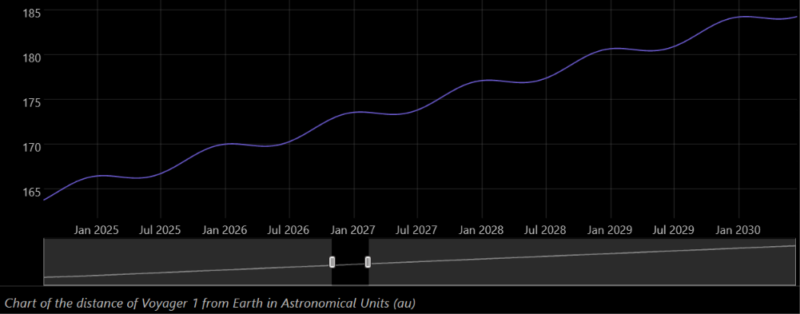
By the end of January 2027, Voyager 1 will have gotten as far as 173.58 AU from Earth. Then as Earth swings around the side of the sun near Voyager, the distance between us decreases. At its closest next spring, on April 23, Voyager 1 will get as close as 173.31 AU from Earth. But that’s still greater than 1 light-day. Then the distance between Earth and Voyager 1 will continue to increase again … until next spring when it gets a bit closer once more.
So, no, Voyager 1 will never be closer to Earth than 1 light-day again.
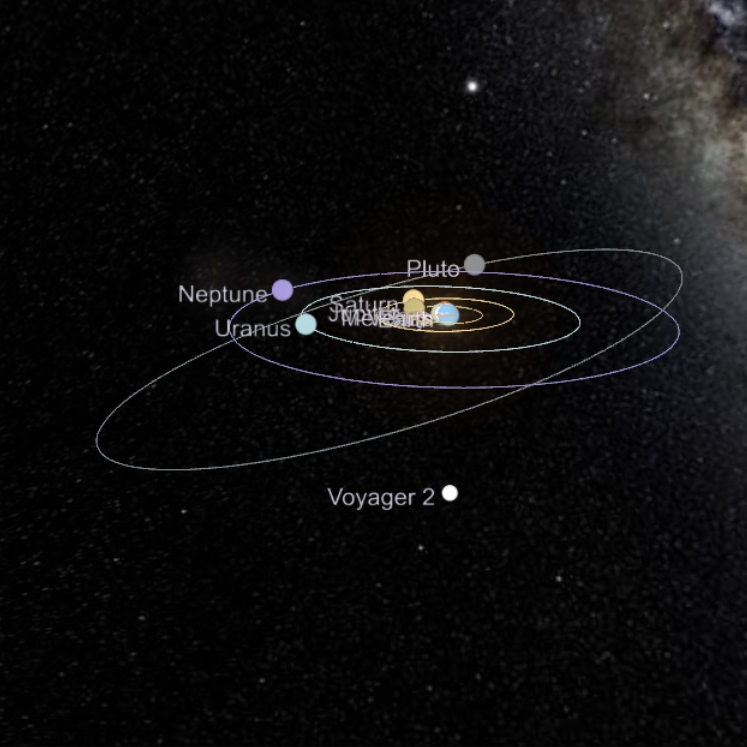
Where are Voyager 1 and Voyager 2 now?
A closer look at Voyager 2 in relation to Earth
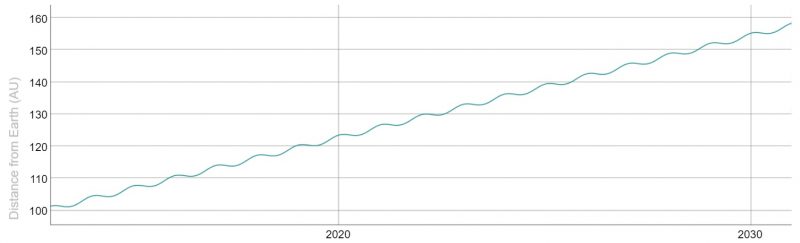
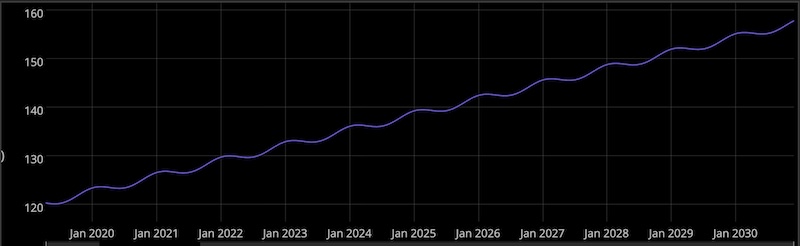
Now, let’s look specifically at Voyager 2 as an example. Every year from late February to the beginning of June, Voyager 2 actually gets closer to Earth. We measure the distance between objects in space in astronomical units, or AU. This measurement is based on the distance between Earth and the sun, which is one AU.
On February 9, 2026, Voyager 2 was 143.09 AU from Earth. Then, Earth’s orbit began bringing us closer to Voyager 2 once again. The distance between us and Voyager 2 will continue to shrinking until early June when it’ll be 142.4 AU from Earth.
–>
Bottom line: The Voyager spacecraft get closer to Earth for a few months every year because Earth moves toward the spacecraft faster in its orbit around the sun than the spacecraft moves away from us. Will Voyager 1 ever get closer than 1 light-day again?
The post Will Voyager 1 ever be closer than 1 light-day from Earth again? first appeared on EarthSky.
from EarthSky https://ift.tt/QFnuLvR
Why do the Voyager spacecraft sometimes get closer to Earth?
For a few months each year, the distances between the Voyager spacecraft and Earth actually decrease. You might know that both Voyager spacecraft were launched into space in the 1970s and visited the outer planets through the 1980s. They’ve been heading out of our solar system ever since. In 2012, Voyager 1 entered interstellar space. Then, in 2018, NASA announced that Voyager 2 had entered interstellar space, too. They are both headed outward, never to return to Earth. So, can they get closer?
The answer is that for a few months each year, Earth in its orbit moves toward the spacecraft faster than they’re moving away. Earth’s motion around the sun is faster than the motion of the Voyager spacecraft. Earth moves through space at a speed of 67,000 miles per hour (30 km/s). Voyager 1 moves at a speed of 38,000 miles per hour (17 km/s). Voyager 2 moves at a speed of 35,000 miles per hour (16 km/s).
So, for a portion of the year, Earth comes around the side of the sun and is speeding toward the spacecraft faster than they’re moving away. Therefore their distances to Earth are getting closer, if only temporarily. They never change their outward motion. It is we who change.
From this video, you can see the trajectory of the Voyager spacecraft as they leave Earth, encounter the outer planets (changing their trajectories), and then head in a straight line outward, out of the solar system.
Voyager 1 is now more than 1 light-day away
On November 18, 2026, Voyager 1 hit a milestone when it reached 1 light-day from Earth. That’s farther than any human-made spacecraft has ever traveled from our home planet. One light-day is equal to 173.14 astronomical units (AU).
Because Voyager 1 and Earth get closer together at the beginning of every year, a reader contacted me to ask if Voyager 1 and Earth will ever be closer than 1 light-day apart again.
By the end of January 2027, Voyager 1 will have gotten as far as 173.58 AU from Earth. Then as Earth swings around the side of the sun near Voyager, the distance between us decreases. At its closest next spring, on April 23, Voyager 1 will get as close as 173.31 AU from Earth. But that’s still greater than 1 light-day. Then the distance between Earth and Voyager 1 will continue to increase again … until next spring when it gets a bit closer once more.
So, no, Voyager 1 will never be closer to Earth than 1 light-day again.
Where are Voyager 1 and Voyager 2 now?
A closer look at Voyager 2 in relation to Earth
Now, let’s look specifically at Voyager 2 as an example. Every year from late February to the beginning of June, Voyager 2 actually gets closer to Earth. We measure the distance between objects in space in astronomical units, or AU. This measurement is based on the distance between Earth and the sun, which is one AU.
On February 9, 2026, Voyager 2 was 143.09 AU from Earth. Then, Earth’s orbit began bringing us closer to Voyager 2 once again. The distance between us and Voyager 2 will continue to shrinking until early June when it’ll be 142.4 AU from Earth.
–>
Bottom line: The Voyager spacecraft get closer to Earth for a few months every year because Earth moves toward the spacecraft faster in its orbit around the sun than the spacecraft moves away from us. Will Voyager 1 ever get closer than 1 light-day again?
The post Will Voyager 1 ever be closer than 1 light-day from Earth again? first appeared on EarthSky.
from EarthSky https://ift.tt/QFnuLvR

Aucun commentaire:
Enregistrer un commentaire