
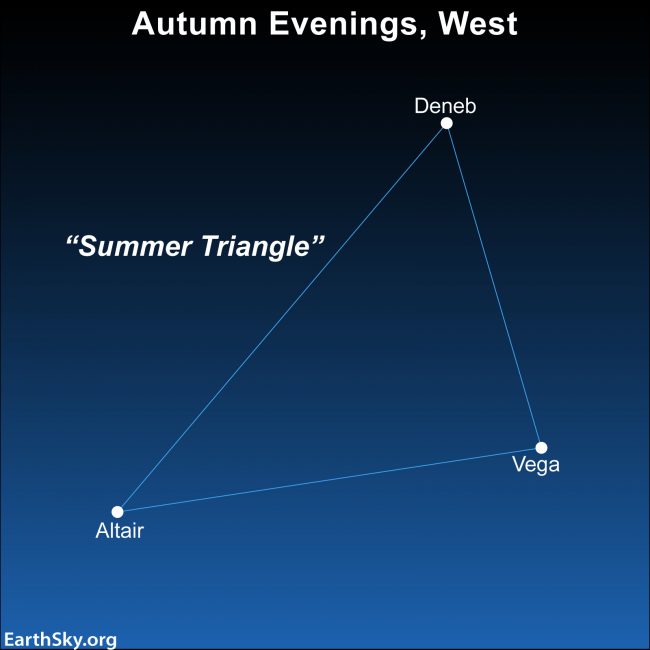
The Summer Triangle in autumn
The Summer Triangle isn’t a constellation. It’s an asterism, an obvious pattern or group of stars with a popular name. The Summer Triangle consists of three bright stars in three separate constellations.
The Summer Triangle is the signature star formation in the Northern Hemisphere’s summer sky. However, as the September equinox comes and goes – and as the weeks of autumn begin to slide by – you’ll continue to notice this famous trio of stars.
You’ll find the Summer Triangle in November and December. Look for it tonight in the early evening. Look west!
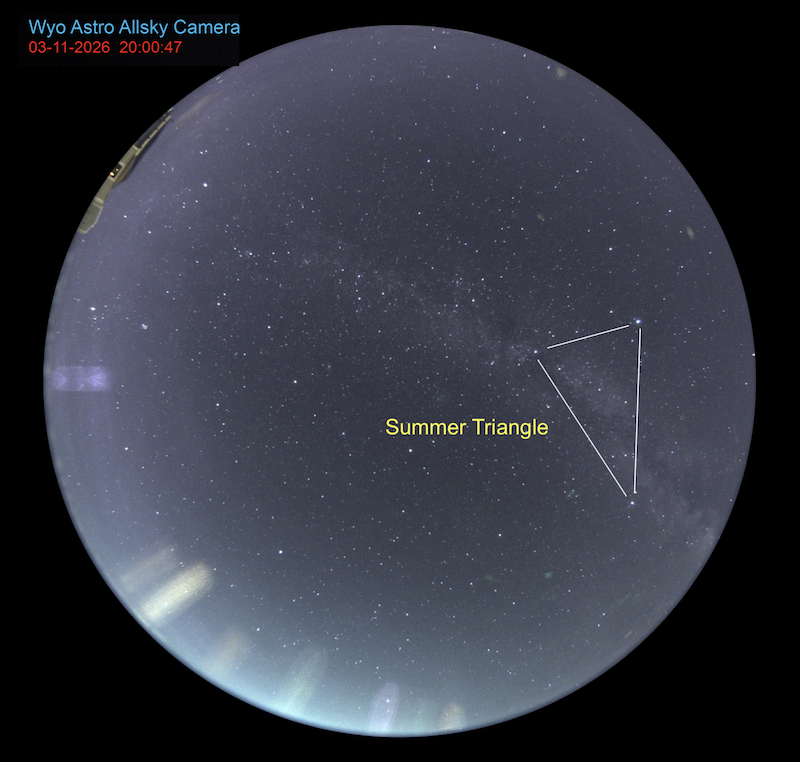
The 3 stars of the Summer Triangle
The brightest of the three stars is Vega is in the constellation Lyra the Harp. It’s the 5th-brightest star in our night sky. You’ll recognize Vega for its blue-white color. This star is located 25 light-years away.
Next in brightness is the star Altair is in Aquila the Eagle. Its only 16.7 light-years away. You’ll recognize Altair becuase it’s flanked closely by two fainter stars.
Deneb — in Cygnus the Swan — is the faintest of the Summer Triangle stars. But it has good reason to be faintest to our eye, because Deneb is one of the most distant stars we see with the unaided eye. It’s a luminous supergiant star, located roughly 1,400 to 2,600 light–years from Earth.
When is it visible in the evening sky
In the month of June – around the June solstice – the Summer Triangle pops out in the east as darkness falls and shines all night long. But now – after sunset in November – the Summer Triangle appears high in the western evening sky. As evening deepens, the Summer Triangle descends westward, with all three of its stars staying above the horizon until mid-to-late evening.
Altair – the Summer Triangle’s southernmost star – will set around 10 to 11 p.m. in November at mid-northern latitudes. Notice where you see the Summer Triangle at a given time this evening. The Summer Triangle will return to this same place in the sky some four minutes earlier with each passing day, or two hours earlier with each passing month.
Bottom line: Look westward this evening for the three brilliant stars of the Summer Triangle: Vega, Deneb and Altair.
EarthSky astronomy kits are perfect for beginners. Order yours from the EarthSky store.
The post See the Summer Triangle in the northern autumn sky first appeared on EarthSky.
from EarthSky https://ift.tt/wTzqluJ
The Summer Triangle in autumn
The Summer Triangle isn’t a constellation. It’s an asterism, an obvious pattern or group of stars with a popular name. The Summer Triangle consists of three bright stars in three separate constellations.
The Summer Triangle is the signature star formation in the Northern Hemisphere’s summer sky. However, as the September equinox comes and goes – and as the weeks of autumn begin to slide by – you’ll continue to notice this famous trio of stars.
You’ll find the Summer Triangle in November and December. Look for it tonight in the early evening. Look west!
The 3 stars of the Summer Triangle
The brightest of the three stars is Vega is in the constellation Lyra the Harp. It’s the 5th-brightest star in our night sky. You’ll recognize Vega for its blue-white color. This star is located 25 light-years away.
Next in brightness is the star Altair is in Aquila the Eagle. Its only 16.7 light-years away. You’ll recognize Altair becuase it’s flanked closely by two fainter stars.
Deneb — in Cygnus the Swan — is the faintest of the Summer Triangle stars. But it has good reason to be faintest to our eye, because Deneb is one of the most distant stars we see with the unaided eye. It’s a luminous supergiant star, located roughly 1,400 to 2,600 light–years from Earth.
When is it visible in the evening sky
In the month of June – around the June solstice – the Summer Triangle pops out in the east as darkness falls and shines all night long. But now – after sunset in November – the Summer Triangle appears high in the western evening sky. As evening deepens, the Summer Triangle descends westward, with all three of its stars staying above the horizon until mid-to-late evening.
Altair – the Summer Triangle’s southernmost star – will set around 10 to 11 p.m. in November at mid-northern latitudes. Notice where you see the Summer Triangle at a given time this evening. The Summer Triangle will return to this same place in the sky some four minutes earlier with each passing day, or two hours earlier with each passing month.
Bottom line: Look westward this evening for the three brilliant stars of the Summer Triangle: Vega, Deneb and Altair.
EarthSky astronomy kits are perfect for beginners. Order yours from the EarthSky store.
The post See the Summer Triangle in the northern autumn sky first appeared on EarthSky.
from EarthSky https://ift.tt/wTzqluJ

Aucun commentaire:
Enregistrer un commentaire