

The 2027 EarthSky Lunar Calendar is now available! Makes a great gift. Get yours today!
North Star and South Star
The North Star for Earth is Polaris. Does our next-door neighbor planet, Mars, have the same North Star as Earth? If not, does Mars have a star located more or less above its north pole?
Let’s talk about what we mean by North Star. Every planet in our solar system spins on its axis. Earth’s spin is what defines the length of our day of approximately 24 hours. If you continue the imaginary line of a planet’s axis out into space, it might point to a star that’s visible to the eye.
We call such stars pole stars. On Earth, the northern pole star — less than a degree from the north celestial pole — is the beloved star Polaris. Scouts and hikers know you can use Polaris to find the direction north when compasses or GPS fails.
However, Earth’s Southern Hemisphere doesn’t have a comparable South Star. The nearest visible star to the south celestial pole of Earth is about 9 degrees away.
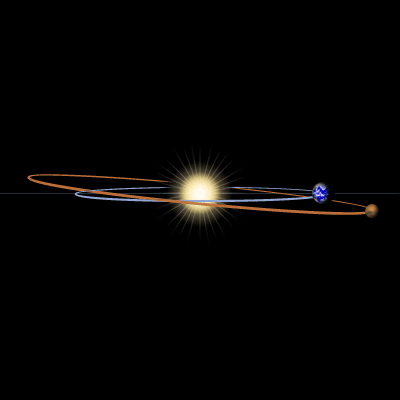
A North Star for Mars?
So, does Mars have a North or South Star? The answer is … not in any satisfying way. There’s no bright North Star, and only a modestly-bright South Star, for Mars.
In the northern sky as seen from Mars, the best candidate for a North Star is located on Mars’ sky dome about 1/2 degree from Mars’ north celestial pole. That’s closer than Polaris is to Earth’s north celestial pole. So what’s the problem? Well, while Polaris is relatively bright (47th brightest of all stars in the night sky), the star near Mars’ north celestial pole is faint.
In fact, this star is barely within the limit of visibility to the eye alone. That makes it a poor candidate for a North Star.
Mars’ north pole points to a spot in the sky that’s about midway between Deneb, the brightest star in the constellation Cygnus the Swan, and Alderamin, the brightest star in the constellation Cepheus the King. See a chart of the position of Mars’ north celestial pole between the constellations Cygnus and Cepheus.
The southern sky view from Mars
Meanwhile, in the southern sky as seen from Mars, Kappa Velorum is only about 3 degrees from the Martian south celestial pole. That’s not as close as Polaris is to Earth’s north celestial pole, plus this star is only modestly bright, not nearly as bright as Polaris.
Future Mars colonists aren’t going to have a bright North Star — like our Polaris — to guide them.
On the other hand, if you were standing outside at night on the surface of Mars, you’d see some other cool stuff!
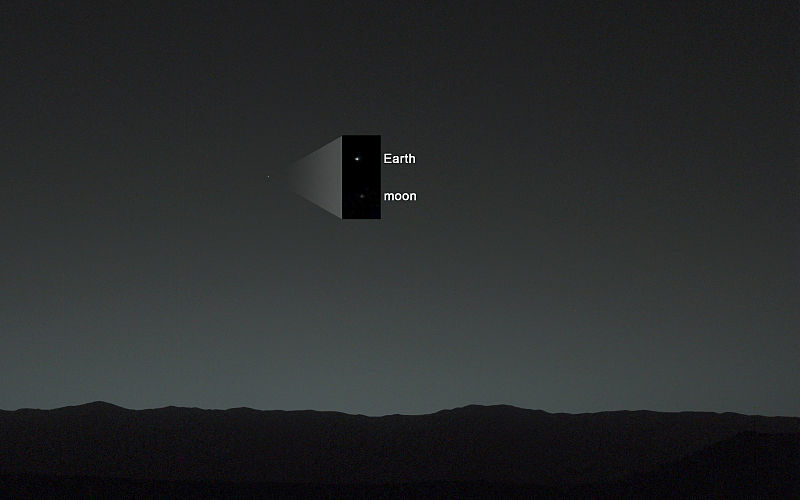
Can you see the moon orbiting Earth from Mars?
As seen from Mars, you could see Earth’s moon orbiting around Earth. From Earth, we can’t see any other planets’ satellites with the unaided eye, but this amazing sight on Mars would be visible to the eye alone. Both the Earth and the moon would appear starlike.
In general, the Earth as seen from Mars would somewhat mimic our view of Venus as seen from Earth. By that we mean that — like Venus in relationship to Earth — Earth in relationship to Mars is an inner planet. It orbits closer to the sun than Mars. Thus, Earth as seen from Mars would constantly shift from a morning to an evening “star” and back, just as Venus does as seen from our world.
And although both Earth and the moon would appear as stars to the unaided eye, observers on Mars with telescopes would sometimes see them as crescent worlds, just as we see Venus.
So … no North Star for Mars. But Martian stargazers wouldn’t lack for things to see!

Bottom line: Does planet Mars have a North Star akin to Earth’s North Star Polaris? No, there is not a Mars North Star. But Martian stargazers wouldn’t lack for things to see!
Read more: Why is Mars sometimes bright and sometimes faint?
Read more: Active volcanoes on Mars?
The post Is there a North Star for Mars? first appeared on EarthSky.
from EarthSky https://ift.tt/CIMEPJe
The 2027 EarthSky Lunar Calendar is now available! Makes a great gift. Get yours today!
North Star and South Star
The North Star for Earth is Polaris. Does our next-door neighbor planet, Mars, have the same North Star as Earth? If not, does Mars have a star located more or less above its north pole?
Let’s talk about what we mean by North Star. Every planet in our solar system spins on its axis. Earth’s spin is what defines the length of our day of approximately 24 hours. If you continue the imaginary line of a planet’s axis out into space, it might point to a star that’s visible to the eye.
We call such stars pole stars. On Earth, the northern pole star — less than a degree from the north celestial pole — is the beloved star Polaris. Scouts and hikers know you can use Polaris to find the direction north when compasses or GPS fails.
However, Earth’s Southern Hemisphere doesn’t have a comparable South Star. The nearest visible star to the south celestial pole of Earth is about 9 degrees away.
A North Star for Mars?
So, does Mars have a North or South Star? The answer is … not in any satisfying way. There’s no bright North Star, and only a modestly-bright South Star, for Mars.
In the northern sky as seen from Mars, the best candidate for a North Star is located on Mars’ sky dome about 1/2 degree from Mars’ north celestial pole. That’s closer than Polaris is to Earth’s north celestial pole. So what’s the problem? Well, while Polaris is relatively bright (47th brightest of all stars in the night sky), the star near Mars’ north celestial pole is faint.
In fact, this star is barely within the limit of visibility to the eye alone. That makes it a poor candidate for a North Star.
Mars’ north pole points to a spot in the sky that’s about midway between Deneb, the brightest star in the constellation Cygnus the Swan, and Alderamin, the brightest star in the constellation Cepheus the King. See a chart of the position of Mars’ north celestial pole between the constellations Cygnus and Cepheus.
The southern sky view from Mars
Meanwhile, in the southern sky as seen from Mars, Kappa Velorum is only about 3 degrees from the Martian south celestial pole. That’s not as close as Polaris is to Earth’s north celestial pole, plus this star is only modestly bright, not nearly as bright as Polaris.
Future Mars colonists aren’t going to have a bright North Star — like our Polaris — to guide them.
On the other hand, if you were standing outside at night on the surface of Mars, you’d see some other cool stuff!
Can you see the moon orbiting Earth from Mars?
As seen from Mars, you could see Earth’s moon orbiting around Earth. From Earth, we can’t see any other planets’ satellites with the unaided eye, but this amazing sight on Mars would be visible to the eye alone. Both the Earth and the moon would appear starlike.
In general, the Earth as seen from Mars would somewhat mimic our view of Venus as seen from Earth. By that we mean that — like Venus in relationship to Earth — Earth in relationship to Mars is an inner planet. It orbits closer to the sun than Mars. Thus, Earth as seen from Mars would constantly shift from a morning to an evening “star” and back, just as Venus does as seen from our world.
And although both Earth and the moon would appear as stars to the unaided eye, observers on Mars with telescopes would sometimes see them as crescent worlds, just as we see Venus.
So … no North Star for Mars. But Martian stargazers wouldn’t lack for things to see!
Bottom line: Does planet Mars have a North Star akin to Earth’s North Star Polaris? No, there is not a Mars North Star. But Martian stargazers wouldn’t lack for things to see!
Read more: Why is Mars sometimes bright and sometimes faint?
Read more: Active volcanoes on Mars?
The post Is there a North Star for Mars? first appeared on EarthSky.
from EarthSky https://ift.tt/CIMEPJe

Aucun commentaire:
Enregistrer un commentaire