
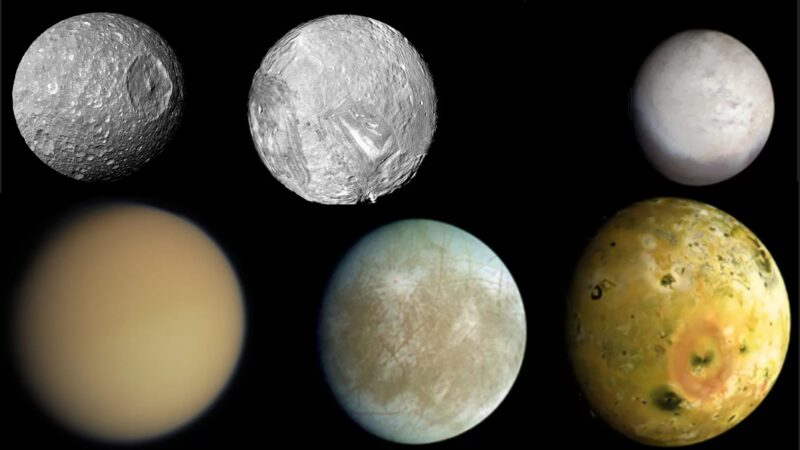
The solar system’s most bizarre moons
Some of the most bizarre worlds in our solar system are moons. That is, they don’t orbit our sun directly, but instead orbit planets, dwarf planets or even asteroids. From icy geysers to endless volcanic eruptions to hidden oceans, these natural satellites have proven much more dynamic than our own dormant moon.
Here’s a quick tour of some of the strangest moons in our solar system.
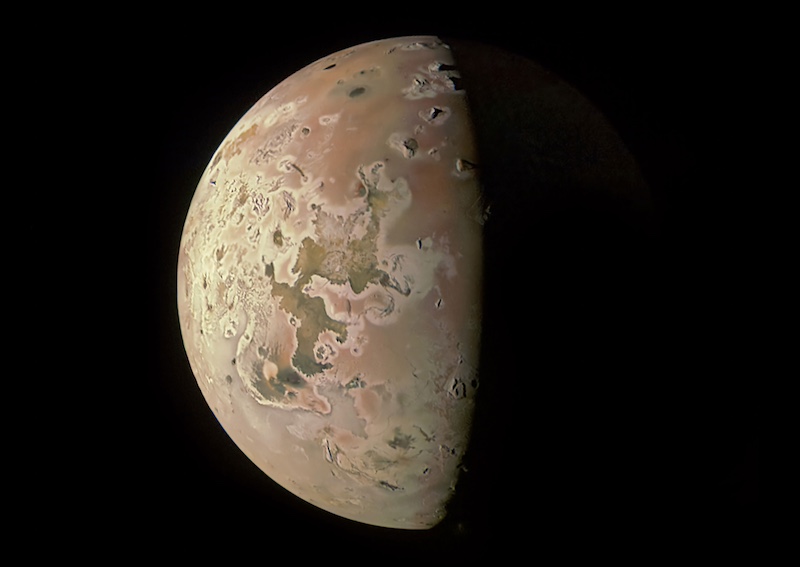
#1 Io: A world of nonstop volcanoes
Orbiting Jupiter, Io is the most volcanically active world in the solar system. Its surface is constantly being reshaped by eruptions that send plumes hundreds of miles into space.
Unlike Earth’s volcanoes, Io’s are driven by tidal heating. That means that Jupiter’s immense gravity stretches and squeezes the little moon. And, as it does so, friction builds up inside, melting rock into magma.
The result is a surface dotted with lava lakes and sulfur deposits. There are no visible impact craters — because eruptions constantly resurface this little world.
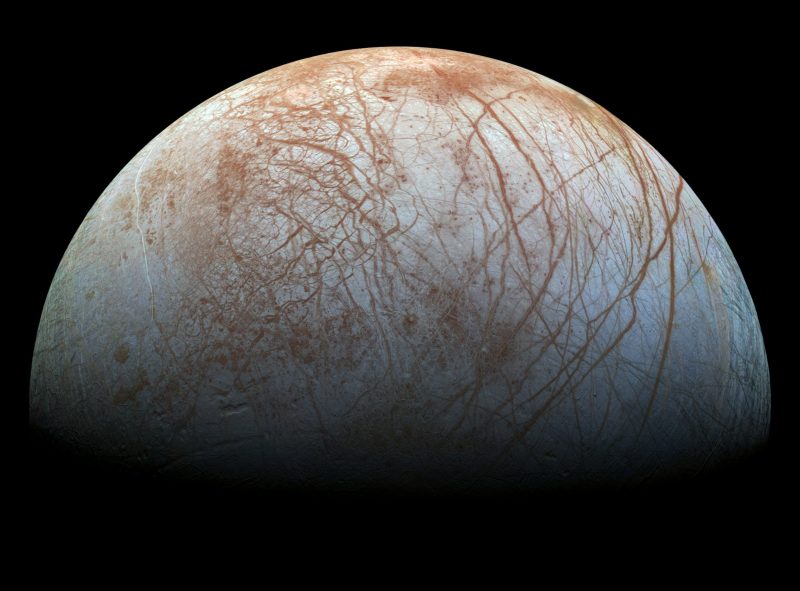
#2 Europa: An ocean beneath the ice
Another of Jupiter’s moons, Europa, looks smooth and icy on the outside. But beneath that frozen shell lies a global ocean of liquid water. Scientists believe this ocean may contain more water than all of Earth’s oceans combined. Reddish cracks crisscross the surface, likely caused by ice shifting over the ocean below.
Because earthly scientists believe liquid water is a key ingredient for life, Europa is one of the most promising places to search for life in the solar system. Future space missions, including NASA’s Europa Clipper, aim to study this hidden ocean in detail.
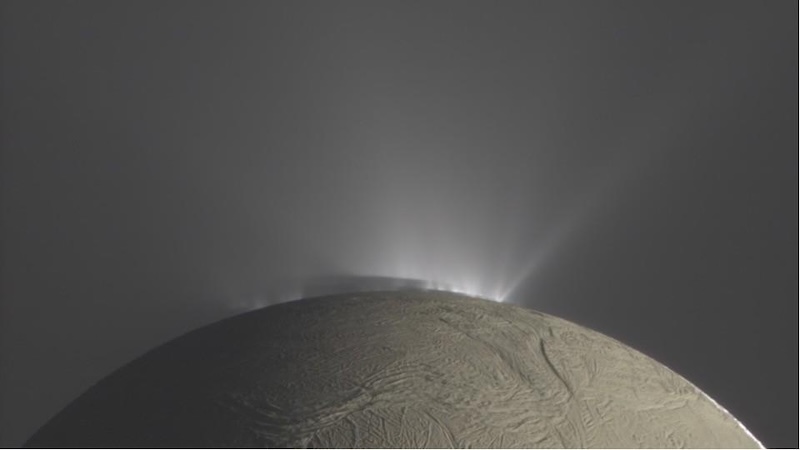
#3 Enceladus: Geysers in space
Enceladus blew scientists’ minds when NASA’s Cassini mission discovered jets of water vapor blasting from the south pole of this Saturn moon.
These geysers erupt from an underground ocean, which — in the little moon’s relatively weak gravity — spray material into space. This material feeds Saturn’s E ring! Even more intriguing, the water vapor plumes issuing from Enceladus’ hidden ocean contain complex organic molecules — the building blocks of life.
#4 Titan: Lakes of methane
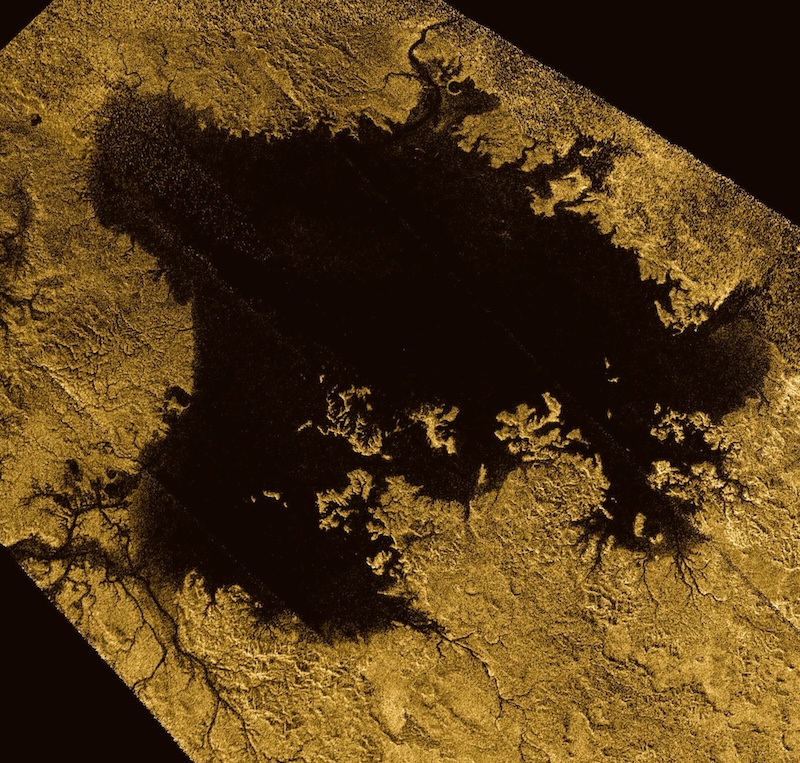
The largest moon of Saturn is Titan. It’s the only moon in our solar system with a thick atmosphere. Scientists say it has weather, rivers and lakes. But those lakes aren’t filled with water. Instead, they contain liquid methane and ethane.
This hazy, orange world hosts a methane cycle similar to Earth’s water cycle, complete with clouds and rain. Beneath its surface, Titan may also harbor a subsurface ocean of water.
NASA’s Dragonfly mission is currently scheduled to launch in 2028 and arrive at Titan in 2034. Once it lands, the drone-like spacecraft will hop across Titan’s alien landscape.
#5 Mimas: Death Star’s twin
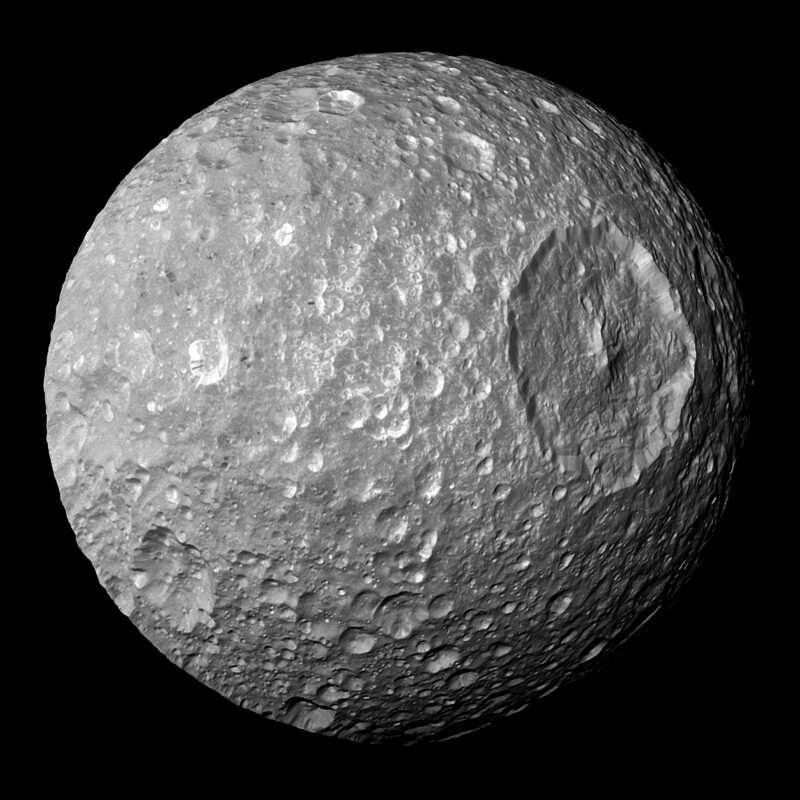
When people see Saturn’s 7th-largest satellite Mimas, they think of the Death Star. The two have a very similar shape, sporting a larger crater in the northern hemisphere that takes up a good deal of territory. In fact, many people think the Death Star was modeled on the moon Mimas.
In reality, the original Star Wars movie came out on May 25, 1977. But we didn’t get a closeup look at Mimas until Voyager 1 passed it in 1980. So, the resemblance is just coincidental.
The crater, named after William Herschel — who discovered the moon as a tiny dot in his telescope — is 86 miles (138 km) across. The terrain shows the entire satellite felt the shockwaves from the impact that created this mighty crater on Mimas.
#6 Miranda: A patchwork world
Miranda, a small moon of Uranus, looks like it did shatter … and then reassemble. Its surface is a crazy quilt of textures and ages. It might also be home to the tallest cliff in our solar system. Verona Rupes is a 12-mile (20-km) high scarp.
One theory suggests Miranda broke apart in a massive impact. The pieces then reassembled themselves through gravity into the Frankenstein-like appearance this moon has today.

#7 Triton: A captured rebel
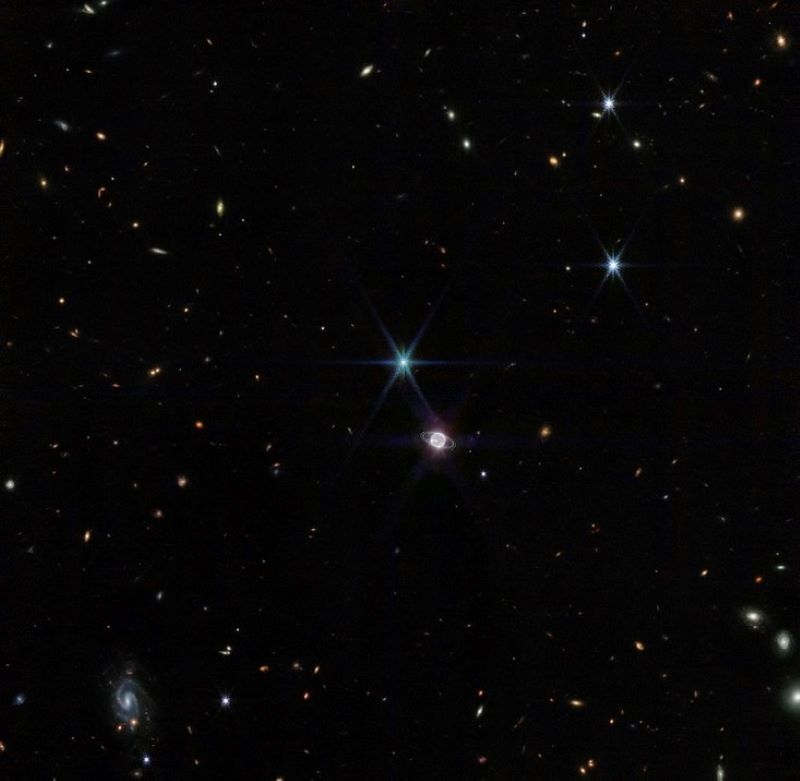
Neptune’s large moon Triton orbits in the direction opposite its planet’s rotation. So it likely didn’t form there, but instead is a captured Kuiper Belt object.
Triton is also geologically active, with nitrogen geysers erupting from its frozen surface. It’s one of the most intriguing — and least explored — moons.
Why these bizarre moons matter?
These bizarre moons can help scientists understand how planetary systems evolve. They show the complexity and diversity of distant worlds. Some even provide potential for life far from the sun’s warmth.
Future missions (such as JUICE, Dragonfly and Europa Clipper) will continue to explore these strange satellites, searching for answers to some of the biggest questions in science: How do worlds form? What makes one world habitable and another not? Are we alone?
Bottom line: The solar system’s most bizarre moons reveal active, complex worlds that continue to surprise scientists. Are any of them harboring life?
Read more: Is there enough water on the moon for future cities?
Read more: The tally is in! 6,000 exoplanets now confirmed
The post Solar system’s most bizarre moons! Take the tour first appeared on EarthSky.
from EarthSky https://ift.tt/xbGBA3D
The solar system’s most bizarre moons
Some of the most bizarre worlds in our solar system are moons. That is, they don’t orbit our sun directly, but instead orbit planets, dwarf planets or even asteroids. From icy geysers to endless volcanic eruptions to hidden oceans, these natural satellites have proven much more dynamic than our own dormant moon.
Here’s a quick tour of some of the strangest moons in our solar system.
#1 Io: A world of nonstop volcanoes
Orbiting Jupiter, Io is the most volcanically active world in the solar system. Its surface is constantly being reshaped by eruptions that send plumes hundreds of miles into space.
Unlike Earth’s volcanoes, Io’s are driven by tidal heating. That means that Jupiter’s immense gravity stretches and squeezes the little moon. And, as it does so, friction builds up inside, melting rock into magma.
The result is a surface dotted with lava lakes and sulfur deposits. There are no visible impact craters — because eruptions constantly resurface this little world.
#2 Europa: An ocean beneath the ice
Another of Jupiter’s moons, Europa, looks smooth and icy on the outside. But beneath that frozen shell lies a global ocean of liquid water. Scientists believe this ocean may contain more water than all of Earth’s oceans combined. Reddish cracks crisscross the surface, likely caused by ice shifting over the ocean below.
Because earthly scientists believe liquid water is a key ingredient for life, Europa is one of the most promising places to search for life in the solar system. Future space missions, including NASA’s Europa Clipper, aim to study this hidden ocean in detail.
#3 Enceladus: Geysers in space
Enceladus blew scientists’ minds when NASA’s Cassini mission discovered jets of water vapor blasting from the south pole of this Saturn moon.
These geysers erupt from an underground ocean, which — in the little moon’s relatively weak gravity — spray material into space. This material feeds Saturn’s E ring! Even more intriguing, the water vapor plumes issuing from Enceladus’ hidden ocean contain complex organic molecules — the building blocks of life.
#4 Titan: Lakes of methane
The largest moon of Saturn is Titan. It’s the only moon in our solar system with a thick atmosphere. Scientists say it has weather, rivers and lakes. But those lakes aren’t filled with water. Instead, they contain liquid methane and ethane.
This hazy, orange world hosts a methane cycle similar to Earth’s water cycle, complete with clouds and rain. Beneath its surface, Titan may also harbor a subsurface ocean of water.
NASA’s Dragonfly mission is currently scheduled to launch in 2028 and arrive at Titan in 2034. Once it lands, the drone-like spacecraft will hop across Titan’s alien landscape.
#5 Mimas: Death Star’s twin
When people see Saturn’s 7th-largest satellite Mimas, they think of the Death Star. The two have a very similar shape, sporting a larger crater in the northern hemisphere that takes up a good deal of territory. In fact, many people think the Death Star was modeled on the moon Mimas.
In reality, the original Star Wars movie came out on May 25, 1977. But we didn’t get a closeup look at Mimas until Voyager 1 passed it in 1980. So, the resemblance is just coincidental.
The crater, named after William Herschel — who discovered the moon as a tiny dot in his telescope — is 86 miles (138 km) across. The terrain shows the entire satellite felt the shockwaves from the impact that created this mighty crater on Mimas.
#6 Miranda: A patchwork world
Miranda, a small moon of Uranus, looks like it did shatter … and then reassemble. Its surface is a crazy quilt of textures and ages. It might also be home to the tallest cliff in our solar system. Verona Rupes is a 12-mile (20-km) high scarp.
One theory suggests Miranda broke apart in a massive impact. The pieces then reassembled themselves through gravity into the Frankenstein-like appearance this moon has today.
#7 Triton: A captured rebel
Neptune’s large moon Triton orbits in the direction opposite its planet’s rotation. So it likely didn’t form there, but instead is a captured Kuiper Belt object.
Triton is also geologically active, with nitrogen geysers erupting from its frozen surface. It’s one of the most intriguing — and least explored — moons.
Why these bizarre moons matter?
These bizarre moons can help scientists understand how planetary systems evolve. They show the complexity and diversity of distant worlds. Some even provide potential for life far from the sun’s warmth.
Future missions (such as JUICE, Dragonfly and Europa Clipper) will continue to explore these strange satellites, searching for answers to some of the biggest questions in science: How do worlds form? What makes one world habitable and another not? Are we alone?
Bottom line: The solar system’s most bizarre moons reveal active, complex worlds that continue to surprise scientists. Are any of them harboring life?
Read more: Is there enough water on the moon for future cities?
Read more: The tally is in! 6,000 exoplanets now confirmed
The post Solar system’s most bizarre moons! Take the tour first appeared on EarthSky.
from EarthSky https://ift.tt/xbGBA3D

Aucun commentaire:
Enregistrer un commentaire