
Great Square of Pegasus
Throughout late September and October evenings, the Great Square of Pegasus is ascending in the eastern evening sky. Then the Great Square will be high in the sky around the December solstice. And it’ll disappear from the evening sky sometime in February.
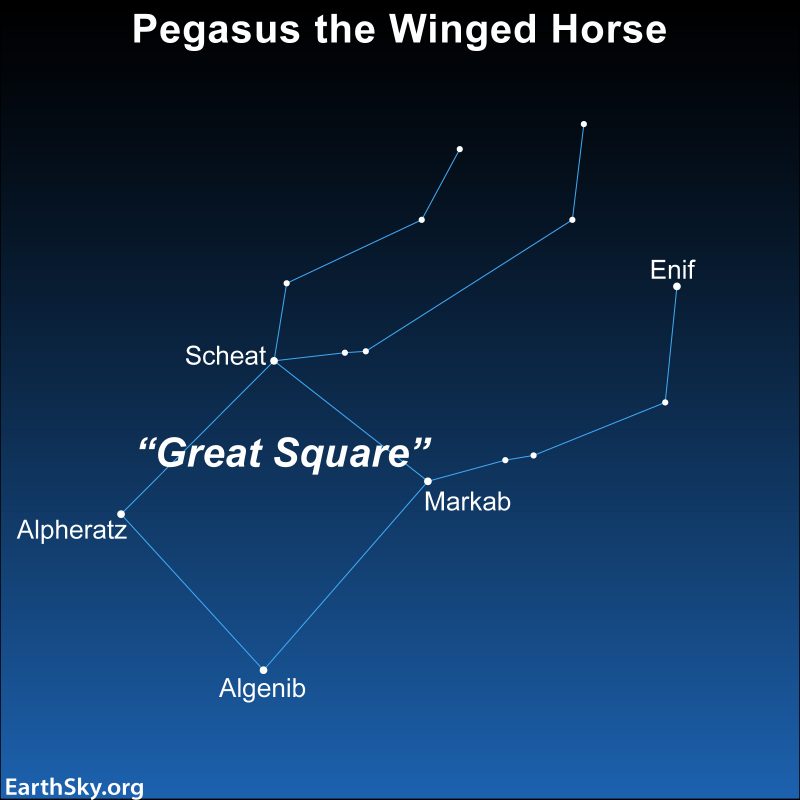
The Great Square is an asterism — an obvious pattern of stars — that consists of four stars of nearly equal brightness. Specifically, they are Scheat, Alpheratz, Markab and Algenib. The star Alpheratz is part of the constellation Andromeda and joins with three stars from Pegasus to form the Great Square.
The constellation Pegasus represents a Flying Horse. But the Great Square — the prominent asterism within Pegasus — is a landmark of the Northern Hemisphere’s autumn sky.
To find the Great Square
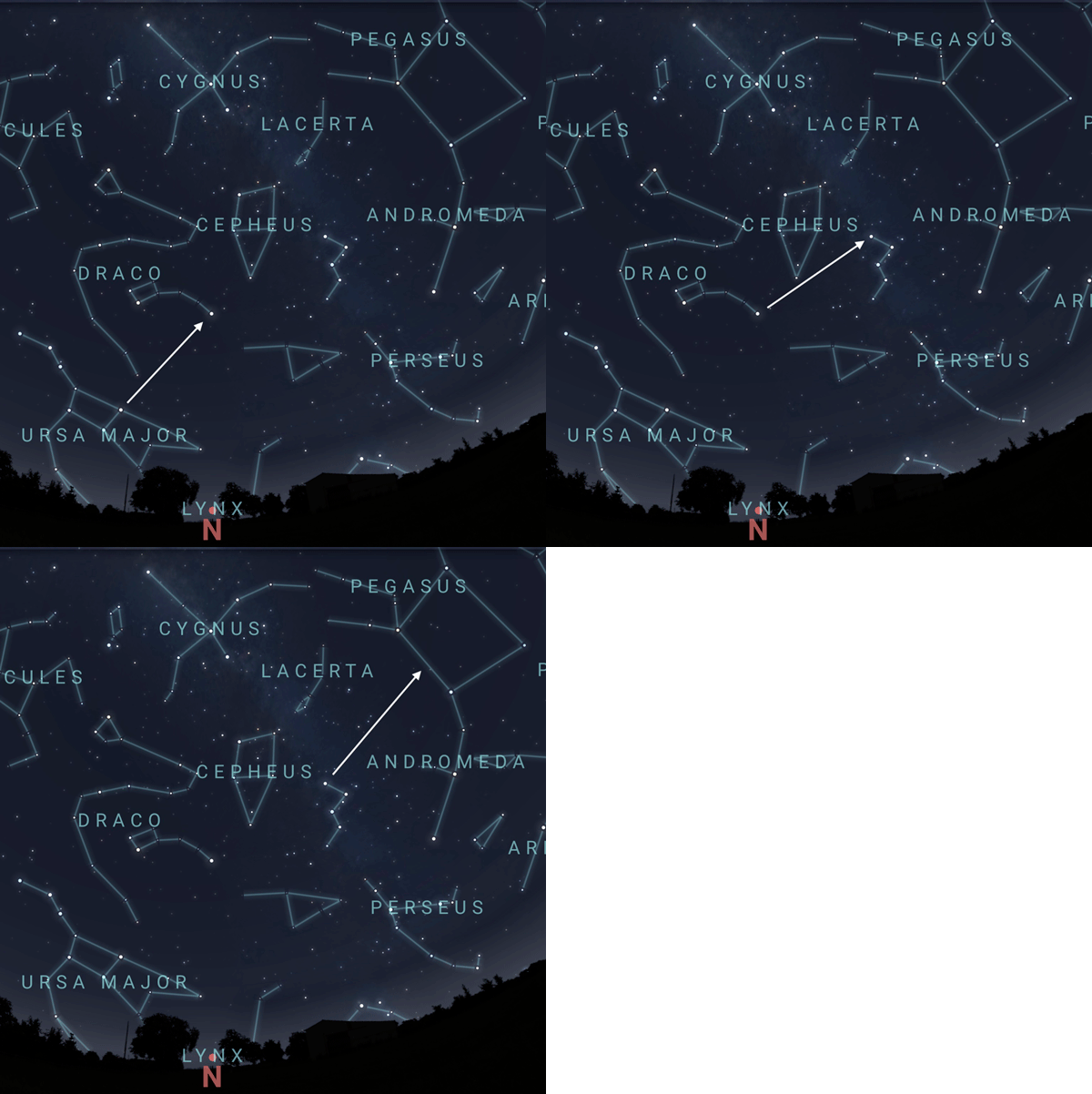
To find the Great Square, use the Big Dipper to star-hop to Polaris, the North Star. Then draw an imaginary line from Polaris until you land on the outer star of the W or M-shaped constellation Cassiopeia the Queen.
Finally, a line from Cassiopeia faithfully escorts you to the Great Square of Pegasus.
Use the Great Square to find the Andromeda Galaxy

Great Square of Pegasus: A big square of nothing
Often, at events where many are stargazing for the first time, one may hear:
… the Great Square has nothing in it.
But, like all parts of the night sky, the Great Square isn’t really empty. It might look empty to you, because the stars inside the Great Square are so faint. The unaided eye can’t easily detect them. But, if you use binoculars or a small telescope you can easily see many stars within the Great Square.
Also, counting stars inside the Great Square is a good way to determine how dark your sky is when observing.
- Under light-polluted city skies, you might see no stars inside.
- Under average rural conditions, you might spot three to five stars.
- Under pristine dark-sky conditions, you might count up to 30 or more stars inside the square,
1st discovery of an exoplanet orbiting a sunlike star
One of the most famous faint stars near the Great Square is 51 Pegasi. In 1995, astronomers announced in the journal Nature they’d discovered a planet around this star.
This exoplanet is now called 51 Pegasi b (informally Dimidium).
It’s famous as the first confirmed example of a known planet beyond our solar system orbiting a sunlike star.
And today we know there are at least 40 exoplanets in Pegasus, with some 6,300 exoplanets known in our Milky Way galaxy at large.
The astronomers who found 51 Pegasi b – Michel Mayor of the University of Geneva and Didier Queloz at the Cavendish Laboratory and Geneva University – received the 2019 Nobel Prize in Physics for their discovery.
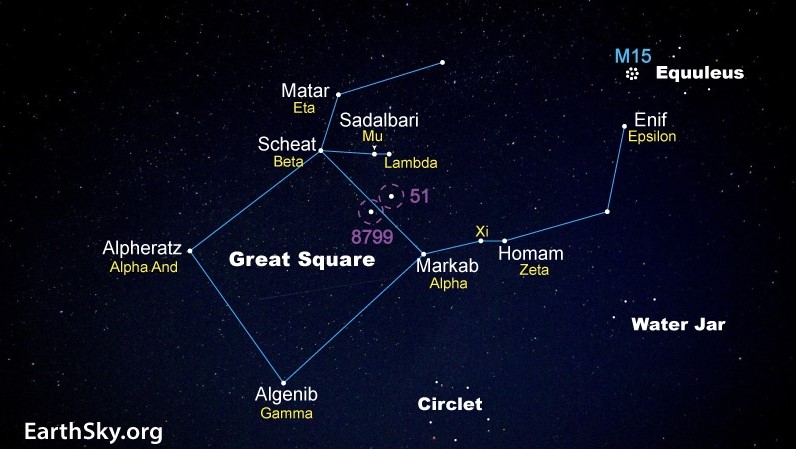
Some books say that 51 Pegasi is visible with the unaided eye. But it’s a challenge. Using binoculars, look roughly halfway between Scheat and Markab in the Great Square of Pegasus. Note that you won’t be able to see any planets! Pegasus 51 is approximately 50 light-years away from Earth.
Mythology of the Great Square of Pegasus
You might recall that Pegasus was a winged horse in Greek mythology. The constellation Pegasus is one of seven constellations in the autumn sky that explain why it’s never a good idea to claim a mortal’s beauty is greater than that of the gods. You’ll find this story plastered all over the autumn night sky, and Pegasus figures into it prominently.
The story goes that Cassiopeia the Queen bragged that she (or her daughter Andromeda the Princess) was more beautiful than the immortal Nereids, or sea nymphs. This angered the gods, who asked the sea-god Poseidon to take revenge. The punishment was that Cepheus the King and Cassiopeia had to sacrifice Andromeda to Cetus the Whale (sometimes called a sea monster). Andromeda was chained to a rock at sea. She was about to be gobbled up by Cetus, when she saw Perseus the Hero – riding Pegasus the Flying Horse – swooping toward her.
Perseus had a trick up his sleeve. He faced Cetus, holding up the head of the Gorgon Medusa. It’s said the sight of Medusa turned Cetus to stone. Then Perseus whacked the chains that bound Andromeda and freed her. And then, they rode off on Pegasus the Flying Horse and lived happily ever after. Later, Zeus placed all of them in the sky as stars, along with Delphinus the Dolphin, who’d provided comfort to Andromeda.
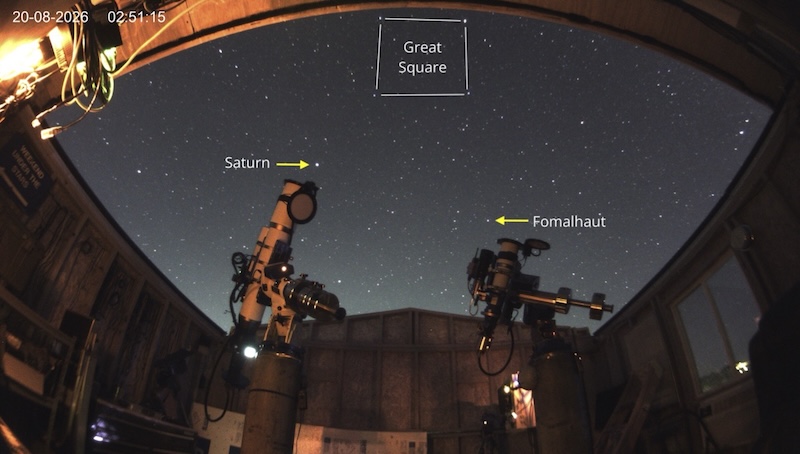
In 2026, Saturn and Fomalhaut are near the Great Square
Bottom line: How to find the Great Square of Pegasus star pattern, and why it’s worth locating in the evening sky.
Read more: Pegasus the Flying Horse, and the best sky story ever
The post Great Square of Pegasus gallops into the autumn sky first appeared on EarthSky.
from EarthSky https://ift.tt/W3jFwu8
Great Square of Pegasus
Throughout late September and October evenings, the Great Square of Pegasus is ascending in the eastern evening sky. Then the Great Square will be high in the sky around the December solstice. And it’ll disappear from the evening sky sometime in February.
The Great Square is an asterism — an obvious pattern of stars — that consists of four stars of nearly equal brightness. Specifically, they are Scheat, Alpheratz, Markab and Algenib. The star Alpheratz is part of the constellation Andromeda and joins with three stars from Pegasus to form the Great Square.
The constellation Pegasus represents a Flying Horse. But the Great Square — the prominent asterism within Pegasus — is a landmark of the Northern Hemisphere’s autumn sky.
To find the Great Square
To find the Great Square, use the Big Dipper to star-hop to Polaris, the North Star. Then draw an imaginary line from Polaris until you land on the outer star of the W or M-shaped constellation Cassiopeia the Queen.
Finally, a line from Cassiopeia faithfully escorts you to the Great Square of Pegasus.
Use the Great Square to find the Andromeda Galaxy
Great Square of Pegasus: A big square of nothing
Often, at events where many are stargazing for the first time, one may hear:
… the Great Square has nothing in it.
But, like all parts of the night sky, the Great Square isn’t really empty. It might look empty to you, because the stars inside the Great Square are so faint. The unaided eye can’t easily detect them. But, if you use binoculars or a small telescope you can easily see many stars within the Great Square.
Also, counting stars inside the Great Square is a good way to determine how dark your sky is when observing.
- Under light-polluted city skies, you might see no stars inside.
- Under average rural conditions, you might spot three to five stars.
- Under pristine dark-sky conditions, you might count up to 30 or more stars inside the square,
1st discovery of an exoplanet orbiting a sunlike star
One of the most famous faint stars near the Great Square is 51 Pegasi. In 1995, astronomers announced in the journal Nature they’d discovered a planet around this star.
This exoplanet is now called 51 Pegasi b (informally Dimidium).
It’s famous as the first confirmed example of a known planet beyond our solar system orbiting a sunlike star.
And today we know there are at least 40 exoplanets in Pegasus, with some 6,300 exoplanets known in our Milky Way galaxy at large.
The astronomers who found 51 Pegasi b – Michel Mayor of the University of Geneva and Didier Queloz at the Cavendish Laboratory and Geneva University – received the 2019 Nobel Prize in Physics for their discovery.
Some books say that 51 Pegasi is visible with the unaided eye. But it’s a challenge. Using binoculars, look roughly halfway between Scheat and Markab in the Great Square of Pegasus. Note that you won’t be able to see any planets! Pegasus 51 is approximately 50 light-years away from Earth.
Mythology of the Great Square of Pegasus
You might recall that Pegasus was a winged horse in Greek mythology. The constellation Pegasus is one of seven constellations in the autumn sky that explain why it’s never a good idea to claim a mortal’s beauty is greater than that of the gods. You’ll find this story plastered all over the autumn night sky, and Pegasus figures into it prominently.
The story goes that Cassiopeia the Queen bragged that she (or her daughter Andromeda the Princess) was more beautiful than the immortal Nereids, or sea nymphs. This angered the gods, who asked the sea-god Poseidon to take revenge. The punishment was that Cepheus the King and Cassiopeia had to sacrifice Andromeda to Cetus the Whale (sometimes called a sea monster). Andromeda was chained to a rock at sea. She was about to be gobbled up by Cetus, when she saw Perseus the Hero – riding Pegasus the Flying Horse – swooping toward her.
Perseus had a trick up his sleeve. He faced Cetus, holding up the head of the Gorgon Medusa. It’s said the sight of Medusa turned Cetus to stone. Then Perseus whacked the chains that bound Andromeda and freed her. And then, they rode off on Pegasus the Flying Horse and lived happily ever after. Later, Zeus placed all of them in the sky as stars, along with Delphinus the Dolphin, who’d provided comfort to Andromeda.
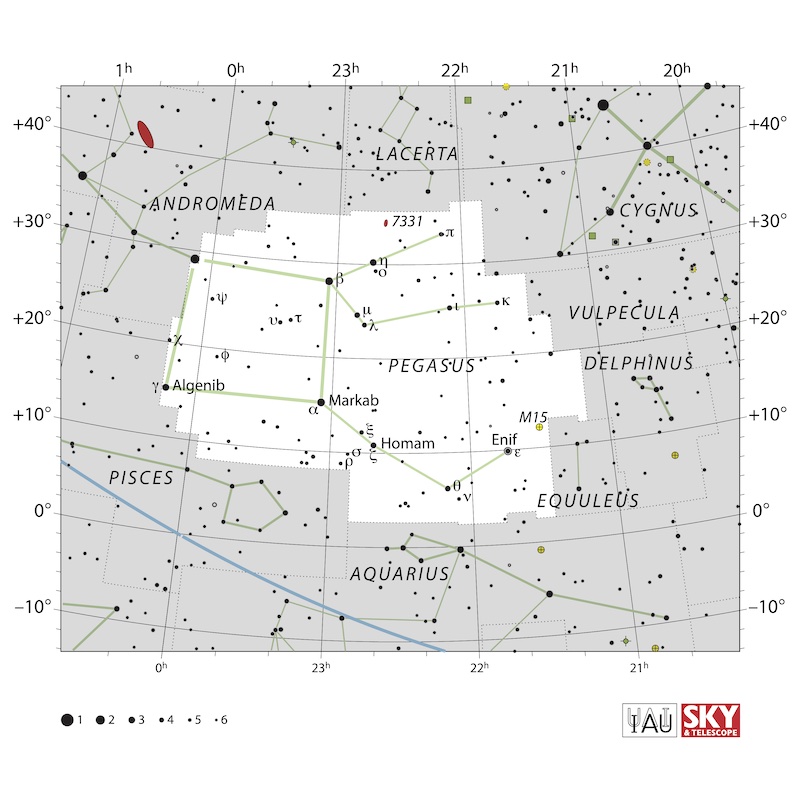
In 2026, Saturn and Fomalhaut are near the Great Square
Bottom line: How to find the Great Square of Pegasus star pattern, and why it’s worth locating in the evening sky.
Read more: Pegasus the Flying Horse, and the best sky story ever
The post Great Square of Pegasus gallops into the autumn sky first appeared on EarthSky.
from EarthSky https://ift.tt/W3jFwu8

Aucun commentaire:
Enregistrer un commentaire