

Vulpecula the Fox is not an ancient constellation. Instead, it’s one of many created by Johannes Hevelius in the 17th century. Hevelius carved a lot of new constellations out of dim regions of sky next to better-known constellations. Vulpecula is one of the small constellations that lies inside the famous asterism of the Summer Triangle. And it contains two favorite targets of amateur astronomers.
Locating Vulpecula the Fox
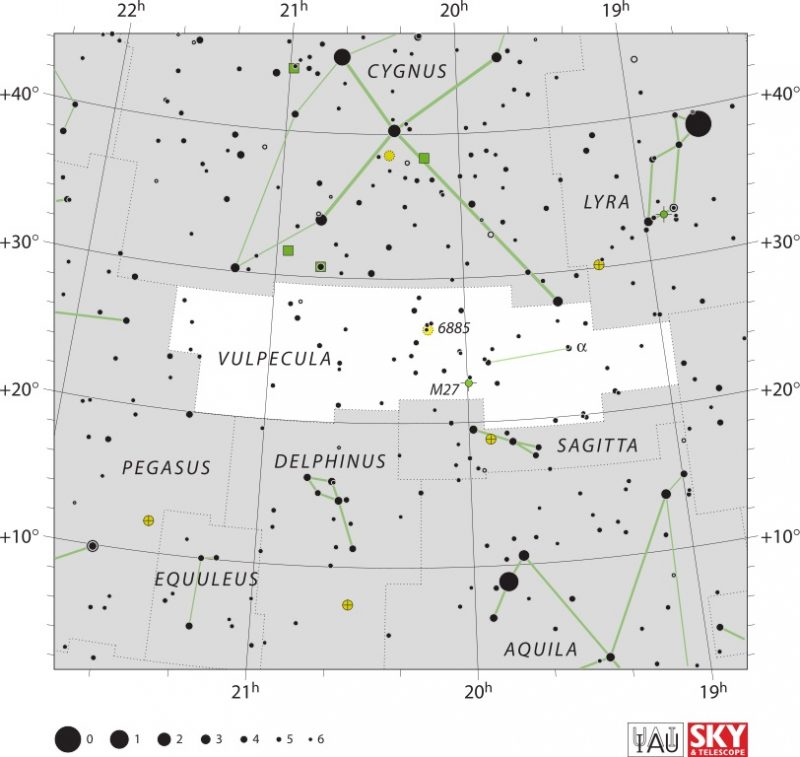
Although Vulpecula the Fox is a dim constellation, you can find it easily under dark skies because of its location within the Summer Triangle. Only Vulpecula and Sagitta the Arrow reside within the boundaries of this star pattern.
If you don’t know how to find the Summer Triangle, look for three bright stars rising in the east after dark. These stars are Altair in Aquila the Eagle, Deneb in Cygnus the Swan and Vega in Lyra the Harp. Vulpecula lies near the head of Cygnus the Swan, near the colorful double star Albireo.
Stars in Vulpecula
Vulpecula is small in size (ranking 55th out of 88 constellations) and contains no bright stars of note. But that doesn’t mean it has little to offer!
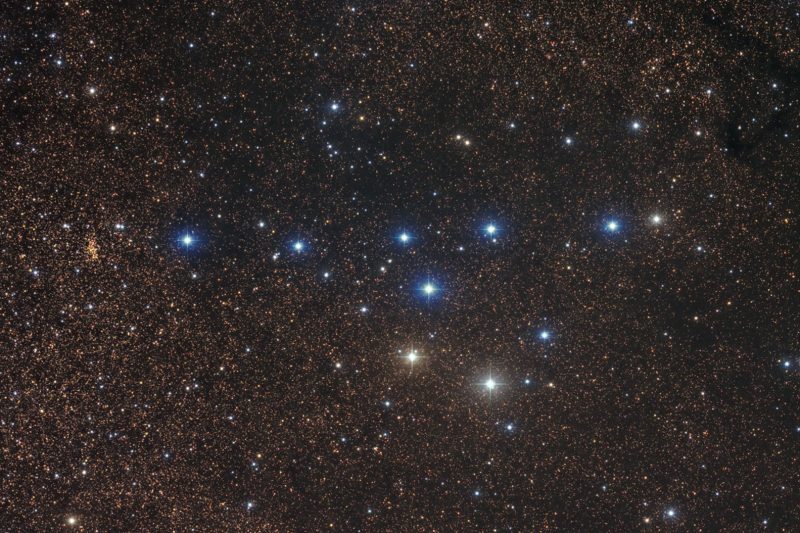
The star grouping that brings amateur astronomers to Vulpecula is the Coathanger. The Coathanger has a few other names, such as Brocchi’s Cluster and Collinder 399. Although it’s called a cluster, studies have shown that it’s not a cluster in the formal sense – a group of gravitationally connected stars – but instead just a chance alignment of stars. This becomes more clear when you learn that the distances to its 10 or so stars span a vast range, including 218 light-years, 400 light-years, 760 light-years, 901 light-years and 1,132 light-years.
The Coathanger consists of stars of magnitude 5 and 6. They are arranged in a horizontal row with a hook shape sticking out from its middle, meaning they very much resemble a coathanger. You can see this best through binoculars or a low-power telescope. Through binoculars in the Northern Hemisphere, the Coathanger will appear upside down, but through the inverted view of a telescope, it appears right side up. And it’s the opposite for those in the Southern Hemisphere.
You can find the Coathanger about halfway between Albireo and Zeta Aquilae, the wingtip of Aquila the Eagle.
The Dumbbell Nebula in Vulpecula
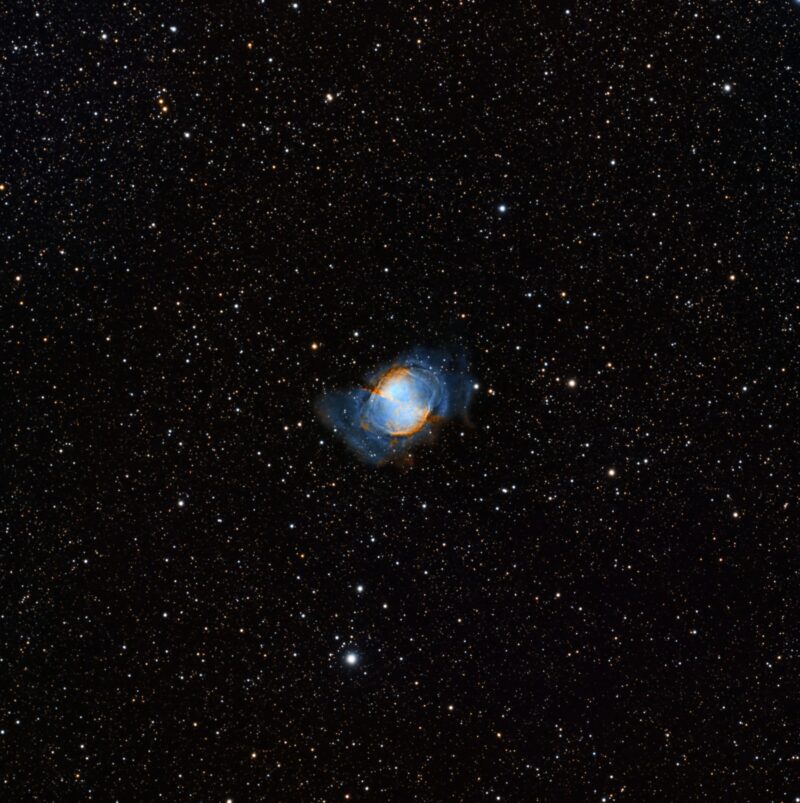
The Dumbbell Nebula is another favorite target of amateur astronomers in Vulpecula.
This nebula lies about 8 1/2 degrees east of Albireo. Also known as M27, it glows at magnitude 8.1.
The Dumbbell Nebula became the first known planetary nebula when Charles Messier discovered it in 1764.
You can see the Dumbbell in binoculars, and even a small telescope can bring out its slight hourglass shape. The nebula, which lies about 1,360 light-years away, was created when the central star blew off its envelope of gas at the end of its life.
Bottom line: Vulpecula the Fox is a small constellation that lies inside the Summer Triangle. Amateur astronomers go here to spot the Coathanger Cluster and the Dumbbell Nebula.
The post Vulpecula the Fox lies inside the Summer Triangle first appeared on EarthSky.
from EarthSky https://ift.tt/1Ejwd5Q
Vulpecula the Fox is not an ancient constellation. Instead, it’s one of many created by Johannes Hevelius in the 17th century. Hevelius carved a lot of new constellations out of dim regions of sky next to better-known constellations. Vulpecula is one of the small constellations that lies inside the famous asterism of the Summer Triangle. And it contains two favorite targets of amateur astronomers.
Locating Vulpecula the Fox
Although Vulpecula the Fox is a dim constellation, you can find it easily under dark skies because of its location within the Summer Triangle. Only Vulpecula and Sagitta the Arrow reside within the boundaries of this star pattern.
If you don’t know how to find the Summer Triangle, look for three bright stars rising in the east after dark. These stars are Altair in Aquila the Eagle, Deneb in Cygnus the Swan and Vega in Lyra the Harp. Vulpecula lies near the head of Cygnus the Swan, near the colorful double star Albireo.
Stars in Vulpecula
Vulpecula is small in size (ranking 55th out of 88 constellations) and contains no bright stars of note. But that doesn’t mean it has little to offer!
The star grouping that brings amateur astronomers to Vulpecula is the Coathanger. The Coathanger has a few other names, such as Brocchi’s Cluster and Collinder 399. Although it’s called a cluster, studies have shown that it’s not a cluster in the formal sense – a group of gravitationally connected stars – but instead just a chance alignment of stars. This becomes more clear when you learn that the distances to its 10 or so stars span a vast range, including 218 light-years, 400 light-years, 760 light-years, 901 light-years and 1,132 light-years.
The Coathanger consists of stars of magnitude 5 and 6. They are arranged in a horizontal row with a hook shape sticking out from its middle, meaning they very much resemble a coathanger. You can see this best through binoculars or a low-power telescope. Through binoculars in the Northern Hemisphere, the Coathanger will appear upside down, but through the inverted view of a telescope, it appears right side up. And it’s the opposite for those in the Southern Hemisphere.
You can find the Coathanger about halfway between Albireo and Zeta Aquilae, the wingtip of Aquila the Eagle.
The Dumbbell Nebula in Vulpecula
The Dumbbell Nebula is another favorite target of amateur astronomers in Vulpecula.
This nebula lies about 8 1/2 degrees east of Albireo. Also known as M27, it glows at magnitude 8.1.
The Dumbbell Nebula became the first known planetary nebula when Charles Messier discovered it in 1764.
You can see the Dumbbell in binoculars, and even a small telescope can bring out its slight hourglass shape. The nebula, which lies about 1,360 light-years away, was created when the central star blew off its envelope of gas at the end of its life.
Bottom line: Vulpecula the Fox is a small constellation that lies inside the Summer Triangle. Amateur astronomers go here to spot the Coathanger Cluster and the Dumbbell Nebula.
The post Vulpecula the Fox lies inside the Summer Triangle first appeared on EarthSky.
from EarthSky https://ift.tt/1Ejwd5Q

Aucun commentaire:
Enregistrer un commentaire