
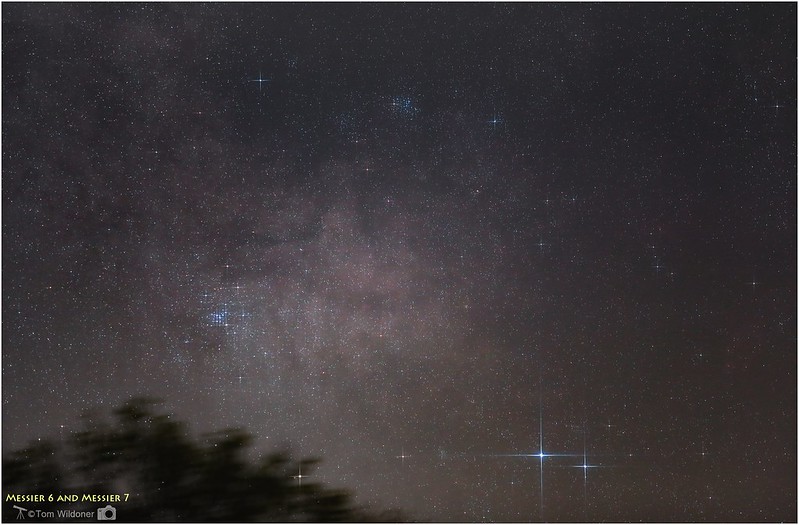
- The star clusters M6 (Butterfly Cluster) and M7 (Ptolemy’s Cluster) are near the tail of the Scorpion in the constellation Scorpius. Look for them on dark Northern Hemisphere summer nights!
- Both M6 and M7 are open star clusters, which means they are groups of stars that formed together from the same cloud of gas and dust, making them like star siblings.
- You can spot these clusters with your unaided eye on a dark, moonless night, but they look even more beautiful through binoculars.
M6 and M7: Open star clusters in the Scorpion’s Tail
Two spectacular star clusters glitter near Scorpius the Scorpion’s stinger stars, Shaula and Lesath. Messier 6 and Messier 7 – or M6 and M7 – are open star clusters. Each cluster is a group of stars formed from the same huge cloud of gas.
These two clusters are visible on summer evenings in the Northern Hemisphere, or winter evenings in the Southern Hemisphere. They’re best viewed in a dark sky, and are a stunning sight through binoculars.
How to find M6 and M7
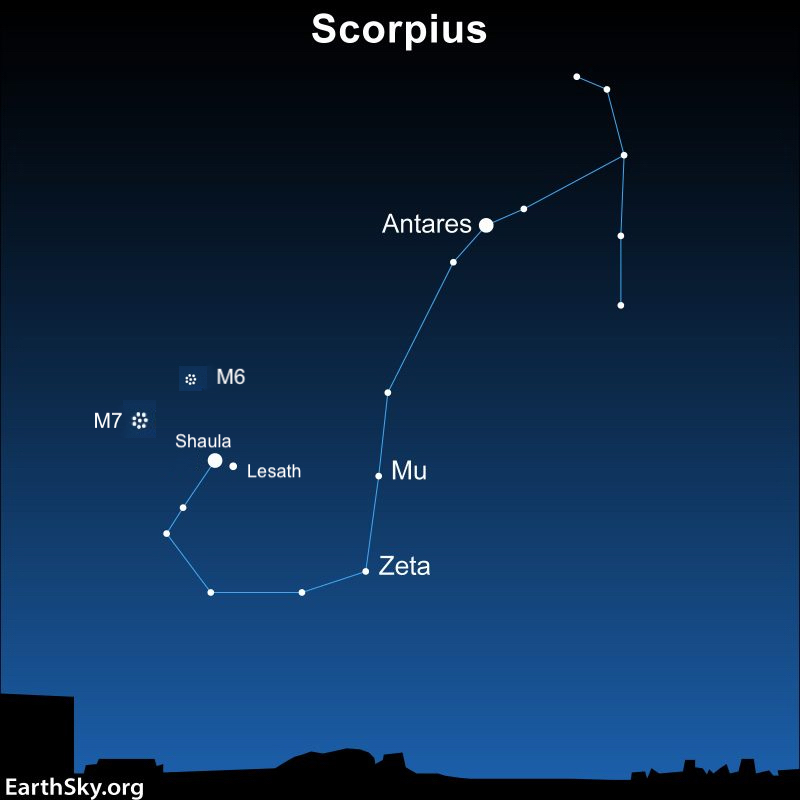
These star clusters are easy to spot in a dark sky near the curved tail of the constellation Scorpius the Scorpion. Scorpius is shaped like the letter J. And the two stars, Shaula and Lesath – at the end of the curved part of the J – mark the end of the Scorpion’s Tail. They’re known as the Cat’s Eyes, or the stinger of Scorpius.
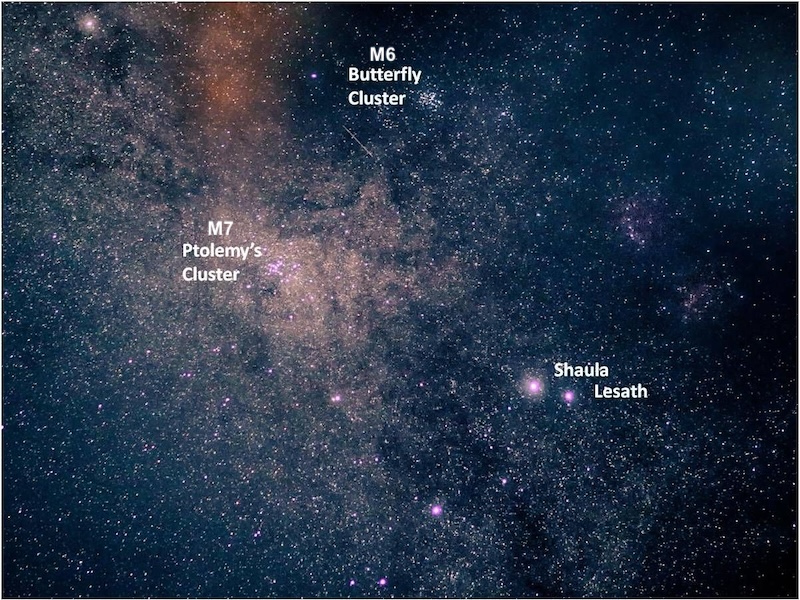
Plus, if you draw an imaginary line from Lesath through Shaula, you’ll find M7, which is the brighter and larger of the two star clusters. Then from M7, you find M6 only a short hop away.
And although M6 and M7 are visible to the unaided eye on a dark, moonless night, the brilliance and beauty of these deep sky objects is magnificent through binoculars.
If you’re in the northern U.S., Canada or a similar latitude, you’ll need an unobstructed horizon toward the south to find M6 and M7. They are highest in the sky when due south, and even then never climb very high in the sky. Meanwhile, from latitudes like those in the southern U.S., the clusters are easy to spot at their highest in the south, above the Scorpion’s Tail. Generally, Scorpius is much easier to view from the equator and most of the Southern Hemisphere.
Best time to view
Consequently, in mid-June, these clusters are visible in the sky around midnight (1 a.m. daylight saving time in the U.S.). And keep in mind that all the stars (and star clusters) return to the same place in the sky some four minutes earlier with each passing day, or two hours earlier with each passing month. Therefore, M6 and M7 appear highest in the sky at about 10 p.m. (11 p.m. daylight saving time) in mid-July, and 8 p.m. (9 p.m. daylight saving time) in mid-August.
M6 and M7 science
Even though M6 (Butterfly Cluster) and M7 (Ptolemy’s Cluster) appear close together on the sky’s dome, they are far apart in space. Indeed, M6 is about 1,600 light-years away and shines at magnitude 4.2. M7 is about 980 light-years and shines at magnitude 3.3. So, the clusters are not related to each other, but only appear near each other along our line of sight.
But, within each cluster, the stars are related. Each cluster was born from a single interstellar cloud of gas and dust. The hundreds of stars in each cluster are indeed sibling stars, in that they are gravitationally bound to one another and travel in the same direction through space. Therefore, astronomers call such a collection of stars an open star cluster.
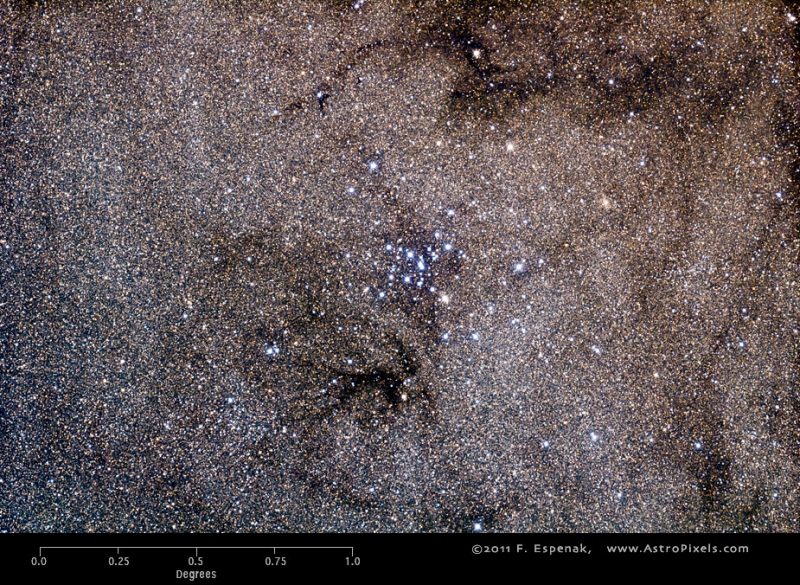
The clusters are in the thick of the Milky Way
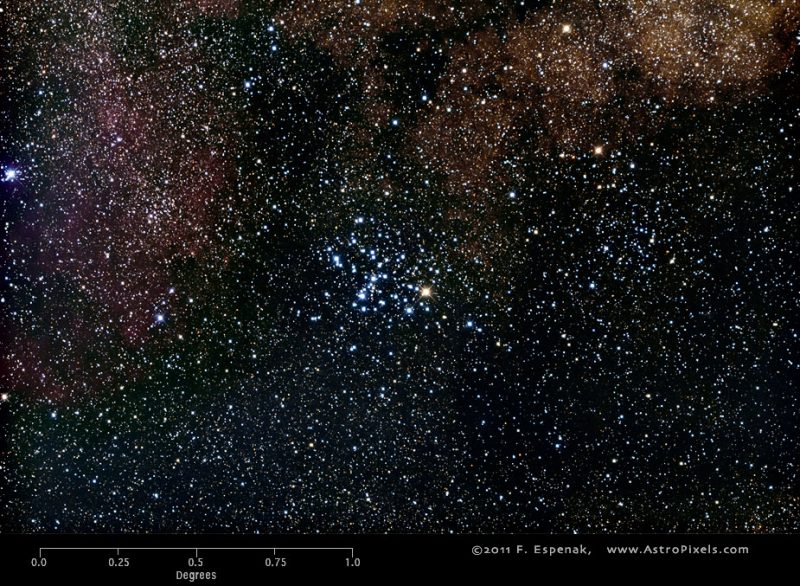
M6 and M7 reside near the galactic equator, the region on the sky’s dome rich with star clusters, star clouds and nebulae. Once you find M6 and M7, try locating other deep-sky binocular doubles, such as M8 and M20. And also check out M16 and M17. These deep-sky wonders loom farther away. Also, M6 and M7 are open star clusters. But M8 and M20, and M16 and M17, are nebulae where stars are forming.
Bottom line: Messier 6 and Messier 7 are striking star clusters near the tail of Scorpius. M6 and M7 are best in dark sky conditions through binoculars.
The post M6 and M7: Open star clusters in the Scorpion’s Tail first appeared on EarthSky.
from EarthSky https://ift.tt/XJe2z6K
- The star clusters M6 (Butterfly Cluster) and M7 (Ptolemy’s Cluster) are near the tail of the Scorpion in the constellation Scorpius. Look for them on dark Northern Hemisphere summer nights!
- Both M6 and M7 are open star clusters, which means they are groups of stars that formed together from the same cloud of gas and dust, making them like star siblings.
- You can spot these clusters with your unaided eye on a dark, moonless night, but they look even more beautiful through binoculars.
M6 and M7: Open star clusters in the Scorpion’s Tail
Two spectacular star clusters glitter near Scorpius the Scorpion’s stinger stars, Shaula and Lesath. Messier 6 and Messier 7 – or M6 and M7 – are open star clusters. Each cluster is a group of stars formed from the same huge cloud of gas.
These two clusters are visible on summer evenings in the Northern Hemisphere, or winter evenings in the Southern Hemisphere. They’re best viewed in a dark sky, and are a stunning sight through binoculars.
How to find M6 and M7
These star clusters are easy to spot in a dark sky near the curved tail of the constellation Scorpius the Scorpion. Scorpius is shaped like the letter J. And the two stars, Shaula and Lesath – at the end of the curved part of the J – mark the end of the Scorpion’s Tail. They’re known as the Cat’s Eyes, or the stinger of Scorpius.
Plus, if you draw an imaginary line from Lesath through Shaula, you’ll find M7, which is the brighter and larger of the two star clusters. Then from M7, you find M6 only a short hop away.
And although M6 and M7 are visible to the unaided eye on a dark, moonless night, the brilliance and beauty of these deep sky objects is magnificent through binoculars.
If you’re in the northern U.S., Canada or a similar latitude, you’ll need an unobstructed horizon toward the south to find M6 and M7. They are highest in the sky when due south, and even then never climb very high in the sky. Meanwhile, from latitudes like those in the southern U.S., the clusters are easy to spot at their highest in the south, above the Scorpion’s Tail. Generally, Scorpius is much easier to view from the equator and most of the Southern Hemisphere.
Best time to view
Consequently, in mid-June, these clusters are visible in the sky around midnight (1 a.m. daylight saving time in the U.S.). And keep in mind that all the stars (and star clusters) return to the same place in the sky some four minutes earlier with each passing day, or two hours earlier with each passing month. Therefore, M6 and M7 appear highest in the sky at about 10 p.m. (11 p.m. daylight saving time) in mid-July, and 8 p.m. (9 p.m. daylight saving time) in mid-August.
M6 and M7 science
Even though M6 (Butterfly Cluster) and M7 (Ptolemy’s Cluster) appear close together on the sky’s dome, they are far apart in space. Indeed, M6 is about 1,600 light-years away and shines at magnitude 4.2. M7 is about 980 light-years and shines at magnitude 3.3. So, the clusters are not related to each other, but only appear near each other along our line of sight.
But, within each cluster, the stars are related. Each cluster was born from a single interstellar cloud of gas and dust. The hundreds of stars in each cluster are indeed sibling stars, in that they are gravitationally bound to one another and travel in the same direction through space. Therefore, astronomers call such a collection of stars an open star cluster.
The clusters are in the thick of the Milky Way
M6 and M7 reside near the galactic equator, the region on the sky’s dome rich with star clusters, star clouds and nebulae. Once you find M6 and M7, try locating other deep-sky binocular doubles, such as M8 and M20. And also check out M16 and M17. These deep-sky wonders loom farther away. Also, M6 and M7 are open star clusters. But M8 and M20, and M16 and M17, are nebulae where stars are forming.
Bottom line: Messier 6 and Messier 7 are striking star clusters near the tail of Scorpius. M6 and M7 are best in dark sky conditions through binoculars.
The post M6 and M7: Open star clusters in the Scorpion’s Tail first appeared on EarthSky.
from EarthSky https://ift.tt/XJe2z6K

Aucun commentaire:
Enregistrer un commentaire