
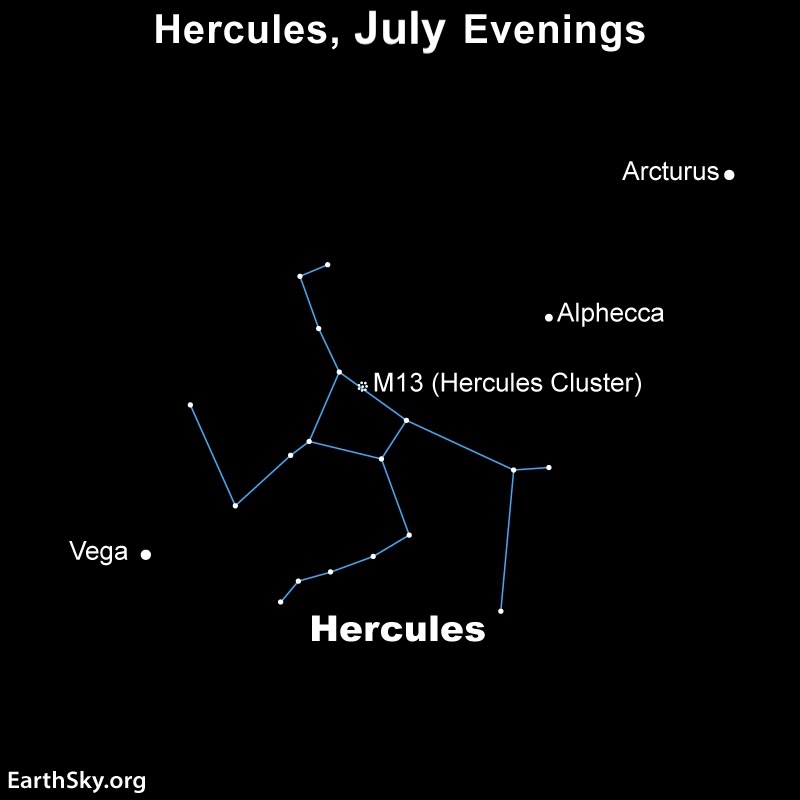
Hercules is the strong man of ancient Roman mythology. He was a son of Jupiter who had to perform the famous twelve labors. Now, astronomers know Hercules as a constellation high in the northern sky on July evenings in the Northern Hemisphere.
Hercules is home to an asterism known as the Keystone, where you can find what might be the best globular cluster for Northern Hemisphere observers: M13, or the Great Cluster in Hercules.
Also, Hercules is one of the largest of the 88 constellations, ranking fifth in size.
How to find Hercules from the Northern Hemisphere
Hercules lies next to the bright star Vega in the constellation Lyra, which lies high in Northern Hemisphere summer skies.
Specifically, Hercules lies west of Lyra and east of the constellation Boötes with its bright star Arcturus.
But because the stars of Hercules are not particularly bright, it is hard to pick out the constellation. Overall, its most distinctive shape is the asterism of the Keystone near the center of the constellation. Hercules appears somewhat like a pinwheel, with arms of stars emanating outward from this central Keystone shape.
How to find Hercules from the Southern Hemisphere
Via Daniel Gaussen, Founder & Guide – Stargaze Mackenzie – New Zealand
From the Southern Hemisphere, Hercules can be seen low in the northern sky during winter evenings. And although it never climbs as high as it does for Northern Hemisphere observers, it remains a rewarding constellation to seek out, with its distinctive Keystone asterism and the famous Great Cluster in Hercules.
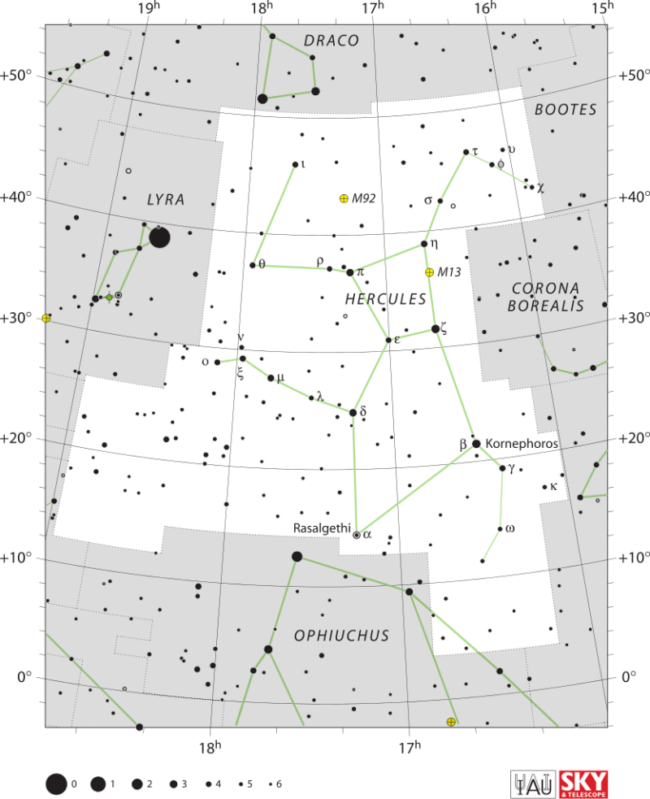
Viewed from the opposite hemisphere, the constellation appears inverted compared to Northern Hemisphere star charts. This reversal makes the Strongman appear to stand upright, with the Keystone forming his torso and his legs extending downward, rather than appearing upside down as he does for observers in the north. His arms stretch upward from the Keystone, with Beta Herculis (Kornephoros) marking one of the highest and brightest stars in the figure.
Hercules reaches its greatest altitude as it crosses the meridian (the invisible line on the sky from north to south) on winter evenings, around July. From Twizel (44 degrees south latitude) in New Zealand’s South Island, Beta Herculis rises to only about 25 degrees above the northern horizon. From Auckland (37 degrees south latitude), the same star reaches around 30 degrees, while observers in Sydney (32 degrees south latitude) see it climb to approximately 35 degrees. The rest of the constellation extends progressively lower, with much of Hercules remaining close to the northern horizon.
Identifying Hercules in dark skies
Even at these modest elevations, Hercules can still be identified under dark skies. The Keystone is a distinctive shape, and binoculars will reveal the faint, misty glow of M13 close to the horizon. Indeed, through a small telescope, the cluster begins to resolve into countless ancient stars, although its low altitude means atmospheric turbulence and haze near the horizon can reduce sharpness and detail compared with the higher views available from the Northern Hemisphere.
But for globular cluster hunters, however, Hercules faces strong competition in the south from some of the sky’s greatest globulars, including 47 Tucanae and Omega Centauri, two of the largest and brightest globular clusters in the Milky Way.
Stars of the Strongman
And even though the stars of Hercules are not particularly bright, the Keystone is obvious in dark skies.
The brightest star in the Keystone of Hercules is magnitude 2.81 Zeta Herculis, which lies 35 light-years away.
At the opposite corner of the Keystone (and the Keystone star closest to Vega) is the magnitude 3.15 star Pi Herculis. Pi Herculis lies 377 light-years away.
The northernmost Keystone star is magnitude 3.48 Eta Herculis at 112 light-years distant.
Opposite Eta Herculis and the dimmest of the four Keystone stars is magnitude 3.92 Epsilon Herculis. It lies 155 light-years away.
Additionally, the other two semi-bright stars in Hercules form an arm winding off from Zeta Herculis. The star closest to Zeta Herculis is Beta Herculis, or Kornephoros. It lies 139 light-years away with a magnitude 2.81.
And the other bright star lies close to the border with Ophiuchus. It is Alpha Herculis, lying 360 light-years away shining at magnitude 3.48. This star also has the nickname of Rasalgethi. As a matter of fact, Rasalgethi is three stars. The first component is a red giant and the other two form a double star system of a yellow giant and a yellow-white dwarf.
Globular clusters in Hercules
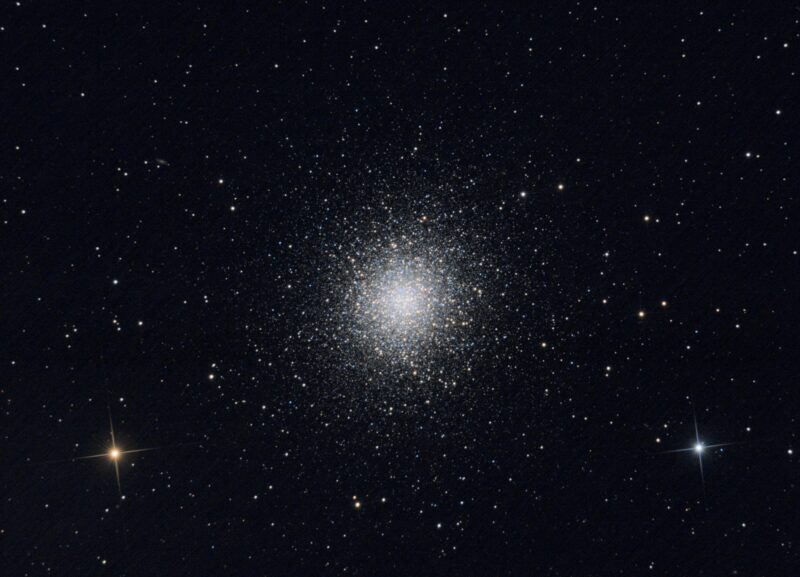
Primarily, the real attractions with the Hercules constellation are its two spectacular globular clusters. Both are Messier objects, easy to find in binoculars and a real treat through a telescope.
The first, M13, lies right on the Keystone (although in actuality it is 25,000 light-years away, much farther than the Keystone stars). M13 is 2/3 of the way on a line that stretches between the stars Zeta Herculis and Eta Herculis. It lies just 2 1/2 degrees from Eta.
The Great Cluster in Hercules shines at magnitude 5.9, meaning it’s possible to see it as a fuzzy patch with your eye alone from dark sites. So when looking at M13, you are looking at the combined light of hundreds of thousands of distant stars.
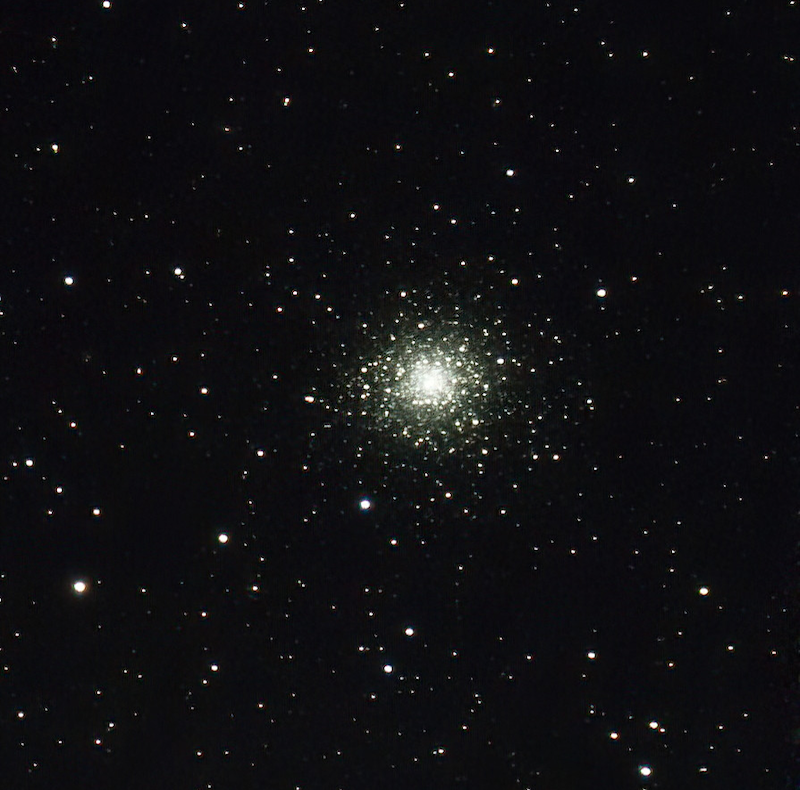
Another globular cluster in Hercules is M92. M92 makes a triangle with the two northernmost stars in the Keystone. Imagine it as where Hercules’ head would be. M92 lies about 6 1/2 degrees north of Pi Herculis and nearly 8 degrees from Eta Herculis. Shining at magnitude 6.5, M92 lies about 26,000 light-years away. You can marginally see it without optical aid, but it shows up easily in binoculars or a telescope.
M92 and the celestial pole
Another key point: 14,000 years from now, the Earth will have wobbled on its axis so that M92 is less than one degree from the north celestial pole at that time. (Read more about the precession and which stars will become the North Star over time at The North Star: Does it ever move?)
You can see in the simulation below that the north celestial pole skirts through Hercules in the bottom left corner of the visualization.
Due to Earth's precession, Polaris, Alderamin, Vega, and Thuban take turns being the North Star every 26,000 years. Due to proper motion, even Arcturus took a turn 58,000 years ago.
Simulation: higher res, more years, including Arcturus' brief reign.https://t.co/le8yOqJ5QV pic.twitter.com/5diNCQsqL6
— Tony Dunn (@tony873004) June 8, 2022
Bottom line: Hercules the Strongman is a great constellation to view in Northern Hemisphere summer. With only a pair of binoculars you can see the globular cluster M13 in Hercules’ distinctive Keystone.
Read more: M13, the Great Cluster in Hercules
The post Hercules the Strongman and a great globular cluster first appeared on EarthSky.
from EarthSky https://ift.tt/G1UFZ2g
Hercules is the strong man of ancient Roman mythology. He was a son of Jupiter who had to perform the famous twelve labors. Now, astronomers know Hercules as a constellation high in the northern sky on July evenings in the Northern Hemisphere.
Hercules is home to an asterism known as the Keystone, where you can find what might be the best globular cluster for Northern Hemisphere observers: M13, or the Great Cluster in Hercules.
Also, Hercules is one of the largest of the 88 constellations, ranking fifth in size.
How to find Hercules from the Northern Hemisphere
Hercules lies next to the bright star Vega in the constellation Lyra, which lies high in Northern Hemisphere summer skies.
Specifically, Hercules lies west of Lyra and east of the constellation Boötes with its bright star Arcturus.
But because the stars of Hercules are not particularly bright, it is hard to pick out the constellation. Overall, its most distinctive shape is the asterism of the Keystone near the center of the constellation. Hercules appears somewhat like a pinwheel, with arms of stars emanating outward from this central Keystone shape.
How to find Hercules from the Southern Hemisphere
Via Daniel Gaussen, Founder & Guide – Stargaze Mackenzie – New Zealand
From the Southern Hemisphere, Hercules can be seen low in the northern sky during winter evenings. And although it never climbs as high as it does for Northern Hemisphere observers, it remains a rewarding constellation to seek out, with its distinctive Keystone asterism and the famous Great Cluster in Hercules.
Viewed from the opposite hemisphere, the constellation appears inverted compared to Northern Hemisphere star charts. This reversal makes the Strongman appear to stand upright, with the Keystone forming his torso and his legs extending downward, rather than appearing upside down as he does for observers in the north. His arms stretch upward from the Keystone, with Beta Herculis (Kornephoros) marking one of the highest and brightest stars in the figure.
Hercules reaches its greatest altitude as it crosses the meridian (the invisible line on the sky from north to south) on winter evenings, around July. From Twizel (44 degrees south latitude) in New Zealand’s South Island, Beta Herculis rises to only about 25 degrees above the northern horizon. From Auckland (37 degrees south latitude), the same star reaches around 30 degrees, while observers in Sydney (32 degrees south latitude) see it climb to approximately 35 degrees. The rest of the constellation extends progressively lower, with much of Hercules remaining close to the northern horizon.
Identifying Hercules in dark skies
Even at these modest elevations, Hercules can still be identified under dark skies. The Keystone is a distinctive shape, and binoculars will reveal the faint, misty glow of M13 close to the horizon. Indeed, through a small telescope, the cluster begins to resolve into countless ancient stars, although its low altitude means atmospheric turbulence and haze near the horizon can reduce sharpness and detail compared with the higher views available from the Northern Hemisphere.
But for globular cluster hunters, however, Hercules faces strong competition in the south from some of the sky’s greatest globulars, including 47 Tucanae and Omega Centauri, two of the largest and brightest globular clusters in the Milky Way.
Stars of the Strongman
And even though the stars of Hercules are not particularly bright, the Keystone is obvious in dark skies.
The brightest star in the Keystone of Hercules is magnitude 2.81 Zeta Herculis, which lies 35 light-years away.
At the opposite corner of the Keystone (and the Keystone star closest to Vega) is the magnitude 3.15 star Pi Herculis. Pi Herculis lies 377 light-years away.
The northernmost Keystone star is magnitude 3.48 Eta Herculis at 112 light-years distant.
Opposite Eta Herculis and the dimmest of the four Keystone stars is magnitude 3.92 Epsilon Herculis. It lies 155 light-years away.
Additionally, the other two semi-bright stars in Hercules form an arm winding off from Zeta Herculis. The star closest to Zeta Herculis is Beta Herculis, or Kornephoros. It lies 139 light-years away with a magnitude 2.81.
And the other bright star lies close to the border with Ophiuchus. It is Alpha Herculis, lying 360 light-years away shining at magnitude 3.48. This star also has the nickname of Rasalgethi. As a matter of fact, Rasalgethi is three stars. The first component is a red giant and the other two form a double star system of a yellow giant and a yellow-white dwarf.
Globular clusters in Hercules
Primarily, the real attractions with the Hercules constellation are its two spectacular globular clusters. Both are Messier objects, easy to find in binoculars and a real treat through a telescope.
The first, M13, lies right on the Keystone (although in actuality it is 25,000 light-years away, much farther than the Keystone stars). M13 is 2/3 of the way on a line that stretches between the stars Zeta Herculis and Eta Herculis. It lies just 2 1/2 degrees from Eta.
The Great Cluster in Hercules shines at magnitude 5.9, meaning it’s possible to see it as a fuzzy patch with your eye alone from dark sites. So when looking at M13, you are looking at the combined light of hundreds of thousands of distant stars.
Another globular cluster in Hercules is M92. M92 makes a triangle with the two northernmost stars in the Keystone. Imagine it as where Hercules’ head would be. M92 lies about 6 1/2 degrees north of Pi Herculis and nearly 8 degrees from Eta Herculis. Shining at magnitude 6.5, M92 lies about 26,000 light-years away. You can marginally see it without optical aid, but it shows up easily in binoculars or a telescope.
M92 and the celestial pole
Another key point: 14,000 years from now, the Earth will have wobbled on its axis so that M92 is less than one degree from the north celestial pole at that time. (Read more about the precession and which stars will become the North Star over time at The North Star: Does it ever move?)
You can see in the simulation below that the north celestial pole skirts through Hercules in the bottom left corner of the visualization.
Due to Earth's precession, Polaris, Alderamin, Vega, and Thuban take turns being the North Star every 26,000 years. Due to proper motion, even Arcturus took a turn 58,000 years ago.
Simulation: higher res, more years, including Arcturus' brief reign.https://t.co/le8yOqJ5QV pic.twitter.com/5diNCQsqL6
— Tony Dunn (@tony873004) June 8, 2022
Bottom line: Hercules the Strongman is a great constellation to view in Northern Hemisphere summer. With only a pair of binoculars you can see the globular cluster M13 in Hercules’ distinctive Keystone.
Read more: M13, the Great Cluster in Hercules
The post Hercules the Strongman and a great globular cluster first appeared on EarthSky.
from EarthSky https://ift.tt/G1UFZ2g

Aucun commentaire:
Enregistrer un commentaire