
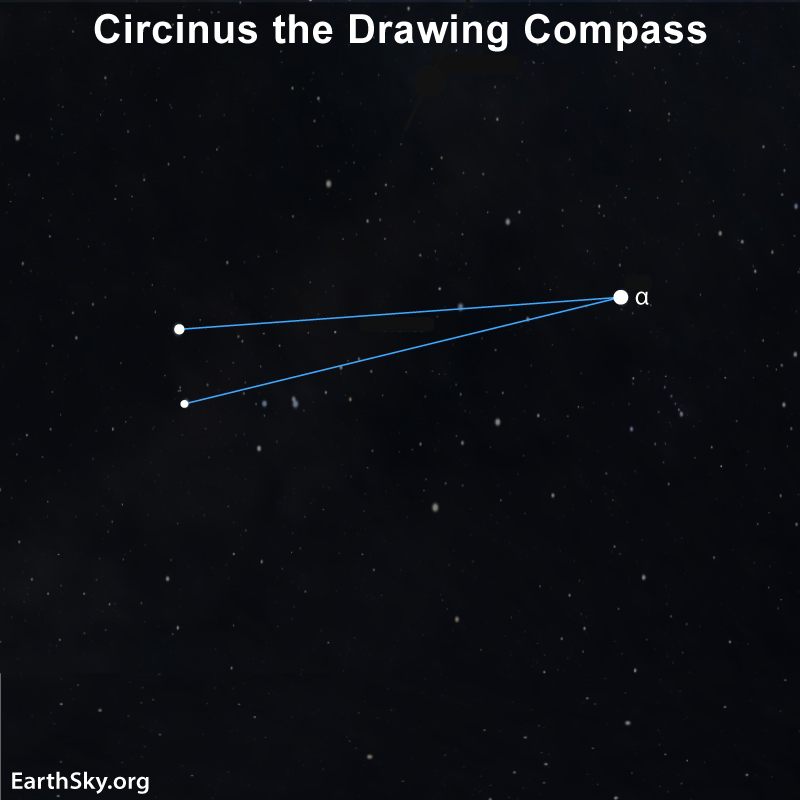
Circinus the Drawing Compass is a dim constellation of the Southern Hemisphere. Its biggest claim to fame is that it’s located next to Alpha Centauri, the third brightest star in our sky and closest star system to Earth.
Both Circinus and Alpha Centauri lie near the south celestial pole. And so, from the Southern Hemisphere, Circinus never sets. It’s circumpolar, meaning its visible throughout the night all year round in the southern sky.
Circinus is one of the 14 constellations that Nicolas-Louis de Lacaille named in the 18th century. He named it after a drafting tool, the drawing compass.
How to find Circinus
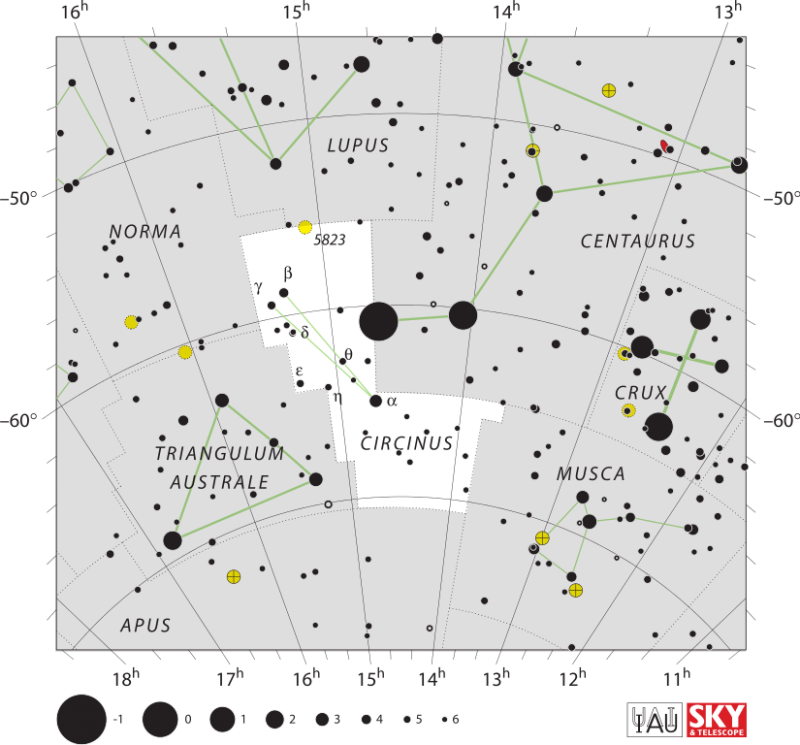
Circinus may be dim, with only one star brighter than magnitude 4, but the presence of Alpha Centauri next door makes it easy to find. As the third-brightest star in the sky, Alpha Centauri is easy to find. This magnitude -0.27 star is so far south that to even get a glimpse of it from the Northern Hemisphere, you have to be south of 29 degrees north latitude. Of course, in the Southern Hemisphere, you just have to look up.
On the opposite side of Circinus from Alpha Centauri is Triangulum Australe, the Southern Triangle. Indeed, Triangulum Australe does resemble a triangle, with its brightest corner star farthest from Circinus.
Stars and star clusters in the Drawing Compass
Circinus’ brightest star, Alpha Circini, is magnitude 3.19 and lies 53 light-years away. And its second brightest star, Beta Circini, lies 7 1/2 degrees from Alpha and shines at magnitude 4.07. It’s 97 light-years from Earth.
Circinus’ best open cluster is NGC 5823. This cluster is magnitude 7.9. Also, about 3 1/2 degrees away is another cluster for telescope observers, NGC 5715, at magnitude 10.
Circinus lies along the Milky Way, which makes it a rich hunting ground for simply scanning with a telescope and seeing what pops up.
Bottom line: Circinus the Drawing Compass is a dim constellation located next to the third brightest star in the sky, Alpha Centauri.
Read more: Meet Crux, the constellation of the Southern Cross
Read more: Glowworms turn cave ceilings into underground starscapes
The post Circinus the Drawing Compass, Alpha Centauri’s neighbor first appeared on EarthSky.
from EarthSky https://ift.tt/NMiEur6
Circinus the Drawing Compass is a dim constellation of the Southern Hemisphere. Its biggest claim to fame is that it’s located next to Alpha Centauri, the third brightest star in our sky and closest star system to Earth.
Both Circinus and Alpha Centauri lie near the south celestial pole. And so, from the Southern Hemisphere, Circinus never sets. It’s circumpolar, meaning its visible throughout the night all year round in the southern sky.
Circinus is one of the 14 constellations that Nicolas-Louis de Lacaille named in the 18th century. He named it after a drafting tool, the drawing compass.
How to find Circinus
Circinus may be dim, with only one star brighter than magnitude 4, but the presence of Alpha Centauri next door makes it easy to find. As the third-brightest star in the sky, Alpha Centauri is easy to find. This magnitude -0.27 star is so far south that to even get a glimpse of it from the Northern Hemisphere, you have to be south of 29 degrees north latitude. Of course, in the Southern Hemisphere, you just have to look up.
On the opposite side of Circinus from Alpha Centauri is Triangulum Australe, the Southern Triangle. Indeed, Triangulum Australe does resemble a triangle, with its brightest corner star farthest from Circinus.
Stars and star clusters in the Drawing Compass
Circinus’ brightest star, Alpha Circini, is magnitude 3.19 and lies 53 light-years away. And its second brightest star, Beta Circini, lies 7 1/2 degrees from Alpha and shines at magnitude 4.07. It’s 97 light-years from Earth.
Circinus’ best open cluster is NGC 5823. This cluster is magnitude 7.9. Also, about 3 1/2 degrees away is another cluster for telescope observers, NGC 5715, at magnitude 10.
Circinus lies along the Milky Way, which makes it a rich hunting ground for simply scanning with a telescope and seeing what pops up.
Bottom line: Circinus the Drawing Compass is a dim constellation located next to the third brightest star in the sky, Alpha Centauri.
Read more: Meet Crux, the constellation of the Southern Cross
Read more: Glowworms turn cave ceilings into underground starscapes
The post Circinus the Drawing Compass, Alpha Centauri’s neighbor first appeared on EarthSky.
from EarthSky https://ift.tt/NMiEur6

Aucun commentaire:
Enregistrer un commentaire