

An update to the Atlantic hurricane season forecast
On July 3, 2026, the World Meteorological Organization provided an update on how El Niño is developing. It said that from July through September we can expect a rapid development into a strong El Niño event. This means higher temperatures over much of the globe, including for the waters of the Gulf and Atlantic. So on July 8, 2026, Colorado State University provided an updated Atlantic hurricane forecast for this season. It has revised the number of tropical storms down from an already low forecast.
Both NOAA and Colorado State University (CSU) release a forecast for the Atlantic hurricane season each year. This year, both organizations called for a below-average year for tropical storms in the Atlantic basin. Back on April 9, the CSU forecast called for 13 named storms, including 2 major hurricanes. And now, as of July 8, CSU predicts 9 named storms and just 1 major hurricane.
Even though a strengthening El Niño means a less-likely chance for an active hurricane season in the Atlantic, CSU said:
Coastal residents are reminded that it only takes one hurricane making landfall to make it an active season for them.
As always, be aware and be prepared.
The original Atlantic hurricane season forecast for 2026
Originally, the National Oceanic and Atmospheric Administration (NOAA) released its official forecast for the 2026 Atlantic hurricane season on May 21, 2026. And it predicted a below-average hurricane season, specifically, 8-14 total named storms (this includes both tropical storms and hurricanes), 3-6 hurricanes and 1-3 major hurricanes. NOAA has not yet made any changes to its 2026 forecast.
Hurricane season runs from June 1 through November 30. With one month down, the Atlantic has only seen one named storm in 2026. Tropical Storm Arthur impacted the Texas coast in mid-June.
What are the categories of hurricanes? Well, major hurricanes are those that reach categories 3, 4 or 5.
- Category 3: 111–129 mph sustained winds (180-209 km/h)
- Category 4: 130–156 mph sustained winds (210-250 km/h)
- Category 5: 157 mph or higher sustained winds (251+ km/h)
Why does El Niño mean fewer hurricanes?
El Niño conditions happen when warmer-than-average water pools in the eastern Pacific near equatorial South America. Normally, cold, nutrient-rich water rises from the deep ocean in this area. But El Niño blocks the upwelling of this cold water. So it disrupts marine life and local fisheries. And its effects cascade into Earth’s atmosphere, creating conditions like rainfall and temperature shifts in some parts of the world … and affecting wind shear.
It’s El Niño’s wind shear effects that have a major impact on hurricanes. Wind shear is the change in speed and direction of the wind. Specifically for hurricanes, what matters is the condition of wind shear at 5,000 to 35,000 feet (1,500 m to 10,700 m) above the ground.
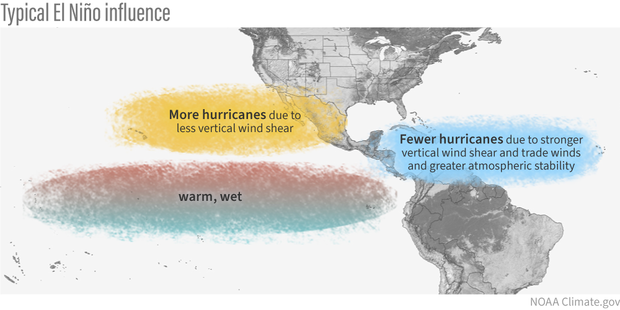
In the Atlantic, El Niño can create strong wind shear, so strong it can rip apart storms or prohibit them from forming in the first place. El Niño often brings a downstream trough of flowing winds over the Caribbean Sea and western tropical Atlantic. It’s this trough that brings the wind shear that can disrupt hurricane formation or growth. Plus, El Niño can bring sinking air to the region, which is a sign of an area of high pressure. And hurricanes are, essentially, huge organized low-pressure systems.
While El Niño hinders the formation of strong hurricane activity in the Atlantic Ocean, it helps hurricane formation in the Pacific. El Niño creates a ridge over parts of the Pacific, which favors conditions such as weaker upper-level winds and less vertical wind shear.
In conditions such as these, hurricanes can grow without obstruction.
Keep up-to-date with tropical conditions
To stay up-to-date on the tropics, visit NOAA’s National Hurricane Center page. You can toggle between Atlantic, Pacific and Central Pacific, as well as 2-day and 7-day forecasts.
Bottom line: On July 8, 2026, Colorado State University, one of the two organizations that make Atlantic hurricane season forecasts, revised their forecast down for fewer storms in 2026.
Read more: Here’s the hurricane name list for 2026
The post Atlantic hurricane season forecast updated due to El Niño first appeared on EarthSky.
from EarthSky https://ift.tt/fbmdjTk
An update to the Atlantic hurricane season forecast
On July 3, 2026, the World Meteorological Organization provided an update on how El Niño is developing. It said that from July through September we can expect a rapid development into a strong El Niño event. This means higher temperatures over much of the globe, including for the waters of the Gulf and Atlantic. So on July 8, 2026, Colorado State University provided an updated Atlantic hurricane forecast for this season. It has revised the number of tropical storms down from an already low forecast.
Both NOAA and Colorado State University (CSU) release a forecast for the Atlantic hurricane season each year. This year, both organizations called for a below-average year for tropical storms in the Atlantic basin. Back on April 9, the CSU forecast called for 13 named storms, including 2 major hurricanes. And now, as of July 8, CSU predicts 9 named storms and just 1 major hurricane.
Even though a strengthening El Niño means a less-likely chance for an active hurricane season in the Atlantic, CSU said:
Coastal residents are reminded that it only takes one hurricane making landfall to make it an active season for them.
As always, be aware and be prepared.
The original Atlantic hurricane season forecast for 2026
Originally, the National Oceanic and Atmospheric Administration (NOAA) released its official forecast for the 2026 Atlantic hurricane season on May 21, 2026. And it predicted a below-average hurricane season, specifically, 8-14 total named storms (this includes both tropical storms and hurricanes), 3-6 hurricanes and 1-3 major hurricanes. NOAA has not yet made any changes to its 2026 forecast.
Hurricane season runs from June 1 through November 30. With one month down, the Atlantic has only seen one named storm in 2026. Tropical Storm Arthur impacted the Texas coast in mid-June.
What are the categories of hurricanes? Well, major hurricanes are those that reach categories 3, 4 or 5.
- Category 3: 111–129 mph sustained winds (180-209 km/h)
- Category 4: 130–156 mph sustained winds (210-250 km/h)
- Category 5: 157 mph or higher sustained winds (251+ km/h)
Why does El Niño mean fewer hurricanes?
El Niño conditions happen when warmer-than-average water pools in the eastern Pacific near equatorial South America. Normally, cold, nutrient-rich water rises from the deep ocean in this area. But El Niño blocks the upwelling of this cold water. So it disrupts marine life and local fisheries. And its effects cascade into Earth’s atmosphere, creating conditions like rainfall and temperature shifts in some parts of the world … and affecting wind shear.
It’s El Niño’s wind shear effects that have a major impact on hurricanes. Wind shear is the change in speed and direction of the wind. Specifically for hurricanes, what matters is the condition of wind shear at 5,000 to 35,000 feet (1,500 m to 10,700 m) above the ground.
In the Atlantic, El Niño can create strong wind shear, so strong it can rip apart storms or prohibit them from forming in the first place. El Niño often brings a downstream trough of flowing winds over the Caribbean Sea and western tropical Atlantic. It’s this trough that brings the wind shear that can disrupt hurricane formation or growth. Plus, El Niño can bring sinking air to the region, which is a sign of an area of high pressure. And hurricanes are, essentially, huge organized low-pressure systems.
While El Niño hinders the formation of strong hurricane activity in the Atlantic Ocean, it helps hurricane formation in the Pacific. El Niño creates a ridge over parts of the Pacific, which favors conditions such as weaker upper-level winds and less vertical wind shear.
In conditions such as these, hurricanes can grow without obstruction.
Keep up-to-date with tropical conditions
To stay up-to-date on the tropics, visit NOAA’s National Hurricane Center page. You can toggle between Atlantic, Pacific and Central Pacific, as well as 2-day and 7-day forecasts.
Bottom line: On July 8, 2026, Colorado State University, one of the two organizations that make Atlantic hurricane season forecasts, revised their forecast down for fewer storms in 2026.
Read more: Here’s the hurricane name list for 2026
The post Atlantic hurricane season forecast updated due to El Niño first appeared on EarthSky.
from EarthSky https://ift.tt/fbmdjTk

Aucun commentaire:
Enregistrer un commentaire