
Stars twinkle, while planets (usually) shine steadily
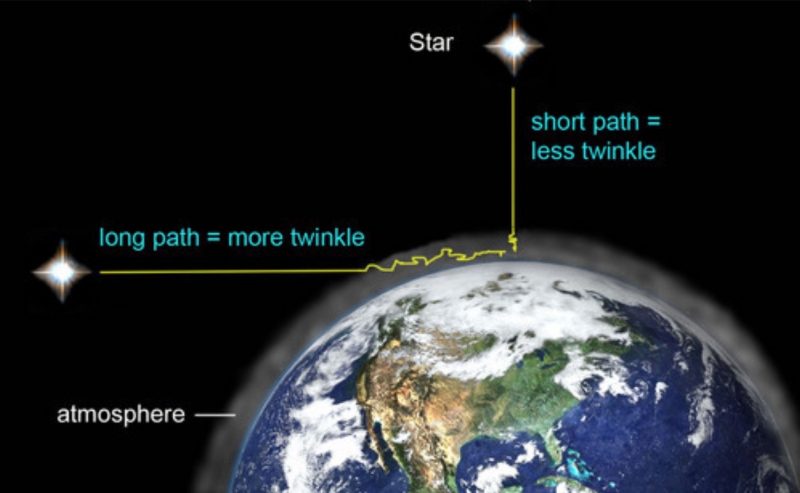
Stars twinkle because they’re so far away from Earth that, even through large telescopes, they appear only as pinpoints. And it’s easy for Earth’s atmosphere to disturb the pinpoint light of a star. As a star’s light pierces our atmosphere, it’s refracted – causing it to change direction slightly – by the various temperature and density layers in Earth’s atmosphere. You might think of it as the light traveling a zig-zag path to our eyes, instead of the straight path the light would travel if Earth didn’t have an atmosphere.
Astronomers use the term “scintillation” to describe the twinkling of stars.
The twinkling of the stars is called scintillation. Stars are so far away, that they are actually just points of light pic.twitter.com/xcnIKKhYZE
— Space Explorer Mike (@MichaelGalanin) September 8, 2017
Planets are different: they appear as tiny disks
Planets shine more steadily because they’re closer to Earth and so appear not as pinpoints, but as tiny disks in our sky. You can see planets as disks if you look through a telescope, while stars remain pinpoints. Earth’s atmosphere refracts the light from these little disks as it travels toward our eyes. But – while the light from one edge of a planet’s disk might “zig” one way – light from the opposite edge of the disk might be “zagging” in an opposite way. The zigs and zags of light from a planetary disk cancel each other out, and that’s why planets appear to shine steadily.
You might see planets twinkling if you spot them low in the sky. That’s because, in the direction of any horizon, you’re looking through more atmosphere than when you look overhead.
If you could see stars and planets from outer space, both would shine steadily. There would be no atmosphere to disturb the steady streaming of their light.
Can you figure out which objects are stars and which are planets just by looking for the twinklers vs the non-twinklers? Experienced observers often can, but, at first, if you can recognize a planet in some other way, you might notice the steadiness of its light by contrasting it to a nearby star.
Bottom line: Stars appear as pinpoints of light, making them vulnerable to atmospheric disturbance, which is why they twinkle. Planets appear as tiny disks, producing a steadier beam of light that is less visibly affected by the atmosphere.
Enjoying EarthSky so far? Sign up for our free, daily newsletter today!
Read more: Flashing star? Here are 3 candidates
The post Why do stars twinkle, but planets don’t? first appeared on EarthSky.
from EarthSky https://ift.tt/p3J2DIv
Stars twinkle, while planets (usually) shine steadily
Stars twinkle because they’re so far away from Earth that, even through large telescopes, they appear only as pinpoints. And it’s easy for Earth’s atmosphere to disturb the pinpoint light of a star. As a star’s light pierces our atmosphere, it’s refracted – causing it to change direction slightly – by the various temperature and density layers in Earth’s atmosphere. You might think of it as the light traveling a zig-zag path to our eyes, instead of the straight path the light would travel if Earth didn’t have an atmosphere.
Astronomers use the term “scintillation” to describe the twinkling of stars.
The twinkling of the stars is called scintillation. Stars are so far away, that they are actually just points of light pic.twitter.com/xcnIKKhYZE
— Space Explorer Mike (@MichaelGalanin) September 8, 2017
Planets are different: they appear as tiny disks
Planets shine more steadily because they’re closer to Earth and so appear not as pinpoints, but as tiny disks in our sky. You can see planets as disks if you look through a telescope, while stars remain pinpoints. Earth’s atmosphere refracts the light from these little disks as it travels toward our eyes. But – while the light from one edge of a planet’s disk might “zig” one way – light from the opposite edge of the disk might be “zagging” in an opposite way. The zigs and zags of light from a planetary disk cancel each other out, and that’s why planets appear to shine steadily.
You might see planets twinkling if you spot them low in the sky. That’s because, in the direction of any horizon, you’re looking through more atmosphere than when you look overhead.
If you could see stars and planets from outer space, both would shine steadily. There would be no atmosphere to disturb the steady streaming of their light.
Can you figure out which objects are stars and which are planets just by looking for the twinklers vs the non-twinklers? Experienced observers often can, but, at first, if you can recognize a planet in some other way, you might notice the steadiness of its light by contrasting it to a nearby star.
Bottom line: Stars appear as pinpoints of light, making them vulnerable to atmospheric disturbance, which is why they twinkle. Planets appear as tiny disks, producing a steadier beam of light that is less visibly affected by the atmosphere.
Enjoying EarthSky so far? Sign up for our free, daily newsletter today!
Read more: Flashing star? Here are 3 candidates
The post Why do stars twinkle, but planets don’t? first appeared on EarthSky.
from EarthSky https://ift.tt/p3J2DIv

Aucun commentaire:
Enregistrer un commentaire