
What are von Kármán vortices?
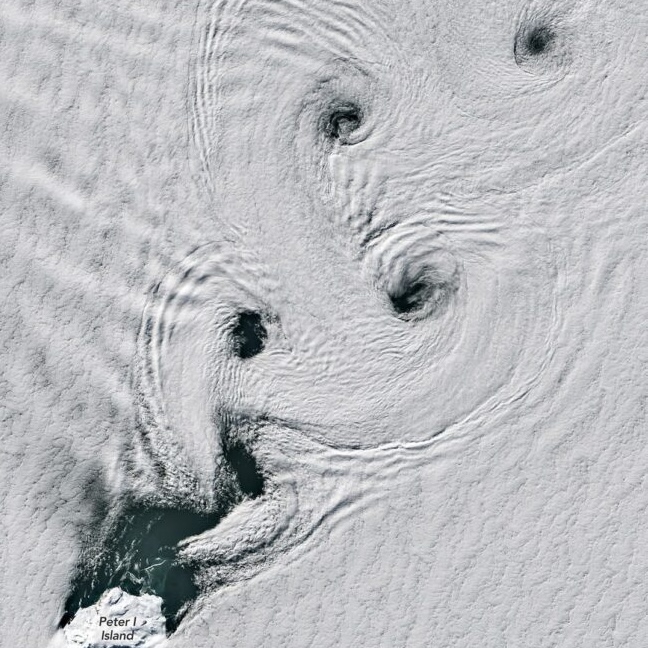
The cloudy chain of spiraling eddies – like you see above – are known as von Kármán vortices. They’re named for Theodore von Kármán (1881-1963), a Hungarian-American physicist. He was the first to describe the physical processes that create them. The patterns can form nearly anywhere an object disturbs the flow of a fluid. That means oceans … or air.
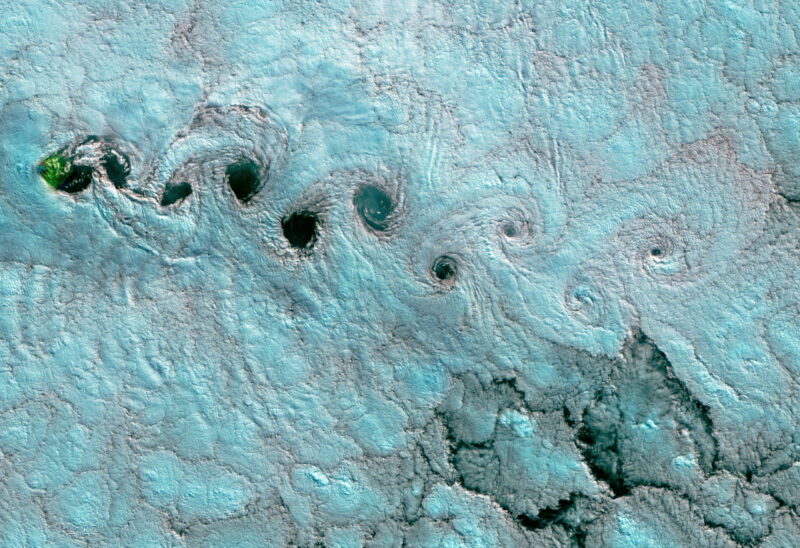
In the case of the von Kármán vortices above, they formed in Earth’s atmosphere, downwind from Peter I Island. This ice-covered volcanic island sits in the Southern Ocean between Antarctica and South America. Winds were blowing between 11 to 34 miles per hour (18 to 54 kph) on February 11, 2026, when they encountered the volcanic barrier. The wind parted on either side of the island and spun into the shapes you see here. Note that this doesn’t always happen. Stronger winds wouldn’t have allowed the eddies to retain their shape.
More on how von Kármán vortices form
Our atmosphere is composed of gases, but it flows like a fluid. And tall peaks on islands can disrupt the flow of wind, to create the swirling clouds we know as von Kármán vortices. As the winds divert around these high areas, the disturbance in the flow propagates downstream in the form of vortices that alternate their direction of rotation.

Satellites have spotted von Kármán vortices around the globe. We’ve seen these vortices off of Guadalupe Island near the coast of Chile, in the Greenland Sea, in the Arctic and even next to a tropical storm. In the satellite image below, the vortices formed in the eastern Pacific Ocean on April 30, 2024.
Animation of von Kármán vortices
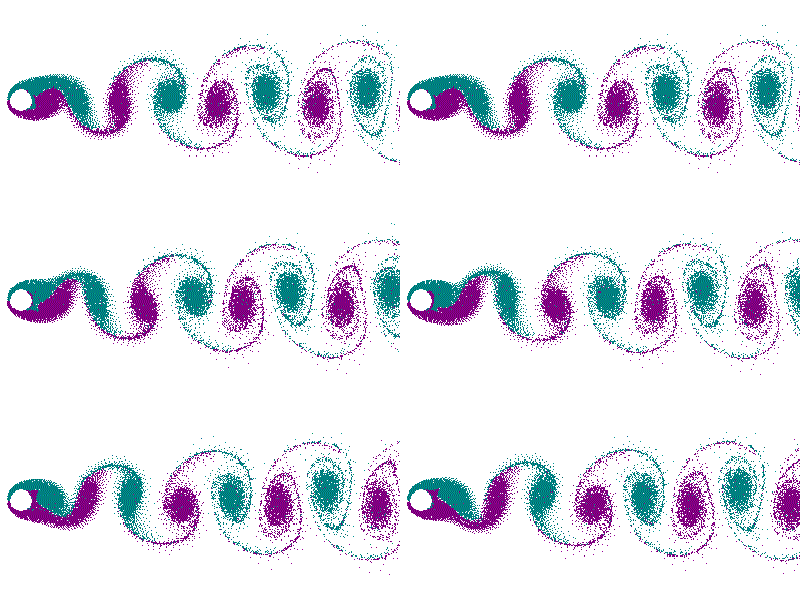
Von Kármán vortices can form nearly anywhere that fluid flow is disturbed by an object. In the images below, that “object” is an island or group of islands. Watch the animation below courtesy of Cesareo de la Rosa Siqueira at the University of São Paulo, Brazil. You’ll see how a von Kármán vortex “street” develops behind a cylinder moving through a fluid.
More images of the cloudy, swirling eddies
Swirling clouds over Norwegian island
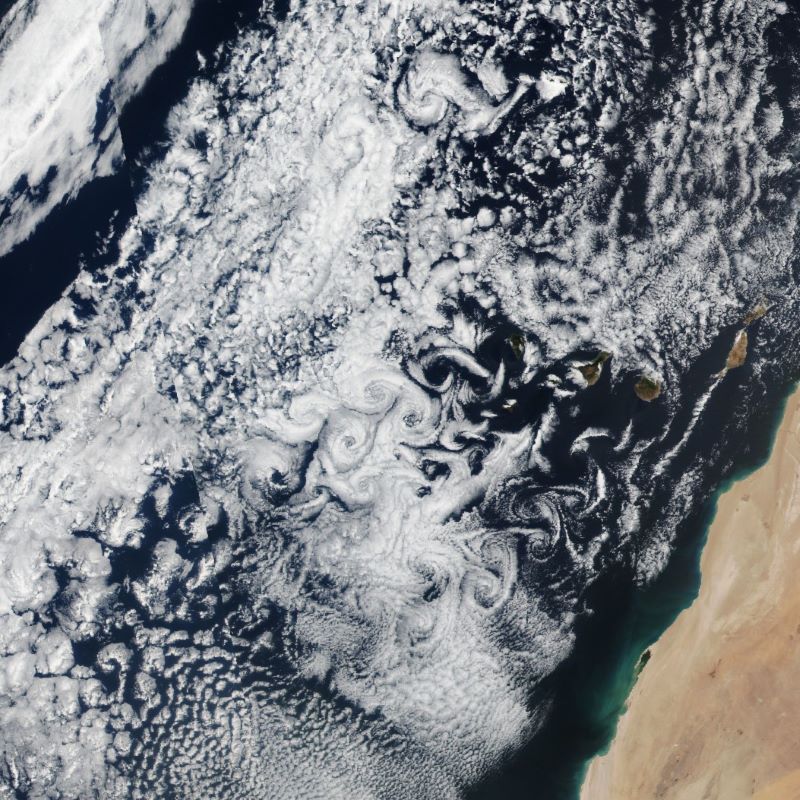
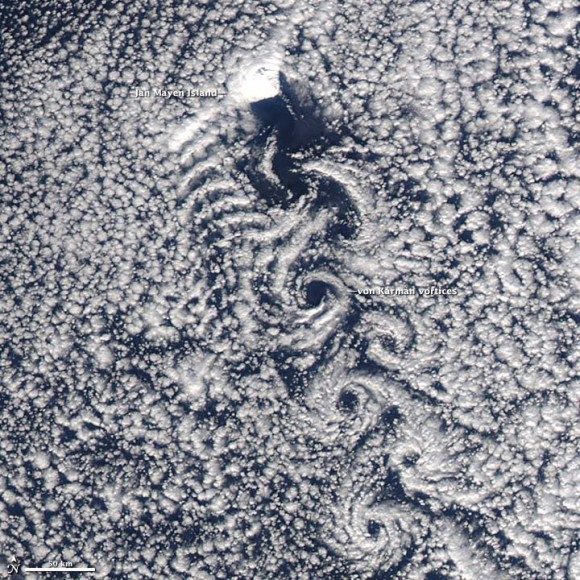
In the image below, an isolated Norwegian territory in the North Atlantic Ocean, called Jan Mayen Island, is responsible for the spiraling cloud pattern. The unique flow occurs when winds rushing from the north encounter Beerenberg Volcano. This snow-covered peak on the eastern end of the island rises 1.4 miles (2.2 km) above the sea surface. As winds pass around the volcano, the disturbance in the flow propagates downstream in the form of a double row of vortices that alternate their direction of rotation.
Bottom line: See von Kármán vortices – mesmerizing, swirling pattern of clouds – in these satellite images. These clouds form when the wind hits a barrier like a mountain.
Read more from NASA’s Earth Obervatory
Read more: Cloud streets: What are they? How do they form?
The post Von Kármán vortices are mesmerizing, swirling clouds first appeared on EarthSky.
from EarthSky https://ift.tt/usHB20f
What are von Kármán vortices?
The cloudy chain of spiraling eddies – like you see above – are known as von Kármán vortices. They’re named for Theodore von Kármán (1881-1963), a Hungarian-American physicist. He was the first to describe the physical processes that create them. The patterns can form nearly anywhere an object disturbs the flow of a fluid. That means oceans … or air.
In the case of the von Kármán vortices above, they formed in Earth’s atmosphere, downwind from Peter I Island. This ice-covered volcanic island sits in the Southern Ocean between Antarctica and South America. Winds were blowing between 11 to 34 miles per hour (18 to 54 kph) on February 11, 2026, when they encountered the volcanic barrier. The wind parted on either side of the island and spun into the shapes you see here. Note that this doesn’t always happen. Stronger winds wouldn’t have allowed the eddies to retain their shape.
More on how von Kármán vortices form
Our atmosphere is composed of gases, but it flows like a fluid. And tall peaks on islands can disrupt the flow of wind, to create the swirling clouds we know as von Kármán vortices. As the winds divert around these high areas, the disturbance in the flow propagates downstream in the form of vortices that alternate their direction of rotation.
Satellites have spotted von Kármán vortices around the globe. We’ve seen these vortices off of Guadalupe Island near the coast of Chile, in the Greenland Sea, in the Arctic and even next to a tropical storm. In the satellite image below, the vortices formed in the eastern Pacific Ocean on April 30, 2024.
Animation of von Kármán vortices
Von Kármán vortices can form nearly anywhere that fluid flow is disturbed by an object. In the images below, that “object” is an island or group of islands. Watch the animation below courtesy of Cesareo de la Rosa Siqueira at the University of São Paulo, Brazil. You’ll see how a von Kármán vortex “street” develops behind a cylinder moving through a fluid.
More images of the cloudy, swirling eddies
Swirling clouds over Norwegian island
In the image below, an isolated Norwegian territory in the North Atlantic Ocean, called Jan Mayen Island, is responsible for the spiraling cloud pattern. The unique flow occurs when winds rushing from the north encounter Beerenberg Volcano. This snow-covered peak on the eastern end of the island rises 1.4 miles (2.2 km) above the sea surface. As winds pass around the volcano, the disturbance in the flow propagates downstream in the form of a double row of vortices that alternate their direction of rotation.
Bottom line: See von Kármán vortices – mesmerizing, swirling pattern of clouds – in these satellite images. These clouds form when the wind hits a barrier like a mountain.
Read more from NASA’s Earth Obervatory
Read more: Cloud streets: What are they? How do they form?
The post Von Kármán vortices are mesmerizing, swirling clouds first appeared on EarthSky.
from EarthSky https://ift.tt/usHB20f

Aucun commentaire:
Enregistrer un commentaire