

Use Vega to locate the Keystone in Hercules
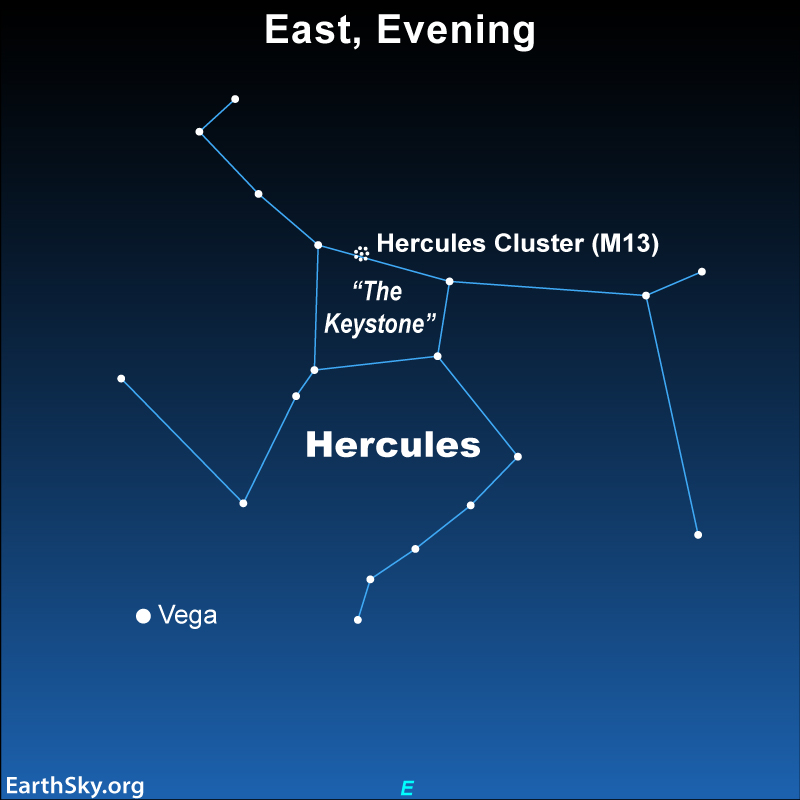
In late spring from mid-northern latitudes, you can easily find the brilliant blue-white star Vega in the eastern sky at dusk and nightfall. And this star, which lies in the constellation Lyra the Harp, acts as your guide star to the Keystone, a wedge-shaped pattern of four stars in neighboring constellation Hercules.
Look for the Keystone asterism – star pattern – to the upper right of Vega. If you hold your fist at arm’s length, it’ll easily fit between Vega and the Keystone.
Also, you can locate the Keystone by using Vega in conjunction with the brilliant yellow-orange star Arcturus, in Boötes the Herdsman. From mid-northern latitudes this time of year, Arcturus is found quite high in the eastern sky at nightfall. Then, by late evening, Arcturus moves high overhead. The Keystone is found about 1/3 of the way from Vega to Arcturus.
Use the Keystone to find M13
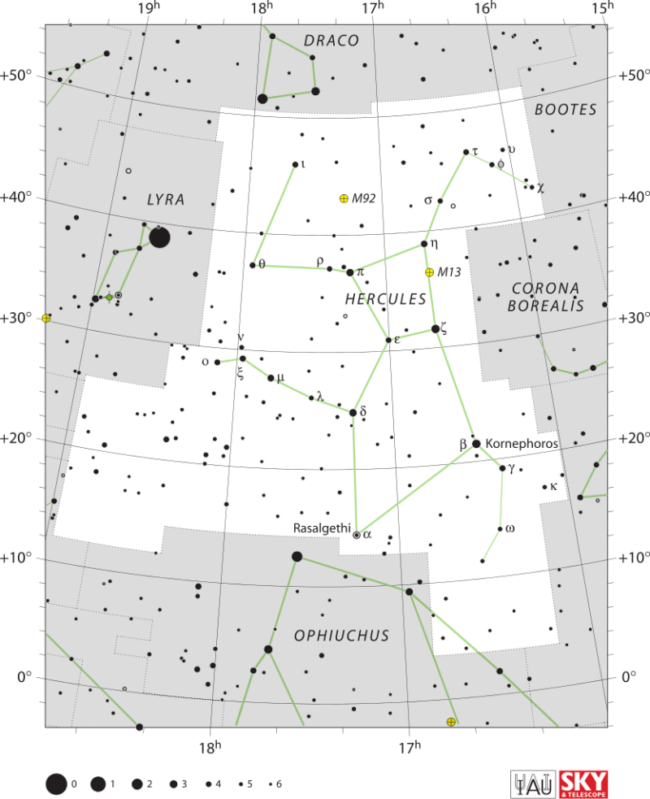
Furthermore, the Keystone is your ticket to find a famous globular star cluster in Hercules, otherwise known as the Hercules cluster, aka Messier 13 or M13.
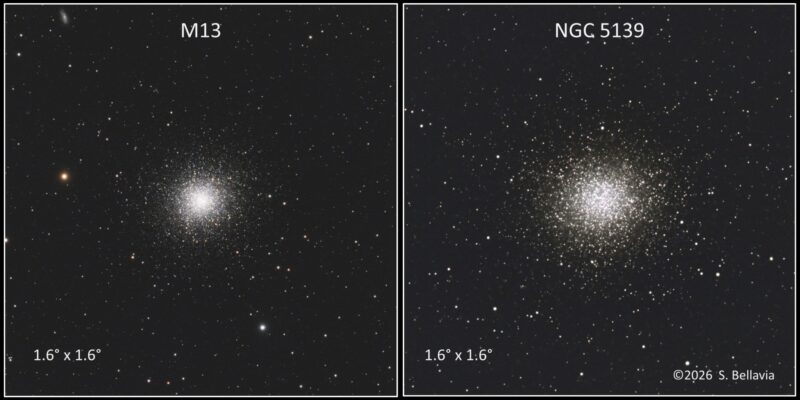
Most likely, you’ll need binoculars to see the Hercules cluster. Sharp-eyed people can see it with the unaided eye in a dark, transparent sky. Through binoculars, this cluster looks like a dim smudge or a somewhat fuzzy star. However, a telescope begins to resolve this faint fuzzy object into what it really is: a huge globe-shaped stellar city populated with hundreds of thousands of stars!
The Keystone and the Hercules cluster will swing high overhead after midnight, and are found in the western sky before dawn.
Photos of M13 from EarthSky Community Photos


Finding the Hercules Cluster from Southern Latitudes
Via Daniel Gaussen, Founder & Guide – Stargaze Mackenzie – New Zealand
The great globular cluster M13 is also visible for Southern Hemisphere viewers, although it never climbs especially high above the horizon and never becomes as prominent as it does for observers farther north. Like Northern Hemisphere observers, southern observers require dark skies to glimpse a very faint M13 with the unaided eye. Through binoculars it appears as a faint hazy patch, while telescopes begin to resolve its densely packed population of ancient stars.
M13’s home constellation Hercules becomes visible during late autumn and is best placed during winter nights. You can still find Hercules’ Keystone by using the bright star Vega, low in the northeastern sky, to guide the way west. Because Hercules remains low above the northern horizon from southern latitudes, a clear northern horizon and dark skies greatly improve the view. Even so, the Keystone can still be recognised as a compact quadrilateral pattern west (or left) of Vega.
M13 competes with the Southern Hemisphere’s own spectacular globular clusters, particularly Omega Centauri and 47 Tucanae. Both appear much larger and brighter from southern latitudes, often climbing high overhead, and provide a striking comparison to the Hercules Cluster. Nonetheless, M13 is a worthwhile target for Southern Hemisphere observers to seek out.
Bottom line: Let the bright star Vega guide you to a famous star pattern in Hercules – called the Keystone – and then to the Hercules cluster, aka M13, a famous globular star cluster.
Enjoying EarthSky so far? Sign up for our free daily newsletter today!
EarthSky astronomy kits are perfect for beginners. Order today from the EarthSky store
The post Find the Keystone in Hercules, and the Hercules Cluster M13 first appeared on EarthSky.
from EarthSky https://ift.tt/ruIX2B5
Use Vega to locate the Keystone in Hercules
In late spring from mid-northern latitudes, you can easily find the brilliant blue-white star Vega in the eastern sky at dusk and nightfall. And this star, which lies in the constellation Lyra the Harp, acts as your guide star to the Keystone, a wedge-shaped pattern of four stars in neighboring constellation Hercules.
Look for the Keystone asterism – star pattern – to the upper right of Vega. If you hold your fist at arm’s length, it’ll easily fit between Vega and the Keystone.
Also, you can locate the Keystone by using Vega in conjunction with the brilliant yellow-orange star Arcturus, in Boötes the Herdsman. From mid-northern latitudes this time of year, Arcturus is found quite high in the eastern sky at nightfall. Then, by late evening, Arcturus moves high overhead. The Keystone is found about 1/3 of the way from Vega to Arcturus.
Use the Keystone to find M13
Furthermore, the Keystone is your ticket to find a famous globular star cluster in Hercules, otherwise known as the Hercules cluster, aka Messier 13 or M13.
Most likely, you’ll need binoculars to see the Hercules cluster. Sharp-eyed people can see it with the unaided eye in a dark, transparent sky. Through binoculars, this cluster looks like a dim smudge or a somewhat fuzzy star. However, a telescope begins to resolve this faint fuzzy object into what it really is: a huge globe-shaped stellar city populated with hundreds of thousands of stars!
The Keystone and the Hercules cluster will swing high overhead after midnight, and are found in the western sky before dawn.
Photos of M13 from EarthSky Community Photos
Finding the Hercules Cluster from Southern Latitudes
Via Daniel Gaussen, Founder & Guide – Stargaze Mackenzie – New Zealand
The great globular cluster M13 is also visible for Southern Hemisphere viewers, although it never climbs especially high above the horizon and never becomes as prominent as it does for observers farther north. Like Northern Hemisphere observers, southern observers require dark skies to glimpse a very faint M13 with the unaided eye. Through binoculars it appears as a faint hazy patch, while telescopes begin to resolve its densely packed population of ancient stars.
M13’s home constellation Hercules becomes visible during late autumn and is best placed during winter nights. You can still find Hercules’ Keystone by using the bright star Vega, low in the northeastern sky, to guide the way west. Because Hercules remains low above the northern horizon from southern latitudes, a clear northern horizon and dark skies greatly improve the view. Even so, the Keystone can still be recognised as a compact quadrilateral pattern west (or left) of Vega.
M13 competes with the Southern Hemisphere’s own spectacular globular clusters, particularly Omega Centauri and 47 Tucanae. Both appear much larger and brighter from southern latitudes, often climbing high overhead, and provide a striking comparison to the Hercules Cluster. Nonetheless, M13 is a worthwhile target for Southern Hemisphere observers to seek out.
Bottom line: Let the bright star Vega guide you to a famous star pattern in Hercules – called the Keystone – and then to the Hercules cluster, aka M13, a famous globular star cluster.
Enjoying EarthSky so far? Sign up for our free daily newsletter today!
EarthSky astronomy kits are perfect for beginners. Order today from the EarthSky store
The post Find the Keystone in Hercules, and the Hercules Cluster M13 first appeared on EarthSky.
from EarthSky https://ift.tt/ruIX2B5

Aucun commentaire:
Enregistrer un commentaire