
Maybe you associate the word zodiac with astrology. But it has an honored place in astronomy, too. Here’s why.
Constellations and astrological signs
At 1 UTC on May 21, 2026, the sun will enter the astrological sign of Gemini. But – in the real sky – the sun doesn’t cross the official IAU constellation boundary into Gemini until a month later, around the June solstice (June 21).
Why is there a difference between signs as defined by astrologers, and constellations as defined by an international organization of astronomers?
The signs of Aries, Taurus, etc. – still used in astrology – are 30 degree-wide bands along the ecliptic, starting at longitude 0 degrees. This is also known as the First Point of Aries. The constellations are areas of the starry sky, defined since 1930 by specific lines and boundaries. The two coincided, somewhat over 2,000 years ago, when the system of astrological signs was defined. But precession – the wobbling of Earth’s spin axis over a cycle of 25,800 years – has made them increasingly divergent.
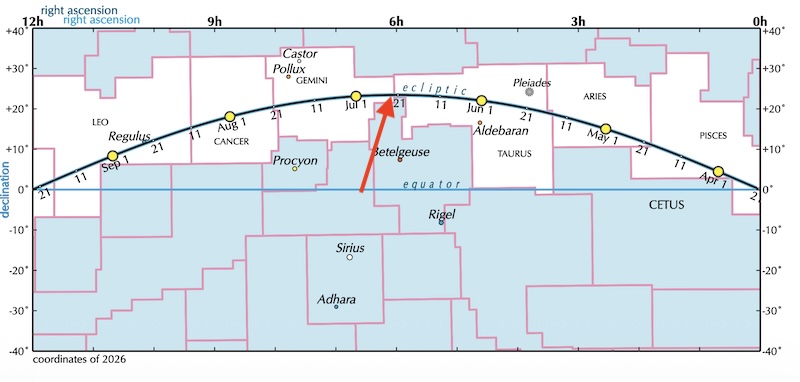
The sun’s path through the sky
The chart above shows the sun’s travel from around March 20, 2026, (the spring or vernal equinox) to September 21, 2026. You can see that the sun does indeed enter Taurus around May 21. But this brings it to the beginning (roughly) of constellation Taurus, not Gemini. It will have to travel another 30 degrees – one month – to enter Gemini.
The stars and constellations stay fixed. What shifts over time is the celestial equator – the “belt,” you could say, of the spinning Earth – and the mapping system based on it.
Picturing constellations and signs
Mentally move them. Imagine the sun’s March-to-May track, and the celestial equator – the blue line on the chart above – slid 30 degrees to the left (east), while everything else stays in place. The crossing-point of equator and ecliptic – which is the zero point for longitude – is 30 degrees to the left: it is at what is now longitude 30 degrees, the beginning of Aries. So it really is then the First Point of Aries. In this mental projection, the sun is at the First Point of Aries in March, and arrives at the gates of Gemini at this time in May.
This was how things stood when the system of signs was agreed upon, around 2,000 years ago.
You can, with some imagination, see it in your sky, or on the chart above.
There is the sun (below the horizon) at its May 21, 2026, position where it enters the astrological sign of Gemini. If this were 150 BCE it would be 30 degrees on – at what is now longitude 90 degrees – the solstice point of our time, by the feet of Gemini.
Bottom line: What is the difference between the signs of the zodiac and the constellations of the zodiac? Astronomer Guy Ottewell illustrates and discusses this difference.
Read more: Planisphere: Your friend to find stars and constellations
Read more: What’s a constellation? What’s an asterism?
The post Constellations and signs: What’s the difference? first appeared on EarthSky.
from EarthSky https://ift.tt/TSsfV2y
Maybe you associate the word zodiac with astrology. But it has an honored place in astronomy, too. Here’s why.
Constellations and astrological signs
At 1 UTC on May 21, 2026, the sun will enter the astrological sign of Gemini. But – in the real sky – the sun doesn’t cross the official IAU constellation boundary into Gemini until a month later, around the June solstice (June 21).
Why is there a difference between signs as defined by astrologers, and constellations as defined by an international organization of astronomers?
The signs of Aries, Taurus, etc. – still used in astrology – are 30 degree-wide bands along the ecliptic, starting at longitude 0 degrees. This is also known as the First Point of Aries. The constellations are areas of the starry sky, defined since 1930 by specific lines and boundaries. The two coincided, somewhat over 2,000 years ago, when the system of astrological signs was defined. But precession – the wobbling of Earth’s spin axis over a cycle of 25,800 years – has made them increasingly divergent.
The sun’s path through the sky
The chart above shows the sun’s travel from around March 20, 2026, (the spring or vernal equinox) to September 21, 2026. You can see that the sun does indeed enter Taurus around May 21. But this brings it to the beginning (roughly) of constellation Taurus, not Gemini. It will have to travel another 30 degrees – one month – to enter Gemini.
The stars and constellations stay fixed. What shifts over time is the celestial equator – the “belt,” you could say, of the spinning Earth – and the mapping system based on it.
Picturing constellations and signs
Mentally move them. Imagine the sun’s March-to-May track, and the celestial equator – the blue line on the chart above – slid 30 degrees to the left (east), while everything else stays in place. The crossing-point of equator and ecliptic – which is the zero point for longitude – is 30 degrees to the left: it is at what is now longitude 30 degrees, the beginning of Aries. So it really is then the First Point of Aries. In this mental projection, the sun is at the First Point of Aries in March, and arrives at the gates of Gemini at this time in May.
This was how things stood when the system of signs was agreed upon, around 2,000 years ago.
You can, with some imagination, see it in your sky, or on the chart above.
There is the sun (below the horizon) at its May 21, 2026, position where it enters the astrological sign of Gemini. If this were 150 BCE it would be 30 degrees on – at what is now longitude 90 degrees – the solstice point of our time, by the feet of Gemini.
Bottom line: What is the difference between the signs of the zodiac and the constellations of the zodiac? Astronomer Guy Ottewell illustrates and discusses this difference.
Read more: Planisphere: Your friend to find stars and constellations
Read more: What’s a constellation? What’s an asterism?
The post Constellations and signs: What’s the difference? first appeared on EarthSky.
from EarthSky https://ift.tt/TSsfV2y

Aucun commentaire:
Enregistrer un commentaire