

Follow the arc to Arcturus
Arcturus is a red giant star. So it’s huge and only 36.7 light-years away.
As a result, Arcturus is the 4th-brightest star in Earth’s sky. It’s the brightest star in the northern half of the sky. It’s far enough north on the sky’s dome that – for Northern Hemisphere observers – it’s visible during some part of the night throughout most of the year.
Look for Arcturus on spring evenings in the Northern Hemisphere. There’s an easy mnemonic for finding it. Just remember the phrase follow the arc to Arcturus. So you’ll follow the arc in the Big Dipper’s handle – just draw that line outward, in your mind – until you reach this bright orange star.
Arcturus is the alpha star of a cone-shaped constellation called Boötes the Herdsman. It’s tough to see a herdsman in these stars. But you might see a kite! See the chart below.

It’s the brightest star in the northern half of the sky
When astronomers speak of the celestial sphere, they’re talking about the imaginary sphere of stars surrounding Earth.
Imagine Earth’s equator projected onto the sky. A line drawn all the way around the sky – above Earth’s equator – is called the celestial equator. It divides the sky into northern and southern hemispheres, much as the earthly equator does for Earth.
The three brightest stars of the sky – Sirius, Canopus and Alpha Centauri – are all south of this celestial equator.
And, meanwhile, Arcturus is north of the celestial equator. That makes Arcturus the brightest star in the northern part of the sky. But it’s only marginally brighter than the north celestial sphere’s 2nd-brightest star, blue-white Vega.
By the way … did you know? Some people think Polaris, the North Star, is the brightest star. But it’s not. It’s about the 50th brightest star! It’s famous for being located near the celestial north pole. Read about Polaris here.
History and mythology of Bootes and Arcturus
Arcturus’ constellation Boötes the Herdsman is sometimes pictured as guarding the Great Bear, or Ursa Major, which contains the Big Dipper asterism. We sometimes hear Arcturus called the Bear Guard.
In China, Arcturus’ constellation is also called the Dragon.
In some classical Greek stories, Boötes was Icarus, who flew too close to the sun.
Because it passes directly over the Hawaiian islands, Arcturus – brightest light in Bootes – was a particularly important navigational star to the islands’ indigenous inhabitants and other Polynesians.
The translation may be questioned, but Arcturus is among the few stars mentioned in the Bible. (“Which maketh Arcturus, Orion and Pleiades, and the chambers of the south” – Job 9:9, KJV, and “Canst thou bring forth Mazzaroth in his season? or canst thou guide Arcturus with his sons?” – Job 38:32, KJV.)
Arcturus is so bright, it’s can be seen in daytime
In 1635, less than three decades after the invention of the telescope, Jean-Baptiste Morin of France observed Arcturus in the daytime with a telescope.
It was the first time that any star, besides the sun and a rare supernova, had been seen telescopically during daylight hours.
You can also observe Arcturus with the unaided eye during the day. There’s an explanatioin on how to do it in this reprint of a science paper from 1911.
1933 Century of Progress Exposition in Chicago
One interesting story about Arcturus relates to the 1933 Century of Progress Exposition in Chicago. Its promoters wanted a flashy way to open the show. And somebody figured out that the light from Arcturus could start it.
At 9:15 pm on May 27, 1933, four telescopes located in different observatories captured the light from the star and focused it into photoelectric cells. The photocells in turn worked as the switch that turned on the main spotlights to open the exhibition. It’s a good thing it wasn’t cloudy!
How did this idea come about? There’d also been a World’s Fair in Chicago in 1893, 40 years earlier. And, at the time, astronomers thought that Arcturus was 40 light-years away. If so, that light left Arcturus at the end of the 1893 fair and traveled for 40 years through space, like an Olympic torch bearer, to open the 1933 show.
It was a good idea. But today’s astronomers place the distance to Arcturus at just less than 37 light-years. Oh well. Progress!

Arcturus compared to our sun
Arcturus is a more evolved star than our sun. Billions of years from now, our sun will be a red giant star, much as Arcturus is now.
Arcturus’ diameter is roughly 25 times greater than our sun. Because of its larger size, it radiates more than 100 times the light of our sun, in visible light. If you consider infrared and other frequencies in the electromagnetic spectrum, Arcturus is about 200 times more powerful than our sun. But its mass is only slightly greater than the sun’s.
The reddish or orange color of Arcturus signifies its temperature, which is about 7,300 degrees Fahrenheit (around 4,000 degrees Celsius). That makes it several thousand degrees cooler than the surface of our sun.
Arcturus is flying southward
Generally speaking, the stars are fixed. They are all moving through space, but we don’t see them move because they’re so far away. But Arcturus has a large proper motion, or sideways motion, on the dome of Earth’s sky. Among the 1st-magnitude (or bright) stars in our stellar neighborhood, only Alpha Centauri – our sun’s nearest neighbor among the stars – has a higher proper motion.
And of course, the large proper motion of Alpha Centauri stems from the fact that it’s so close to us.
But what does the proper motion of Arcturus tell us?
It tells us that Arcturus is moving at a tremendous speed (76 miles/s or 122 km/s) relative to our solar system. Arcturus is thought to be an old star. It appears to be moving with a group of at least 52 other such stars, known as the Arcturus stream or Arcturus moving group.
Scientists think these stars weren’t part of our Milky Way galaxy, originally. Instead, they might have come from a dwarf satellite galaxy that assimilated into the Milky Way.
From the vantage point of Earth, Arcturus is rapidly moving in a southerly direction at a rate of 3.9 arcminutes per century. It’s now at about its closest point to Earth. As it moves away, it’ll someday vanish from visibility to the unaided eye.
This will happen when it reaches the border of the southern constellations Carina and Vela … in about 150,000 years.
The position of Arcturus is RA: 14h 15 m 39.7s, dec: +19° 10′ 56″
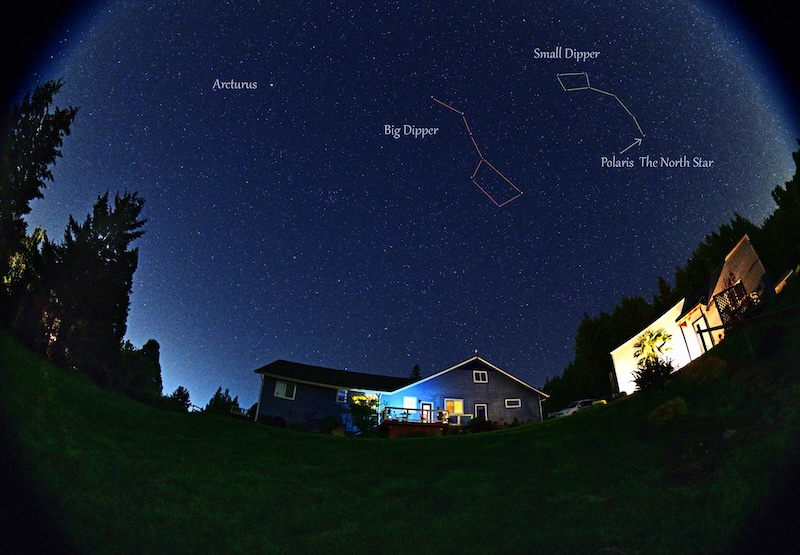
Bottom line: Arcturus is the brightest star in the northern half of the sky. It’s easy to find in spring in the Northern Hemisphere near the handle of the Big Dipper.
The post Arcturus, brightest star of the northern sky first appeared on EarthSky.
from EarthSky https://ift.tt/og1HdsF
Follow the arc to Arcturus
Arcturus is a red giant star. So it’s huge and only 36.7 light-years away.
As a result, Arcturus is the 4th-brightest star in Earth’s sky. It’s the brightest star in the northern half of the sky. It’s far enough north on the sky’s dome that – for Northern Hemisphere observers – it’s visible during some part of the night throughout most of the year.
Look for Arcturus on spring evenings in the Northern Hemisphere. There’s an easy mnemonic for finding it. Just remember the phrase follow the arc to Arcturus. So you’ll follow the arc in the Big Dipper’s handle – just draw that line outward, in your mind – until you reach this bright orange star.
Arcturus is the alpha star of a cone-shaped constellation called Boötes the Herdsman. It’s tough to see a herdsman in these stars. But you might see a kite! See the chart below.
It’s the brightest star in the northern half of the sky
When astronomers speak of the celestial sphere, they’re talking about the imaginary sphere of stars surrounding Earth.
Imagine Earth’s equator projected onto the sky. A line drawn all the way around the sky – above Earth’s equator – is called the celestial equator. It divides the sky into northern and southern hemispheres, much as the earthly equator does for Earth.
The three brightest stars of the sky – Sirius, Canopus and Alpha Centauri – are all south of this celestial equator.
And, meanwhile, Arcturus is north of the celestial equator. That makes Arcturus the brightest star in the northern part of the sky. But it’s only marginally brighter than the north celestial sphere’s 2nd-brightest star, blue-white Vega.
By the way … did you know? Some people think Polaris, the North Star, is the brightest star. But it’s not. It’s about the 50th brightest star! It’s famous for being located near the celestial north pole. Read about Polaris here.
History and mythology of Bootes and Arcturus
Arcturus’ constellation Boötes the Herdsman is sometimes pictured as guarding the Great Bear, or Ursa Major, which contains the Big Dipper asterism. We sometimes hear Arcturus called the Bear Guard.
In China, Arcturus’ constellation is also called the Dragon.
In some classical Greek stories, Boötes was Icarus, who flew too close to the sun.
Because it passes directly over the Hawaiian islands, Arcturus – brightest light in Bootes – was a particularly important navigational star to the islands’ indigenous inhabitants and other Polynesians.
The translation may be questioned, but Arcturus is among the few stars mentioned in the Bible. (“Which maketh Arcturus, Orion and Pleiades, and the chambers of the south” – Job 9:9, KJV, and “Canst thou bring forth Mazzaroth in his season? or canst thou guide Arcturus with his sons?” – Job 38:32, KJV.)
Arcturus is so bright, it’s can be seen in daytime
In 1635, less than three decades after the invention of the telescope, Jean-Baptiste Morin of France observed Arcturus in the daytime with a telescope.
It was the first time that any star, besides the sun and a rare supernova, had been seen telescopically during daylight hours.
You can also observe Arcturus with the unaided eye during the day. There’s an explanatioin on how to do it in this reprint of a science paper from 1911.
1933 Century of Progress Exposition in Chicago
One interesting story about Arcturus relates to the 1933 Century of Progress Exposition in Chicago. Its promoters wanted a flashy way to open the show. And somebody figured out that the light from Arcturus could start it.
At 9:15 pm on May 27, 1933, four telescopes located in different observatories captured the light from the star and focused it into photoelectric cells. The photocells in turn worked as the switch that turned on the main spotlights to open the exhibition. It’s a good thing it wasn’t cloudy!
How did this idea come about? There’d also been a World’s Fair in Chicago in 1893, 40 years earlier. And, at the time, astronomers thought that Arcturus was 40 light-years away. If so, that light left Arcturus at the end of the 1893 fair and traveled for 40 years through space, like an Olympic torch bearer, to open the 1933 show.
It was a good idea. But today’s astronomers place the distance to Arcturus at just less than 37 light-years. Oh well. Progress!
Arcturus compared to our sun
Arcturus is a more evolved star than our sun. Billions of years from now, our sun will be a red giant star, much as Arcturus is now.
Arcturus’ diameter is roughly 25 times greater than our sun. Because of its larger size, it radiates more than 100 times the light of our sun, in visible light. If you consider infrared and other frequencies in the electromagnetic spectrum, Arcturus is about 200 times more powerful than our sun. But its mass is only slightly greater than the sun’s.
The reddish or orange color of Arcturus signifies its temperature, which is about 7,300 degrees Fahrenheit (around 4,000 degrees Celsius). That makes it several thousand degrees cooler than the surface of our sun.
Arcturus is flying southward
Generally speaking, the stars are fixed. They are all moving through space, but we don’t see them move because they’re so far away. But Arcturus has a large proper motion, or sideways motion, on the dome of Earth’s sky. Among the 1st-magnitude (or bright) stars in our stellar neighborhood, only Alpha Centauri – our sun’s nearest neighbor among the stars – has a higher proper motion.
And of course, the large proper motion of Alpha Centauri stems from the fact that it’s so close to us.
But what does the proper motion of Arcturus tell us?
It tells us that Arcturus is moving at a tremendous speed (76 miles/s or 122 km/s) relative to our solar system. Arcturus is thought to be an old star. It appears to be moving with a group of at least 52 other such stars, known as the Arcturus stream or Arcturus moving group.
Scientists think these stars weren’t part of our Milky Way galaxy, originally. Instead, they might have come from a dwarf satellite galaxy that assimilated into the Milky Way.
From the vantage point of Earth, Arcturus is rapidly moving in a southerly direction at a rate of 3.9 arcminutes per century. It’s now at about its closest point to Earth. As it moves away, it’ll someday vanish from visibility to the unaided eye.
This will happen when it reaches the border of the southern constellations Carina and Vela … in about 150,000 years.
The position of Arcturus is RA: 14h 15 m 39.7s, dec: +19° 10′ 56″
Bottom line: Arcturus is the brightest star in the northern half of the sky. It’s easy to find in spring in the Northern Hemisphere near the handle of the Big Dipper.
The post Arcturus, brightest star of the northern sky first appeared on EarthSky.
from EarthSky https://ift.tt/og1HdsF

Aucun commentaire:
Enregistrer un commentaire