
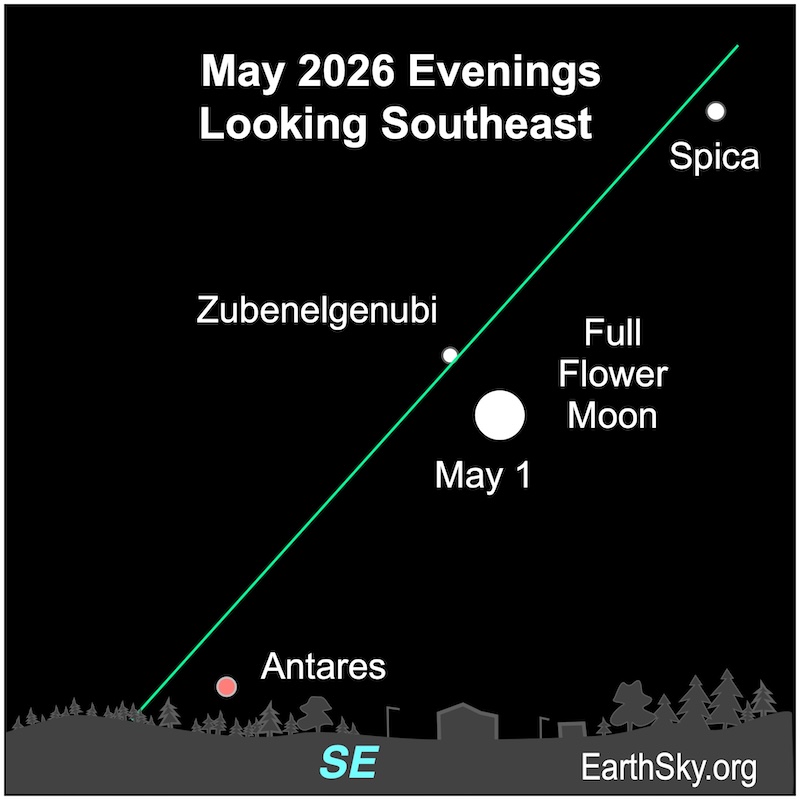
There are two full moons in May 2026. The first – on May 1 – is the full Flower Moon. The second full moon – a Blue Moon – falls on May 31. And the May 1st full moon is the first of three full micromoons – or most distant full moons – in a row in 2026.
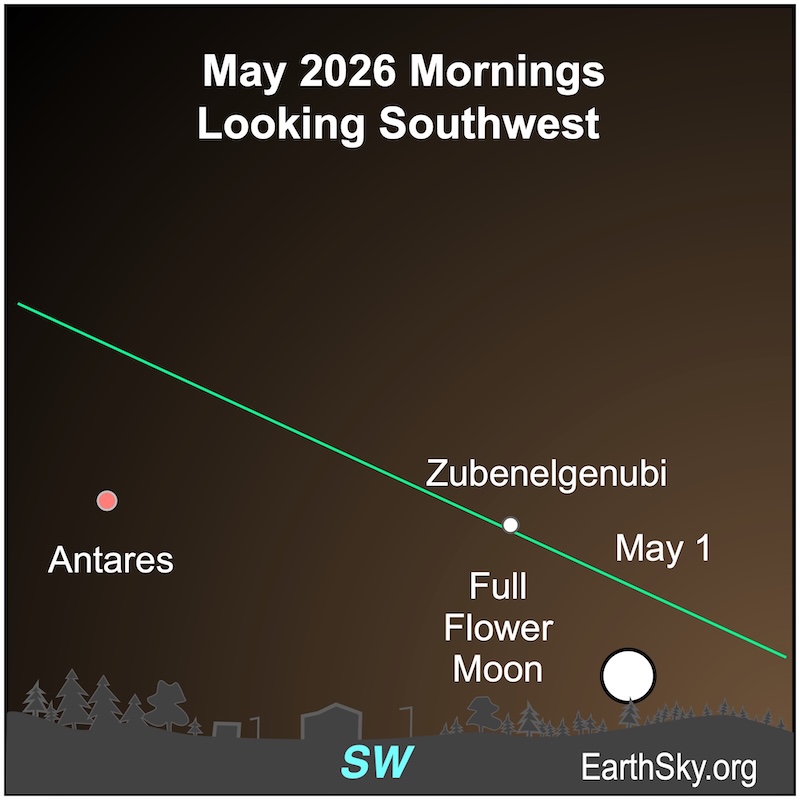
When and where to watch in 2026 for the full Flower Moon: Look for the bright, round moon rising low in the east at sunset on May 1. It will reach its highest point in the sky after midnight. And it will lie low in the west shortly before sunrise on May 2.
Crest of the full moon falls at 17:23 UTC on May 1. That’s 12:23 p.m. CDT on May 1. So the moon will look full and round when it’s setting that morning at sunrise and as it’s rising that evening at sunset.
It’s a micrcomoon: The May 1 full Flower Moon is a micromoon. That’s a moon that’s more distant than an average full moon. In fact, it’s the first of three full micromoons in a row. It’ll be 249,793 miles (402,003 km) away.
This full moon falls on May Day, which lies about midway between the March equinox and the June solstice. It – as well as Groundhog Day, Lammas, and Halloween – is a cross-quarter day.
Chart for the morning of May 1
The moon is fullest around noon
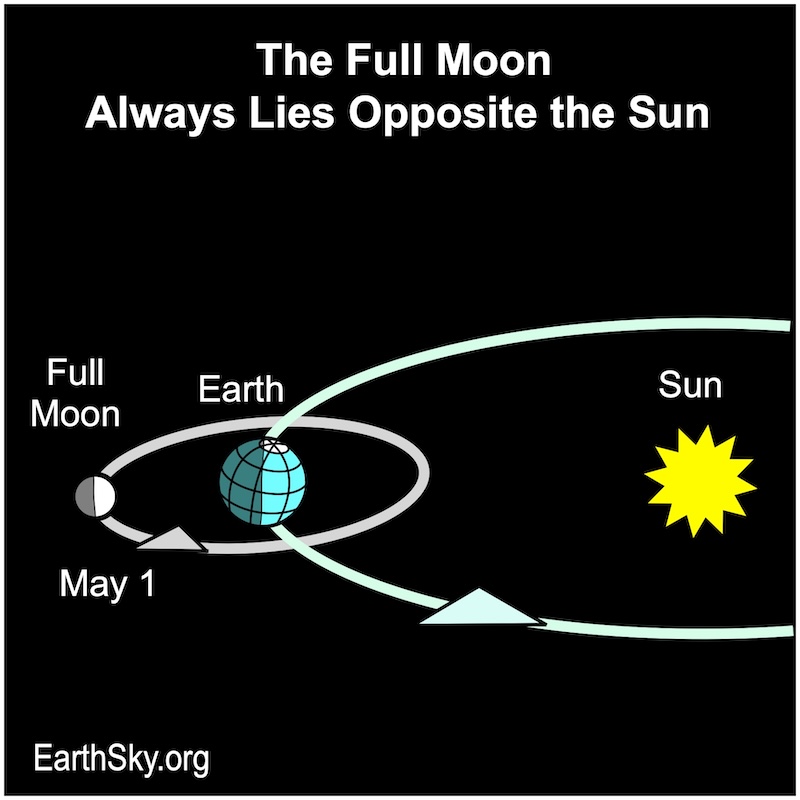
The moon will reach its fullest phase near noon on May 1 for the those in central time zones. It will appear nearly as full when it lies in the west near sunrise on May 1. And again when it lies in the east near sunset on May 1. At full moon, the sun, Earth, and moon align in space, with Earth in the middle. The moon’s day side – its fully lighted hemisphere – faces us. That’s why the moon looks full.
It’s the Flower Moon
All the full moons have nicknames. Popular names for May’s full moon include the Planting Moon and the Milky Moon, but the Flower Moon is the most common. As you might expect, the name Flower Moon recognizes the blooming of wildflowers and garden flowers. In the light of May’s full moon, many have an enchanting appearance..
Arc of the May full moon
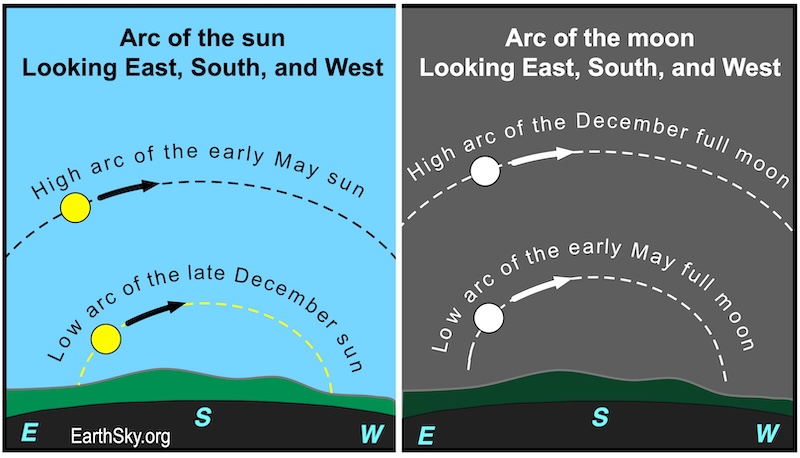
The moon’s arc across our sky varies from month to month and from season to season. Every full moon rises somewhere along the eastern horizon. It’s opposite the sun as it sets in the west. And every full moon arcs across the sky throughout the night. And then it sets somewhere along the western horizon around dawn.
For us in the Northern Hemisphere, the arc of early May’s full moon is lower than the paths of the full moons since December. However, it is higher than the next two which fall in the overnights of May 30 and June 29 in North America.
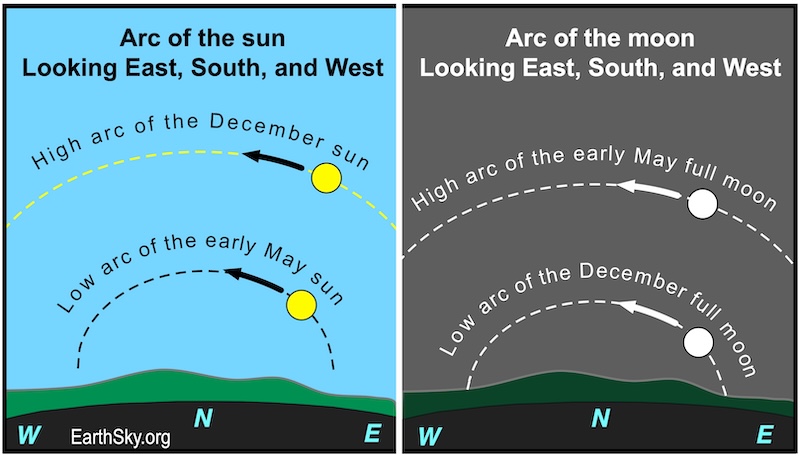
For those folks in the Southern Hemisphere, the full moon’s arc across the sky is climbing higher with each successive month since December. And it will continue to do so until the full moon nearest the June solstice. In 2026, that will be the June 29 full moon.
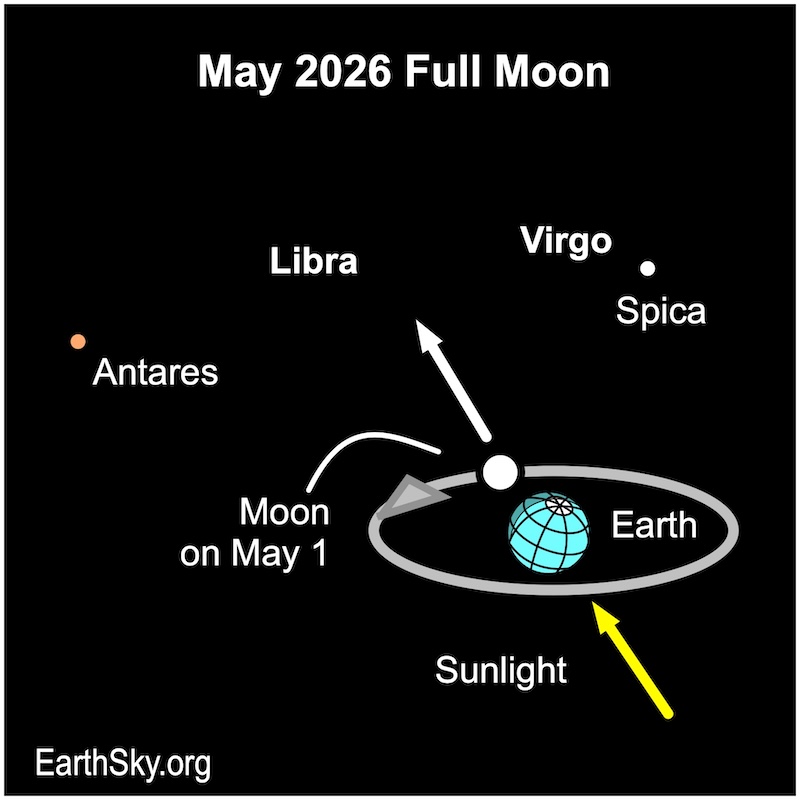
The May full moon is in both Virgo and Libra
As seen from the Americas, the almost full moon on the morning of May 1 is located in the direction of the constellation Virgo. When it rises about fourteen hours later in the evening of May 1, it has moved into the next zodiacal constellation eastward, Libra the Scales.
Bottom line: The May full moon occurs near the middle of the day on May 1. It appears full both as it sets in the morning of May 1, and as it rises in the evening of May 1.
The post May’s full moon is called the Flower Moon first appeared on EarthSky.
from EarthSky https://ift.tt/GEtLrgU
There are two full moons in May 2026. The first – on May 1 – is the full Flower Moon. The second full moon – a Blue Moon – falls on May 31. And the May 1st full moon is the first of three full micromoons – or most distant full moons – in a row in 2026.
When and where to watch in 2026 for the full Flower Moon: Look for the bright, round moon rising low in the east at sunset on May 1. It will reach its highest point in the sky after midnight. And it will lie low in the west shortly before sunrise on May 2.
Crest of the full moon falls at 17:23 UTC on May 1. That’s 12:23 p.m. CDT on May 1. So the moon will look full and round when it’s setting that morning at sunrise and as it’s rising that evening at sunset.
It’s a micrcomoon: The May 1 full Flower Moon is a micromoon. That’s a moon that’s more distant than an average full moon. In fact, it’s the first of three full micromoons in a row. It’ll be 249,793 miles (402,003 km) away.
This full moon falls on May Day, which lies about midway between the March equinox and the June solstice. It – as well as Groundhog Day, Lammas, and Halloween – is a cross-quarter day.
Chart for the morning of May 1
The moon is fullest around noon
The moon will reach its fullest phase near noon on May 1 for the those in central time zones. It will appear nearly as full when it lies in the west near sunrise on May 1. And again when it lies in the east near sunset on May 1. At full moon, the sun, Earth, and moon align in space, with Earth in the middle. The moon’s day side – its fully lighted hemisphere – faces us. That’s why the moon looks full.
It’s the Flower Moon
All the full moons have nicknames. Popular names for May’s full moon include the Planting Moon and the Milky Moon, but the Flower Moon is the most common. As you might expect, the name Flower Moon recognizes the blooming of wildflowers and garden flowers. In the light of May’s full moon, many have an enchanting appearance..
Arc of the May full moon
The moon’s arc across our sky varies from month to month and from season to season. Every full moon rises somewhere along the eastern horizon. It’s opposite the sun as it sets in the west. And every full moon arcs across the sky throughout the night. And then it sets somewhere along the western horizon around dawn.
For us in the Northern Hemisphere, the arc of early May’s full moon is lower than the paths of the full moons since December. However, it is higher than the next two which fall in the overnights of May 30 and June 29 in North America.
For those folks in the Southern Hemisphere, the full moon’s arc across the sky is climbing higher with each successive month since December. And it will continue to do so until the full moon nearest the June solstice. In 2026, that will be the June 29 full moon.
The May full moon is in both Virgo and Libra
As seen from the Americas, the almost full moon on the morning of May 1 is located in the direction of the constellation Virgo. When it rises about fourteen hours later in the evening of May 1, it has moved into the next zodiacal constellation eastward, Libra the Scales.
Bottom line: The May full moon occurs near the middle of the day on May 1. It appears full both as it sets in the morning of May 1, and as it rises in the evening of May 1.
The post May’s full moon is called the Flower Moon first appeared on EarthSky.
from EarthSky https://ift.tt/GEtLrgU

Aucun commentaire:
Enregistrer un commentaire