
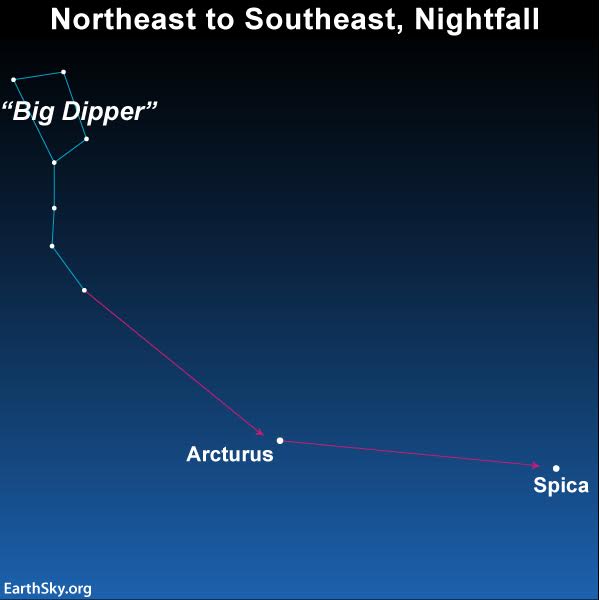
Arc to Arcturus, and speed on to Spica. Scouts learn this phrase. Grandparents teach it to kids. It’s one of the first sky tools many learn to use in astronomy. It’s a handy way to identify stars and patterns in the sky.
This mnemonic – a memory trick or device – directs you to two stars that are bright enough to shine even through the light pollution of suburbs and small cities. In fact, Spica is a prime example of a 1st-magnitude star. This means that, according to a brightness scale first used by the early astronomers Hipparchus (c.190-c.120 BCE) and Ptolemy (c.100-c.170 CE), it is one of our sky’s brightest stars.
And the star Arcturus beams brighter yet. It’s shining one magnitude (2.5 times) more brightly than Spica.
Arc to Arcturus
On any evening this month, look for the asterism of the Big Dipper high in the northeastern sky. You can’t miss the distinctive arrangement of its seven bright stars. Some people see it as an old-fashioned water ladle or a long-handled dipping spoon. Notice it has two parts: a bowl and a handle. Extend the curve of the handle until you come to a bright orange star. That’s Arcturus! It shines at a magnitude of -0.04.
Arcturus is a giant star, located an estimated 36.7 light-years from Earth. It is the 4th brightest star in the night sky. And it’s the brightest star in the constellation Boötes the Herdsman. Its name derives from the Ancient Greek for “Guardian of the Bear” due to its proximity to Ursa Major, the Great Bear. Some sky watchers still refer to it as the Bear Guard.
Speed on to Spica
Once you’ve followed the curve of the Big Dipper’s handle to Arcturus, you’re on your way to your next target. Just extend that same curve and speed on to the bright, blue-white star Spica! It shines at +1.04 magnitude. It’s the 16th brightest star in the sky.
Spica is the brightest light in Virgo the Maiden, a large, rambling constellation. Spica’s name derives from the Latin word for “ear,” referring to an ear of wheat held by the maiden. Greek astronomers associated the star and its constellation with the goddess of the harvest, Demeter. It’s also been associated with Demeter’s daughter, Persephone.
Today we know Spica as a tight double star. The two stars are indistinguishable from a single point of light in ordinary telescopes. Spica’s dual nature was revealed only by analyzing its light with a spectroscope. That’s an instrument that splits light into its component colors. Separated by just less than 11 million miles (18 million km), Spica’s two stars orbit a common center of gravity in only four days. They’re collectively more than 2,000 times brighter than our sun, and are estimated to be 7.8 and 4 times larger!
Bottom line: If you only ever learn one star mnemonic, make it this one! Arc to Arcturus and speed on to Spica to identify two of the sky’s brightest stars.
The post Follow the arc to Arcturus, then speed on to Spica first appeared on EarthSky.
from EarthSky https://ift.tt/Qvq03jt
Arc to Arcturus, and speed on to Spica. Scouts learn this phrase. Grandparents teach it to kids. It’s one of the first sky tools many learn to use in astronomy. It’s a handy way to identify stars and patterns in the sky.
This mnemonic – a memory trick or device – directs you to two stars that are bright enough to shine even through the light pollution of suburbs and small cities. In fact, Spica is a prime example of a 1st-magnitude star. This means that, according to a brightness scale first used by the early astronomers Hipparchus (c.190-c.120 BCE) and Ptolemy (c.100-c.170 CE), it is one of our sky’s brightest stars.
And the star Arcturus beams brighter yet. It’s shining one magnitude (2.5 times) more brightly than Spica.
Arc to Arcturus
On any evening this month, look for the asterism of the Big Dipper high in the northeastern sky. You can’t miss the distinctive arrangement of its seven bright stars. Some people see it as an old-fashioned water ladle or a long-handled dipping spoon. Notice it has two parts: a bowl and a handle. Extend the curve of the handle until you come to a bright orange star. That’s Arcturus! It shines at a magnitude of -0.04.
Arcturus is a giant star, located an estimated 36.7 light-years from Earth. It is the 4th brightest star in the night sky. And it’s the brightest star in the constellation Boötes the Herdsman. Its name derives from the Ancient Greek for “Guardian of the Bear” due to its proximity to Ursa Major, the Great Bear. Some sky watchers still refer to it as the Bear Guard.
Speed on to Spica
Once you’ve followed the curve of the Big Dipper’s handle to Arcturus, you’re on your way to your next target. Just extend that same curve and speed on to the bright, blue-white star Spica! It shines at +1.04 magnitude. It’s the 16th brightest star in the sky.
Spica is the brightest light in Virgo the Maiden, a large, rambling constellation. Spica’s name derives from the Latin word for “ear,” referring to an ear of wheat held by the maiden. Greek astronomers associated the star and its constellation with the goddess of the harvest, Demeter. It’s also been associated with Demeter’s daughter, Persephone.
Today we know Spica as a tight double star. The two stars are indistinguishable from a single point of light in ordinary telescopes. Spica’s dual nature was revealed only by analyzing its light with a spectroscope. That’s an instrument that splits light into its component colors. Separated by just less than 11 million miles (18 million km), Spica’s two stars orbit a common center of gravity in only four days. They’re collectively more than 2,000 times brighter than our sun, and are estimated to be 7.8 and 4 times larger!
Bottom line: If you only ever learn one star mnemonic, make it this one! Arc to Arcturus and speed on to Spica to identify two of the sky’s brightest stars.
The post Follow the arc to Arcturus, then speed on to Spica first appeared on EarthSky.
from EarthSky https://ift.tt/Qvq03jt

Aucun commentaire:
Enregistrer un commentaire