We tell you all you need to know about halos in our YouTube video here. Don’t forget to subscribe!
What causes halos?
Have you ever looked up and spotted a large ring of light around the sun or moon? Scientists refer to these as 22-degree halos. They got that name because the radius of the circle is always approximately 22 degrees.
There’s an old weather saying: ring around the moon means rain soon. There’s truth to this saying, because high cirrus clouds often come before a storm. Notice in these photos that the sky looks fairly clear. After all, you can see the sun or moon. And yet halos are a sign of high, thin cirrus clouds drifting 20,000 feet (6 km) or more above our heads.
These clouds contain millions of tiny ice crystals. The halos you see are caused by both refraction, or splitting of light, and also by reflection, or glints of light from these ice crystals. The crystals must be oriented and positioned just so with respect to your eye, for the halo to appear.
That’s why, like rainbows, halos around the sun – or moon – are personal. Everyone sees their own unique halo, made by the ice crystals from their point of view. So they are different from the ice crystals making the halo of a person standing next to you.
View at EarthSky Community Photos. | Roberto Ortu captured this moon halo on February 2, 2026, in Italy and wrote: “A moon halo has an apparent radius of 22 degrees and forms around the moon due to refraction by hexagonal-shaped ice crystals that are present in Earth’s atmosphere.” Thank you, Roberto! Notice that – unlike solar halos, which can be colorful – lunar halos are mostly colorless.
A word of caution for photographers
Take care when photographing solar halos. Pointing a camera directly at the unobscured sun can damage it. Never look directly at the sun, even when it is less bright through clouds or fog.
Are halos more common at high latitudes?
We asked Les Cowley of the website Atmospheric Optics if halos around the sun and moon are more frequently seen at high latitudes and less commonly seen closer to the equator. He said:
That’s a good question that is not easy to answer accurately because no halo frequency statistics are collected except in one or two mid-latitude European countries.
We need to distinguish between (a) halos formed by low level diamond dust during very cold weather and (b) halos formed by ice crystals in high cirrus cloud.
Obviously (a) halos only occur in polar regions or countries with very cold winters (Canada for example is not high latitude).
(b) Halos can occur anywhere on the planet during winter or summer. Their frequency depends on the frequency of cirrus coverage and whether it has had a history such that it contains halo forming crystals. The latter is hard to predict. For example, there are major differences in halo frequencies and types of halos across even 200 miles [300 km] in the U.K.
Halos are made by both refraction and reflection ice crystals, such as these, in this photo by Walt Tate. Image via Walt Tate/ Atmospheric Optics. Used with permission.
If you see a halo, notice this!
Because moonlight isn’t very bright, lunar halos are mostly colorless. However, you might notice red on the inside and blue on the outside of the halo. These colors are more noticeable in halos around the sun. If you do see a halo around the moon or sun, notice that the inner edge is sharp, while the outer edge is more diffuse. Also, notice that the sky surrounding the halo is darker than the rest of the sky.
Halo photos from EarthSky’s Community
View at EarthSky Community Photos. | Samit Saha captured this image on January 30, 2026, and wrote: “A bright lunar halo surrounds the moon on a bone-chilling winter night in India. The circular ring formed as moonlight passed through countless hexagonal ice crystals suspended in high, thin cirrostratus clouds, creating the classic 22-degree halo. Snow-covered hills beneath the sky emphasize the clarity and depth of the winter atmosphere. The wide-field view reveals several familiar constellations – Orion, Taurus, Gemini, and the Pleiades – along with the bright planet Jupiter, all sharing the frame with the glowing halo. Such halos often signal approaching weather changes, yet for a brief moment, the sky offered a rare balance of atmospheric optics and celestial geometry, captured in a single exposure.” Thank you, Samit!View at EarthSky Community Photos. | Bonnie Swan captured this image in Wisconsin on January 21, 2026, and wrote: “While driving east early in the morning, the halo and sun dogs around the rising sun continued to be very bright, when I found a vantage point to get the whole image, I had to pull over to capture it!” Thank you, Bonnie!View at EarthSky Community Photos. | Dario Giannobile captured this in Manhattan on December 12, 2025, and wrote: “In a handheld shot of the Statue of Liberty taken from the ferry connecting Ellis Island to Manhattan, with seagulls crossing the sky, a series of rare optical phenomena framed the Statue’s crown. These are complex interactions of light with small ice crystals suspended in the air. This rare atmospheric condition created an extraordinary scene: a perfect solar halo, accompanied by parhelia (so-called “false suns”), a parhelic arc and a superior tangent arc.” Thank you, Dario!
More halo photos from our friends
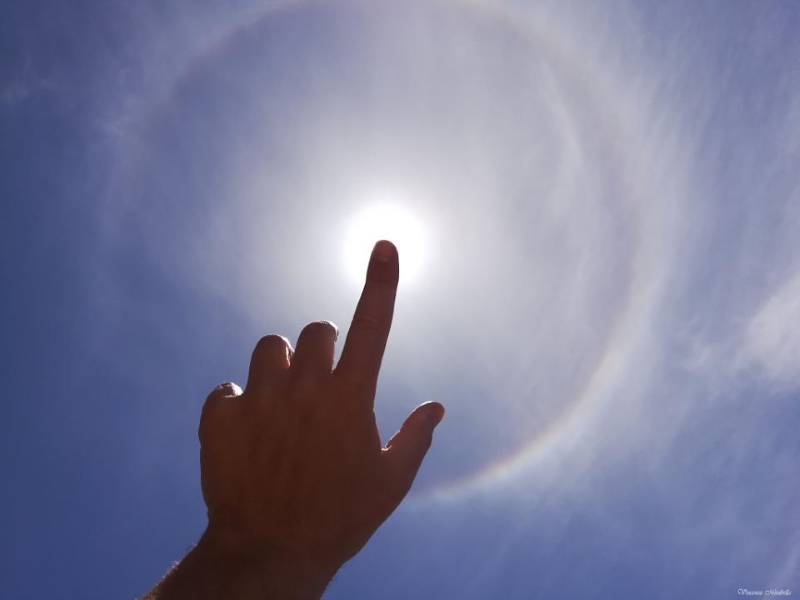
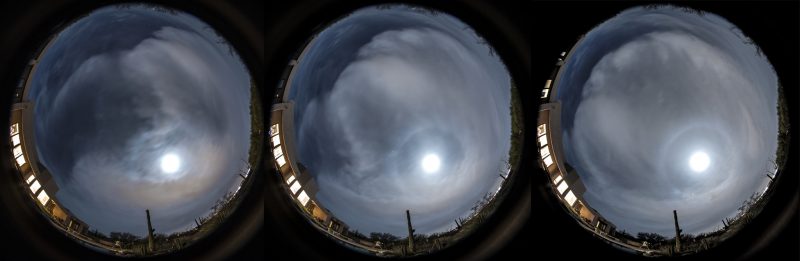
Everyone sees his or her own halo. That’s because – for every individual – a solar or lunar halo is made of light reflecting and refracting from different ice crystals in high, thin cirrus clouds. Image via Vincenzo Mirabella/ NASA. Used with permission.View at EarthSky Community Photos. | Amrinderjit Singh captured this photo from India on December 12, 2025, and wrote: “At 2200 meters high in the mountains, the sky offered its beauty by displaying a halo around the sun and I was right there to capture this beautiful landscape.” Thank you, Amrinderjit!View at EarthSky Community Photos. | Teresa Raines captured this image from Arizona on January 4, 2026, and wrote: “Lunar halo, with Orion in the bottom right corner, Jupiter next to moon peeking through top palm tree frond.” Thank you, Teresa!Eliot Herman wrote on May 5, 2018: “This shows the change that occurred over 7 minutes as a lunar halo emerged. It then persisted for about 40 minutes and disappeared with increasing clouds. Although it appears the halo is forming from an odd shape, what is actually illuminated is the edge of the clouds just before the halo formed as the clouds drifted in front of the moon. But it does have a nice illusion of an odd-shaped halo then becoming round.” Used with permission.
Bottom line: High, thin cirrus clouds drifting high above your head create the halos you see around the sun or moon. The halos are from tiny ice crystals in Earth’s atmosphere. They do it by refracting and reflecting the light. Lunar halos are signs that storms are nearby.
We tell you all you need to know about halos in our YouTube video here. Don’t forget to subscribe!
What causes halos?
Have you ever looked up and spotted a large ring of light around the sun or moon? Scientists refer to these as 22-degree halos. They got that name because the radius of the circle is always approximately 22 degrees.
There’s an old weather saying: ring around the moon means rain soon. There’s truth to this saying, because high cirrus clouds often come before a storm. Notice in these photos that the sky looks fairly clear. After all, you can see the sun or moon. And yet halos are a sign of high, thin cirrus clouds drifting 20,000 feet (6 km) or more above our heads.
These clouds contain millions of tiny ice crystals. The halos you see are caused by both refraction, or splitting of light, and also by reflection, or glints of light from these ice crystals. The crystals must be oriented and positioned just so with respect to your eye, for the halo to appear.
That’s why, like rainbows, halos around the sun – or moon – are personal. Everyone sees their own unique halo, made by the ice crystals from their point of view. So they are different from the ice crystals making the halo of a person standing next to you.
View at EarthSky Community Photos. | Roberto Ortu captured this moon halo on February 2, 2026, in Italy and wrote: “A moon halo has an apparent radius of 22 degrees and forms around the moon due to refraction by hexagonal-shaped ice crystals that are present in Earth’s atmosphere.” Thank you, Roberto! Notice that – unlike solar halos, which can be colorful – lunar halos are mostly colorless.
A word of caution for photographers
Take care when photographing solar halos. Pointing a camera directly at the unobscured sun can damage it. Never look directly at the sun, even when it is less bright through clouds or fog.
Are halos more common at high latitudes?
We asked Les Cowley of the website Atmospheric Optics if halos around the sun and moon are more frequently seen at high latitudes and less commonly seen closer to the equator. He said:
That’s a good question that is not easy to answer accurately because no halo frequency statistics are collected except in one or two mid-latitude European countries.
We need to distinguish between (a) halos formed by low level diamond dust during very cold weather and (b) halos formed by ice crystals in high cirrus cloud.
Obviously (a) halos only occur in polar regions or countries with very cold winters (Canada for example is not high latitude).
(b) Halos can occur anywhere on the planet during winter or summer. Their frequency depends on the frequency of cirrus coverage and whether it has had a history such that it contains halo forming crystals. The latter is hard to predict. For example, there are major differences in halo frequencies and types of halos across even 200 miles [300 km] in the U.K.
Halos are made by both refraction and reflection ice crystals, such as these, in this photo by Walt Tate. Image via Walt Tate/ Atmospheric Optics. Used with permission.
If you see a halo, notice this!
Because moonlight isn’t very bright, lunar halos are mostly colorless. However, you might notice red on the inside and blue on the outside of the halo. These colors are more noticeable in halos around the sun. If you do see a halo around the moon or sun, notice that the inner edge is sharp, while the outer edge is more diffuse. Also, notice that the sky surrounding the halo is darker than the rest of the sky.
Halo photos from EarthSky’s Community
View at EarthSky Community Photos. | Samit Saha captured this image on January 30, 2026, and wrote: “A bright lunar halo surrounds the moon on a bone-chilling winter night in India. The circular ring formed as moonlight passed through countless hexagonal ice crystals suspended in high, thin cirrostratus clouds, creating the classic 22-degree halo. Snow-covered hills beneath the sky emphasize the clarity and depth of the winter atmosphere. The wide-field view reveals several familiar constellations – Orion, Taurus, Gemini, and the Pleiades – along with the bright planet Jupiter, all sharing the frame with the glowing halo. Such halos often signal approaching weather changes, yet for a brief moment, the sky offered a rare balance of atmospheric optics and celestial geometry, captured in a single exposure.” Thank you, Samit!View at EarthSky Community Photos. | Bonnie Swan captured this image in Wisconsin on January 21, 2026, and wrote: “While driving east early in the morning, the halo and sun dogs around the rising sun continued to be very bright, when I found a vantage point to get the whole image, I had to pull over to capture it!” Thank you, Bonnie!View at EarthSky Community Photos. | Dario Giannobile captured this in Manhattan on December 12, 2025, and wrote: “In a handheld shot of the Statue of Liberty taken from the ferry connecting Ellis Island to Manhattan, with seagulls crossing the sky, a series of rare optical phenomena framed the Statue’s crown. These are complex interactions of light with small ice crystals suspended in the air. This rare atmospheric condition created an extraordinary scene: a perfect solar halo, accompanied by parhelia (so-called “false suns”), a parhelic arc and a superior tangent arc.” Thank you, Dario!
More halo photos from our friends
Everyone sees his or her own halo. That’s because – for every individual – a solar or lunar halo is made of light reflecting and refracting from different ice crystals in high, thin cirrus clouds. Image via Vincenzo Mirabella/ NASA. Used with permission.View at EarthSky Community Photos. | Amrinderjit Singh captured this photo from India on December 12, 2025, and wrote: “At 2200 meters high in the mountains, the sky offered its beauty by displaying a halo around the sun and I was right there to capture this beautiful landscape.” Thank you, Amrinderjit!View at EarthSky Community Photos. | Teresa Raines captured this image from Arizona on January 4, 2026, and wrote: “Lunar halo, with Orion in the bottom right corner, Jupiter next to moon peeking through top palm tree frond.” Thank you, Teresa!Eliot Herman wrote on May 5, 2018: “This shows the change that occurred over 7 minutes as a lunar halo emerged. It then persisted for about 40 minutes and disappeared with increasing clouds. Although it appears the halo is forming from an odd shape, what is actually illuminated is the edge of the clouds just before the halo formed as the clouds drifted in front of the moon. But it does have a nice illusion of an odd-shaped halo then becoming round.” Used with permission.
Bottom line: High, thin cirrus clouds drifting high above your head create the halos you see around the sun or moon. The halos are from tiny ice crystals in Earth’s atmosphere. They do it by refracting and reflecting the light. Lunar halos are signs that storms are nearby.








Aucun commentaire:
Enregistrer un commentaire