
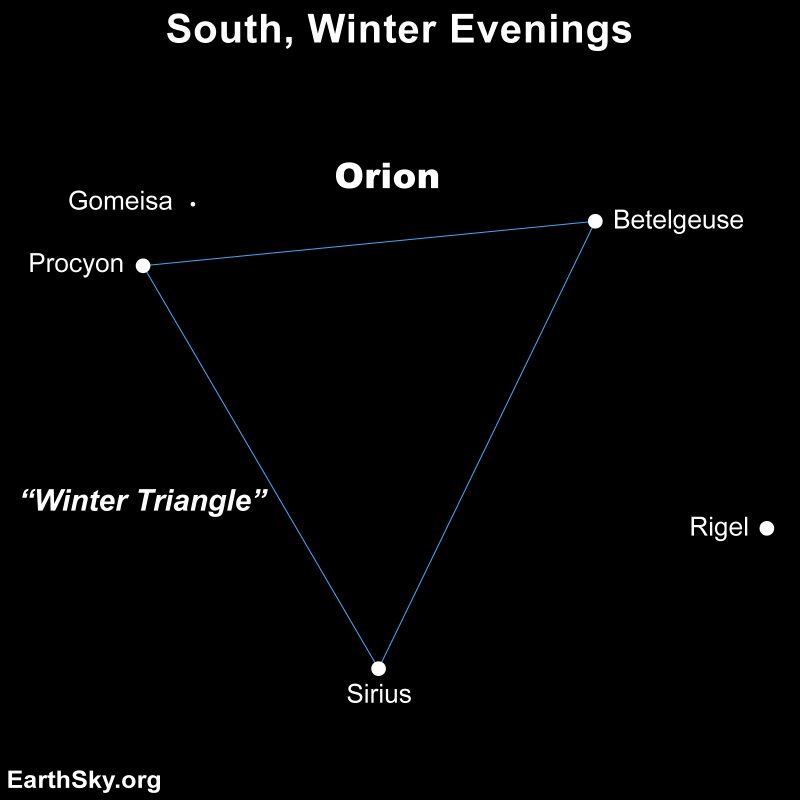
The Winter Triangle is one of the most recognizable patterns in the night sky. It isn’t a constellation, but it’s an asterism, or prominent group of stars that form a noticeable pattern. The Winter Triangle is easy to spot and serves as a guide to some of the finest celestial sights of the season.
Three dazzling stars from three different constellations make up the Winter Triangle: Sirius in Canis Major, Procyon in Canis Minor and Betelgeuse in Orion. Together, these three stars form a triangle covering a large area of the sky.
Sirius is the brightest star visible in Earth’s night sky, it’s dazzling white with flashes of color when near the horizon. Procyon shines nearby. It’s slightly fainter than Sirius. Betelgeuse completes the triangle with its distinct reddish-orange glow, marking the shoulder of Orion.
When is it visible?
In the Northern Hemisphere, the Winter Triangle is an obvious pattern in the evening sky from December to March. Then it emerges in the morning sky in September.
In the Southern Hemisphere, the Winter Triangle is prominent during the summer months, from December to March. The triangle looks inverted compared to the Northern Hemisphere view and is visible high overhead on warm summer evenings. And it emerges in the morning sky in May.
The Winter Triangle is part of the Winter Circle
Because all three stars are extremely bright, the Winter Triangle is even visible from cities with moderate light pollution. And the Winter Triangle is part of a larger asterism known as the Winter Circle or Winter Hexagon. It’s a six-star asterism that includes Sirius and Procyon plus Rigel, Aldebaran, Capella, and Castor. The Winter Circle stretches across several constellations and forms one of the largest and most obvious patterns visible in the winter sky.

Deep-sky sights within the Winter Triangle
The region in and around the Winter Triangle contains several celestial objects. One of the most famous is the Orion Nebula (M42), a glowing cloud of gas and dust visible to the unaided eye as a faint smudge in Orion’s Sword. And it’s spectacular through binoculars or a small telescope.
Near Sirius lies the open cluster M41, a compact group of young stars that are easy to spot in binoculars.
And under dark skies, the band of the Milky Way flows through this region, particularly around Orion and Monoceros.
Images from EarthSky Community Photos


Bottom line: The Winter Triangle is a distinct pattern of stars in the night sky formed by three bright stars: Sirius, Betelgeuse and Procyon. It’s also part of a larger pattern of stars known as the Winter Circle or Hexagon.
Read more: Messier objects are fuzzy patches in the night sky
Read more: What are the best targets for binoculars?
The post The Winter Triangle stands out in the night sky first appeared on EarthSky.
from EarthSky https://ift.tt/ZrCmNld
The Winter Triangle is one of the most recognizable patterns in the night sky. It isn’t a constellation, but it’s an asterism, or prominent group of stars that form a noticeable pattern. The Winter Triangle is easy to spot and serves as a guide to some of the finest celestial sights of the season.
Three dazzling stars from three different constellations make up the Winter Triangle: Sirius in Canis Major, Procyon in Canis Minor and Betelgeuse in Orion. Together, these three stars form a triangle covering a large area of the sky.
Sirius is the brightest star visible in Earth’s night sky, it’s dazzling white with flashes of color when near the horizon. Procyon shines nearby. It’s slightly fainter than Sirius. Betelgeuse completes the triangle with its distinct reddish-orange glow, marking the shoulder of Orion.
When is it visible?
In the Northern Hemisphere, the Winter Triangle is an obvious pattern in the evening sky from December to March. Then it emerges in the morning sky in September.
In the Southern Hemisphere, the Winter Triangle is prominent during the summer months, from December to March. The triangle looks inverted compared to the Northern Hemisphere view and is visible high overhead on warm summer evenings. And it emerges in the morning sky in May.
The Winter Triangle is part of the Winter Circle
Because all three stars are extremely bright, the Winter Triangle is even visible from cities with moderate light pollution. And the Winter Triangle is part of a larger asterism known as the Winter Circle or Winter Hexagon. It’s a six-star asterism that includes Sirius and Procyon plus Rigel, Aldebaran, Capella, and Castor. The Winter Circle stretches across several constellations and forms one of the largest and most obvious patterns visible in the winter sky.
Deep-sky sights within the Winter Triangle
The region in and around the Winter Triangle contains several celestial objects. One of the most famous is the Orion Nebula (M42), a glowing cloud of gas and dust visible to the unaided eye as a faint smudge in Orion’s Sword. And it’s spectacular through binoculars or a small telescope.
Near Sirius lies the open cluster M41, a compact group of young stars that are easy to spot in binoculars.
And under dark skies, the band of the Milky Way flows through this region, particularly around Orion and Monoceros.
Images from EarthSky Community Photos
Bottom line: The Winter Triangle is a distinct pattern of stars in the night sky formed by three bright stars: Sirius, Betelgeuse and Procyon. It’s also part of a larger pattern of stars known as the Winter Circle or Hexagon.
Read more: Messier objects are fuzzy patches in the night sky
Read more: What are the best targets for binoculars?
The post The Winter Triangle stands out in the night sky first appeared on EarthSky.
from EarthSky https://ift.tt/ZrCmNld

Aucun commentaire:
Enregistrer un commentaire