
The best comets of 2026
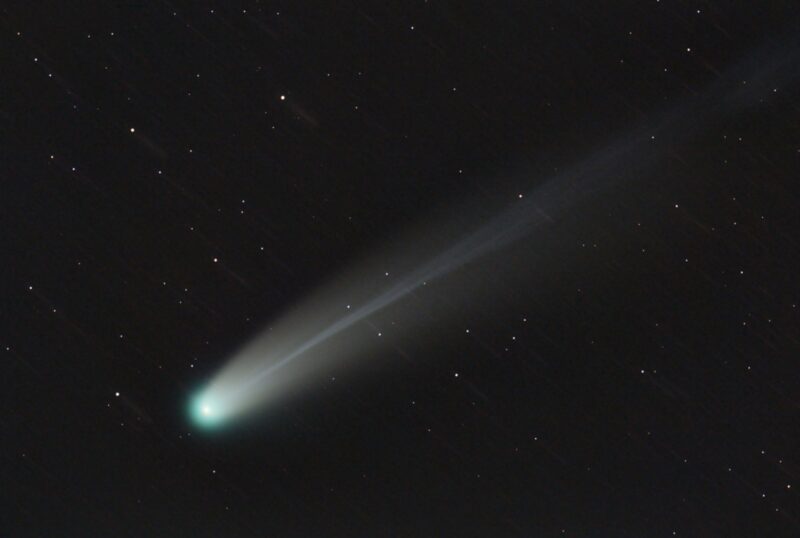
We already know of a few good comets speeding toward the inner solar system in 2026. At the moment, some outlets are already calling Comet 2025 R3 (PanSTARRS) the Great Comet of 2026. It will speed past our region of the solar system in April. But on January 13, a brand new sungrazing comet was discovered. The comet still only has a preliminary name: 6AC4721. This comet could become impressive in April, though it’s still a bit soon to know. We’ll keep you updated with all these comets and any new discoveries!
Comet C/2024 E1 (Wierzchos)
Polish astronomer Kacper Wierzchos at the University of Arizona discovered a new comet on March 3, 2024, that was then named for him. The comet has slowly been making its way closer to the inner solar system. On January 20, 2026, Comet Wierzchos – or C/2024 E1 – will reach perihelion, its closest approach to the sun.
Nearly a month later, on February 17, Wierzchos will be closest to Earth, at 94 million miles (151.5 million km) distant. That’s just a bit farther than the Earth-sun distance, or 1 astronomical unit (AU).
Currently, the comet is as bright as a magnitude 8 to 8.7 star. That means you should be able to easily pick it up using a small telescope. However, the comet has been extremely close to the southwestern horizon.
By February 23, 2026, Comet Wierzchos should be high enough for you to give it a try. Around then, it passes close to where we see a few galaxies in Cetus the Whale, including NGC 908 and 909. Afterward, Comet Wierzchos will continue to pass in front of some galaxies in Cetus, such as NGC 1065 on February 27. As this comet travels at around 105,000 miles per hour (46.773 km per second) relative to the sun, it appears near other galaxies just a day later.
The illustrations below are for the Northern Hemisphere. From late January, the best views of comet Wierzchos will be for observers in the Southern Hemisphere, facing the southwestern horizon just after sunset. The view will improve for southern observers during February, as the comet appears slightly higher over the west-southwest horizon just after sunset. In fact, Southern Hemisphere observers will have the best view of the closest approach to Earth on February 17. Then the comet is passing close to where we see stars HIP 6502 and 6771 in the constellation of Sculptor.
Finder charts for Comet 2024 E1 (Wierzchos)


New discovery 6AC4721
On January 13, 2026, astronomers detected an object that appears to be a comet, and its trajectory suggests it will pass extremely close to the sun around April 4. Thus, it’s a sungrazer comet.
Astronomer Piero Sicoli from the Sormano Astronomical Observatory in Italy found that this object – temporarily known as comet candidate 6AC4721 – has an orbit very similar to comet C/1963 R1 (Pereyra). So it might be a fragment of it or another comet with a very similar trajectory of a type called Kreutz comets. These comets are named in honor of German astronomer Heinrich Kreutz.
Kreutz comets are a family of sungrazing comets. They pass extremely close to the sun and are thought to be big fragments of a huge comet that broke apart centuries ago.
Astronomers will give the new object a formal designation once it is confirmed. This should happen in the next few days, as it is already showing a small tail and diffuse coma.
A detail that has caught astronomers’ attention is that the new-found object is showing a magnitude of 18 at a distance of 2 AU. This suggests it should be decent sized, and therefore it might get bright as it approaches the sun in the next weeks. Preliminary observations suggest the newly found comet’s nucleus might have a diameter of 1.5 miles (2.4 km) or smaller.
Of course, there’s also a good chance it might disintegrate as it gets closer to our star, especially if it passes extremely close. Time will tell.
A few other comets that have passed really close to the sun and performed well include C/1965 S1 (Ikeya–Seki) and most recently, C/2011 W3 (Lovejoy). This kind of event does not occur often, so this will be a rare opportunity for scientists to learn more about sungrazer comets.
Comet C/2025 R3 (PanSTARRS)
Another celestial visitor on its way to the inner solar system is comet C/2025 R3, or PanSTARRS. Some outlets have already dubbed this the Great Comet of 2026. That’s because estimates of its brightness range from magnitude 7 all the way up to 3. A magnitude-3 comet would be visible to the unaided eye.
Comet PanSTARRS will be closest to the sun on April 19, 2026. Then it will then pass closest to Earth just a week later, on April 26. The comet will get as close as 45.5 million miles (73.2 million km) from Earth. That’s slightly closer than half the Earth-sun distance. When Comet PanSTARRS passes closest to Earth, it will be in the direction of where we see the sun. That’s because the comet will be passing between Earth and the sun at that time.
So, our best bet is to try to see the comet before it gets too close to the sun’s glare. And keep in mind this comet will be in the morning sky instead of the evening sky. A good date to try to spot the comet will be around April 11 and 12, 2026. At this time, the comet will be passing close to where we see some galaxies in the constellation Pegasus the Flying Horse just before sunrise.
Observers in the Southern Hemisphere will have to wait until late April to try to spot Comet PanSTARRS low in the western horizon just after sunset. But the situation rapidly improves from there in early May as the comet gets higher just after dusk.
Exactly how bright the comet will actually get remains to be seen.
Finder charts for Comet 2025 R3 (PanSTARRS)


[caption id="attachment_533848" align="alignnone" width="800"] This star chart shows the location of Comet 2025 R3 (PanSTARRS) at 5:30 a.m. CDT on April 15, 2026. It will be near the variable star 75 Pegasus, within the Great Square of Pegasus the Flying Horse. Image via Stellarium/ Eddie Irizarry. Used with permission.
Comet 10P/Tempel 2
Back on July 4, 1873, Wilhelm Tempel discovered the comet that we now call 10P/Tempel 2. Comet Tempel 2 will visit during northern summer nights. And you’ll probably need binoculars or a small telescope to see it.
Comet 10P/Tempel 2 reaches perihelion – its closest point to the sun – on August 2, 2026. Then, just a day later, on August 3, the celestial visitor will be closest to Earth. It’s a short-period comet that orbits the sun every five years. Another fun fact is that it’s a Jupiter-family comet that will pass very close to the orbit of Mars this year. But while it will get close to Mars’ orbit, it won’t get close to the red planet itself.
This comet might reach around magnitude 8 during four months of the year: June, July, August and September. If so, you should be able to easily see it with a small telescope. Over these months, the comet will be traversing in front of the stars of Capricornus the Sea-goat and Aquarius the Water Bearer.
For observers in the Northern Hemisphere, Comet Tempel 2 becomes visible late in the night in early August. Meanwhile, those in the Southern Hemisphere will be able to see it from early in the night, and will thus have the best views during closest approach to Earth as the comet will be higher in the eastern sky.
It’s possible that Comet Tempel 2 will get even brighter. Some estimates put it up to magnitude 7 or 6.8 during closest approach to Earth on August 3. That would mean it might be visible using just binoculars.
The nucleus of Tempel 2 is around 6.5 miles (10.5 km) in diameter. During closest approach to our planet, the comet will pass about 38.5 million miles (61.9 million km) away.
Finder charts for Comet 10P/Tempel 2


Comet 3I/ATLAS
We haven’t forgotten about interstellar comet 3I/ATLAS. It’s already moving out of the inner solar system, but it’s still visible through 8-inch and larger diameter telescopes and smaller ones equipped with cameras. Even though it’s gradually becoming fainter, many observers might still try to get one last view of it before it leaves our solar system forever.
Comet 3I/ATLAS is still in the constellation of Cancer the Crab. At 9 p.m. CST on January 19, 2026, it will pass close to where we see the galaxies NGC 2593 and NGC 2596. As of mid January, the interstellar visitor was showing a magnitude between 12 and 14, with its anti-tail clearly visible.
By comparing the comet’s location related to the background stars, you can detect its motion. And the motion appears slow, but only because of its great distance from us. It’s currently around 2 AU away, and it’s traveling at more than 130,000 miles per hour (209.2 kmh).

There’s always the possibility that a new comet may be discovered and then become visible to the unaided eye. Meanwhile, these celestial visitors might provide nice views using optical aid.
Bottom line: What will be the best comets of 2026? Here’s a list of those we already know, and keep watching for new discoveries!
The post The best comets of 2026: Here’s what to watch for first appeared on EarthSky.
from EarthSky https://ift.tt/riOlCzt
The best comets of 2026
We already know of a few good comets speeding toward the inner solar system in 2026. At the moment, some outlets are already calling Comet 2025 R3 (PanSTARRS) the Great Comet of 2026. It will speed past our region of the solar system in April. But on January 13, a brand new sungrazing comet was discovered. The comet still only has a preliminary name: 6AC4721. This comet could become impressive in April, though it’s still a bit soon to know. We’ll keep you updated with all these comets and any new discoveries!
Comet C/2024 E1 (Wierzchos)
Polish astronomer Kacper Wierzchos at the University of Arizona discovered a new comet on March 3, 2024, that was then named for him. The comet has slowly been making its way closer to the inner solar system. On January 20, 2026, Comet Wierzchos – or C/2024 E1 – will reach perihelion, its closest approach to the sun.
Nearly a month later, on February 17, Wierzchos will be closest to Earth, at 94 million miles (151.5 million km) distant. That’s just a bit farther than the Earth-sun distance, or 1 astronomical unit (AU).
Currently, the comet is as bright as a magnitude 8 to 8.7 star. That means you should be able to easily pick it up using a small telescope. However, the comet has been extremely close to the southwestern horizon.
By February 23, 2026, Comet Wierzchos should be high enough for you to give it a try. Around then, it passes close to where we see a few galaxies in Cetus the Whale, including NGC 908 and 909. Afterward, Comet Wierzchos will continue to pass in front of some galaxies in Cetus, such as NGC 1065 on February 27. As this comet travels at around 105,000 miles per hour (46.773 km per second) relative to the sun, it appears near other galaxies just a day later.
The illustrations below are for the Northern Hemisphere. From late January, the best views of comet Wierzchos will be for observers in the Southern Hemisphere, facing the southwestern horizon just after sunset. The view will improve for southern observers during February, as the comet appears slightly higher over the west-southwest horizon just after sunset. In fact, Southern Hemisphere observers will have the best view of the closest approach to Earth on February 17. Then the comet is passing close to where we see stars HIP 6502 and 6771 in the constellation of Sculptor.
Finder charts for Comet 2024 E1 (Wierzchos)
New discovery 6AC4721
On January 13, 2026, astronomers detected an object that appears to be a comet, and its trajectory suggests it will pass extremely close to the sun around April 4. Thus, it’s a sungrazer comet.
Astronomer Piero Sicoli from the Sormano Astronomical Observatory in Italy found that this object – temporarily known as comet candidate 6AC4721 – has an orbit very similar to comet C/1963 R1 (Pereyra). So it might be a fragment of it or another comet with a very similar trajectory of a type called Kreutz comets. These comets are named in honor of German astronomer Heinrich Kreutz.
Kreutz comets are a family of sungrazing comets. They pass extremely close to the sun and are thought to be big fragments of a huge comet that broke apart centuries ago.
Astronomers will give the new object a formal designation once it is confirmed. This should happen in the next few days, as it is already showing a small tail and diffuse coma.
A detail that has caught astronomers’ attention is that the new-found object is showing a magnitude of 18 at a distance of 2 AU. This suggests it should be decent sized, and therefore it might get bright as it approaches the sun in the next weeks. Preliminary observations suggest the newly found comet’s nucleus might have a diameter of 1.5 miles (2.4 km) or smaller.
Of course, there’s also a good chance it might disintegrate as it gets closer to our star, especially if it passes extremely close. Time will tell.
A few other comets that have passed really close to the sun and performed well include C/1965 S1 (Ikeya–Seki) and most recently, C/2011 W3 (Lovejoy). This kind of event does not occur often, so this will be a rare opportunity for scientists to learn more about sungrazer comets.
Comet C/2025 R3 (PanSTARRS)
Another celestial visitor on its way to the inner solar system is comet C/2025 R3, or PanSTARRS. Some outlets have already dubbed this the Great Comet of 2026. That’s because estimates of its brightness range from magnitude 7 all the way up to 3. A magnitude-3 comet would be visible to the unaided eye.
Comet PanSTARRS will be closest to the sun on April 19, 2026. Then it will then pass closest to Earth just a week later, on April 26. The comet will get as close as 45.5 million miles (73.2 million km) from Earth. That’s slightly closer than half the Earth-sun distance. When Comet PanSTARRS passes closest to Earth, it will be in the direction of where we see the sun. That’s because the comet will be passing between Earth and the sun at that time.
So, our best bet is to try to see the comet before it gets too close to the sun’s glare. And keep in mind this comet will be in the morning sky instead of the evening sky. A good date to try to spot the comet will be around April 11 and 12, 2026. At this time, the comet will be passing close to where we see some galaxies in the constellation Pegasus the Flying Horse just before sunrise.
Observers in the Southern Hemisphere will have to wait until late April to try to spot Comet PanSTARRS low in the western horizon just after sunset. But the situation rapidly improves from there in early May as the comet gets higher just after dusk.
Exactly how bright the comet will actually get remains to be seen.
Finder charts for Comet 2025 R3 (PanSTARRS)
[caption id="attachment_533848" align="alignnone" width="800"] This star chart shows the location of Comet 2025 R3 (PanSTARRS) at 5:30 a.m. CDT on April 15, 2026. It will be near the variable star 75 Pegasus, within the Great Square of Pegasus the Flying Horse. Image via Stellarium/ Eddie Irizarry. Used with permission.
Comet 10P/Tempel 2
Back on July 4, 1873, Wilhelm Tempel discovered the comet that we now call 10P/Tempel 2. Comet Tempel 2 will visit during northern summer nights. And you’ll probably need binoculars or a small telescope to see it.
Comet 10P/Tempel 2 reaches perihelion – its closest point to the sun – on August 2, 2026. Then, just a day later, on August 3, the celestial visitor will be closest to Earth. It’s a short-period comet that orbits the sun every five years. Another fun fact is that it’s a Jupiter-family comet that will pass very close to the orbit of Mars this year. But while it will get close to Mars’ orbit, it won’t get close to the red planet itself.
This comet might reach around magnitude 8 during four months of the year: June, July, August and September. If so, you should be able to easily see it with a small telescope. Over these months, the comet will be traversing in front of the stars of Capricornus the Sea-goat and Aquarius the Water Bearer.
For observers in the Northern Hemisphere, Comet Tempel 2 becomes visible late in the night in early August. Meanwhile, those in the Southern Hemisphere will be able to see it from early in the night, and will thus have the best views during closest approach to Earth as the comet will be higher in the eastern sky.
It’s possible that Comet Tempel 2 will get even brighter. Some estimates put it up to magnitude 7 or 6.8 during closest approach to Earth on August 3. That would mean it might be visible using just binoculars.
The nucleus of Tempel 2 is around 6.5 miles (10.5 km) in diameter. During closest approach to our planet, the comet will pass about 38.5 million miles (61.9 million km) away.
Finder charts for Comet 10P/Tempel 2
Comet 3I/ATLAS
We haven’t forgotten about interstellar comet 3I/ATLAS. It’s already moving out of the inner solar system, but it’s still visible through 8-inch and larger diameter telescopes and smaller ones equipped with cameras. Even though it’s gradually becoming fainter, many observers might still try to get one last view of it before it leaves our solar system forever.
Comet 3I/ATLAS is still in the constellation of Cancer the Crab. At 9 p.m. CST on January 19, 2026, it will pass close to where we see the galaxies NGC 2593 and NGC 2596. As of mid January, the interstellar visitor was showing a magnitude between 12 and 14, with its anti-tail clearly visible.
By comparing the comet’s location related to the background stars, you can detect its motion. And the motion appears slow, but only because of its great distance from us. It’s currently around 2 AU away, and it’s traveling at more than 130,000 miles per hour (209.2 kmh).
There’s always the possibility that a new comet may be discovered and then become visible to the unaided eye. Meanwhile, these celestial visitors might provide nice views using optical aid.
Bottom line: What will be the best comets of 2026? Here’s a list of those we already know, and keep watching for new discoveries!
The post The best comets of 2026: Here’s what to watch for first appeared on EarthSky.
from EarthSky https://ift.tt/riOlCzt

Aucun commentaire:
Enregistrer un commentaire