
Will you have a white Christmas in 2025?
It’s almost that time of the year! Christmas is quickly approaching, and – if you live in the U.S. – you might have been wondering if it’ll be snowy or green for you this holiday. As is always the case with weather: It depends on your location. Let’s dive in.
The current pattern for temperatures
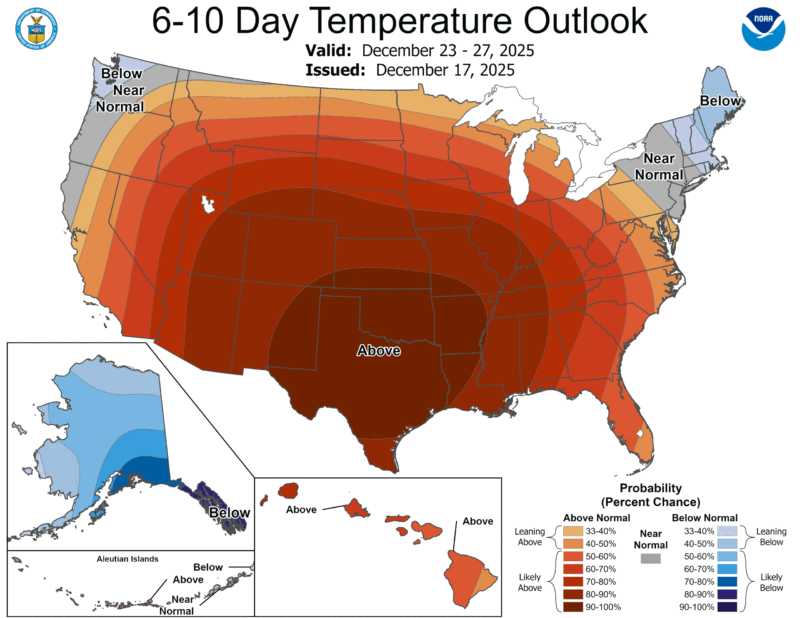
As is typical during a La Niña winter, the polar jet stream is variable across North America, particularly in the lower 48. The current variability has the jet stream far to the north, which is keeping the cold air pinned up in Canada. While parts of the country have seen Arctic outbreaks, the trend now is for the jet stream to drift back north. That will keep much of the United States with higher odds for staying warmer than average.
The current outlook from the Climate Prediction Center through December 27 has most of the country with those higher odds for above average temperatures. (It’s important to note that the map below shows the probability of below or above average temperatures. The higher the probability means the higher the chance of being above or below average, not by how much the temperature will be above or below average.)
Snow, rain or neither?
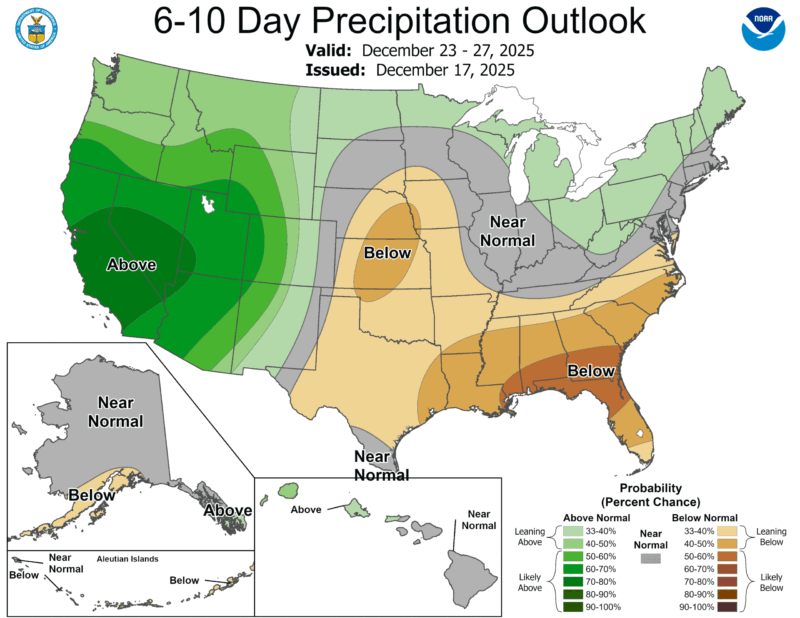
In the low levels of the atmosphere, forecast guidance is indicating that strong cyclones (or low pressures) will dip south with any variability in the jet stream and bring moisture toward the West Coast of the United States. This is increasing the likelihood of higher-than-average precipitation across the western part of the country, while the middle and southern United States have higher odds of being drier than average.
Putting it all together
If we compare these two maps and look at where the higher odds for above-average precipitation occur and where we have higher odds for below-average temperatures, there appear to only be a few locations where snow might be possible.
Forecast solutions are indicating, however, that snow could be on the ground (either from a previous snow, or snow falling near Christmas) for the higher elevations in the western part of the United States near the mountain ranges of the Rockies, the Sierra Nevadas and the Cascades.
In addition to snow at these locations, there are indicators that the northern Plains bordering Canada could have measurable snow possibly fall Christmas Day. Meanwhile, a day or two after Christmas there could be snow in the lake effect belt for places like the Upper Peninsula, northern Michigan and western New York. The northeast bordering Canada could see snow then as well. (Although we admit, snow the day after Christmas isn’t quite as magical.)
The trends are certainly not in our favor for a white Christmas, as they continue to lean warmer than average, which for many will make snow more challenging to develop. However, in terms of what to actually expect, keep up to date with your local forecast through the National Weather Service. In the top left on that page, put your location into the search bar to check out the forecast for you.
A white Christmas in 2025? Well, climatologically speaking…
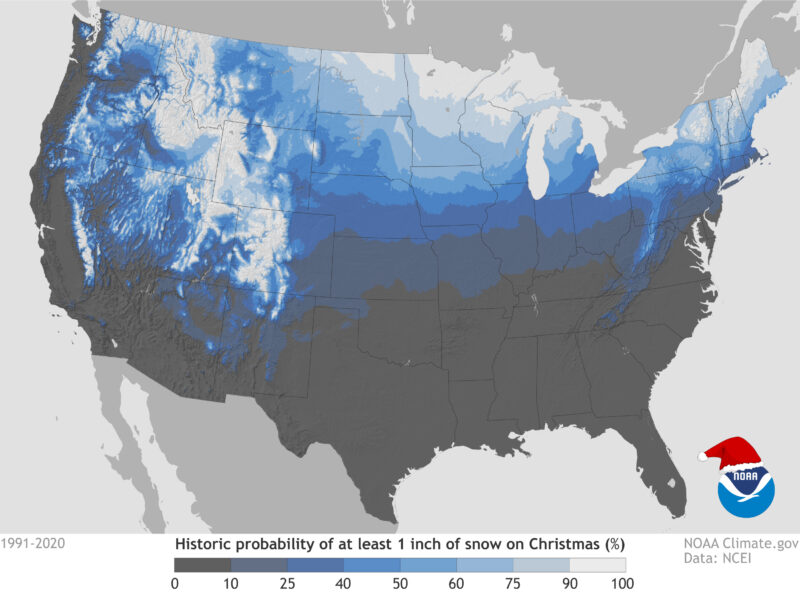
The forecast for snow can change quickly, but there are some areas that are more likely to see snow than others in terms of what we’ve experienced over the past three decades. Using data from 1991 to 2020, NOAA and the National Centers for Environmental Information made a map showing the most likely locations to have at least 1 inch (25 mm) of snow on the ground on December 25, Christmas Day.
Looking at the historic data, the most likely locations to see a white Christmas are in the highest elevations of the mountains, especially in the western United States, and communities bordering Canada. This is partially due to the higher chance of colder air spilling down from the Arctic as well as factors like elevation and likelihood of snow events. If you want an interactive version of this map, you can find it here. The data on this map are calculated from the daily information reported from the almost 15,000 NOAA-operated weather stations across the country.
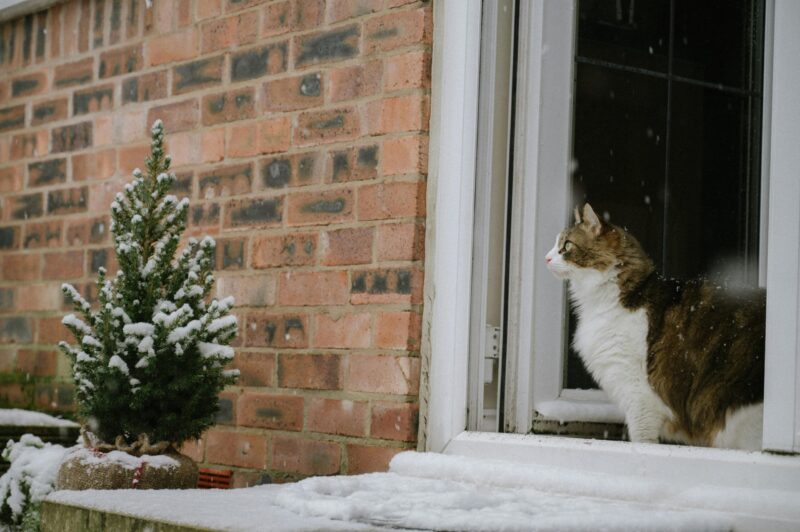
Bottom line: Will the U.S. have a white Christmas in 2025? Most of the U.S. will have a green and relatively warm Christmas, but snow is possible in some areas. More here!
The post Will the U.S. have a white Christmas in 2025? Find out here! first appeared on EarthSky.
from EarthSky https://ift.tt/GLtcuwd
Will you have a white Christmas in 2025?
It’s almost that time of the year! Christmas is quickly approaching, and – if you live in the U.S. – you might have been wondering if it’ll be snowy or green for you this holiday. As is always the case with weather: It depends on your location. Let’s dive in.
The current pattern for temperatures
As is typical during a La Niña winter, the polar jet stream is variable across North America, particularly in the lower 48. The current variability has the jet stream far to the north, which is keeping the cold air pinned up in Canada. While parts of the country have seen Arctic outbreaks, the trend now is for the jet stream to drift back north. That will keep much of the United States with higher odds for staying warmer than average.
The current outlook from the Climate Prediction Center through December 27 has most of the country with those higher odds for above average temperatures. (It’s important to note that the map below shows the probability of below or above average temperatures. The higher the probability means the higher the chance of being above or below average, not by how much the temperature will be above or below average.)
Snow, rain or neither?
In the low levels of the atmosphere, forecast guidance is indicating that strong cyclones (or low pressures) will dip south with any variability in the jet stream and bring moisture toward the West Coast of the United States. This is increasing the likelihood of higher-than-average precipitation across the western part of the country, while the middle and southern United States have higher odds of being drier than average.
Putting it all together
If we compare these two maps and look at where the higher odds for above-average precipitation occur and where we have higher odds for below-average temperatures, there appear to only be a few locations where snow might be possible.
Forecast solutions are indicating, however, that snow could be on the ground (either from a previous snow, or snow falling near Christmas) for the higher elevations in the western part of the United States near the mountain ranges of the Rockies, the Sierra Nevadas and the Cascades.
In addition to snow at these locations, there are indicators that the northern Plains bordering Canada could have measurable snow possibly fall Christmas Day. Meanwhile, a day or two after Christmas there could be snow in the lake effect belt for places like the Upper Peninsula, northern Michigan and western New York. The northeast bordering Canada could see snow then as well. (Although we admit, snow the day after Christmas isn’t quite as magical.)
The trends are certainly not in our favor for a white Christmas, as they continue to lean warmer than average, which for many will make snow more challenging to develop. However, in terms of what to actually expect, keep up to date with your local forecast through the National Weather Service. In the top left on that page, put your location into the search bar to check out the forecast for you.
A white Christmas in 2025? Well, climatologically speaking…
The forecast for snow can change quickly, but there are some areas that are more likely to see snow than others in terms of what we’ve experienced over the past three decades. Using data from 1991 to 2020, NOAA and the National Centers for Environmental Information made a map showing the most likely locations to have at least 1 inch (25 mm) of snow on the ground on December 25, Christmas Day.
Looking at the historic data, the most likely locations to see a white Christmas are in the highest elevations of the mountains, especially in the western United States, and communities bordering Canada. This is partially due to the higher chance of colder air spilling down from the Arctic as well as factors like elevation and likelihood of snow events. If you want an interactive version of this map, you can find it here. The data on this map are calculated from the daily information reported from the almost 15,000 NOAA-operated weather stations across the country.
Bottom line: Will the U.S. have a white Christmas in 2025? Most of the U.S. will have a green and relatively warm Christmas, but snow is possible in some areas. More here!
The post Will the U.S. have a white Christmas in 2025? Find out here! first appeared on EarthSky.
from EarthSky https://ift.tt/GLtcuwd

Aucun commentaire:
Enregistrer un commentaire