
EarthSky’s 2026 lunar calendar is available now. Get yours today! Makes a great gift.
- A naturalist in Malaysia discovered a new fairy lantern plant. Scientists named it Thismia selangorensis.
- The tiny, delicate species is extremely rare, with fewer than 20 known plants.
- Scientists warn it is critically endangered and needs careful protection.
Extraordinary new plant species discovered at busy park
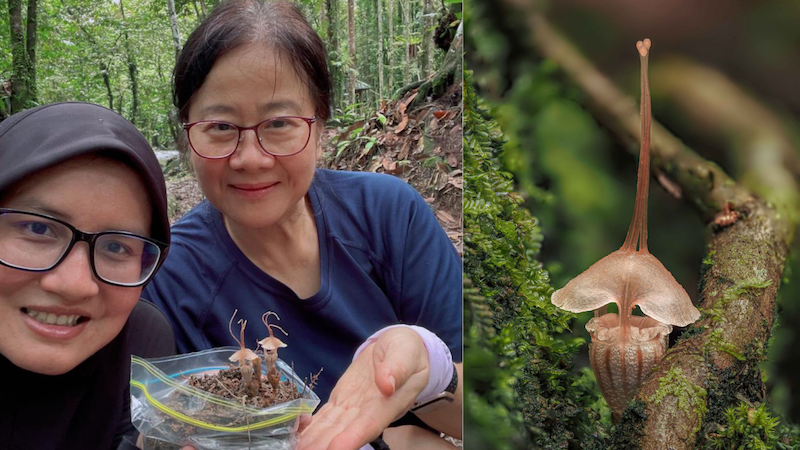
In November 2023, naturalist Gim Siew Tan was exploring a local nature reserve near Kuala Lumpur, the capital of Malaysia. It is a popular picnic and camping destination, the last place she would expect to find a new plant species. Yet, there it was, growing against the odds, in a park frequented by many people. Tan had discovered the delicate flower of a diminutive plant that is a new species of fairy lantern. Scientists described this exquisite new species in a paper published in late November 2025. They named it Thismia selangorensis.
Siti-Munirah Mat Yunoh, of the Forest Research Institute Malaysia, is the paper’s lead author. She said, in a blog by Pensoft Publishers:
This discovery shows that significant scientific finds are not limited to remote jungles; they can also be made in ordinary environments where constant human activity leaves little room for expectation. Protecting Thismia selangorensis will require cooperation among researchers, the forest department, stakeholders, and the public, as its survival depends on how carefully we tread in its habitat.
The researchers published their study in the peer-reviewed journal PhytoKeys on November 28, 2025.
Fairy lanterns are parasitic plants
Fairy lanterns – which belong to the genus Thismia – are myco-heterotrophic plants. That means they don’t have chlorophyll like most plants. Therefore, they don’t get their energy from the sun. Instead, they’re parasites, stealing nutrients from fungi living in the soil.
There are 120 known Thismia plants, found in East Asia, Southeast Asia, New Guinea, Australia, New Zealand and the Americas. They usually grow in undisturbed tropical forests and in moist shaded soil, surrounded by leaf litter. These plants are tuberous, which means they store food in swollen underground structures called tubers. They are most visible when they produce flowers. In addition, fungus gnats pollinate many types of Thismia flowers.
A rare new fairy lantern
Scientists named this new fairy lantern species Thismia selangorensis, after the Malaysian state – Selangor – where they found it.
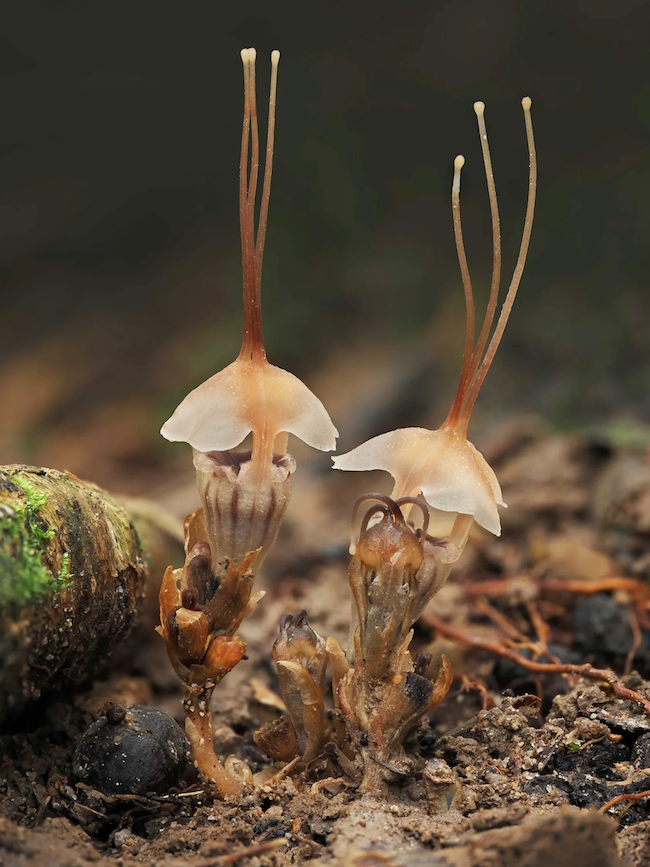
Thismia selangorensis produces flowers between October and February. When flowering, the plant is only 4 inches (10 cm) tall. As a result, it is only visible when the flowers are out. Moreover, each plant produces one flower, colored a peach-pink shade.
Each flower has a lower cup with stripes. Above it grows an umbrella-like mitre. In addition, three slim club-like appendages emerge from that mitre. The flower itself is connected to a short stem which ends in stubby coralliform roots (small roots having the branching structure of corals).
Finding this new fairy lantern species
Despite decades of human activity in the area, the new species remained undiscovered until naturalist Gim Siew Tan found it in November 2023. At the time, Tan was on a routine photography excursion at Taman Eko Rimba Sungai Chongkak, part of the Hulu Langat Forest Reserve, not far from Kuala Lumpur. She first spotted the plant’s delicate flower nestled in a hole at the base of a riverside tree, like it was living in a tiny cave.
Subsequently, Tan and other researchers found more plants growing in moist soil among fallen leaves and along roots near the bases of riverside trees. There are less than 20 known individual plants, all within just a 1.5-square-mile area (4 square km). That’s a tiny population in an area that many people visit. As a result, scientists consider Thismia selangorensis a critically endangered species, following standards in the IUCN Red List.

An urgent need to conserve this rare species
Researchers found the plants in a part of the forest that has remained relatively undisturbed. However, these fairy lanterns are growing close to campsites and picnic areas. As a result, people may inadvertently trample on them. Furthermore, the plants are vulnerable to flooding.
Scientists strongly recommend careful management of the area to preserve Thismia selangorensis. They also plan to continue monitoring the plants they have already discovered and search for more specimens outside its currently known range.
Siti-Munirah commented:
The most important effort now is to raise awareness about this species so the public realizes that it exists – right here, in this small corner of the world, and nowhere else, at least for now. Understanding its presence is the first step towards ensuring that this extraordinary plant is not lost before many people even know it exists.
Bottom line: Scientists have discovered an exquisite new species of fairy lantern – called Thismia selangorensis – at a park near Kuala Lumpur, Malaysia.
Read more: Frog saunas could help frogs threatened by fungus
Dead man’s fingers are our creepy lifeform of the week
The post New fairy lantern plant discovered at popular Malaysian park first appeared on EarthSky.
from EarthSky https://ift.tt/21UdzZ9
EarthSky’s 2026 lunar calendar is available now. Get yours today! Makes a great gift.
- A naturalist in Malaysia discovered a new fairy lantern plant. Scientists named it Thismia selangorensis.
- The tiny, delicate species is extremely rare, with fewer than 20 known plants.
- Scientists warn it is critically endangered and needs careful protection.
Extraordinary new plant species discovered at busy park
In November 2023, naturalist Gim Siew Tan was exploring a local nature reserve near Kuala Lumpur, the capital of Malaysia. It is a popular picnic and camping destination, the last place she would expect to find a new plant species. Yet, there it was, growing against the odds, in a park frequented by many people. Tan had discovered the delicate flower of a diminutive plant that is a new species of fairy lantern. Scientists described this exquisite new species in a paper published in late November 2025. They named it Thismia selangorensis.
Siti-Munirah Mat Yunoh, of the Forest Research Institute Malaysia, is the paper’s lead author. She said, in a blog by Pensoft Publishers:
This discovery shows that significant scientific finds are not limited to remote jungles; they can also be made in ordinary environments where constant human activity leaves little room for expectation. Protecting Thismia selangorensis will require cooperation among researchers, the forest department, stakeholders, and the public, as its survival depends on how carefully we tread in its habitat.
The researchers published their study in the peer-reviewed journal PhytoKeys on November 28, 2025.
Fairy lanterns are parasitic plants
Fairy lanterns – which belong to the genus Thismia – are myco-heterotrophic plants. That means they don’t have chlorophyll like most plants. Therefore, they don’t get their energy from the sun. Instead, they’re parasites, stealing nutrients from fungi living in the soil.
There are 120 known Thismia plants, found in East Asia, Southeast Asia, New Guinea, Australia, New Zealand and the Americas. They usually grow in undisturbed tropical forests and in moist shaded soil, surrounded by leaf litter. These plants are tuberous, which means they store food in swollen underground structures called tubers. They are most visible when they produce flowers. In addition, fungus gnats pollinate many types of Thismia flowers.
A rare new fairy lantern
Scientists named this new fairy lantern species Thismia selangorensis, after the Malaysian state – Selangor – where they found it.
Thismia selangorensis produces flowers between October and February. When flowering, the plant is only 4 inches (10 cm) tall. As a result, it is only visible when the flowers are out. Moreover, each plant produces one flower, colored a peach-pink shade.
Each flower has a lower cup with stripes. Above it grows an umbrella-like mitre. In addition, three slim club-like appendages emerge from that mitre. The flower itself is connected to a short stem which ends in stubby coralliform roots (small roots having the branching structure of corals).
Finding this new fairy lantern species
Despite decades of human activity in the area, the new species remained undiscovered until naturalist Gim Siew Tan found it in November 2023. At the time, Tan was on a routine photography excursion at Taman Eko Rimba Sungai Chongkak, part of the Hulu Langat Forest Reserve, not far from Kuala Lumpur. She first spotted the plant’s delicate flower nestled in a hole at the base of a riverside tree, like it was living in a tiny cave.
Subsequently, Tan and other researchers found more plants growing in moist soil among fallen leaves and along roots near the bases of riverside trees. There are less than 20 known individual plants, all within just a 1.5-square-mile area (4 square km). That’s a tiny population in an area that many people visit. As a result, scientists consider Thismia selangorensis a critically endangered species, following standards in the IUCN Red List.
An urgent need to conserve this rare species
Researchers found the plants in a part of the forest that has remained relatively undisturbed. However, these fairy lanterns are growing close to campsites and picnic areas. As a result, people may inadvertently trample on them. Furthermore, the plants are vulnerable to flooding.
Scientists strongly recommend careful management of the area to preserve Thismia selangorensis. They also plan to continue monitoring the plants they have already discovered and search for more specimens outside its currently known range.
Siti-Munirah commented:
The most important effort now is to raise awareness about this species so the public realizes that it exists – right here, in this small corner of the world, and nowhere else, at least for now. Understanding its presence is the first step towards ensuring that this extraordinary plant is not lost before many people even know it exists.
Bottom line: Scientists have discovered an exquisite new species of fairy lantern – called Thismia selangorensis – at a park near Kuala Lumpur, Malaysia.
Read more: Frog saunas could help frogs threatened by fungus
Dead man’s fingers are our creepy lifeform of the week
The post New fairy lantern plant discovered at popular Malaysian park first appeared on EarthSky.
from EarthSky https://ift.tt/21UdzZ9

Aucun commentaire:
Enregistrer un commentaire