
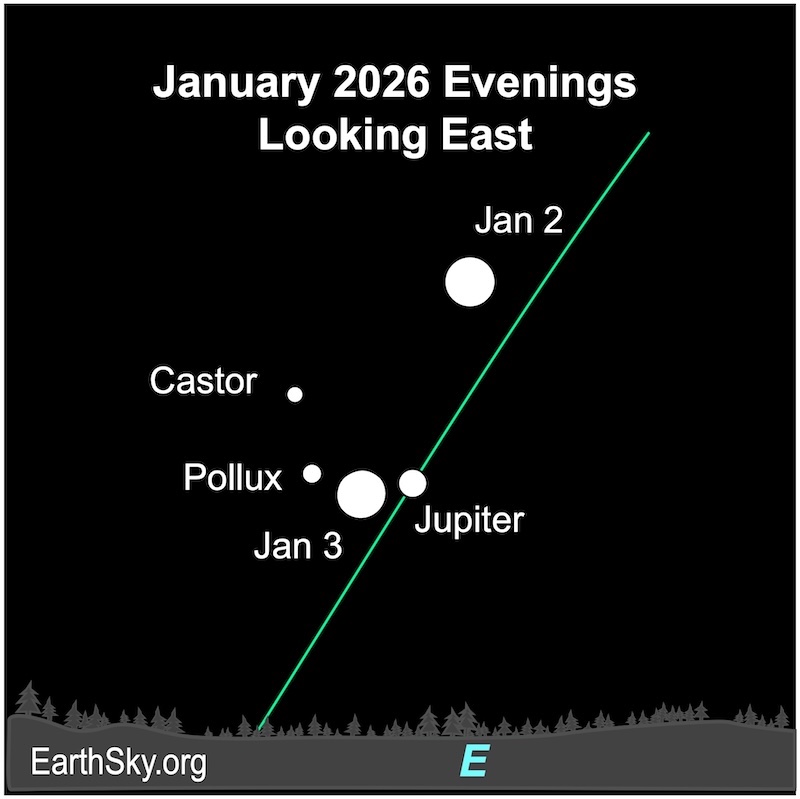
Crest of the full moon falls at 10:03 UTC on January 3. That’s 4:03 a.m. for folks in central North America. So the moon will be at its fullest on the morning of January 3, but it will appear full on both nights, January 2 and 3.
When and where to look in 2026: Look for the bright, round full moon rising in the east before sunset on January 2, 2026. It will be glowing nearly overhead around midnight, and dropping low in the west near sunrise. And that bright star rising near the moon is no star at all, it’s the planet Jupiter. Jupiter will reach its biggest and brightest for 2026 in just one week! The moon will also look full as it rises around sunset on January 3.
The full moon glows near Jupiter
This year, the January full moon will lie near Jupiter, now at its brightest this year. Even though it is close to the very bright full moon, Jupiter is bright enough to be spotted in the moonlight. On the following night, the almost full moon will hang even closer to the bright planet.
This January full moon is also a Supermoon
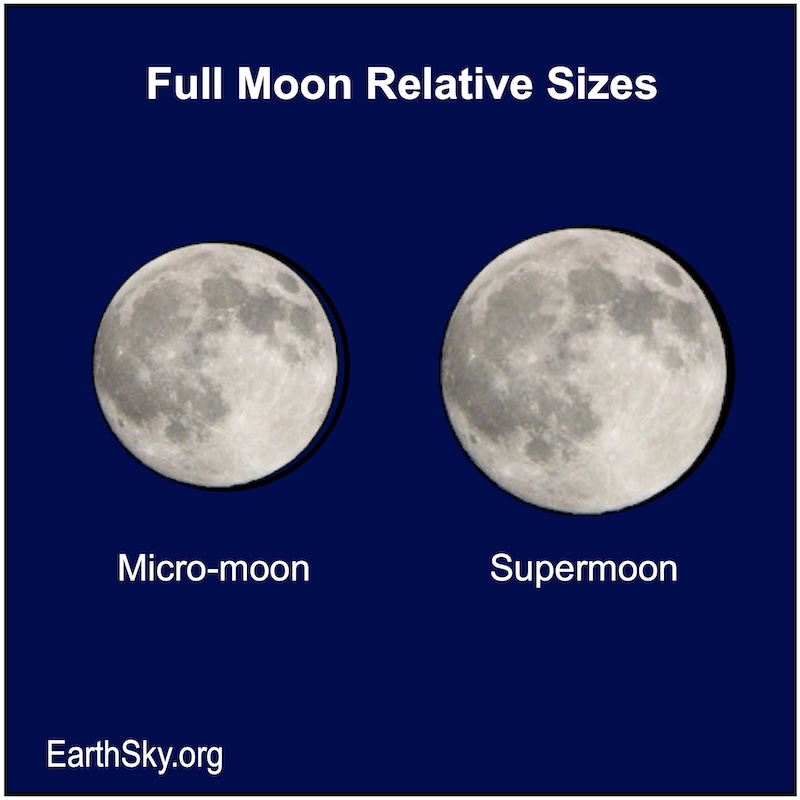
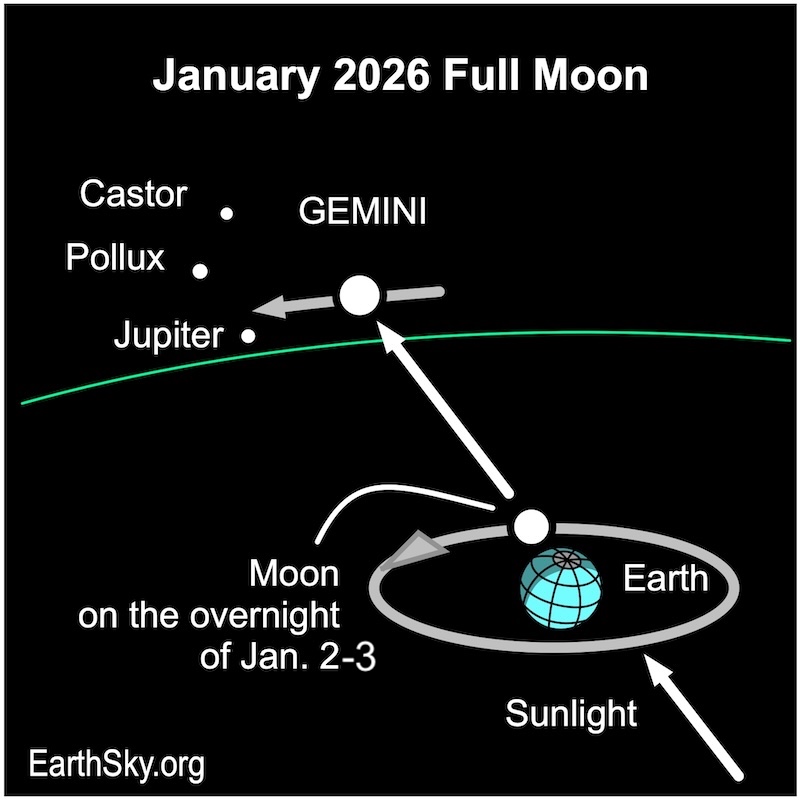
January 2026 will see lunar perigee – the point in the moon’s orbit where to comes closest to Earth – occur about 36 hours before when the moon is at its fullest. This means it is a perigean full moon, or what is often called a supermoon. At this point, the moon will lie 225,130 miles (362,312 kilometers) from Earth. For comparison, a more typical full moon is 18,000 miles further, putting it at 240,000 miles.
Since it is closer to us on Earth, does a supermoon appear noticeably larger than an ordinary full moon?
While it is true that experienced observers do say they can detect a size difference, you’d have to be a very keen observer to notice it. Truly most of us can’t tell any difference in the size of a supermoon and an ordinary full moon.
But … do super moons look brighter than ordinary full moons? Yes! By a noticeable amount. That’ because a supermoon exceeds the disk size of an average-sized moon by up to 8% and the brightness of an average-sized full moon by some 16%. And then, it exceeds the disk size of a micro-moon (a year’s most distant, and, therefore, smallest full moon) up to 14% and the brightness of a micro-moon by some 30%. So, if you go outside in the pre-dawn hours of January 3, as well as in the evening before, there is a possibility you’ll notice the full moon is exceptionally bright!
Read more: The moon illusion makes the moon look huge!
January’s full moon near the twin stars of Gemini
The January full moon can lie in front of one of two constellations of the zodiac. If the full moon falls in the firs half of the month, as it does this year, it lands in Gemini the Twins. If it happens during the second half, as it will next year, it falls in Cancer the Crab.
The moon is roundest on the day when it is full, but it appears almost, but not quite full the day before and after. On the evening of this January’s full moon, the twin stars of Gemini, Castor (the dimmer one) and Pollux – and Jupiter – will shine nearby. However, the bright moonlight might make these two famous stars too dim to see. If you can’t spot them, rest assured, they are still there!
January’s full moon is the Wolf Moon
All full moons have popular nicknames. January’s full moon is often called the Wolf Moon because, in parts of the world where they live, wolves are active in January and often how on cold nights. Other names derived from North American indigenous peoples also refer to January’s cold. They include the Cold Moon, Frost Exploding Moon, Freeze Up Moon, and Hard Moon.
Early January full moon and the June sun
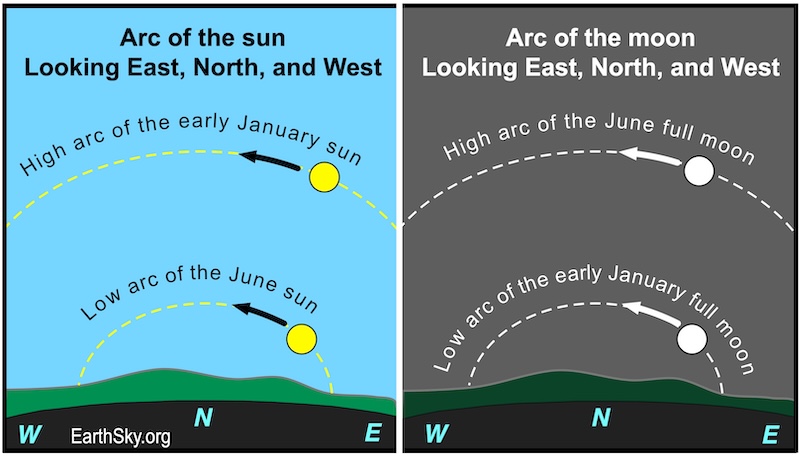
Every full moon stays – more or less – opposite the sun. The moon’s path roughly follows the sun’s daytime path from six months ago, and six months hence.
In the Northern Hemisphere, you can see this happening as you watch the early January full moon rise to almost the top of the sky near midnight. Because this full moon happens to fall closer to the December solstice than the one in December 2025, it rises almost to the top of the sky, higher than other full moons.
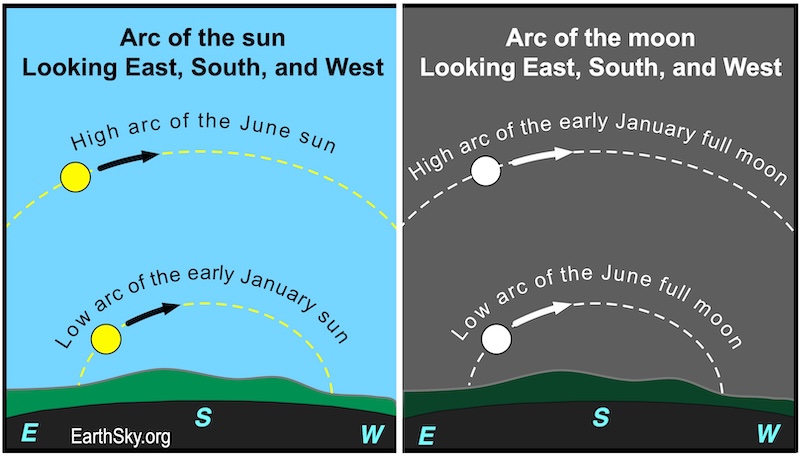
For the Southern Hemisphere, it’s the same effect, but reversed. Since it’s early summer there, this full moon rides low in the sky as the December sun rides high.
Tracing the high path of the early January full moon
You can experiment with the path of the sun and moon. Simply trace a line with your finger from east to west along a low arc above the southern horizon to emulate the sun’s early January path. Then trace another path high overhead to mimic the full moon’s path in early January. And you’ll see that the higher path will be much longer than the lower one.
The monthly paths come into balance
Little by little, we can watch the two paths come back into balance. Each month until June, the full moon will cross the sky at a slightly lower arc than the previous month. And each successive full moon takes less time than the previous one to cross the sky. Since this month’s full moon is closest to the December solstice, it rises the highest. At March’s full moon, which is near the Northern Hemisphere’s spring equinox, the two paths – of the moon and of the sun – will nearly be the same.
Then, near the June solstice, those of us in the Northern Hemisphere see the sun cross high overhead during the year’s longest days. And, during the short northern summer late spring and early summer nights, we see the full moon cross lower and spend less time in the sky.
And the cycle continues.
Bottom line: The 2026 January full Wolf Moon, a supermoon, falls on January 3 at 10:03 (4:03 a.m. CST). So the moon will be at its fullest on the morning of January 3. And it’ll appear full on both nights, January 2 and 3. It’s near the planet Jupiter and the stars Castor and Pollux.
The post January full moon is the Super Wolf Moon. It’s near Jupiter! first appeared on EarthSky.
from EarthSky https://ift.tt/hW4Ks9k
Crest of the full moon falls at 10:03 UTC on January 3. That’s 4:03 a.m. for folks in central North America. So the moon will be at its fullest on the morning of January 3, but it will appear full on both nights, January 2 and 3.
When and where to look in 2026: Look for the bright, round full moon rising in the east before sunset on January 2, 2026. It will be glowing nearly overhead around midnight, and dropping low in the west near sunrise. And that bright star rising near the moon is no star at all, it’s the planet Jupiter. Jupiter will reach its biggest and brightest for 2026 in just one week! The moon will also look full as it rises around sunset on January 3.
The full moon glows near Jupiter
This year, the January full moon will lie near Jupiter, now at its brightest this year. Even though it is close to the very bright full moon, Jupiter is bright enough to be spotted in the moonlight. On the following night, the almost full moon will hang even closer to the bright planet.
This January full moon is also a Supermoon
January 2026 will see lunar perigee – the point in the moon’s orbit where to comes closest to Earth – occur about 36 hours before when the moon is at its fullest. This means it is a perigean full moon, or what is often called a supermoon. At this point, the moon will lie 225,130 miles (362,312 kilometers) from Earth. For comparison, a more typical full moon is 18,000 miles further, putting it at 240,000 miles.
Since it is closer to us on Earth, does a supermoon appear noticeably larger than an ordinary full moon?
While it is true that experienced observers do say they can detect a size difference, you’d have to be a very keen observer to notice it. Truly most of us can’t tell any difference in the size of a supermoon and an ordinary full moon.
But … do super moons look brighter than ordinary full moons? Yes! By a noticeable amount. That’ because a supermoon exceeds the disk size of an average-sized moon by up to 8% and the brightness of an average-sized full moon by some 16%. And then, it exceeds the disk size of a micro-moon (a year’s most distant, and, therefore, smallest full moon) up to 14% and the brightness of a micro-moon by some 30%. So, if you go outside in the pre-dawn hours of January 3, as well as in the evening before, there is a possibility you’ll notice the full moon is exceptionally bright!
Read more: The moon illusion makes the moon look huge!
January’s full moon near the twin stars of Gemini
The January full moon can lie in front of one of two constellations of the zodiac. If the full moon falls in the firs half of the month, as it does this year, it lands in Gemini the Twins. If it happens during the second half, as it will next year, it falls in Cancer the Crab.
The moon is roundest on the day when it is full, but it appears almost, but not quite full the day before and after. On the evening of this January’s full moon, the twin stars of Gemini, Castor (the dimmer one) and Pollux – and Jupiter – will shine nearby. However, the bright moonlight might make these two famous stars too dim to see. If you can’t spot them, rest assured, they are still there!
January’s full moon is the Wolf Moon
All full moons have popular nicknames. January’s full moon is often called the Wolf Moon because, in parts of the world where they live, wolves are active in January and often how on cold nights. Other names derived from North American indigenous peoples also refer to January’s cold. They include the Cold Moon, Frost Exploding Moon, Freeze Up Moon, and Hard Moon.
Early January full moon and the June sun
Every full moon stays – more or less – opposite the sun. The moon’s path roughly follows the sun’s daytime path from six months ago, and six months hence.
In the Northern Hemisphere, you can see this happening as you watch the early January full moon rise to almost the top of the sky near midnight. Because this full moon happens to fall closer to the December solstice than the one in December 2025, it rises almost to the top of the sky, higher than other full moons.
For the Southern Hemisphere, it’s the same effect, but reversed. Since it’s early summer there, this full moon rides low in the sky as the December sun rides high.
Tracing the high path of the early January full moon
You can experiment with the path of the sun and moon. Simply trace a line with your finger from east to west along a low arc above the southern horizon to emulate the sun’s early January path. Then trace another path high overhead to mimic the full moon’s path in early January. And you’ll see that the higher path will be much longer than the lower one.
The monthly paths come into balance
Little by little, we can watch the two paths come back into balance. Each month until June, the full moon will cross the sky at a slightly lower arc than the previous month. And each successive full moon takes less time than the previous one to cross the sky. Since this month’s full moon is closest to the December solstice, it rises the highest. At March’s full moon, which is near the Northern Hemisphere’s spring equinox, the two paths – of the moon and of the sun – will nearly be the same.
Then, near the June solstice, those of us in the Northern Hemisphere see the sun cross high overhead during the year’s longest days. And, during the short northern summer late spring and early summer nights, we see the full moon cross lower and spend less time in the sky.
And the cycle continues.
Bottom line: The 2026 January full Wolf Moon, a supermoon, falls on January 3 at 10:03 (4:03 a.m. CST). So the moon will be at its fullest on the morning of January 3. And it’ll appear full on both nights, January 2 and 3. It’s near the planet Jupiter and the stars Castor and Pollux.
The post January full moon is the Super Wolf Moon. It’s near Jupiter! first appeared on EarthSky.
from EarthSky https://ift.tt/hW4Ks9k

Aucun commentaire:
Enregistrer un commentaire