
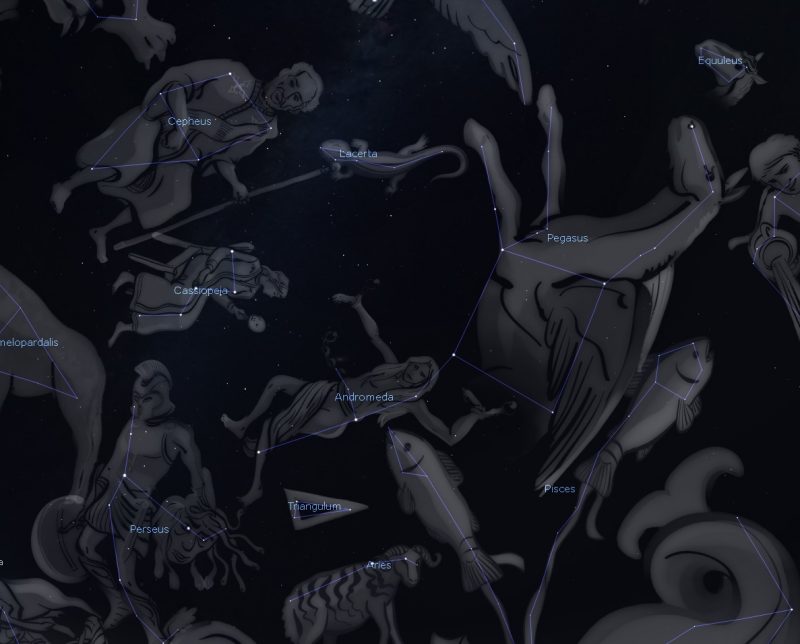
The constellation Andromeda is named for the daughter of Queen Cassiopeia and King Cepheus of Greek mythology. Andromeda has the nickname of the Chained Lady because her parents chained her up and offered her as a sacrifice to appease the sea monster Cetus. In the story, she is saved by Perseus and eventually becomes his queen. All these mythological characters are now visible as constellations in the night sky.
How to find the constellation Andromeda
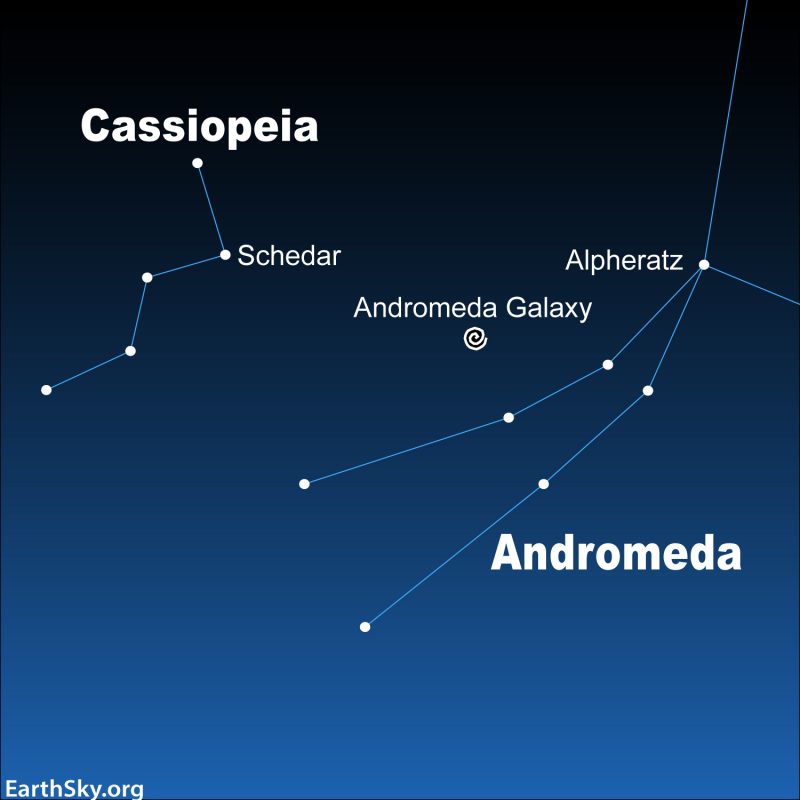
Andromeda is easy to find because of the company it keeps. The W-shaped constellation Cassiopeia points toward Andromeda. Andromeda is also next to the Great Square of Pegasus. In fact, one of the stars of the Great Square actually belongs to Andromeda.
November and December are excellent months to try to spot Andromeda the Chained Lady. Look east after it gets dark to find the constellation already high above the horizon. Plus, Andromeda favors viewers in the Northern Hemisphere; it is not visible to those south of 40 degrees south latitude. The constellation is the 19th largest, in size, of the 88 constellations. The finder chart above can guide you to it.
Stars of the constellation Andromeda
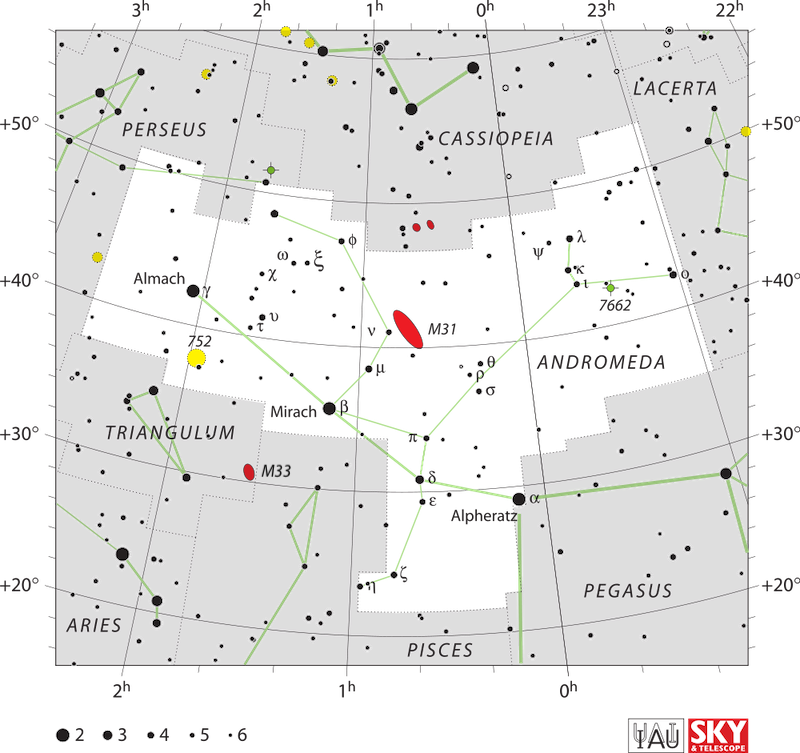
The brightest star in the Great Square of Pegasus actually belongs to Andromeda: the magnitude 2.06 star Alpheratz. Alpheratz lies 97 light-years away. In addition, another magnitude 2.06 star, Mirach, lies to the upper left of Alpheratz. Mirach lies 197 light-years away and is the closest bright star to the Andromeda galaxy. The third brightest star in Andromeda is magnitude 2.26 Almach, to the upper left of Mirach. Almach lies 355 light-years away.
Finding the Andromeda galaxy with Cassiopeia
Although M31, the Andromeda galaxy, is centrally located in the constellation Andromeda, it’s also easy to find by using the stars of Cassiopeia. The magnitude 3.5 galaxy can be seen as a hazy patch in a dark sky, but most people will need binoculars or a telescope to find the wide misty patch.
Andromeda stretches about 3 degrees across and 1 degree wide. That’s twice as wide as the full moon. It lies at a distance of approximately 2.5 million light-years from Earth, which means that as we view the light from Andromeda, we are seeing it as it was 2.5 million years ago.
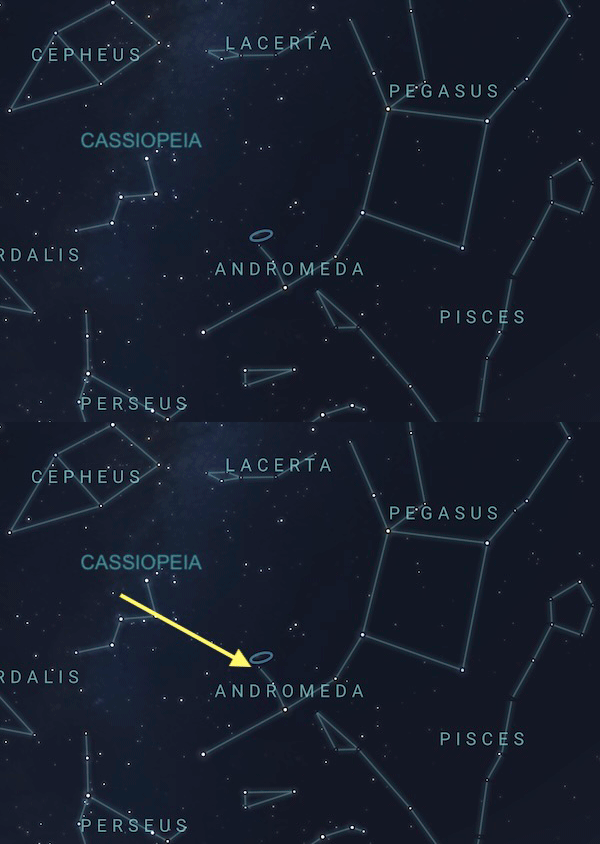
To find the Andromeda galaxy, look for the W shape of Cassiopeia. With the two V shapes that make up the W, use the V shape on the right. Imagine the V as an arrow, pointing into the constellation Andromeda. From the tip of the arrow star to the spiral galaxy, the angular distance is a little over 15 degrees. (Hold your hand at arm’s length and use your index finger and pinky spread apart to measure 15 degrees on the sky’s dome.) The arrow of Cassiopeia does not point precisely to Andromeda, however. You will have to look a bit to the right to find the galaxy M31.
Finding Andromeda Galaxy with Andromeda
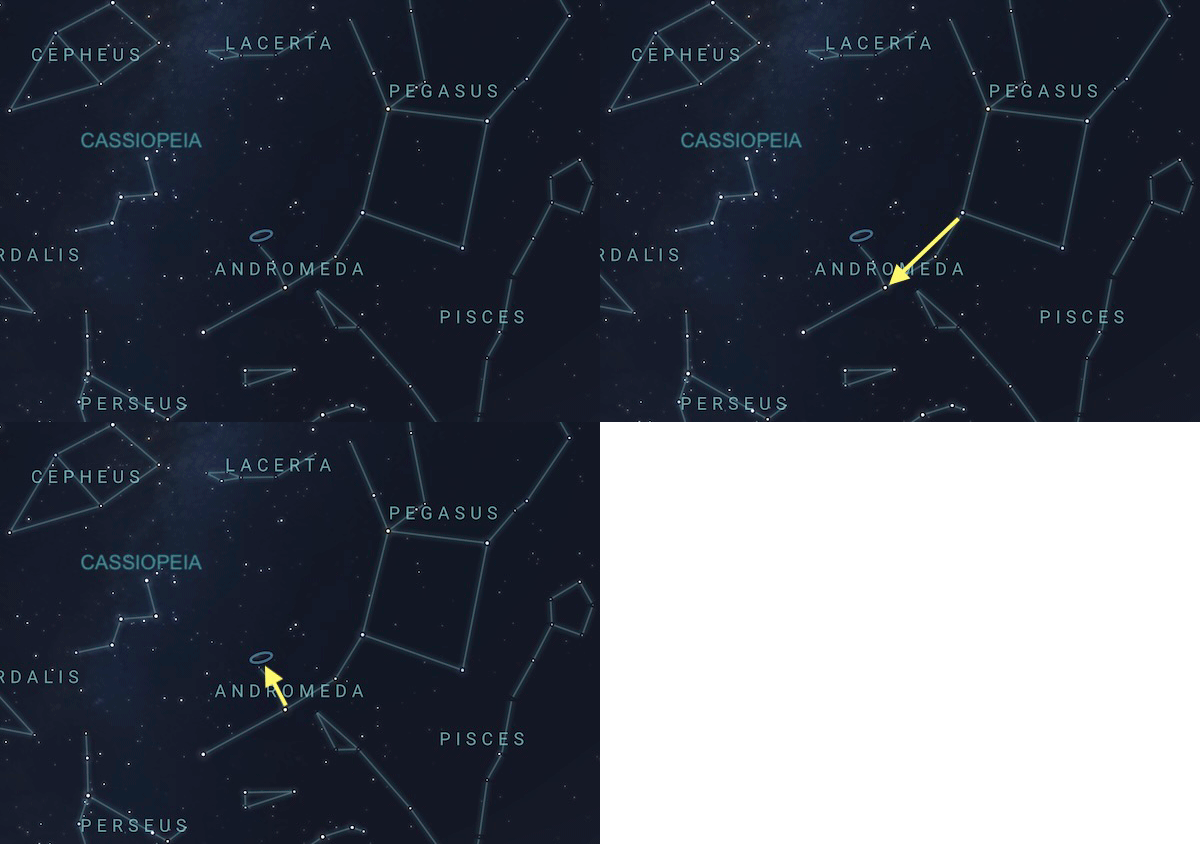
To use a star from Andromeda to find the Andromeda galaxy, start with the star that is connected to the Great Square of Pegasus. Then look left and find three stars leading away from it: a 3rd magnitude star (Delta Andromedae), Mirach and Almach. Focus on Mirach, and then look above Mirach. There are two stars in a line above it, the top one dimmer than the bottom. If you can see the highest star without optical aid, look just to its right for a slightly lighter patch of sky. Put your binoculars or a telescope on it to confirm that you’ve found the Andromeda galaxy.
Observing M31, the Andromeda Galaxy
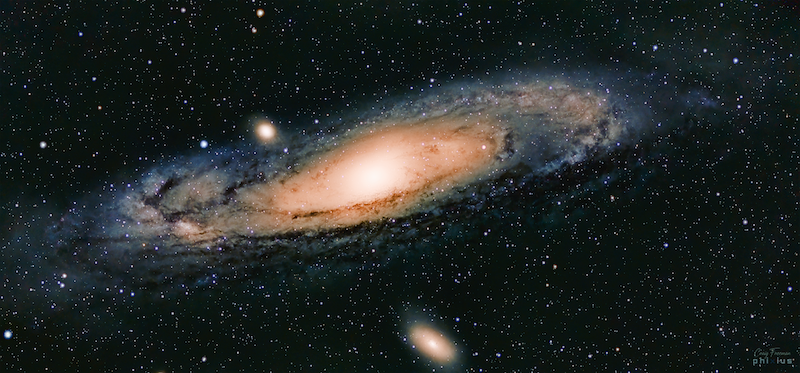
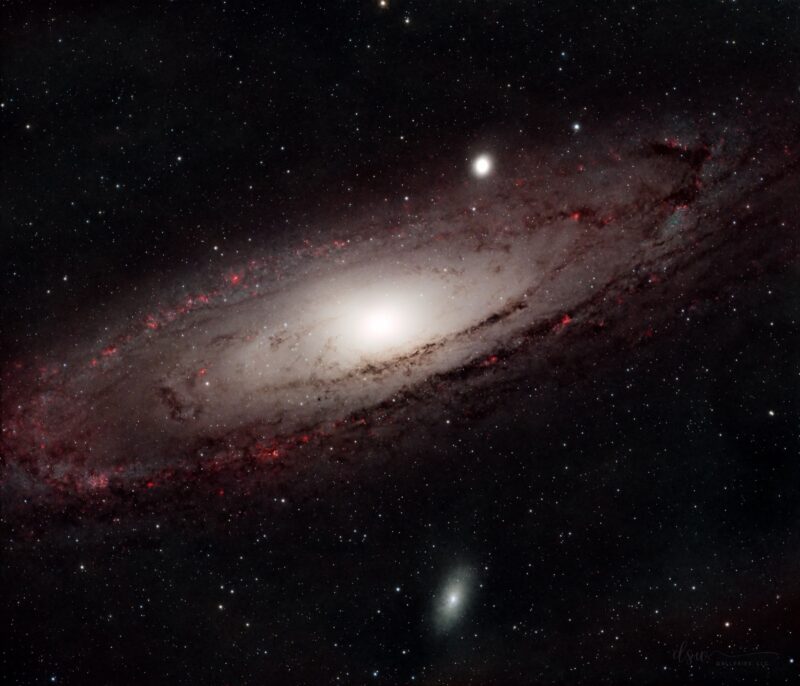
M31, at magnitude 3.5, should be easy to see once you have it located in your binoculars or telescope. Indeed, the grayish patch should show an oval shape, characteristic of spiral galaxies. In addition, two other Messier objects are within your field of view when you are looking at Andromeda. M32 and M110 are elliptical galaxies that are companions to the large Andromeda galaxy. They also lie 2.5 million light-years away. M32 is magnitude 8.1 and is closest to the galaxy, appearing to lie on the larger spiral’s edge. M110 is magnitude 8.5 and is a bit farther away from the large spiral.
Read more: Are the Andromeda and Milky Way galaxies already merging?
Bottom line: The constellation Andromeda the Chained Lady is most famous for containing the closest large spiral galaxy to the Milky Way.
The post The constellation Andromeda the Chained Lady first appeared on EarthSky.
from EarthSky https://ift.tt/xHbTNcl
The constellation Andromeda is named for the daughter of Queen Cassiopeia and King Cepheus of Greek mythology. Andromeda has the nickname of the Chained Lady because her parents chained her up and offered her as a sacrifice to appease the sea monster Cetus. In the story, she is saved by Perseus and eventually becomes his queen. All these mythological characters are now visible as constellations in the night sky.
How to find the constellation Andromeda
Andromeda is easy to find because of the company it keeps. The W-shaped constellation Cassiopeia points toward Andromeda. Andromeda is also next to the Great Square of Pegasus. In fact, one of the stars of the Great Square actually belongs to Andromeda.
November and December are excellent months to try to spot Andromeda the Chained Lady. Look east after it gets dark to find the constellation already high above the horizon. Plus, Andromeda favors viewers in the Northern Hemisphere; it is not visible to those south of 40 degrees south latitude. The constellation is the 19th largest, in size, of the 88 constellations. The finder chart above can guide you to it.
Stars of the constellation Andromeda
The brightest star in the Great Square of Pegasus actually belongs to Andromeda: the magnitude 2.06 star Alpheratz. Alpheratz lies 97 light-years away. In addition, another magnitude 2.06 star, Mirach, lies to the upper left of Alpheratz. Mirach lies 197 light-years away and is the closest bright star to the Andromeda galaxy. The third brightest star in Andromeda is magnitude 2.26 Almach, to the upper left of Mirach. Almach lies 355 light-years away.
Finding the Andromeda galaxy with Cassiopeia
Although M31, the Andromeda galaxy, is centrally located in the constellation Andromeda, it’s also easy to find by using the stars of Cassiopeia. The magnitude 3.5 galaxy can be seen as a hazy patch in a dark sky, but most people will need binoculars or a telescope to find the wide misty patch.
Andromeda stretches about 3 degrees across and 1 degree wide. That’s twice as wide as the full moon. It lies at a distance of approximately 2.5 million light-years from Earth, which means that as we view the light from Andromeda, we are seeing it as it was 2.5 million years ago.
To find the Andromeda galaxy, look for the W shape of Cassiopeia. With the two V shapes that make up the W, use the V shape on the right. Imagine the V as an arrow, pointing into the constellation Andromeda. From the tip of the arrow star to the spiral galaxy, the angular distance is a little over 15 degrees. (Hold your hand at arm’s length and use your index finger and pinky spread apart to measure 15 degrees on the sky’s dome.) The arrow of Cassiopeia does not point precisely to Andromeda, however. You will have to look a bit to the right to find the galaxy M31.
Finding Andromeda Galaxy with Andromeda
To use a star from Andromeda to find the Andromeda galaxy, start with the star that is connected to the Great Square of Pegasus. Then look left and find three stars leading away from it: a 3rd magnitude star (Delta Andromedae), Mirach and Almach. Focus on Mirach, and then look above Mirach. There are two stars in a line above it, the top one dimmer than the bottom. If you can see the highest star without optical aid, look just to its right for a slightly lighter patch of sky. Put your binoculars or a telescope on it to confirm that you’ve found the Andromeda galaxy.
Observing M31, the Andromeda Galaxy
M31, at magnitude 3.5, should be easy to see once you have it located in your binoculars or telescope. Indeed, the grayish patch should show an oval shape, characteristic of spiral galaxies. In addition, two other Messier objects are within your field of view when you are looking at Andromeda. M32 and M110 are elliptical galaxies that are companions to the large Andromeda galaxy. They also lie 2.5 million light-years away. M32 is magnitude 8.1 and is closest to the galaxy, appearing to lie on the larger spiral’s edge. M110 is magnitude 8.5 and is a bit farther away from the large spiral.
Read more: Are the Andromeda and Milky Way galaxies already merging?
Bottom line: The constellation Andromeda the Chained Lady is most famous for containing the closest large spiral galaxy to the Milky Way.
The post The constellation Andromeda the Chained Lady first appeared on EarthSky.
from EarthSky https://ift.tt/xHbTNcl

Aucun commentaire:
Enregistrer un commentaire