
Scientists have discovered 2 new Nanotyrannus dinosaurs. Researchers had previously mistaken these specimens as juvenile T. rexes. In this video, provided by the North Carolina Museum of Natural Sciences, the paper’s lead author, Lindsay Zanno, talks about the new species they discovered.
2 new dinosaur species arise from cases of mistaken identity
Most of us would agree that the fearsome Tyrannosaurus rex, which lived 67 to 66 million years ago, ranks as the most iconic of dinosaurs. But did you know that smaller T. rex-like dinosaurs coexisted with them? For a long time, scientists have hotly debated the identity of some small T. rex-like fossils. Were they juvenile T. rexes or entirely new species? On October 30, 2025, researchers said that two of those fossils were actually two distinct species of the genus Nanotyrannus.
Specifically, they focused on Nanotyrannus lancensis, one of the two Dueling Dinosaurs. This unique fossil set, unearthed in Montana in 2006, consisted of a small tyrannosaur and a triceratops frozen in combat with each other.
Lindsay Zanno, at the North Carolina Museum of Natural Sciences, is the lead author of the paper. She said:
This discovery paints a richer, more competitive picture of the last days of the dinosaur. With enormous size, a powerful bite force and stereoscopic vision, T. rex was a formidable predator, but it did not reign uncontested. Darting alongside was Nanotyrannus – a leaner, swifter and more agile hunter.
The researchers published their findings in the peer-reviewed journal Nature on October 30, 2025.
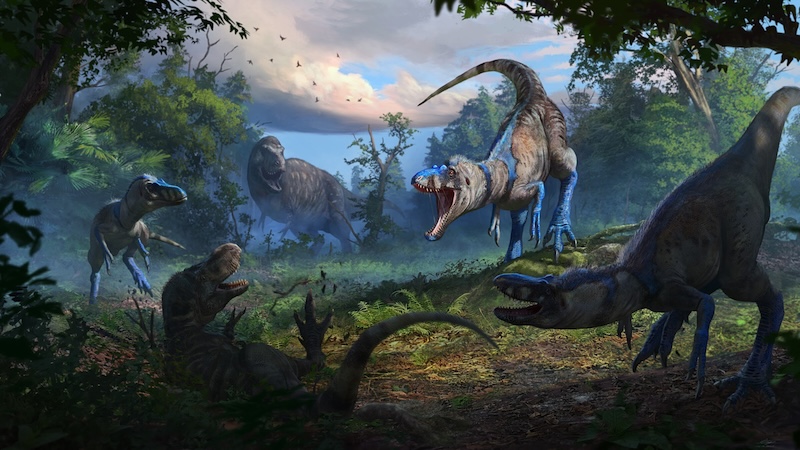
The Dueling Dinosaurs
About 67 million years ago, two dinosaurs – a predator and its prey – somehow died in mid-combat with each other. Sediment rapidly buried their bodies, and over time their bones became fossilized. Then, in 2006, these two fossilized dinosaurs, a tyrannosaur and a triceratops, were discovered at the Hell Creek Formation in Montana.
The Dueling Dinosaurs now reside at the North Carolina Museum of Natural Sciences. Prior to that, two ranches had been in a drawn-out legal dispute over who owned the fossils. The case went all the way to the Montana Supreme Court. In the end, their ruling paved the way for the museum to acquire these unusual fossils.
One of the Dueling Dinosaurs was Triceratops horridus. But the other – the sharp-toothed predator – puzzled scientists. It looked like a small T. rex. Was it a juvenile? Or an entirely different species?
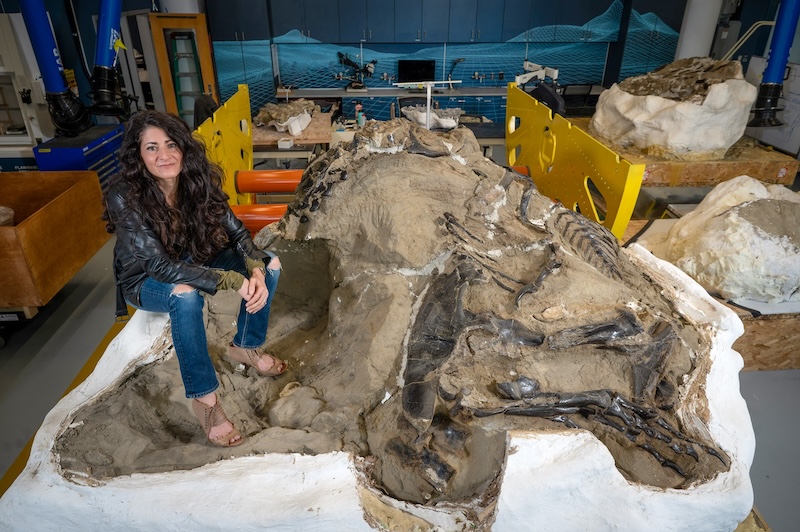
Discovering Nanotyrannus lancensis
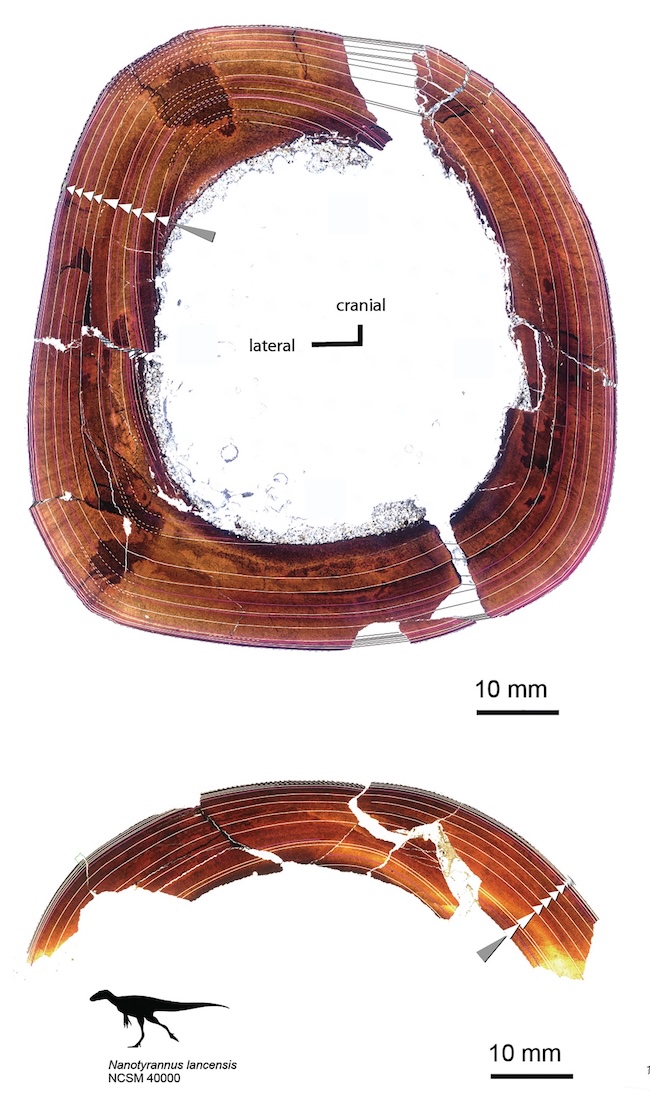
The scientists conducted an exhaustive study of the small tyrannosaur in question. They analyzed growth rings in a leg bone. They studied its spinal fusion, along with other developmental anatomy traits. As a result, they concluded this creature was about 20 years old when it died, a physically mature dinosaur.
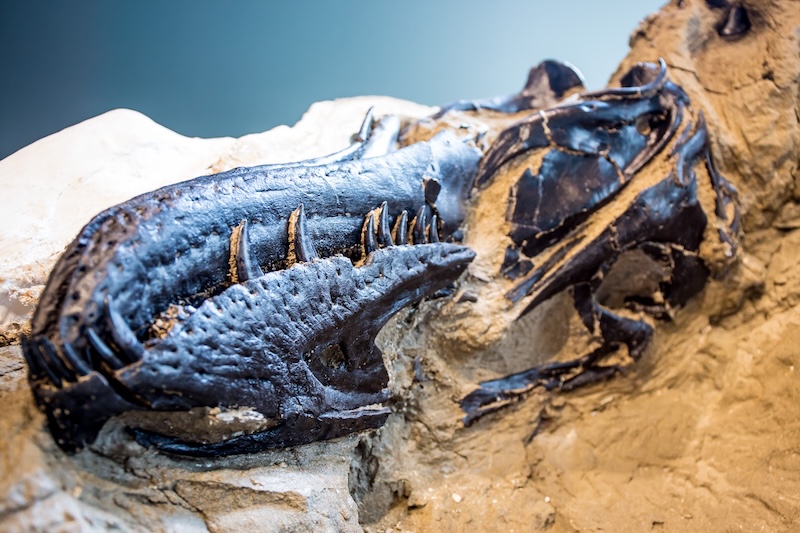
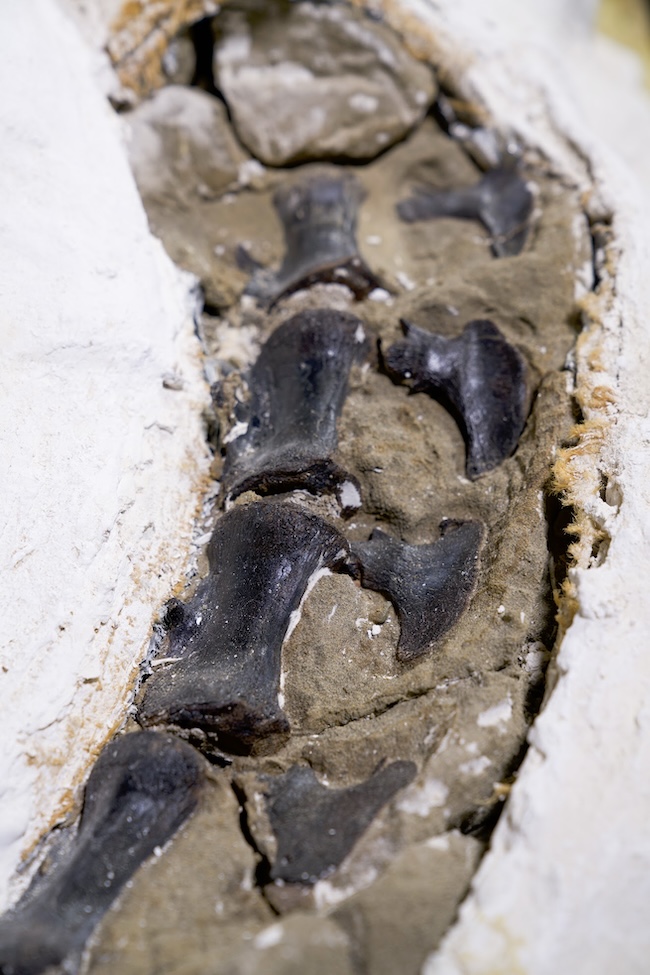
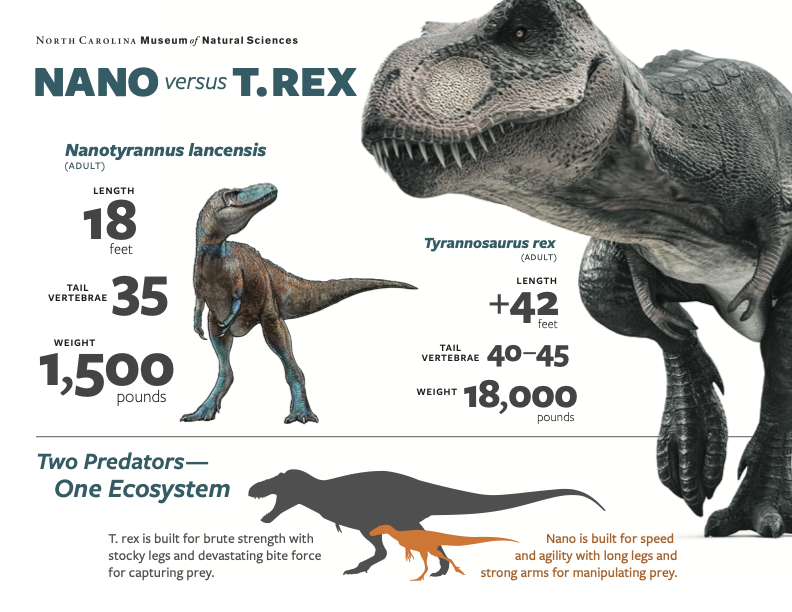
This animal had other characteristics that set it apart from T. rex. For one thing, its forelimbs were proportionally larger than those of T. rex. It had more teeth in its jaws than T. rex. Also, there were fewer tail vertebrae. And interestingly, it had different nerve patterns etched in its skull. In dinosaurs, such features become fixed early in life. Therefore, the scientists concluded this was not a teenage T. rex.
Nanotyrannus lancensis’ skull, forelimb, and tail
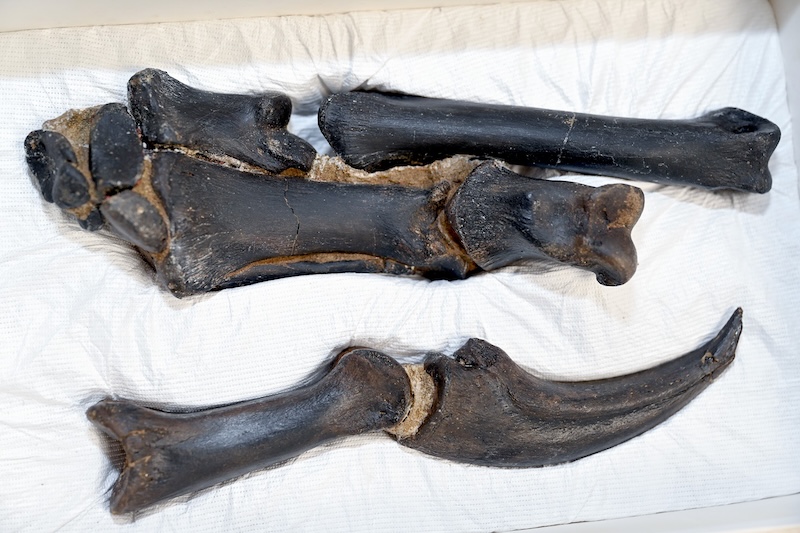
Growth rings in Nanotyrannus lancensis’ leg bone
Discovery of a second Nanotyrannus
This study suggests that some juvenile T. rex fossils might actually be Nanotyrannus. As a result, scientists will have to re-evaluate the growth stages of T. rex because some juveniles they study might not be T. rexes.
Zanno commented:
This fossil doesn’t just settle the debate. It flips decades of T. rex research on its head.
She and paper co-author James Napoli also examined over 200 tyrannosaur fossils. One of them, misidentified as a teenage T. rex, was a Nanotyrannus, also from the Hell Creek Formation. However, it was slightly different from Nanotyrannus lancensis in the Dueling Dinosaurs. The scientists named the new dinosaur Nanotyrannus lethaeus. Their research now showed there were at least two species of Nanotyrannus during the late Cretaceous, living alongside the much larger T. rex.
An infographic comparing Nanotyrannus and T. rex
Bottom line: One of the Dueling Dinosaurs fossils of Montana, which scientists thought was a juvenile T. rex, is actually a new Nanotyrannus species.
Source: Nanotyrannus and Tyrannosaurus coexisted at the close of the Cretaceous
Via North Carolina State University
Read more: Here’s how fierce T. rex got to North America
The post Nanotyrannus, a T. rex mini-me, coexisted with the big guys first appeared on EarthSky.
from EarthSky https://ift.tt/61QVwPC
Scientists have discovered 2 new Nanotyrannus dinosaurs. Researchers had previously mistaken these specimens as juvenile T. rexes. In this video, provided by the North Carolina Museum of Natural Sciences, the paper’s lead author, Lindsay Zanno, talks about the new species they discovered.
2 new dinosaur species arise from cases of mistaken identity
Most of us would agree that the fearsome Tyrannosaurus rex, which lived 67 to 66 million years ago, ranks as the most iconic of dinosaurs. But did you know that smaller T. rex-like dinosaurs coexisted with them? For a long time, scientists have hotly debated the identity of some small T. rex-like fossils. Were they juvenile T. rexes or entirely new species? On October 30, 2025, researchers said that two of those fossils were actually two distinct species of the genus Nanotyrannus.
Specifically, they focused on Nanotyrannus lancensis, one of the two Dueling Dinosaurs. This unique fossil set, unearthed in Montana in 2006, consisted of a small tyrannosaur and a triceratops frozen in combat with each other.
Lindsay Zanno, at the North Carolina Museum of Natural Sciences, is the lead author of the paper. She said:
This discovery paints a richer, more competitive picture of the last days of the dinosaur. With enormous size, a powerful bite force and stereoscopic vision, T. rex was a formidable predator, but it did not reign uncontested. Darting alongside was Nanotyrannus – a leaner, swifter and more agile hunter.
The researchers published their findings in the peer-reviewed journal Nature on October 30, 2025.
The Dueling Dinosaurs
About 67 million years ago, two dinosaurs – a predator and its prey – somehow died in mid-combat with each other. Sediment rapidly buried their bodies, and over time their bones became fossilized. Then, in 2006, these two fossilized dinosaurs, a tyrannosaur and a triceratops, were discovered at the Hell Creek Formation in Montana.
The Dueling Dinosaurs now reside at the North Carolina Museum of Natural Sciences. Prior to that, two ranches had been in a drawn-out legal dispute over who owned the fossils. The case went all the way to the Montana Supreme Court. In the end, their ruling paved the way for the museum to acquire these unusual fossils.
One of the Dueling Dinosaurs was Triceratops horridus. But the other – the sharp-toothed predator – puzzled scientists. It looked like a small T. rex. Was it a juvenile? Or an entirely different species?
Discovering Nanotyrannus lancensis
The scientists conducted an exhaustive study of the small tyrannosaur in question. They analyzed growth rings in a leg bone. They studied its spinal fusion, along with other developmental anatomy traits. As a result, they concluded this creature was about 20 years old when it died, a physically mature dinosaur.
This animal had other characteristics that set it apart from T. rex. For one thing, its forelimbs were proportionally larger than those of T. rex. It had more teeth in its jaws than T. rex. Also, there were fewer tail vertebrae. And interestingly, it had different nerve patterns etched in its skull. In dinosaurs, such features become fixed early in life. Therefore, the scientists concluded this was not a teenage T. rex.
Nanotyrannus lancensis’ skull, forelimb, and tail
Growth rings in Nanotyrannus lancensis’ leg bone
Discovery of a second Nanotyrannus
This study suggests that some juvenile T. rex fossils might actually be Nanotyrannus. As a result, scientists will have to re-evaluate the growth stages of T. rex because some juveniles they study might not be T. rexes.
Zanno commented:
This fossil doesn’t just settle the debate. It flips decades of T. rex research on its head.
She and paper co-author James Napoli also examined over 200 tyrannosaur fossils. One of them, misidentified as a teenage T. rex, was a Nanotyrannus, also from the Hell Creek Formation. However, it was slightly different from Nanotyrannus lancensis in the Dueling Dinosaurs. The scientists named the new dinosaur Nanotyrannus lethaeus. Their research now showed there were at least two species of Nanotyrannus during the late Cretaceous, living alongside the much larger T. rex.
An infographic comparing Nanotyrannus and T. rex
Bottom line: One of the Dueling Dinosaurs fossils of Montana, which scientists thought was a juvenile T. rex, is actually a new Nanotyrannus species.
Source: Nanotyrannus and Tyrannosaurus coexisted at the close of the Cretaceous
Via North Carolina State University
Read more: Here’s how fierce T. rex got to North America
The post Nanotyrannus, a T. rex mini-me, coexisted with the big guys first appeared on EarthSky.
from EarthSky https://ift.tt/61QVwPC

Aucun commentaire:
Enregistrer un commentaire