
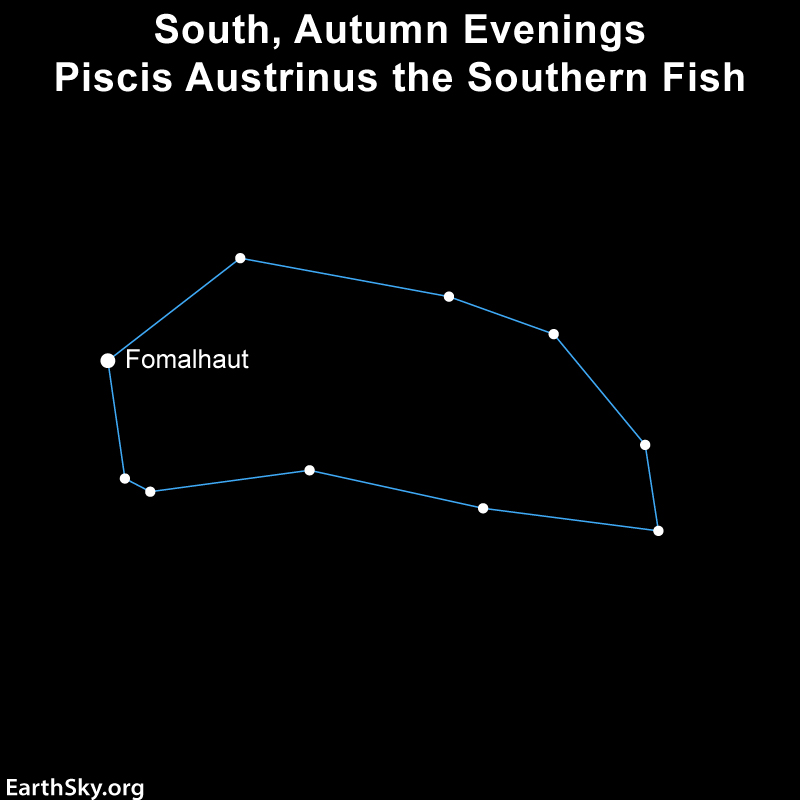
Gazing toward our galaxy’s south window into intergalactic space
When you gaze toward the bright star Fomalhaut, in the constellation Piscis Austrinus the Southern Fish, you’re looking toward what’s called our galaxy’s south window. That is, you’re looking away from the flat plane of our Milky Way, where most of our galaxy’s stars reside. And you’re looking toward the direction toward one of the galaxy’s poles. Why find Fomalhaut? When you look at this star – sometimes called the Loneliest Star – you are looking some 90 degrees from the plane of our galaxy’s equator.
Most of the galaxy’s stars reside in its flat plane. So – to the eye – the region of the sky around Fomalhaut looks relatively empty. But beyond Fomalhaut, and beyond other Milky Way stars in this direction of space – beyond your ability to see with the eye alone – you’re gazing into the vast space between galaxies.
Voila! You’re looking out the galaxy’s south window.
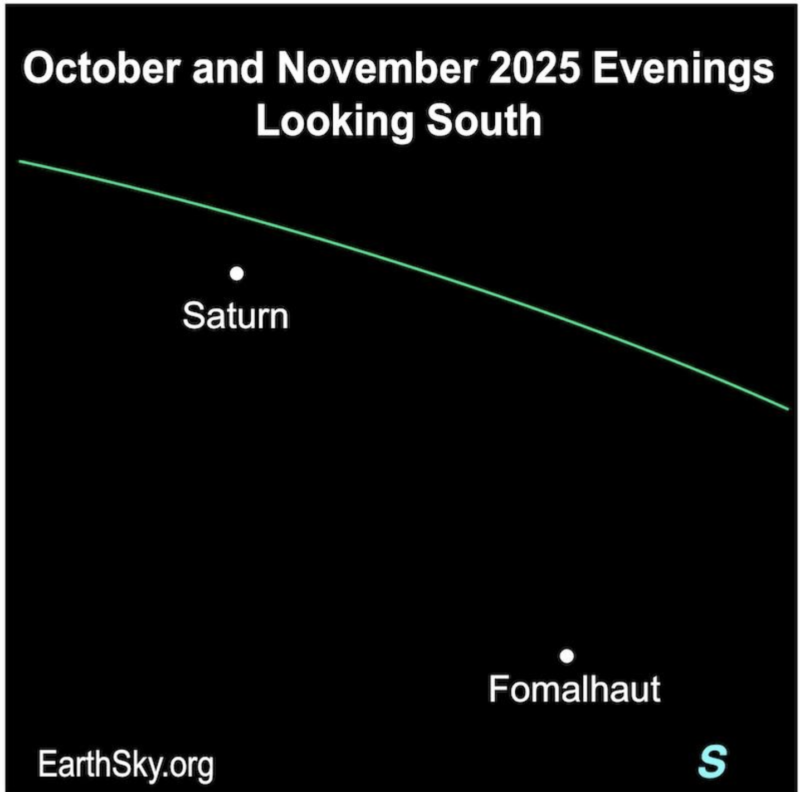
The Milky Way’s south galactic pole
Our Milky Way galaxy is round and flat, like a pancake. When you look toward Fomalhaut, you’re looking away from the pancake, and out the south window of the galaxy. In other words, we’re looking away from the star-packed disk of the galaxy, into intergalactic space and the realm of galaxies.
Want the exact location of the south galactic pole? It lies east of Fomalhaut, in the faint constellation Sculptor. See the chart below.
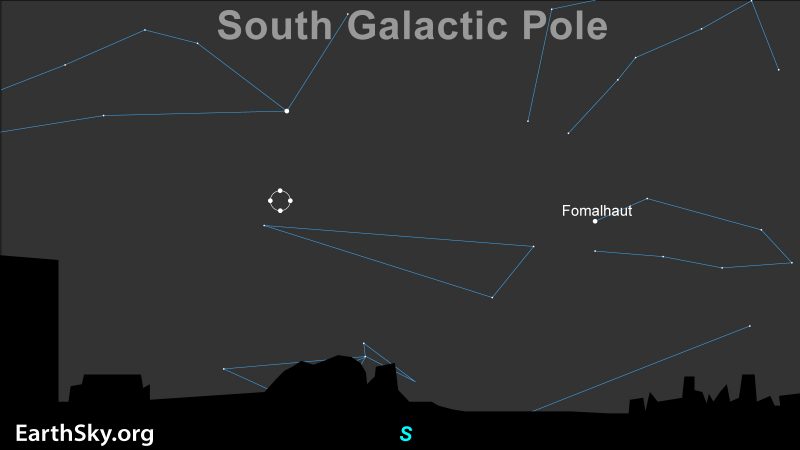
Finding Fomalhaut
Fomalhaut is a very noticeable star because it’s in a region of the heavens where there are few stars bright enough to be seen with the eye. That’s why Fomalhaut is often called the Loneliest Star.
If you’re not sure which star is Fomalhaut, try using the Great Square of Pegasus as a guide. The Great Square of Pegasus appears in the south to overhead by around 7 to 8 p.m. local time in late November and early December. You’ll notice, this large asterism really does look like a large square pattern, with four medium-bright stars marking the corners. Then draw a line from the two westernmost stars downward to Fomalhaut. The golden light – in 2025 – between them is Saturn. See the chart below.
What about from the Southern Hemisphere? Look for the Great Square to the north around 9 to 10 p.m. local time in late November and early December. Then draw a line from the two westernmost stars upward to Fomalhaut. Be sure to look for golden Saturn in between them.
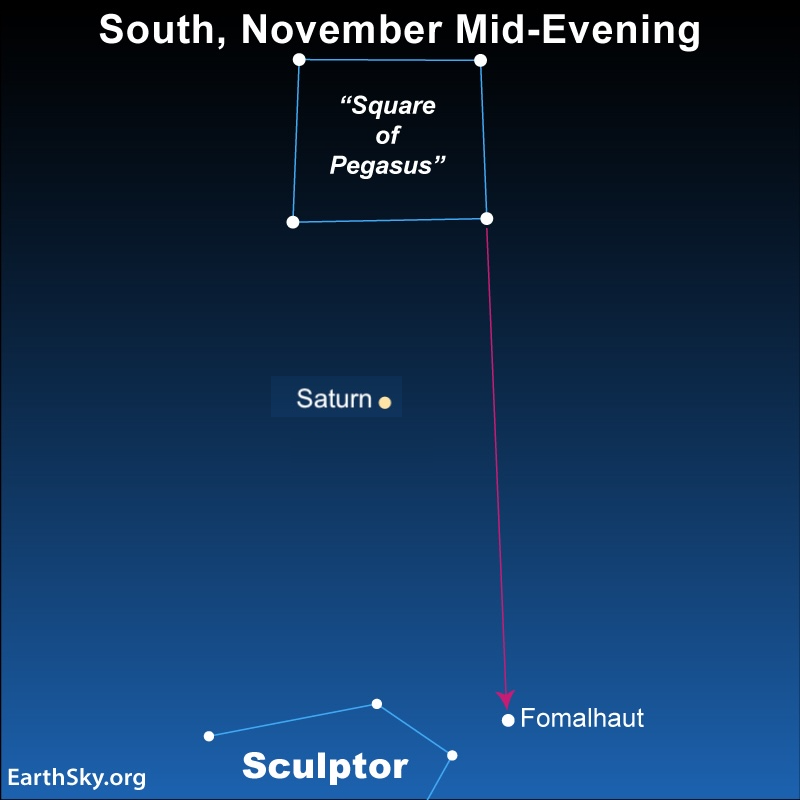
Bottom line: Use the Great Square of Pegasus to locate Fomalhaut. And once you’ve found Fomalhaut, you’re on your way to looking out our galaxy’s south window into intergalactic space.
For more sky events, visit EarthSky’s night sky guide.
Easily locate stars and constellations during any day and time with EarthSky’s Planisphere.
The post Galaxy’s south window looks into intergalactic space first appeared on EarthSky.
from EarthSky https://ift.tt/8p9bxVu
Gazing toward our galaxy’s south window into intergalactic space
When you gaze toward the bright star Fomalhaut, in the constellation Piscis Austrinus the Southern Fish, you’re looking toward what’s called our galaxy’s south window. That is, you’re looking away from the flat plane of our Milky Way, where most of our galaxy’s stars reside. And you’re looking toward the direction toward one of the galaxy’s poles. Why find Fomalhaut? When you look at this star – sometimes called the Loneliest Star – you are looking some 90 degrees from the plane of our galaxy’s equator.
Most of the galaxy’s stars reside in its flat plane. So – to the eye – the region of the sky around Fomalhaut looks relatively empty. But beyond Fomalhaut, and beyond other Milky Way stars in this direction of space – beyond your ability to see with the eye alone – you’re gazing into the vast space between galaxies.
Voila! You’re looking out the galaxy’s south window.
The Milky Way’s south galactic pole
Our Milky Way galaxy is round and flat, like a pancake. When you look toward Fomalhaut, you’re looking away from the pancake, and out the south window of the galaxy. In other words, we’re looking away from the star-packed disk of the galaxy, into intergalactic space and the realm of galaxies.
Want the exact location of the south galactic pole? It lies east of Fomalhaut, in the faint constellation Sculptor. See the chart below.
Finding Fomalhaut
Fomalhaut is a very noticeable star because it’s in a region of the heavens where there are few stars bright enough to be seen with the eye. That’s why Fomalhaut is often called the Loneliest Star.
If you’re not sure which star is Fomalhaut, try using the Great Square of Pegasus as a guide. The Great Square of Pegasus appears in the south to overhead by around 7 to 8 p.m. local time in late November and early December. You’ll notice, this large asterism really does look like a large square pattern, with four medium-bright stars marking the corners. Then draw a line from the two westernmost stars downward to Fomalhaut. The golden light – in 2025 – between them is Saturn. See the chart below.
What about from the Southern Hemisphere? Look for the Great Square to the north around 9 to 10 p.m. local time in late November and early December. Then draw a line from the two westernmost stars upward to Fomalhaut. Be sure to look for golden Saturn in between them.
Bottom line: Use the Great Square of Pegasus to locate Fomalhaut. And once you’ve found Fomalhaut, you’re on your way to looking out our galaxy’s south window into intergalactic space.
For more sky events, visit EarthSky’s night sky guide.
Easily locate stars and constellations during any day and time with EarthSky’s Planisphere.
The post Galaxy’s south window looks into intergalactic space first appeared on EarthSky.
from EarthSky https://ift.tt/8p9bxVu

Aucun commentaire:
Enregistrer un commentaire