
Orion’s Belt points to Sirius
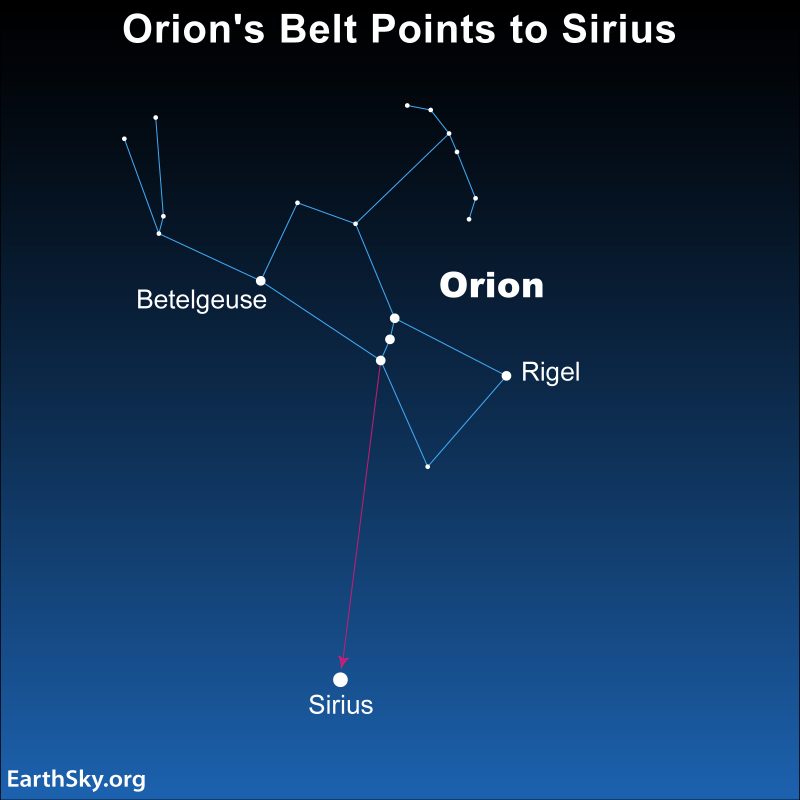
It’s one of the neatest tricks in all the heavens: Orion’s Belt points to Sirius, the sky’s brightest star. So on September mornings, you’ll find both Orion the Hunter and the very bright star Sirius in the eastern part of the sky before dawn. Before you know it, they’ll be shifting into the evening sky. Identify them now, and enjoy them for months to come.
Also, sometimes there are bright planets that might outshine even Sirius, in the same region. In fact, in September 2025, Venus and Jupiter are also in the morning sky and definitely outshine our brightest star.
What’s more, sometimes there are bright planets in the evening sky during the northern winter, when Orion and Sirius shine brightly. And those planets, too, might be brighter than the sky’s brightest star. In those cases, how can you be sure the object you’re looking at is Sirius? The constellation Orion is your ticket. No matter where you are, no matter what time of the year it is, Orion’s Belt always points to Sirius.
Orion returned to the morning sky in late July
Orion returned to the sky before dawn in late July and early August. In September, you can easily find this large constellation before sunup. Just look in the eastern part of the sky. You’ll easily notice Orion’s Belt, which consists of a short, straight row of three medium-bright stars.
To find Sirius, draw a line through Orion’s Belt and extend that line toward the horizon. There, you’ll spot Sirius, the sky’s brightest star.
Sirius is in the constellation Canis Major the Greater Dog. It’s often called the Dog Star.
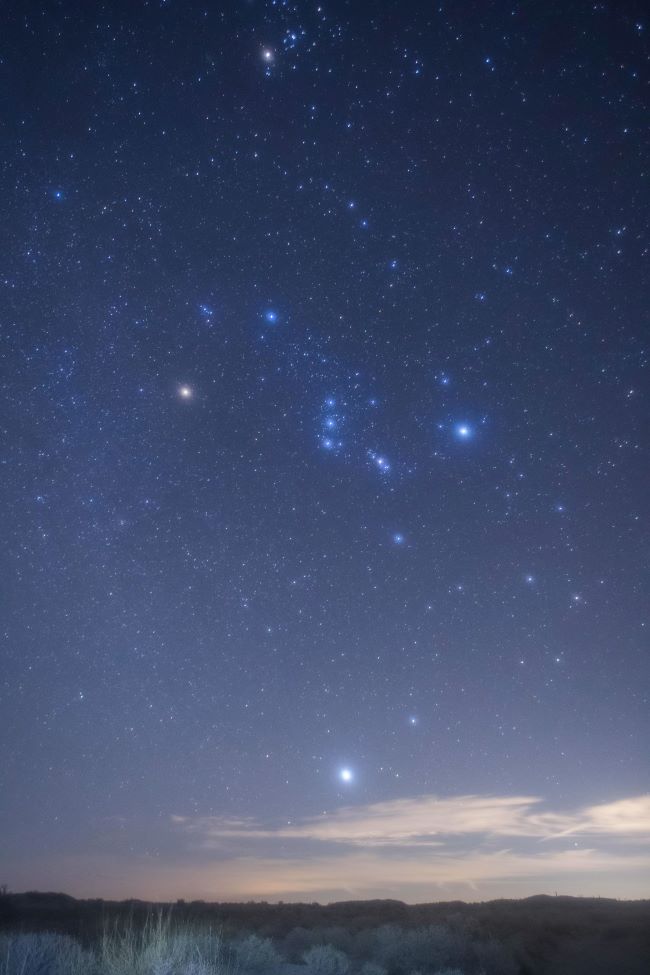
Bottom line: In September 2025, you’ll find the constellation Orion, whose three Belt stars make a short, straight row, in the southeast before dawn. Orion’s Belt points to Sirius, the brightest star of the nighttime sky. Only (some) planets shine brighter.
Help support EarthSky! Check out the EarthSky store for fun astronomy gifts and tools for all ages!
The post Orion’s Belt points to Sirius on September mornings first appeared on EarthSky.
from EarthSky https://ift.tt/Tw1HsJc
Orion’s Belt points to Sirius
It’s one of the neatest tricks in all the heavens: Orion’s Belt points to Sirius, the sky’s brightest star. So on September mornings, you’ll find both Orion the Hunter and the very bright star Sirius in the eastern part of the sky before dawn. Before you know it, they’ll be shifting into the evening sky. Identify them now, and enjoy them for months to come.
Also, sometimes there are bright planets that might outshine even Sirius, in the same region. In fact, in September 2025, Venus and Jupiter are also in the morning sky and definitely outshine our brightest star.
What’s more, sometimes there are bright planets in the evening sky during the northern winter, when Orion and Sirius shine brightly. And those planets, too, might be brighter than the sky’s brightest star. In those cases, how can you be sure the object you’re looking at is Sirius? The constellation Orion is your ticket. No matter where you are, no matter what time of the year it is, Orion’s Belt always points to Sirius.
Orion returned to the morning sky in late July
Orion returned to the sky before dawn in late July and early August. In September, you can easily find this large constellation before sunup. Just look in the eastern part of the sky. You’ll easily notice Orion’s Belt, which consists of a short, straight row of three medium-bright stars.
To find Sirius, draw a line through Orion’s Belt and extend that line toward the horizon. There, you’ll spot Sirius, the sky’s brightest star.
Sirius is in the constellation Canis Major the Greater Dog. It’s often called the Dog Star.
Bottom line: In September 2025, you’ll find the constellation Orion, whose three Belt stars make a short, straight row, in the southeast before dawn. Orion’s Belt points to Sirius, the brightest star of the nighttime sky. Only (some) planets shine brighter.
Help support EarthSky! Check out the EarthSky store for fun astronomy gifts and tools for all ages!
The post Orion’s Belt points to Sirius on September mornings first appeared on EarthSky.
from EarthSky https://ift.tt/Tw1HsJc

Aucun commentaire:
Enregistrer un commentaire