
Pismis 24 is a nearby spot of massive star birth
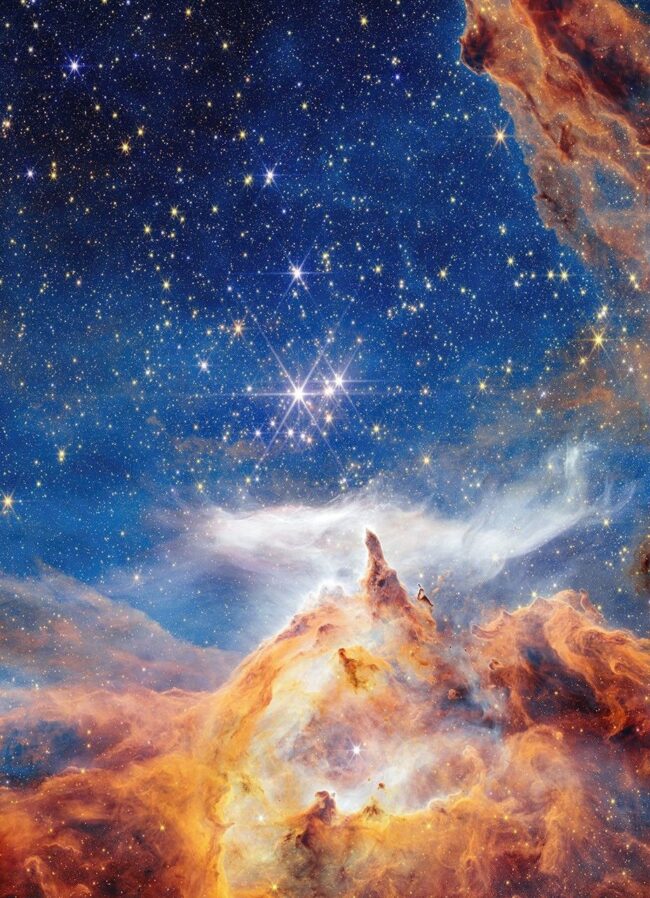
NASA shared this jaw-dropping new image from the James Webb Space Telescope on September 4, 2025. It pictures Pismis 24, a glittering hotbed of star formation that is blasting away the gassy and dusty cocoon of its birth. The young star cluster is just 5,500 light-years away in the constellation Scorpius. That makes it one of the closest sites of massive star birth to us. And this allows scientists an excellent look at how large, massive stars evolve.
The star cluster lies at the core of the Lobster Nebula (NGC 6357). The brightest star in this image is Pismis 24-1. But it’s not one star. It’s at least two stars, with masses of 74 and 66 times that of our sun.
Stars in the cluster
The brightest stars in the cluster have diffraction spikes, but many other stars are a part of this cluster, too. We see hundreds to thousands of stars in white, yellow and red. At the same time, we also see tens of thousands of stars that are not part of the cluster but float in the background as part of the Milky Way galaxy.
This view is just a small part of the Lobster Nebula, which is filled with hot, young stars blasting away the gas and dust. In the image, we see fingers of gas pointing toward the cluster. NASA said:
More than 1,000 solar systems could fit in the tip of the tallest one, which is about 5.4 light-years from bottom going up, up, up to its top.
Bottom line: NASA has released an incredible image of Pismis 24, a sparkling cluster of star formation. It’s one of the nearest sites of massive star birth.
The post Meet Pismis 24, a glittering hotbed of star birth first appeared on EarthSky.
from EarthSky https://ift.tt/Ky9vZHL
Pismis 24 is a nearby spot of massive star birth
NASA shared this jaw-dropping new image from the James Webb Space Telescope on September 4, 2025. It pictures Pismis 24, a glittering hotbed of star formation that is blasting away the gassy and dusty cocoon of its birth. The young star cluster is just 5,500 light-years away in the constellation Scorpius. That makes it one of the closest sites of massive star birth to us. And this allows scientists an excellent look at how large, massive stars evolve.
The star cluster lies at the core of the Lobster Nebula (NGC 6357). The brightest star in this image is Pismis 24-1. But it’s not one star. It’s at least two stars, with masses of 74 and 66 times that of our sun.
Stars in the cluster
The brightest stars in the cluster have diffraction spikes, but many other stars are a part of this cluster, too. We see hundreds to thousands of stars in white, yellow and red. At the same time, we also see tens of thousands of stars that are not part of the cluster but float in the background as part of the Milky Way galaxy.
This view is just a small part of the Lobster Nebula, which is filled with hot, young stars blasting away the gas and dust. In the image, we see fingers of gas pointing toward the cluster. NASA said:
More than 1,000 solar systems could fit in the tip of the tallest one, which is about 5.4 light-years from bottom going up, up, up to its top.
Bottom line: NASA has released an incredible image of Pismis 24, a sparkling cluster of star formation. It’s one of the nearest sites of massive star birth.
The post Meet Pismis 24, a glittering hotbed of star birth first appeared on EarthSky.
from EarthSky https://ift.tt/Ky9vZHL

Aucun commentaire:
Enregistrer un commentaire