
A video featuring study co-author Richard Butler on the ankylosaur Spicomellus afer, provided by the University of Birmingham.
- Spicomellus afer is the oldest known ankylosaur, dated at 165 million years old. It was discovered in Morocco.
- It had bizarre, never-before-seen armor, including spikes over 3 feet (1 meter) long fused directly to bones near the neck.
- The discovery challenges previous ideas about ankylosaur evolution, showing complex armor and tail weapons appeared much earlier than expected.
Scientists have never ever seen anything like this before!
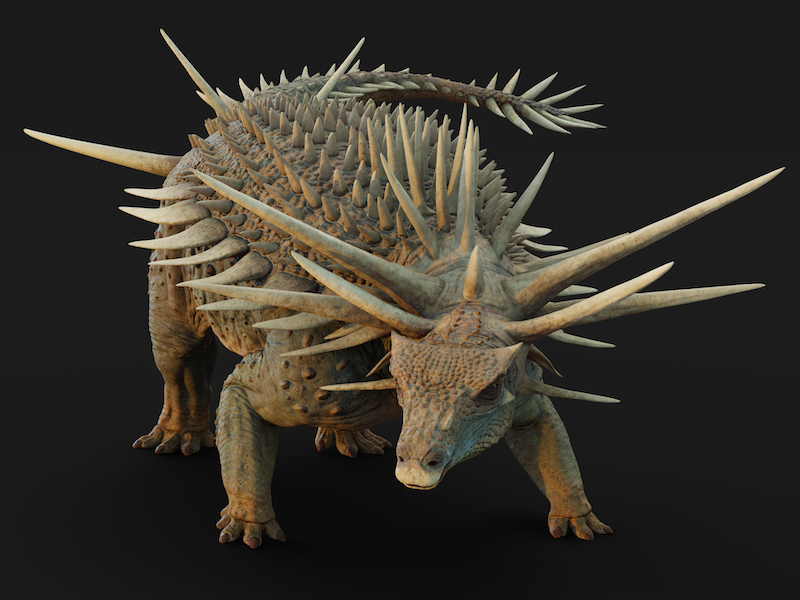
Ankylosaurs were a group of herbivorous four-legged dinosaurs. They were short stout creatures built like a tank, notable for body armor such as bony plates that covered most of their body. In late August 2025, scientists announced new details about a strange ankylosaur unearthed in Morocco, Africa, dated at 165 million years old. Spicomellus afer had an odd bony collar lined with spikes, some that were over three feet long. There were additional spikes all over its body. Moreover, the partial skeleton recovered by the team showed evidence of a tail weapon, a feature not expected in early ankylosaurs.
Richard Butler of the University of Birmingham, a paper co-author, said in a statement:
Seeing and studying the Spicomellus fossils for the first time was spine-tingling. We just couldn’t believe how weird it was and how unlike any other dinosaur, or indeed any other animal we know of alive or extinct. It turns much of what we thought we knew about ankylosaurs and their evolution on its head and demonstrates just how much there still is to learn about dinosaurs.
The researchers published their findings in the peer-reviewed journal Nature on August 27, 2025.
An ankylosaur with very unusual armor
The most eye-catching features of Spicomellus were spikes all over its body. Bony spikes, fused to the animal’s ribs, are features that no one has ever seen before in any creature. The most impressive spikes, over three feet long, protruded from a bony collar around its neck. The scientists think these spikes may have been even longer when the animal was alive.
Susannah Maidment of the Natural History Museum, London, the paper’s lead author, said in the statement:
To find such elaborate armor in an early ankylosaur changes our understanding of how these dinosaurs evolved. It shows just how significant Africa’s dinosaurs are, and how important it is to improve our understanding of them.
Spicomellus had a diversity of plates and spikes extending from all over its body, including meter-long neck spikes, huge upwards-projecting spikes over the hips, and a whole range of long, blade-like spikes, pieces of armor made up of two long spikes, and plates down the shoulder. We’ve never seen anything like this in any animal before.
It’s particularly strange as this is the oldest known ankylosaur, so we might expect that a later species might have inherited similar features, but they haven’t.

Finding the oldest known ankylosaur
Most ankylosaurs are known from the late Cretaceous of North America, and date from 68 to 66 million years ago. Prior to that, their presence is sparse in the fossil record. Scientists say that Spicomellus, at 165 million years old, is the earliest known ankylosaur. Furthermore, it is the first ankylosaur found in Africa.
Spicomellus was first described in 2021, based on a rib bone bearing four spines. The Natural History Museum in London acquired the fossil in 2019 from a commercial fossil dealer.
In 2023, English, Moroccan, and American scientists returned to the locality where that rib had been found. There, they were able to get more fossils that a farmer had already dug up and also excavated some themselves. The partial skeleton from that site included several vertebrae, ribs with spikes, several body plates, and a bony collar with spikes.

A dinosaur unlike any known creature
The scientists think that the extraordinary spikes on Spicomellus, not found on any other ankylosaur, may have been used to attract mates. Or perhaps to intimidate rivals. In contrast, the body armor of Cretaceous ankylosaurs most likely evolved for defense against larger predatory dinosaurs and reptiles.
Some Cretaceous ankylosaurs were also known for their tail weapons (or clubs), structures at the end of their tail for swiping attackers or rivals. To support such a weapon, the tail vertebrae need to be fused together to form a structure called a handle. Although the end of Spicomellus‘ tail was not recovered, its fused tail vertebrae indicated it had a handle and therefore, likely sported a tail weapon.
Butler wrote this in a post thread on BlueSky:
This turns ankylosaur evolution on its head in many ways — we have the most bizarre armor in ankylosaur history right at the beginning of the evolution of the group, perhaps functioning for display rather than defense. We have a tail weapon at least 30 million years earlier than expected.
It also highlights the incredible significance of Moroccan paleontology. A very sad part of this story is that Spicomellus fossils — very likely parts of the same skeleton that we describe — are for sale having been illegally poached and smuggled. I hope these find their way back to Morocco.
Bottom line: Spicomellus afer, an early ankylosaur found in Morocco, had bizarre spikes all over its body. Those around its neck reach over three feet in length.
Source: Extreme armour in the world’s oldest ankylosaur
Read more: Khankhuuluu is a new T. rex dinosaur relative from Mongolia
The post Bizarre ankylosaur with spikes is unlike any known dinosaur first appeared on EarthSky.
from EarthSky https://ift.tt/IhtOBSb
A video featuring study co-author Richard Butler on the ankylosaur Spicomellus afer, provided by the University of Birmingham.
- Spicomellus afer is the oldest known ankylosaur, dated at 165 million years old. It was discovered in Morocco.
- It had bizarre, never-before-seen armor, including spikes over 3 feet (1 meter) long fused directly to bones near the neck.
- The discovery challenges previous ideas about ankylosaur evolution, showing complex armor and tail weapons appeared much earlier than expected.
Scientists have never ever seen anything like this before!
Ankylosaurs were a group of herbivorous four-legged dinosaurs. They were short stout creatures built like a tank, notable for body armor such as bony plates that covered most of their body. In late August 2025, scientists announced new details about a strange ankylosaur unearthed in Morocco, Africa, dated at 165 million years old. Spicomellus afer had an odd bony collar lined with spikes, some that were over three feet long. There were additional spikes all over its body. Moreover, the partial skeleton recovered by the team showed evidence of a tail weapon, a feature not expected in early ankylosaurs.
Richard Butler of the University of Birmingham, a paper co-author, said in a statement:
Seeing and studying the Spicomellus fossils for the first time was spine-tingling. We just couldn’t believe how weird it was and how unlike any other dinosaur, or indeed any other animal we know of alive or extinct. It turns much of what we thought we knew about ankylosaurs and their evolution on its head and demonstrates just how much there still is to learn about dinosaurs.
The researchers published their findings in the peer-reviewed journal Nature on August 27, 2025.
An ankylosaur with very unusual armor
The most eye-catching features of Spicomellus were spikes all over its body. Bony spikes, fused to the animal’s ribs, are features that no one has ever seen before in any creature. The most impressive spikes, over three feet long, protruded from a bony collar around its neck. The scientists think these spikes may have been even longer when the animal was alive.
Susannah Maidment of the Natural History Museum, London, the paper’s lead author, said in the statement:
To find such elaborate armor in an early ankylosaur changes our understanding of how these dinosaurs evolved. It shows just how significant Africa’s dinosaurs are, and how important it is to improve our understanding of them.
Spicomellus had a diversity of plates and spikes extending from all over its body, including meter-long neck spikes, huge upwards-projecting spikes over the hips, and a whole range of long, blade-like spikes, pieces of armor made up of two long spikes, and plates down the shoulder. We’ve never seen anything like this in any animal before.
It’s particularly strange as this is the oldest known ankylosaur, so we might expect that a later species might have inherited similar features, but they haven’t.
Finding the oldest known ankylosaur
Most ankylosaurs are known from the late Cretaceous of North America, and date from 68 to 66 million years ago. Prior to that, their presence is sparse in the fossil record. Scientists say that Spicomellus, at 165 million years old, is the earliest known ankylosaur. Furthermore, it is the first ankylosaur found in Africa.
Spicomellus was first described in 2021, based on a rib bone bearing four spines. The Natural History Museum in London acquired the fossil in 2019 from a commercial fossil dealer.
In 2023, English, Moroccan, and American scientists returned to the locality where that rib had been found. There, they were able to get more fossils that a farmer had already dug up and also excavated some themselves. The partial skeleton from that site included several vertebrae, ribs with spikes, several body plates, and a bony collar with spikes.
A dinosaur unlike any known creature
The scientists think that the extraordinary spikes on Spicomellus, not found on any other ankylosaur, may have been used to attract mates. Or perhaps to intimidate rivals. In contrast, the body armor of Cretaceous ankylosaurs most likely evolved for defense against larger predatory dinosaurs and reptiles.
Some Cretaceous ankylosaurs were also known for their tail weapons (or clubs), structures at the end of their tail for swiping attackers or rivals. To support such a weapon, the tail vertebrae need to be fused together to form a structure called a handle. Although the end of Spicomellus‘ tail was not recovered, its fused tail vertebrae indicated it had a handle and therefore, likely sported a tail weapon.
Butler wrote this in a post thread on BlueSky:
This turns ankylosaur evolution on its head in many ways — we have the most bizarre armor in ankylosaur history right at the beginning of the evolution of the group, perhaps functioning for display rather than defense. We have a tail weapon at least 30 million years earlier than expected.
It also highlights the incredible significance of Moroccan paleontology. A very sad part of this story is that Spicomellus fossils — very likely parts of the same skeleton that we describe — are for sale having been illegally poached and smuggled. I hope these find their way back to Morocco.
Bottom line: Spicomellus afer, an early ankylosaur found in Morocco, had bizarre spikes all over its body. Those around its neck reach over three feet in length.
Source: Extreme armour in the world’s oldest ankylosaur
Read more: Khankhuuluu is a new T. rex dinosaur relative from Mongolia
The post Bizarre ankylosaur with spikes is unlike any known dinosaur first appeared on EarthSky.
from EarthSky https://ift.tt/IhtOBSb

Aucun commentaire:
Enregistrer un commentaire