
An interview about interbreeding between Neanderthals and modern humans, with the study’s lead author Israel Hershkovitz, of Tel Aviv University. Video provided by Tel Aviv University.
Ancient skull of a 5-year-old child reveals a surprise
Today, there is only one human species on Earth: Homo sapiens, also known as modern humans. That’s us. But in the past, there were others, such as Neanderthals and Denisovans. Furthermore, there is evidence of interbreeding between the three human species. Almost all of us carry a small percentage of DNA from these extinct humans. Recently, scientists found the earliest evidence of interbreeding between modern humans and Neanderthals 140,000 years ago in Israel. They discovered it in the skull of a 5-year-old child that showed traits of both species.
Israel Hershkovitz, of Tel Aviv University, led the study. He commented about interbreeding between modern humans and Neanderthals in a statement:
Genetic studies over the past decade have shown that these two groups exchanged genes. Even today, 40,000 years after the last Neanderthals disappeared, part of our genome — 2 to 6 percent — is of Neanderthal origin. These gene exchanges took place between 60,000 to 40,000 years ago.
Here, we are dealing with a human fossil that is 140,000 years old. In our study, we show that the child’s skull, which in its overall shape resembles that of Homo sapiens — especially in the curvature of the skull vault — has an intracranial blood supply system, a lower jaw, and an inner ear structure typical of Neanderthals.”

The researchers published their findings in the July-August issue of the journal L’Anthropologie.
The Skhul Cave child
In 1931, an incomplete skeleton of a 5-year-old child was found in the Skhul Cave at Mount Carmel, Israel. This child had been intentionally buried there about 140,000 years ago.
In this new study, the researchers reexamined the child’s skull: a cranium (part of the skull surrounding the brain) and a lower jaw with teeth.
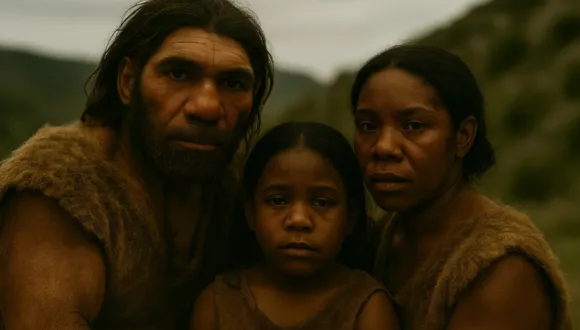
Analysis of child’s skull reveals traits from Neanderthals and modern humans
The scientists ran a micro-CT scan of the skull to create a detailed three-dimensional model of it. The resulting data provided a new look at features that were not visible in previous studies. For instance, they could now see structure of the inner ears.
In addition, the researchers used the data to create a meticulous reconstruction of the skull’s interior, allowing them to study blood vessels around the brain.
Their analysis revealed that the skull’s overall shape resembled that of a modern human. However, the blood vessels around the brain, the lower jaw, and inner ear structure resembled those of Neanderthals.


The earliest known offspring of a modern human and Neanderthal
Hershkovitz commented:
The fossil we studied is the earliest known physical evidence of mating between Neanderthals and Homo sapiens.
In 1998, a skeleton of a child was discovered in Portugal that showed traits of both of these human groups. But that skeleton, nicknamed the ‘Lapedo Valley Child,’ dates back to 28,000 years ago, more than 100,000 years after the Skhul child.
Traditionally, anthropologists have attributed the fossils discovered in the Skhul Cave, along with fossils from the Qafzeh Cave near Nazareth, to an early group of Homo sapiens. The current study reveals that at least some of the fossils from the Skhul Cave are the result of continuous genetic infiltration from the local — and older — Neanderthal population into the Homo sapiens population.
Who were the Neanderthals?
Homo neanderthalensis – the Neanderthals – were a human species that lived 400,000 to 40,000 years ago. They first evolved in Europe, then spread into central Asia. Modern humans shared a common ancestor with them about 500,000 years ago.
Neanderthals had short stocky muscular bodies. They also had distinctive heads, with strong double-arched brow ridges and a large nose.
They are often stereotyped as backward brutish creatures. But archaeological evidence has revealed they were intelligent humans. They were skilled at making tools like spears and flint hand axes. And they were excellent hunters. Neanderthals also cared for their sick and intentionally buried their dead in graves, indicating they were compassionate humans. Archaeologists have also found evidence that they made jewelry. For instance, a piece using eagle talons was found in Croatia that dated to 130,000 years ago.
Neanderthals and modern humans in prehistoric Israel
Scientists once thought that Neanderthals had migrated to the region that is modern-day Israel about 70,000 years ago. But in 2021, Hershkovitz and his colleagues provided evidence that Neanderthals had first lived in the region as early as 400,000 years ago. They referred to these humans as “Nesher Ramla Homo,” named after the site where they were discovered.
Modern humans evolved in East Africa about 300,000 years ago. Eventually, they left their home continent in waves of migrations. According to Hershkovitz, a wave of modern humans that left Africa, around 200,000 years ago, encountered Neanderthals living in present-day Israel.
This new study of the child from Skhul Cave provides the earliest fossil evidence that modern humans and Neanderthals interbred. While Neanderthals, as a species, became extinct 40,000 years ago, some of their genes continue to live on through us.
Bottom line: The fossil remains of a child, dated to 140,000 years ago, shows the earliest known evidence of breeding between Neanderthals and modern humans.
Read more: New evidence: humans and Neanderthals interacted in Israel
The post Neanderthals and modern humans interbred 140,000 years ago first appeared on EarthSky.
from EarthSky https://ift.tt/RhqraM1
An interview about interbreeding between Neanderthals and modern humans, with the study’s lead author Israel Hershkovitz, of Tel Aviv University. Video provided by Tel Aviv University.
Ancient skull of a 5-year-old child reveals a surprise
Today, there is only one human species on Earth: Homo sapiens, also known as modern humans. That’s us. But in the past, there were others, such as Neanderthals and Denisovans. Furthermore, there is evidence of interbreeding between the three human species. Almost all of us carry a small percentage of DNA from these extinct humans. Recently, scientists found the earliest evidence of interbreeding between modern humans and Neanderthals 140,000 years ago in Israel. They discovered it in the skull of a 5-year-old child that showed traits of both species.
Israel Hershkovitz, of Tel Aviv University, led the study. He commented about interbreeding between modern humans and Neanderthals in a statement:
Genetic studies over the past decade have shown that these two groups exchanged genes. Even today, 40,000 years after the last Neanderthals disappeared, part of our genome — 2 to 6 percent — is of Neanderthal origin. These gene exchanges took place between 60,000 to 40,000 years ago.
Here, we are dealing with a human fossil that is 140,000 years old. In our study, we show that the child’s skull, which in its overall shape resembles that of Homo sapiens — especially in the curvature of the skull vault — has an intracranial blood supply system, a lower jaw, and an inner ear structure typical of Neanderthals.”
The researchers published their findings in the July-August issue of the journal L’Anthropologie.
The Skhul Cave child
In 1931, an incomplete skeleton of a 5-year-old child was found in the Skhul Cave at Mount Carmel, Israel. This child had been intentionally buried there about 140,000 years ago.
In this new study, the researchers reexamined the child’s skull: a cranium (part of the skull surrounding the brain) and a lower jaw with teeth.
Analysis of child’s skull reveals traits from Neanderthals and modern humans
The scientists ran a micro-CT scan of the skull to create a detailed three-dimensional model of it. The resulting data provided a new look at features that were not visible in previous studies. For instance, they could now see structure of the inner ears.
In addition, the researchers used the data to create a meticulous reconstruction of the skull’s interior, allowing them to study blood vessels around the brain.
Their analysis revealed that the skull’s overall shape resembled that of a modern human. However, the blood vessels around the brain, the lower jaw, and inner ear structure resembled those of Neanderthals.
The earliest known offspring of a modern human and Neanderthal
Hershkovitz commented:
The fossil we studied is the earliest known physical evidence of mating between Neanderthals and Homo sapiens.
In 1998, a skeleton of a child was discovered in Portugal that showed traits of both of these human groups. But that skeleton, nicknamed the ‘Lapedo Valley Child,’ dates back to 28,000 years ago, more than 100,000 years after the Skhul child.
Traditionally, anthropologists have attributed the fossils discovered in the Skhul Cave, along with fossils from the Qafzeh Cave near Nazareth, to an early group of Homo sapiens. The current study reveals that at least some of the fossils from the Skhul Cave are the result of continuous genetic infiltration from the local — and older — Neanderthal population into the Homo sapiens population.
Who were the Neanderthals?
Homo neanderthalensis – the Neanderthals – were a human species that lived 400,000 to 40,000 years ago. They first evolved in Europe, then spread into central Asia. Modern humans shared a common ancestor with them about 500,000 years ago.
Neanderthals had short stocky muscular bodies. They also had distinctive heads, with strong double-arched brow ridges and a large nose.
They are often stereotyped as backward brutish creatures. But archaeological evidence has revealed they were intelligent humans. They were skilled at making tools like spears and flint hand axes. And they were excellent hunters. Neanderthals also cared for their sick and intentionally buried their dead in graves, indicating they were compassionate humans. Archaeologists have also found evidence that they made jewelry. For instance, a piece using eagle talons was found in Croatia that dated to 130,000 years ago.
Neanderthals and modern humans in prehistoric Israel
Scientists once thought that Neanderthals had migrated to the region that is modern-day Israel about 70,000 years ago. But in 2021, Hershkovitz and his colleagues provided evidence that Neanderthals had first lived in the region as early as 400,000 years ago. They referred to these humans as “Nesher Ramla Homo,” named after the site where they were discovered.
Modern humans evolved in East Africa about 300,000 years ago. Eventually, they left their home continent in waves of migrations. According to Hershkovitz, a wave of modern humans that left Africa, around 200,000 years ago, encountered Neanderthals living in present-day Israel.
This new study of the child from Skhul Cave provides the earliest fossil evidence that modern humans and Neanderthals interbred. While Neanderthals, as a species, became extinct 40,000 years ago, some of their genes continue to live on through us.
Bottom line: The fossil remains of a child, dated to 140,000 years ago, shows the earliest known evidence of breeding between Neanderthals and modern humans.
Read more: New evidence: humans and Neanderthals interacted in Israel
The post Neanderthals and modern humans interbred 140,000 years ago first appeared on EarthSky.
from EarthSky https://ift.tt/RhqraM1

Aucun commentaire:
Enregistrer un commentaire