
Originally published by ESO on August 26, 2025. Edits by EarthSky.
A baby planet is born
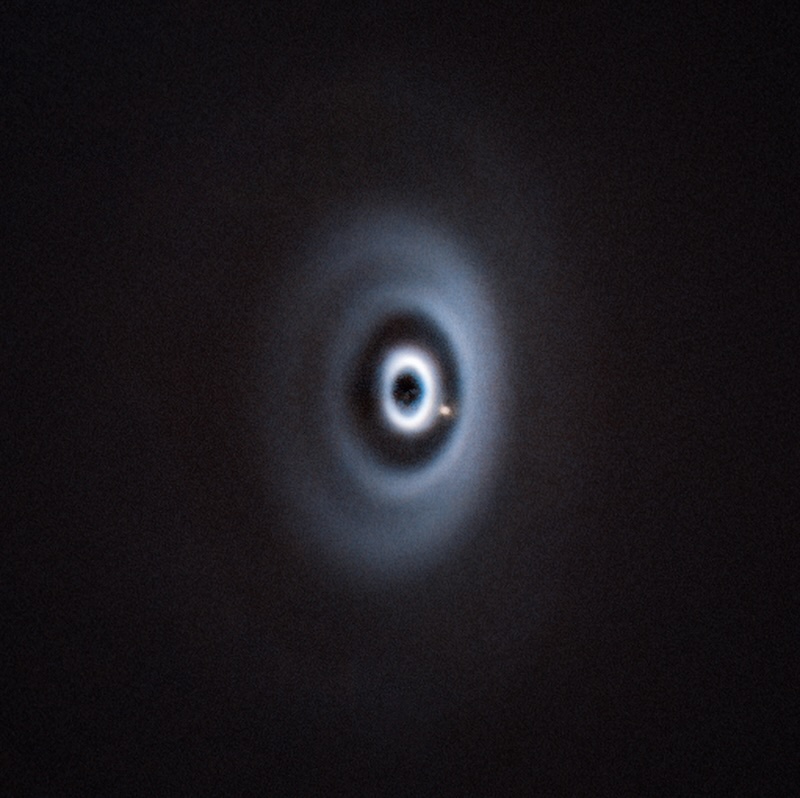
What appears to be a ripple in space actually depicts a newborn planet eating its way through its dusty cradle as it orbits its host star. This image, taken with ESO’s Very Large Telescope (VLT) in Chile, is the first clear detection of a baby planet in a disk with multiple rings.
These so-called protoplanetary disks surround young stars and appear as disk-shaped structures of gas and dust. They are the birthplace of planets, and scientists think the rings indicate the presence of (hungry) planets in the disk. Initially, little particles in the spinning disk begin to accumulate and grow as gravity takes over, stealing more material from the native disk until they evolve into embryo planets.
About the discovery
The clear detection of the planet WISPIT 2b in this image is an important step forward in our understanding of how planets form. It’s about five times the mass of Jupiter, and its host star is a younger version of our sun. It reinforces the idea that gaps can be created by newly formed planets. Thus, a prediction only made in theory has now been verified observationally.
While looking for stars hosting young planets, the team of researchers were lucky to find a young planet still embedded in its birth disk. This discovery was published in a paper led by Richelle van Capelleveen at the University of Leiden, Netherlands. It’s in collaboration with an international team of astronomers from the University of Galway and the University of Arizona. It was made possible through the observations of the planet-hunting SPHERE instrument on the VLT.
The University of Arizona’s MagAO-X AO system on the 6.5 meter Magellan telescope in Chile detected hydrogen gas falling onto the planet. This discovery confirmed that it is accreting matter from its surroundings. Further observations of this system might reveal new insights about how our own solar system might have looked in its early days.
Bottom line: Astronomers spot a baby planet shaping its star’s protoplanetary disk: a rare look at planet formation in action, 430 light-years from Earth.
Read more: Newborn planet spotted sculpting a spiral around its star
The post Baby planet caught carving a path in its star’s dusty disk first appeared on EarthSky.
from EarthSky https://ift.tt/e3TLBXA
Originally published by ESO on August 26, 2025. Edits by EarthSky.
A baby planet is born
What appears to be a ripple in space actually depicts a newborn planet eating its way through its dusty cradle as it orbits its host star. This image, taken with ESO’s Very Large Telescope (VLT) in Chile, is the first clear detection of a baby planet in a disk with multiple rings.
These so-called protoplanetary disks surround young stars and appear as disk-shaped structures of gas and dust. They are the birthplace of planets, and scientists think the rings indicate the presence of (hungry) planets in the disk. Initially, little particles in the spinning disk begin to accumulate and grow as gravity takes over, stealing more material from the native disk until they evolve into embryo planets.
About the discovery
The clear detection of the planet WISPIT 2b in this image is an important step forward in our understanding of how planets form. It’s about five times the mass of Jupiter, and its host star is a younger version of our sun. It reinforces the idea that gaps can be created by newly formed planets. Thus, a prediction only made in theory has now been verified observationally.
While looking for stars hosting young planets, the team of researchers were lucky to find a young planet still embedded in its birth disk. This discovery was published in a paper led by Richelle van Capelleveen at the University of Leiden, Netherlands. It’s in collaboration with an international team of astronomers from the University of Galway and the University of Arizona. It was made possible through the observations of the planet-hunting SPHERE instrument on the VLT.
The University of Arizona’s MagAO-X AO system on the 6.5 meter Magellan telescope in Chile detected hydrogen gas falling onto the planet. This discovery confirmed that it is accreting matter from its surroundings. Further observations of this system might reveal new insights about how our own solar system might have looked in its early days.
Bottom line: Astronomers spot a baby planet shaping its star’s protoplanetary disk: a rare look at planet formation in action, 430 light-years from Earth.
Read more: Newborn planet spotted sculpting a spiral around its star
The post Baby planet caught carving a path in its star’s dusty disk first appeared on EarthSky.
from EarthSky https://ift.tt/e3TLBXA

Aucun commentaire:
Enregistrer un commentaire