
Can trees bleed? Watch this video to find out. Image via Andrew Svk/ Unsplash.
The dragon blood tree is one of the most unique and enigmatic species in the plant world. Its strange appearance and blood-red sap have captivated botanists, scientists and travelers for centuries. However, this tree stands out not only for its shape and the color of its sap, but also for its ecological, medicinal and cultural value.
A tree that bleeds?
The dragon blood tree (Dracaena cinnabari) lives only on the island of Socotra, Yemen. The name Dracaena comes from the ancient Greek “drakaina,” meaning “female dragon.” This name is related to the red sap of certain species, which people have said looks like dragon’s blood.
Within the Dracaena genus, there are 189 species distributed throughout tropical and subtropical areas of the planet. Red sap is a distinctive and striking characteristic of some specific species of the Dracaena genus. But it is not common to all. In fact, most species do not have visible red sap.
Some species may have clear, whitish or yellowish sap, but only a few select Dracaena species (such as D. cinnabari, D. draco or Croton lechleri) have this distinctive red sap. However, the dragon blood tree stands out from all the others. While other species can produce sap that varies in shade, Dracaena cinnabari’s sap is known for its vivid red color.
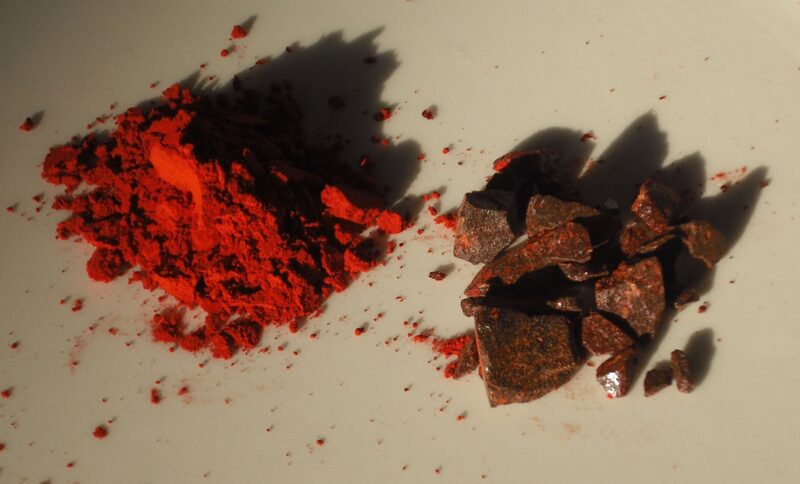
When you cut the trunk or branches of these trees, the sap flows out as a liquid and then solidifies into a dark red resin as it dries when exposed to oxygen. This is what we know as “dragon’s blood”. Thus, it appears as if these trees are bleeding, although it’s simply a process of oxidation.
Dragon’s blood is the result of a natural defense mechanism, where the tree releases its red sap and resin when the bark is damaged. The resin forms a protective barrier over the wound, inhibiting the entry of microorganisms and insects.
Of the 189 Dracaena species in the world, the dragon blood tree has the most intense red sap and resin. Impressive!
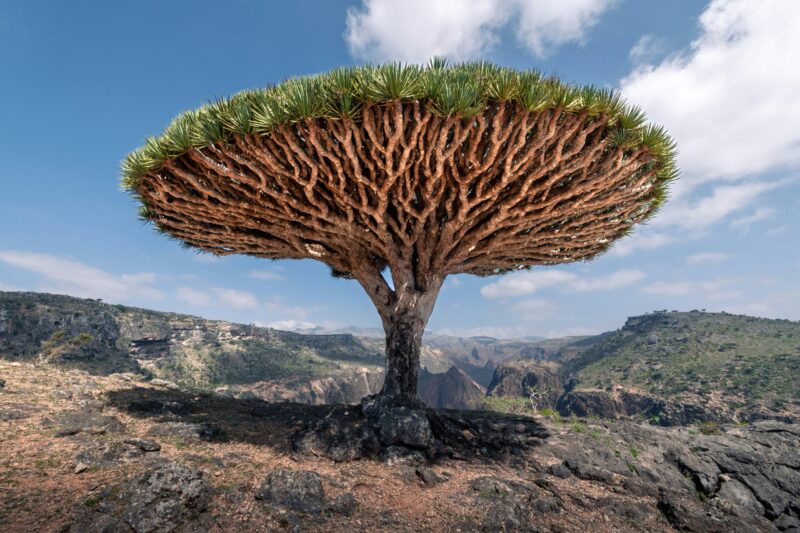
The dragon blood tree has an inverted umbrella shape
The production of this sap and resin is this tree’s most famous trait. But it’s not its only notable feature. It also has a distinctive inverted umbrella shape, which is the result of an adaptation to store water.
Its thick, twisted branches open at the top, forming a dense canopy. And from these branches, elongated, pointed green leaves grow. This unique design allows it to collect raindrops, dew, and moisture from fog. Thus, the dense foliage at the top of the tree traps water and directs it to the roots.
This tree grows in an arid climate, and its strange appearance makes it highly efficient at surviving in extreme conditions.

Where does the dragon blood tree live?
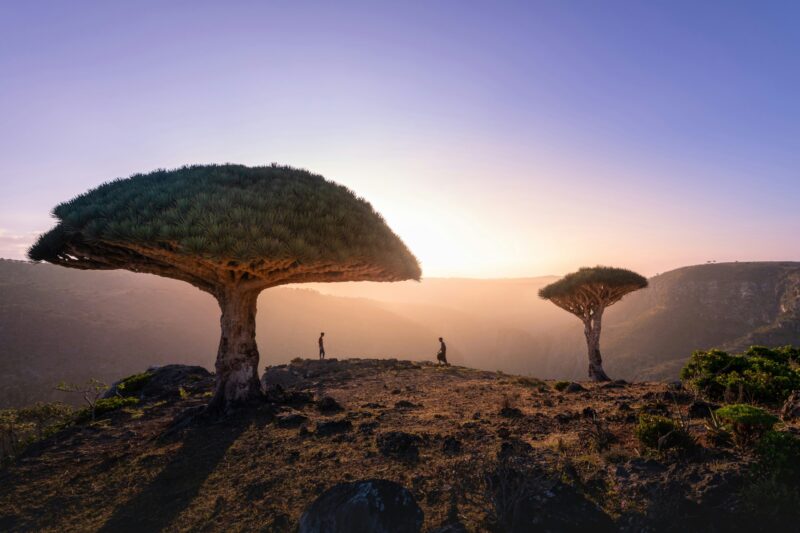
The Dracaena cinnabari lives only on the island of Socotra, a territory of Yemen located in the Indian Ocean. For this reason, it is Yemen’s national tree.
Socotra is famous for its unique biodiversity and high number of species found nowhere else on the planet. The dragon blood tree grows mainly in the island’s mountainous areas and plateaus. Here, the arid climate and rock formations have shaped a flora completely different from that of the rest of the world.
However, a related and similar-looking tree, Dracaena draco, grows in the Canary Islands, Spain. These islands are more than 4,400 miles (7,080 km) from Socotra. In addition, the island of Tenerife is home to the oldest and largest tree from the Dracaena genus. It is believed to be around 800 to 1,000 years, but some locals think it could be even older, potentially 2,000 years old. It is called “El Drago Milenario.” For comparison, the dragon blood tree can live for several hundred years, with scientists estimating some specimens at more than 700 years old.
Dragon’s blood in history
Dragon’s blood resin has been used for thousands of years as a dye, medicine and varnish around the world. The oldest written records date back more than 2,000 years. However, its use in Native American cultures may have been earlier and transmitted orally.
Pre-Columbian civilizations (Amazon, Peru, Ecuador) used the resin of Croton lechleri (an Amazonian species) to treat wounds and cuts (as a healing agent), infections, and digestive and respiratory problems. They applied it directly to the skin or drank it diluted.
In China and India, people used dragon’s blood in traditional medicine to stimulate circulation, treat ulcers and as an astringent.
In the Middle Ages, people valued it for its supposed magical and healing properties.
And in ancient Greece and Rome, people used the resin of species such as Dracaena cinnabari (Socotra) or Dracaena draco (Canary Islands) as a pigment, ritual incense and medicinal ingredient.
Resin with a multitude of uses
Today, people continue to use dragon’s blood in natural medicine, cosmetics and some pharmaceutical products.
In natural and herbal medicine, dragon’s blood is used as a healing agent and tissue regenerator. People apply it directly to wounds, burns, bites and cuts to accelerate healing.
People also use it orally. In controlled and diluted doses, it can treat stomach ulcers, intestinal inflammation and diarrhea, especially when derived from Croton lechleri. That’s a species rich in compounds such as taspine, which has been shown to have antiviral, anti-inflammatory and antibacterial properties.
Furthermore, dragon’s blood is effective in treating mouth infections, inflamed gums and sore throats, either through mouthwashes or gargles. Thanks to its astringent effect, people use it to stop minor bleeding and soothe skin and mucus membrane irritations.
In natural cosmetics, it has gained prominence in recent years for its regenerative, healing and antioxidant properties. Dragon’s blood is in various formulas for anti-wrinkle creams, serums for sensitive or rosacea-prone skin, treatments for stretch marks, scars, acne and even sunburn creams. Its antioxidant properties help combat cellular aging, while its soothing effect improves the appearance of damaged or inflamed skin.
On the other hand, in the pharmaceutical industry, several of its active compounds, such as taspine, are being investigated as possible ingredients in antiviral, antitumor and wound-healing medications.
Although less common today, some traditional uses also persist as a natural dye or artisanal varnish, especially in the making of sacred art or musical instruments. These practices were more common in previous centuries.
Conservation status
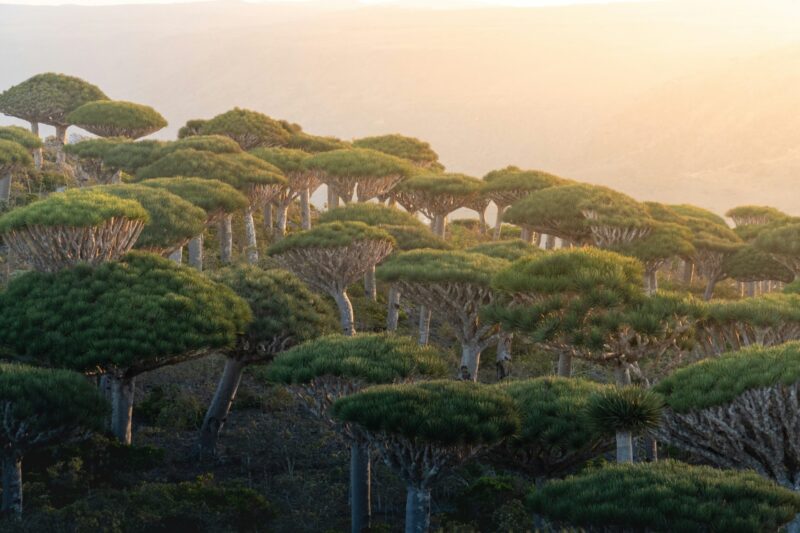
The International Union for Conservation of Nature (IUCN) lists the dragon blood tree as an endangered species. Its population has declined due to several factors. Climate change affects air humidity and fog patterns, which are essential for its hydration. Plus, habitat loss due to intensive goat grazing and human expansion is also causing its decline.
Various conservation efforts are underway, including reforestation programs and protection of the tree’s natural habitat on Socotra.
Bottom line: The dragon blood tree is a wonder on the outside and the inside. It has a red sap that solidifies when exposed to oxygen and looks like blood! This is what we know as “dragon’s blood”.
Mountain mystery: How’d that record tree get up here?
The passion flower is our flamboyant lifeform of the week
The post Meet the dragon blood tree. Can this species bleed? first appeared on EarthSky.
from EarthSky https://ift.tt/KQ6YxSc
Can trees bleed? Watch this video to find out. Image via Andrew Svk/ Unsplash.
The dragon blood tree is one of the most unique and enigmatic species in the plant world. Its strange appearance and blood-red sap have captivated botanists, scientists and travelers for centuries. However, this tree stands out not only for its shape and the color of its sap, but also for its ecological, medicinal and cultural value.
A tree that bleeds?
The dragon blood tree (Dracaena cinnabari) lives only on the island of Socotra, Yemen. The name Dracaena comes from the ancient Greek “drakaina,” meaning “female dragon.” This name is related to the red sap of certain species, which people have said looks like dragon’s blood.
Within the Dracaena genus, there are 189 species distributed throughout tropical and subtropical areas of the planet. Red sap is a distinctive and striking characteristic of some specific species of the Dracaena genus. But it is not common to all. In fact, most species do not have visible red sap.
Some species may have clear, whitish or yellowish sap, but only a few select Dracaena species (such as D. cinnabari, D. draco or Croton lechleri) have this distinctive red sap. However, the dragon blood tree stands out from all the others. While other species can produce sap that varies in shade, Dracaena cinnabari’s sap is known for its vivid red color.
When you cut the trunk or branches of these trees, the sap flows out as a liquid and then solidifies into a dark red resin as it dries when exposed to oxygen. This is what we know as “dragon’s blood”. Thus, it appears as if these trees are bleeding, although it’s simply a process of oxidation.
Dragon’s blood is the result of a natural defense mechanism, where the tree releases its red sap and resin when the bark is damaged. The resin forms a protective barrier over the wound, inhibiting the entry of microorganisms and insects.
Of the 189 Dracaena species in the world, the dragon blood tree has the most intense red sap and resin. Impressive!
The dragon blood tree has an inverted umbrella shape
The production of this sap and resin is this tree’s most famous trait. But it’s not its only notable feature. It also has a distinctive inverted umbrella shape, which is the result of an adaptation to store water.
Its thick, twisted branches open at the top, forming a dense canopy. And from these branches, elongated, pointed green leaves grow. This unique design allows it to collect raindrops, dew, and moisture from fog. Thus, the dense foliage at the top of the tree traps water and directs it to the roots.
This tree grows in an arid climate, and its strange appearance makes it highly efficient at surviving in extreme conditions.
Where does the dragon blood tree live?
The Dracaena cinnabari lives only on the island of Socotra, a territory of Yemen located in the Indian Ocean. For this reason, it is Yemen’s national tree.
Socotra is famous for its unique biodiversity and high number of species found nowhere else on the planet. The dragon blood tree grows mainly in the island’s mountainous areas and plateaus. Here, the arid climate and rock formations have shaped a flora completely different from that of the rest of the world.
However, a related and similar-looking tree, Dracaena draco, grows in the Canary Islands, Spain. These islands are more than 4,400 miles (7,080 km) from Socotra. In addition, the island of Tenerife is home to the oldest and largest tree from the Dracaena genus. It is believed to be around 800 to 1,000 years, but some locals think it could be even older, potentially 2,000 years old. It is called “El Drago Milenario.” For comparison, the dragon blood tree can live for several hundred years, with scientists estimating some specimens at more than 700 years old.
Dragon’s blood in history
Dragon’s blood resin has been used for thousands of years as a dye, medicine and varnish around the world. The oldest written records date back more than 2,000 years. However, its use in Native American cultures may have been earlier and transmitted orally.
Pre-Columbian civilizations (Amazon, Peru, Ecuador) used the resin of Croton lechleri (an Amazonian species) to treat wounds and cuts (as a healing agent), infections, and digestive and respiratory problems. They applied it directly to the skin or drank it diluted.
In China and India, people used dragon’s blood in traditional medicine to stimulate circulation, treat ulcers and as an astringent.
In the Middle Ages, people valued it for its supposed magical and healing properties.
And in ancient Greece and Rome, people used the resin of species such as Dracaena cinnabari (Socotra) or Dracaena draco (Canary Islands) as a pigment, ritual incense and medicinal ingredient.
Resin with a multitude of uses
Today, people continue to use dragon’s blood in natural medicine, cosmetics and some pharmaceutical products.
In natural and herbal medicine, dragon’s blood is used as a healing agent and tissue regenerator. People apply it directly to wounds, burns, bites and cuts to accelerate healing.
People also use it orally. In controlled and diluted doses, it can treat stomach ulcers, intestinal inflammation and diarrhea, especially when derived from Croton lechleri. That’s a species rich in compounds such as taspine, which has been shown to have antiviral, anti-inflammatory and antibacterial properties.
Furthermore, dragon’s blood is effective in treating mouth infections, inflamed gums and sore throats, either through mouthwashes or gargles. Thanks to its astringent effect, people use it to stop minor bleeding and soothe skin and mucus membrane irritations.
In natural cosmetics, it has gained prominence in recent years for its regenerative, healing and antioxidant properties. Dragon’s blood is in various formulas for anti-wrinkle creams, serums for sensitive or rosacea-prone skin, treatments for stretch marks, scars, acne and even sunburn creams. Its antioxidant properties help combat cellular aging, while its soothing effect improves the appearance of damaged or inflamed skin.
On the other hand, in the pharmaceutical industry, several of its active compounds, such as taspine, are being investigated as possible ingredients in antiviral, antitumor and wound-healing medications.
Although less common today, some traditional uses also persist as a natural dye or artisanal varnish, especially in the making of sacred art or musical instruments. These practices were more common in previous centuries.
Conservation status
The International Union for Conservation of Nature (IUCN) lists the dragon blood tree as an endangered species. Its population has declined due to several factors. Climate change affects air humidity and fog patterns, which are essential for its hydration. Plus, habitat loss due to intensive goat grazing and human expansion is also causing its decline.
Various conservation efforts are underway, including reforestation programs and protection of the tree’s natural habitat on Socotra.
Bottom line: The dragon blood tree is a wonder on the outside and the inside. It has a red sap that solidifies when exposed to oxygen and looks like blood! This is what we know as “dragon’s blood”.
Mountain mystery: How’d that record tree get up here?
The passion flower is our flamboyant lifeform of the week
The post Meet the dragon blood tree. Can this species bleed? first appeared on EarthSky.
from EarthSky https://ift.tt/KQ6YxSc

Aucun commentaire:
Enregistrer un commentaire