
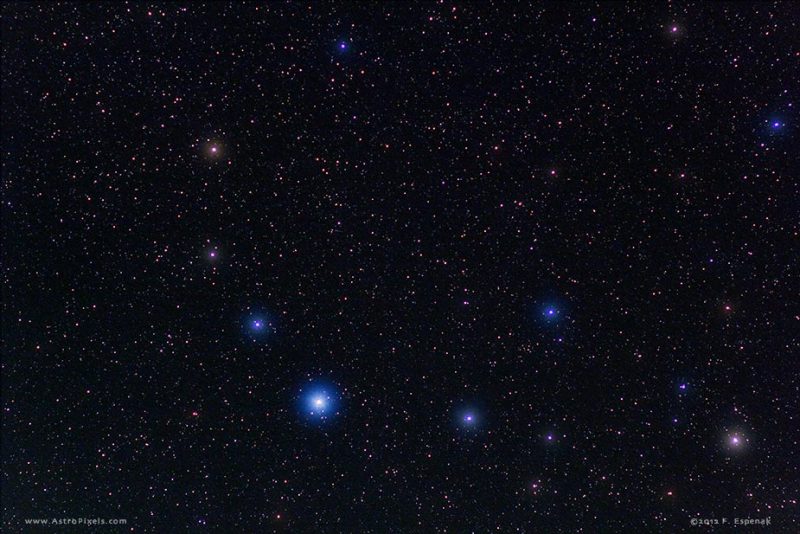
On any evening from June, July and August, look for the constellation Corona Borealis, also known as the Northern Crown. However, you’ll need a dark sky to see it. If you have one, the constellation is easy and distinctive. In fact, its stars form a distinct C shape in the night sky. Then, in the middle of the C is a white jewel of a star. This star, the brightest light in the Northern Crown, is called Alphecca or Gemma.
To see this famous C-shaped pattern of stars from the Northern Hemisphere, you’ll be looking high overhead during the evening hours in the northern summer. From the Southern Hemisphere, the constellation is low in the northern sky during the southern winter.
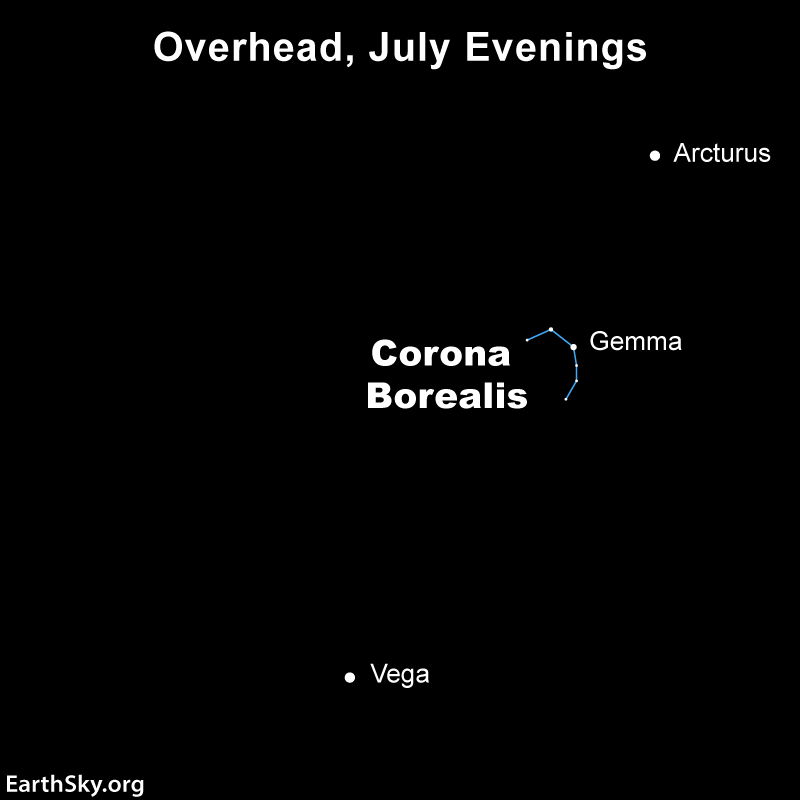
Look for Corona Borealis between 2 bright stars
The Crown is located roughly along a line between two bright stars. The first is the orange star Arcturus in the constellation Boötes the Herdsman. The second is beautiful, blue-white Vega in the constellation Lyra the Harp.
Arcturus has already passed its highest point in the evening at this time of year and is slowly descending to the west. However, Vega is still high in the east in July and overhead in August evenings. With dark skies you’ll notice the orange color of Arcturus and Vega’s bright blue-white tinge.
Corona Borealis is between these two stars, though closer to Vega. Remember, a dark sky is best for seeing this faint semicircle of stars.
Or find it between two constellations
Also, you can look for the Northern Crown between the constellations of Hercules the Strongman and Boötes the Herdsman. See chart below.
Gem of the Northern Crown
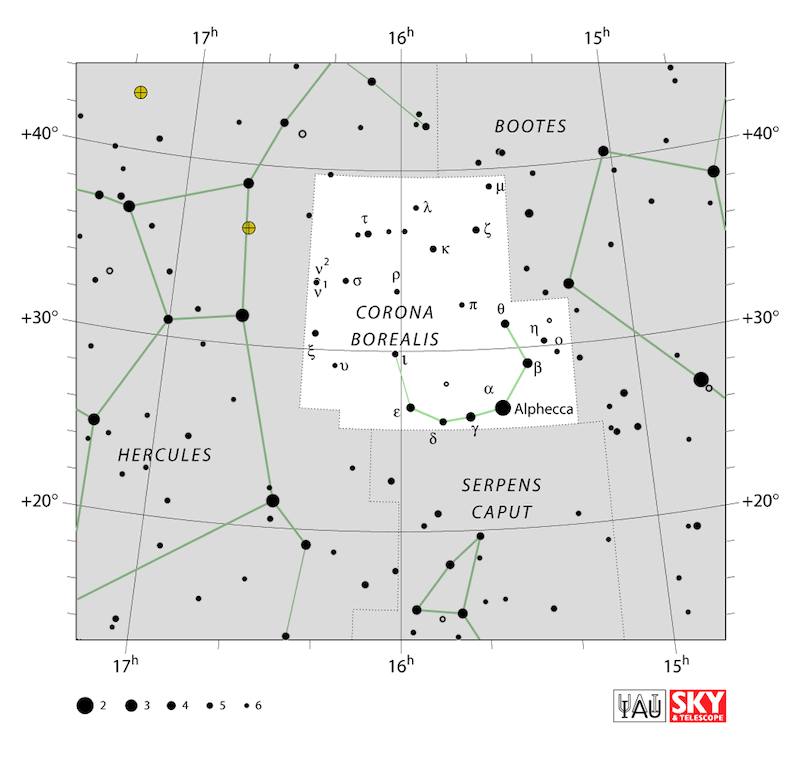
The brightest star in Corona Borealis is Gemma at magnitude 2.21. The meaning of this Latin star name should be obvious. This star is the gem of the Northern Crown. It is 75 light-years distant.
But, as is the case with many stars, this star has more than one name. It’s also called Alphecca. This second name is from an Arabic phrase meaning the bright one of the dish. So you can see that, throughout history, stargazers have identified Corona Borealis with a common shape: a bowl, a disk, or a crown.
By the way, Gemma, aka Alphecca, is an eclipsing binary system. It consists of a smaller sunlike star that passes in front of a brighter star every 17.4 days, as seen from our earthly vantage point.
Read more about Gemma, aka Alphecca, in the Northern Crown
Other bright stars in the Northern Crown
The second brightest star, Beta Coronae Borealis, has the name of Nusakan. Nusakan shines at magnitude 3.65. Nukasan and Alphecca are a little less than three degrees apart. Nukasan lies 114 light-years away.
The other stars that make up the curved shape of Corona Borealis are all 3rd and 4th magnitude. Theta lies on the other side of Nukasan and Gamma and Delta lie on the other side of Alphecca. Also, Gamma is a double star, but the two are very close and require high magnification and steady skies to see.
Watch out for the Blaze Star
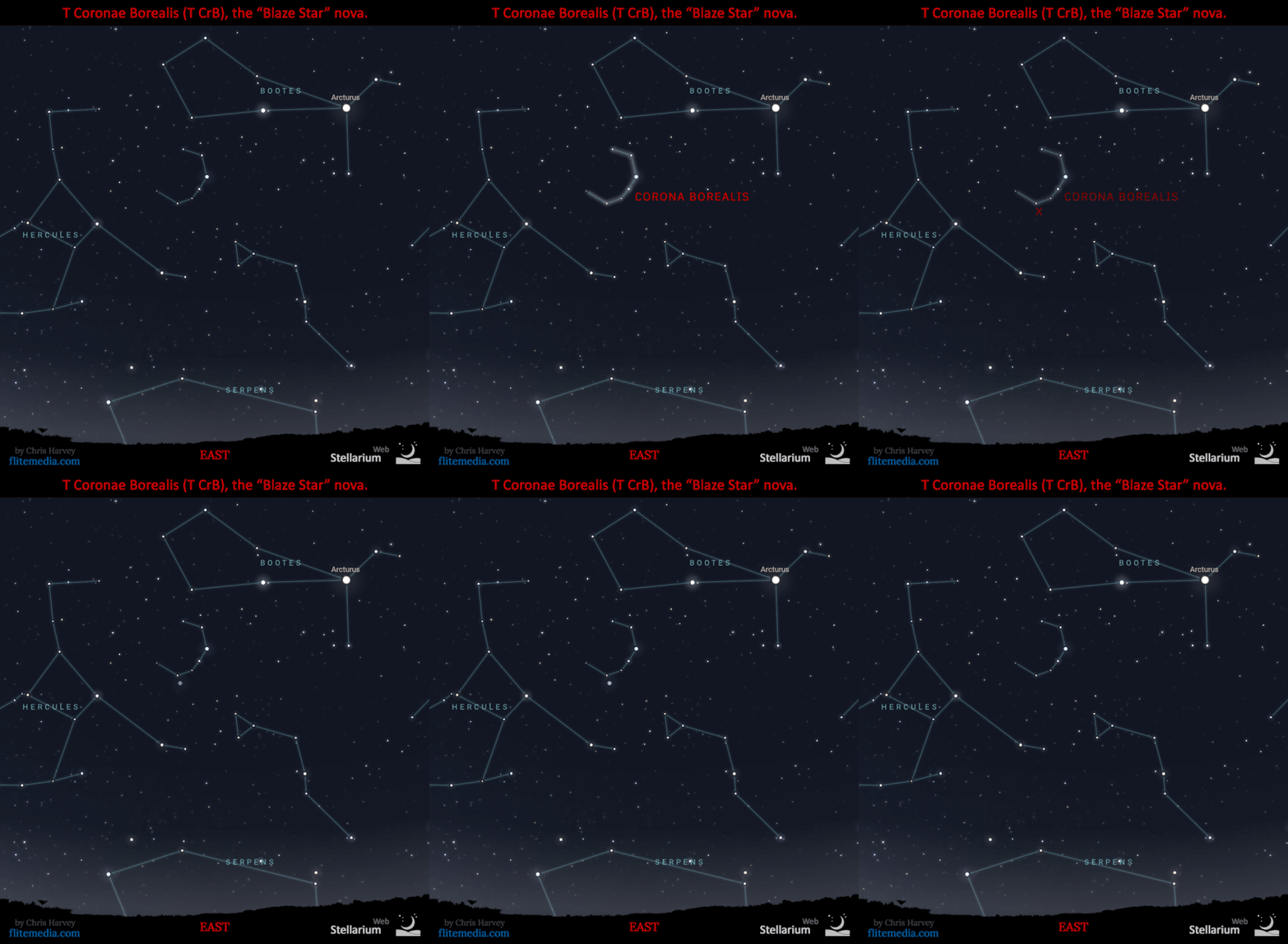
The Blaze Star is also in the constellation Corona Borealis. It was supposed to go nova last year. Well, we’re still waiting. But when it finally does erupt, it’ll be a once-in-a-lifetime show in our night sky.
The eagerly awaited Blaze Star nova is a real opportunity for keen night sky observers to witness a “new star” in the sky … but only for a few days before it fades away again.
Read more: When will the Blaze Star explode and how can I see it?
Bottom line: On June, July and August evenings, look for Corona Borealis’ graceful semicircle of stars between the two bright stars Arcturus and Vega.
EarthSky astronomy kits are perfect for beginners. Order yours today.
The post Corona Borealis, the Northern Crown is overhead now first appeared on EarthSky.
from EarthSky https://ift.tt/owuCv2r
On any evening from June, July and August, look for the constellation Corona Borealis, also known as the Northern Crown. However, you’ll need a dark sky to see it. If you have one, the constellation is easy and distinctive. In fact, its stars form a distinct C shape in the night sky. Then, in the middle of the C is a white jewel of a star. This star, the brightest light in the Northern Crown, is called Alphecca or Gemma.
To see this famous C-shaped pattern of stars from the Northern Hemisphere, you’ll be looking high overhead during the evening hours in the northern summer. From the Southern Hemisphere, the constellation is low in the northern sky during the southern winter.
Look for Corona Borealis between 2 bright stars
The Crown is located roughly along a line between two bright stars. The first is the orange star Arcturus in the constellation Boötes the Herdsman. The second is beautiful, blue-white Vega in the constellation Lyra the Harp.
Arcturus has already passed its highest point in the evening at this time of year and is slowly descending to the west. However, Vega is still high in the east in July and overhead in August evenings. With dark skies you’ll notice the orange color of Arcturus and Vega’s bright blue-white tinge.
Corona Borealis is between these two stars, though closer to Vega. Remember, a dark sky is best for seeing this faint semicircle of stars.
Or find it between two constellations
Also, you can look for the Northern Crown between the constellations of Hercules the Strongman and Boötes the Herdsman. See chart below.
Gem of the Northern Crown
The brightest star in Corona Borealis is Gemma at magnitude 2.21. The meaning of this Latin star name should be obvious. This star is the gem of the Northern Crown. It is 75 light-years distant.
But, as is the case with many stars, this star has more than one name. It’s also called Alphecca. This second name is from an Arabic phrase meaning the bright one of the dish. So you can see that, throughout history, stargazers have identified Corona Borealis with a common shape: a bowl, a disk, or a crown.
By the way, Gemma, aka Alphecca, is an eclipsing binary system. It consists of a smaller sunlike star that passes in front of a brighter star every 17.4 days, as seen from our earthly vantage point.
Read more about Gemma, aka Alphecca, in the Northern Crown
Other bright stars in the Northern Crown
The second brightest star, Beta Coronae Borealis, has the name of Nusakan. Nusakan shines at magnitude 3.65. Nukasan and Alphecca are a little less than three degrees apart. Nukasan lies 114 light-years away.
The other stars that make up the curved shape of Corona Borealis are all 3rd and 4th magnitude. Theta lies on the other side of Nukasan and Gamma and Delta lie on the other side of Alphecca. Also, Gamma is a double star, but the two are very close and require high magnification and steady skies to see.
Watch out for the Blaze Star
The Blaze Star is also in the constellation Corona Borealis. It was supposed to go nova last year. Well, we’re still waiting. But when it finally does erupt, it’ll be a once-in-a-lifetime show in our night sky.
The eagerly awaited Blaze Star nova is a real opportunity for keen night sky observers to witness a “new star” in the sky … but only for a few days before it fades away again.
Read more: When will the Blaze Star explode and how can I see it?
Bottom line: On June, July and August evenings, look for Corona Borealis’ graceful semicircle of stars between the two bright stars Arcturus and Vega.
EarthSky astronomy kits are perfect for beginners. Order yours today.
The post Corona Borealis, the Northern Crown is overhead now first appeared on EarthSky.
from EarthSky https://ift.tt/owuCv2r

Aucun commentaire:
Enregistrer un commentaire