
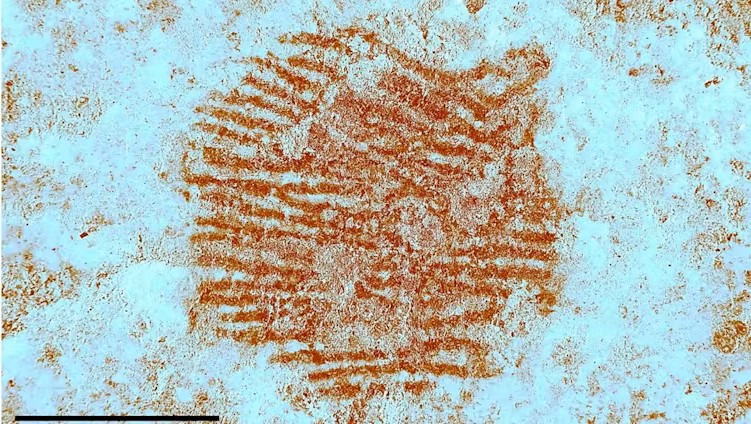
- Researchers have discovered the oldest known human fingerprint. It’s at least 42,000 years old. They found it on a rock in Spain.
- The fingerprint is a sign of artistic expression. That’s because the rock had natural markings that looked like eyes and a mouth and the fingerprint made with red ochre marked the spot for a nose.
- Forensic scientists helped uncover the fingerprint. It showed that not even Neanderthals could escape being identified by forensic scientists.
By David Álvarez Alonso, Universidad Complutense de Madrid; Andrés Díez Herrero, Instituto Geológico y Minero de España (IGME – CSIC); María de Andrés-Herrero, Universidad Complutense de Madrid, and Miguel Angel Mate Gonzalez, Universidad de Salamanca.
The Conversation published this original story on June 11, 2025. Edits by EarthSky.
Oldest known human fingerprint found on Neanderthal artwork
A unique archaeological find has recently expanded our knowledge of Neanderthals’ capacity for symbolic thought. The object in question is a granite stone, on which a red ochre dot was deliberately applied to reinforce the image of a human face. It is, to date, the oldest example of portable art associated with Neanderthals.
The most remarkable aspect of this discovery was the identification of a fingerprint in the pigment, at a level we have unequivocally dated to more than 42,000 years ago.
The fingerprint means the find is direct evidence of a symbolic action that we can attribute to a Neanderthal human (Homo neanderthalensis).
This discovery is the fruit of over two years of research. The peer-reviewed journal Archaeological and Anthropological Sciences published our study in May 2025. In addition to the team of archaeologists and geologists, our paper was co-authored by members of the Central Identification Unit of the General Commissary of Scientific Police, whose contributions were vital to the work’s success.

The last Neanderthal
We’ve found remains of occupations of the last European Neanderthals at the Abrigo de San Lázaro archaeological site in Spain. And that’s where the red-spotted stone was, too, in the Eresma river valley, downstream from the Spanish city of Segovia.
The stone was in a level where we have previously found Mousterian (Middle Paleolithic) industry. These are stone tools clearly associated with Neanderthal occupations, such as those documented in the known areas of Abrigo del Molino and other nearby sites.
Oldest known human fingerprint is red spot for a nose
In our study, we hypothesize that the object was chosen and collected from the riverbed because of its peculiar natural features. Put simply, it looks like a human face.
Facial pareidolia is the psychological phenomenon whereby we perceive images such as faces in inanimate objects. In this stone, you can identify the upper and lower indentations as eyes and a mouth. The application of red pigment to make a nose reinforces the perception of a face, and acts as a symbolically charged visual marker.
The possibility that we are dealing with a symbolic representation of a human face adds a particularly significant interpretative dimension to the archaeological find.
Forensic police identify the oldest known human fingerprint
One of the most remarkable aspects of this research was its cross-disciplinary collaboration between archaeologists, geoarchaeologists and members of the General Commissary of the Spanish Scientific Police.
To reach our conclusions, we applied a combination of techniques to the object. First, we performed detailed 3D mapping using high-precision scanners and digital models. This helped to rule out that the stone had served any functional purpose, such as that of an anvil or hammer.
We then carried out non-invasive analyses, such as X-ray fluorescence and scanning electron microscopy. The results confirmed that the red pigment was externally applied ochre, as opposed to a natural mark resulting from the decomposition of minerals in the granite itself.
But the most surprising breakthrough came from multispectral analysis. This is a well-known technique that the Spanish General Commissary of Scientific Police developed and adapted specifically for the study of the stone. By using this method, Samuel Miralles Mosquera, a forensic imaging expert, revealed a fingerprint that was invisible to the unaided eye, printed directly into the pigment.
The image was later analyzed by Mª Carmen Sastre Barrio, Encarnación Nieva Gómez, Mª Remedios Díaz Delgado and Elena Ruiz Mediavilla, identification specialists of the same team. They confirmed that it matched the fingerprint of an adult human male.
Their work allowed for the identification of the fingerprint with a previously unprecedented level of detail in the context of Paleolithic study.
Archaeology meets forensics
Their help made the research a pioneering reference in the field of applying archaeology and forensic identification to prehistoric times. It provides a new window on the symbolic world of the Neanderthals. And it opens new avenues for the study of their artistic expression, their visual sensitivity and their capacity for abstraction.
Combining these scientific techniques reinforces the authenticity of the find and underlines its exceptional nature. It is one of the most complete physical testimonies of a symbolic act performed by a Neanderthal, whose fingerprint was deliberately left in the pigment.
Who would have imagined that, more than 40,000 years later, not even Neanderthals could escape being identified by forensic scientists.
The emergence of art?
The origin of humans’ symbolic behavior – and with it the emergence of art itself – is one of the most hotly debated questions in research on humankind’s cognitive evolution. While both phenomena did not emerge simultaneously, they are deeply interconnected. The capacity for symbolic thought is ultimately the foundation of all forms of artistic expression.
For decades, some claimed this ability was exclusive to “modern” or present-day human beings (Homo sapiens). However, the development of new methodologies and the discovery of increasingly solid evidence have challenged this view to the point of refuting it.
There is now a growing consensus that Neanderthals also possessed a complex symbolic repertoire. They manifested it through modified objects, use of pigments, ritual behaviors and other unambiguously symbolic expressions.

Neanderthals and artistic expression
One of the key milestones in this shift in opinion was the publication – in the journal Science in 2018 – of the dating of several cave paintings found in three Spanish caves: Ardales, La Pasiega and Maltravieso. These were the first paintings with a symbolic character that researchers attributed to Neanderthals.
The paintings included simple, geometric shapes, including discernible patterns. The study revealed the ability of this human group to deliberately generate symbolic images charged with shared meaning. While the representations are simple, they appear repeatedly in different places on the walls of the caves.
To this list of findings, we can now add the work of another anonymous Neanderthal. This male, one of Europe’s last Neanderthal inhabitants, saw a face on a rock collected from the river, intentionally painted a red dot with ochre, and left his mark on history.
David Álvarez Alonso, Universidad Complutense de Madrid; Andrés Díez Herrero, Instituto Geológico y Minero de España (IGME – CSIC); María de Andrés-Herrero, Universidad Complutense de Madrid, and Miguel Angel Mate Gonzalez, Universidad de Salamanca
This article is republished from The Conversation under a Creative Commons license. Read the original article.
Bottom line: Archaeologists in Spain found the oldest known human fingerprint on a rock, marking the nose on artwork by a Neanderthal. Forensic science helped uncover it.
Read more: New evidence: humans and Neanderthals interacted in Israel
The post Oldest known human fingerprint found on Neanderthal art first appeared on EarthSky.
from EarthSky https://ift.tt/9s1AnWN
- Researchers have discovered the oldest known human fingerprint. It’s at least 42,000 years old. They found it on a rock in Spain.
- The fingerprint is a sign of artistic expression. That’s because the rock had natural markings that looked like eyes and a mouth and the fingerprint made with red ochre marked the spot for a nose.
- Forensic scientists helped uncover the fingerprint. It showed that not even Neanderthals could escape being identified by forensic scientists.
By David Álvarez Alonso, Universidad Complutense de Madrid; Andrés Díez Herrero, Instituto Geológico y Minero de España (IGME – CSIC); María de Andrés-Herrero, Universidad Complutense de Madrid, and Miguel Angel Mate Gonzalez, Universidad de Salamanca.
The Conversation published this original story on June 11, 2025. Edits by EarthSky.
Oldest known human fingerprint found on Neanderthal artwork
A unique archaeological find has recently expanded our knowledge of Neanderthals’ capacity for symbolic thought. The object in question is a granite stone, on which a red ochre dot was deliberately applied to reinforce the image of a human face. It is, to date, the oldest example of portable art associated with Neanderthals.
The most remarkable aspect of this discovery was the identification of a fingerprint in the pigment, at a level we have unequivocally dated to more than 42,000 years ago.
The fingerprint means the find is direct evidence of a symbolic action that we can attribute to a Neanderthal human (Homo neanderthalensis).
This discovery is the fruit of over two years of research. The peer-reviewed journal Archaeological and Anthropological Sciences published our study in May 2025. In addition to the team of archaeologists and geologists, our paper was co-authored by members of the Central Identification Unit of the General Commissary of Scientific Police, whose contributions were vital to the work’s success.
The last Neanderthal
We’ve found remains of occupations of the last European Neanderthals at the Abrigo de San Lázaro archaeological site in Spain. And that’s where the red-spotted stone was, too, in the Eresma river valley, downstream from the Spanish city of Segovia.
The stone was in a level where we have previously found Mousterian (Middle Paleolithic) industry. These are stone tools clearly associated with Neanderthal occupations, such as those documented in the known areas of Abrigo del Molino and other nearby sites.
Oldest known human fingerprint is red spot for a nose
In our study, we hypothesize that the object was chosen and collected from the riverbed because of its peculiar natural features. Put simply, it looks like a human face.
Facial pareidolia is the psychological phenomenon whereby we perceive images such as faces in inanimate objects. In this stone, you can identify the upper and lower indentations as eyes and a mouth. The application of red pigment to make a nose reinforces the perception of a face, and acts as a symbolically charged visual marker.
The possibility that we are dealing with a symbolic representation of a human face adds a particularly significant interpretative dimension to the archaeological find.
Forensic police identify the oldest known human fingerprint
One of the most remarkable aspects of this research was its cross-disciplinary collaboration between archaeologists, geoarchaeologists and members of the General Commissary of the Spanish Scientific Police.
To reach our conclusions, we applied a combination of techniques to the object. First, we performed detailed 3D mapping using high-precision scanners and digital models. This helped to rule out that the stone had served any functional purpose, such as that of an anvil or hammer.
We then carried out non-invasive analyses, such as X-ray fluorescence and scanning electron microscopy. The results confirmed that the red pigment was externally applied ochre, as opposed to a natural mark resulting from the decomposition of minerals in the granite itself.
But the most surprising breakthrough came from multispectral analysis. This is a well-known technique that the Spanish General Commissary of Scientific Police developed and adapted specifically for the study of the stone. By using this method, Samuel Miralles Mosquera, a forensic imaging expert, revealed a fingerprint that was invisible to the unaided eye, printed directly into the pigment.
The image was later analyzed by Mª Carmen Sastre Barrio, Encarnación Nieva Gómez, Mª Remedios Díaz Delgado and Elena Ruiz Mediavilla, identification specialists of the same team. They confirmed that it matched the fingerprint of an adult human male.
Their work allowed for the identification of the fingerprint with a previously unprecedented level of detail in the context of Paleolithic study.
Archaeology meets forensics
Their help made the research a pioneering reference in the field of applying archaeology and forensic identification to prehistoric times. It provides a new window on the symbolic world of the Neanderthals. And it opens new avenues for the study of their artistic expression, their visual sensitivity and their capacity for abstraction.
Combining these scientific techniques reinforces the authenticity of the find and underlines its exceptional nature. It is one of the most complete physical testimonies of a symbolic act performed by a Neanderthal, whose fingerprint was deliberately left in the pigment.
Who would have imagined that, more than 40,000 years later, not even Neanderthals could escape being identified by forensic scientists.
The emergence of art?
The origin of humans’ symbolic behavior – and with it the emergence of art itself – is one of the most hotly debated questions in research on humankind’s cognitive evolution. While both phenomena did not emerge simultaneously, they are deeply interconnected. The capacity for symbolic thought is ultimately the foundation of all forms of artistic expression.
For decades, some claimed this ability was exclusive to “modern” or present-day human beings (Homo sapiens). However, the development of new methodologies and the discovery of increasingly solid evidence have challenged this view to the point of refuting it.
There is now a growing consensus that Neanderthals also possessed a complex symbolic repertoire. They manifested it through modified objects, use of pigments, ritual behaviors and other unambiguously symbolic expressions.
Neanderthals and artistic expression
One of the key milestones in this shift in opinion was the publication – in the journal Science in 2018 – of the dating of several cave paintings found in three Spanish caves: Ardales, La Pasiega and Maltravieso. These were the first paintings with a symbolic character that researchers attributed to Neanderthals.
The paintings included simple, geometric shapes, including discernible patterns. The study revealed the ability of this human group to deliberately generate symbolic images charged with shared meaning. While the representations are simple, they appear repeatedly in different places on the walls of the caves.
To this list of findings, we can now add the work of another anonymous Neanderthal. This male, one of Europe’s last Neanderthal inhabitants, saw a face on a rock collected from the river, intentionally painted a red dot with ochre, and left his mark on history.
David Álvarez Alonso, Universidad Complutense de Madrid; Andrés Díez Herrero, Instituto Geológico y Minero de España (IGME – CSIC); María de Andrés-Herrero, Universidad Complutense de Madrid, and Miguel Angel Mate Gonzalez, Universidad de Salamanca
This article is republished from The Conversation under a Creative Commons license. Read the original article.
Bottom line: Archaeologists in Spain found the oldest known human fingerprint on a rock, marking the nose on artwork by a Neanderthal. Forensic science helped uncover it.
Read more: New evidence: humans and Neanderthals interacted in Israel
The post Oldest known human fingerprint found on Neanderthal art first appeared on EarthSky.
from EarthSky https://ift.tt/9s1AnWN

Aucun commentaire:
Enregistrer un commentaire