
The red panda is a Asian treasure. Watch this video for more info about this lovely creature. Image via Xiangkun Zhu/ Unsplash.
That’s right, a red panda is not really a panda. So, how did it get that name? And what is it really, then? There are plenty of other curiosities surrounding red pandas, such as their thumbs that aren’t fingers plus the fact that they feed mainly on bamboo, which they can’t digest. Read on to get the true story about this remarkable creature.
The red panda is not a panda
The red panda is a mammal with a name that can be misleading, as it’s not a panda in the modern sense of the word. That is, it’s not closely related to the giant panda, the big, black-and-white bear.
This confusion has historical, linguistic and scientific roots that have been the subject of debate for more than a century. The term panda comes from the Nepali words nigalya ponya, meaning bamboo eater.
It was the French zoologist Frédéric Cuvier who first described the red panda in 1825. This happened several decades before the giant panda was discovered by the Western culture in 1869. Therefore, the red panda is the “original” panda. When the giant panda was discovered, it was so named because both eat bamboo and bear a certain physical resemblance.
So, what is the red panda, really? For a long time, scientists debated which taxonomic group this animal belongs to. The most frequently considered options were bears, due to its resemblance to the giant panda, and raccoons, due to its dental, facial and behavioral characteristics.
This debate lasted for decades, as the tools necessary for proper study did not exist. Thanks to advances in molecular biology and genetics, we now know the red panda is neither a bear nor a raccoon but belongs to its own family: Ailuridae.
Scientists discovered that, although this creature belongs to the Carnivora order, like bears and raccoons, it diverged evolutionarily about 40 million years ago.
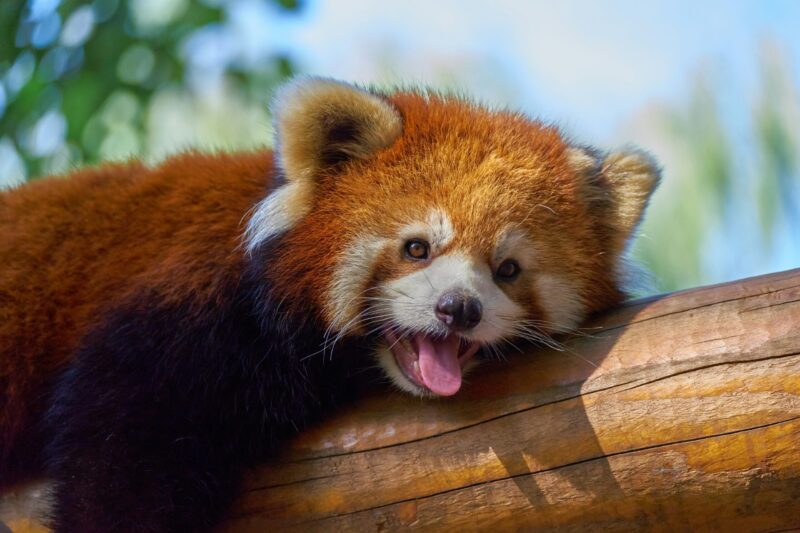
The carnivorous red panda eats bamboo
Red pandas eat meat, for example, chicks and small rodents. It can also feed on stems, shoots, acorns, fruits, mushrooms, roots, lichens, eggs and insects. Therefore, despite being listed as a carnivore, it is actually omnivorous.
But what is most striking is that its diet (about 2/3s) is based on bamboo, a plant it cannot properly digest. The red panda’s digestive system is not designed to process cellulose, a main component of bamboo. This means it must consume large amounts of this plant to obtain the nutrients it needs.
Red pandas, like giant pandas, have carnivorous ancestors, which means their digestive systems have not fully adapted to digesting bamboo cellulose. However, like other plant-eating animals, bacteria eventually develop in their digestive systems that can help break down cellulose. Perhaps red pandas just need a little more time to develop a more appropriate digestive system.
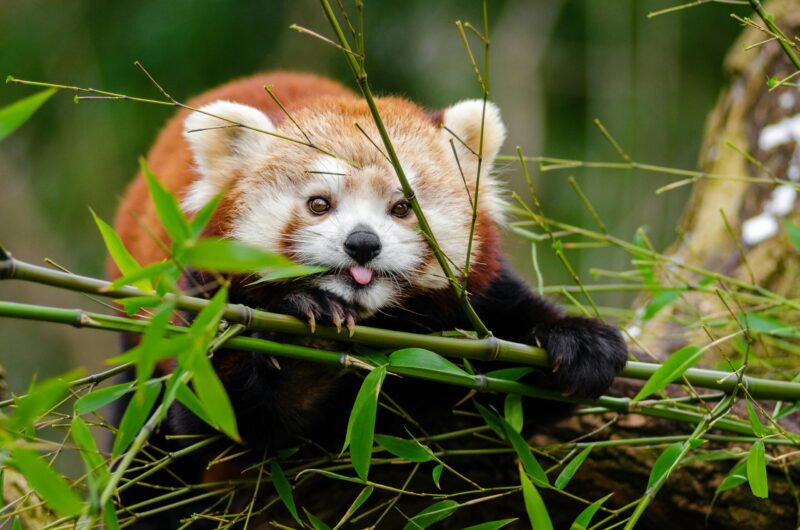
Red pandas have a false thumb
Speaking of evolution, since both the red panda and the giant panda evolved a bamboo-based diet, this led them to develop similar adaptations. For example, a false thumb.
This is the sesamoid bone, a component of the wrist that in both pandas is enlarged and elongated, similar to the bones of the true fingers. The false thumb allows these animals to grip branches while eating leaves.
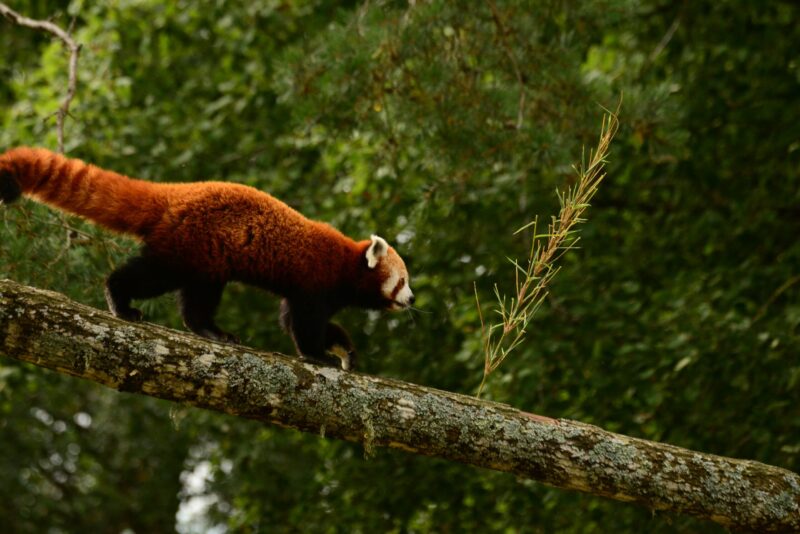
Furthermore, red pandas are excellent climbers, as they have retractable claws and flexible ankles that allow them to climb trees and leap up to 5 feet (1.5 meters) from one branch to another with great agility. These characteristics help them escape predators and find food in high places.
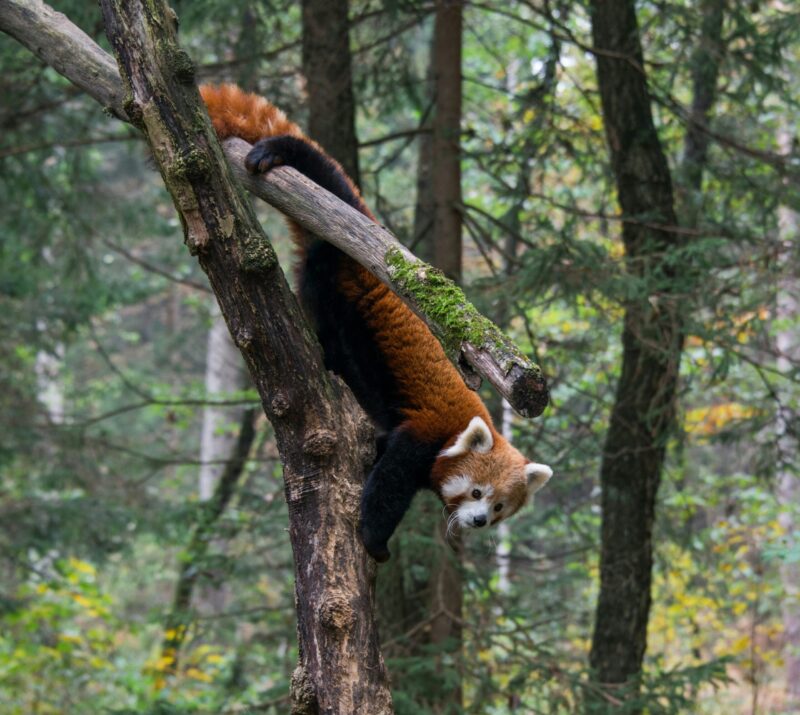
Habitat of the red panda
You may find it curious that, despite having some difficulty assimilating cellulose, they still feed on bamboo. However, this plant is widespread in the areas they inhabit.
The red panda has a limited distribution area. In fact, its habitat is limited to isolated patches in the mountainous regions of five Asian countries: Nepal, India, Bhutan, Myanmar and China.
These animals live in mixed forests of coniferous and deciduous trees dominated by fir, spruce, oak, walnut and maple trees, with dense bamboo understories.
These adorable creatures live in cold or temperate climates, but without extreme temperatures. They live between 7,200 and 15,000 feet (2,200 and 4,800 meters) above sea level.
There are two subspecies: the Himalayan and the Chinese red panda. The first one is characterized by its lighter facial fur, while the second has a darker color and more pronounced features.
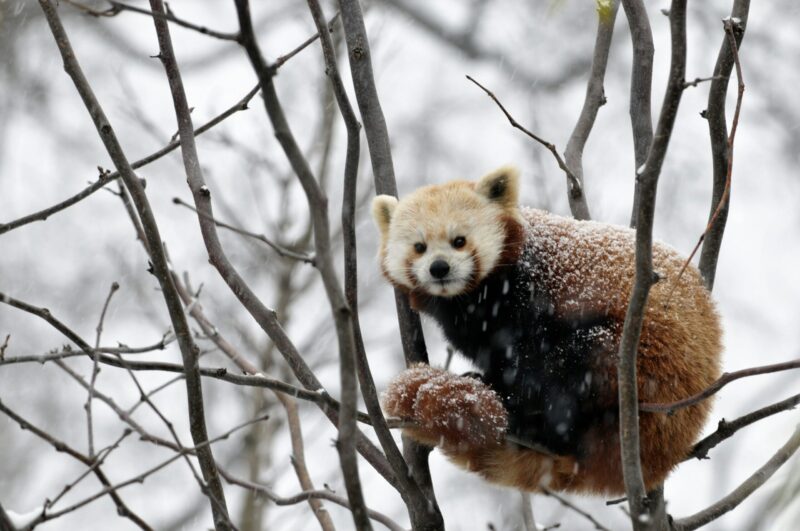
Who needs a scarf when you have a fluffy tail?
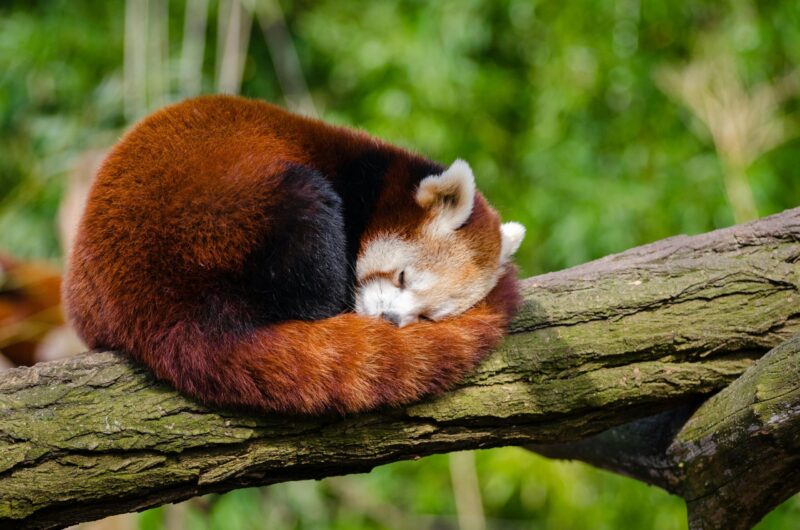
Just as their claws help them move, their tails provide excellent balance and allow them to grip and move through slippery areas with great agility. Furthermore, these animals sleep curled up and can wrap their tails around their bodies to conserve heat in extremely cold conditions. They even cover their faces with their tails to stay warm.
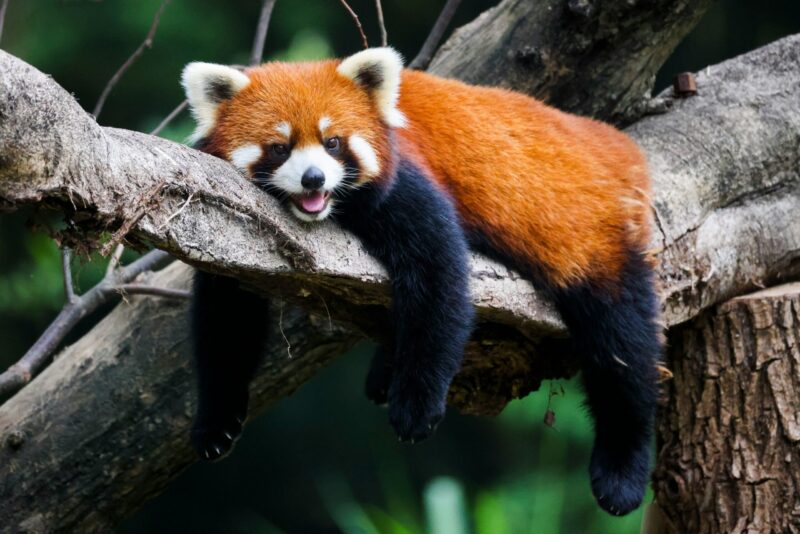
Their bodies are covered in long, dense reddish-orange fur that darkens to black on the ventral area and toward the legs. The tail, on the other hand, has about 12 alternating red and beige rings.
Although their fur doesn’t precisely resemble their surroundings, its reddish-orange coloration can blend somewhat with vegetation, for example, in places like tree trunks where moss and lichens are present. This makes them less visible to potential predators.
Red pandas measure 12 to 24 inches (30 to 60 cm) and weigh between 9 and 13 pounds (4 and 6 kg), with males being larger than females. In comparison, they have a very large tongue, which can measure up to 5 inches (12 cm) long. This tongue is also flexible, which helps them extract grubs and other insects from crevices in tree bark.
How do red pandas behave?
Red pandas spend most of their time in trees, where they feed and sleep. They are also nocturnal, so they are most active at dusk, during the night and at dawn. They’re also agile tree explorers, stealthily slipping through branches in search of food.
In general, this is a primarily solitary species that only interacts with others of its species during the breeding season. Furthermore, it is a sedentary animal, spending the day primarily sleeping and eating.
Females can have their first cub around the age of two. They may have between one and four cubs, but two are most common. Gestation lasts between 112 and 158 days. Cubs are born blind and weigh between 0.24 and 0.28 pounds (110 and 130 grams). At 90 days, they begin to explore, but they don’t become independent until they are six months old.
An Asian treasure in danger of extinction
Unfortunately, red pandas are endangered, according to the IUCN. The red panda has been classified as an endangered species due to the decline in its population, which has decreased by 50% in the last three generations, estimated over a period of approximately 18 years. This decline is expected to continue and worsen in the coming years due to various threats.
It is one of the most endangered animal species in the world due to the destruction and fragmentation of its habitat, people hunting for its fur and the illegal trade of individuals for sale as pets. Climate change, natural disasters and forest fires are also significantly altering its habitat.
There are not enough data to identify an exact number, but it is suspected that fewer than 10,000 individuals remain in the wild worldwide.
Bottom line: The red panda is so peculiar! It is not a panda, it feeds mainly on bamboo that it can’t digest, and it has a false thumb.
Read more: Why pandas are black and white
Read more: Watch giant pandas frolic in the snow
The post Meet the adorable red panda, which isn’t really a panda! first appeared on EarthSky.
from EarthSky https://ift.tt/qZ2lD4t
The red panda is a Asian treasure. Watch this video for more info about this lovely creature. Image via Xiangkun Zhu/ Unsplash.
That’s right, a red panda is not really a panda. So, how did it get that name? And what is it really, then? There are plenty of other curiosities surrounding red pandas, such as their thumbs that aren’t fingers plus the fact that they feed mainly on bamboo, which they can’t digest. Read on to get the true story about this remarkable creature.
The red panda is not a panda
The red panda is a mammal with a name that can be misleading, as it’s not a panda in the modern sense of the word. That is, it’s not closely related to the giant panda, the big, black-and-white bear.
This confusion has historical, linguistic and scientific roots that have been the subject of debate for more than a century. The term panda comes from the Nepali words nigalya ponya, meaning bamboo eater.
It was the French zoologist Frédéric Cuvier who first described the red panda in 1825. This happened several decades before the giant panda was discovered by the Western culture in 1869. Therefore, the red panda is the “original” panda. When the giant panda was discovered, it was so named because both eat bamboo and bear a certain physical resemblance.
So, what is the red panda, really? For a long time, scientists debated which taxonomic group this animal belongs to. The most frequently considered options were bears, due to its resemblance to the giant panda, and raccoons, due to its dental, facial and behavioral characteristics.
This debate lasted for decades, as the tools necessary for proper study did not exist. Thanks to advances in molecular biology and genetics, we now know the red panda is neither a bear nor a raccoon but belongs to its own family: Ailuridae.
Scientists discovered that, although this creature belongs to the Carnivora order, like bears and raccoons, it diverged evolutionarily about 40 million years ago.
The carnivorous red panda eats bamboo
Red pandas eat meat, for example, chicks and small rodents. It can also feed on stems, shoots, acorns, fruits, mushrooms, roots, lichens, eggs and insects. Therefore, despite being listed as a carnivore, it is actually omnivorous.
But what is most striking is that its diet (about 2/3s) is based on bamboo, a plant it cannot properly digest. The red panda’s digestive system is not designed to process cellulose, a main component of bamboo. This means it must consume large amounts of this plant to obtain the nutrients it needs.
Red pandas, like giant pandas, have carnivorous ancestors, which means their digestive systems have not fully adapted to digesting bamboo cellulose. However, like other plant-eating animals, bacteria eventually develop in their digestive systems that can help break down cellulose. Perhaps red pandas just need a little more time to develop a more appropriate digestive system.
Red pandas have a false thumb
Speaking of evolution, since both the red panda and the giant panda evolved a bamboo-based diet, this led them to develop similar adaptations. For example, a false thumb.
This is the sesamoid bone, a component of the wrist that in both pandas is enlarged and elongated, similar to the bones of the true fingers. The false thumb allows these animals to grip branches while eating leaves.
Furthermore, red pandas are excellent climbers, as they have retractable claws and flexible ankles that allow them to climb trees and leap up to 5 feet (1.5 meters) from one branch to another with great agility. These characteristics help them escape predators and find food in high places.
Habitat of the red panda
You may find it curious that, despite having some difficulty assimilating cellulose, they still feed on bamboo. However, this plant is widespread in the areas they inhabit.
The red panda has a limited distribution area. In fact, its habitat is limited to isolated patches in the mountainous regions of five Asian countries: Nepal, India, Bhutan, Myanmar and China.
These animals live in mixed forests of coniferous and deciduous trees dominated by fir, spruce, oak, walnut and maple trees, with dense bamboo understories.
These adorable creatures live in cold or temperate climates, but without extreme temperatures. They live between 7,200 and 15,000 feet (2,200 and 4,800 meters) above sea level.
There are two subspecies: the Himalayan and the Chinese red panda. The first one is characterized by its lighter facial fur, while the second has a darker color and more pronounced features.
Who needs a scarf when you have a fluffy tail?
Just as their claws help them move, their tails provide excellent balance and allow them to grip and move through slippery areas with great agility. Furthermore, these animals sleep curled up and can wrap their tails around their bodies to conserve heat in extremely cold conditions. They even cover their faces with their tails to stay warm.
Their bodies are covered in long, dense reddish-orange fur that darkens to black on the ventral area and toward the legs. The tail, on the other hand, has about 12 alternating red and beige rings.
Although their fur doesn’t precisely resemble their surroundings, its reddish-orange coloration can blend somewhat with vegetation, for example, in places like tree trunks where moss and lichens are present. This makes them less visible to potential predators.
Red pandas measure 12 to 24 inches (30 to 60 cm) and weigh between 9 and 13 pounds (4 and 6 kg), with males being larger than females. In comparison, they have a very large tongue, which can measure up to 5 inches (12 cm) long. This tongue is also flexible, which helps them extract grubs and other insects from crevices in tree bark.
How do red pandas behave?
Red pandas spend most of their time in trees, where they feed and sleep. They are also nocturnal, so they are most active at dusk, during the night and at dawn. They’re also agile tree explorers, stealthily slipping through branches in search of food.
In general, this is a primarily solitary species that only interacts with others of its species during the breeding season. Furthermore, it is a sedentary animal, spending the day primarily sleeping and eating.
Females can have their first cub around the age of two. They may have between one and four cubs, but two are most common. Gestation lasts between 112 and 158 days. Cubs are born blind and weigh between 0.24 and 0.28 pounds (110 and 130 grams). At 90 days, they begin to explore, but they don’t become independent until they are six months old.
An Asian treasure in danger of extinction
Unfortunately, red pandas are endangered, according to the IUCN. The red panda has been classified as an endangered species due to the decline in its population, which has decreased by 50% in the last three generations, estimated over a period of approximately 18 years. This decline is expected to continue and worsen in the coming years due to various threats.
It is one of the most endangered animal species in the world due to the destruction and fragmentation of its habitat, people hunting for its fur and the illegal trade of individuals for sale as pets. Climate change, natural disasters and forest fires are also significantly altering its habitat.
There are not enough data to identify an exact number, but it is suspected that fewer than 10,000 individuals remain in the wild worldwide.
Bottom line: The red panda is so peculiar! It is not a panda, it feeds mainly on bamboo that it can’t digest, and it has a false thumb.
Read more: Why pandas are black and white
Read more: Watch giant pandas frolic in the snow
The post Meet the adorable red panda, which isn’t really a panda! first appeared on EarthSky.
from EarthSky https://ift.tt/qZ2lD4t

Aucun commentaire:
Enregistrer un commentaire