
Watch this video about Khankhuuluu mongoliensis, an ancestor of T. Rex. Video via the University of Calgary.
- Scientists have identified a new dinosaur species in Mongolia, Khankhuuluu mongoliensis, an early ancestor of T. rex.
- It lived around 90 to 83 million years ago and was smaller and nimbler than T. rex.
- The discovery helps fill a key evolutionary gap, showing how medium-sized tyrannosaurs evolved into apex predators like T. rex.
Khankhuuluu, the prince of dragons
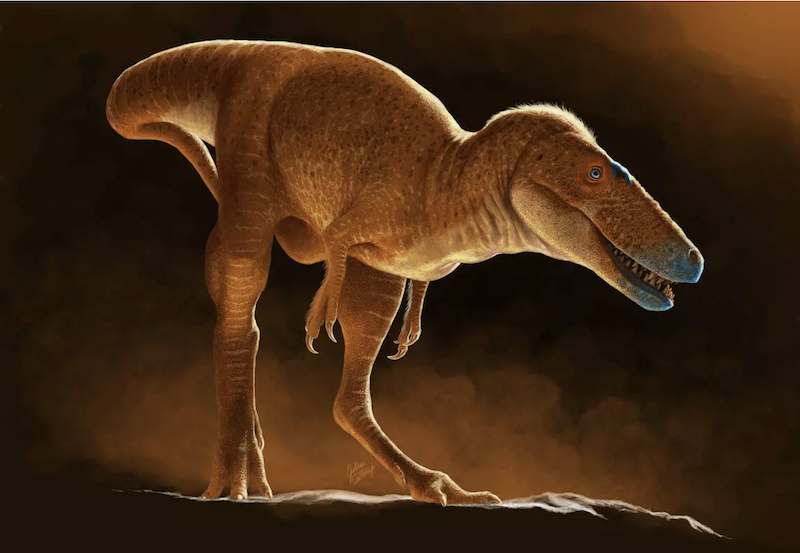
Tyrannosaurus rex, the dinosaur that stole the show in the movie Jurassic Park, was a fearsome apex predator that lived 68 to 66 million years ago. Scientists know from the fossil record that T. rex evolved in western North America. Also, fossil evidence suggests its ancestors came from Asia, crossing a land bridge that once connected the two continents. On June 11, 2025, researchers at the University of Calgary said a dinosaur found in Mongolia 50 years ago is an ancestor of tyrannosaurs such as T. rex. This ancestor was smaller, about the size of a horse, weighing around 1,650 pounds (750 kilograms). In contrast, T. rex was about three times larger.
The researchers named it Khankhuuluu mongoliensis. In Mongolian, Khankhuuluu roughly translates to prince of dragons. Its species name, mongoliensis, is for the fossil’s country of origin.
Co-author Jared Voris of the University of Calgary explained how they chose its name:
We wanted something to epitomize how it’s not quite the king yet. Tyrannosaurs are often referred to as kings of the Cretaceous and Tyrannosaurus rex means the tyrant lizard king, so we wanted something that comes before a king, which is a prince.
The scientists published their peer-reviewed findings in the journal Nature on June 11, 2025.
Reclassifying a fossil as a new dinosaur species
In 1972 and 1973, excavators uncovered two Khankhuuluu fossils at the Bayanshiree Formation in southeastern Mongolia. A researcher had initially identified it as a medium-sized tyrannosaur called Alectrosaurus olseni. The fossils were found in ground layers that date them to approximately 90 million to 83 million years ago (the upper Turonian to upper Santonian ages of the geologic timescale).
Nearly 50 years later, Voris traveled to the Institute of Paleontology at the Mongolian Academy of Sciences, in Ulaanbaatar, Mongolia, to examine the fossils. There, he discovered that it was actually a new dinosaur species.
Voris said:
I realized there were features that made this different from other Alectrosaurus fossils, and they also provided a lot more information into the evolutionary history of tyrannosaurs.
Basically, right before they got to be these apex predators, tyrannosaurs were these medium-sized, fleet-footed predators that lived in the shadows of other apex predators.
But those “other apex predators” eventually went extinct, allowing Khankhuuluu to evolve and become a large tyrannosaur.
He added:
We’ve never really had a good representation of that transition. This new species actually provides us that window into the ascent stage of tyrannosaurs; right when they’re transitioning to the apex predator form.
Khankhuuluu was a precursor to giant tyrannosaurs
Khankhuuluu appears to be a link between the early tyrannosaurs that were smaller and nimbler, and larger apex predator tyrannosaurs that evolved late in the Cretaceous. In addition, the researchers noted that it shared but also lacked characteristics of later tyrannosaur species like Albertosaurus and Gorgosaurus.
About the size of a horse, Khankhuuluu was two to three times smaller than large tyrannosaurs like T. rex. Its skull, which had small horns, was long and shallow. This skull shape suggests that Khankhuuluu did not have the bite force of T. rex to crush through bone when biting down on an animal.
In addition, the scientists said Khankhuuluu was built to swiftly ambush its prey. This is in contrast to the later massive tyrannosaurs, which used the force of their weight to take down animals. They compared Khankhuuluu’s hunting strategy to that of a hyena or jackal, while large tyrannosaurs were more lion-like in their hunting habits.

Tyrannosaur ancestors migrated to North America from Asia
During the Cretaceous, western North America was an island continent called Laramidia. A large inland sea separated it from the rest of North America. Ancestors of tyrannosaurs crossed over from Asia into Laramidia via a land bridge connecting the two continents.
In their research, the scientists also reanalyzed the tyrannosaur family tree. Co-author Darla Zelenitsky of the University of Calgary said:
Khankhuuluu, or a closely related species, would have immigrated to North America from Asia around 85 million years ago. Our study provides solid evidence that large tyrannosaurs first evolved in North America as a result of this immigration event of ancestor tyrannosauroids.
Their study also revealed that a few million years later, large apex predator tyrannosaurs reappeared in Asia. They evolved into medium-sized long-snouted species that were nicknamed Pinocchio rexes. Meanwhile, in North America, tyrannosaurs continued to evolve toward large-bodied apex predators like T. rex.
Zelenitsky commented:
Finding a new species is always very exciting. It tells us how tyrannosaurs as a group became so diverse and successful at the end of the Cretaceous.
Voris added:
This shows that these animals were moving back and forth between North America and Asia. That hasn’t changed. We have tons of evidence of patterns like this happening with wolves, deer, and humans, so it shows a lot of the patterns that we see in the modern day are things that were going on back when the dinosaurs were around.
Bottom line: Scientists recently reclassified a dinosaur from Mongolia as a new species. They say that this dinosaur, Khankhuuluu mongoliensis, is an ancestor of T. rex.
Source: A new Mongolian tyrannosauroid and the evolution of Eutyrannosauria
Read more: Here’s how fierce T. rex got to North America
The post Khankhuuluu is a new T. rex dinosaur relative from Mongolia first appeared on EarthSky.
from EarthSky https://ift.tt/B0lzCwO
Watch this video about Khankhuuluu mongoliensis, an ancestor of T. Rex. Video via the University of Calgary.
- Scientists have identified a new dinosaur species in Mongolia, Khankhuuluu mongoliensis, an early ancestor of T. rex.
- It lived around 90 to 83 million years ago and was smaller and nimbler than T. rex.
- The discovery helps fill a key evolutionary gap, showing how medium-sized tyrannosaurs evolved into apex predators like T. rex.
Khankhuuluu, the prince of dragons
Tyrannosaurus rex, the dinosaur that stole the show in the movie Jurassic Park, was a fearsome apex predator that lived 68 to 66 million years ago. Scientists know from the fossil record that T. rex evolved in western North America. Also, fossil evidence suggests its ancestors came from Asia, crossing a land bridge that once connected the two continents. On June 11, 2025, researchers at the University of Calgary said a dinosaur found in Mongolia 50 years ago is an ancestor of tyrannosaurs such as T. rex. This ancestor was smaller, about the size of a horse, weighing around 1,650 pounds (750 kilograms). In contrast, T. rex was about three times larger.
The researchers named it Khankhuuluu mongoliensis. In Mongolian, Khankhuuluu roughly translates to prince of dragons. Its species name, mongoliensis, is for the fossil’s country of origin.
Co-author Jared Voris of the University of Calgary explained how they chose its name:
We wanted something to epitomize how it’s not quite the king yet. Tyrannosaurs are often referred to as kings of the Cretaceous and Tyrannosaurus rex means the tyrant lizard king, so we wanted something that comes before a king, which is a prince.
The scientists published their peer-reviewed findings in the journal Nature on June 11, 2025.
Reclassifying a fossil as a new dinosaur species
In 1972 and 1973, excavators uncovered two Khankhuuluu fossils at the Bayanshiree Formation in southeastern Mongolia. A researcher had initially identified it as a medium-sized tyrannosaur called Alectrosaurus olseni. The fossils were found in ground layers that date them to approximately 90 million to 83 million years ago (the upper Turonian to upper Santonian ages of the geologic timescale).
Nearly 50 years later, Voris traveled to the Institute of Paleontology at the Mongolian Academy of Sciences, in Ulaanbaatar, Mongolia, to examine the fossils. There, he discovered that it was actually a new dinosaur species.
Voris said:
I realized there were features that made this different from other Alectrosaurus fossils, and they also provided a lot more information into the evolutionary history of tyrannosaurs.
Basically, right before they got to be these apex predators, tyrannosaurs were these medium-sized, fleet-footed predators that lived in the shadows of other apex predators.
But those “other apex predators” eventually went extinct, allowing Khankhuuluu to evolve and become a large tyrannosaur.
He added:
We’ve never really had a good representation of that transition. This new species actually provides us that window into the ascent stage of tyrannosaurs; right when they’re transitioning to the apex predator form.
Khankhuuluu was a precursor to giant tyrannosaurs
Khankhuuluu appears to be a link between the early tyrannosaurs that were smaller and nimbler, and larger apex predator tyrannosaurs that evolved late in the Cretaceous. In addition, the researchers noted that it shared but also lacked characteristics of later tyrannosaur species like Albertosaurus and Gorgosaurus.
About the size of a horse, Khankhuuluu was two to three times smaller than large tyrannosaurs like T. rex. Its skull, which had small horns, was long and shallow. This skull shape suggests that Khankhuuluu did not have the bite force of T. rex to crush through bone when biting down on an animal.
In addition, the scientists said Khankhuuluu was built to swiftly ambush its prey. This is in contrast to the later massive tyrannosaurs, which used the force of their weight to take down animals. They compared Khankhuuluu’s hunting strategy to that of a hyena or jackal, while large tyrannosaurs were more lion-like in their hunting habits.
Tyrannosaur ancestors migrated to North America from Asia
During the Cretaceous, western North America was an island continent called Laramidia. A large inland sea separated it from the rest of North America. Ancestors of tyrannosaurs crossed over from Asia into Laramidia via a land bridge connecting the two continents.
In their research, the scientists also reanalyzed the tyrannosaur family tree. Co-author Darla Zelenitsky of the University of Calgary said:
Khankhuuluu, or a closely related species, would have immigrated to North America from Asia around 85 million years ago. Our study provides solid evidence that large tyrannosaurs first evolved in North America as a result of this immigration event of ancestor tyrannosauroids.
Their study also revealed that a few million years later, large apex predator tyrannosaurs reappeared in Asia. They evolved into medium-sized long-snouted species that were nicknamed Pinocchio rexes. Meanwhile, in North America, tyrannosaurs continued to evolve toward large-bodied apex predators like T. rex.
Zelenitsky commented:
Finding a new species is always very exciting. It tells us how tyrannosaurs as a group became so diverse and successful at the end of the Cretaceous.
Voris added:
This shows that these animals were moving back and forth between North America and Asia. That hasn’t changed. We have tons of evidence of patterns like this happening with wolves, deer, and humans, so it shows a lot of the patterns that we see in the modern day are things that were going on back when the dinosaurs were around.
Bottom line: Scientists recently reclassified a dinosaur from Mongolia as a new species. They say that this dinosaur, Khankhuuluu mongoliensis, is an ancestor of T. rex.
Source: A new Mongolian tyrannosauroid and the evolution of Eutyrannosauria
Read more: Here’s how fierce T. rex got to North America
The post Khankhuuluu is a new T. rex dinosaur relative from Mongolia first appeared on EarthSky.
from EarthSky https://ift.tt/B0lzCwO

Aucun commentaire:
Enregistrer un commentaire