

Odds of asteroid 2024 YR4 hitting the moon are up again!
Asteroid 2024 YR4’s chances of hitting the moon have gone up again. On June 3, 2025, the Webb Space Telescope reported one more observation of the asteroid as it moves away from us. This observation helped to further refine the space rock’s orbit. NASA reassured the public that:
In the small chance that the asteroid were to impact, it would not alter the moon’s orbit.
If you recall, when the asteroid was first discovered there was a chance that it would hit Earth. In fact, it reach a 3 on the Torino Asteroid Hazard Scale. There was a lot of talk about it, including an EarthSky interview with astronomer Richard Binzel of MIT, inventor of the Torino Scale. But, in February, we learned that the odds of an asteroid strike by 2024 YR4 in 2032 had dropped to near zero. Instead, we now wait to see if it has the moon in its sights on December 22, 2032.
So when will we know more about whether it will strike the moon? Not for quite a while. The next observations from NASA won’t come until the asteroid’s orbit around the sun brings it back into Earth’s vicinity in 2028.
Previous likelihood went up in April
On April 2, 2025, NASA said that new data from the Webb space telescope and ground-based telescopes suggested a 3.8% chance of a moon strike.
That was also up – from a 1.8%, or a 1-in-56 chance – from back in February. So the odds of a moon strike continue to climb.
Earthly astronomers are perking up again, over the possibility of a moon strike. Would we be able to see it strike from Earth? Where on the moon might it strike? And, NASA said, there’s a good chance that – if it strikes – the strike will be near the moon’s limb, or edge. That means it could strike behind the limb, meaning we wouldn’t get much of a show. Or it could mean a strike on the Earth-facing side of the moon. If so, telescopes up!
Webb observations have helped astronomers refine their knowledge of this asteroid’s size. NASA said 2024 YR4 is somewhere between 174 to 220 feet (53 to 67 meters) in diameter, or about the size of a 10-story building. Previous estimates of the asteroid placed it at around 150 feet (45 meters). So it’s slightly bigger than we thought. An object that size striking Earth could take out a city. So, if it hits the moon, it’ll pack a wallop. What a sight that would be!
The asteroid’s shape and origin
On April 8, 2025, NOIRlab said that observations with Gemini South reveal the asteroid’s shape and origin. Scientists said it has a bit of a hockey-puck-like shape. And they said it mostly likely came from the main asteroid belt. Both of these were unusual findings. Regarding the shape, team member Bryce Bolin of Eureka Scientific said:
This find was rather unexpected since most asteroids are thought to be shaped like potatoes or toy tops rather than flat disks.
And about the asteroid’s origin, Bolin said:
We are a bit surprised about its origin in the central main asteroid belt, which is a location in the asteroid belt that we did not think many Earth-crossing asteroids could originate from.
In the player above, you’ll find EarthSky’s interview with Richard Binzel, inventor of the Torino Scale, from earlier in 2025. Some of the details of this interview are no longer valid. Asteroid 2024 YR4 now lies at 0 on the Torino Scale, not 3. But the interview is very good for showing you how astronomers think about close-passing asteroids.
When the odds of 2024 YR4 hitting Earth plummeted
Inventor of the Torino scale Richard Binzel told EarthSky on February 23, 2025:
Asteroid 2024 YR4 has now been reassigned to Torino Scale Level 0: the level for No Hazard. Additional tracking of its orbital path reduces its possibility of intersecting the Earth to below the 1-in-1,000 threshold. That is the established level for downgrading to Level 0. [Editor’s note: Odds of 1-in-1,000 are the threshold for Level 0 for any space object smaller than 100 meters. The initial estimates of 2024 YR4 were for a size of 50 meters].
2024 YR4 fell to Torino Scale Level 1 (Green ‘Normal’) on February 20, down from Level 3 (Yellow ‘Meriting Attention by Astronomers’).
Level 0 is labeled as the (White) No Hazard zone on the Torino Scale, which considers the two dimensions of impact probability and impact consequence in assigning its Levels. Find the Torino Scale categories’ full descriptions here.
In detail for the current probability, the NASA JPL Center for Near-Earth Object Studies now lists the 2024 YR4 probability as 0.00005 (0.005%) or 1-in-20,000 for its passage by Earth in 2032.
That’s zero, folks!
In late January, EarthSky’s Deborah Byrd interviewed asteroid expert Richard Binzel of MIT – inventor of the Torino Impact Hazard Scale – about a possible strike to Earth by asteroid 2024 YR4. He also talked a lot about the overall picture of how astronomers are keeping Earth safe from asteroid collisions. It’s fascinating stuff. Watch the video here.
The 2025 EarthSky lunar calendar makes a great gift. Get yours today!
Odds of impact increased before dropping
Not long after 2024 YR4’s discovery – in late 2024 – astronomers were saying there was a 1-in-83 chance of a strike. Then the odds went to 1 in 53, then 1 in 43, then 1 in 38, and – at worst – the odds were 1 in 32. That became the new record for an asteroid on the Torino scale, beating the infamous asteroid Apophis in 2004. As we have been saying all along:
It’s likely that the odds will go down to zero with further data.
The new estimates for 2024 YR4 – showing it is no longer considered a possible threat to Earth – come from NASA’s Center for Near Earth Object Studies (CNEOS) at the Jet Propulsion Laboratory in Pasadena, California.

Asteroid 2024 YR4 is moving away from us
Asteroid 2024 YR4 is 116 million miles (188 million km) away and getting farther every second. Some observers noticed the asteroid will be somewhat “close” to the Lucy spacecraft, so its team checked to see if 2024 YR4 would be observable by the spacecraft. But – at its closest to Lucy – the asteroid will still be too faint for the spacecraft’s L’LORRI instrument to detect.
Asteroid 2024 YR4 discovered on Christmas Day 2024
Asteroid 2024 YR4 swept into the view of the ATLAS asteroid impact early warning system – with telescopes in Hawaii, Chile and South Africa – on December 25, 2024.
EarthSky spoke with the inventor of the Torino scale, Richard Binzel of the Massachusetts Institute of Technology (MIT), on January 27, 2025. He said:
In all likelihood, this object will fall to Torino Scale 1 and then 0; or directly fall to 0 with more measurements.
2/ The clip below shows ESO’s VLT recent observations of asteroid 2024 YR4, which have helped refine its trajectory. It is estimated to be 40-100 m wide, but more data and analysis are needed to confirm the size, and to refine its trajectory. ? ?
? ESO/O. Hainaut et al.
— ESO (@eso.org) January 29, 2025 at 11:01 AM
An asteroid’s ranking on the Torino scale
The only asteroid ever to have a higher score on the Torino scale was 99942 Apophis. It briefly had a rating of 4 on the Torino Scale in late 2004. And, yes, Apophis caused a stir and earned the nickname of the Doomsday Asteroid. But asteroid Apophis is now just a zero on the Torino scale. That’s because astronomers watched it carefully, refining their knowledge of its orbit. They determined that Apophis has a negligible risk of impact for at least a century.
So it’s normal for an asteroid’s score on the Torino scale can change. In fact, it’s likely to change as astronomers gather more observations of the object and also track its motion around the sun.
Watch a video of size comparisons in asteroids, here.
What is the Torino scale?
The IAU has been using the Torino Impact Hazard Scale since 1999 to categorize asteroids that could potentially hit Earth. An object – such as 2024 YR4 – with a score of 3 puts it in the yellow zone. This means the object merits attention by astronomers and the public. The description of a score of 3 reads:
A close encounter, meriting attention by astronomers. Current calculations give a 1% or greater chance of collision capable of localized destruction. Most likely, new telescopic observations will lead to reassignment to Level 0. Attention by public and by public officials is merited if the encounter is less than a decade away.
In fact, most new asteroids that get listed on the Torino scale have their likelihood of hitting Earth go up with more observations … until it drops to zero. That’s because the uncertain path of the asteroid is wide and more observations shrinks the path, making it look more likely, until the path shrinks enough to show that it will not cross Earth’s. It’s likely that’s what will happen with asteroid 2024 YR4 also.
In 2023, EarthSky spoke with the inventor of the Torino scale, Richard Binzel of the Massachusetts Institute of Technology. He said that we should expect more objects to make the Torino scale as our technology improves, allowing us to see smaller objects we otherwise would have missed.
Asteroid Potential Impact Warning Notification
Because the asteroid passed a slim threshold of hitting Earth, it triggered a Potential Impact Warning Notification on January 29, 2025. That warning came from the International Asteroid Warning Network, a global collaboration of observatories, scientific institutions and other interested parties coordinated by NASA.
On January 29, the impact probability was a mere 1.3% as calculated by CNEOS and ESA’s Near Earth Objects Coordination Centre in Frascati, Italy, in cooperation with the NEO Dynamic Site (NEODyS-2), also in Italy.
The notice gave the potential date of impact as December 22, 2032, and listed possible impact locations across the eastern Pacific, northern South America, into Africa and southern Asia. If it were to strike Earth, it would cause “severe blast damage.” Specifically, the blast damage could occur as far as 30 miles (50 km) from the site of impact.
DART
If someday we find an asteroid that is on a collision course with Earth, we’ll be somewhat prepared. We’ve already sent a mission to hit and move an asteroid as a test of our planetary defense system. That mission was the Double Asteroid Redirection Test (DART), which impacted an asteroid’s moon named Dimorphos in 2022.
And Dimorphos was much larger than asteroid 2024 YR4, at 525 feet (160 meters) across.
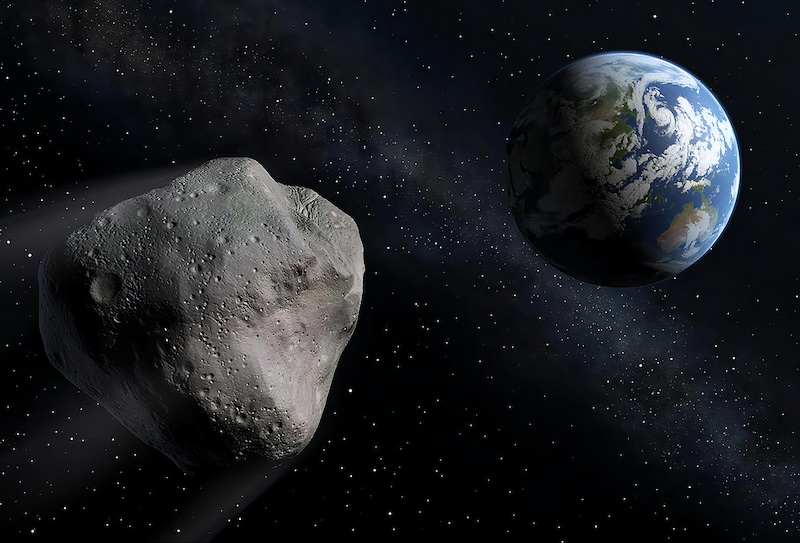
Bottom line: NASA shared a new observation of asteroid 2024 YR4 by the Webb space telescope. It increased the odds of a strike to Earth’s moon, bringing the chances up to 4.3% for a strike in 2032.
Via
The post Asteroid 2024 YR4 chances of hitting the moon go up again first appeared on EarthSky.
from EarthSky https://ift.tt/1seLEVT
Odds of asteroid 2024 YR4 hitting the moon are up again!
Asteroid 2024 YR4’s chances of hitting the moon have gone up again. On June 3, 2025, the Webb Space Telescope reported one more observation of the asteroid as it moves away from us. This observation helped to further refine the space rock’s orbit. NASA reassured the public that:
In the small chance that the asteroid were to impact, it would not alter the moon’s orbit.
If you recall, when the asteroid was first discovered there was a chance that it would hit Earth. In fact, it reach a 3 on the Torino Asteroid Hazard Scale. There was a lot of talk about it, including an EarthSky interview with astronomer Richard Binzel of MIT, inventor of the Torino Scale. But, in February, we learned that the odds of an asteroid strike by 2024 YR4 in 2032 had dropped to near zero. Instead, we now wait to see if it has the moon in its sights on December 22, 2032.
So when will we know more about whether it will strike the moon? Not for quite a while. The next observations from NASA won’t come until the asteroid’s orbit around the sun brings it back into Earth’s vicinity in 2028.
Previous likelihood went up in April
On April 2, 2025, NASA said that new data from the Webb space telescope and ground-based telescopes suggested a 3.8% chance of a moon strike.
That was also up – from a 1.8%, or a 1-in-56 chance – from back in February. So the odds of a moon strike continue to climb.
Earthly astronomers are perking up again, over the possibility of a moon strike. Would we be able to see it strike from Earth? Where on the moon might it strike? And, NASA said, there’s a good chance that – if it strikes – the strike will be near the moon’s limb, or edge. That means it could strike behind the limb, meaning we wouldn’t get much of a show. Or it could mean a strike on the Earth-facing side of the moon. If so, telescopes up!
Webb observations have helped astronomers refine their knowledge of this asteroid’s size. NASA said 2024 YR4 is somewhere between 174 to 220 feet (53 to 67 meters) in diameter, or about the size of a 10-story building. Previous estimates of the asteroid placed it at around 150 feet (45 meters). So it’s slightly bigger than we thought. An object that size striking Earth could take out a city. So, if it hits the moon, it’ll pack a wallop. What a sight that would be!
The asteroid’s shape and origin
On April 8, 2025, NOIRlab said that observations with Gemini South reveal the asteroid’s shape and origin. Scientists said it has a bit of a hockey-puck-like shape. And they said it mostly likely came from the main asteroid belt. Both of these were unusual findings. Regarding the shape, team member Bryce Bolin of Eureka Scientific said:
This find was rather unexpected since most asteroids are thought to be shaped like potatoes or toy tops rather than flat disks.
And about the asteroid’s origin, Bolin said:
We are a bit surprised about its origin in the central main asteroid belt, which is a location in the asteroid belt that we did not think many Earth-crossing asteroids could originate from.
In the player above, you’ll find EarthSky’s interview with Richard Binzel, inventor of the Torino Scale, from earlier in 2025. Some of the details of this interview are no longer valid. Asteroid 2024 YR4 now lies at 0 on the Torino Scale, not 3. But the interview is very good for showing you how astronomers think about close-passing asteroids.
When the odds of 2024 YR4 hitting Earth plummeted
Inventor of the Torino scale Richard Binzel told EarthSky on February 23, 2025:
Asteroid 2024 YR4 has now been reassigned to Torino Scale Level 0: the level for No Hazard. Additional tracking of its orbital path reduces its possibility of intersecting the Earth to below the 1-in-1,000 threshold. That is the established level for downgrading to Level 0. [Editor’s note: Odds of 1-in-1,000 are the threshold for Level 0 for any space object smaller than 100 meters. The initial estimates of 2024 YR4 were for a size of 50 meters].
2024 YR4 fell to Torino Scale Level 1 (Green ‘Normal’) on February 20, down from Level 3 (Yellow ‘Meriting Attention by Astronomers’).
Level 0 is labeled as the (White) No Hazard zone on the Torino Scale, which considers the two dimensions of impact probability and impact consequence in assigning its Levels. Find the Torino Scale categories’ full descriptions here.
In detail for the current probability, the NASA JPL Center for Near-Earth Object Studies now lists the 2024 YR4 probability as 0.00005 (0.005%) or 1-in-20,000 for its passage by Earth in 2032.
That’s zero, folks!
In late January, EarthSky’s Deborah Byrd interviewed asteroid expert Richard Binzel of MIT – inventor of the Torino Impact Hazard Scale – about a possible strike to Earth by asteroid 2024 YR4. He also talked a lot about the overall picture of how astronomers are keeping Earth safe from asteroid collisions. It’s fascinating stuff. Watch the video here.
The 2025 EarthSky lunar calendar makes a great gift. Get yours today!
Odds of impact increased before dropping
Not long after 2024 YR4’s discovery – in late 2024 – astronomers were saying there was a 1-in-83 chance of a strike. Then the odds went to 1 in 53, then 1 in 43, then 1 in 38, and – at worst – the odds were 1 in 32. That became the new record for an asteroid on the Torino scale, beating the infamous asteroid Apophis in 2004. As we have been saying all along:
It’s likely that the odds will go down to zero with further data.
The new estimates for 2024 YR4 – showing it is no longer considered a possible threat to Earth – come from NASA’s Center for Near Earth Object Studies (CNEOS) at the Jet Propulsion Laboratory in Pasadena, California.
Asteroid 2024 YR4 is moving away from us
Asteroid 2024 YR4 is 116 million miles (188 million km) away and getting farther every second. Some observers noticed the asteroid will be somewhat “close” to the Lucy spacecraft, so its team checked to see if 2024 YR4 would be observable by the spacecraft. But – at its closest to Lucy – the asteroid will still be too faint for the spacecraft’s L’LORRI instrument to detect.
Asteroid 2024 YR4 discovered on Christmas Day 2024
Asteroid 2024 YR4 swept into the view of the ATLAS asteroid impact early warning system – with telescopes in Hawaii, Chile and South Africa – on December 25, 2024.
EarthSky spoke with the inventor of the Torino scale, Richard Binzel of the Massachusetts Institute of Technology (MIT), on January 27, 2025. He said:
In all likelihood, this object will fall to Torino Scale 1 and then 0; or directly fall to 0 with more measurements.
2/ The clip below shows ESO’s VLT recent observations of asteroid 2024 YR4, which have helped refine its trajectory. It is estimated to be 40-100 m wide, but more data and analysis are needed to confirm the size, and to refine its trajectory. ? ?
? ESO/O. Hainaut et al.
— ESO (@eso.org) January 29, 2025 at 11:01 AM
An asteroid’s ranking on the Torino scale
The only asteroid ever to have a higher score on the Torino scale was 99942 Apophis. It briefly had a rating of 4 on the Torino Scale in late 2004. And, yes, Apophis caused a stir and earned the nickname of the Doomsday Asteroid. But asteroid Apophis is now just a zero on the Torino scale. That’s because astronomers watched it carefully, refining their knowledge of its orbit. They determined that Apophis has a negligible risk of impact for at least a century.
So it’s normal for an asteroid’s score on the Torino scale can change. In fact, it’s likely to change as astronomers gather more observations of the object and also track its motion around the sun.
Watch a video of size comparisons in asteroids, here.
What is the Torino scale?
The IAU has been using the Torino Impact Hazard Scale since 1999 to categorize asteroids that could potentially hit Earth. An object – such as 2024 YR4 – with a score of 3 puts it in the yellow zone. This means the object merits attention by astronomers and the public. The description of a score of 3 reads:
A close encounter, meriting attention by astronomers. Current calculations give a 1% or greater chance of collision capable of localized destruction. Most likely, new telescopic observations will lead to reassignment to Level 0. Attention by public and by public officials is merited if the encounter is less than a decade away.
In fact, most new asteroids that get listed on the Torino scale have their likelihood of hitting Earth go up with more observations … until it drops to zero. That’s because the uncertain path of the asteroid is wide and more observations shrinks the path, making it look more likely, until the path shrinks enough to show that it will not cross Earth’s. It’s likely that’s what will happen with asteroid 2024 YR4 also.
In 2023, EarthSky spoke with the inventor of the Torino scale, Richard Binzel of the Massachusetts Institute of Technology. He said that we should expect more objects to make the Torino scale as our technology improves, allowing us to see smaller objects we otherwise would have missed.
Asteroid Potential Impact Warning Notification
Because the asteroid passed a slim threshold of hitting Earth, it triggered a Potential Impact Warning Notification on January 29, 2025. That warning came from the International Asteroid Warning Network, a global collaboration of observatories, scientific institutions and other interested parties coordinated by NASA.
On January 29, the impact probability was a mere 1.3% as calculated by CNEOS and ESA’s Near Earth Objects Coordination Centre in Frascati, Italy, in cooperation with the NEO Dynamic Site (NEODyS-2), also in Italy.
The notice gave the potential date of impact as December 22, 2032, and listed possible impact locations across the eastern Pacific, northern South America, into Africa and southern Asia. If it were to strike Earth, it would cause “severe blast damage.” Specifically, the blast damage could occur as far as 30 miles (50 km) from the site of impact.
DART
If someday we find an asteroid that is on a collision course with Earth, we’ll be somewhat prepared. We’ve already sent a mission to hit and move an asteroid as a test of our planetary defense system. That mission was the Double Asteroid Redirection Test (DART), which impacted an asteroid’s moon named Dimorphos in 2022.
And Dimorphos was much larger than asteroid 2024 YR4, at 525 feet (160 meters) across.
Bottom line: NASA shared a new observation of asteroid 2024 YR4 by the Webb space telescope. It increased the odds of a strike to Earth’s moon, bringing the chances up to 4.3% for a strike in 2032.
Via
The post Asteroid 2024 YR4 chances of hitting the moon go up again first appeared on EarthSky.
from EarthSky https://ift.tt/1seLEVT

Aucun commentaire:
Enregistrer un commentaire