
Maybe you associate the word zodiac with astrology. But it has an honored place in astronomy, too. Skywatchers, in particular, are keenly aware of the zodiac constellations because they contain what’s called the ecliptic, or sun’s path across our sky. Why is the sun’s path so important? Join our night sky experts – Deborah Byrd and Bob King, aka AstroBob – to find out!
Looking up has never felt more important.
Help EarthSky keep bringing the sky to your screen.
What is the zodiac?
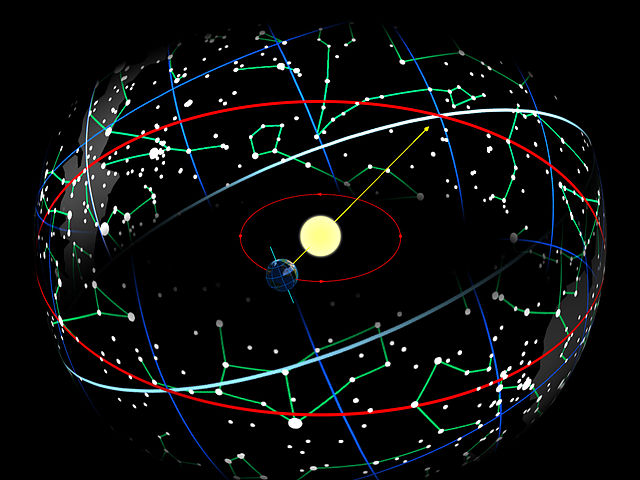
Both astrologers and astronomers speak of the zodiac. Astrologers see it in the 12 “signs” listed in a horoscope. But astronomers would see these zodiac “signs” as being derived from real constellations our night sky. These constellations are the same ones that contain the path of our sun over the course of a year.
So the zodiac belongs to both astronomy and astrology. Skywatchers, in particular, are keenly aware of the zodiac constellations, because they contain what’s called the ecliptic, or sun’s path across our sky. Why is the sun’s path so important? Keep reading!
The early stargazers knew that the location of the sun relative to distant stars drifts throughout the seasons. Suppose you have a clear view to the western horizon. And suppose you watch a sunset every clear night for a year. After sunset, as the sky darkens, you would see stars – often in familiar patterns – in the western sky. Then, a month later, you wouldn’t see those stars. They’d be gone below your western horizon. We today know that happens because Earth is moving around the sun, and the panorama of the background stars is constantly shifting. But, to the early stargazers, those stars had simply left the sky. Now they were with the sun. Or you might say the sun was in those constellations.
Over the course of a year, the sun appears to be in front of, or in, different constellations. One month, the sun appears in Gemini. The next month, it’s in Cancer.
And so it goes, through all the constellations of the zodiac.
Why the zodiac is important in astronomy
So why are the constellations of the zodiac important to skywatchers?
The reason is that our Earth and the other planets in our solar system orbit the sun in a flat plane. Remember those models of the solar system our teachers asked us to make in school? As you got older, you learned that the planets don’t orbit in random locations around our star? Instead, their orbits go outward from the sun, with each smaller orbit inside a larger orbit, but – more or less – on the same plane. It’s as if the solar system is a big pancake with a cherry (the sun) in the middle!
And that’s the reason that, when we look out into our night sky, we don’t see the planets in random places in the sky. Instead, we see them along a single line across the sky – the ecliptic – or sun’s path. That path shifts higher or lower at different times or day or night, and at different times of year. But we all know, more or less, how the sun moves across our sky. The moon moves across that same path. And so do the planets. That’s a big help in learning to identify them.
Why the zodiac constellations don’t always align with astrological signs
So do the “signs” of the zodiac line with with constellations of the zodiac. The answer to that is no. To understand why not, you need to know a bit more about how Earth moves. We also need to talk about how we measure time.
Time is a fiendishly difficult thing to define, especially if we insist on using the sun and stars as a reference. Our calendar is, for better or worse, tied to the seasons. June 21 – the approximate date of summer solstice north of the equator and the winter solstice to the south – marks the day the sun appears at its most northerly point in the sky. At the June solstice, the North Pole is most tilted towards the sun.
What makes this complicated is that – over a very long timescale – the North Pole is not always pointing in the same direction relative to the background stars. Our planet spins like a top. And like a top, the Earth also wobbles! A wobbling Earth makes the North Pole trace out a circle on the celestial sphere. The wobble is quite slow; it takes 26,000 years to go around once. But, as the years go by, the effect accumulates.
Over the course of one orbit around the sun, the direction of the Earth’s axis drifts ever so slightly. This means that the place along our orbit where the solstice occurs also changes by a very small amount. The solstice actually occurs about 20 minutes earlier than one full trip in front of the background stars!

Our drifting calendars
Since we tie our calendar (and astrologers tie the signs) to the solstices and equinoxes, the Earth doesn’t actually complete an entire orbit in one year. The seasonal or tropical year is actually a hair less time than one full orbit (sidereal year). This means that, each year, the sun’s location relative to the stars on any given day – June 21, for example – drifts a very tiny amount.
But wait about 2,000 years, and the sun will sit in an entirely different constellation!
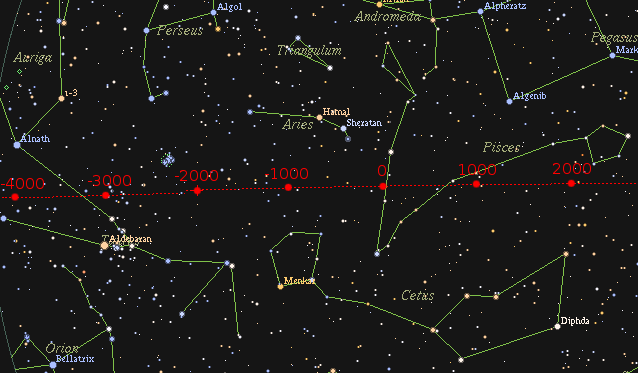
On the June solstice 2,000 years ago, the sun sat almost halfway between Gemini and Cancer. Fifteen years ago, on the June solstice, the sun was sitting between Gemini and Taurus. In the year 4609, the June solstice point will pass out of the constellation Taurus and into the constellation Aries.
The signs aligned, more or less, with their corresponding constellations when people defined the modern Western zodiac about 2,000 years ago. But in the intervening centuries, the slow wobble of the Earth’s axis has caused the solstice and equinox points to shift roughly 30 degrees westward relative to the constellations. At present, signs and constellations are about one calendar month off. In another two thousand years or so, they’ll be about two months off.
Modern constellations and the zodiac
To complicate matters more, the constellations – unlike the astrological signs – are not of equal size and shape. The stars that make up a constellation are not, for the most part, physically related. They’re just based on patterns that our ancestors saw as they gazed skyward and tried to make sense of it all.
In 1930, the International Astronomical Union formalized the constellations as regions of the sky, not just the star patterns within them. With this, they defined the boundaries we use today. These modern constellations are rooted in those the Greek astronomer Ptolemy introduced in the second century CE. He, in turn, borrowed them from ancient Babylonian texts. Different cultures have seen patterns in the sky unique to their history. Many cultures share some constellations (Orion is a notable example), but most don’t.
With the current boundaries, there are actually 13 constellations that lie along the sun’s path. The extra one not listed in any horoscope is Ophiuchus, the Serpent Bearer, which sits between Sagittarius and Scorpius. Whereas the signs remain fixed relative to the solstices and equinoxes, the solstices and equinoxes drift westward relative to the constellations or backdrop stars.
While the zodiac may not be a great predictor of love, fortune, and health, it is a great tool for better understanding the motions of the sun, the Earth, and even the cultures that have come and gone on our little planet. The zodiac signs, derived from the constellations along the sun’s path in the sky, track the orbit and wobble of Earth and remind us of astronomy’s humble roots.
Take the quiz!
Are you familiar with the zodiac constellations now? Test yourself with this fun quiz!
Bottom line: Maybe you associate the word zodiac with astrology. But it has an honored place in astronomy, too. It’s defined by the path of the sun across our sky.
The post What is the zodiac? Why is it important in astronomy? first appeared on EarthSky.
from EarthSky https://ift.tt/WzCxmML
Maybe you associate the word zodiac with astrology. But it has an honored place in astronomy, too. Skywatchers, in particular, are keenly aware of the zodiac constellations because they contain what’s called the ecliptic, or sun’s path across our sky. Why is the sun’s path so important? Join our night sky experts – Deborah Byrd and Bob King, aka AstroBob – to find out!
Looking up has never felt more important.
Help EarthSky keep bringing the sky to your screen.
What is the zodiac?
Both astrologers and astronomers speak of the zodiac. Astrologers see it in the 12 “signs” listed in a horoscope. But astronomers would see these zodiac “signs” as being derived from real constellations our night sky. These constellations are the same ones that contain the path of our sun over the course of a year.
So the zodiac belongs to both astronomy and astrology. Skywatchers, in particular, are keenly aware of the zodiac constellations, because they contain what’s called the ecliptic, or sun’s path across our sky. Why is the sun’s path so important? Keep reading!
The early stargazers knew that the location of the sun relative to distant stars drifts throughout the seasons. Suppose you have a clear view to the western horizon. And suppose you watch a sunset every clear night for a year. After sunset, as the sky darkens, you would see stars – often in familiar patterns – in the western sky. Then, a month later, you wouldn’t see those stars. They’d be gone below your western horizon. We today know that happens because Earth is moving around the sun, and the panorama of the background stars is constantly shifting. But, to the early stargazers, those stars had simply left the sky. Now they were with the sun. Or you might say the sun was in those constellations.
Over the course of a year, the sun appears to be in front of, or in, different constellations. One month, the sun appears in Gemini. The next month, it’s in Cancer.
And so it goes, through all the constellations of the zodiac.
Why the zodiac is important in astronomy
So why are the constellations of the zodiac important to skywatchers?
The reason is that our Earth and the other planets in our solar system orbit the sun in a flat plane. Remember those models of the solar system our teachers asked us to make in school? As you got older, you learned that the planets don’t orbit in random locations around our star? Instead, their orbits go outward from the sun, with each smaller orbit inside a larger orbit, but – more or less – on the same plane. It’s as if the solar system is a big pancake with a cherry (the sun) in the middle!
And that’s the reason that, when we look out into our night sky, we don’t see the planets in random places in the sky. Instead, we see them along a single line across the sky – the ecliptic – or sun’s path. That path shifts higher or lower at different times or day or night, and at different times of year. But we all know, more or less, how the sun moves across our sky. The moon moves across that same path. And so do the planets. That’s a big help in learning to identify them.
Why the zodiac constellations don’t always align with astrological signs
So do the “signs” of the zodiac line with with constellations of the zodiac. The answer to that is no. To understand why not, you need to know a bit more about how Earth moves. We also need to talk about how we measure time.
Time is a fiendishly difficult thing to define, especially if we insist on using the sun and stars as a reference. Our calendar is, for better or worse, tied to the seasons. June 21 – the approximate date of summer solstice north of the equator and the winter solstice to the south – marks the day the sun appears at its most northerly point in the sky. At the June solstice, the North Pole is most tilted towards the sun.
What makes this complicated is that – over a very long timescale – the North Pole is not always pointing in the same direction relative to the background stars. Our planet spins like a top. And like a top, the Earth also wobbles! A wobbling Earth makes the North Pole trace out a circle on the celestial sphere. The wobble is quite slow; it takes 26,000 years to go around once. But, as the years go by, the effect accumulates.
Over the course of one orbit around the sun, the direction of the Earth’s axis drifts ever so slightly. This means that the place along our orbit where the solstice occurs also changes by a very small amount. The solstice actually occurs about 20 minutes earlier than one full trip in front of the background stars!
Our drifting calendars
Since we tie our calendar (and astrologers tie the signs) to the solstices and equinoxes, the Earth doesn’t actually complete an entire orbit in one year. The seasonal or tropical year is actually a hair less time than one full orbit (sidereal year). This means that, each year, the sun’s location relative to the stars on any given day – June 21, for example – drifts a very tiny amount.
But wait about 2,000 years, and the sun will sit in an entirely different constellation!
On the June solstice 2,000 years ago, the sun sat almost halfway between Gemini and Cancer. Fifteen years ago, on the June solstice, the sun was sitting between Gemini and Taurus. In the year 4609, the June solstice point will pass out of the constellation Taurus and into the constellation Aries.
The signs aligned, more or less, with their corresponding constellations when people defined the modern Western zodiac about 2,000 years ago. But in the intervening centuries, the slow wobble of the Earth’s axis has caused the solstice and equinox points to shift roughly 30 degrees westward relative to the constellations. At present, signs and constellations are about one calendar month off. In another two thousand years or so, they’ll be about two months off.
Modern constellations and the zodiac
To complicate matters more, the constellations – unlike the astrological signs – are not of equal size and shape. The stars that make up a constellation are not, for the most part, physically related. They’re just based on patterns that our ancestors saw as they gazed skyward and tried to make sense of it all.
In 1930, the International Astronomical Union formalized the constellations as regions of the sky, not just the star patterns within them. With this, they defined the boundaries we use today. These modern constellations are rooted in those the Greek astronomer Ptolemy introduced in the second century CE. He, in turn, borrowed them from ancient Babylonian texts. Different cultures have seen patterns in the sky unique to their history. Many cultures share some constellations (Orion is a notable example), but most don’t.
With the current boundaries, there are actually 13 constellations that lie along the sun’s path. The extra one not listed in any horoscope is Ophiuchus, the Serpent Bearer, which sits between Sagittarius and Scorpius. Whereas the signs remain fixed relative to the solstices and equinoxes, the solstices and equinoxes drift westward relative to the constellations or backdrop stars.
While the zodiac may not be a great predictor of love, fortune, and health, it is a great tool for better understanding the motions of the sun, the Earth, and even the cultures that have come and gone on our little planet. The zodiac signs, derived from the constellations along the sun’s path in the sky, track the orbit and wobble of Earth and remind us of astronomy’s humble roots.
Take the quiz!
Are you familiar with the zodiac constellations now? Test yourself with this fun quiz!
Bottom line: Maybe you associate the word zodiac with astrology. But it has an honored place in astronomy, too. It’s defined by the path of the sun across our sky.
The post What is the zodiac? Why is it important in astronomy? first appeared on EarthSky.
from EarthSky https://ift.tt/WzCxmML

Aucun commentaire:
Enregistrer un commentaire