The 2025 Milky Way Photographer of the Year awards are here! Sponsored by Capture the Atlas, company co-founder and chief photographer Dan Zafra will sit down with EarthSky’s Dave Adalian at 12:15 CT (17:15 UTC) on Monday, May 26. Dan will walk us through 5 of the best winning skyscapes from the 8th annual contest winners. And he’ll give us a few pointers for making our own Milky Way works of art. Join us!
Back for its 8th year, Capture the Atlas brings its Milky Way photography contest to new heights. For the first time, the contest includes an image taken from space. NASA astronaut Don Pettit shares a staggering view from the International Space Station. But the views of our home galaxy are stunning from all across Earth as well.
Dan Zafra is editor of the travel photography blog Capture the Atlas, which focuses on landscape and astrophotography. We share here 10 of the 25 winning Milky Way photos from his contest. You can see all the winners here.
We hope this gallery inspires other astrophotographers to capture amazing images of the night sky. And submit them to us! If you want to see the Milky Way with your own eyes, find a dark-sky location near you. In the meantime, enjoy our 10 spectacular selections of the best Milky Way photos of 2025.
Double Milky Way Arch Over Matterhorn by Angel Fux
Angel Fux captured this image from Zermatt, Switzerland. Angel wrote: “This image captures the rare double arch Milky Way, where both the winter Milky Way (with Orion rising) and the summer Milky Way (with the galactic center) appear in the same night—a seamless transition between seasons. Taken at 3,200 meters [10,500 feet] in the heart of winter, the night was brutally cold, testing both my endurance and equipment. This is a time blend, preserving the real positions of both arches by combining frames taken hours apart, with the foreground captured at dawn for the best detail.” See more of Capture the Atlas‘ best Milky Way photos of 2025 below.
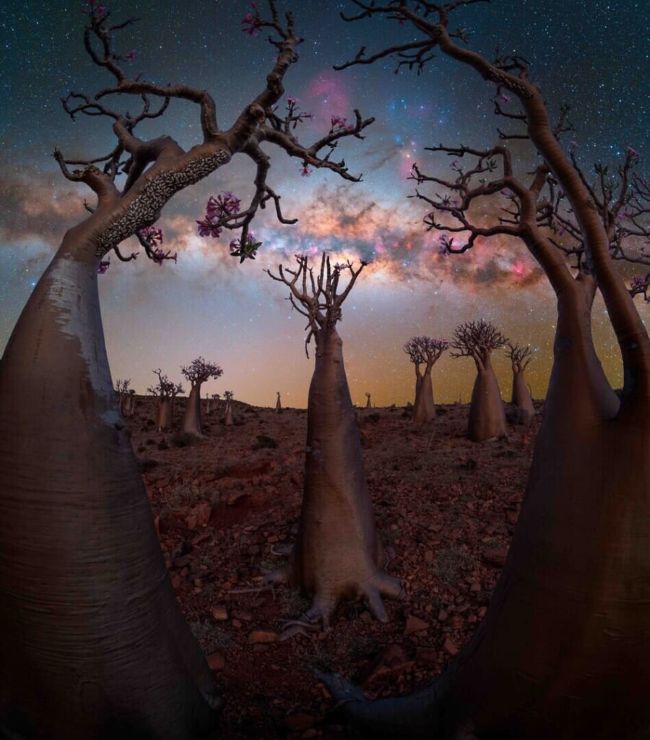
Bottle Tree Paradise by Benjamin Barakat
Benjamin Barakat took this image from Socotra, Yemen. Benjamin wrote: “Socotra is one of my favorite places on Earth. After shooting there for the past 4 years and scouting the island, I’ve discovered hidden gems like this one, which I call Bottle Tree Paradise. Bottle trees are unique to Socotra, a result of the island’s long isolation from the mainland. This separation allowed them to evolve distinctive features, such as their water-storing, bottle-shaped trunks, which help them survive Socotra’s harsh, dry climate. They are believed to have originated from ancient plant species that adapted to the island’s unique environment over millions of years.”
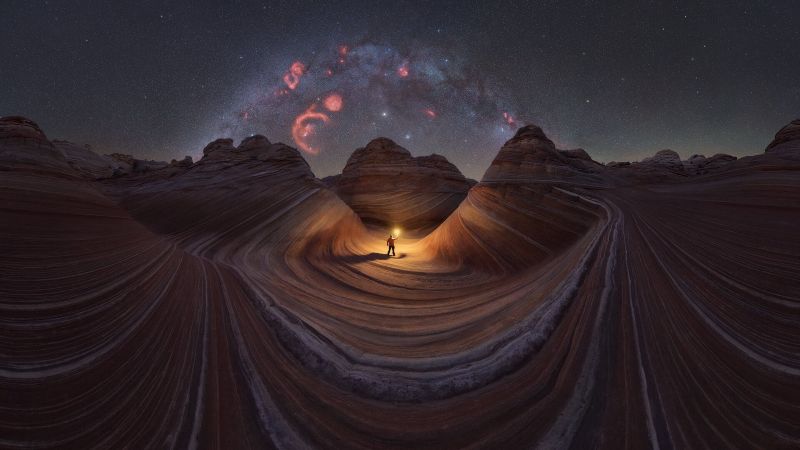
The Wave by Luis Cajete
Luis Cajete captured this image at The Wave in Utah. Luis wrote: “One of my greatest passions is visiting stunning natural wonders and paying my personal tribute to them through night photography. I took this image at Coyote Buttes, a geological masterpiece located in Arizona, where special access permits are required to protect it for future generations. Despite the intense cold during those days, it was incredibly exciting to visit the great sandstone wave for the first time and enjoy its spectacular shapes and colors.”
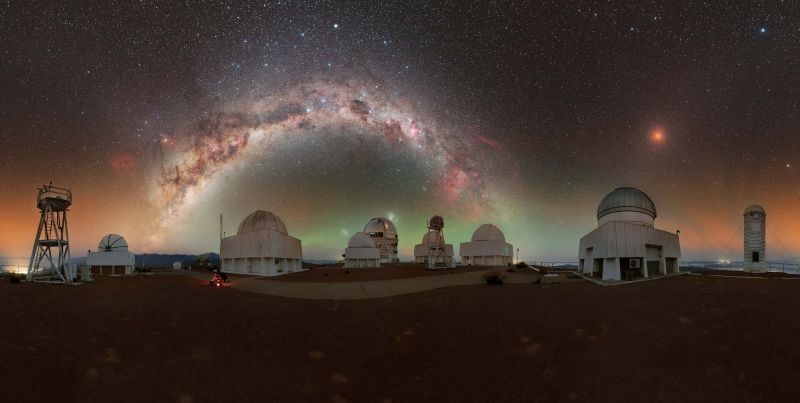
Tololo Lunar Eclipse Sky by Petr Horálek
Petr Horálek captured this image from Cerro Tololo Observatory in Chile. Petr wrote: “On March 14, 2025, a total lunar eclipse occurred, especially visible over the Americas and the Pacific Ocean. I was fortunate to observe this particular eclipse from the NSF Cerro Tololo Inter-American Observatory in Chile. You can see how epic the sky was during totality, as the moon darkened enough for the majestic Milky Way, the faint belt of zodiacal light, and prominent airglow to stand out.”
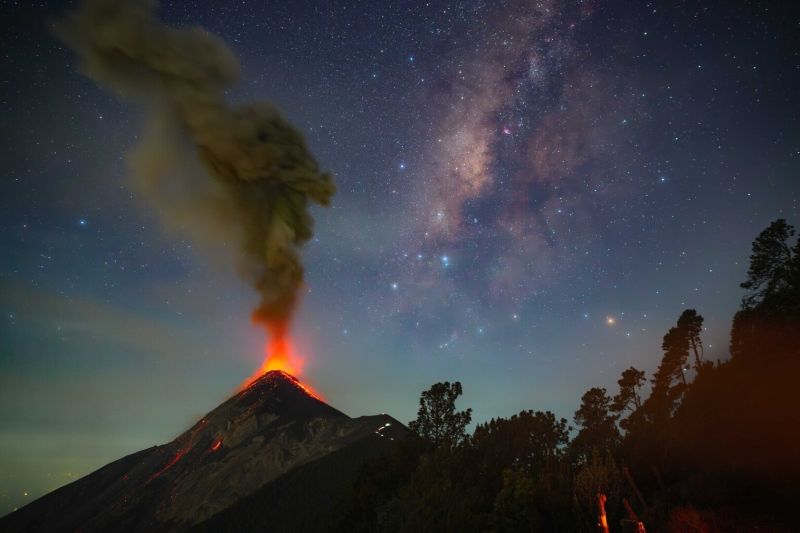
Cosmic Fire by Sergio Montúfar
Sergio Montúfar captured this image from Volcán Acatenango in Guatemala. Sergio wrote: “On the early morning of June 2, 2024, I summited the volcano for the first time, hoping to witness the fiery beauty of the neighboring Volcan de Fuego against the Milky Way’s backdrop. That night, the volcano was incredibly active – each thunderous explosion reverberated in my chest, while glowing lava illuminated the dark slopes. Above, the Milky Way stretched diagonally across the sky, a mesmerizing band of stars contrasting with the chaos below. The volcano erupted, created a stunning visual contrast between Earth’s fury and the cosmos’ serenity.”
Winter Fairy Tale by Uroš Fink
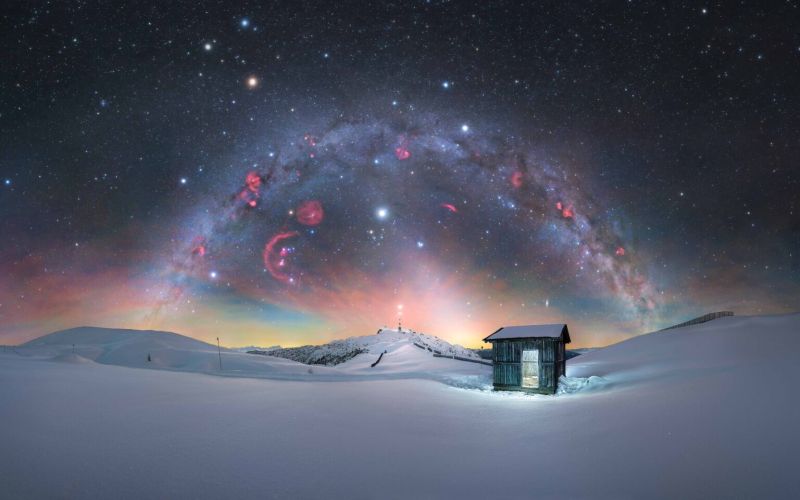
Uroš Fink captured this image from Dobratsch Nature Park in Austria. Uroš wrote: “Arriving at the cabin, I was greeted by untouched snow, completely free of footprints. I spent the evening exploring compositions, and this is my favorite: a panorama of the winter Milky Way with reddish nebulae, stretching above Dobratsch Mountain. I captured the zodiacal light and even the Gegenschein glow! The sky was magnificent, with Jupiter and Mars shining brightly. It turned out exactly as I envisioned – a true winter fairytale.”
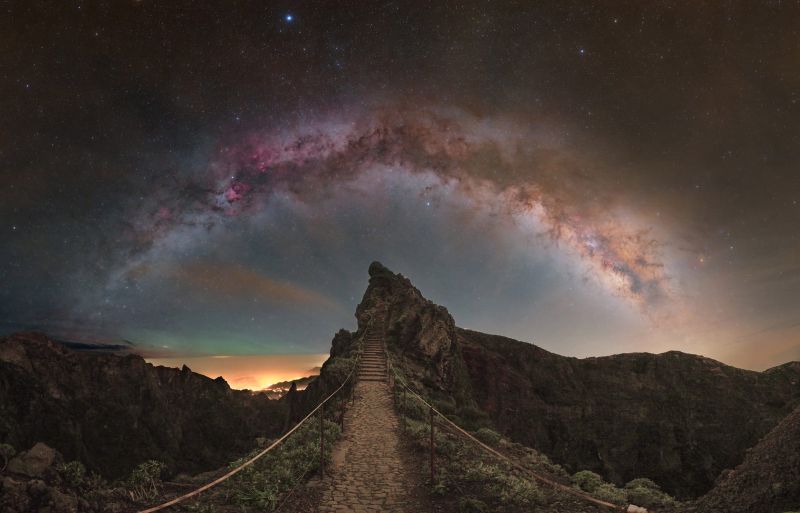
Stairway to Heaven by Marcin Rosadzinski
Marcin Rosadzinski captured this image from Madeira Island in Portugal. Marcin wrote: “The wide angle reveals a vast stretch of the galaxy, with hydrogen nebulae glowing red. From right to left, you can see the constellations of Sagittarius, Ophiuchus and Scorpius, along with the colorful Rho Ophiuchi and red-glowing Lagoon, Omega, and Eagle Nebulae. In the constellations of Cygnus and Cepheus, you can spot the North America and Elephant’s Trunk Nebulae.”
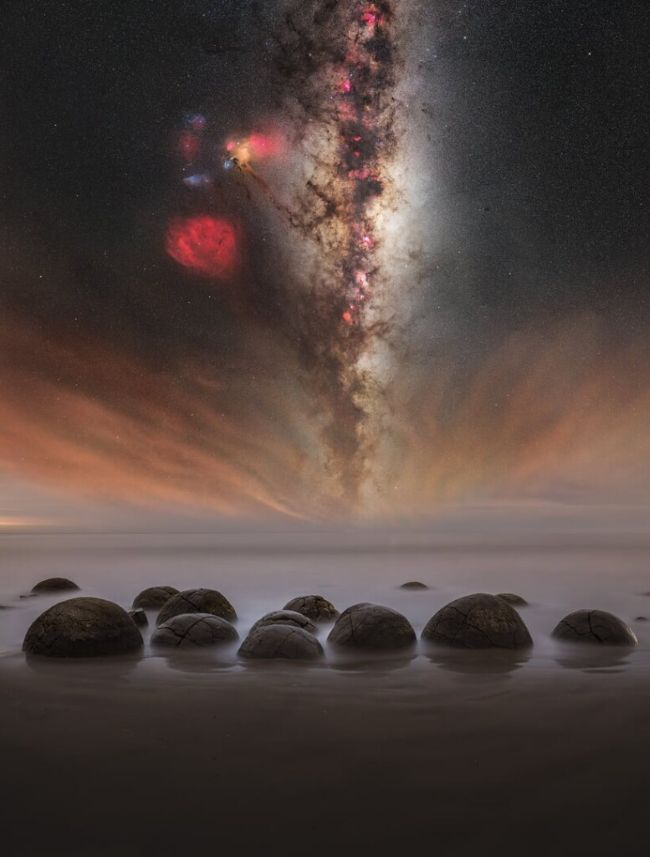
Galaxy of the Stone Array by Alvin Wu
Alvin Wu captured this image from Moeraki Boulders in New Zealand. Alvin wrote: “The Milky Way hangs over the sea. The night sky of the Southern Hemisphere condenses the poetry of Li Bai, a poet from China’s Tang Dynasty, into eternity. On a clear night, the Milky Way pours down over the sea like a waterfall from the sky, intertwining with the atmospheric glow on the water’s surface.”
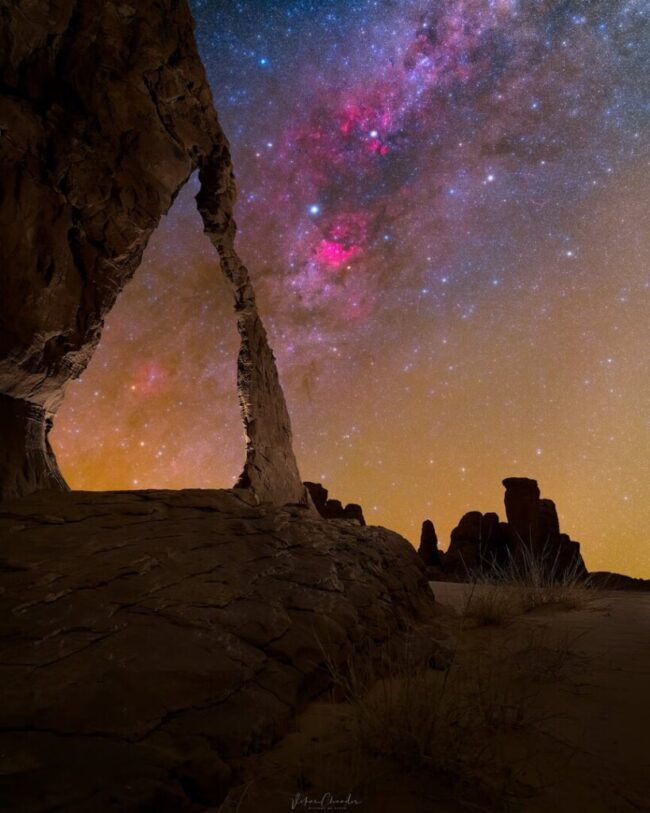
Echiwile Arch by Vikas Chander
Vikas Chander captured this image in Ennedi, Chad. Vikas wrote: “When one first Googles information about visiting Chad, the results aren’t very encouraging from a safety perspective. Nevertheless, the intrepid astrophotographer in me decided to take the chance and visit this landlocked country, specifically the Ennedi Massif in the north. Sparsely populated and completely devoid of light pollution, the 3-day drive from the capital, N’Djamena, was well worth the troubles and risks involved. The region is filled with numerous rock formations, shapes and arches, offering an abundance of options for foreground elements to frame the dramatic night skies. Seen here is a small arch in the shape of a hoof in the Ennedi region.”
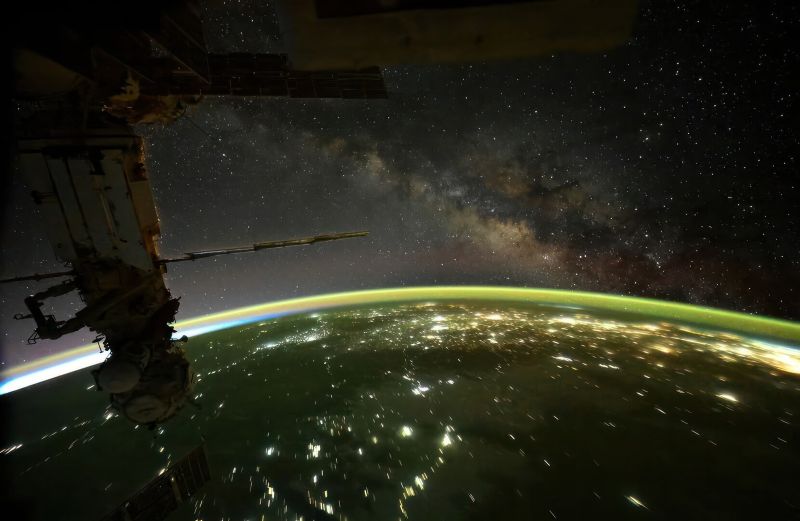
One in a Billion by Don Pettit
NASA astronaut Don Pettit took this image from the International Space Station. Don wrote: “I float in the cupola, looking out the 7 windows composing this faceted transparent jewel. While my mind is submerged in contemplation, my eyes gorge on the dim reflections from a nighttime Earth. There are over 8 billion people that call this planet home. There are 7 of us that can say the same for space station. What a privilege it is to be here. I used an orbital star tracker to take out the star streak motion from orbit.”
Bottom line: The blog “Capture the Atlas” has announced its 2025 Milky Way Photographer of the Year contest. See 10 of the 25 best Milky Way photos from all over the world here.
The 2025 Milky Way Photographer of the Year awards are here! Sponsored by Capture the Atlas, company co-founder and chief photographer Dan Zafra will sit down with EarthSky’s Dave Adalian at 12:15 CT (17:15 UTC) on Monday, May 26. Dan will walk us through 5 of the best winning skyscapes from the 8th annual contest winners. And he’ll give us a few pointers for making our own Milky Way works of art. Join us!
Back for its 8th year, Capture the Atlas brings its Milky Way photography contest to new heights. For the first time, the contest includes an image taken from space. NASA astronaut Don Pettit shares a staggering view from the International Space Station. But the views of our home galaxy are stunning from all across Earth as well.
Dan Zafra is editor of the travel photography blog Capture the Atlas, which focuses on landscape and astrophotography. We share here 10 of the 25 winning Milky Way photos from his contest. You can see all the winners here.
We hope this gallery inspires other astrophotographers to capture amazing images of the night sky. And submit them to us! If you want to see the Milky Way with your own eyes, find a dark-sky location near you. In the meantime, enjoy our 10 spectacular selections of the best Milky Way photos of 2025.
Double Milky Way Arch Over Matterhorn by Angel Fux
Angel Fux captured this image from Zermatt, Switzerland. Angel wrote: “This image captures the rare double arch Milky Way, where both the winter Milky Way (with Orion rising) and the summer Milky Way (with the galactic center) appear in the same night—a seamless transition between seasons. Taken at 3,200 meters [10,500 feet] in the heart of winter, the night was brutally cold, testing both my endurance and equipment. This is a time blend, preserving the real positions of both arches by combining frames taken hours apart, with the foreground captured at dawn for the best detail.” See more of Capture the Atlas‘ best Milky Way photos of 2025 below.
Bottle Tree Paradise by Benjamin Barakat
Benjamin Barakat took this image from Socotra, Yemen. Benjamin wrote: “Socotra is one of my favorite places on Earth. After shooting there for the past 4 years and scouting the island, I’ve discovered hidden gems like this one, which I call Bottle Tree Paradise. Bottle trees are unique to Socotra, a result of the island’s long isolation from the mainland. This separation allowed them to evolve distinctive features, such as their water-storing, bottle-shaped trunks, which help them survive Socotra’s harsh, dry climate. They are believed to have originated from ancient plant species that adapted to the island’s unique environment over millions of years.”
The Wave by Luis Cajete
Luis Cajete captured this image at The Wave in Utah. Luis wrote: “One of my greatest passions is visiting stunning natural wonders and paying my personal tribute to them through night photography. I took this image at Coyote Buttes, a geological masterpiece located in Arizona, where special access permits are required to protect it for future generations. Despite the intense cold during those days, it was incredibly exciting to visit the great sandstone wave for the first time and enjoy its spectacular shapes and colors.”
Tololo Lunar Eclipse Sky by Petr Horálek
Petr Horálek captured this image from Cerro Tololo Observatory in Chile. Petr wrote: “On March 14, 2025, a total lunar eclipse occurred, especially visible over the Americas and the Pacific Ocean. I was fortunate to observe this particular eclipse from the NSF Cerro Tololo Inter-American Observatory in Chile. You can see how epic the sky was during totality, as the moon darkened enough for the majestic Milky Way, the faint belt of zodiacal light, and prominent airglow to stand out.”
Cosmic Fire by Sergio Montúfar
Sergio Montúfar captured this image from Volcán Acatenango in Guatemala. Sergio wrote: “On the early morning of June 2, 2024, I summited the volcano for the first time, hoping to witness the fiery beauty of the neighboring Volcan de Fuego against the Milky Way’s backdrop. That night, the volcano was incredibly active – each thunderous explosion reverberated in my chest, while glowing lava illuminated the dark slopes. Above, the Milky Way stretched diagonally across the sky, a mesmerizing band of stars contrasting with the chaos below. The volcano erupted, created a stunning visual contrast between Earth’s fury and the cosmos’ serenity.”
Winter Fairy Tale by Uroš Fink
Uroš Fink captured this image from Dobratsch Nature Park in Austria. Uroš wrote: “Arriving at the cabin, I was greeted by untouched snow, completely free of footprints. I spent the evening exploring compositions, and this is my favorite: a panorama of the winter Milky Way with reddish nebulae, stretching above Dobratsch Mountain. I captured the zodiacal light and even the Gegenschein glow! The sky was magnificent, with Jupiter and Mars shining brightly. It turned out exactly as I envisioned – a true winter fairytale.”
Stairway to Heaven by Marcin Rosadzinski
Marcin Rosadzinski captured this image from Madeira Island in Portugal. Marcin wrote: “The wide angle reveals a vast stretch of the galaxy, with hydrogen nebulae glowing red. From right to left, you can see the constellations of Sagittarius, Ophiuchus and Scorpius, along with the colorful Rho Ophiuchi and red-glowing Lagoon, Omega, and Eagle Nebulae. In the constellations of Cygnus and Cepheus, you can spot the North America and Elephant’s Trunk Nebulae.”
Galaxy of the Stone Array by Alvin Wu
Alvin Wu captured this image from Moeraki Boulders in New Zealand. Alvin wrote: “The Milky Way hangs over the sea. The night sky of the Southern Hemisphere condenses the poetry of Li Bai, a poet from China’s Tang Dynasty, into eternity. On a clear night, the Milky Way pours down over the sea like a waterfall from the sky, intertwining with the atmospheric glow on the water’s surface.”
Echiwile Arch by Vikas Chander
Vikas Chander captured this image in Ennedi, Chad. Vikas wrote: “When one first Googles information about visiting Chad, the results aren’t very encouraging from a safety perspective. Nevertheless, the intrepid astrophotographer in me decided to take the chance and visit this landlocked country, specifically the Ennedi Massif in the north. Sparsely populated and completely devoid of light pollution, the 3-day drive from the capital, N’Djamena, was well worth the troubles and risks involved. The region is filled with numerous rock formations, shapes and arches, offering an abundance of options for foreground elements to frame the dramatic night skies. Seen here is a small arch in the shape of a hoof in the Ennedi region.”
One in a Billion by Don Pettit
NASA astronaut Don Pettit took this image from the International Space Station. Don wrote: “I float in the cupola, looking out the 7 windows composing this faceted transparent jewel. While my mind is submerged in contemplation, my eyes gorge on the dim reflections from a nighttime Earth. There are over 8 billion people that call this planet home. There are 7 of us that can say the same for space station. What a privilege it is to be here. I used an orbital star tracker to take out the star streak motion from orbit.”
Bottom line: The blog “Capture the Atlas” has announced its 2025 Milky Way Photographer of the Year contest. See 10 of the 25 best Milky Way photos from all over the world here.



Aucun commentaire:
Enregistrer un commentaire