
Hugh Safford of UC Davis recounts his discovery of the record tree in California and what it means, to EarthSky host Dave Adalian.
No hype. Just real science, powered by real people. That’s you.
Record tree in California was a surprise find
Hugh Safford, a forest ecologist at UC Davis, was hiking in California’s High Sierra in September 2024 when he came across something unexpected. He spotted a Jeffrey pine at the timberline on Mount Kaweah in Sequoia National Park. Safford said:
I thought, ‘What’s that?’ I walk over, and it’s a Jeffrey pine! It made no sense. What is a Jeffrey pine doing above 11,500 feet (3,500 meters)?
While Jeffrey pines do grow in mountainous regions in the Sierra Nevada, Safford ended up finding them as high as 12,657 feet (3,958 meters) elevation. That’s 1,860 feet (567 meters) higher than the previous highest-known elevation of a Jeffrey pine. What’s more, it’s higher than trees that are normally seen at elevations higher than Jeffrey pines, such as lodgepole, limber and foxtail pines. So that makes the Jeffrey pine California’s highest tree. For now. Safford’s work shows that other trees are also growing at higher elevations than they used to. The cause, of course, is global warming.
Safford published his peer-reviewed study in the journal Madroño March 4, 2025.
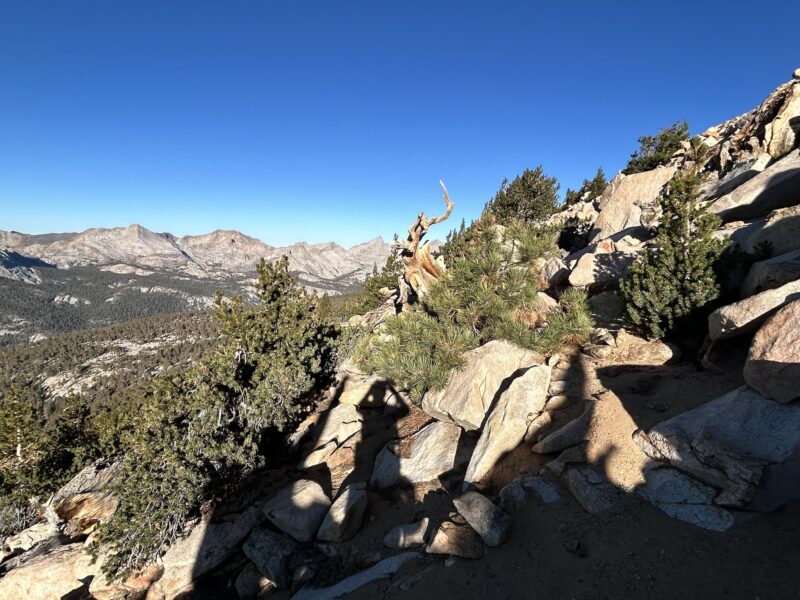
Higher trees due to a warming world
Trees, along with other planets and animals, are moving to higher elevations than was their traditional range. And it’s due to our warming world. In the Sierra Nevada, the snow is melting earlier with warmer air temperatures. So this land is now more hospitable to plants that previously couldn’t live there. For example, Jeffrey pine seeds are germinating on land that would have been frozen a few decades ago.
But how did these big pine seeds get so much higher so quickly? Likely with the help of birds. Safford suspects Clark’s nutcrackers are responsible for getting the seeds up the mountain. Safford said these birds can carry the seeds up from thousands of feet lower down on the mountain to store them in the cooler upper zones for later in the summer, like putting a snack in the fridge.


Record tree is one of many
Safford found not just one tree high up in the Sierras, but a number of them. He was able to hike to 14 Jeffrey pines above 11,800 feet (3,597 meters) elevation. He noted that some were at least 20 years old. But there were even more – at least a dozen – that he couldn’t get to. Safford plans to return to the High Sierra this summer with other researchers to investigate these Jeffrey pines.
While trees (and other plants and animals) are expanding their range upward, they’re losing ground lower down. And the uphill movement is too slow to keep pace with what they’re losing. Safford said:
I’m looking at trees surviving in habitats where they couldn’t before, but they’re also dying in places they used to live before. They’re not just holding hands and walking uphill. This crazy leapfrogging of species challenges what we think we know about these systems reacting as the climate warms.
Even with the older Jeffrey pines that Safford saw high on the mountain, none of them had pine cones. These trees are at their limit of their tolerances. As Safford told Dave Adalian in EarthSky’s livestream:
These trees are not enjoying their time there.
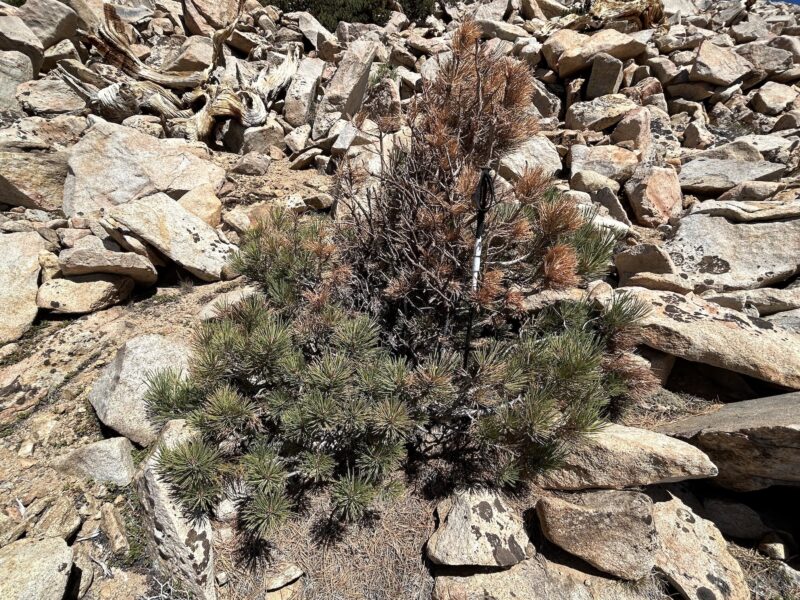
grows near the timberline. As is common for taller specimens, it has a dead top. Jeffrey pines
are just barely hanging on at these elevations, and they are not reproducing. Image via Hugh Safford/ UC Davis.
Doing science on the ground
Safford made this discovery because he was out in nature, seeing for himself the conditions on the ground. It shows the value of firsthand experience as opposed to relying on satellite imagery. Safford said:
People aren’t marching to the tops of the mountains to see where the trees really are. Instead, they are relying on satellite imagery, which can’t see most small trees. What science does is help us understand how the world functions. In this case, where you see the impacts of climate change most dramatically are at high elevations and high latitudes. If we want our finger on the pulse of how the climate is warming and what the impacts are, that’s where it will be happening first. We just need to get people out there.
Bottom line: A record tree in California signals that the Jeffrey pine is now the highest tree to grow in the state. Global warming is pushing species uphill, but at a rate that doesn’t keep up with what’s dying lower down.
Source: New Elevation Records for Jeffrey Pine (PINUS JEFFREYI A.Murray Bis & Al.)
Read more: Extreme weather and climate change with Davide Faranda
The post Mountain mystery: How’d that record tree get up here? first appeared on EarthSky.
from EarthSky https://ift.tt/CfuDjXh
Hugh Safford of UC Davis recounts his discovery of the record tree in California and what it means, to EarthSky host Dave Adalian.
No hype. Just real science, powered by real people. That’s you.
Record tree in California was a surprise find
Hugh Safford, a forest ecologist at UC Davis, was hiking in California’s High Sierra in September 2024 when he came across something unexpected. He spotted a Jeffrey pine at the timberline on Mount Kaweah in Sequoia National Park. Safford said:
I thought, ‘What’s that?’ I walk over, and it’s a Jeffrey pine! It made no sense. What is a Jeffrey pine doing above 11,500 feet (3,500 meters)?
While Jeffrey pines do grow in mountainous regions in the Sierra Nevada, Safford ended up finding them as high as 12,657 feet (3,958 meters) elevation. That’s 1,860 feet (567 meters) higher than the previous highest-known elevation of a Jeffrey pine. What’s more, it’s higher than trees that are normally seen at elevations higher than Jeffrey pines, such as lodgepole, limber and foxtail pines. So that makes the Jeffrey pine California’s highest tree. For now. Safford’s work shows that other trees are also growing at higher elevations than they used to. The cause, of course, is global warming.
Safford published his peer-reviewed study in the journal Madroño March 4, 2025.
Higher trees due to a warming world
Trees, along with other planets and animals, are moving to higher elevations than was their traditional range. And it’s due to our warming world. In the Sierra Nevada, the snow is melting earlier with warmer air temperatures. So this land is now more hospitable to plants that previously couldn’t live there. For example, Jeffrey pine seeds are germinating on land that would have been frozen a few decades ago.
But how did these big pine seeds get so much higher so quickly? Likely with the help of birds. Safford suspects Clark’s nutcrackers are responsible for getting the seeds up the mountain. Safford said these birds can carry the seeds up from thousands of feet lower down on the mountain to store them in the cooler upper zones for later in the summer, like putting a snack in the fridge.
Record tree is one of many
Safford found not just one tree high up in the Sierras, but a number of them. He was able to hike to 14 Jeffrey pines above 11,800 feet (3,597 meters) elevation. He noted that some were at least 20 years old. But there were even more – at least a dozen – that he couldn’t get to. Safford plans to return to the High Sierra this summer with other researchers to investigate these Jeffrey pines.
While trees (and other plants and animals) are expanding their range upward, they’re losing ground lower down. And the uphill movement is too slow to keep pace with what they’re losing. Safford said:
I’m looking at trees surviving in habitats where they couldn’t before, but they’re also dying in places they used to live before. They’re not just holding hands and walking uphill. This crazy leapfrogging of species challenges what we think we know about these systems reacting as the climate warms.
Even with the older Jeffrey pines that Safford saw high on the mountain, none of them had pine cones. These trees are at their limit of their tolerances. As Safford told Dave Adalian in EarthSky’s livestream:
These trees are not enjoying their time there.
grows near the timberline. As is common for taller specimens, it has a dead top. Jeffrey pines
are just barely hanging on at these elevations, and they are not reproducing. Image via Hugh Safford/ UC Davis.
Doing science on the ground
Safford made this discovery because he was out in nature, seeing for himself the conditions on the ground. It shows the value of firsthand experience as opposed to relying on satellite imagery. Safford said:
People aren’t marching to the tops of the mountains to see where the trees really are. Instead, they are relying on satellite imagery, which can’t see most small trees. What science does is help us understand how the world functions. In this case, where you see the impacts of climate change most dramatically are at high elevations and high latitudes. If we want our finger on the pulse of how the climate is warming and what the impacts are, that’s where it will be happening first. We just need to get people out there.
Bottom line: A record tree in California signals that the Jeffrey pine is now the highest tree to grow in the state. Global warming is pushing species uphill, but at a rate that doesn’t keep up with what’s dying lower down.
Source: New Elevation Records for Jeffrey Pine (PINUS JEFFREYI A.Murray Bis & Al.)
Read more: Extreme weather and climate change with Davide Faranda
The post Mountain mystery: How’d that record tree get up here? first appeared on EarthSky.
from EarthSky https://ift.tt/CfuDjXh

Aucun commentaire:
Enregistrer un commentaire