
Spica can point you to Omega Centauri
The famous star Omega Centauri cluster is the largest and finest globular star cluster visible to the eye alone. It contains some of our Milky Way galaxy’s most ancient stars. And the bright star Spica can help you find it.
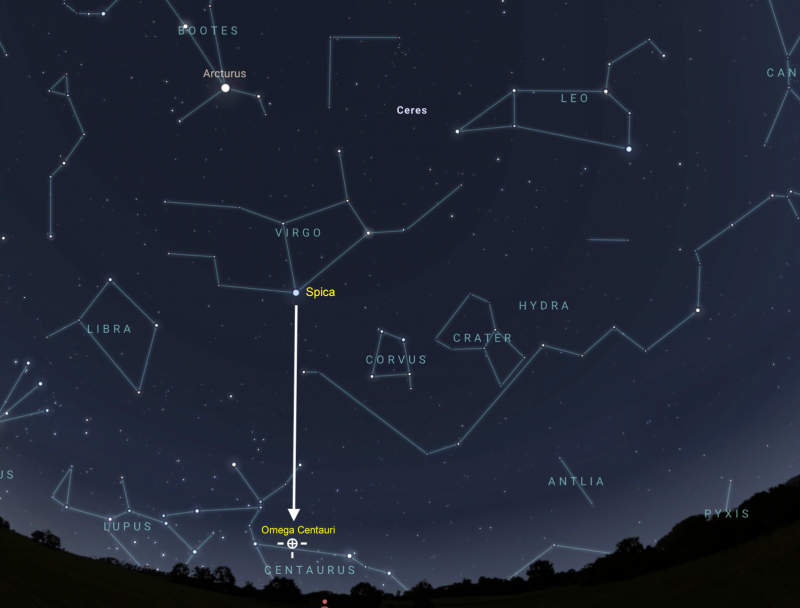
In Northern Hemisphere spring, Spica and Omega Centauri climb up highest for the night in the hour or so after midnight. When they’re at their highest point – as seen from the Northern Hemisphere – a line drawn from Spica drawn straight down toward the southern horizon points to Omega Centauri.
And because the stars return to the sky about four minutes earlier with each passing day, Spica and Omega Centauri will be up highest for the night around one hour earlier in mid-April (12 midnight or 1 a.m. DST), and two hours earlier by the end of April (11 p.m. or 12 DST), and so on.

How can I find Spica?
Seeing Omega Centauri is very special, in part because you can see it with your eye alone, assuming you have a dark enough sky. Very few of the 150 or so globular star clusters in the Milky Way galaxy are visible without optics.
But how can you first find Spica? It’s easy … if you live in the Northern Hemisphere. That’s because you can use the famous Big Dipper asterism to point to Spica. Just “follow the arc” in the Big Dipper’s handle to the bright orange star Arcturus. Then “speed on to Spica,” as show in the chart below.

Also, check EarthSky’s visible planets and night sky guide for current sky events. It’ll let you know when the moon is near Spica.
Look when they’re highest
So – when Spica is highest in the south for Northern Hemisphere viewers – Omega Centauri is, too.
When Spica is highest, look for Omega Centauri about 35 degrees directly below it. A fist at arm’s length approximates 10 degrees.
You can see Omega Centauri with the unaided eye if your sky is dark enough and if you’re far enough south on the Earth. People living south of 35 degrees north latitude have a realistic chance of spotting the cluster over the southern horizon, though Omega Centauri has been seen as far north as Point Pelee National Park in Canada (42 degrees north latitude). Omega Centauri looks like a faint (and possibly fuzzy) star.

View from the Southern Hemisphere?
Of course, Omega Centauri is awesome from the Southern Hemisphere.
As seen from the Southern Hemisphere, Spica and Omega Centauri pass more nearly overhead. They still transit at approximately the same time (1 a.m. early April, midnight in mid-April, 11 p.m. in early May). They’re still located about 35 degrees apart.
From the Southern Hemisphere, you’ve got a beautiful way to find this cluster. And, indeed, your view of the cluster will be better than in the north, because Omega Centauri will be higher in your sky.
To get in its general vicinity on the sky’s dome, look for the famous Southern Cross, which, officially, is the constellation Crux. In Crux – visible in binoculars – is the Jewel Box, an open star cluster with about 100 members, whose stars are colored red, white and blue.
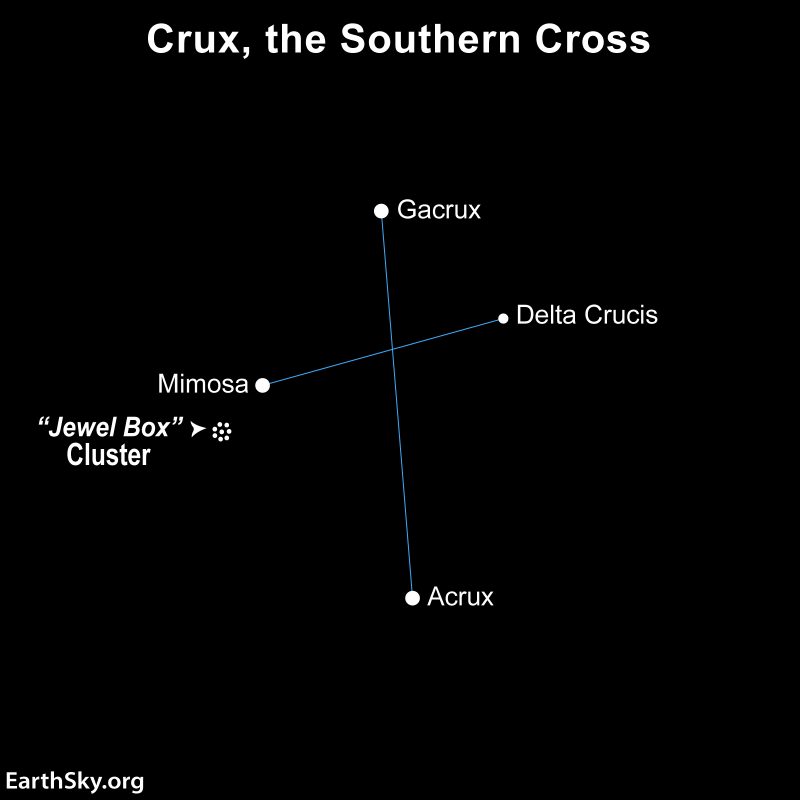
If you can locate the Southern Cross and the Jewel Box, you’ll also find Omega Centauri. Consult the chart below for its location.

Bottom line: In the spring, the bright star Spica can lead you to the Omega Centauri globular cluster. From the Southern Hemisphere, star hop from the Southern Cross, to the Jewel Box star cluster, and then to Omega Centauri. Binoculars or a telescope show it best. Like all globular clusters, the best view of Omega Centauri is through a telescope. Then you see it as a globe-shaped stellar city, teeming with an estimated 10 million stars!
EarthSky astronomy kits are perfect for beginners. Order today from the EarthSky store
The post Look for amazing Omega Centauri, using Spica as a guide first appeared on EarthSky.
from EarthSky https://ift.tt/o3eVjMX
Spica can point you to Omega Centauri
The famous star Omega Centauri cluster is the largest and finest globular star cluster visible to the eye alone. It contains some of our Milky Way galaxy’s most ancient stars. And the bright star Spica can help you find it.
In Northern Hemisphere spring, Spica and Omega Centauri climb up highest for the night in the hour or so after midnight. When they’re at their highest point – as seen from the Northern Hemisphere – a line drawn from Spica drawn straight down toward the southern horizon points to Omega Centauri.
And because the stars return to the sky about four minutes earlier with each passing day, Spica and Omega Centauri will be up highest for the night around one hour earlier in mid-April (12 midnight or 1 a.m. DST), and two hours earlier by the end of April (11 p.m. or 12 DST), and so on.
How can I find Spica?
Seeing Omega Centauri is very special, in part because you can see it with your eye alone, assuming you have a dark enough sky. Very few of the 150 or so globular star clusters in the Milky Way galaxy are visible without optics.
But how can you first find Spica? It’s easy … if you live in the Northern Hemisphere. That’s because you can use the famous Big Dipper asterism to point to Spica. Just “follow the arc” in the Big Dipper’s handle to the bright orange star Arcturus. Then “speed on to Spica,” as show in the chart below.
Also, check EarthSky’s visible planets and night sky guide for current sky events. It’ll let you know when the moon is near Spica.
Look when they’re highest
So – when Spica is highest in the south for Northern Hemisphere viewers – Omega Centauri is, too.
When Spica is highest, look for Omega Centauri about 35 degrees directly below it. A fist at arm’s length approximates 10 degrees.
You can see Omega Centauri with the unaided eye if your sky is dark enough and if you’re far enough south on the Earth. People living south of 35 degrees north latitude have a realistic chance of spotting the cluster over the southern horizon, though Omega Centauri has been seen as far north as Point Pelee National Park in Canada (42 degrees north latitude). Omega Centauri looks like a faint (and possibly fuzzy) star.
View from the Southern Hemisphere?
Of course, Omega Centauri is awesome from the Southern Hemisphere.
As seen from the Southern Hemisphere, Spica and Omega Centauri pass more nearly overhead. They still transit at approximately the same time (1 a.m. early April, midnight in mid-April, 11 p.m. in early May). They’re still located about 35 degrees apart.
From the Southern Hemisphere, you’ve got a beautiful way to find this cluster. And, indeed, your view of the cluster will be better than in the north, because Omega Centauri will be higher in your sky.
To get in its general vicinity on the sky’s dome, look for the famous Southern Cross, which, officially, is the constellation Crux. In Crux – visible in binoculars – is the Jewel Box, an open star cluster with about 100 members, whose stars are colored red, white and blue.
If you can locate the Southern Cross and the Jewel Box, you’ll also find Omega Centauri. Consult the chart below for its location.
Bottom line: In the spring, the bright star Spica can lead you to the Omega Centauri globular cluster. From the Southern Hemisphere, star hop from the Southern Cross, to the Jewel Box star cluster, and then to Omega Centauri. Binoculars or a telescope show it best. Like all globular clusters, the best view of Omega Centauri is through a telescope. Then you see it as a globe-shaped stellar city, teeming with an estimated 10 million stars!
EarthSky astronomy kits are perfect for beginners. Order today from the EarthSky store
The post Look for amazing Omega Centauri, using Spica as a guide first appeared on EarthSky.
from EarthSky https://ift.tt/o3eVjMX

Aucun commentaire:
Enregistrer un commentaire