
Star-hop to the Andromeda Galaxy
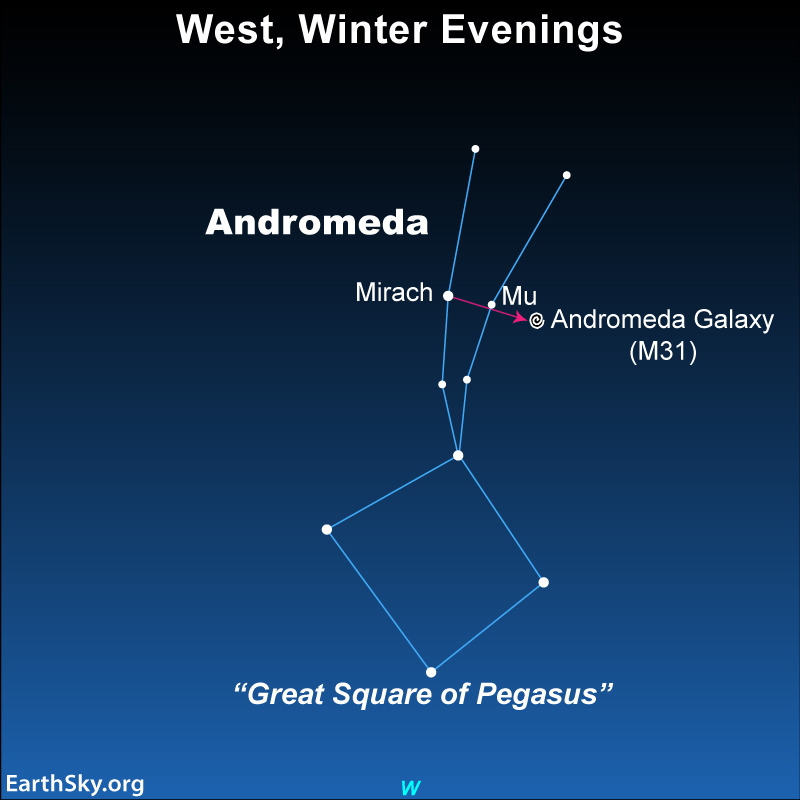
Tonight, try star-hopping to the famous Andromeda Galaxy – the large spiral galaxy next door to our Milky Way – from the Great Square of Pegasus. Are you ready?
First, look westward for the four stars of the Great Square. You’ll find them in the west at nightfall. While the Great Square will sink toward the western horizon as evening deepens, this famous pattern of stars will remain in view until around mid-evening (at mid-northern latitudes).
Also, keep in mind the Great Square is so large that your hand can slip in between any two Great Square stars. By the way, you hold your hand at arm’s length to measure distances on the sky’s dome.
More about M31: Great galaxy in Andromeda
Start with the Great Square of Pegasus
First, focus on the top star of the Great Square on the above sky chart. If you look carefully, you’ll see the constellation Andromeda as two streamers of stars jutting up from this uppermost Great Square star. Also, the two streamers mimic the shape of a cornucopia or a bugle.
Next, go to the second star upward on each streamer: Mirach and Mu Andromedae (abbreviated Mu on the sky chart). Then, draw an imaginary line from Mirach through Mu, going twice the Mirach/Mu distance. Now, you’ve just landed on the Andromeda Galaxy!
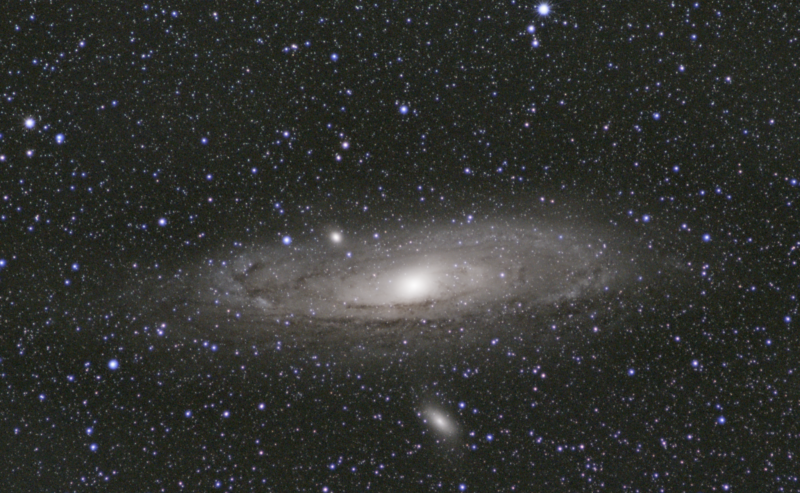
In fact, on a dark night, the Andromeda Galaxy looks like a faint, blurry patch of light or a smudge on the sky. If you can’t see it with the unaided eye, your sky might not be dark enough.
Try binoculars for a better view!
The Andromeda Galaxy from our Community Photos

Bottom line: The four stars of the Great Square of Pegasus are easy to find, and they can help you locate the Andromeda Galaxy. Are you ready? Let’s star-hop!
Do you love stargazing? Order your EarthSky Planisphere today!
The post Andromeda Galaxy: Find it by star-hopping from Pegasus first appeared on EarthSky.
from EarthSky https://ift.tt/pPyzuQF
Star-hop to the Andromeda Galaxy
Tonight, try star-hopping to the famous Andromeda Galaxy – the large spiral galaxy next door to our Milky Way – from the Great Square of Pegasus. Are you ready?
First, look westward for the four stars of the Great Square. You’ll find them in the west at nightfall. While the Great Square will sink toward the western horizon as evening deepens, this famous pattern of stars will remain in view until around mid-evening (at mid-northern latitudes).
Also, keep in mind the Great Square is so large that your hand can slip in between any two Great Square stars. By the way, you hold your hand at arm’s length to measure distances on the sky’s dome.
More about M31: Great galaxy in Andromeda
Start with the Great Square of Pegasus
First, focus on the top star of the Great Square on the above sky chart. If you look carefully, you’ll see the constellation Andromeda as two streamers of stars jutting up from this uppermost Great Square star. Also, the two streamers mimic the shape of a cornucopia or a bugle.
Next, go to the second star upward on each streamer: Mirach and Mu Andromedae (abbreviated Mu on the sky chart). Then, draw an imaginary line from Mirach through Mu, going twice the Mirach/Mu distance. Now, you’ve just landed on the Andromeda Galaxy!
In fact, on a dark night, the Andromeda Galaxy looks like a faint, blurry patch of light or a smudge on the sky. If you can’t see it with the unaided eye, your sky might not be dark enough.
Try binoculars for a better view!
The Andromeda Galaxy from our Community Photos
Bottom line: The four stars of the Great Square of Pegasus are easy to find, and they can help you locate the Andromeda Galaxy. Are you ready? Let’s star-hop!
Do you love stargazing? Order your EarthSky Planisphere today!
The post Andromeda Galaxy: Find it by star-hopping from Pegasus first appeared on EarthSky.
from EarthSky https://ift.tt/pPyzuQF

Aucun commentaire:
Enregistrer un commentaire